Project on sentences
Project created by
Rudraksh coaching classes
Amit verma
Whatsapp number :8871538455
A sentence is a group of words make a complete sense.
A set of words that is complete in itself,
typically containing a subject and predicate,
conveying a statement, question,
exclamation, or command, and consisting of
a main clause and sometimes one or more
subordinate clauses.
Types of sentences
 Sentences can be classified in two ways: based on their
function and based on their structure. When you
describe a sentence based on its function, you’re
describing it based on what it does.
 Declarative
 Interrogative
 Exclamatory
 Imperative
 Conditional
Declarative sentence
 Declarative
 A declarative sentence is a sentence that:
 Makes a statement
 Provides an explanation
 Conveys one or more facts
Declarative sentence
 Declarative sentences are among the most common
sentences in the English language. You use them every
day. They end with periods.
 Here are a few examples of declarative sentences:
 I forgot to wear a hat today.
 Your pizza is doughy because you didn’t cook it long
enough.
 Spiders and crabs are both members of the arthropod
family.
Interrogative sentence
 Interrogative
 An interrogative sentence is a sentence that asks a
question, like:
 How many pet iguanas do you have?
 May I sit here?
 Aren’t there enough umbrellas to go around?
 One hallmark of interrogative sentences is that they
usually begin with pronouns or auxiliary verbs. When this
kind of sentence does start with the subject, it’s usually in
colloquial speech. For example:
 He went there again?
 Rats can’t swim, right?
Exclamatory sentence
 Exclamatory
 Much like an interrogative question ends with a question mark,
an exclamatory sentence ends with an exclamation mark. These
sentences communicate heightened emotion and are often used
as greetings, warnings, or rallying cries. Examples include:
 Hey!
 High voltage! Do not touch!
 This is Sparta!
 The only difference between a declarative sentence and an
exclamatory one is the punctuation at the end. But that
punctuation makes a big difference in how the reader or listened
interprets the sentence. Consider the difference between these:
 It’s snowing.
 It’s snowing!
Imperative sentence
 Imperative
 An imperative sentence is a sentence that gives the reader
advice, instructions, a command or makes a request.
 An imperative sentence can end in either a period or an
exclamation point, depending on the urgency of the
sentiment being expressed. Imperative sentences include:
 Get off my lawn!
 After the timer dings, take the cookies out of the oven.
 Always pack an extra pair of socks.
 With an imperative sentence, the subject is generally
omitted because the reader understands they’re the one
being addressed.
Conditional sentence
 Conditional
 Conditional sentences are sentences that discuss
factors and their consequences in an if-then structure.
Their structure is:
 Conditional clause (typically known as the if-clause) +
consequence of that clause.
 A basic example of a conditional sentence is:
 When you eat ice cream too fast, you get brain freeze.
Types of sentence
 Types of sentence based on structure
 The other way to categorize sentences is to classify
them based on their structure. Each of the types of
sentences discussed above also fits into the categories
discussed below.
 Simple
 Compound
 Complex
 Complex compound
Simple sentence
 Simple
 A simple sentence is the most basic type of sentence. This
kind of sentence consists of just one independent clause,
which means it communicates a complete thought and
contains a subject and a verb.
 A few examples of simple sentences include:
 How are you?
 She built a garden.
 We found some sea glass.
 A simple sentence is the smallest possible grammatically
correct sentence. Anything less is known as a sentence
fragment.
Complex sentences
 Complex
 In contrast to a simple sentence, a complex sentence contains
one independent clause and at least one dependent clause.
While an independent clause can be its own sentence, a
dependent clause can’t. Dependent clauses rely on the
independent clauses in their sentences to provide context.
 Dependent clauses appear after a conjunction or marker
word or before a comma. Marker words are words like whenever,
although, since, while, and before. These words illustrate
relationships between clauses.
 The following are complex sentences:
 Before you enter my house, take off your shoes.
 Matt plays six different instruments, yet never performs in
public.
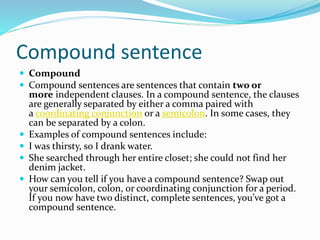
Compound sentence
 Compound
 Compound sentences are sentences that contain two or
more independent clauses. In a compound sentence, the clauses
are generally separated by either a comma paired with
a coordinating conjunction or a semicolon. In some cases, they
can be separated by a colon.
 Examples of compound sentences include:
 I was thirsty, so I drank water.
 She searched through her entire closet; she could not find her
denim jacket.
 How can you tell if you have a compound sentence? Swap out
your semicolon, colon, or coordinating conjunction for a period.
If you now have two distinct, complete sentences, you’ve got a
compound sentence.
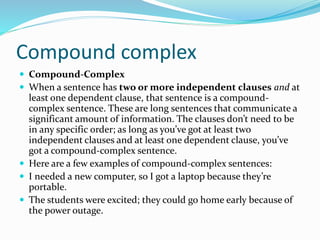
Compound complex
 Compound-Complex
 When a sentence has two or more independent clauses and at
least one dependent clause, that sentence is a compound-
complex sentence. These are long sentences that communicate a
significant amount of information. The clauses don’t need to be
in any specific order; as long as you’ve got at least two
independent clauses and at least one dependent clause, you’ve
got a compound-complex sentence.
 Here are a few examples of compound-complex sentences:
 I needed a new computer, so I got a laptop because they’re
portable.
 The students were excited; they could go home early because of
the power outage.
Slide created by
Amit verma
Rudraksh coaching classes
Whatsapp number-8871538455

English grammar projects on sentences

  • 1.
    Project on sentences Projectcreated by Rudraksh coaching classes Amit verma Whatsapp number :8871538455
  • 2.
    A sentence isa group of words make a complete sense. A set of words that is complete in itself, typically containing a subject and predicate, conveying a statement, question, exclamation, or command, and consisting of a main clause and sometimes one or more subordinate clauses.
  • 3.
    Types of sentences Sentences can be classified in two ways: based on their function and based on their structure. When you describe a sentence based on its function, you’re describing it based on what it does.  Declarative  Interrogative  Exclamatory  Imperative  Conditional
  • 4.
    Declarative sentence  Declarative A declarative sentence is a sentence that:  Makes a statement  Provides an explanation  Conveys one or more facts
  • 5.
    Declarative sentence  Declarativesentences are among the most common sentences in the English language. You use them every day. They end with periods.  Here are a few examples of declarative sentences:  I forgot to wear a hat today.  Your pizza is doughy because you didn’t cook it long enough.  Spiders and crabs are both members of the arthropod family.
  • 6.
    Interrogative sentence  Interrogative An interrogative sentence is a sentence that asks a question, like:  How many pet iguanas do you have?  May I sit here?  Aren’t there enough umbrellas to go around?  One hallmark of interrogative sentences is that they usually begin with pronouns or auxiliary verbs. When this kind of sentence does start with the subject, it’s usually in colloquial speech. For example:  He went there again?  Rats can’t swim, right?
  • 7.
    Exclamatory sentence  Exclamatory Much like an interrogative question ends with a question mark, an exclamatory sentence ends with an exclamation mark. These sentences communicate heightened emotion and are often used as greetings, warnings, or rallying cries. Examples include:  Hey!  High voltage! Do not touch!  This is Sparta!  The only difference between a declarative sentence and an exclamatory one is the punctuation at the end. But that punctuation makes a big difference in how the reader or listened interprets the sentence. Consider the difference between these:  It’s snowing.  It’s snowing!
  • 8.
    Imperative sentence  Imperative An imperative sentence is a sentence that gives the reader advice, instructions, a command or makes a request.  An imperative sentence can end in either a period or an exclamation point, depending on the urgency of the sentiment being expressed. Imperative sentences include:  Get off my lawn!  After the timer dings, take the cookies out of the oven.  Always pack an extra pair of socks.  With an imperative sentence, the subject is generally omitted because the reader understands they’re the one being addressed.
  • 9.
    Conditional sentence  Conditional Conditional sentences are sentences that discuss factors and their consequences in an if-then structure. Their structure is:  Conditional clause (typically known as the if-clause) + consequence of that clause.  A basic example of a conditional sentence is:  When you eat ice cream too fast, you get brain freeze.
  • 10.
    Types of sentence Types of sentence based on structure  The other way to categorize sentences is to classify them based on their structure. Each of the types of sentences discussed above also fits into the categories discussed below.  Simple  Compound  Complex  Complex compound
  • 11.
    Simple sentence  Simple A simple sentence is the most basic type of sentence. This kind of sentence consists of just one independent clause, which means it communicates a complete thought and contains a subject and a verb.  A few examples of simple sentences include:  How are you?  She built a garden.  We found some sea glass.  A simple sentence is the smallest possible grammatically correct sentence. Anything less is known as a sentence fragment.
  • 12.
    Complex sentences  Complex In contrast to a simple sentence, a complex sentence contains one independent clause and at least one dependent clause. While an independent clause can be its own sentence, a dependent clause can’t. Dependent clauses rely on the independent clauses in their sentences to provide context.  Dependent clauses appear after a conjunction or marker word or before a comma. Marker words are words like whenever, although, since, while, and before. These words illustrate relationships between clauses.  The following are complex sentences:  Before you enter my house, take off your shoes.  Matt plays six different instruments, yet never performs in public.
  • 13.
    Compound sentence  Compound Compound sentences are sentences that contain two or more independent clauses. In a compound sentence, the clauses are generally separated by either a comma paired with a coordinating conjunction or a semicolon. In some cases, they can be separated by a colon.  Examples of compound sentences include:  I was thirsty, so I drank water.  She searched through her entire closet; she could not find her denim jacket.  How can you tell if you have a compound sentence? Swap out your semicolon, colon, or coordinating conjunction for a period. If you now have two distinct, complete sentences, you’ve got a compound sentence.
  • 14.
    Compound complex  Compound-Complex When a sentence has two or more independent clauses and at least one dependent clause, that sentence is a compound- complex sentence. These are long sentences that communicate a significant amount of information. The clauses don’t need to be in any specific order; as long as you’ve got at least two independent clauses and at least one dependent clause, you’ve got a compound-complex sentence.  Here are a few examples of compound-complex sentences:  I needed a new computer, so I got a laptop because they’re portable.  The students were excited; they could go home early because of the power outage.
  • 15.
    Slide created by Amitverma Rudraksh coaching classes Whatsapp number-8871538455