USMAN IDREES
MADIHA RAZZAQ
VERBS
Verb
 A word or group of word that is used to describe
an action, a state, a process, and experience .
 Verbs show action or state of being.
Examples: go, is
 An action verb expresses a physical or mental
action.
Example: He paints.
We thought about it.
1. Regular verb and Irregular verb
2. Transitive and Intransitive verb
3. Special verb
4. State verb
5. Linking verb
6. Phrasal verb
7. Verb tenses
8. Gerund and Infinitive verb
In English verb is divided in to three types. There are
the main verbs ,the Auxiliaries (helping) and Modal
Auxiliaries. But enable easy to understand I divided
eight verbs .
1. Regular verb and Irregular verb
Regular verb Irregular verb
Walk
Note
Stop
Relax
Visit
Plan
Kill
Kiss
Sound
Need
Be
Go
Speak
See
Run
Drive
Do
Have
Buy
 Irregular verbs are verbs that don't take on the regular –
d, -ed, or -ied spelling patterns of the past simple (V2) or
past participle (V3). Many of the irregular V2 and V3 forms
are the same, such as: cut - cut, had - had, let - let, sold-
sold, fed- fed…
2.Transitive and Intransitive Verb
Transitive
 Transitive verb or Object Verb is a verb that needs to be
followed by an object, often a noun ,pronoun, or a noun
phrase.
 Example take , smoke , kill , teach , catch, eat,…
Thearith throws the football.
Transitive verb Direct Object
what?
Intransitive verb
An Intransitive verbs is one that has a complete meaning
By itself.
Example: I talk, I understand, She sleep, We work.
She sleep alone ?
She cries.
Intransitive verb
3.Special verb
 Special verbs are helping verb that can be add to make a
single verb phrase to express the certain tense of meaning.
 There are two kinds of special verb:
 Auxiliary verb(helping)
 Modal Auxiliary verb
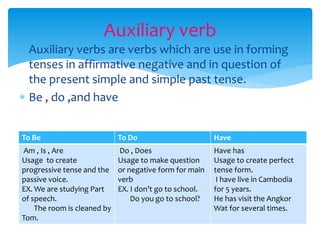
Auxiliary verb
 Auxiliary verbs are verbs which are use in forming
tenses in affirmative negative and in question of
the present simple and simple past tense.
 Be , do ,and have
To Be To Do Have
Am , Is , Are
Usage to create
progressive tense and the
passive voice.
EX. We are studying Part
of speech.
The room is cleaned by
Tom.
Do , Does
Usage to make question
or negative form for main
verb
EX. I don’t go to school.
Do you go to school?
Have has
Usage to create perfect
tense form.
I have live in Cambodia
for 5 years.
He has visit the Angkor
Wat for several times.
Modal Auxiliary verb
• Modal Auxiliary verb belongs to the larger category a auxiliary
verb . There are use as conjunction with another verb(before the
base form of the main verb).
• There are can, could, may, might , shout , ought to, had better ,
must , have to , will , shall , should , may /might have , could have ,
would have , must have , should have , ought to have.
4.State verb
 State verbs are verb that give an expression in the condition
of life , want, mental ,state , senses ,and opinion.
 It is not used in progressive tenses.
Example
I believe that you are very cleaver.
I don’t think that he is telling the truth.
Do you remember me?
..
State verb have
Believe
Feel
Know
See
appear
believe
belong
consider
consist
contain
Think
Remember
Like
Want
suspect
understand
want
wish
owe
own
prefer
5. Linking verb
 Linking verb is a verb that need to be follow by a
complement often and adjective or adjective phrase.
 Such as: feel , look , To Be ,get , come …….
Example
 I feel sick.
 Nita look beautiful.
 You are clever.
6. Phrasal verb
 A phrasal verb is a verb plus a preposition or adverb which
creates a meaning different from the original verb.
 I talked my mother into letting me borrow the car.
She looked the phone number up.
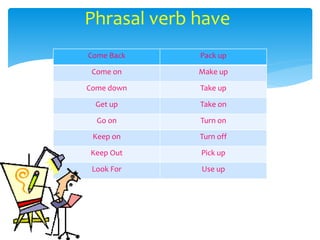
Phrasal verb have
Come Back Pack up
Come on Make up
Come down Take up
Get up Take on
Go on Turn on
Keep on Turn off
Keep Out Pick up
Look For Use up
7. Verb Tenses
The tense of a verb tells when an action takes place.
A present tense of a verb names an action that
happens regularly. It can also express a
general truth.
Present Tense Forms
Singular
I race.
You race.
He, she, or it races.
Plural
We race.
You race.
They race.
The tense of a verb tells when an action takes place.
A past tense of a verb names an
action already happened.
The past tense of many verbs is formed by
adding –ed to the base form of the verb.
Singular
I raced.
You raced.
He, she, or it raced.
Plural
We raced.
You raced.
They raced.
Past Tense Forms
A future tense of a verb names an
action that will take place in the
future.
In the future tense the word will is used
with the verb. Sometimes shall is used
when the pronoun I or we is the subject.
Future Tense Forms
Singular
I will (shall) go.
You will go.
He, she, or it will go.
Plural
We will (shall) go.
You will go.
They will go.
8. Gerund and Infinitive
 Gerund is verb that use as a noun.
 Gerund can be used as subject or object.
Example:
 Jogging is a hobby of mine.
 Daniel quit smoking a year ago.
 I look forward to helping you paint the house.
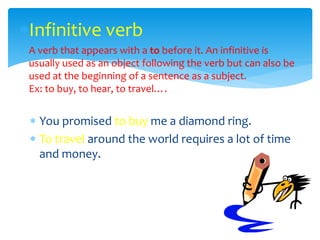
Infinitive verb
 A verb that appears with a to before it. An infinitive is
usually used as an object following the verb but can also be
used at the beginning of a sentence as a subject.
Ex: to buy, to hear, to travel….
 You promised to buy me a diamond ring.
 To travel around the world requires a lot of time
and money.
References
www.google.com
Parts of speech book. NTS
Basic Grammar book. IDE
Thank you for your Attention.
Question And Answer.
The End

Verbs

  • 2.
  • 3.
  • 4.
    Verb  A wordor group of word that is used to describe an action, a state, a process, and experience .  Verbs show action or state of being. Examples: go, is  An action verb expresses a physical or mental action. Example: He paints. We thought about it.
  • 5.
    1. Regular verband Irregular verb 2. Transitive and Intransitive verb 3. Special verb 4. State verb 5. Linking verb 6. Phrasal verb 7. Verb tenses 8. Gerund and Infinitive verb In English verb is divided in to three types. There are the main verbs ,the Auxiliaries (helping) and Modal Auxiliaries. But enable easy to understand I divided eight verbs .
  • 6.
    1. Regular verband Irregular verb Regular verb Irregular verb Walk Note Stop Relax Visit Plan Kill Kiss Sound Need Be Go Speak See Run Drive Do Have Buy  Irregular verbs are verbs that don't take on the regular – d, -ed, or -ied spelling patterns of the past simple (V2) or past participle (V3). Many of the irregular V2 and V3 forms are the same, such as: cut - cut, had - had, let - let, sold- sold, fed- fed…
  • 7.
    2.Transitive and IntransitiveVerb Transitive  Transitive verb or Object Verb is a verb that needs to be followed by an object, often a noun ,pronoun, or a noun phrase.  Example take , smoke , kill , teach , catch, eat,… Thearith throws the football. Transitive verb Direct Object what?
  • 8.
    Intransitive verb An Intransitiveverbs is one that has a complete meaning By itself. Example: I talk, I understand, She sleep, We work. She sleep alone ? She cries. Intransitive verb
  • 9.
    3.Special verb  Specialverbs are helping verb that can be add to make a single verb phrase to express the certain tense of meaning.  There are two kinds of special verb:  Auxiliary verb(helping)  Modal Auxiliary verb
  • 10.
    Auxiliary verb  Auxiliaryverbs are verbs which are use in forming tenses in affirmative negative and in question of the present simple and simple past tense.  Be , do ,and have To Be To Do Have Am , Is , Are Usage to create progressive tense and the passive voice. EX. We are studying Part of speech. The room is cleaned by Tom. Do , Does Usage to make question or negative form for main verb EX. I don’t go to school. Do you go to school? Have has Usage to create perfect tense form. I have live in Cambodia for 5 years. He has visit the Angkor Wat for several times.
  • 11.
    Modal Auxiliary verb •Modal Auxiliary verb belongs to the larger category a auxiliary verb . There are use as conjunction with another verb(before the base form of the main verb). • There are can, could, may, might , shout , ought to, had better , must , have to , will , shall , should , may /might have , could have , would have , must have , should have , ought to have.
  • 12.
    4.State verb  Stateverbs are verb that give an expression in the condition of life , want, mental ,state , senses ,and opinion.  It is not used in progressive tenses. Example I believe that you are very cleaver. I don’t think that he is telling the truth. Do you remember me? ..
  • 13.
  • 14.
    5. Linking verb Linking verb is a verb that need to be follow by a complement often and adjective or adjective phrase.  Such as: feel , look , To Be ,get , come ……. Example  I feel sick.  Nita look beautiful.  You are clever.
  • 15.
    6. Phrasal verb A phrasal verb is a verb plus a preposition or adverb which creates a meaning different from the original verb.  I talked my mother into letting me borrow the car. She looked the phone number up.
  • 16.
    Phrasal verb have ComeBack Pack up Come on Make up Come down Take up Get up Take on Go on Turn on Keep on Turn off Keep Out Pick up Look For Use up
  • 17.
    7. Verb Tenses Thetense of a verb tells when an action takes place. A present tense of a verb names an action that happens regularly. It can also express a general truth. Present Tense Forms Singular I race. You race. He, she, or it races. Plural We race. You race. They race.
  • 18.
    The tense ofa verb tells when an action takes place. A past tense of a verb names an action already happened. The past tense of many verbs is formed by adding –ed to the base form of the verb. Singular I raced. You raced. He, she, or it raced. Plural We raced. You raced. They raced. Past Tense Forms
  • 19.
    A future tenseof a verb names an action that will take place in the future. In the future tense the word will is used with the verb. Sometimes shall is used when the pronoun I or we is the subject. Future Tense Forms Singular I will (shall) go. You will go. He, she, or it will go. Plural We will (shall) go. You will go. They will go.
  • 20.
    8. Gerund andInfinitive  Gerund is verb that use as a noun.  Gerund can be used as subject or object. Example:  Jogging is a hobby of mine.  Daniel quit smoking a year ago.  I look forward to helping you paint the house.
  • 21.
    Infinitive verb  Averb that appears with a to before it. An infinitive is usually used as an object following the verb but can also be used at the beginning of a sentence as a subject. Ex: to buy, to hear, to travel….  You promised to buy me a diamond ring.  To travel around the world requires a lot of time and money.
  • 22.
    References www.google.com Parts of speechbook. NTS Basic Grammar book. IDE
  • 23.
    Thank you foryour Attention.
  • 24.