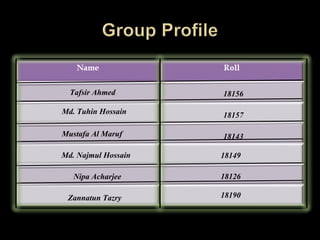
Tafsir Ahmed
Md. Tuhin Hossain
Md. Najmul Hossain
Nipa Acharjee
Zannatun Tazry
Mustafa Al Maruf
18156
18143
18149
18126
18190
18157
 Insurance that is used to cover damage to a
property caused by fire. Fire insurance is a
specialized form of insurance beyond property
insurance, and is designed to cover the cost of
replacement, reconstruction or repair beyond
what is covered by the property insurance
policy.
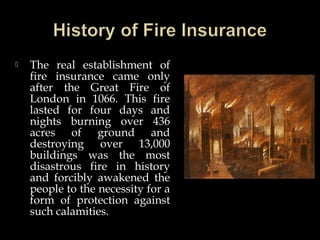
 The real establishment of
fire insurance came only
after the Great Fire of
London in 1066. This fire
lasted for four days and
nights burning over 436
acres of ground and
destroying over 13,000
buildings was the most
disastrous fire in history
and forcibly awakened the
people to the necessity for a
form of protection against
such calamities.
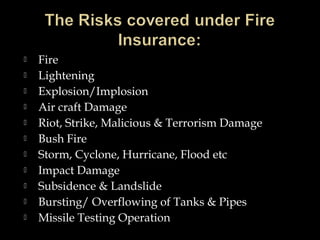
 Fire
 Lightening
 Explosion/Implosion
 Air craft Damage
 Riot, Strike, Malicious & Terrorism Damage
 Bush Fire
 Storm, Cyclone, Hurricane, Flood etc
 Impact Damage
 Subsidence & Landslide
 Bursting/ Overflowing of Tanks & Pipes
 Missile Testing Operation
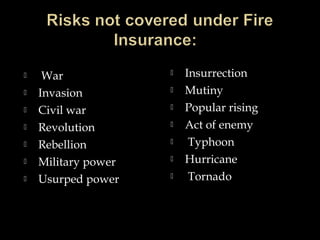
  War
 Invasion
 Civil war
 Revolution
 Rebellion
 Military power
 Usurped power
 Insurrection
 Mutiny
 Popular rising
 Act of enemy
  Typhoon
 Hurricane
  Tornado
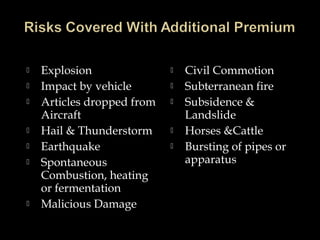
 Explosion
 Impact by vehicle
 Articles dropped from
Aircraft
 Hail & Thunderstorm
 Earthquake
 Spontaneous
Combustion, heating
or fermentation
 Malicious Damage
 Civil Commotion
 Subterranean fire
 Subsidence &
Landslide
 Horses &Cattle
 Bursting of pipes or
apparatus
 Fire insurance contract may be defined as "an
agreement, whereby one party in return for a
consideration undertakes to indemnify the
other party against financial loss which the
latter may sustain by reason of certain defined
subject-matter being damaged or destroyed by
fire or other defined perils up to an agreed
amount."
 The party responsible to indemnify the loss is
called the insurer,
 The party who is to be indemnified is called the
insured,
 The consideration for the contract is termed 'the
premium',
 The defined subject-matter is termed 'the property
insured"
 The sum set forth in the contract is called the
assured sum, and
 The document containing the terms and conditions
of the contract is known as 'the policy.
 Any loss caused by fire lighted purposively is
not a loss by fire if it was intentional. However,
the property burned accidentally in an
ordinary fire, such as domestic fire, the loss is
covered even if the fire remains under control.
 When a fire was purposively lighted but
became out of control at a later stage is taken
under the definition of fire. The object of fire
insurance is to indemnify the insured against
accidental loss by fire.
 Features of General Contract
• Proposal
• Acceptance
• Commencement of risk
• Cover note
 Insurable interest
 Principle of Good Faith
 Principle of indemnity
 Subrogation
 Warranties
 Proximate cause
The insurable interest is the
pecuniary interest where by the
policy holder is benefited by the
existence of the subject matter
and is prejudiced death or
damage of the subject matter.
The contract of fire insurance is one
in which the observance the utmost
good faith- by both the parties are of
vital significant. The utmost good
faith in fire insurance has two
aspects-first, disclosure of material
facts and second, preservation of the
property insured.
The doctrine of indemnity aims to
compensate the insured for a loss
sustained, and the compensation should
be such as to place him as nearly as
possible in the same pecuniary position
after the loss as he occupied
immediately before the occurrence. The
insured cannot claim anything in excess
of the amount required to recoup the
actual loss sustained.
The doctrine of Subrogation refers to
the right of the insurer to stand in the
place of the insured, after settlement
of claim, in so far as the insured’s
right of recovery from a third party
due to whose negligence the loss may
happened.
There are certain conditions and
promises in the insurance contract,
which are called warranties. On
breach of warranties the insurer
become free from his liability.
Therefore the insured must have to
fulfill the conditions and promises
during the insurance contract.
Proximate cause means the active
efficient cause that sets in motion a
train of events which brings about a
result , without intervention of any
force started and working actively
from a new an independent source.
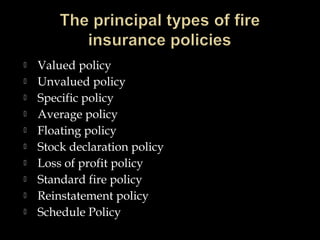
 Valued policy
 Unvalued policy
 Specific policy
 Average policy
 Floating policy
 Stock declaration policy
 Loss of profit policy
 Standard fire policy
 Reinstatement policy
 Schedule Policy
This is a type of fire insurance policy where the value
of the subject-matter of insurance is agreed upon at the
time of making the contract. The insurer is liable to pay
the amount specified or valued irrespective of the
amount of loss caused due to fire. In this policy the
principles of indemnity has no application. The insurer
pays a fixed sum and does not indemnify for the losses.
Valued policy is taken for those goods whose value
becomes difficult to calculate in case of loss by fire. This
type of policies are suitable for insuring works of art,
jewelry and paintings where the value of the damaged
articles becomes difficult to measure.
 Valuable policy is a type of policy where the
amount of loss is not valued at the time of
undertaking contract of insurance. It is
determined at the time and place of loss on the
basis of market value of the property. It is
generally based on the basis of principle of
indemnity.
 A specific policy is a type of policy in which the
property is insured for a specific sum
irrespective of its value. The value of the whole
subject matter is immaterial and as such it
becomes a under insurance policy. For
example, if a property is insured for Rs. 10000
though its actual value is Rs. 20000. In the
event of loss to property, not more than Rs.
10000 can be recovered.
 It is a type of policy where the average clause is
inserted. Under this policy the indemnity is
determined on the basis of the value of the
property insured. In average policy under
insurance contracts are penalized. If a policy is
taken for Rs. 10000 against a real value of the
property Rs. 50000. The loss is 800. The claim
for the loss will be restricted to the
proportionate of sum assured to the actual
value of the property.
 Floating policy is taken out for those goods
which are frequently changing in a warehouse.
This policy can be taken on those goods which
are lying on different localities or go downs
Since quantity of goods lying in the warehouse
or at different places fluctuate from time to
time, it becomes difficult for the owner to take
a specific policy. Floating policies are suitable
to those traders or products whose raw-
materials or merchandise are lying at different
localities or go downs.
 It is a type of fire policy where all types of risks
like fire, burglary, riot, explosion and strikes
are covered. This policy is otherwise called as
all in one policy or all Insurance policy. Since
this type of policy covers a wide range of
perils, these are very popular in England.
 The actual process of rating consists of three
steps:
 Classification,
 Discrimination and
 Fixing rates or schedule rating.
Different premium rates are fixed for each class.
These classifications do not hold good for a long
time because of varied nature of risk. Now the
risks are classified into various classes according to
factors affecting fire risk.
 Construction or Structure
 Occupancy
 Nature of Flooring
 Height
 Floor and wall opening
 Exposure
 Lighting, Heating and Power
 The differentiation of the rates for individual
risks in a particular class is known as
discrimination. Each additional feature of risk
is charged extra premium. The better types of
risks are encouraged and attracted by the
insurer. Lesser premium is charged where fire
extinguishing appliances or fire-resisting
construction are present.
 It is a plan by which hazards with respect to
any particular risk are measured. It is defined
as," an empirical standard for the measurement
of relative quantity of fire hazard.
 Moral hazard
 Legal frameworks
 Regulatory bodies and processes
 Competition
 Skills and training
 Market initiatives
 Bad faith
 Disputes over the amount of coverage
 Disputes about the extent of coverage available
 Improper or wrongful claim denials
 Adverse selection
 Fire protection expensive
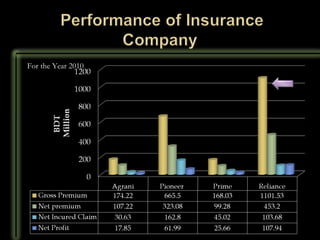
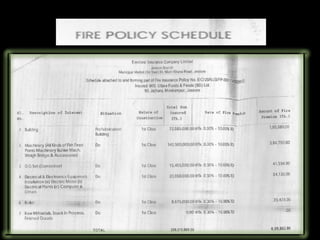
For the Year 2010
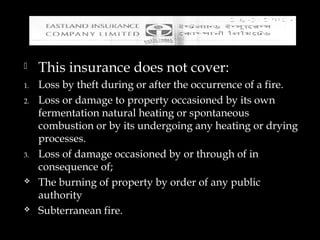
 This insurance does not cover:
1. Loss by theft during or after the occurrence of a fire.
2. Loss or damage to property occasioned by its own
fermentation natural heating or spontaneous
combustion or by its undergoing any heating or drying
processes.
3. Loss of damage occasioned by or through of in
consequence of;
 The burning of property by order of any public
authority
 Subterranean fire.
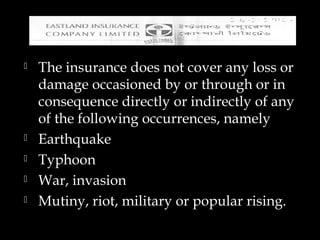
 The insurance does not cover any loss or
damage occasioned by or through or in
consequence directly or indirectly of any
of the following occurrences, namely
 Earthquake
 Typhoon
 War, invasion
 Mutiny, riot, military or popular rising.
 After knowing the brief history, types, perils
associated, advantages, barriers and
precautions of fire insurance we conclude that
There is no way to face the risks of fire or to
completely eliminate the factors of fire but we
can be saved from the damages associated from
fire through insurance. Fire insurance is a key
to cover losses caused by fire. It cannot bring
back your dear ones but try to overcome or to
fill the spaces in the life of the heirs.
Fire insurance
Fire insurance

Fire insurance

  • 3.
    Tafsir Ahmed Md. TuhinHossain Md. Najmul Hossain Nipa Acharjee Zannatun Tazry Mustafa Al Maruf 18156 18143 18149 18126 18190 18157
  • 4.
     Insurance thatis used to cover damage to a property caused by fire. Fire insurance is a specialized form of insurance beyond property insurance, and is designed to cover the cost of replacement, reconstruction or repair beyond what is covered by the property insurance policy.
  • 5.
     The realestablishment of fire insurance came only after the Great Fire of London in 1066. This fire lasted for four days and nights burning over 436 acres of ground and destroying over 13,000 buildings was the most disastrous fire in history and forcibly awakened the people to the necessity for a form of protection against such calamities.
  • 6.
     Fire  Lightening Explosion/Implosion  Air craft Damage  Riot, Strike, Malicious & Terrorism Damage  Bush Fire  Storm, Cyclone, Hurricane, Flood etc  Impact Damage  Subsidence & Landslide  Bursting/ Overflowing of Tanks & Pipes  Missile Testing Operation
  • 7.
      War  Invasion Civil war  Revolution  Rebellion  Military power  Usurped power  Insurrection  Mutiny  Popular rising  Act of enemy   Typhoon  Hurricane   Tornado
  • 8.
     Explosion  Impactby vehicle  Articles dropped from Aircraft  Hail & Thunderstorm  Earthquake  Spontaneous Combustion, heating or fermentation  Malicious Damage  Civil Commotion  Subterranean fire  Subsidence & Landslide  Horses &Cattle  Bursting of pipes or apparatus
  • 9.
     Fire insurancecontract may be defined as "an agreement, whereby one party in return for a consideration undertakes to indemnify the other party against financial loss which the latter may sustain by reason of certain defined subject-matter being damaged or destroyed by fire or other defined perils up to an agreed amount."
  • 10.
     The partyresponsible to indemnify the loss is called the insurer,  The party who is to be indemnified is called the insured,  The consideration for the contract is termed 'the premium',  The defined subject-matter is termed 'the property insured"  The sum set forth in the contract is called the assured sum, and  The document containing the terms and conditions of the contract is known as 'the policy.
  • 11.
     Any losscaused by fire lighted purposively is not a loss by fire if it was intentional. However, the property burned accidentally in an ordinary fire, such as domestic fire, the loss is covered even if the fire remains under control.  When a fire was purposively lighted but became out of control at a later stage is taken under the definition of fire. The object of fire insurance is to indemnify the insured against accidental loss by fire.
  • 12.
     Features ofGeneral Contract • Proposal • Acceptance • Commencement of risk • Cover note
  • 13.
     Insurable interest Principle of Good Faith  Principle of indemnity  Subrogation  Warranties  Proximate cause The insurable interest is the pecuniary interest where by the policy holder is benefited by the existence of the subject matter and is prejudiced death or damage of the subject matter. The contract of fire insurance is one in which the observance the utmost good faith- by both the parties are of vital significant. The utmost good faith in fire insurance has two aspects-first, disclosure of material facts and second, preservation of the property insured. The doctrine of indemnity aims to compensate the insured for a loss sustained, and the compensation should be such as to place him as nearly as possible in the same pecuniary position after the loss as he occupied immediately before the occurrence. The insured cannot claim anything in excess of the amount required to recoup the actual loss sustained. The doctrine of Subrogation refers to the right of the insurer to stand in the place of the insured, after settlement of claim, in so far as the insured’s right of recovery from a third party due to whose negligence the loss may happened. There are certain conditions and promises in the insurance contract, which are called warranties. On breach of warranties the insurer become free from his liability. Therefore the insured must have to fulfill the conditions and promises during the insurance contract. Proximate cause means the active efficient cause that sets in motion a train of events which brings about a result , without intervention of any force started and working actively from a new an independent source.
  • 14.
     Valued policy Unvalued policy  Specific policy  Average policy  Floating policy  Stock declaration policy  Loss of profit policy  Standard fire policy  Reinstatement policy  Schedule Policy
  • 15.
    This is atype of fire insurance policy where the value of the subject-matter of insurance is agreed upon at the time of making the contract. The insurer is liable to pay the amount specified or valued irrespective of the amount of loss caused due to fire. In this policy the principles of indemnity has no application. The insurer pays a fixed sum and does not indemnify for the losses. Valued policy is taken for those goods whose value becomes difficult to calculate in case of loss by fire. This type of policies are suitable for insuring works of art, jewelry and paintings where the value of the damaged articles becomes difficult to measure.
  • 16.
     Valuable policyis a type of policy where the amount of loss is not valued at the time of undertaking contract of insurance. It is determined at the time and place of loss on the basis of market value of the property. It is generally based on the basis of principle of indemnity.
  • 17.
     A specificpolicy is a type of policy in which the property is insured for a specific sum irrespective of its value. The value of the whole subject matter is immaterial and as such it becomes a under insurance policy. For example, if a property is insured for Rs. 10000 though its actual value is Rs. 20000. In the event of loss to property, not more than Rs. 10000 can be recovered.
  • 18.
     It isa type of policy where the average clause is inserted. Under this policy the indemnity is determined on the basis of the value of the property insured. In average policy under insurance contracts are penalized. If a policy is taken for Rs. 10000 against a real value of the property Rs. 50000. The loss is 800. The claim for the loss will be restricted to the proportionate of sum assured to the actual value of the property.
  • 19.
     Floating policyis taken out for those goods which are frequently changing in a warehouse. This policy can be taken on those goods which are lying on different localities or go downs Since quantity of goods lying in the warehouse or at different places fluctuate from time to time, it becomes difficult for the owner to take a specific policy. Floating policies are suitable to those traders or products whose raw- materials or merchandise are lying at different localities or go downs.
  • 20.
     It isa type of fire policy where all types of risks like fire, burglary, riot, explosion and strikes are covered. This policy is otherwise called as all in one policy or all Insurance policy. Since this type of policy covers a wide range of perils, these are very popular in England.
  • 21.
     The actualprocess of rating consists of three steps:  Classification,  Discrimination and  Fixing rates or schedule rating.
  • 22.
    Different premium ratesare fixed for each class. These classifications do not hold good for a long time because of varied nature of risk. Now the risks are classified into various classes according to factors affecting fire risk.  Construction or Structure  Occupancy  Nature of Flooring  Height  Floor and wall opening  Exposure  Lighting, Heating and Power
  • 23.
     The differentiationof the rates for individual risks in a particular class is known as discrimination. Each additional feature of risk is charged extra premium. The better types of risks are encouraged and attracted by the insurer. Lesser premium is charged where fire extinguishing appliances or fire-resisting construction are present.
  • 24.
     It isa plan by which hazards with respect to any particular risk are measured. It is defined as," an empirical standard for the measurement of relative quantity of fire hazard.
  • 25.
     Moral hazard Legal frameworks  Regulatory bodies and processes  Competition  Skills and training  Market initiatives  Bad faith  Disputes over the amount of coverage  Disputes about the extent of coverage available  Improper or wrongful claim denials  Adverse selection  Fire protection expensive
  • 26.
  • 27.
     This insurancedoes not cover: 1. Loss by theft during or after the occurrence of a fire. 2. Loss or damage to property occasioned by its own fermentation natural heating or spontaneous combustion or by its undergoing any heating or drying processes. 3. Loss of damage occasioned by or through of in consequence of;  The burning of property by order of any public authority  Subterranean fire.
  • 28.
     The insurancedoes not cover any loss or damage occasioned by or through or in consequence directly or indirectly of any of the following occurrences, namely  Earthquake  Typhoon  War, invasion  Mutiny, riot, military or popular rising.
  • 31.
     After knowingthe brief history, types, perils associated, advantages, barriers and precautions of fire insurance we conclude that There is no way to face the risks of fire or to completely eliminate the factors of fire but we can be saved from the damages associated from fire through insurance. Fire insurance is a key to cover losses caused by fire. It cannot bring back your dear ones but try to overcome or to fill the spaces in the life of the heirs.