~ Ruthvik
 Insurance is the form of risk management
primarily used to hedge against the risk of
contingent, uncertain loss.
 Insurance can be defined as the equitable
transfer of risk of loss , from one entity to
another, in exchange of payment.
 INSURER:The company selling the insurance.
 INSURED:The insured or the policyholder ,is the
person or the entity buying the insurance policy.
 PREMIUM:The amount paid by the insured for
the insurance policy is known as premium
 PERIL: Cause of the loss (tsunami, flood,
earthquake)
 RISK: A Chance that a loss can occur
Insurance is a contract between the insurer and
the insured whereby the insurer undertakes to
pay the insured a fixed amount, in exchange for
a fixed sum (premium), on happening of a
certain event (like certain age/death) or
compensate on the actual loss when it takes
place, due to the risk insured.
 Pure Risks-These risks involve only the chance of loss, there is never an
opportunity for gain or profit.
Examples: injury from an accident, loss of home from an earthquake.
 Speculative Risks-These risks involve both the chance of gain or loss.
Examples:Gambling at the race track, or investing in the real estate market.
Only Pure Risks are Insurable
Pure risk Speculative risk
Enforceable by law
Cooperative device.
Large number of insured person.
Value of risk.
Payment at contingency.
Insurance is not a gambling
Insurance is not a charity
 Insurance is an agreement enforceable by law.
 It is a contract between the insurer and the
insured and it is always made in writing.
 The consideration is in the form of premium
which insured agrees to pay to the insurer.
 The insurance is a system wherein large
number of persons, exposed to a similar risk,
are covered and the risk is spread over among
the larger insurable public.Therefore,
insurance is a social or cooperative method
wherein losses of one is borne by the society.
 To spread the loss, large number of persons should be insured.The
co-operation of a small number of persons may also be insurance
but it will be limited to smaller area.The cost of insurance to each
member may be higher. So, it may be unmarketable.
 Therefore, to make the insurance cheaper, it is essential to insure
large number of persons or property because the lesser would be
cost of insurance and so, the lower would be premium. In past
years, tariff associations or mutual fire insurance associations
were found to share the loss at cheaper rate. In order to function
successfully, the insurance should be joined by a large number of
persons.
 Before insuring an object, the risk is evaluated in
order to determine the amount of premium to
be charged on the insured.
 Several methods are being adopted to evaluate
the risks involved in the subject matter.
 If there is an expectation of heavy loss, higher
premiums will be charged.
 Hence, the probability of occurrence of loss is
calculated at the time of insurance.
 An insurer is liable to pay compensation to the insured
only when certain contingencies arise.
 In life insurance, the contingency — the death or the
expiry of the term will certainly occur. In such cases,
the life insurer has to pay the assured sum.
 In other insurance contracts, the contingency — a fire
accident or the marine perils, may or may not occur.
 So, if the contingency occurs, payment is made,
otherwise no payment need to be made to the
policyholders.
 Gambling means an activity that must result
either in a gain or a loss. It is neither risk
taking (in the sense of speculation) nor
investing.
 Only Pure risk can be insured.Thus insurance
can never be considered as gambling.
 Premium collected from the policyholders
under an insurance is the cost of risk so
covered.
 Charity is given without consideration but
insurance is not possible without premium.
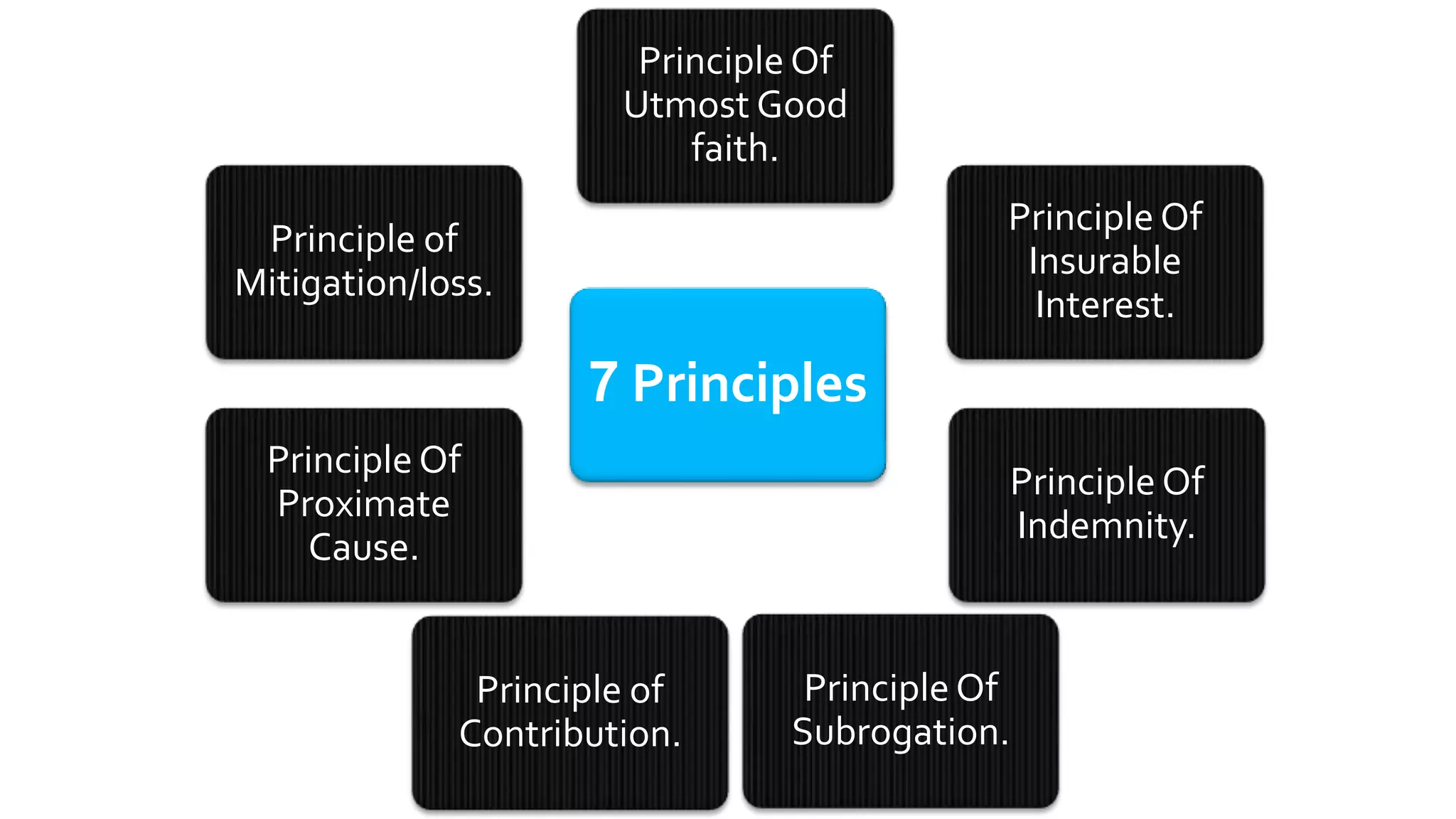
PrincipleOf
Utmost Good
faith.
PrincipleOf
Insurable
Interest.
Principle Of
Indemnity.
PrincipleOf
Subrogation.
Principle of
Contribution.
PrincipleOf
Proximate
Cause.
Principle of
Mitigation/loss.
7 Principles
 Under this insurance contract both the parties
should have faith over each other.
 As a client it is the duty of the insured to disclose
all the facts to the insurance company. Any fraud
or misrepresentation of facts can result into
cancellation of the contract.
If you are applying for life insurance
 It is the duty of the Insured to disclose all the
facts of the health conditions he previously had.
 It is the duty of the Insurer to disclose all about
the contract and its critical terms.
(Also includes in what situations the contract is
applicable and not applicable)
 The insured must have insurable interest in
the object of insurance i.e, the physical
existence of the insured object gives him
some gain and non existence gives him loss.
 Simple words, the insured person must suffer
financial loss by the damage of the insured
object
Macaura v Northern Assurance Co Ltd
Macaura sells timber to Irish Canadian Sawmills Ltd and receives
42000 shares as consideration making him the owner of that
company.
Macaura gets insurance policy with northern assurance in his own
name.
Two weeks later, there was a fire. Northern Assurance refused to pay
up because the timber was owned by the company, and that because
the company was a separate legal entity and has no insurable
interest, it did not need to pay Mr Macaura any money.
Indemnity means compensation against loss or
damage.
This principle states that the insurance company
shall not compensate any amount more than the
insured economic loss
This principle is observed more strictly in property
insurance than in life insurance
After insured is compensated of the losses, the
right of ownership passes to the insurer.
This enable the insurer to claim amount from
the third party who is responsible for such loss.
 Mr. Ruthvik insures his house for 2 lakh rupees.The house
is totally destroyed by the negligence of his neighbor
Mr. Sri Hari.
 The insurance company shall settle the claim of 2 lakh
rupees for Mr. Ruthvik and at the same time it can file suit
against Mr. Sri Hari for 3 lakh rupees.
 If the insurance company wins the case and collects
3 lakhs, the company retains 2 lakhs (which is already paid
to Mr. Ruthvik) plus other expenses and the balance
amount shall be given to Mr. Ruthvik
Also known as double insurance
This principle states that if the insured takes
more than one policy on the same subject
matter, then the insured can claim only to the
extent of the actual loss either from all insurers
or from any one of the insurer.
If the insured takes claim only from one insurer,
then such insurer can claim proportionate claim
from the other insurers.
Proximate cause means, nearest cause or direct cause.
This principle occurs when the loss is occurred due to
more than one cause.
The proximate clause means, the most dominant and
the most effective clause of loss is to be considered
Immediate cause has to be observed but not the remote
cause.
A Ship caught fire due to the air bombing of an
enemy aircraft.
 Remote cause:The loss was occurred to due
the fire accident
 Proximate clause:War
 Hence no claim is payable.
 Ruthvik falls from a ladder at a low height and
scratches his leg a little. He is taken to a
hospital and in the hospital he contacts
cholera from the next bed patient and dies.
 Remote cause: Falling from ladder
 Proximate cause: Cholera
InYORKSHIRE DALE S.S. Co.V. MINISTER OF WAR
TRANSPORT (1942), the statement made was,
“Choice of the real or efficient cause from out of the
whole complex of the facts must be made by applying
commonsense standards.
Causation is to be understood as the man in the street,
and not as either scientist or the metaphysician would
understand it”
 According to this principle the insured must
try his level best to safeguard his property
and minimize the risk of loss even though the
insurance cover exists.
Large number of exposure units
Loss must be due to chance
Define and measurable loss
Calculable chance of loss
Non-catastrophic loss
Premium should be economically feasible
 There must be a
sufficiently large number
of homogeneous
exposures in order
combine losses that are
reasonably predictable.
 The loss must be accidental. No insurer shall
insure a deliberate loss. It has be to
unintentional and beyond the control of the
insured.
 The loss should be both determinable and
measurable.This means the loss should be
definite as to cause, time, place, and amount.
Life insurance in most cases meets this
requirement easily.
 The cause and time of death can be readily
determined in most cases
 The insurer must be able to calculate both the
frequency and the severity of future losses
with some accuracy.
 Prediction of losses will be difficult if the
losses are incurred deliberately.
 Catastrophe means an event causing a great damage to a larger area.
Example: floods , earthquakes etc.
 The losses should be non-catastrophic. Not all the units in a
homogeneous group will be subject to an adverse event.This means that
a large proportion of exposure units should not incur losses at the same
time
 The losses should be non-catastrophic. Not all the units in a
homogeneous group will be subject to an adverse event.This means that
a large proportion of exposure units should not incur losses at the same
time
 Premium must be reasonable and economical
i.e, the insured must be able to pay such
premium.
Insurance provides social and economics benefits
Protects society’s wealth.
Development of social sectors.
Employment opportunities.
Reduction of worries and fears.
Prevents losses.
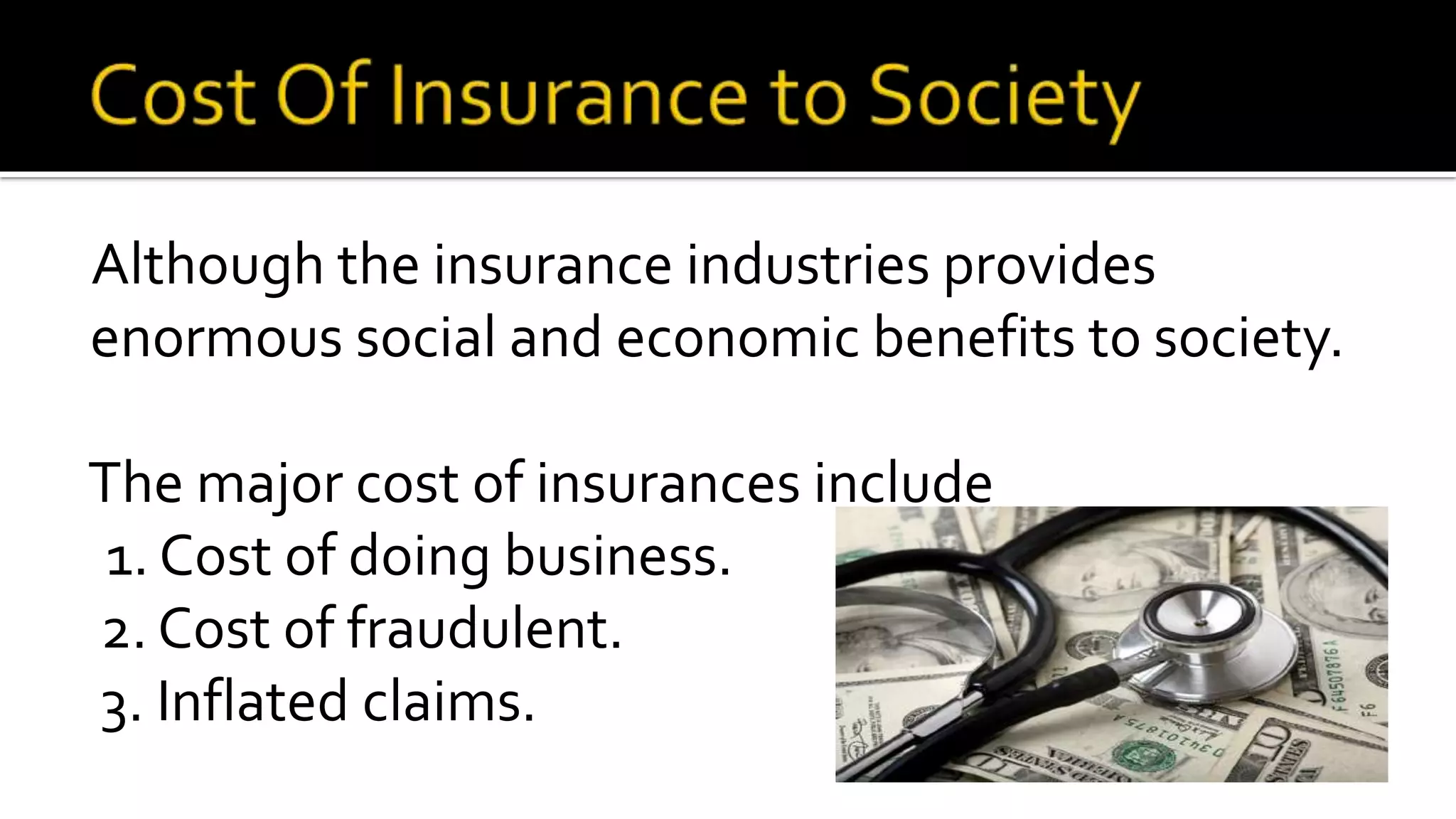
Although the insurance industries provides
enormous social and economic benefits to society.
The major cost of insurances include
1. Cost of doing business.
2. Cost of fraudulent.
3. Inflated claims.
The function Of
insurer can be
determined based
on the type of
business,
availability of
financial resources
and other factors.
The following are
the functions:-
• Production.
• Underwriting.
• Financing &
Investing
• A/c’ng & Record
keeping.
• Rate making.
• Miscellaneous
functions.
Life
Insurers
Health
Insurer
Foreign
Insurer
Domestic
Insurer
Alien
Insurer
Licensed
Insurer
Unlicensed
Insurer
Stock
Insurer
Mutual
Insurer
Govt
Insurers
> Life insurances business began in 1818 with the establishment
of oriental life insurance company.
> The reopening of the insurance sector began during the years
1990.
> The insurance bill was presented in both parliament houses.
> IRDA was established based on recommendations of RN
Malhotra Committee in1999.
> The IRDA opened the market in Aug 2000, foreign companies
were allowed ownership up to 26%.
> The gen insurance business in India is currently at Rs.
78000crores,premium per annum growing a healthy rate at 17%.
*To promote the interest and rights of policy
holders.
*To promote growth of insurance industry in the
country.
*To establish guide lines for agents and brokers.
*To establish guide lines for the functioning of the
insurance operations.
*To ensure transparency and clarity in the
functioning of insurance companies.
 It manages the investments of funds.
 It is the duty to protect the policy holders
interest in settling the claims.
 It solves the disputes arising between
intermediaries & insurers.
 It controls, promotes and makes sure that
there is a growth in insurances business.
 It excises all the functions and powers of the
controller of insurances
 It inspects and carries out investigation
including audit of intermediaries.
 It controls the terms and conditions and rates
offered by insurances companies.
Historical background:-
* Oriental insurance Co..Was the 1st British
insurances company to start its business in 1818.
* Bombay mutual life assurance society was the 1st
insurances co.. In India 1870.
* Life insurances business was Nationalised in
1956.
 Today there are many private players in both life
insurances and General insurances.
 The insurance of India consist of 53insurances co..
There fore 24 are life insurances business and 29 are
non life insurers.
 During FY2015-16 the life insurance industry recorded
a new premium income of Rs. 1.38trillon indicating a
growth rate of 22.5%.
 For general insurance recorded growth rate of 12% in
2016 .
 Acquiring big data.
 Increased demand for cyber insurances.
 Concept of peer2peer insurances.
 Focus on M-Health application.
 Using aerial digital and imagery.
Insurance

Insurance

  • 1.
  • 2.
     Insurance isthe form of risk management primarily used to hedge against the risk of contingent, uncertain loss.  Insurance can be defined as the equitable transfer of risk of loss , from one entity to another, in exchange of payment.
  • 3.
     INSURER:The companyselling the insurance.  INSURED:The insured or the policyholder ,is the person or the entity buying the insurance policy.  PREMIUM:The amount paid by the insured for the insurance policy is known as premium  PERIL: Cause of the loss (tsunami, flood, earthquake)  RISK: A Chance that a loss can occur
  • 4.
    Insurance is acontract between the insurer and the insured whereby the insurer undertakes to pay the insured a fixed amount, in exchange for a fixed sum (premium), on happening of a certain event (like certain age/death) or compensate on the actual loss when it takes place, due to the risk insured.
  • 5.
     Pure Risks-Theserisks involve only the chance of loss, there is never an opportunity for gain or profit. Examples: injury from an accident, loss of home from an earthquake.  Speculative Risks-These risks involve both the chance of gain or loss. Examples:Gambling at the race track, or investing in the real estate market. Only Pure Risks are Insurable Pure risk Speculative risk
  • 7.
    Enforceable by law Cooperativedevice. Large number of insured person. Value of risk. Payment at contingency. Insurance is not a gambling Insurance is not a charity
  • 8.
     Insurance isan agreement enforceable by law.  It is a contract between the insurer and the insured and it is always made in writing.  The consideration is in the form of premium which insured agrees to pay to the insurer.
  • 9.
     The insuranceis a system wherein large number of persons, exposed to a similar risk, are covered and the risk is spread over among the larger insurable public.Therefore, insurance is a social or cooperative method wherein losses of one is borne by the society.
  • 10.
     To spreadthe loss, large number of persons should be insured.The co-operation of a small number of persons may also be insurance but it will be limited to smaller area.The cost of insurance to each member may be higher. So, it may be unmarketable.  Therefore, to make the insurance cheaper, it is essential to insure large number of persons or property because the lesser would be cost of insurance and so, the lower would be premium. In past years, tariff associations or mutual fire insurance associations were found to share the loss at cheaper rate. In order to function successfully, the insurance should be joined by a large number of persons.
  • 11.
     Before insuringan object, the risk is evaluated in order to determine the amount of premium to be charged on the insured.  Several methods are being adopted to evaluate the risks involved in the subject matter.  If there is an expectation of heavy loss, higher premiums will be charged.  Hence, the probability of occurrence of loss is calculated at the time of insurance.
  • 12.
     An insureris liable to pay compensation to the insured only when certain contingencies arise.  In life insurance, the contingency — the death or the expiry of the term will certainly occur. In such cases, the life insurer has to pay the assured sum.  In other insurance contracts, the contingency — a fire accident or the marine perils, may or may not occur.  So, if the contingency occurs, payment is made, otherwise no payment need to be made to the policyholders.
  • 13.
     Gambling meansan activity that must result either in a gain or a loss. It is neither risk taking (in the sense of speculation) nor investing.  Only Pure risk can be insured.Thus insurance can never be considered as gambling.
  • 14.
     Premium collectedfrom the policyholders under an insurance is the cost of risk so covered.  Charity is given without consideration but insurance is not possible without premium.
  • 16.
    PrincipleOf Utmost Good faith. PrincipleOf Insurable Interest. Principle Of Indemnity. PrincipleOf Subrogation. Principleof Contribution. PrincipleOf Proximate Cause. Principle of Mitigation/loss. 7 Principles
  • 17.
     Under thisinsurance contract both the parties should have faith over each other.  As a client it is the duty of the insured to disclose all the facts to the insurance company. Any fraud or misrepresentation of facts can result into cancellation of the contract.
  • 18.
    If you areapplying for life insurance  It is the duty of the Insured to disclose all the facts of the health conditions he previously had.  It is the duty of the Insurer to disclose all about the contract and its critical terms. (Also includes in what situations the contract is applicable and not applicable)
  • 19.
     The insuredmust have insurable interest in the object of insurance i.e, the physical existence of the insured object gives him some gain and non existence gives him loss.  Simple words, the insured person must suffer financial loss by the damage of the insured object
  • 20.
    Macaura v NorthernAssurance Co Ltd Macaura sells timber to Irish Canadian Sawmills Ltd and receives 42000 shares as consideration making him the owner of that company. Macaura gets insurance policy with northern assurance in his own name. Two weeks later, there was a fire. Northern Assurance refused to pay up because the timber was owned by the company, and that because the company was a separate legal entity and has no insurable interest, it did not need to pay Mr Macaura any money.
  • 21.
    Indemnity means compensationagainst loss or damage. This principle states that the insurance company shall not compensate any amount more than the insured economic loss This principle is observed more strictly in property insurance than in life insurance
  • 22.
    After insured iscompensated of the losses, the right of ownership passes to the insurer. This enable the insurer to claim amount from the third party who is responsible for such loss.
  • 23.
     Mr. Ruthvikinsures his house for 2 lakh rupees.The house is totally destroyed by the negligence of his neighbor Mr. Sri Hari.  The insurance company shall settle the claim of 2 lakh rupees for Mr. Ruthvik and at the same time it can file suit against Mr. Sri Hari for 3 lakh rupees.  If the insurance company wins the case and collects 3 lakhs, the company retains 2 lakhs (which is already paid to Mr. Ruthvik) plus other expenses and the balance amount shall be given to Mr. Ruthvik
  • 24.
    Also known asdouble insurance This principle states that if the insured takes more than one policy on the same subject matter, then the insured can claim only to the extent of the actual loss either from all insurers or from any one of the insurer.
  • 25.
    If the insuredtakes claim only from one insurer, then such insurer can claim proportionate claim from the other insurers.
  • 26.
    Proximate cause means,nearest cause or direct cause. This principle occurs when the loss is occurred due to more than one cause. The proximate clause means, the most dominant and the most effective clause of loss is to be considered Immediate cause has to be observed but not the remote cause.
  • 27.
    A Ship caughtfire due to the air bombing of an enemy aircraft.  Remote cause:The loss was occurred to due the fire accident  Proximate clause:War  Hence no claim is payable.
  • 28.
     Ruthvik fallsfrom a ladder at a low height and scratches his leg a little. He is taken to a hospital and in the hospital he contacts cholera from the next bed patient and dies.  Remote cause: Falling from ladder  Proximate cause: Cholera
  • 29.
    InYORKSHIRE DALE S.S.Co.V. MINISTER OF WAR TRANSPORT (1942), the statement made was, “Choice of the real or efficient cause from out of the whole complex of the facts must be made by applying commonsense standards. Causation is to be understood as the man in the street, and not as either scientist or the metaphysician would understand it”
  • 30.
     According tothis principle the insured must try his level best to safeguard his property and minimize the risk of loss even though the insurance cover exists.
  • 32.
    Large number ofexposure units Loss must be due to chance Define and measurable loss Calculable chance of loss Non-catastrophic loss Premium should be economically feasible
  • 33.
     There mustbe a sufficiently large number of homogeneous exposures in order combine losses that are reasonably predictable.
  • 34.
     The lossmust be accidental. No insurer shall insure a deliberate loss. It has be to unintentional and beyond the control of the insured.
  • 35.
     The lossshould be both determinable and measurable.This means the loss should be definite as to cause, time, place, and amount. Life insurance in most cases meets this requirement easily.  The cause and time of death can be readily determined in most cases
  • 36.
     The insurermust be able to calculate both the frequency and the severity of future losses with some accuracy.  Prediction of losses will be difficult if the losses are incurred deliberately.
  • 37.
     Catastrophe meansan event causing a great damage to a larger area. Example: floods , earthquakes etc.  The losses should be non-catastrophic. Not all the units in a homogeneous group will be subject to an adverse event.This means that a large proportion of exposure units should not incur losses at the same time  The losses should be non-catastrophic. Not all the units in a homogeneous group will be subject to an adverse event.This means that a large proportion of exposure units should not incur losses at the same time
  • 38.
     Premium mustbe reasonable and economical i.e, the insured must be able to pay such premium.
  • 40.
    Insurance provides socialand economics benefits Protects society’s wealth. Development of social sectors. Employment opportunities. Reduction of worries and fears. Prevents losses.
  • 41.
    Although the insuranceindustries provides enormous social and economic benefits to society. The major cost of insurances include 1. Cost of doing business. 2. Cost of fraudulent. 3. Inflated claims.
  • 42.
    The function Of insurercan be determined based on the type of business, availability of financial resources and other factors. The following are the functions:- • Production. • Underwriting. • Financing & Investing • A/c’ng & Record keeping. • Rate making. • Miscellaneous functions.
  • 43.
  • 44.
    > Life insurancesbusiness began in 1818 with the establishment of oriental life insurance company. > The reopening of the insurance sector began during the years 1990. > The insurance bill was presented in both parliament houses. > IRDA was established based on recommendations of RN Malhotra Committee in1999. > The IRDA opened the market in Aug 2000, foreign companies were allowed ownership up to 26%. > The gen insurance business in India is currently at Rs. 78000crores,premium per annum growing a healthy rate at 17%.
  • 45.
    *To promote theinterest and rights of policy holders. *To promote growth of insurance industry in the country. *To establish guide lines for agents and brokers. *To establish guide lines for the functioning of the insurance operations. *To ensure transparency and clarity in the functioning of insurance companies.
  • 46.
     It managesthe investments of funds.  It is the duty to protect the policy holders interest in settling the claims.  It solves the disputes arising between intermediaries & insurers.  It controls, promotes and makes sure that there is a growth in insurances business.
  • 47.
     It excisesall the functions and powers of the controller of insurances  It inspects and carries out investigation including audit of intermediaries.  It controls the terms and conditions and rates offered by insurances companies.
  • 48.
    Historical background:- * Orientalinsurance Co..Was the 1st British insurances company to start its business in 1818. * Bombay mutual life assurance society was the 1st insurances co.. In India 1870. * Life insurances business was Nationalised in 1956.
  • 49.
     Today thereare many private players in both life insurances and General insurances.  The insurance of India consist of 53insurances co.. There fore 24 are life insurances business and 29 are non life insurers.  During FY2015-16 the life insurance industry recorded a new premium income of Rs. 1.38trillon indicating a growth rate of 22.5%.  For general insurance recorded growth rate of 12% in 2016 .
  • 50.
     Acquiring bigdata.  Increased demand for cyber insurances.  Concept of peer2peer insurances.  Focus on M-Health application.  Using aerial digital and imagery.