Mrs. S. DHURGA DEVI, M.COM, B.ED, M.Phil,
ASSISTANT PROFESSOR OF COMMERCE,
EMG YADAVA WOMENS COLLEGE,
MADURAI
Fire Insurance Meaning
Fire insurance is contract where the insurer undertakes to pay
the insured in case of damage caused by fire. To claim fire insurance
two conditions need to be met. There must be actual loss due to fire
and the fire must must be accidental.
The term fire insurance refers to a form of property
insurance that covers damage and losses caused by fire. Most
policies come with some form of fire protection, but homeowners
may be able to purchase additional coverage in case their property is
lost or damaged because of fire.
Purchasing additional fire coverage helps to cover the cost of
replacement, repair, or reconstruction of property above the limit
set by the property insurance policy. Fire insurance policies typically
contain general exclusions such as war, nuclear risks, and similar
perils.
A fire insurance is a contract between a policyholder and
the insurance company in which the insurer agrees to
compensate the insured in case of loss or damage happens to
a particular property due to fire. The premium is also pre-
decided and the insurer compensates for the loss up to the
insured amount only.
If you are also planning to buy a fire insurance policy, here
are some of the important characteristics of the insurance
contract
NATURE OF FIRE INSURANCE
1.Insurable Interest –
It is necessary for the insured party to have the insurable interest in
the property for which he/she wants to buy insurance. With insurable
interest, we mean, the policyholder is benefited by the survival of the
insured things and suffers a loss in case of its destruction. Remember, the
insurable interest should exist both at the time of buying the policy and at
the time of filing a claim.
2. Utmost Good Faith
A fire insurance contract is governed by the principle of utmost good
faith that says it is necessary for the policyholder to disclose all vital
points with regard to the subject-matter of the insurance policy so that the
insurer can have a proper calculation with regards to the risks involved.
The policyholder should give information pertaining to the environment,
construction of the house, the possibility of catching fire, etc. The
insurance company has all rights to terminate the contract if it finds that
important points are not disclosed.
3.Contract of indemnity – The insurer will settle the claim only up to
the insured limit. In case there is no loss, no claim is applicable.
4.Personal insurance contract – As a fire insurance is a personal
contract, the policyholder is involved with the property. As a result, it is
necessary that the insurance company should have complete knowledge
about the behavior of the policyholder. Moreover, the policyholder can’t
transfer the insurance policy without the permission of the insurer. In
case the possession of goods is transferred to a third-party, the insurer has
all rights to terminate the insurance contract.
5.Personal right – The person whose name is mentioned in the fire
insurance contract as the policyholder is eligible to receive the insured
amount in case of any loss or damage.
6.Direct loss
As it is a fire insurance, the fire should be the direct and immediate
cause of the loss or
Damage.
7.Description of property
It is an important part of the insurance contract, which says that the
location of the property should be mentioned in the policy document.
Moreover, at the time of claim, the insurer will settle the claim only when
the accident happened at the insured place. In the case of any change
in the location, it is necessary to inform the insurance company
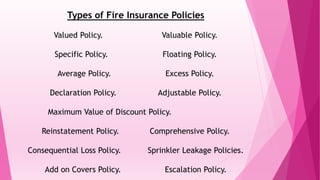
Types of Fire Insurance Policies
Valued Policy. Valuable Policy.
Specific Policy. Floating Policy.
Average Policy. Excess Policy.
Declaration Policy. Adjustable Policy.
Maximum Value of Discount Policy.
Reinstatement Policy. Comprehensive Policy.
Consequential Loss Policy. Sprinkler Leakage Policies.
Add on Covers Policy. Escalation Policy.
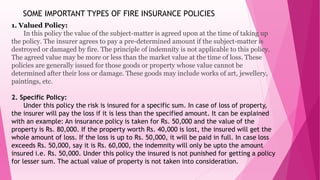
1. Valued Policy:
In this policy the value of the subject-matter is agreed upon at the time of taking up
the policy. The insurer agrees to pay a pre-determined amount if the subject-matter is
destroyed or damaged by fire. The principle of indemnity is not applicable to this policy.
The agreed value may be more or less than the market value at the time of loss. These
policies are generally issued for those goods or property whose value cannot be
determined after their loss or damage. These goods may include works of art, jewellery,
paintings, etc.
2. Specific Policy:
Under this policy the risk is insured for a specific sum. In case of loss of property,
the insurer will pay the loss if it is less than the specified amount. It can be explained
with an example: An insurance policy is taken for Rs. 50,000 and the value of the
property is Rs. 80,000. If the property worth Rs. 40,000 is lost, the insured will get the
whole amount of loss. If the loss is up to Rs. 50,000, it will be paid in full. In case loss
exceeds Rs. 50,000, say it is Rs. 60,000, the indemnity will only be upto the amount
insured i.e. Rs. 50,000. Under this policy the insured is not punished for getting a policy
for lesser sum. The actual value of property is not taken into consideration.
SOME IMPORTANT TYPES OF FIRE INSURANCE POLICIES
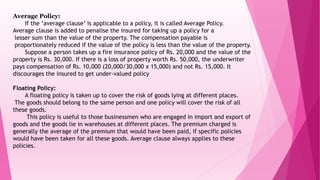
Average Policy:
If the ‘average clause’ is applicable to a policy, it is called Average Policy.
Average clause is added to penalise the insured for taking up a policy for a
lesser sum than the value of the property. The compensation payable is
proportionately reduced if the value of the policy is less than the value of the property.
Suppose a person takes up a fire insurance policy of Rs. 20,000 and the value of the
property is Rs. 30,000. If there is a loss of property worth Rs. 50,000, the underwriter
pays compensation of Rs. 10,000 (20,000/30,000 x 15,000) and not Rs. 15,000. It
discourages the insured to get under-valued policy
Floating Policy:
A floating policy is taken up to cover the risk of goods lying at different places.
The goods should belong to the same person and one policy will cover the risk of all
these goods.
This policy is useful to those businessmen who are engaged in import and export of
goods and the goods lie in warehouses at different places. The premium charged is
generally the average of the premium that would have been paid, if specific policies
would have been taken for all these goods. Average clause always applies to these
policies.
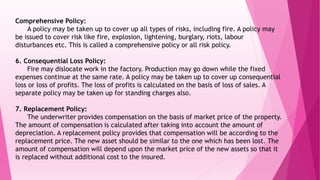
Comprehensive Policy:
A policy may be taken up to cover up all types of risks, including fire. A policy may
be issued to cover risk like fire, explosion, lightening, burglary, riots, labour
disturbances etc. This is called a comprehensive policy or all risk policy.
6. Consequential Loss Policy:
Fire may dislocate work in the factory. Production may go down while the fixed
expenses continue at the same rate. A policy may be taken up to cover up consequential
loss or loss of profits. The loss of profits is calculated on the basis of loss of sales. A
separate policy may be taken up for standing charges also.
7. Replacement Policy:
The underwriter provides compensation on the basis of market price of the property.
The amount of compensation is calculated after taking into account the amount of
depreciation. A replacement policy provides that compensation will be according to the
replacement price. The new asset should be similar to the one which has been lost. The
amount of compensation will depend upon the market price of the new assets so that it
is replaced without additional cost to the insured.
Valuable Policy: The value of property insured is determined only at the time of
happening of risk. In case of risk, the market value of property would be the basis for
payment of compensation.
Reinstatement Policy: If the insurer undertakes to reinstate (replace) the insured
property in case of risk, it is called as reinstatement or replacement policy.
FUNDAMENTAL PRINCIPLES OF FIRE INSURANCE
The following are the fundamental principles essential for a valid contract of fire
insurance.
A contract of indemnity :
Its object is to place insured as far as possible in the same financial position
after a loss as that occupied immediately before the loss. The insured can recover
only the amount of actual loss subject to the sum assured.
Insurable Interest :
In fire insurance the insurable interest must exist at the time of effecting the
insurance as well as at the time of the loss. The interest, however, may be legal or
equitable or may arise under a contract of purchase or sale. The following have
been held to have insurable interest in the subject matter Owner,
Mortgagee,Trustee, Executor,Warehouseman, Common, Bailee, Pledgee,Person in
lawful possession, Finder,Insurer
Commission Agent where the agency is couppled with interest and
Tenants who are liable to pay rent after a fire.It should however, be noted that
persons can insure only to the extent of such limited interest.
Contract of Good Faith :
The contract of fire insurance is a contract of Uberrimae fidei i.e., a contract
based upon absolute good faith, and therefore, the insured must make full and
detailed disclosure of all material facts likely to affect the judgement of fire
officials in determining the rates of premium or deciding whether the proposal
should be accepted. The description of the property, when asked for, should be
correctly give, and all information that may be required as to the class of goods
and articles that are kept on the premises or in the surrounding neighbourhood,
should be accurately supplied.
Loss Through Fire :
Loss resulting from fire of some other cause which is the proximate cause is the
risk covered under a fire insurance contract. But where the fire is caused by the
insured himself or with his connivance or by the operation of a peril specifically
excluded under the policy like earthquake, the loss will not be covered.
A Contract from Year to Year :
A fire insurance policy is usually for one year only and can be renewed after
that.
Principles of Subrogation and Contribution :
Subrogation is a doctrine applicable to both fire and
marine insurance by which the insurer or underwriter,
becomes entitled to on his paying compensation to the
insure, to claim the advantage of every right of the insured
against third parties who may be proved to be responsible for
that loss, owning to such third parties negligence, default
etc.
Where the subject matter has been insured with more
than one insurer, each insurer has to meet the loss only
rateably. If he has paid more than his share of loss, he is
entitled to recover the excess paid from his co insurers.
Thus, the principle of contribution applies in the case of fire
insurance.
PROCEDURE FOR TAKING FIRE INSURANCE POLICY
Following are the procedure to take a fire insurance policy
1. Selection of Insurance Company
First of all one should identify a fire insurance company from which
the policy is to be purchased. In India, four general insurance
companies owned by Government were operating in this field. These
companies are:
National Insurance Company,
Oriental Fire and General Insurance Company,
New India Assurance Company, and
United India Insurance Company.
Now private insurers have also entered the field.
These companies can either be directly contacted or through a broker.
2. Proposal form
After having chosen a company, the proposer will have to fill in a proposal
form which furnishes the basis of the contract. The proposal form requires the
proposer to give details such as his name, address, occupation and value and
nature of property to be insured, type of policy required, amount of assured sum,
etc.
The proposal form should be signed properly and sent to the company for
acceptance.
3. Evidence of responsibility
Fire insurance is a personal contract. Just by setting fire to the property, the
insured can claim large sums of money. Hence, before accepting a risk, the
insurance company requests the proposer to furnish reasonable evidence of his
responsibility.
Before assuming the risk, the insurer has to ascertain whether the proposer is
a respectable person and is taking policy in utmost good faith.
4. Survey of property
The next step in effecting fire insurance is a survey of property proposed to be
insured through qualified experts known as surveyors. These surveyors are deputed
to inspect the property carefully and to assess the degree of risk involved. It is on
the basis of their report that the company accepts or rejects the proposal and
determines the rates of premiums.
In case the risk is small, agent’s report will be sufficient and the insurer does
not insist on the survey. F if the risk is very high, the insurance company will
depute surveyors to inspect the property to to get first hand information and to
and to estimate the degree of risk involved.
On the basis of this report, the insurance company may accept the proposal or
reject it.
5. Acceptance of proposal form
After examining the contents of the proposal form and the surveyor’s report,
the insurer will decide whether to accept the proposal or not. If he finds that the
information furnished in the proposal form and surveyor ‘s report is satisfactory,
he will accept the proposal and intimate the same to the proposer.
6. Commencement of Risk
As soon as acceptance of the proposal is conveyed, the proposer will be asked
to pay the premium within a stipulated period of time. On payment of the
premium, the fire insurance contract is said to have entered upon and the risk
commences.
7. Issue of Cover note
Once the risk is assumed, the insurer is supposed to issue a fire policy to the
insured. As the preparation of fire policy takes some time, the insurer will issue a
provisional document known as Cover Note. The cover note is in the nature of
interim policy and covers the risk immediately on the receipt of first premium.
The cover note is effective till the fire policy is issued. The cover note
protects the insured as much as the policy.
8. Issue of Fire Insurance Policy
Later on, the insurer prepares the first insurance policy (to replace the cover
note) and sends it to the insured. The policy is the final acceptance of the
company and simultaneously it cancels the, provisional acceptance given
before.The fire policy contains the name and address of the insured, the sum
insured, the terms and premiums, date of issuing the policy, policy number,
description and location of property covered and other details. It is generally
issued for one year.
Fire insurance part1

Fire insurance part1

  • 1.
    Mrs. S. DHURGADEVI, M.COM, B.ED, M.Phil, ASSISTANT PROFESSOR OF COMMERCE, EMG YADAVA WOMENS COLLEGE, MADURAI
  • 2.
    Fire Insurance Meaning Fireinsurance is contract where the insurer undertakes to pay the insured in case of damage caused by fire. To claim fire insurance two conditions need to be met. There must be actual loss due to fire and the fire must must be accidental. The term fire insurance refers to a form of property insurance that covers damage and losses caused by fire. Most policies come with some form of fire protection, but homeowners may be able to purchase additional coverage in case their property is lost or damaged because of fire. Purchasing additional fire coverage helps to cover the cost of replacement, repair, or reconstruction of property above the limit set by the property insurance policy. Fire insurance policies typically contain general exclusions such as war, nuclear risks, and similar perils.
  • 3.
    A fire insuranceis a contract between a policyholder and the insurance company in which the insurer agrees to compensate the insured in case of loss or damage happens to a particular property due to fire. The premium is also pre- decided and the insurer compensates for the loss up to the insured amount only. If you are also planning to buy a fire insurance policy, here are some of the important characteristics of the insurance contract NATURE OF FIRE INSURANCE
  • 4.
    1.Insurable Interest – Itis necessary for the insured party to have the insurable interest in the property for which he/she wants to buy insurance. With insurable interest, we mean, the policyholder is benefited by the survival of the insured things and suffers a loss in case of its destruction. Remember, the insurable interest should exist both at the time of buying the policy and at the time of filing a claim. 2. Utmost Good Faith A fire insurance contract is governed by the principle of utmost good faith that says it is necessary for the policyholder to disclose all vital points with regard to the subject-matter of the insurance policy so that the insurer can have a proper calculation with regards to the risks involved. The policyholder should give information pertaining to the environment, construction of the house, the possibility of catching fire, etc. The insurance company has all rights to terminate the contract if it finds that important points are not disclosed.
  • 5.
    3.Contract of indemnity– The insurer will settle the claim only up to the insured limit. In case there is no loss, no claim is applicable. 4.Personal insurance contract – As a fire insurance is a personal contract, the policyholder is involved with the property. As a result, it is necessary that the insurance company should have complete knowledge about the behavior of the policyholder. Moreover, the policyholder can’t transfer the insurance policy without the permission of the insurer. In case the possession of goods is transferred to a third-party, the insurer has all rights to terminate the insurance contract. 5.Personal right – The person whose name is mentioned in the fire insurance contract as the policyholder is eligible to receive the insured amount in case of any loss or damage.
  • 6.
    6.Direct loss As itis a fire insurance, the fire should be the direct and immediate cause of the loss or Damage. 7.Description of property It is an important part of the insurance contract, which says that the location of the property should be mentioned in the policy document. Moreover, at the time of claim, the insurer will settle the claim only when the accident happened at the insured place. In the case of any change in the location, it is necessary to inform the insurance company
  • 8.
    Types of FireInsurance Policies Valued Policy. Valuable Policy. Specific Policy. Floating Policy. Average Policy. Excess Policy. Declaration Policy. Adjustable Policy. Maximum Value of Discount Policy. Reinstatement Policy. Comprehensive Policy. Consequential Loss Policy. Sprinkler Leakage Policies. Add on Covers Policy. Escalation Policy.
  • 9.
    1. Valued Policy: Inthis policy the value of the subject-matter is agreed upon at the time of taking up the policy. The insurer agrees to pay a pre-determined amount if the subject-matter is destroyed or damaged by fire. The principle of indemnity is not applicable to this policy. The agreed value may be more or less than the market value at the time of loss. These policies are generally issued for those goods or property whose value cannot be determined after their loss or damage. These goods may include works of art, jewellery, paintings, etc. 2. Specific Policy: Under this policy the risk is insured for a specific sum. In case of loss of property, the insurer will pay the loss if it is less than the specified amount. It can be explained with an example: An insurance policy is taken for Rs. 50,000 and the value of the property is Rs. 80,000. If the property worth Rs. 40,000 is lost, the insured will get the whole amount of loss. If the loss is up to Rs. 50,000, it will be paid in full. In case loss exceeds Rs. 50,000, say it is Rs. 60,000, the indemnity will only be upto the amount insured i.e. Rs. 50,000. Under this policy the insured is not punished for getting a policy for lesser sum. The actual value of property is not taken into consideration. SOME IMPORTANT TYPES OF FIRE INSURANCE POLICIES
  • 10.
    Average Policy: If the‘average clause’ is applicable to a policy, it is called Average Policy. Average clause is added to penalise the insured for taking up a policy for a lesser sum than the value of the property. The compensation payable is proportionately reduced if the value of the policy is less than the value of the property. Suppose a person takes up a fire insurance policy of Rs. 20,000 and the value of the property is Rs. 30,000. If there is a loss of property worth Rs. 50,000, the underwriter pays compensation of Rs. 10,000 (20,000/30,000 x 15,000) and not Rs. 15,000. It discourages the insured to get under-valued policy Floating Policy: A floating policy is taken up to cover the risk of goods lying at different places. The goods should belong to the same person and one policy will cover the risk of all these goods. This policy is useful to those businessmen who are engaged in import and export of goods and the goods lie in warehouses at different places. The premium charged is generally the average of the premium that would have been paid, if specific policies would have been taken for all these goods. Average clause always applies to these policies.
  • 11.
    Comprehensive Policy: A policymay be taken up to cover up all types of risks, including fire. A policy may be issued to cover risk like fire, explosion, lightening, burglary, riots, labour disturbances etc. This is called a comprehensive policy or all risk policy. 6. Consequential Loss Policy: Fire may dislocate work in the factory. Production may go down while the fixed expenses continue at the same rate. A policy may be taken up to cover up consequential loss or loss of profits. The loss of profits is calculated on the basis of loss of sales. A separate policy may be taken up for standing charges also. 7. Replacement Policy: The underwriter provides compensation on the basis of market price of the property. The amount of compensation is calculated after taking into account the amount of depreciation. A replacement policy provides that compensation will be according to the replacement price. The new asset should be similar to the one which has been lost. The amount of compensation will depend upon the market price of the new assets so that it is replaced without additional cost to the insured.
  • 12.
    Valuable Policy: Thevalue of property insured is determined only at the time of happening of risk. In case of risk, the market value of property would be the basis for payment of compensation. Reinstatement Policy: If the insurer undertakes to reinstate (replace) the insured property in case of risk, it is called as reinstatement or replacement policy.
  • 13.
    FUNDAMENTAL PRINCIPLES OFFIRE INSURANCE The following are the fundamental principles essential for a valid contract of fire insurance. A contract of indemnity : Its object is to place insured as far as possible in the same financial position after a loss as that occupied immediately before the loss. The insured can recover only the amount of actual loss subject to the sum assured. Insurable Interest : In fire insurance the insurable interest must exist at the time of effecting the insurance as well as at the time of the loss. The interest, however, may be legal or equitable or may arise under a contract of purchase or sale. The following have been held to have insurable interest in the subject matter Owner, Mortgagee,Trustee, Executor,Warehouseman, Common, Bailee, Pledgee,Person in lawful possession, Finder,Insurer Commission Agent where the agency is couppled with interest and Tenants who are liable to pay rent after a fire.It should however, be noted that persons can insure only to the extent of such limited interest.
  • 14.
    Contract of GoodFaith : The contract of fire insurance is a contract of Uberrimae fidei i.e., a contract based upon absolute good faith, and therefore, the insured must make full and detailed disclosure of all material facts likely to affect the judgement of fire officials in determining the rates of premium or deciding whether the proposal should be accepted. The description of the property, when asked for, should be correctly give, and all information that may be required as to the class of goods and articles that are kept on the premises or in the surrounding neighbourhood, should be accurately supplied. Loss Through Fire : Loss resulting from fire of some other cause which is the proximate cause is the risk covered under a fire insurance contract. But where the fire is caused by the insured himself or with his connivance or by the operation of a peril specifically excluded under the policy like earthquake, the loss will not be covered. A Contract from Year to Year : A fire insurance policy is usually for one year only and can be renewed after that.
  • 15.
    Principles of Subrogationand Contribution : Subrogation is a doctrine applicable to both fire and marine insurance by which the insurer or underwriter, becomes entitled to on his paying compensation to the insure, to claim the advantage of every right of the insured against third parties who may be proved to be responsible for that loss, owning to such third parties negligence, default etc. Where the subject matter has been insured with more than one insurer, each insurer has to meet the loss only rateably. If he has paid more than his share of loss, he is entitled to recover the excess paid from his co insurers. Thus, the principle of contribution applies in the case of fire insurance.
  • 16.
    PROCEDURE FOR TAKINGFIRE INSURANCE POLICY Following are the procedure to take a fire insurance policy 1. Selection of Insurance Company First of all one should identify a fire insurance company from which the policy is to be purchased. In India, four general insurance companies owned by Government were operating in this field. These companies are: National Insurance Company, Oriental Fire and General Insurance Company, New India Assurance Company, and United India Insurance Company. Now private insurers have also entered the field. These companies can either be directly contacted or through a broker.
  • 17.
    2. Proposal form Afterhaving chosen a company, the proposer will have to fill in a proposal form which furnishes the basis of the contract. The proposal form requires the proposer to give details such as his name, address, occupation and value and nature of property to be insured, type of policy required, amount of assured sum, etc. The proposal form should be signed properly and sent to the company for acceptance. 3. Evidence of responsibility Fire insurance is a personal contract. Just by setting fire to the property, the insured can claim large sums of money. Hence, before accepting a risk, the insurance company requests the proposer to furnish reasonable evidence of his responsibility. Before assuming the risk, the insurer has to ascertain whether the proposer is a respectable person and is taking policy in utmost good faith.
  • 18.
    4. Survey ofproperty The next step in effecting fire insurance is a survey of property proposed to be insured through qualified experts known as surveyors. These surveyors are deputed to inspect the property carefully and to assess the degree of risk involved. It is on the basis of their report that the company accepts or rejects the proposal and determines the rates of premiums. In case the risk is small, agent’s report will be sufficient and the insurer does not insist on the survey. F if the risk is very high, the insurance company will depute surveyors to inspect the property to to get first hand information and to and to estimate the degree of risk involved. On the basis of this report, the insurance company may accept the proposal or reject it. 5. Acceptance of proposal form After examining the contents of the proposal form and the surveyor’s report, the insurer will decide whether to accept the proposal or not. If he finds that the information furnished in the proposal form and surveyor ‘s report is satisfactory, he will accept the proposal and intimate the same to the proposer.
  • 19.
    6. Commencement ofRisk As soon as acceptance of the proposal is conveyed, the proposer will be asked to pay the premium within a stipulated period of time. On payment of the premium, the fire insurance contract is said to have entered upon and the risk commences. 7. Issue of Cover note Once the risk is assumed, the insurer is supposed to issue a fire policy to the insured. As the preparation of fire policy takes some time, the insurer will issue a provisional document known as Cover Note. The cover note is in the nature of interim policy and covers the risk immediately on the receipt of first premium. The cover note is effective till the fire policy is issued. The cover note protects the insured as much as the policy. 8. Issue of Fire Insurance Policy Later on, the insurer prepares the first insurance policy (to replace the cover note) and sends it to the insured. The policy is the final acceptance of the company and simultaneously it cancels the, provisional acceptance given before.The fire policy contains the name and address of the insured, the sum insured, the terms and premiums, date of issuing the policy, policy number, description and location of property covered and other details. It is generally issued for one year.