Prof. Isha Jaiswal
Introduction
 Fire is considered to be pure and holy.
 Fire is considered as one type of energy, which is very useful to the human
beings in day to day routines and industry also.
 It is considered to be of utmost help to the mankind. But when it becomes
wrath it creates a great disaster and man becomes helpless against this fire-
disaster.
 In fire disaster so many properties, factories, machineries, manufactured
goods, tools, furniture, animals etc becomes morsel of fire.
 Many provisions of the Insurance Act, 1932 and General Insurance
Business (Nationalization) Act, 1972 relates to fire insurance business in
India.
 From January 1, 1994, fire insurance business is being transacted only by
the GIC of India and its four subsidiaries.
History of Fire Insurance
 The real establishment of the insurance came only after
the great fire which took place in London in Sept. 1666.
 It lasted for four days and nights, burning over 436 acres
of ground and destroying over 13,000 buildings.
 During that time also fire insurance did not developed
with great speed because of slow progress of commerce
and trade.
 The first fire insurance company was established in 1681,
named as “The first office”.
Contd.
 The next fire insurance company came in London as
“Corporation of London”.
 In 1696 “Hand in Hand Society” was established.
 After that the “sun Fire Office” was formed in 1710 to
transact insurance of goods.
 In 1714, “Union Fire Office” was created.
 The “West Minister” was established in 1717.
 The development of the fire insurance is linked industrial
revolution and has resulted into the growth of fire business
in India.
Causes of Fire/Physical and Moral
Hazards of Fire Insurance
Fire damage is the result of two types of risk:
1. Physical Risk: It refers to the natural risk of fire in the
property which may occur due to smoke, construction,
artificial lighting and heating, lack of extinguishing apparatus
etc.
2. Moral Risk: The moral risk depends upon the man as
physical risk depends on the property. The property may be
set on fire by the owner or by any person with his
willingness, carelessness and lack of sense of duty may also
increase the fire damage. Thus, where the property was
destroyed with the willingness of the property owner, is
known as moral hazard.
Definition of Fire Insurance
Business
 Under section 2(6A) Insurance Act 1938, the fire
insurance business is defined as follows: “Fire
insurance business means the business of effecting,
otherwise than independently to some other class of
business, contracts of insurance against loss by or
incidental to fire or other occurrence customarily
included among the risks insured against in fire
insurance policies”.
 The contract is to be found embodied for a period of
one year and renewed each year.
FEATURES OF FIRE INSURANCE
1. Offer & Acceptance
2. Payment of Premium
3. Contract of Indemnity
4. Utmost Good Faith
5. Insurable Interest
6. Contribution
7. Intentional Act
8. Claims
9. Period of fire Insurance (The period can be less than
one year but not more than one year except for the
residential houses)
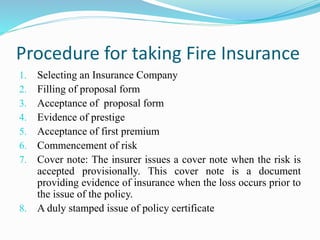
Procedure for taking Fire Insurance
1. Selecting an Insurance Company
2. Filling of proposal form
3. Acceptance of proposal form
4. Evidence of prestige
5. Acceptance of first premium
6. Commencement of risk
7. Cover note: The insurer issues a cover note when the risk is
accepted provisionally. This cover note is a document
providing evidence of insurance when the loss occurs prior to
the issue of the policy.
8. A duly stamped issue of policy certificate
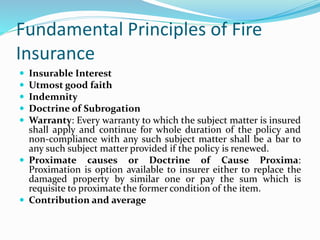
Fundamental Principles of Fire
Insurance
 Insurable Interest
 Utmost good faith
 Indemnity
 Doctrine of Subrogation
 Warranty: Every warranty to which the subject matter is insured
shall apply and continue for whole duration of the policy and
non-compliance with any such subject matter shall be a bar to
any such subject matter provided if the policy is renewed.
 Proximate causes or Doctrine of Cause Proxima:
Proximation is option available to insurer either to replace the
damaged property by similar one or pay the sum which is
requisite to proximate the former condition of the item.
 Contribution and average
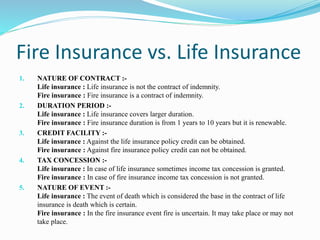
Fire Insurance vs. Life Insurance
1. NATURE OF CONTRACT :-
Life insurance : Life insurance is not the contract of indemnity.
Fire insurance : Fire insurance is a contract of indemnity.
2. DURATION PERIOD :-
Life insurance : Life insurance covers larger duration.
Fire insurance : Fire insurance duration is from 1 years to 10 years but it is renewable.
3. CREDIT FACILITY :-
Life insurance : Against the life insurance policy credit can be obtained.
Fire insurance : Against fire insurance policy credit can not be obtained.
4. TAX CONCESSION :-
Life insurance : In case of life insurance sometimes income tax concession is granted.
Fire insurance : In case of fire insurance income tax concession is not granted.
5. NATURE OF EVENT :-
Life insurance : The event of death which is considered the base in the contract of life
insurance is death which is certain.
Fire insurance : In the fire insurance event fire is uncertain. It may take place or may not
take place.
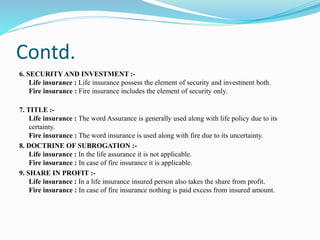
Contd.
6. SECURITY AND INVESTMENT :-
Life insurance : Life insurance possess the element of security and investment both.
Fire insurance : Fire insurance includes the element of security only.
7. TITLE :-
Life insurance : The word Assurance is generally used along with life policy due to its
certainty.
Fire insurance : The word insurance is used along with fire due to its uncertainty.
8. DOCTRINE OF SUBROGATION :-
Life insurance : In the life assurance it is not applicable.
Fire insurance : In case of fire insurance it is applicable.
9. SHARE IN PROFIT :-
Life insurance : In a life insurance insured person also takes the share from profit.
Fire insurance : In case of fire insurance nothing is paid excess from insured amount.
Contd.
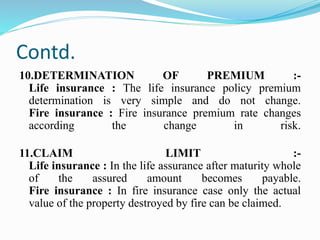
10.DETERMINATION OF PREMIUM :-
Life insurance : The life insurance policy premium
determination is very simple and do not change.
Fire insurance : Fire insurance premium rate changes
according the change in risk.
11.CLAIM LIMIT :-
Life insurance : In the life assurance after maturity whole
of the assured amount becomes payable.
Fire insurance : In fire insurance case only the actual
value of the property destroyed by fire can be claimed.
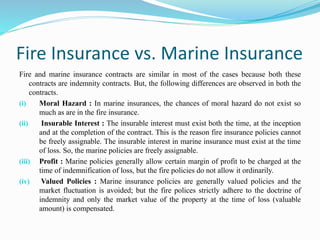
Fire Insurance vs. Marine Insurance
Fire and marine insurance contracts are similar in most of the cases because both these
contracts are indemnity contracts. But, the following differences are observed in both the
contracts.
(i) Moral Hazard : In marine insurances, the chances of moral hazard do not exist so
much as are in the fire insurance.
(ii) Insurable Interest : The insurable interest must exist both the time, at the inception
and at the completion of the contract. This is the reason fire insurance policies cannot
be freely assignable. The insurable interest in marine insurance must exist at the time
of loss. So, the marine policies are freely assignable.
(iii) Profit : Marine policies generally allow certain margin of profit to be charged at the
time of indemnification of loss, but the fire policies do not allow it ordinarily.
(iv) Valued Policies : Marine insurance policies are generally valued policies and the
market fluctuation is avoided; but the fire polices strictly adhere to the doctrine of
indemnity and only the market value of the property at the time of loss (valuable
amount) is compensated.

Fire insurance

  • 1.
  • 2.
    Introduction  Fire isconsidered to be pure and holy.  Fire is considered as one type of energy, which is very useful to the human beings in day to day routines and industry also.  It is considered to be of utmost help to the mankind. But when it becomes wrath it creates a great disaster and man becomes helpless against this fire- disaster.  In fire disaster so many properties, factories, machineries, manufactured goods, tools, furniture, animals etc becomes morsel of fire.  Many provisions of the Insurance Act, 1932 and General Insurance Business (Nationalization) Act, 1972 relates to fire insurance business in India.  From January 1, 1994, fire insurance business is being transacted only by the GIC of India and its four subsidiaries.
  • 3.
    History of FireInsurance  The real establishment of the insurance came only after the great fire which took place in London in Sept. 1666.  It lasted for four days and nights, burning over 436 acres of ground and destroying over 13,000 buildings.  During that time also fire insurance did not developed with great speed because of slow progress of commerce and trade.  The first fire insurance company was established in 1681, named as “The first office”.
  • 4.
    Contd.  The nextfire insurance company came in London as “Corporation of London”.  In 1696 “Hand in Hand Society” was established.  After that the “sun Fire Office” was formed in 1710 to transact insurance of goods.  In 1714, “Union Fire Office” was created.  The “West Minister” was established in 1717.  The development of the fire insurance is linked industrial revolution and has resulted into the growth of fire business in India.
  • 5.
    Causes of Fire/Physicaland Moral Hazards of Fire Insurance Fire damage is the result of two types of risk: 1. Physical Risk: It refers to the natural risk of fire in the property which may occur due to smoke, construction, artificial lighting and heating, lack of extinguishing apparatus etc. 2. Moral Risk: The moral risk depends upon the man as physical risk depends on the property. The property may be set on fire by the owner or by any person with his willingness, carelessness and lack of sense of duty may also increase the fire damage. Thus, where the property was destroyed with the willingness of the property owner, is known as moral hazard.
  • 6.
    Definition of FireInsurance Business  Under section 2(6A) Insurance Act 1938, the fire insurance business is defined as follows: “Fire insurance business means the business of effecting, otherwise than independently to some other class of business, contracts of insurance against loss by or incidental to fire or other occurrence customarily included among the risks insured against in fire insurance policies”.  The contract is to be found embodied for a period of one year and renewed each year.
  • 7.
    FEATURES OF FIREINSURANCE 1. Offer & Acceptance 2. Payment of Premium 3. Contract of Indemnity 4. Utmost Good Faith 5. Insurable Interest 6. Contribution 7. Intentional Act 8. Claims 9. Period of fire Insurance (The period can be less than one year but not more than one year except for the residential houses)
  • 8.
    Procedure for takingFire Insurance 1. Selecting an Insurance Company 2. Filling of proposal form 3. Acceptance of proposal form 4. Evidence of prestige 5. Acceptance of first premium 6. Commencement of risk 7. Cover note: The insurer issues a cover note when the risk is accepted provisionally. This cover note is a document providing evidence of insurance when the loss occurs prior to the issue of the policy. 8. A duly stamped issue of policy certificate
  • 9.
    Fundamental Principles ofFire Insurance  Insurable Interest  Utmost good faith  Indemnity  Doctrine of Subrogation  Warranty: Every warranty to which the subject matter is insured shall apply and continue for whole duration of the policy and non-compliance with any such subject matter shall be a bar to any such subject matter provided if the policy is renewed.  Proximate causes or Doctrine of Cause Proxima: Proximation is option available to insurer either to replace the damaged property by similar one or pay the sum which is requisite to proximate the former condition of the item.  Contribution and average
  • 10.
    Fire Insurance vs.Life Insurance 1. NATURE OF CONTRACT :- Life insurance : Life insurance is not the contract of indemnity. Fire insurance : Fire insurance is a contract of indemnity. 2. DURATION PERIOD :- Life insurance : Life insurance covers larger duration. Fire insurance : Fire insurance duration is from 1 years to 10 years but it is renewable. 3. CREDIT FACILITY :- Life insurance : Against the life insurance policy credit can be obtained. Fire insurance : Against fire insurance policy credit can not be obtained. 4. TAX CONCESSION :- Life insurance : In case of life insurance sometimes income tax concession is granted. Fire insurance : In case of fire insurance income tax concession is not granted. 5. NATURE OF EVENT :- Life insurance : The event of death which is considered the base in the contract of life insurance is death which is certain. Fire insurance : In the fire insurance event fire is uncertain. It may take place or may not take place.
  • 11.
    Contd. 6. SECURITY ANDINVESTMENT :- Life insurance : Life insurance possess the element of security and investment both. Fire insurance : Fire insurance includes the element of security only. 7. TITLE :- Life insurance : The word Assurance is generally used along with life policy due to its certainty. Fire insurance : The word insurance is used along with fire due to its uncertainty. 8. DOCTRINE OF SUBROGATION :- Life insurance : In the life assurance it is not applicable. Fire insurance : In case of fire insurance it is applicable. 9. SHARE IN PROFIT :- Life insurance : In a life insurance insured person also takes the share from profit. Fire insurance : In case of fire insurance nothing is paid excess from insured amount.
  • 12.
    Contd. 10.DETERMINATION OF PREMIUM:- Life insurance : The life insurance policy premium determination is very simple and do not change. Fire insurance : Fire insurance premium rate changes according the change in risk. 11.CLAIM LIMIT :- Life insurance : In the life assurance after maturity whole of the assured amount becomes payable. Fire insurance : In fire insurance case only the actual value of the property destroyed by fire can be claimed.
  • 13.
    Fire Insurance vs.Marine Insurance Fire and marine insurance contracts are similar in most of the cases because both these contracts are indemnity contracts. But, the following differences are observed in both the contracts. (i) Moral Hazard : In marine insurances, the chances of moral hazard do not exist so much as are in the fire insurance. (ii) Insurable Interest : The insurable interest must exist both the time, at the inception and at the completion of the contract. This is the reason fire insurance policies cannot be freely assignable. The insurable interest in marine insurance must exist at the time of loss. So, the marine policies are freely assignable. (iii) Profit : Marine policies generally allow certain margin of profit to be charged at the time of indemnification of loss, but the fire policies do not allow it ordinarily. (iv) Valued Policies : Marine insurance policies are generally valued policies and the market fluctuation is avoided; but the fire polices strictly adhere to the doctrine of indemnity and only the market value of the property at the time of loss (valuable amount) is compensated.