FIRE INSURANCE
-ISHA CHUGH
ASSISTANT PROFESSOR
GARGI COLLEGE
UNIVERSITY OF DELHI
BANKING AND INSURANCE
UNIT 6
TOPIC: FIRE INSURANCE
(NON-LIFE INSURANCE)
 As per the Insurance Act 1938, under Section 2 (6A),
Fire Insurance is defined as “the business of effecting, otherwise
than independently to some other class of business, contracts of
insurance against loss by or incidental to fire or other occurrence
customarily included among the risks insured against in fire
insurance policies.”
 Fire insurance is an agreement whereby one party (the insurer),
in return, for a consideration undertakes to the indemnify the
other party (the insured) against financial loss which he may
sustain by reason of certain defined subject matter being
damaged by the destroyed by fire or other defined perils up to
an agreed amount.
 The word fire here does not mean the fire used for domestic and household
activities. It refers to fire which is not caused intentionally and has no bound, and
it is production of ignition, light and smoke by combustion.
 It is also one of the oldest types of Insurance which emerged in London.
 On 2nd September 1666, a great fire break out in London which caused mass
destruction in city burning 13,000 houses and lasted for 5 days. This led to
emergence of Fire Insurance Policy so as to compensate people for the losses
suffered by them and so they can start their life again after such a mishap. The
first Fire Insurance Company was established in 1681, Insurance Office for Houses
to insure 5000 brick and frame houses. Later on may more Insurance Companies
were established such as Hand-in Hand, Sun Fire Office, Westminster and the
Royal Exchange in 1720.
PRINCIPLES OF FIRE INSURANCE
Insurable Interest in Fire Insurance
(insurable interest in the subject matter of the contract both in
the at the time of taking the policy and the at the time of loss)
The principle of Good Faith in Fire Insurance
The principle of indemnity
Proximate Cause of Fire Insurance
The doctrine of Subrogation
Warranties in Fire Insurance
 A Fire insurance contract like any other insurance contract must fulfill
the essential elements of a valid contract like offer and the
acceptance, lawful consideration, legality of object etc.
 Premium is a required to be paid the at the time of taking policy
 Fire insurance usually taken for any year duration but in the some
cases for short periods also
 Fire policies can be assigned with the prior consent of the insurer.
 The loss must be outcome of fire or ignition only
 Nothing can be recovered under a fire policy if the fire is caused
deliberately.
 In case of several policies for the same property each insurer is entitled
to CONTRIBUTIONS from other insurers. After indemnification, the insurer
is SUBROGATED on to the rights and interest of the policy holders.
The following
items are
included in
fire insurance
 Buildings
 Plant & Machinery, Equipments and
Accessories
 Furniture and electrical fittings
 Goods as in raw materials, semi-finished and
finished goods stored in warehouses and open
 Pipelines present inside as well as outside the
building
Scope of fire insurance
 According of section 2 of the insurance act 1938, the
scope of fire insurance includes., (a). Fire insurance
business is different from other insurance business
operation and covers the risks caused by fire: (b) In
addition to the risk cause by the fire, it also includes other
reasons and occurrences,. which can be customarily be
included among risk insured under fire insurance
contracts.,
 Thus the scope of fire insurance can be studied from two
angles viz.,
(1) Ordinary scope of fire insurance and
(2) Comprehensive scope of fire insurance
 ORDINARY SCOPE OF FIRE INSURANCE
It includes only those risks which define the narrower scope
of fire insurance viz., the losses caused by fire only. Some
losses caused by the fire and are included in the insurance
against fire and some losses are left out.
 a. RISKS COVERED UNDER FIRE INSURANCE:
The risk causing losses have to be stated in the fire
policy and only these risks are indemnify are by the
insurance company, in case of the loss. The following risks
caused by the fire are generally included in the fire
insurance.
The following risks caused by the fire are generally included in the fire
insurance
 Fire: It excludes loss, destruction and damage caused to the property
by its own spontaneous fermentation of halting, any heating or
drying process. Also it excludes burning of property insured by order
of any Public Authority.
 Lightening: There may be occurrences where lightening leads to fire
or other damages to the Insured property. For example cracks in an
office due to lightening will be covered under the fire policy.
 Explosion/Implosion: It refers to sudden burst caused due to
difference between the internal temperature of the building and the
external atmospheric temperature. This does not cover the domestic
boilers and economizers.
 Aircraft damage: It covers any loss caused by the aerial devices;
aircraft and articles dropped by them and don’t cover those
covered by pressure waves.
 Riot, Strike and malicious damage: It covers the physical
damage to the property caused due to strikes by workers, riots
by public or intentional destruction caused by a person.
 Storm, Cyclone, Typhoon, Tempest, Hurricane, Tornado, Flood
and Inundation: Any damages caused to the insured property
due to these natural occurrences are also included in fire
Insurance policy.
 Impact Damage: It refers to the damage to the insured
property due to its contact with rail, vehicles or any animal. But
such vehicles and animals should not be owned by the insured
or residence of the property.
 Subsidence and land slide including rock slide: can also lead
to damage or destruction of the insured’s property. In such
cases, the insured can file for claim under Fire Insurance Policy.
 Bursting and/or overflowing of water tanks, apparatus
and pipes: These perils are also covered under Fire
Insurance Policy.
 Missile testing operations: can lead to damage to
property and are also covered under Fire Insurance
policy.
 Leakage from automatic sprinkler installations: It covers
destruction of property due to faulty working of
sprinklers but excludes damage which is caused while
repairing and removal of sprinklers or renovation in the
buildings.
 Bush Fire: It refers to fire spread from bushes but doesn’t
cover forest fire.
Secondary scope
There are many special risks which an insured can get it covered
under the Fire Insurance Policy by paying extra premium to the
Insurance Company. These are as follows:
 If fees paid to the architect, surveyor or consultant engineer
exceed more than 3 percent of the claim money.
 The expenses incurred in connection with the removal of
wastages from the construction site, if that amount exceeds
more than 1 per cent of the claim money.
 Loss to the goods kept in the cold storage due to fluctuations
in electricity/ power but within the causes stated in the policy.
 Loss arising out of earth-quake, fire or combustion
 Forest fire.
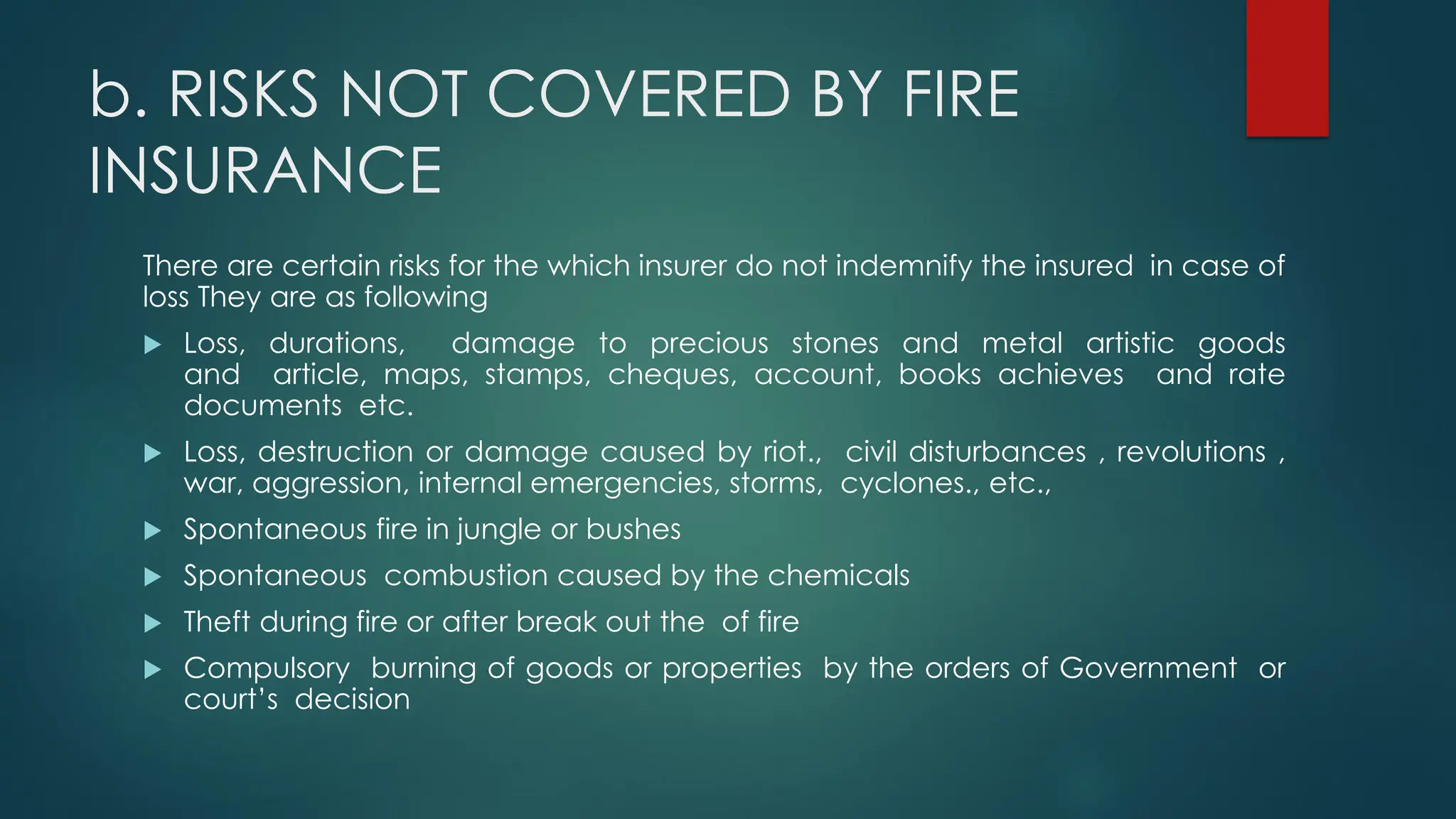
b. RISKS NOT COVERED BY FIRE
INSURANCE
There are certain risks for the which insurer do not indemnify the insured in case of
loss They are as following
 Loss, durations, damage to precious stones and metal artistic goods
and article, maps, stamps, cheques, account, books achieves and rate
documents etc.
 Loss, destruction or damage caused by riot., civil disturbances , revolutions ,
war, aggression, internal emergencies, storms, cyclones., etc.,
 Spontaneous fire in jungle or bushes
 Spontaneous combustion caused by the chemicals
 Theft during fire or after break out the of fire
 Compulsory burning of goods or properties by the orders of Government or
court’s decision
HAZARDS IN
FIRE
INSURANCE
Fire loss is the result of two types of hazard:
 PHYSICAL HAZARDS: It refers to the inherent risk of the fire in the
property which may be on account of the situation, inflammable
nature, constructions artificial lighting and heating, lack of the fire
extinguishing is a appliances, etc. Fire insurance, providers protections
to the property against the occurrence of fire, an unavoidable physical
hazard.
 MORAL HAZARD:The term Moral Hazard refers to the willful and
malicious setting on fire of on the property by the owners or some
body else. Moral hazard may be in anyone of the following forms: (a) IN
CENDIARISM: It refers to the deliberate destruction of one’s own
property by fire. Some insured indulge in such activities to realize the
insured amount from the insurer. (b). ARSON: It refers to setting on fire
the property of the insured by the some other persons. Some persons
may set fire to property of others with a view to getting a reward for
information about the break out of the fire or assisting in extinguishing
it. ( C ). PASSIVE DISHONESTY: It refers to the willful neglect to the by
the insured to take proper action for extinguishing fire and his
carelessness during the occurrence of fire
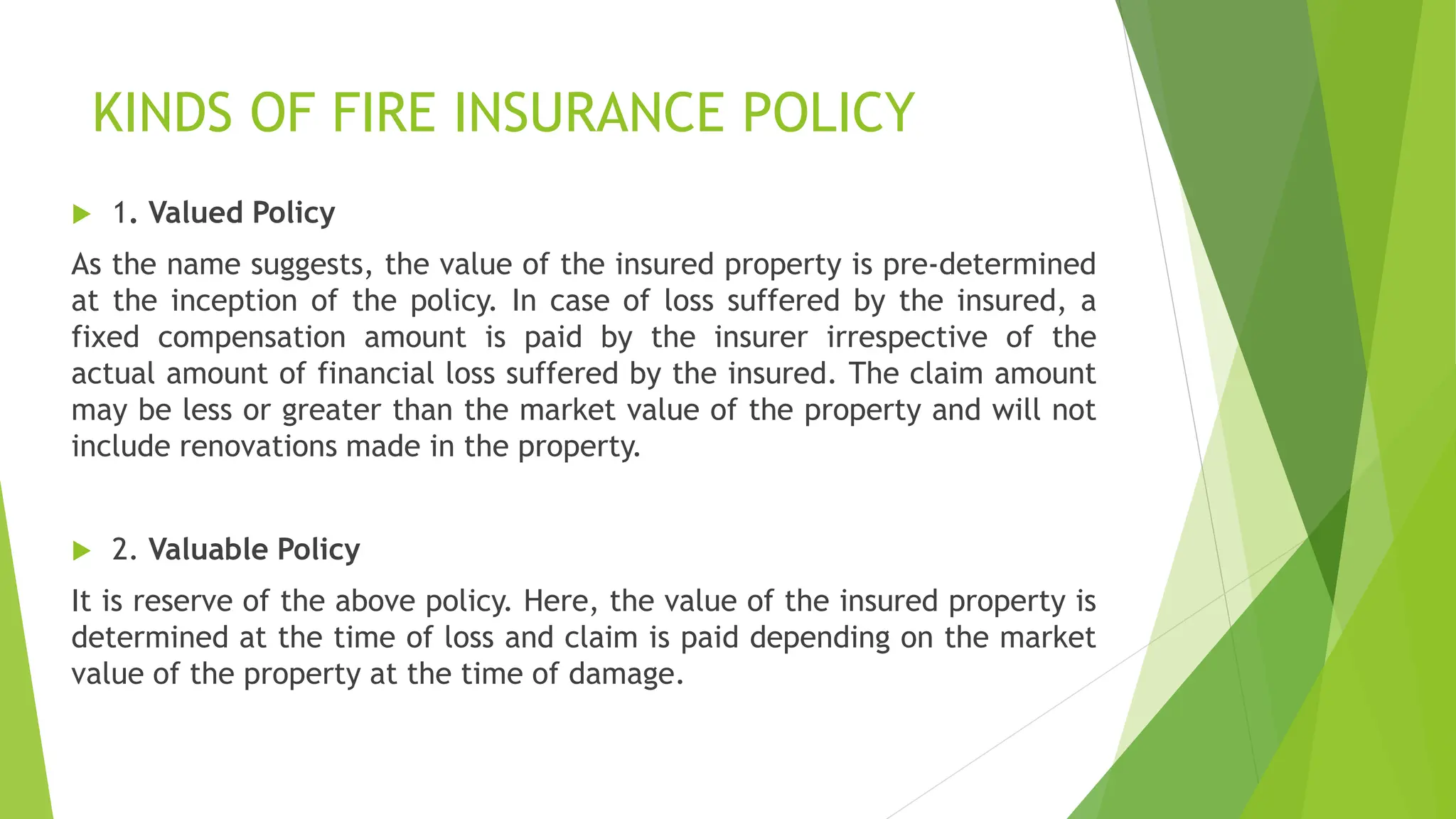
KINDS OF FIRE INSURANCE POLICY
 1. Valued Policy
As the name suggests, the value of the insured property is pre-determined
at the inception of the policy. In case of loss suffered by the insured, a
fixed compensation amount is paid by the insurer irrespective of the
actual amount of financial loss suffered by the insured. The claim amount
may be less or greater than the market value of the property and will not
include renovations made in the property.
 2. Valuable Policy
It is reserve of the above policy. Here, the value of the insured property is
determined at the time of loss and claim is paid depending on the market
value of the property at the time of damage.
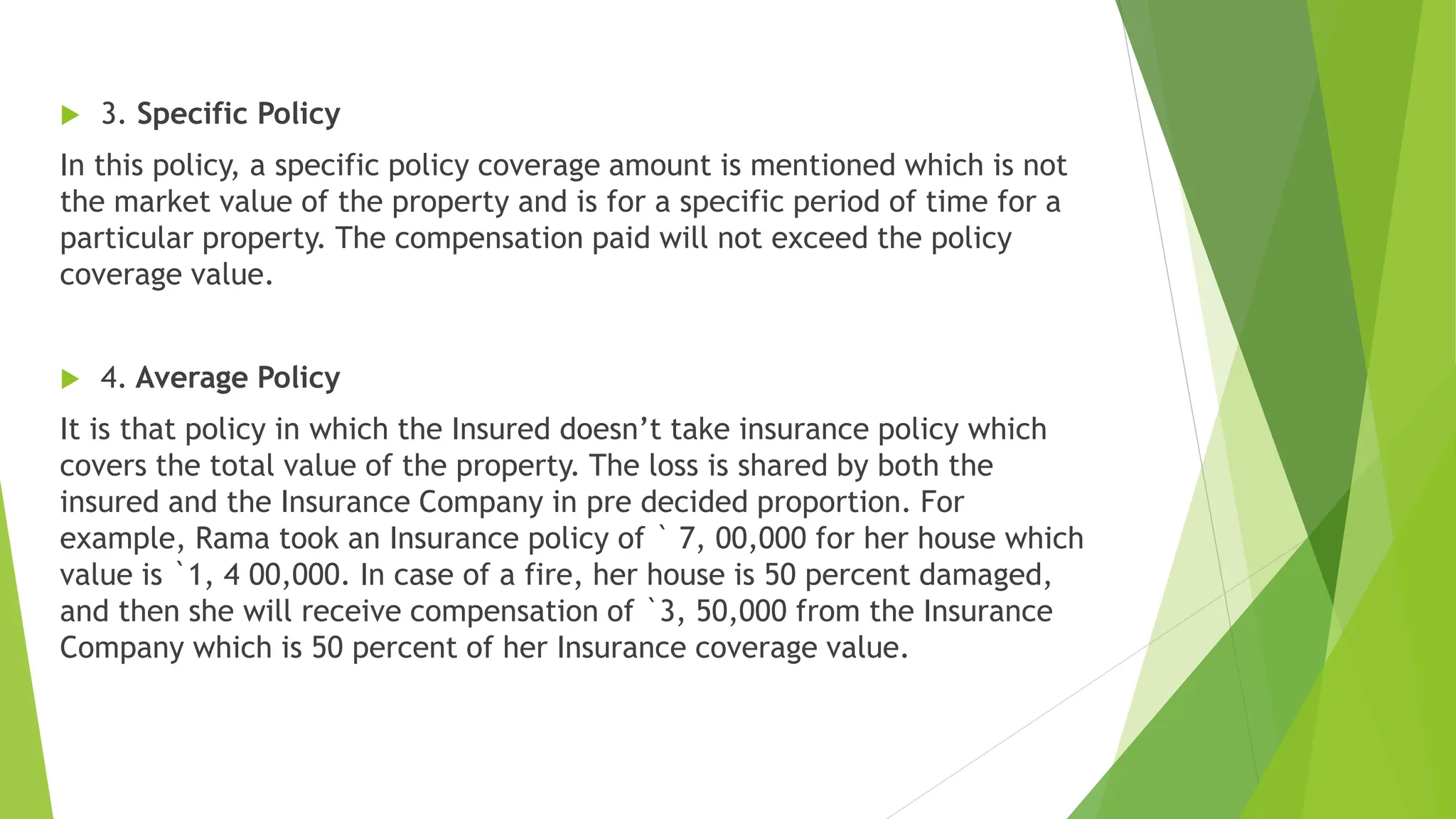
 3. Specific Policy
In this policy, a specific policy coverage amount is mentioned which is not
the market value of the property and is for a specific period of time for a
particular property. The compensation paid will not exceed the policy
coverage value.
 4. Average Policy
It is that policy in which the Insured doesn’t take insurance policy which
covers the total value of the property. The loss is shared by both the
insured and the Insurance Company in pre decided proportion. For
example, Rama took an Insurance policy of ` 7, 00,000 for her house which
value is `1, 4 00,000. In case of a fire, her house is 50 percent damaged,
and then she will receive compensation of `3, 50,000 from the Insurance
Company which is 50 percent of her Insurance coverage value.
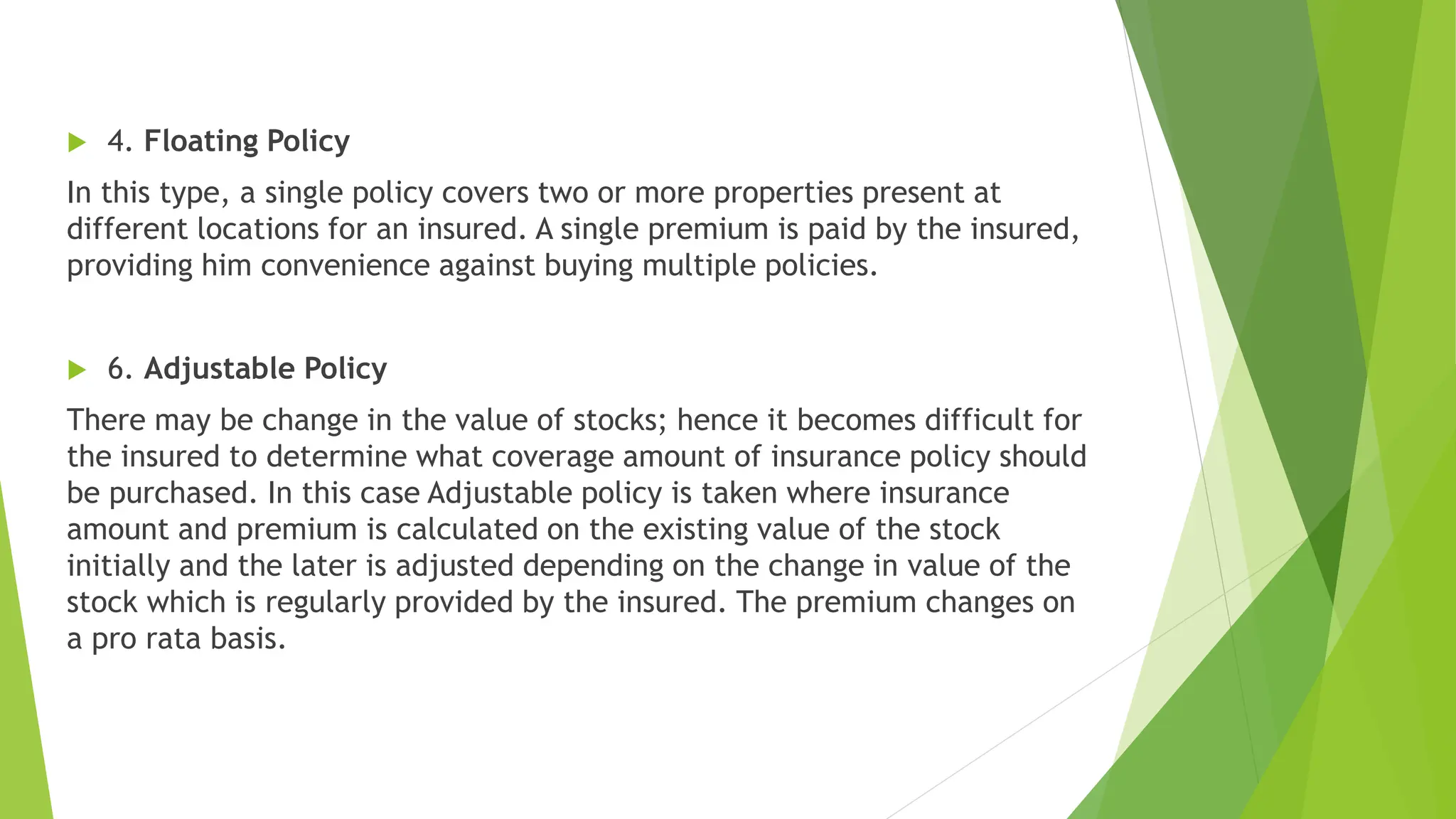
 4. Floating Policy
In this type, a single policy covers two or more properties present at
different locations for an insured. A single premium is paid by the insured,
providing him convenience against buying multiple policies.
 6. Adjustable Policy
There may be change in the value of stocks; hence it becomes difficult for
the insured to determine what coverage amount of insurance policy should
be purchased. In this case Adjustable policy is taken where insurance
amount and premium is calculated on the existing value of the stock
initially and the later is adjusted depending on the change in value of the
stock which is regularly provided by the insured. The premium changes on
a pro rata basis.
 7. Declaration Policy
Unlike above, the Insured takes insurance policy for the maximum value
of the stock and regularly (particular date of the month) declares to the
Insurance Company the change in value of the stock. The insured pays 75
percent of the premium before in advance and remaining depends on the
premium so calculated after one year on average of the value declared by
the insured in that year.
 8. Excess Policy
This policy is for those people, who stock value keeps on fluctuating. In
this scenario, insured purchases two policies- First loss policy for the
minimum stock value and Excess Policy for the excess value of the stock.
The minimum value for the stock is calculated on the past experience and
excess value of the stock is informed by the insured to the insurer every
month. The premium is not high in this case.
 9. Reinstatement Policy
Here, the Insurance Company replaces or reinstates the insured property in
case of damage of fire instead of providing monetary compensation.
 10. Comprehensive Policy
It is that one which Insured gets coverage from not only loss by the fire but
also from theft, war, riot, strike and etc. The premium charged for such a
policy is very high but it provides security to insured against many risks.
 11. Consequential loss Policy
It covers the consequential loss as well loss by fire, suffered by the insured. As
discussed in comprehensive scope, consequential loss is loss suffered by the
insured in terms of loss in profit, salary, inflation incidental to the occurrence
of the fire.
THANK YOU!

Fire-insurance policy and its applications i

  • 1.
    FIRE INSURANCE -ISHA CHUGH ASSISTANTPROFESSOR GARGI COLLEGE UNIVERSITY OF DELHI
  • 2.
    BANKING AND INSURANCE UNIT6 TOPIC: FIRE INSURANCE (NON-LIFE INSURANCE)
  • 4.
     As perthe Insurance Act 1938, under Section 2 (6A), Fire Insurance is defined as “the business of effecting, otherwise than independently to some other class of business, contracts of insurance against loss by or incidental to fire or other occurrence customarily included among the risks insured against in fire insurance policies.”  Fire insurance is an agreement whereby one party (the insurer), in return, for a consideration undertakes to the indemnify the other party (the insured) against financial loss which he may sustain by reason of certain defined subject matter being damaged by the destroyed by fire or other defined perils up to an agreed amount.
  • 5.
     The wordfire here does not mean the fire used for domestic and household activities. It refers to fire which is not caused intentionally and has no bound, and it is production of ignition, light and smoke by combustion.  It is also one of the oldest types of Insurance which emerged in London.  On 2nd September 1666, a great fire break out in London which caused mass destruction in city burning 13,000 houses and lasted for 5 days. This led to emergence of Fire Insurance Policy so as to compensate people for the losses suffered by them and so they can start their life again after such a mishap. The first Fire Insurance Company was established in 1681, Insurance Office for Houses to insure 5000 brick and frame houses. Later on may more Insurance Companies were established such as Hand-in Hand, Sun Fire Office, Westminster and the Royal Exchange in 1720.
  • 6.
    PRINCIPLES OF FIREINSURANCE Insurable Interest in Fire Insurance (insurable interest in the subject matter of the contract both in the at the time of taking the policy and the at the time of loss) The principle of Good Faith in Fire Insurance The principle of indemnity Proximate Cause of Fire Insurance The doctrine of Subrogation Warranties in Fire Insurance
  • 7.
     A Fireinsurance contract like any other insurance contract must fulfill the essential elements of a valid contract like offer and the acceptance, lawful consideration, legality of object etc.  Premium is a required to be paid the at the time of taking policy  Fire insurance usually taken for any year duration but in the some cases for short periods also  Fire policies can be assigned with the prior consent of the insurer.  The loss must be outcome of fire or ignition only  Nothing can be recovered under a fire policy if the fire is caused deliberately.  In case of several policies for the same property each insurer is entitled to CONTRIBUTIONS from other insurers. After indemnification, the insurer is SUBROGATED on to the rights and interest of the policy holders.
  • 8.
    The following items are includedin fire insurance  Buildings  Plant & Machinery, Equipments and Accessories  Furniture and electrical fittings  Goods as in raw materials, semi-finished and finished goods stored in warehouses and open  Pipelines present inside as well as outside the building
  • 9.
    Scope of fireinsurance  According of section 2 of the insurance act 1938, the scope of fire insurance includes., (a). Fire insurance business is different from other insurance business operation and covers the risks caused by fire: (b) In addition to the risk cause by the fire, it also includes other reasons and occurrences,. which can be customarily be included among risk insured under fire insurance contracts.,  Thus the scope of fire insurance can be studied from two angles viz., (1) Ordinary scope of fire insurance and (2) Comprehensive scope of fire insurance
  • 10.
     ORDINARY SCOPEOF FIRE INSURANCE It includes only those risks which define the narrower scope of fire insurance viz., the losses caused by fire only. Some losses caused by the fire and are included in the insurance against fire and some losses are left out.  a. RISKS COVERED UNDER FIRE INSURANCE: The risk causing losses have to be stated in the fire policy and only these risks are indemnify are by the insurance company, in case of the loss. The following risks caused by the fire are generally included in the fire insurance.
  • 11.
    The following riskscaused by the fire are generally included in the fire insurance  Fire: It excludes loss, destruction and damage caused to the property by its own spontaneous fermentation of halting, any heating or drying process. Also it excludes burning of property insured by order of any Public Authority.  Lightening: There may be occurrences where lightening leads to fire or other damages to the Insured property. For example cracks in an office due to lightening will be covered under the fire policy.  Explosion/Implosion: It refers to sudden burst caused due to difference between the internal temperature of the building and the external atmospheric temperature. This does not cover the domestic boilers and economizers.  Aircraft damage: It covers any loss caused by the aerial devices; aircraft and articles dropped by them and don’t cover those covered by pressure waves.
  • 12.
     Riot, Strikeand malicious damage: It covers the physical damage to the property caused due to strikes by workers, riots by public or intentional destruction caused by a person.  Storm, Cyclone, Typhoon, Tempest, Hurricane, Tornado, Flood and Inundation: Any damages caused to the insured property due to these natural occurrences are also included in fire Insurance policy.  Impact Damage: It refers to the damage to the insured property due to its contact with rail, vehicles or any animal. But such vehicles and animals should not be owned by the insured or residence of the property.  Subsidence and land slide including rock slide: can also lead to damage or destruction of the insured’s property. In such cases, the insured can file for claim under Fire Insurance Policy.
  • 13.
     Bursting and/oroverflowing of water tanks, apparatus and pipes: These perils are also covered under Fire Insurance Policy.  Missile testing operations: can lead to damage to property and are also covered under Fire Insurance policy.  Leakage from automatic sprinkler installations: It covers destruction of property due to faulty working of sprinklers but excludes damage which is caused while repairing and removal of sprinklers or renovation in the buildings.  Bush Fire: It refers to fire spread from bushes but doesn’t cover forest fire.
  • 14.
    Secondary scope There aremany special risks which an insured can get it covered under the Fire Insurance Policy by paying extra premium to the Insurance Company. These are as follows:  If fees paid to the architect, surveyor or consultant engineer exceed more than 3 percent of the claim money.  The expenses incurred in connection with the removal of wastages from the construction site, if that amount exceeds more than 1 per cent of the claim money.  Loss to the goods kept in the cold storage due to fluctuations in electricity/ power but within the causes stated in the policy.  Loss arising out of earth-quake, fire or combustion  Forest fire.
  • 15.
    b. RISKS NOTCOVERED BY FIRE INSURANCE There are certain risks for the which insurer do not indemnify the insured in case of loss They are as following  Loss, durations, damage to precious stones and metal artistic goods and article, maps, stamps, cheques, account, books achieves and rate documents etc.  Loss, destruction or damage caused by riot., civil disturbances , revolutions , war, aggression, internal emergencies, storms, cyclones., etc.,  Spontaneous fire in jungle or bushes  Spontaneous combustion caused by the chemicals  Theft during fire or after break out the of fire  Compulsory burning of goods or properties by the orders of Government or court’s decision
  • 16.
    HAZARDS IN FIRE INSURANCE Fire lossis the result of two types of hazard:  PHYSICAL HAZARDS: It refers to the inherent risk of the fire in the property which may be on account of the situation, inflammable nature, constructions artificial lighting and heating, lack of the fire extinguishing is a appliances, etc. Fire insurance, providers protections to the property against the occurrence of fire, an unavoidable physical hazard.  MORAL HAZARD:The term Moral Hazard refers to the willful and malicious setting on fire of on the property by the owners or some body else. Moral hazard may be in anyone of the following forms: (a) IN CENDIARISM: It refers to the deliberate destruction of one’s own property by fire. Some insured indulge in such activities to realize the insured amount from the insurer. (b). ARSON: It refers to setting on fire the property of the insured by the some other persons. Some persons may set fire to property of others with a view to getting a reward for information about the break out of the fire or assisting in extinguishing it. ( C ). PASSIVE DISHONESTY: It refers to the willful neglect to the by the insured to take proper action for extinguishing fire and his carelessness during the occurrence of fire
  • 17.
    KINDS OF FIREINSURANCE POLICY  1. Valued Policy As the name suggests, the value of the insured property is pre-determined at the inception of the policy. In case of loss suffered by the insured, a fixed compensation amount is paid by the insurer irrespective of the actual amount of financial loss suffered by the insured. The claim amount may be less or greater than the market value of the property and will not include renovations made in the property.  2. Valuable Policy It is reserve of the above policy. Here, the value of the insured property is determined at the time of loss and claim is paid depending on the market value of the property at the time of damage.
  • 18.
     3. SpecificPolicy In this policy, a specific policy coverage amount is mentioned which is not the market value of the property and is for a specific period of time for a particular property. The compensation paid will not exceed the policy coverage value.  4. Average Policy It is that policy in which the Insured doesn’t take insurance policy which covers the total value of the property. The loss is shared by both the insured and the Insurance Company in pre decided proportion. For example, Rama took an Insurance policy of ` 7, 00,000 for her house which value is `1, 4 00,000. In case of a fire, her house is 50 percent damaged, and then she will receive compensation of `3, 50,000 from the Insurance Company which is 50 percent of her Insurance coverage value.
  • 19.
     4. FloatingPolicy In this type, a single policy covers two or more properties present at different locations for an insured. A single premium is paid by the insured, providing him convenience against buying multiple policies.  6. Adjustable Policy There may be change in the value of stocks; hence it becomes difficult for the insured to determine what coverage amount of insurance policy should be purchased. In this case Adjustable policy is taken where insurance amount and premium is calculated on the existing value of the stock initially and the later is adjusted depending on the change in value of the stock which is regularly provided by the insured. The premium changes on a pro rata basis.
  • 20.
     7. DeclarationPolicy Unlike above, the Insured takes insurance policy for the maximum value of the stock and regularly (particular date of the month) declares to the Insurance Company the change in value of the stock. The insured pays 75 percent of the premium before in advance and remaining depends on the premium so calculated after one year on average of the value declared by the insured in that year.  8. Excess Policy This policy is for those people, who stock value keeps on fluctuating. In this scenario, insured purchases two policies- First loss policy for the minimum stock value and Excess Policy for the excess value of the stock. The minimum value for the stock is calculated on the past experience and excess value of the stock is informed by the insured to the insurer every month. The premium is not high in this case.
  • 21.
     9. ReinstatementPolicy Here, the Insurance Company replaces or reinstates the insured property in case of damage of fire instead of providing monetary compensation.  10. Comprehensive Policy It is that one which Insured gets coverage from not only loss by the fire but also from theft, war, riot, strike and etc. The premium charged for such a policy is very high but it provides security to insured against many risks.  11. Consequential loss Policy It covers the consequential loss as well loss by fire, suffered by the insured. As discussed in comprehensive scope, consequential loss is loss suffered by the insured in terms of loss in profit, salary, inflation incidental to the occurrence of the fire.
  • 22.