In the name of God
Fire Insurance
By:
 Sepehr Eskandari
 Mohammadhossein tat
 Saeed naseri
 Mohammad vahedi
What is fire?
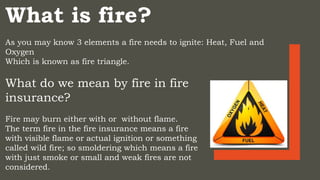
As you may know 3 elements a fire needs to ignite: Heat, Fuel and
Oxygen
Which is known as fire triangle.
What do we mean by fire in fire
insurance?
Fire may burn either with or without flame.
The term fire in the fire insurance means a fire
with visible flame or actual ignition or something
called wild fire; so smoldering which means a fire
with just smoke or small and weak fires are not
considered.
What is fire Insurance?
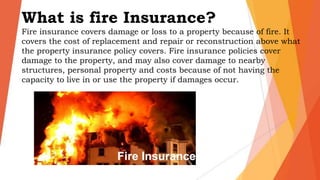
Fire insurance covers damage or loss to a property because of fire. It
covers the cost of replacement and repair or reconstruction above what
the property insurance policy covers. Fire insurance policies cover
damage to the property, and may also cover damage to nearby
structures, personal property and costs because of not having the
capacity to live in or use the property if damages occur.
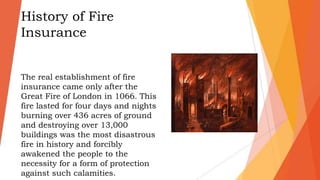
History of Fire
Insurance
The real establishment of fire
insurance came only after the
Great Fire of London in 1066. This
fire lasted for four days and nights
burning over 436 acres of ground
and destroying over 13,000
buildings was the most disastrous
fire in history and forcibly
awakened the people to the
necessity for a form of protection
against such calamities.
How does fire spread?
Fire spreads in two ways:
a. Horizontal
b. Vertical
Horizontal spread of fire
 Wind
 Heat transfer in the form of radiation
 Pouring flammable liquids
 Explosions due to combustion and pressure
Vertical spread of fire
It spreads faster than horizontal form of fire spreading.
Elements are:
 Corridor and Stairs
 Elevator Channel
 Windows
 Explosions due to combustion and pressure
 Pouring flammable liquids from upstairs
 Ceiling falling down
Which perils are specified in the fire
policy?
There are two kinds of perils that are covered under fire
policy:
I. Standard (main) Perils
II. Additional Perils
I. Standard Perils: Fire, lightning and explosion
Fire: It has been explained
before.
Explosion: Sudden change in the temperature in any plant & machinery
or exposure to
atmospheric pressure may result into loss and the same will be covered
Lightning: Any lightning due to cloud burst may damage the
property and the same will be covered under the fire policy. In the
case of lightning, the insurer does not pay the indirect losses resulted
from lightning.
Additional Perils:
 Aircraft Damage
 Riot, Strike and Malicious Damage (RSMD)
 Storm, Cyclone, Typhoon, Tempest, Hurricane, Tornado, Flood
and Inundation (STFI)
 Impact Damage
 Subsidence and Landslide including Rock Slide
 Bursting and/or overflowing of Water Tanks, Apparatus and
Pipes
Missile Testing Operations
 Leakage from Automatic Sprinkler Installations
 Bush Fire
 Burglary
 Glass breakage
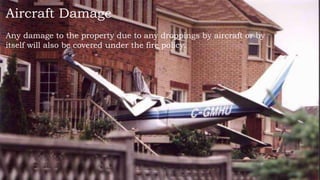
Aircraft Damage
Any damage to the property due to any droppings by aircraft or by
itself will also be covered under the fire policy.
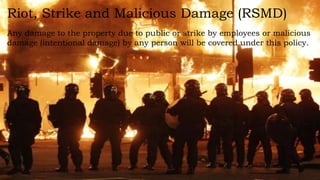
Riot, Strike and Malicious Damage (RSMD)
Any damage to the property due to public or strike by employees or malicious
damage (intentional damage) by any person will be covered under this policy.
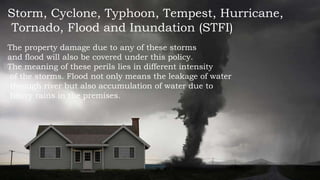
Storm, Cyclone, Typhoon, Tempest, Hurricane,
Tornado, Flood and Inundation (STFI)
The property damage due to any of these storms
and flood will also be covered under this policy.
The meaning of these perils lies in different intensity
of the storms. Flood not only means the leakage of water
through river but also accumulation of water due to
heavy rains in the premises.
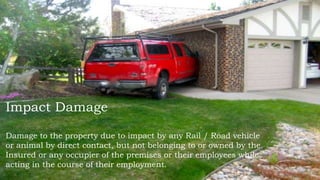
Impact Damage
Damage to the property due to impact by any Rail / Road vehicle
or animal by direct contact, but not belonging to or owned by the
Insured or any occupier of the premises or their employees while
acting in the course of their employment.
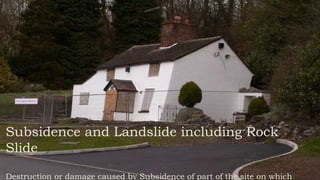
Subsidence and Landslide including Rock
Slide
Destruction or damage caused by Subsidence of part of the site on which
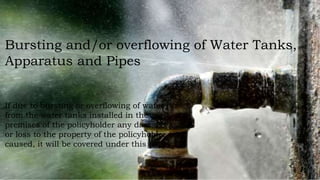
Bursting and/or overflowing of Water Tanks,
Apparatus and Pipes
If due to bursting or overflowing of water
from the water tanks installed in the
premises of the policyholder any damage
or loss to the property of the policyholder is
caused, it will be covered under this policy.
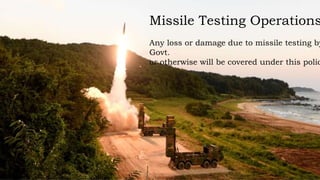
Missile Testing Operations
Any loss or damage due to missile testing by
Govt.
or otherwise will be covered under this polic
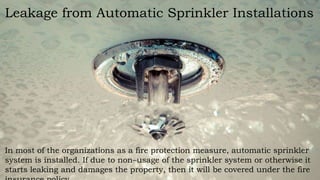
Leakage from Automatic Sprinkler Installations
In most of the organizations as a fire protection measure, automatic sprinkler
system is installed. If due to non–usage of the sprinkler system or otherwise it
starts leaking and damages the property, then it will be covered under the fire
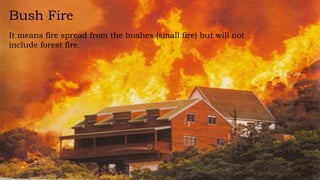
Bush Fire
It means fire spread from the bushes (small fire) but will not
include forest fire.
Burglary
Burglary insurance provides
protection against incidents of
theft to your property. This policy
covers losses or damages to your
property and its contents in your
business premise due to:
 Theft by actual, forcible and
violent entry
 Theft or attempted theft
 Armed robbery
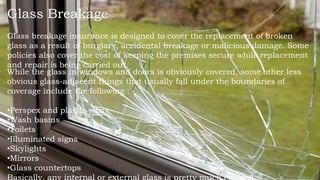
Glass Breakage
Glass breakage insurance is designed to cover the replacement of broken
glass as a result of burglary, accidental breakage or malicious damage. Some
policies also cover the cost of keeping the premises secure while replacement
and repair is being carried out.
While the glass in windows and doors is obviously covered, some other less
obvious glass-adjacent things that usually fall under the boundaries of
coverage include the following :
•Perspex and plastic signs
•Wash basins
•Toilets
•Illuminated signs
•Skylights
•Mirrors
•Glass countertops
Basically, any internal or external glass is pretty much covered
Exclusion
s
(i) In every claim minimum deduction will be made while settling the claim
under this policy. It is to avoid small losses.
(ii) Loss, destruction or damage caused by war, and kindred perils.
(iii) Loss, destruction or damage directly or indirectly caused to the insured
property by nuclear peril.
(iv) Loss, destruction or damage caused to the insured property by pollution or
contamination.
(v) Earthquake: It is not covered under the fire policy but by paying additional
premium, the earthquake can be covered.
PROCEDURE TO INSURE THE PROPERTY
UNDER FIRE INSURANCE
For insuring any property under the fire insurance policy, the
following is the procedure:
1) Filling of proposal form
2) Inspection of the property
3) Payment of premium
4) Issue of Cover note/ Policy document in lieu of acceptance of th
proposal.
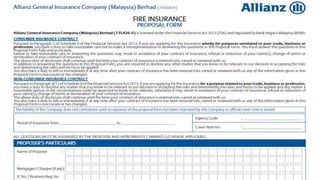
Filling of Proposal Form
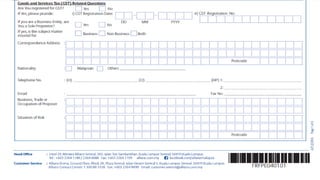
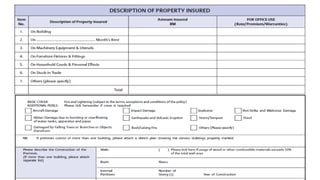
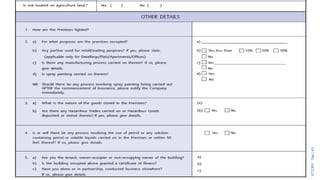
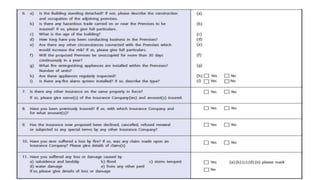
The fire proposal includes the following information :
Description of the property. This would include:
(i) Construction of external walls and roof, number of storeys.
(ii) Occupation of each portion of the building.
(iii) Presence of hazardous goods.
(iv) Process of manufacture.
(v) The sums proposed for insurance.
(vi) The period of insurance.
(vii) History of previous losses.
(viii)Insurance history - whether previously other insurershad
declined the risk, etc.
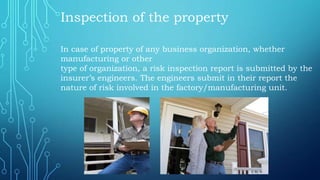
Inspection of the property
In case of property of any business organization, whether
manufacturing or other
type of organization, a risk inspection report is submitted by the
insurer’s engineers. The engineers submit in their report the
nature of risk involved in the factory/manufacturing unit.
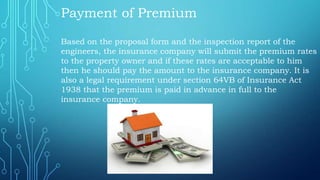
Payment of Premium
Based on the proposal form and the inspection report of the
engineers, the insurance company will submit the premium rates
to the property owner and if these rates are acceptable to him
then he should pay the amount to the insurance company. It is
also a legal requirement under section 64VB of Insurance Act
1938 that the premium is paid in advance in full to the
insurance company.
Premium
The premium for a fire insurance policy is based on the sum
insured, being computed at a rate per cent on that sun insured,
according to the degree of hazard involved. The sum insured,
therefore, should represent the full replacement cost of the
property.
The Premium will be charged depending on:
• The class of building
• The occupation of the building
• The adjacent building of the insured building
• The sum insured etc.
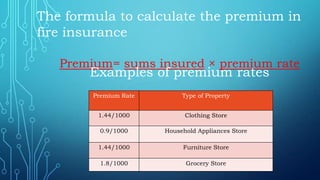
The formula to calculate the premium in
fire insurance
Premium= sums insured × premium rate
Examples of premium rates
Type of PropertyPremium Rate
Clothing Store1.44/1000
Household Appliances Store0.9/1000
Furniture Store1.44/1000
Grocery Store1.8/1000
Issue of Cover note/ Policy document
On receipt of a completed proposal form and / or inspection
report, the cover note is issued, pending preparation of the policy
document. The cover note is an unstamped document issued to
provide evidence of cover till the time the policy is issued. The
cover note provides insurance against specified perils on the
usual terms and conditions of the company’s policy.
The printed policy form provides for a schedule in which the
individual details of the contract are typed. The items are similar
to those in the Cover Note but with more detailed information.
After issuing the policy document, it is likely that there may be
some changes in the nature of property or sum insured may
increase or decrease. In this case, these changes can be
incorporated by way of endorsements which are issued to record
changes such as alteration in risk, increase or decrease of sum
insured, etc.
PROCEDURE TO SETTLE THE FIRE
INSURANCE CLAIM:
A) If there are any damage or loss arising due to fire then the policy holder
should immediately inform the insurance company in writing and with
estimated amount of loss.
B) Survey Report: If the amount of loss is small, the insurance company may
depute an officer to survey the loss and decide on the settlement of the loss on
the basis of the claim form and the officer’s report. However, in large losses, an
independent surveyor duly licensed by the Government is appointed to give a
report on the loss.
The survey report would generally deal with the following matters:
(i) Cause of loss.
(ii)Extent of loss.
(iii) Under-Insurance, if any.
(iv) Details and value of salvage, and how it has been disposed of or
proposed to be disposed of.
(v) Details of expenses (e.g. fire brigade expenses).
(vi) Compliance with policy conditions and warranties.
(vii) Details of other insurance policies on the same property, and the
apportionment of the loss and expenses among co-insurers.
Claim form
The policy holder will submit the claim form with the following information :
(i) Name and address of the Insured.
(ii) Date of loss, time and place from where the fire started.
(iii) Cause of fire.
(iv) Details of the property damaged such as description, etc.
(v) Value at the time of fire, value of salvage and the amount of loss.
(vi) Details of other policies on the same property giving the name of the
insurer, policy number and sum insured.
(vii) Fire Brigade report details.
(viii) F.I.R. at the nearest police station regarding third party liability, if any.
Settlement of claim
On the basis of the claim form and the survey report, decision is
taken about the settlement or otherwise of the loss.
Information required by the insurer for risk
assessment
 Subject-matter of insurance
 Address of the property
 Type of the building
 Type of ceiling and walls
 Number of floors
 Area of the property
 Electric wiring
 Fire extinguishing system (sprinkler, fire extinguishing, etc.)
 Alarms
 Distance of nearest fire fighting station to the insured property
 Number of doors and windows
 Unoccupancy period of the property insured
 Whether the property is already insured under another policy or not
 Risk of explosion
Risk Classification
Different premium rates are fixed for each class. These classifications do
not hold good for a long time because of varied nature of risk. Now the
risks are classified into various classes according to factors affecting fire
risk.
Construction or Structure
Occupancy
Nature of Flooring
Height
Floor and wall opening
Exposure
Lighting, Heating and Power
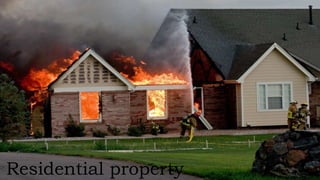
Residential property
There are various kinds of perils that threatening residential property and their
contents. It is possible to export insurance policy just for the fire and theft
perils to meet the needs of individuals but there are more perils (threats) that if
disclose to people certainly, they’ll have desire to buy insurance coverage for all
of them .All risk insurance is that coverage that we were talking about and also
it covers residential properties and its contents. So the insurer is responsible
for all losses and damages entered to the insured; except some
conditions(exclusions)that has been clearly mentioned. Proving this occasion
that the damage happened was one of the excluded perils is the responsibility
of the insurer. In 1915, the first residential property insurance policy was
exported. This insurance policy completed gradually and nowadays it is using
by the individuals. There is an insurance policy for the people whom doing
their business in their own house; like doctors, dentists, attorneys at law, etc.
Because insurers rarely visit the property to be insured, the insurer will design
the proposal form as it contains the whole information for risk assessment, like
wiring, security equipment, etc. In the meantime there should be a list of
contents and the sum insured for each of those contents that has been insured
with less value than their real value, under insurance has been happened.
It’s a building made with brick, stone, and concrete and its rood should be
made by stone, glazed tile, concrete, mosaic, etc. Inside the house should be
covered by inflammable materials and the garage, equipment, warehouse,
fences, walls and front doors should be part of that property. The sum insured
will be estimated on the basis of standard property.
Property Insured
Until 1982, there was no industrial all risk insurance policy. Insurers were
using fire insurance policy and added other risks (like industrial) to this
insurance coverage. In 1982, London’s insurers were thinking about designing
an industrial all risk insurance policy. In this coverage, the basis is on
compensating all insured losses, except some exclusions that exists. Except
some risks like riot, strikes, nuclear power, there are other exclusions:
 split (gap) and building destruction
 corrosion, dust, dryness, and moisture, evaporation, discoloration,
contamination, etc.
 subsidence
Industrial All Risks Insurance
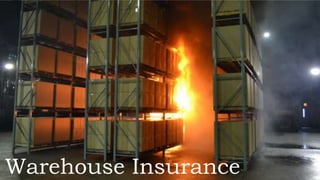
Warehouse Insurance
Warehouses although imperative to the smooth running of many
retailers, contractors, wholesalers, distributors, storage companies
and several other business types around the country, they do however
also carry the biggest risk of all commercial premises that that
company will occupy.
With stock or equipment, stored in warehouses overnight, usually
ranging well into the thousands, it is vital that businesses ensure their
livelihood is covered against any perils (fire, storm, etc.) as well as
theft.
When acquiring cover, we tailor the policy’s cover to meet the needs of
warehouse owners and to ensure the continuity of your business when
the unexpected happens; our policies provide first class cover and are
arranged through the U.K.’s leading insurers.
The type of goods that can be stored in a warehouse is almost limitless;
most of the buildings will have storage areas as well as office space that
are used for administrative purposes. A warehouse insurance policy
(also referred to as a commercial combined policy) can offer both
buildings and contents cover. Many warehouse buildings will differ
from standard commercial buildings, for example some could be
converted factory premises to which many insurers will decline, so have
Key benefits or policy extensions, for these policies range from:
 Property Damage
 Business Interruption
 Book Debts
 Money
 Goods in Transit
 Specified All Risks – specific items away from business premises.
 Employers Liability
 Public and Products Liability
 Commercial Legal Expenses
 Personal Accident
 Computer Breakdown
 Work away cover
 Multi location policies are also available
At Goldcrest Insurance, we have a wide range of insurers at our disposal; therefore we
can market any trade or any construction of premises, so call one of our executives
First loss insurance
It is a type of property insurance policy that provides only
partial insurance. In the event of a claim, the policyholder
agrees to accept an amount less than the full value of
damaged, destroyed or stolen items/property.
EML (estimated maximum loss)
The Estimated Maximum Loss (or the EML) is an estimate of
the maximum loss that can be sustained by the insurer on a
single risk. That risk must be considered to be within the
realms of probability. The estimate can (and usually will)
ignore any “remote coincidences” even if they are possible.
PML (probable maximum loss)
The maximum loss that an insurer would be expected to
incur on a policy. Probable maximum loss (PML) is most
often associated with insurance policies on property, such
as fire insurance. The probable maximum loss represents
the worst-case scenario for an insurer.
How fire insurance policy voids?
In addition to the things that void any insurance contract (like dual
insuring and breach of utmost good faith and etc.) unless your
breach or violation contributed to the loss, it does not render the
policy void. In other words, if you committed arson or caused the
fire, your contract will be found to be void. On the other hand, if
your violation of the policy did not cause the fire, you are still
covered for your loss under Texas law. Here’s a typical example of a
violation that will not render your policy void. Let’s say you added a
foundation endorsement to your policy that provides coverage for
any foundation problems, and that endorsement requires that you
have your foundation inspected once every two years. If you failed
to inspect your foundation, that will not render your policy void.
Exaggerated Insurance Claims
Definition of exaggerated claim: An exaggerated
claim is one in which the insured person
dishonestly says that the value of goods stolen or
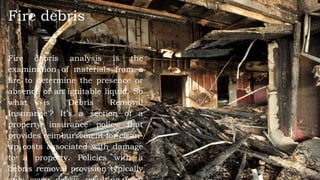
Fire debris
Fire debris analysis is the
examination of materials from a
fire to determine the presence or
absence of an ignitable liquid. So
what is 'Debris Removal
Insurance'? It's a section of a
property insurance policy that
provides reimbursement for clean-
up costs associated with damage
to a property. Policies with a
debris removal provision typically
What should the insured do when the accident
happens?
1) The insured has to send a report to the insurer saying that the accident
has happened within 5 days from when the accident happened.
2) The insured must send a list of the objects which have been saved from the
fire and their new place and tells the insurer about the quality of the accident,
within 10 days from the first report.
3) The insured must do anything to prevent the damage from the accident to
other things while the accident is happening ad after that.
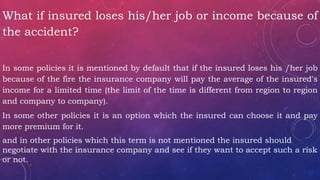
What if insured loses his/her job or income because of
the accident?
In some policies it is mentioned by default that if the insured loses his /her job
because of the fire the insurance company will pay the average of the insured's
income for a limited time (the limit of the time is different from region to region
and company to company).
In some other policies it is an option which the insured can choose it and pay
more premium for it.
and in other policies which this term is not mentioned the insured should
negotiate with the insurance company and see if they want to accept such a risk
or not.
The End
Thank You …

Fire insurance

  • 1.
    In the nameof God Fire Insurance By:  Sepehr Eskandari  Mohammadhossein tat  Saeed naseri  Mohammad vahedi
  • 3.
    What is fire? Asyou may know 3 elements a fire needs to ignite: Heat, Fuel and Oxygen Which is known as fire triangle. What do we mean by fire in fire insurance? Fire may burn either with or without flame. The term fire in the fire insurance means a fire with visible flame or actual ignition or something called wild fire; so smoldering which means a fire with just smoke or small and weak fires are not considered.
  • 4.
    What is fireInsurance? Fire insurance covers damage or loss to a property because of fire. It covers the cost of replacement and repair or reconstruction above what the property insurance policy covers. Fire insurance policies cover damage to the property, and may also cover damage to nearby structures, personal property and costs because of not having the capacity to live in or use the property if damages occur.
  • 5.
    History of Fire Insurance Thereal establishment of fire insurance came only after the Great Fire of London in 1066. This fire lasted for four days and nights burning over 436 acres of ground and destroying over 13,000 buildings was the most disastrous fire in history and forcibly awakened the people to the necessity for a form of protection against such calamities.
  • 6.
    How does firespread? Fire spreads in two ways: a. Horizontal b. Vertical Horizontal spread of fire  Wind  Heat transfer in the form of radiation  Pouring flammable liquids  Explosions due to combustion and pressure
  • 7.
    Vertical spread offire It spreads faster than horizontal form of fire spreading. Elements are:  Corridor and Stairs  Elevator Channel  Windows  Explosions due to combustion and pressure  Pouring flammable liquids from upstairs  Ceiling falling down
  • 8.
    Which perils arespecified in the fire policy? There are two kinds of perils that are covered under fire policy: I. Standard (main) Perils II. Additional Perils I. Standard Perils: Fire, lightning and explosion Fire: It has been explained before. Explosion: Sudden change in the temperature in any plant & machinery or exposure to atmospheric pressure may result into loss and the same will be covered Lightning: Any lightning due to cloud burst may damage the property and the same will be covered under the fire policy. In the case of lightning, the insurer does not pay the indirect losses resulted from lightning.
  • 9.
    Additional Perils:  AircraftDamage  Riot, Strike and Malicious Damage (RSMD)  Storm, Cyclone, Typhoon, Tempest, Hurricane, Tornado, Flood and Inundation (STFI)  Impact Damage  Subsidence and Landslide including Rock Slide  Bursting and/or overflowing of Water Tanks, Apparatus and Pipes Missile Testing Operations  Leakage from Automatic Sprinkler Installations  Bush Fire  Burglary  Glass breakage
  • 10.
    Aircraft Damage Any damageto the property due to any droppings by aircraft or by itself will also be covered under the fire policy.
  • 11.
    Riot, Strike andMalicious Damage (RSMD) Any damage to the property due to public or strike by employees or malicious damage (intentional damage) by any person will be covered under this policy.
  • 12.
    Storm, Cyclone, Typhoon,Tempest, Hurricane, Tornado, Flood and Inundation (STFI) The property damage due to any of these storms and flood will also be covered under this policy. The meaning of these perils lies in different intensity of the storms. Flood not only means the leakage of water through river but also accumulation of water due to heavy rains in the premises.
  • 13.
    Impact Damage Damage tothe property due to impact by any Rail / Road vehicle or animal by direct contact, but not belonging to or owned by the Insured or any occupier of the premises or their employees while acting in the course of their employment.
  • 14.
    Subsidence and Landslideincluding Rock Slide Destruction or damage caused by Subsidence of part of the site on which
  • 15.
    Bursting and/or overflowingof Water Tanks, Apparatus and Pipes If due to bursting or overflowing of water from the water tanks installed in the premises of the policyholder any damage or loss to the property of the policyholder is caused, it will be covered under this policy.
  • 16.
    Missile Testing Operations Anyloss or damage due to missile testing by Govt. or otherwise will be covered under this polic
  • 17.
    Leakage from AutomaticSprinkler Installations In most of the organizations as a fire protection measure, automatic sprinkler system is installed. If due to non–usage of the sprinkler system or otherwise it starts leaking and damages the property, then it will be covered under the fire
  • 18.
    Bush Fire It meansfire spread from the bushes (small fire) but will not include forest fire.
  • 19.
    Burglary Burglary insurance provides protectionagainst incidents of theft to your property. This policy covers losses or damages to your property and its contents in your business premise due to:  Theft by actual, forcible and violent entry  Theft or attempted theft  Armed robbery
  • 20.
    Glass Breakage Glass breakageinsurance is designed to cover the replacement of broken glass as a result of burglary, accidental breakage or malicious damage. Some policies also cover the cost of keeping the premises secure while replacement and repair is being carried out. While the glass in windows and doors is obviously covered, some other less obvious glass-adjacent things that usually fall under the boundaries of coverage include the following : •Perspex and plastic signs •Wash basins •Toilets •Illuminated signs •Skylights •Mirrors •Glass countertops Basically, any internal or external glass is pretty much covered
  • 21.
  • 22.
    (i) In everyclaim minimum deduction will be made while settling the claim under this policy. It is to avoid small losses. (ii) Loss, destruction or damage caused by war, and kindred perils. (iii) Loss, destruction or damage directly or indirectly caused to the insured property by nuclear peril. (iv) Loss, destruction or damage caused to the insured property by pollution or contamination. (v) Earthquake: It is not covered under the fire policy but by paying additional premium, the earthquake can be covered.
  • 23.
    PROCEDURE TO INSURETHE PROPERTY UNDER FIRE INSURANCE For insuring any property under the fire insurance policy, the following is the procedure: 1) Filling of proposal form 2) Inspection of the property 3) Payment of premium 4) Issue of Cover note/ Policy document in lieu of acceptance of th proposal.
  • 24.
    Filling of ProposalForm The fire proposal includes the following information : Description of the property. This would include: (i) Construction of external walls and roof, number of storeys. (ii) Occupation of each portion of the building. (iii) Presence of hazardous goods. (iv) Process of manufacture. (v) The sums proposed for insurance. (vi) The period of insurance. (vii) History of previous losses. (viii)Insurance history - whether previously other insurershad declined the risk, etc.
  • 25.
    Inspection of theproperty In case of property of any business organization, whether manufacturing or other type of organization, a risk inspection report is submitted by the insurer’s engineers. The engineers submit in their report the nature of risk involved in the factory/manufacturing unit.
  • 26.
    Payment of Premium Basedon the proposal form and the inspection report of the engineers, the insurance company will submit the premium rates to the property owner and if these rates are acceptable to him then he should pay the amount to the insurance company. It is also a legal requirement under section 64VB of Insurance Act 1938 that the premium is paid in advance in full to the insurance company.
  • 27.
    Premium The premium fora fire insurance policy is based on the sum insured, being computed at a rate per cent on that sun insured, according to the degree of hazard involved. The sum insured, therefore, should represent the full replacement cost of the property. The Premium will be charged depending on: • The class of building • The occupation of the building • The adjacent building of the insured building • The sum insured etc.
  • 28.
    The formula tocalculate the premium in fire insurance Premium= sums insured × premium rate Examples of premium rates Type of PropertyPremium Rate Clothing Store1.44/1000 Household Appliances Store0.9/1000 Furniture Store1.44/1000 Grocery Store1.8/1000
  • 29.
    Issue of Covernote/ Policy document On receipt of a completed proposal form and / or inspection report, the cover note is issued, pending preparation of the policy document. The cover note is an unstamped document issued to provide evidence of cover till the time the policy is issued. The cover note provides insurance against specified perils on the usual terms and conditions of the company’s policy. The printed policy form provides for a schedule in which the individual details of the contract are typed. The items are similar to those in the Cover Note but with more detailed information. After issuing the policy document, it is likely that there may be some changes in the nature of property or sum insured may increase or decrease. In this case, these changes can be incorporated by way of endorsements which are issued to record changes such as alteration in risk, increase or decrease of sum insured, etc.
  • 38.
    PROCEDURE TO SETTLETHE FIRE INSURANCE CLAIM: A) If there are any damage or loss arising due to fire then the policy holder should immediately inform the insurance company in writing and with estimated amount of loss. B) Survey Report: If the amount of loss is small, the insurance company may depute an officer to survey the loss and decide on the settlement of the loss on the basis of the claim form and the officer’s report. However, in large losses, an independent surveyor duly licensed by the Government is appointed to give a report on the loss.
  • 39.
    The survey reportwould generally deal with the following matters: (i) Cause of loss. (ii)Extent of loss. (iii) Under-Insurance, if any. (iv) Details and value of salvage, and how it has been disposed of or proposed to be disposed of. (v) Details of expenses (e.g. fire brigade expenses). (vi) Compliance with policy conditions and warranties. (vii) Details of other insurance policies on the same property, and the apportionment of the loss and expenses among co-insurers.
  • 40.
    Claim form The policyholder will submit the claim form with the following information : (i) Name and address of the Insured. (ii) Date of loss, time and place from where the fire started. (iii) Cause of fire. (iv) Details of the property damaged such as description, etc. (v) Value at the time of fire, value of salvage and the amount of loss. (vi) Details of other policies on the same property giving the name of the insurer, policy number and sum insured. (vii) Fire Brigade report details. (viii) F.I.R. at the nearest police station regarding third party liability, if any.
  • 41.
    Settlement of claim Onthe basis of the claim form and the survey report, decision is taken about the settlement or otherwise of the loss.
  • 42.
    Information required bythe insurer for risk assessment  Subject-matter of insurance  Address of the property  Type of the building  Type of ceiling and walls  Number of floors  Area of the property  Electric wiring  Fire extinguishing system (sprinkler, fire extinguishing, etc.)  Alarms  Distance of nearest fire fighting station to the insured property  Number of doors and windows  Unoccupancy period of the property insured  Whether the property is already insured under another policy or not  Risk of explosion
  • 43.
    Risk Classification Different premiumrates are fixed for each class. These classifications do not hold good for a long time because of varied nature of risk. Now the risks are classified into various classes according to factors affecting fire risk. Construction or Structure Occupancy Nature of Flooring Height Floor and wall opening Exposure Lighting, Heating and Power
  • 44.
  • 45.
    There are variouskinds of perils that threatening residential property and their contents. It is possible to export insurance policy just for the fire and theft perils to meet the needs of individuals but there are more perils (threats) that if disclose to people certainly, they’ll have desire to buy insurance coverage for all of them .All risk insurance is that coverage that we were talking about and also it covers residential properties and its contents. So the insurer is responsible for all losses and damages entered to the insured; except some conditions(exclusions)that has been clearly mentioned. Proving this occasion that the damage happened was one of the excluded perils is the responsibility of the insurer. In 1915, the first residential property insurance policy was exported. This insurance policy completed gradually and nowadays it is using by the individuals. There is an insurance policy for the people whom doing their business in their own house; like doctors, dentists, attorneys at law, etc. Because insurers rarely visit the property to be insured, the insurer will design the proposal form as it contains the whole information for risk assessment, like wiring, security equipment, etc. In the meantime there should be a list of contents and the sum insured for each of those contents that has been insured with less value than their real value, under insurance has been happened.
  • 46.
    It’s a buildingmade with brick, stone, and concrete and its rood should be made by stone, glazed tile, concrete, mosaic, etc. Inside the house should be covered by inflammable materials and the garage, equipment, warehouse, fences, walls and front doors should be part of that property. The sum insured will be estimated on the basis of standard property. Property Insured
  • 47.
    Until 1982, therewas no industrial all risk insurance policy. Insurers were using fire insurance policy and added other risks (like industrial) to this insurance coverage. In 1982, London’s insurers were thinking about designing an industrial all risk insurance policy. In this coverage, the basis is on compensating all insured losses, except some exclusions that exists. Except some risks like riot, strikes, nuclear power, there are other exclusions:  split (gap) and building destruction  corrosion, dust, dryness, and moisture, evaporation, discoloration, contamination, etc.  subsidence Industrial All Risks Insurance
  • 48.
  • 49.
    Warehouses although imperativeto the smooth running of many retailers, contractors, wholesalers, distributors, storage companies and several other business types around the country, they do however also carry the biggest risk of all commercial premises that that company will occupy. With stock or equipment, stored in warehouses overnight, usually ranging well into the thousands, it is vital that businesses ensure their livelihood is covered against any perils (fire, storm, etc.) as well as theft.
  • 50.
    When acquiring cover,we tailor the policy’s cover to meet the needs of warehouse owners and to ensure the continuity of your business when the unexpected happens; our policies provide first class cover and are arranged through the U.K.’s leading insurers. The type of goods that can be stored in a warehouse is almost limitless; most of the buildings will have storage areas as well as office space that are used for administrative purposes. A warehouse insurance policy (also referred to as a commercial combined policy) can offer both buildings and contents cover. Many warehouse buildings will differ from standard commercial buildings, for example some could be converted factory premises to which many insurers will decline, so have
  • 51.
    Key benefits orpolicy extensions, for these policies range from:  Property Damage  Business Interruption  Book Debts  Money  Goods in Transit  Specified All Risks – specific items away from business premises.  Employers Liability  Public and Products Liability  Commercial Legal Expenses  Personal Accident  Computer Breakdown  Work away cover  Multi location policies are also available At Goldcrest Insurance, we have a wide range of insurers at our disposal; therefore we can market any trade or any construction of premises, so call one of our executives
  • 52.
    First loss insurance Itis a type of property insurance policy that provides only partial insurance. In the event of a claim, the policyholder agrees to accept an amount less than the full value of damaged, destroyed or stolen items/property.
  • 53.
    EML (estimated maximumloss) The Estimated Maximum Loss (or the EML) is an estimate of the maximum loss that can be sustained by the insurer on a single risk. That risk must be considered to be within the realms of probability. The estimate can (and usually will) ignore any “remote coincidences” even if they are possible.
  • 54.
    PML (probable maximumloss) The maximum loss that an insurer would be expected to incur on a policy. Probable maximum loss (PML) is most often associated with insurance policies on property, such as fire insurance. The probable maximum loss represents the worst-case scenario for an insurer.
  • 55.
    How fire insurancepolicy voids? In addition to the things that void any insurance contract (like dual insuring and breach of utmost good faith and etc.) unless your breach or violation contributed to the loss, it does not render the policy void. In other words, if you committed arson or caused the fire, your contract will be found to be void. On the other hand, if your violation of the policy did not cause the fire, you are still covered for your loss under Texas law. Here’s a typical example of a violation that will not render your policy void. Let’s say you added a foundation endorsement to your policy that provides coverage for any foundation problems, and that endorsement requires that you have your foundation inspected once every two years. If you failed to inspect your foundation, that will not render your policy void.
  • 56.
    Exaggerated Insurance Claims Definitionof exaggerated claim: An exaggerated claim is one in which the insured person dishonestly says that the value of goods stolen or
  • 57.
    Fire debris Fire debrisanalysis is the examination of materials from a fire to determine the presence or absence of an ignitable liquid. So what is 'Debris Removal Insurance'? It's a section of a property insurance policy that provides reimbursement for clean- up costs associated with damage to a property. Policies with a debris removal provision typically
  • 58.
    What should theinsured do when the accident happens? 1) The insured has to send a report to the insurer saying that the accident has happened within 5 days from when the accident happened. 2) The insured must send a list of the objects which have been saved from the fire and their new place and tells the insurer about the quality of the accident, within 10 days from the first report. 3) The insured must do anything to prevent the damage from the accident to other things while the accident is happening ad after that.
  • 59.
    What if insuredloses his/her job or income because of the accident? In some policies it is mentioned by default that if the insured loses his /her job because of the fire the insurance company will pay the average of the insured's income for a limited time (the limit of the time is different from region to region and company to company). In some other policies it is an option which the insured can choose it and pay more premium for it. and in other policies which this term is not mentioned the insured should negotiate with the insurance company and see if they want to accept such a risk or not.
  • 60.