3.6 
Mathematics 
of Finance 
Copyright © 2011 Pearson, Inc.
What you’ll learn about 
 Interest Compounded Annually 
 Interest Compounded k Times per Year 
 Interest Compounded Continuously 
 Annual Percentage Yield 
 Annuities – Future Value 
 Loans and Mortgages – Present Value 
… and why 
The mathematics of finance is the science of letting your 
money work for you – valuable information indeed! 
Copyright © 2011 Pearson, Inc. Slide 3.6 - 2
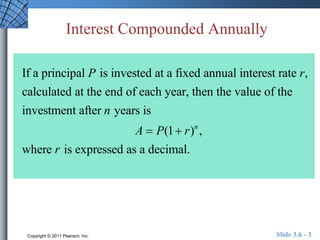
Interest Compounded Annually 
If a principal P is invested at a fixed annual interest rate r, 
calculated at the end of each year, then the value of the 
investment after n years is 
A  P(1 r)n , 
where r is expressed as a decimal. 
Copyright © 2011 Pearson, Inc. Slide 3.6 - 3
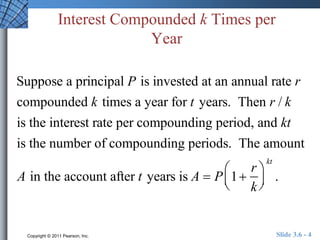
Interest Compounded k Times per 
Year 
Suppose a principal P is invested at an annual rate r 
compounded k times a year for t years. Then r / k 
is the interest rate per compounding period, and kt 
is the number of compounding periods. The amount 
 
A in the account after t years is A  P 1 
r 
k 
  
 
  
kt 
. 
Copyright © 2011 Pearson, Inc. Slide 3.6 - 4
Example Compounding Monthly 
Suppose Paul invests $400 at 8% annual interest 
compounded monthly. Find the value of the investment 
after 5 years. 
Copyright © 2011 Pearson, Inc. Slide 3.6 - 5
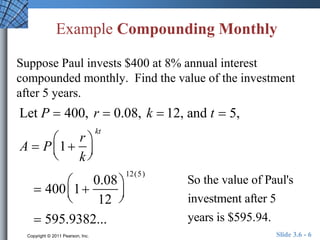
Example Compounding Monthly 
Suppose Paul invests $400 at 8% annual interest 
compounded monthly. Find the value of the investment 
after 5 years. 
Let P  400, r  0.08, k  12, and t  5, 
 
A  P 1 
r 
k 
  
 
  
kt 
 
 400 1 
0.08 
12 
  
 
  
12(5) 
 595.9382... 
So the value of Paul's 
investment after 5 
years is $595.94. 
Copyright © 2011 Pearson, Inc. Slide 3.6 - 6
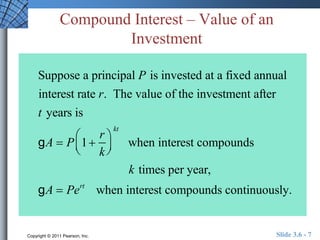
Compound Interest – Value of an 
Investment 
Suppose a principal P is invested at a fixed annual 
interest rate r. The value of the investment after 
t years is 
 
g A  P 1 
r 
k 
  
  kt 
 
when interest compounds 
k times per year, 
g A  Pert when interest compounds continuously. 
Copyright © 2011 Pearson, Inc. Slide 3.6 - 7
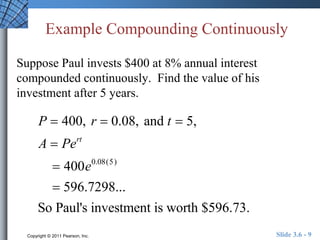
Example Compounding Continuously 
Suppose Paul invests $400 at 8% annual interest 
compounded continuously. Find the value of his 
investment after 5 years. 
Copyright © 2011 Pearson, Inc. Slide 3.6 - 8
Example Compounding Continuously 
Suppose Paul invests $400 at 8% annual interest 
compounded continuously. Find the value of his 
investment after 5 years. 
P  400, r  0.08, and t  5, 
A  Pert 
 400e0.08(5) 
 596.7298... 
So Paul's investment is worth $596.73. 
Copyright © 2011 Pearson, Inc. Slide 3.6 - 9
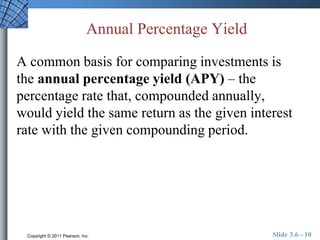
Annual Percentage Yield 
A common basis for comparing investments is 
the annual percentage yield (APY) – the 
percentage rate that, compounded annually, 
would yield the same return as the given interest 
rate with the given compounding period. 
Copyright © 2011 Pearson, Inc. Slide 3.6 - 10
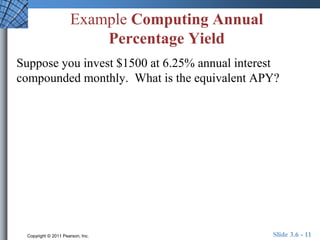
Example Computing Annual 
Percentage Yield 
Suppose you invest $1500 at 6.25% annual interest 
compounded monthly. What is the equivalent APY? 
Copyright © 2011 Pearson, Inc. Slide 3.6 - 11
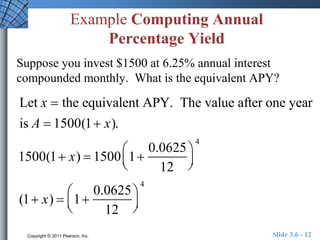
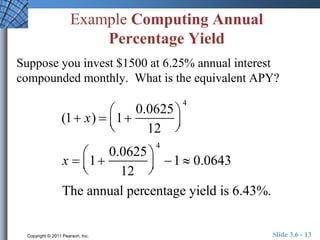
Example Computing Annual 
Percentage Yield 
Suppose you invest $1500 at 6.25% annual interest 
compounded monthly. What is the equivalent APY? 
Let x  the equivalent APY. The value after one year 
is A  1500(1 x). 
 
1500(1 x)  1500 1 
0.0625 
12 
  
 
  
4 
 
(1 x)  1 
0.0625 
12 
  
 
  
4 
Copyright © 2011 Pearson, Inc. Slide 3.6 - 12
Example Computing Annual 
Percentage Yield 
Suppose you invest $1500 at 6.25% annual interest 
compounded monthly. What is the equivalent APY? 
 
(1 x)  1 
0.0625 
12 
  
 
  
4 
 
  
x  1 
0.0625 
12 
  
4 
1  0.0643 
The annual percentage yield is 6.43%. 
Copyright © 2011 Pearson, Inc. Slide 3.6 - 13
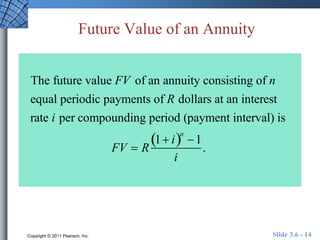
Future Value of an Annuity 
The future value FV of an annuity consisting of n 
equal periodic payments of R dollars at an interest 
rate i per compounding period (payment interval) is 
FV  R 
1 in 
1 
i 
. 
Copyright © 2011 Pearson, Inc. Slide 3.6 - 14
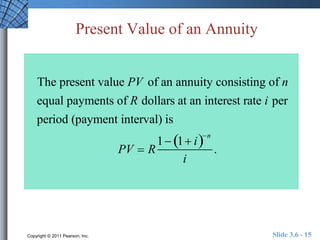
Present Value of an Annuity 
The present value PV of an annuity consisting of n 
equal payments of R dollars at an interest rate i per 
period (payment interval) is 
PV  R 
1 1 in 
i 
. 
Copyright © 2011 Pearson, Inc. Slide 3.6 - 15
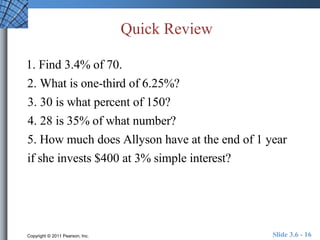
Quick Review 
1. Find 3.4% of 70. 
2. What is one-third of 6.25%? 
3. 30 is what percent of 150? 
4. 28 is 35% of what number? 
5. How much does Allyson have at the end of 1 year 
if she invests $400 at 3% simple interest? 
Copyright © 2011 Pearson, Inc. Slide 3.6 - 16
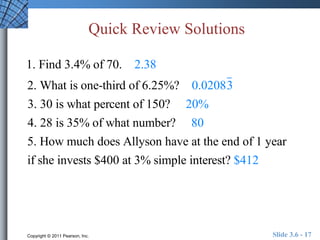
Quick Review Solutions 
1. Find 3.4% of 70. 2.38 
2. What is one-third of 6.25%? 0.02083 
3. 30 is what percent of 150? 20% 
4. 28 is 35% of what number? 80 
5. How much does Allyson have at the end of 1 year 
if she invests $400 at 3% simple interest? $412 
Copyright © 2011 Pearson, Inc. Slide 3.6 - 17
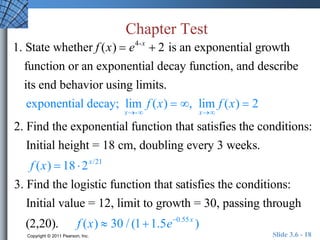
Chapter Test 
1. State whether f (x)  e4-x  2 is an exponential growth 
function or an exponential decay function, and describe 
its end behavior using limits. 
exponential decay; lim 
x- 
f (x)  , lim 
x 
f (x)  2 
2. Find the exponential function that satisfies the conditions: 
Initial height = 18 cm, doubling every 3 weeks. 
f (x)  18  2x/21 
3. Find the logistic function that satisfies the conditions: 
Initial value = 12, limit to growth = 30, passing through 
(2,20). f (x)  30 / (11.5e0.55 x ) 
Copyright © 2011 Pearson, Inc. Slide 3.6 - 18
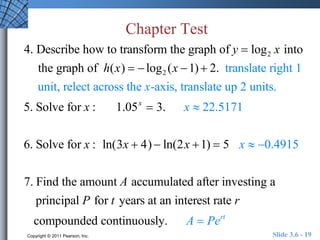
Chapter Test 
4. Describe how to transform the graph of y  log2 x into 
the graph of h(x)   log2 (x 1)  2. translate right 1 
unit, relect across the x-axis, translate up 2 units. 
5. Solve for x : 1.05x  3. x  22.5171 
6. Solve for x : ln(3x  4)  ln(2x 1)  5 x  0.4915 
7. Find the amount A accumulated after investing a 
principal P for t years at an interest rate r 
compounded continuously. A  Pert 
Copyright © 2011 Pearson, Inc. Slide 3.6 - 19
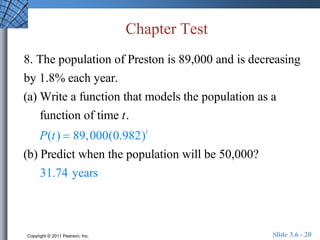
Chapter Test 
8. The population of Preston is 89,000 and is decreasing 
by 1.8% each year. 
(a) Write a function that models the population as a 
function of time t. 
P(t )  89,000(0.982)t 
(b) Predict when the population will be 50,000? 
31.74 years 
Copyright © 2011 Pearson, Inc. Slide 3.6 - 20
Chapter Test 
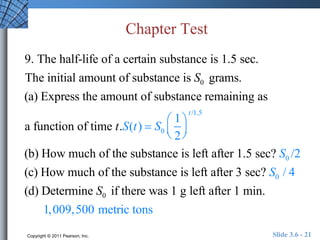
9. The half-life of a certain substance is 1.5 sec. 
The initial amount of substance is S0 grams. 
(a) Express the amount of substance remaining as 
a function of time t.S(t )  S0 
1 
2 
 
  
 
  
t /1.5 
(b) How much of the substance is left after 1.5 sec? S0 /2 
(c) How much of the substance is left after 3 sec? S0 / 4 
(d) Determine S0 if there was 1 g left after 1 min. 
1,009,500 metric tons 
Copyright © 2011 Pearson, Inc. Slide 3.6 - 21
Chapter Test 
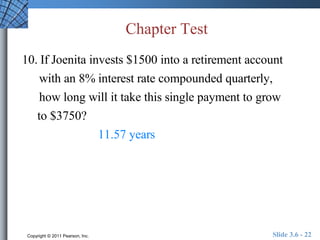
10. If Joenita invests $1500 into a retirement account 
with an 8% interest rate compounded quarterly, 
how long will it take this single payment to grow 
to $3750? 
11.57 years 
Copyright © 2011 Pearson, Inc. Slide 3.6 - 22

Unit 3.6

  • 1.
    3.6 Mathematics ofFinance Copyright © 2011 Pearson, Inc.
  • 2.
    What you’ll learnabout  Interest Compounded Annually  Interest Compounded k Times per Year  Interest Compounded Continuously  Annual Percentage Yield  Annuities – Future Value  Loans and Mortgages – Present Value … and why The mathematics of finance is the science of letting your money work for you – valuable information indeed! Copyright © 2011 Pearson, Inc. Slide 3.6 - 2
  • 3.
    Interest Compounded Annually If a principal P is invested at a fixed annual interest rate r, calculated at the end of each year, then the value of the investment after n years is A  P(1 r)n , where r is expressed as a decimal. Copyright © 2011 Pearson, Inc. Slide 3.6 - 3
  • 4.
    Interest Compounded kTimes per Year Suppose a principal P is invested at an annual rate r compounded k times a year for t years. Then r / k is the interest rate per compounding period, and kt is the number of compounding periods. The amount  A in the account after t years is A  P 1 r k      kt . Copyright © 2011 Pearson, Inc. Slide 3.6 - 4
  • 5.
    Example Compounding Monthly Suppose Paul invests $400 at 8% annual interest compounded monthly. Find the value of the investment after 5 years. Copyright © 2011 Pearson, Inc. Slide 3.6 - 5
  • 6.
    Example Compounding Monthly Suppose Paul invests $400 at 8% annual interest compounded monthly. Find the value of the investment after 5 years. Let P  400, r  0.08, k  12, and t  5,  A  P 1 r k      kt   400 1 0.08 12      12(5)  595.9382... So the value of Paul's investment after 5 years is $595.94. Copyright © 2011 Pearson, Inc. Slide 3.6 - 6
  • 7.
    Compound Interest –Value of an Investment Suppose a principal P is invested at a fixed annual interest rate r. The value of the investment after t years is  g A  P 1 r k     kt  when interest compounds k times per year, g A  Pert when interest compounds continuously. Copyright © 2011 Pearson, Inc. Slide 3.6 - 7
  • 8.
    Example Compounding Continuously Suppose Paul invests $400 at 8% annual interest compounded continuously. Find the value of his investment after 5 years. Copyright © 2011 Pearson, Inc. Slide 3.6 - 8
  • 9.
    Example Compounding Continuously Suppose Paul invests $400 at 8% annual interest compounded continuously. Find the value of his investment after 5 years. P  400, r  0.08, and t  5, A  Pert  400e0.08(5)  596.7298... So Paul's investment is worth $596.73. Copyright © 2011 Pearson, Inc. Slide 3.6 - 9
  • 10.
    Annual Percentage Yield A common basis for comparing investments is the annual percentage yield (APY) – the percentage rate that, compounded annually, would yield the same return as the given interest rate with the given compounding period. Copyright © 2011 Pearson, Inc. Slide 3.6 - 10
  • 11.
    Example Computing Annual Percentage Yield Suppose you invest $1500 at 6.25% annual interest compounded monthly. What is the equivalent APY? Copyright © 2011 Pearson, Inc. Slide 3.6 - 11
  • 12.
    Example Computing Annual Percentage Yield Suppose you invest $1500 at 6.25% annual interest compounded monthly. What is the equivalent APY? Let x  the equivalent APY. The value after one year is A  1500(1 x).  1500(1 x)  1500 1 0.0625 12      4  (1 x)  1 0.0625 12      4 Copyright © 2011 Pearson, Inc. Slide 3.6 - 12
  • 13.
    Example Computing Annual Percentage Yield Suppose you invest $1500 at 6.25% annual interest compounded monthly. What is the equivalent APY?  (1 x)  1 0.0625 12      4    x  1 0.0625 12   4 1  0.0643 The annual percentage yield is 6.43%. Copyright © 2011 Pearson, Inc. Slide 3.6 - 13
  • 14.
    Future Value ofan Annuity The future value FV of an annuity consisting of n equal periodic payments of R dollars at an interest rate i per compounding period (payment interval) is FV  R 1 in 1 i . Copyright © 2011 Pearson, Inc. Slide 3.6 - 14
  • 15.
    Present Value ofan Annuity The present value PV of an annuity consisting of n equal payments of R dollars at an interest rate i per period (payment interval) is PV  R 1 1 in i . Copyright © 2011 Pearson, Inc. Slide 3.6 - 15
  • 16.
    Quick Review 1.Find 3.4% of 70. 2. What is one-third of 6.25%? 3. 30 is what percent of 150? 4. 28 is 35% of what number? 5. How much does Allyson have at the end of 1 year if she invests $400 at 3% simple interest? Copyright © 2011 Pearson, Inc. Slide 3.6 - 16
  • 17.
    Quick Review Solutions 1. Find 3.4% of 70. 2.38 2. What is one-third of 6.25%? 0.02083 3. 30 is what percent of 150? 20% 4. 28 is 35% of what number? 80 5. How much does Allyson have at the end of 1 year if she invests $400 at 3% simple interest? $412 Copyright © 2011 Pearson, Inc. Slide 3.6 - 17
  • 18.
    Chapter Test 1.State whether f (x)  e4-x  2 is an exponential growth function or an exponential decay function, and describe its end behavior using limits. exponential decay; lim x- f (x)  , lim x f (x)  2 2. Find the exponential function that satisfies the conditions: Initial height = 18 cm, doubling every 3 weeks. f (x)  18  2x/21 3. Find the logistic function that satisfies the conditions: Initial value = 12, limit to growth = 30, passing through (2,20). f (x)  30 / (11.5e0.55 x ) Copyright © 2011 Pearson, Inc. Slide 3.6 - 18
  • 19.
    Chapter Test 4.Describe how to transform the graph of y  log2 x into the graph of h(x)   log2 (x 1)  2. translate right 1 unit, relect across the x-axis, translate up 2 units. 5. Solve for x : 1.05x  3. x  22.5171 6. Solve for x : ln(3x  4)  ln(2x 1)  5 x  0.4915 7. Find the amount A accumulated after investing a principal P for t years at an interest rate r compounded continuously. A  Pert Copyright © 2011 Pearson, Inc. Slide 3.6 - 19
  • 20.
    Chapter Test 8.The population of Preston is 89,000 and is decreasing by 1.8% each year. (a) Write a function that models the population as a function of time t. P(t )  89,000(0.982)t (b) Predict when the population will be 50,000? 31.74 years Copyright © 2011 Pearson, Inc. Slide 3.6 - 20
  • 21.
    Chapter Test 9.The half-life of a certain substance is 1.5 sec. The initial amount of substance is S0 grams. (a) Express the amount of substance remaining as a function of time t.S(t )  S0 1 2       t /1.5 (b) How much of the substance is left after 1.5 sec? S0 /2 (c) How much of the substance is left after 3 sec? S0 / 4 (d) Determine S0 if there was 1 g left after 1 min. 1,009,500 metric tons Copyright © 2011 Pearson, Inc. Slide 3.6 - 21
  • 22.
    Chapter Test 10.If Joenita invests $1500 into a retirement account with an 8% interest rate compounded quarterly, how long will it take this single payment to grow to $3750? 11.57 years Copyright © 2011 Pearson, Inc. Slide 3.6 - 22