Unit 2.5 The Norman Monarchs
Norman England by Ms.Farida
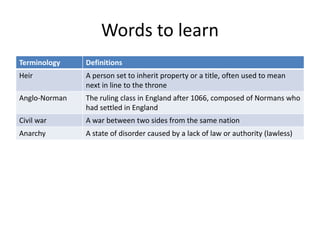
Words to learn
Terminology Definitions
Heir A person set to inherit property or a title, often used to mean
next in line to the throne
Anglo-Norman The ruling class in England after 1066, composed of Normans who
had settled in England
Civil war A war between two sides from the same nation
Anarchy A state of disorder caused by a lack of law or authority (lawless)
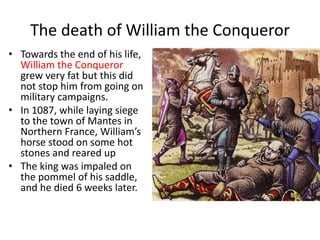
The death of William the Conqueror
• Towards the end of his life,
William the Conqueror
grew very fat but this did
not stop him from going on
military campaigns.
• In 1087, while laying siege
to the town of Mantes in
Northern France, William’s
horse stood on some hot
stones and reared up
• The king was impaled on
the pommel of his saddle,
and he died 6 weeks later.
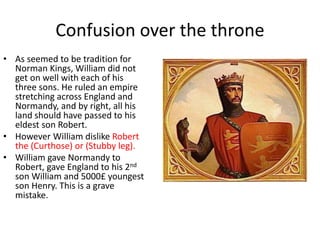
Confusion over the throne
• As seemed to be tradition for
Norman Kings, William did not
get on well with each of his
three sons. He ruled an empire
stretching across England and
Normandy, and by right, all his
land should have passed to his
eldest son Robert.
• However William dislike Robert
the (Curthose) or (Stubby leg).
• William gave Normandy to
Robert, gave England to his 2nd
son William and 5000£ youngest
son Henry. This is a grave
mistake.
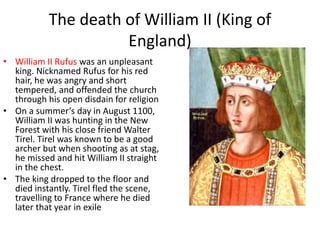
The death of William II (King of
England)
• William II Rufus was an unpleasant
king. Nicknamed Rufus for his red
hair, he was angry and short
tempered, and offended the church
through his open disdain for religion
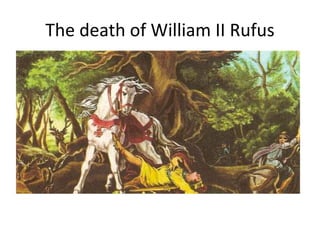
• On a summer’s day in August 1100,
William II was hunting in the New
Forest with his close friend Walter
Tirel. Tirel was known to be a good
archer but when shooting as at stag,
he missed and hit William II straight
in the chest.
• The king dropped to the floor and
died instantly. Tirel fled the scene,
travelling to France where he died
later that year in exile
The death of William II Rufus
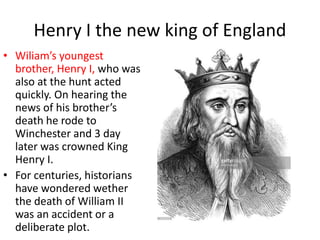
Henry I the new king of England
• Wiliam’s youngest
brother, Henry I, who was
also at the hunt acted
quickly. On hearing the
news of his brother’s
death he rode to
Winchester and 3 day
later was crowned King
Henry I.
• For centuries, historians
have wondered wether
the death of William II
was an accident or a
deliberate plot.
Imprisonment of Roberts
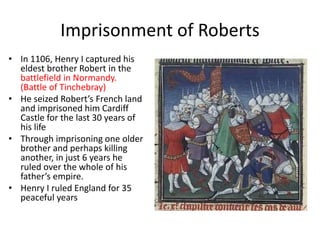
• In 1106, Henry I captured his
eldest brother Robert in the
battlefield in Normandy.
(Battle of Tinchebray)
• He seized Robert’s French land
and imprisoned him Cardiff
Castle for the last 30 years of
his life
• Through imprisoning one older
brother and perhaps killing
another, in just 6 years he
ruled over the whole of his
father’s empire.
• Henry I ruled England for 35
peaceful years
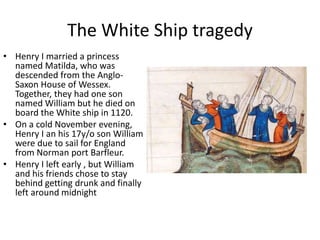
The White Ship tragedy
• Henry I married a princess
named Matilda, who was
descended from the Anglo-
Saxon House of Wessex.
Together, they had one son
named William but he died on
board the White ship in 1120.
• On a cold November evening,
Henry I an his 17y/o son William
were due to sail for England
from Norman port Barfleur.
• Henry I left early , but William
and his friends chose to stay
behind getting drunk and finally
left around midnight
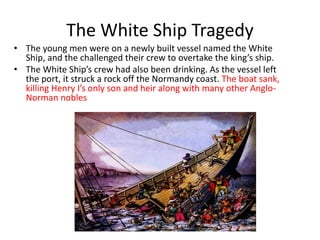
The White Ship Tragedy
• The young men were on a newly built vessel named the White
Ship, and the challenged their crew to overtake the king’s ship.
• The White Ship’s crew had also been drinking. As the vessel left
the port, it struck a rock off the Normandy coast. The boat sank,
killing Henry I’s only son and heir along with many other Anglo-
Norman nobles
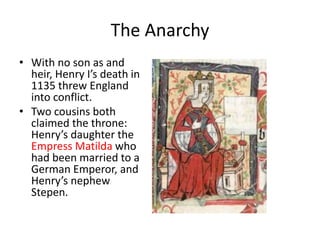
The Anarchy
• With no son as and
heir, Henry I’s death in
1135 threw England
into conflict.
• Two cousins both
claimed the throne:
Henry’s daughter the
Empress Matilda who
had been married to a
German Emperor, and
Henry’s nephew
Stepen.
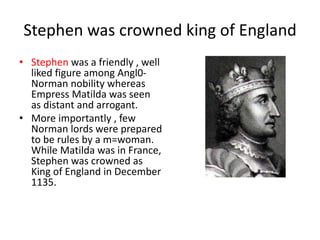
Stephen was crowned king of England
• Stephen was a friendly , well
liked figure among Angl0-
Norman nobility whereas
Empress Matilda was seen
as distant and arrogant.
• More importantly , few
Norman lords were prepared
to be rules by a m=woman.
While Matilda was in France,
Stephen was crowned as
King of England in December
1135.
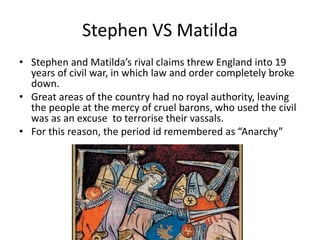
Stephen VS Matilda
• Stephen and Matilda’s rival claims threw England into 19
years of civil war, in which law and order completely broke
down.
• Great areas of the country had no royal authority, leaving
the people at the mercy of cruel barons, who used the civil
was as an excuse to terrorise their vassals.
• For this reason, the period id remembered as “Anarchy”
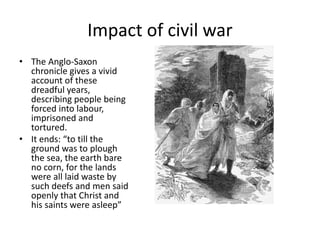
Impact of civil war
• The Anglo-Saxon
chronicle gives a vivid
account of these
dreadful years,
describing people being
forced into labour,
imprisoned and
tortured.
• It ends: “to till the
ground was to plough
the sea, the earth bare
no corn, for the lands
were all laid waste by
such deefs and men said
openly that Christ and
his saints were asleep”
Questions
The End

Unit 2.5 the norman monarchs

  • 1.
    Unit 2.5 TheNorman Monarchs Norman England by Ms.Farida
  • 2.
    Words to learn TerminologyDefinitions Heir A person set to inherit property or a title, often used to mean next in line to the throne Anglo-Norman The ruling class in England after 1066, composed of Normans who had settled in England Civil war A war between two sides from the same nation Anarchy A state of disorder caused by a lack of law or authority (lawless)
  • 3.
    The death ofWilliam the Conqueror • Towards the end of his life, William the Conqueror grew very fat but this did not stop him from going on military campaigns. • In 1087, while laying siege to the town of Mantes in Northern France, William’s horse stood on some hot stones and reared up • The king was impaled on the pommel of his saddle, and he died 6 weeks later.
  • 4.
    Confusion over thethrone • As seemed to be tradition for Norman Kings, William did not get on well with each of his three sons. He ruled an empire stretching across England and Normandy, and by right, all his land should have passed to his eldest son Robert. • However William dislike Robert the (Curthose) or (Stubby leg). • William gave Normandy to Robert, gave England to his 2nd son William and 5000£ youngest son Henry. This is a grave mistake.
  • 5.
    The death ofWilliam II (King of England) • William II Rufus was an unpleasant king. Nicknamed Rufus for his red hair, he was angry and short tempered, and offended the church through his open disdain for religion • On a summer’s day in August 1100, William II was hunting in the New Forest with his close friend Walter Tirel. Tirel was known to be a good archer but when shooting as at stag, he missed and hit William II straight in the chest. • The king dropped to the floor and died instantly. Tirel fled the scene, travelling to France where he died later that year in exile
  • 6.
    The death ofWilliam II Rufus
  • 7.
    Henry I thenew king of England • Wiliam’s youngest brother, Henry I, who was also at the hunt acted quickly. On hearing the news of his brother’s death he rode to Winchester and 3 day later was crowned King Henry I. • For centuries, historians have wondered wether the death of William II was an accident or a deliberate plot.
  • 8.
    Imprisonment of Roberts •In 1106, Henry I captured his eldest brother Robert in the battlefield in Normandy. (Battle of Tinchebray) • He seized Robert’s French land and imprisoned him Cardiff Castle for the last 30 years of his life • Through imprisoning one older brother and perhaps killing another, in just 6 years he ruled over the whole of his father’s empire. • Henry I ruled England for 35 peaceful years
  • 9.
    The White Shiptragedy • Henry I married a princess named Matilda, who was descended from the Anglo- Saxon House of Wessex. Together, they had one son named William but he died on board the White ship in 1120. • On a cold November evening, Henry I an his 17y/o son William were due to sail for England from Norman port Barfleur. • Henry I left early , but William and his friends chose to stay behind getting drunk and finally left around midnight
  • 10.
    The White ShipTragedy • The young men were on a newly built vessel named the White Ship, and the challenged their crew to overtake the king’s ship. • The White Ship’s crew had also been drinking. As the vessel left the port, it struck a rock off the Normandy coast. The boat sank, killing Henry I’s only son and heir along with many other Anglo- Norman nobles
  • 11.
    The Anarchy • Withno son as and heir, Henry I’s death in 1135 threw England into conflict. • Two cousins both claimed the throne: Henry’s daughter the Empress Matilda who had been married to a German Emperor, and Henry’s nephew Stepen.
  • 12.
    Stephen was crownedking of England • Stephen was a friendly , well liked figure among Angl0- Norman nobility whereas Empress Matilda was seen as distant and arrogant. • More importantly , few Norman lords were prepared to be rules by a m=woman. While Matilda was in France, Stephen was crowned as King of England in December 1135.
  • 13.
    Stephen VS Matilda •Stephen and Matilda’s rival claims threw England into 19 years of civil war, in which law and order completely broke down. • Great areas of the country had no royal authority, leaving the people at the mercy of cruel barons, who used the civil was as an excuse to terrorise their vassals. • For this reason, the period id remembered as “Anarchy”
  • 14.
    Impact of civilwar • The Anglo-Saxon chronicle gives a vivid account of these dreadful years, describing people being forced into labour, imprisoned and tortured. • It ends: “to till the ground was to plough the sea, the earth bare no corn, for the lands were all laid waste by such deefs and men said openly that Christ and his saints were asleep”
  • 15.
  • 16.