Unit 5.3 Social Reform
The Age of Reform
Words to learn
Terminology Definition
unions An association of workers formed to persue
collective rights and interest
Friendly society An association of workers designed for helping
one another
Tolpuddle martyr Six Dorset farm labourers who became the
focus of a campaign
Why Social reform needed?
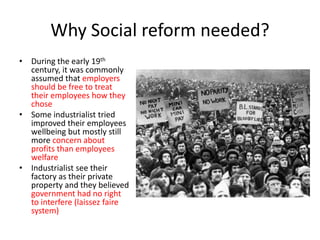
• During the early 19th
century, it was commonly
assumed that employers
should be free to treat
their employees how they
chose
• Some industrialist tried
improved their employees
wellbeing but mostly still
more concern about
profits than employees
welfare
• Industrialist see their
factory as their private
property and they believed
government had no right
to interfere (laissez faire
system)
Action taken by Br Government?
• By 1830, support was
growing in parliament for
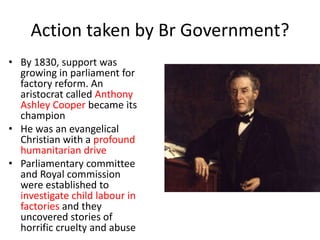
factory reform. An
aristocrat called Anthony
Ashley Cooper became its
champion
• He was an evangelical
Christian with a profound
humanitarian drive
• Parliamentary committee
and Royal commission
were established to
investigate child labour in
factories and they
uncovered stories of
horrific cruelty and abuse
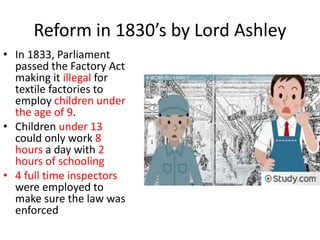
Reform in 1830’s by Lord Ashley
• In 1833, Parliament
passed the Factory Act
making it illegal for
textile factories to
employ children under
the age of 9.
• Children under 13
could only work 8
hours a day with 2
hours of schooling
• 4 full time inspectors
were employed to
make sure the law was
enforced
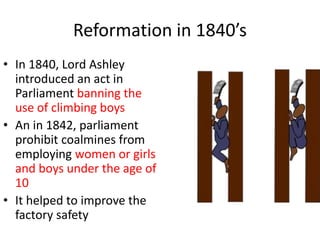
Reformation in 1840’s
• In 1840, Lord Ashley
introduced an act in
Parliament banning the
use of climbing boys
• An in 1842, parliament
prohibit coalmines from
employing women or girls
and boys under the age of
10
• It helped to improve the
factory safety
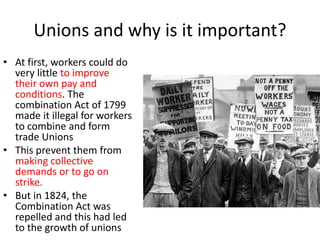
Unions and why is it important?
• At first, workers could do
very little to improve
their own pay and
conditions. The
combination Act of 1799
made it illegal for workers
to combine and form
trade Unions
• This prevent them from
making collective
demands or to go on
strike.
• But in 1824, the
Combination Act was
repelled and this had led
to the growth of unions
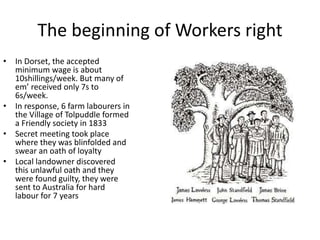
The beginning of Workers right
• In Dorset, the accepted
minimum wage is about
10shillings/week. But many of
em’ received only 7s to
6s/week.
• In response, 6 farm labourers in
the Village of Tolpuddle formed
a Friendly society in 1833
• Secret meeting took place
where they was blinfolded and
swear an oath of loyalty
• Local landowner discovered
this unlawful oath and they
were found guilty, they were
sent to Australia for hard
labour for 7 years
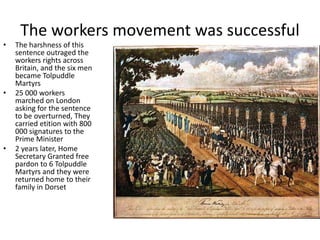
The workers movement was successful
• The harshness of this
sentence outraged the
workers rights across
Britain, and the six men
became Tolpuddle
Martyrs
• 25 000 workers
marched on London
asking for the sentence
to be overturned, They
carried etition with 800
000 signatures to the
Prime Minister
• 2 years later, Home
Secretary Granted free
pardon to 6 Tolpuddle
Martyrs and they were
returned home to their
family in Dorset
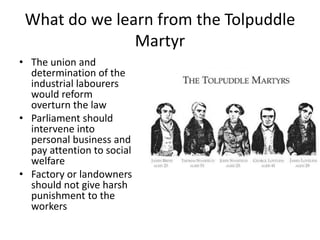
What do we learn from the Tolpuddle
Martyr
• The union and
determination of the
industrial labourers
would reform
overturn the law
• Parliament should
intervene into
personal business and
pay attention to social
welfare
• Factory or landowners
should not give harsh
punishment to the
workers
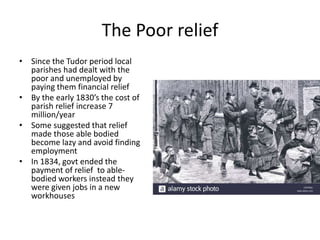
The Poor relief
• Since the Tudor period local
parishes had dealt with the
poor and unemployed by
paying them financial relief
• By the early 1830’s the cost of
parish relief increase 7
million/year
• Some suggested that relief
made those able bodied
become lazy and avoid finding
employment
• In 1834, govt ended the
payment of relief to able-
bodied workers instead they
were given jobs in a new
workhouses
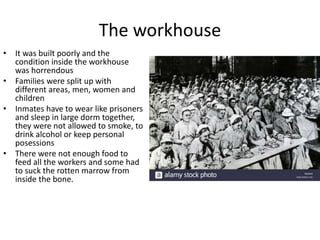
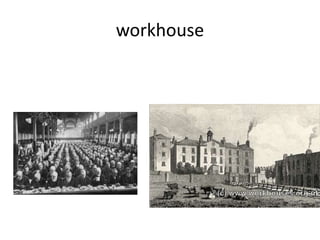
The workhouse
• It was built poorly and the
condition inside the workhouse
was horrendous
• Families were split up with
different areas, men, women and
children
• Inmates have to wear like prisoners
and sleep in large dorm together,
they were not allowed to smoke, to
drink alcohol or keep personal
posessions
• There were not enough food to
feed all the workers and some had
to suck the rotten marrow from
inside the bone.
workhouse
• The end

Unit 5.3 social reforms

  • 1.
    Unit 5.3 SocialReform The Age of Reform
  • 2.
    Words to learn TerminologyDefinition unions An association of workers formed to persue collective rights and interest Friendly society An association of workers designed for helping one another Tolpuddle martyr Six Dorset farm labourers who became the focus of a campaign
  • 3.
    Why Social reformneeded? • During the early 19th century, it was commonly assumed that employers should be free to treat their employees how they chose • Some industrialist tried improved their employees wellbeing but mostly still more concern about profits than employees welfare • Industrialist see their factory as their private property and they believed government had no right to interfere (laissez faire system)
  • 4.
    Action taken byBr Government? • By 1830, support was growing in parliament for factory reform. An aristocrat called Anthony Ashley Cooper became its champion • He was an evangelical Christian with a profound humanitarian drive • Parliamentary committee and Royal commission were established to investigate child labour in factories and they uncovered stories of horrific cruelty and abuse
  • 5.
    Reform in 1830’sby Lord Ashley • In 1833, Parliament passed the Factory Act making it illegal for textile factories to employ children under the age of 9. • Children under 13 could only work 8 hours a day with 2 hours of schooling • 4 full time inspectors were employed to make sure the law was enforced
  • 6.
    Reformation in 1840’s •In 1840, Lord Ashley introduced an act in Parliament banning the use of climbing boys • An in 1842, parliament prohibit coalmines from employing women or girls and boys under the age of 10 • It helped to improve the factory safety
  • 7.
    Unions and whyis it important? • At first, workers could do very little to improve their own pay and conditions. The combination Act of 1799 made it illegal for workers to combine and form trade Unions • This prevent them from making collective demands or to go on strike. • But in 1824, the Combination Act was repelled and this had led to the growth of unions
  • 8.
    The beginning ofWorkers right • In Dorset, the accepted minimum wage is about 10shillings/week. But many of em’ received only 7s to 6s/week. • In response, 6 farm labourers in the Village of Tolpuddle formed a Friendly society in 1833 • Secret meeting took place where they was blinfolded and swear an oath of loyalty • Local landowner discovered this unlawful oath and they were found guilty, they were sent to Australia for hard labour for 7 years
  • 9.
    The workers movementwas successful • The harshness of this sentence outraged the workers rights across Britain, and the six men became Tolpuddle Martyrs • 25 000 workers marched on London asking for the sentence to be overturned, They carried etition with 800 000 signatures to the Prime Minister • 2 years later, Home Secretary Granted free pardon to 6 Tolpuddle Martyrs and they were returned home to their family in Dorset
  • 10.
    What do welearn from the Tolpuddle Martyr • The union and determination of the industrial labourers would reform overturn the law • Parliament should intervene into personal business and pay attention to social welfare • Factory or landowners should not give harsh punishment to the workers
  • 11.
    The Poor relief •Since the Tudor period local parishes had dealt with the poor and unemployed by paying them financial relief • By the early 1830’s the cost of parish relief increase 7 million/year • Some suggested that relief made those able bodied become lazy and avoid finding employment • In 1834, govt ended the payment of relief to able- bodied workers instead they were given jobs in a new workhouses
  • 12.
    The workhouse • Itwas built poorly and the condition inside the workhouse was horrendous • Families were split up with different areas, men, women and children • Inmates have to wear like prisoners and sleep in large dorm together, they were not allowed to smoke, to drink alcohol or keep personal posessions • There were not enough food to feed all the workers and some had to suck the rotten marrow from inside the bone.
  • 13.
  • 14.