Unit 2:Why was Hitler Able to dominate
Germany by 1934?
Depth study history :
Germany 1918-1945 (Part 2)
Objectives (The growth of
Nazism)
 2.1 What did Nazi Party stand for in the 1920’s?
 2.2 Why was Hitler able to become Chancellor by
1933?
 2.3 How did Hitler consolidate his power in 1933-
1934?
 2.4 Opposition to Nazi
2.1 What did Nazi Party stand for in the
1920’s?
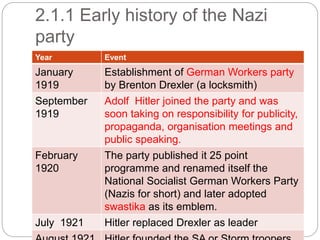
2.1.1 Early history of the Nazi
party
Year Event
January
1919
Establishment of German Workers party
by Brenton Drexler (a locksmith)
September
1919
Adolf Hitler joined the party and was
soon taking on responsibility for publicity,
propaganda, organisation meetings and
public speaking.
February
1920
The party published it 25 point
programme and renamed itself the
National Socialist German Workers Party
(Nazis for short) and later adopted
swastika as its emblem.
July 1921 Hitler replaced Drexler as leader
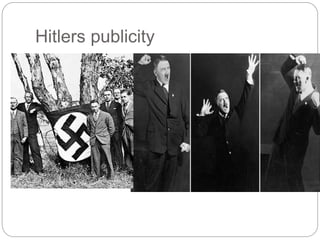
Hitlers publicity
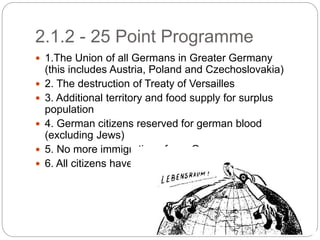
2.1.2 - 25 Point Programme
 1.The Union of all Germans in Greater Germany
(this includes Austria, Poland and Czechoslovakia)
 2. The destruction of Treaty of Versailles
 3. Additional territory and food supply for surplus
population
 4. German citizens reserved for german blood
(excluding Jews)
 5. No more immigration of non German
 6. All citizens have equal rights and obligations
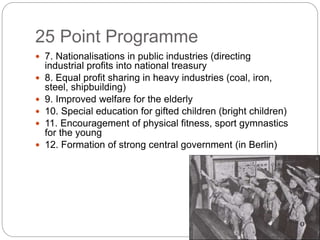
25 Point Programme
 7. Nationalisations in public industries (directing
industrial profits into national treasury
 8. Equal profit sharing in heavy industries (coal, iron,
steel, shipbuilding)
 9. Improved welfare for the elderly
 10. Special education for gifted children (bright children)
 11. Encouragement of physical fitness, sport gymnastics
for the young
 12. Formation of strong central government (in Berlin)
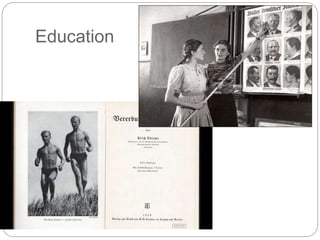
Education
2.1.3 The Munich Putsch, November
1923
Leader Adolf Hitler
Objectiv
e
To overthrow Weimar Government
using violence
Reason
why
Hitler
think its
going to
be
success
ful
•Weimar government were
unpopular because unable to solve
issues in Ruhr
•Weimar was using Freikors
(violent) to kills innocent workers n
former soldiers
•Weimar Govt printed more money
causing hyper infaltion and
economy to collapse
•Weimar depending on foreign govt
now making Germany like slave to
the West
•Hitler has support from General
Erich Ludendorff ( experienced
general in WW1) and has influence
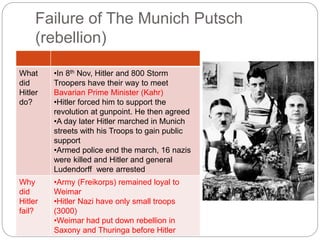
Failure of The Munich Putsch
(rebellion)
What
did
Hitler
do?
•In 8th Nov, Hitler and 800 Storm
Troopers have their way to meet
Bavarian Prime Minister (Kahr)
•Hitler forced him to support the
revolution at gunpoint. He then agreed
•A day later Hitler marched in Munich
streets with his Troops to gain public
support
•Armed police end the march, 16 nazis
were killed and Hitler and general
Ludendorff were arrested
Why
did
Hitler
fail?
•Army (Freikorps) remained loyal to
Weimar
•Hitler Nazi have only small troops
(3000)
•Weimar had put down rebellion in
Saxony and Thuringa before Hitler
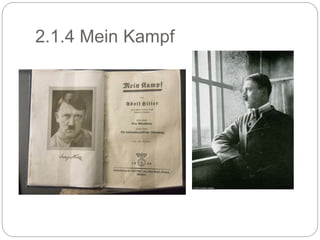
2.1.4 Mein Kampf
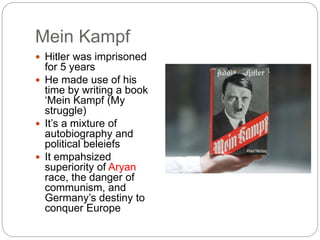
Mein Kampf
 Hitler was imprisoned
for 5 years
 He made use of his
time by writing a book
‘Mein Kampf (My
struggle)
 It’s a mixture of
autobiography and
political beleiefs
 It empahsized
superiority of Aryan
race, the danger of
communism, and
Germany’s destiny to
conquer Europe
2.1.5 Nazi tactics
 Nazi policies
underwent
nationalism and anti
semitic
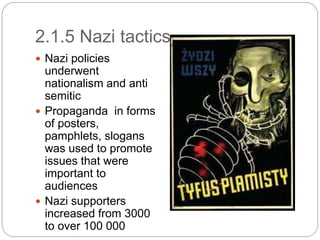
 Propaganda in forms
of posters,
pamphlets, slogans
was used to promote
issues that were
important to
audiences
 Nazi supporters
increased from 3000
to over 100 000
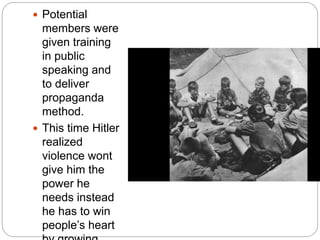
 Potential
members were
given training
in public
speaking and
to deliver
propaganda
method.
 This time Hitler
realized
violence wont
give him the
power he
needs instead
he has to win
people’s heart
2.3 Why was Hitler able to become
Chancellor by 1933?
The Nazis and world economic
depression 1930
 Depression : wage cuts, short
time working, unemployment,
homelessness and poverty in a
scale never seen before.
 Weimar and its coalition took
the blame , Nazi polled over 6
million votes in September
1930 making it the second
most popular party
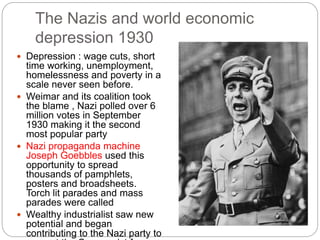
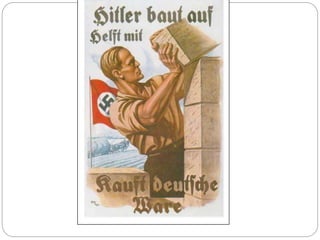
 Nazi propaganda machine
Joseph Goebbles used this
opportunity to spread
thousands of pamphlets,
posters and broadsheets.
Torch lit parades and mass
parades were called
 Wealthy industrialist saw new
potential and began
contributing to the Nazi party to
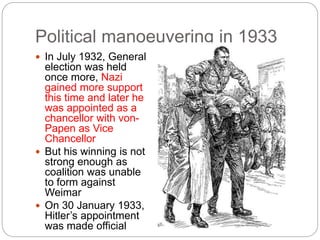
Political manoeuvering in 1933
 In July 1932, General
election was held
once more, Nazi
gained more support
this time and later he
was appointed as a
chancellor with von-
Papen as Vice
Chancellor
 But his winning is not
strong enough as
coalition was unable
to form against
Weimar
 On 30 January 1933,
Hitler’s appointment
was made official
2.4 How did Hitler consolidate his
power in 1933-1934?
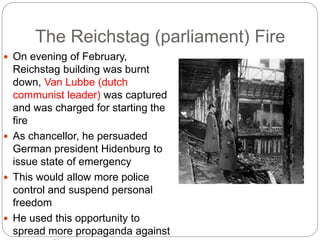
The Reichstag (parliament) Fire
 On evening of February,
Reichstag building was burnt
down, Van Lubbe (dutch
communist leader) was captured
and was charged for starting the
fire
 As chancellor, he persuaded
German president Hidenburg to
issue state of emergency
 This would allow more police
control and suspend personal
freedom
 He used this opportunity to
spread more propaganda against
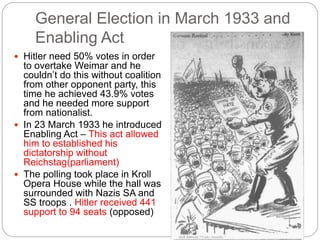
General Election in March 1933 and
Enabling Act
 Hitler need 50% votes in order
to overtake Weimar and he
couldn’t do this without coalition
from other opponent party, this
time he achieved 43.9% votes
and he needed more support
from nationalist.
 In 23 March 1933 he introduced
Enabling Act – This act allowed
him to established his
dictatorship without
Reichstag(parliament)
 The polling took place in Kroll
Opera House while the hall was
surrounded with Nazis SA and
SS troops . Hitler received 441
support to 94 seats (opposed)
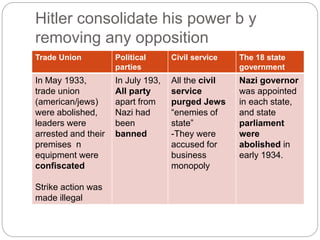
Hitler consolidate his power b y
removing any opposition
Trade Union Political
parties
Civil service The 18 state
government
In May 1933,
trade union
(american/jews)
were abolished,
leaders were
arrested and their
premises n
equipment were
confiscated
Strike action was
made illegal
In July 193,
All party
apart from
Nazi had
been
banned
All the civil
service
purged Jews
“enemies of
state”
-They were
accused for
business
monopoly
Nazi governor
was appointed
in each state,
and state
parliament
were
abolished in
early 1934.
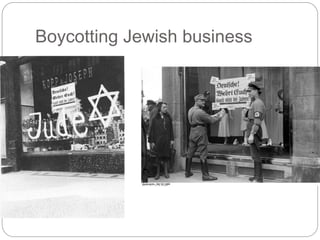
Boycotting Jewish business
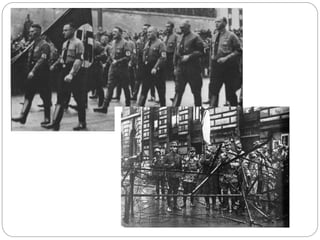
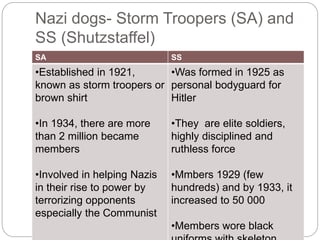
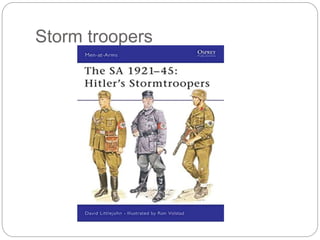
Nazi dogs- Storm Troopers (SA) and
SS (Shutzstaffel)
SA SS
•Established in 1921,
known as storm troopers or
brown shirt
•In 1934, there are more
than 2 million became
members
•Involved in helping Nazis
in their rise to power by
terrorizing opponents
especially the Communist
•Was formed in 1925 as
personal bodyguard for
Hitler
•They are elite soldiers,
highly disciplined and
ruthless force
•Mmbers 1929 (few
hundreds) and by 1933, it
increased to 50 000
•Members wore black
Storm troopers
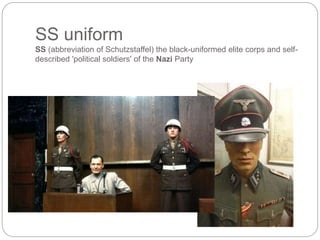
SS uniform
SS (abbreviation of Schutzstaffel) the black-uniformed elite corps and self-
described 'political soldiers' of the Nazi Party
2.4 Who opposed Nazi and what
happen to them?
Hitler the Fuhrer
 On 2nd August
1934, German
president
(hidenburg) died
and Hitler
proclaim himself
as “Fuhrer” as
Head of State
and Commander-
in-Chief of all
army
 Every soldiers
required to swear
an oath of
personal loyalty to
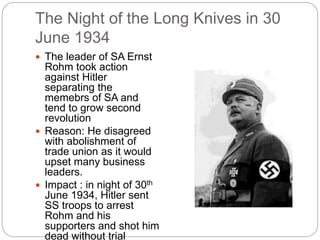
The Night of the Long Knives in 30
June 1934
 The leader of SA Ernst
Rohm took action
against Hitler
separating the
memebrs of SA and
tend to grow second
revolution
 Reason: He disagreed
with abolishment of
trade union as it would
upset many business
leaders.
 Impact : in night of 30th
June 1934, Hitler sent
SS troops to arrest
Rohm and his
supporters and shot him
dead without trial
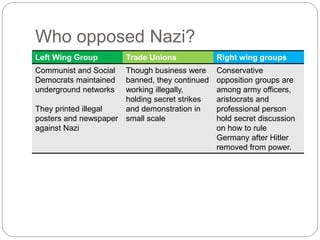
Who opposed Nazi?
Left Wing Group Trade Unions Right wing groups
Communist and Social
Democrats maintained
underground networks
They printed illegal
posters and newspaper
against Nazi
Though business were
banned, they continued
working illegally,
holding secret strikes
and demonstration in
small scale
Conservative
opposition groups are
among army officers,
aristocrats and
professional person
hold secret discussion
on how to rule
Germany after Hitler
removed from power.
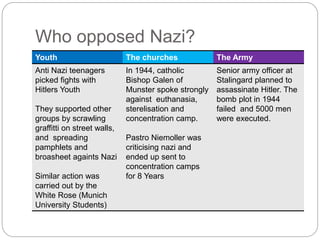
Who opposed Nazi?
Youth The churches The Army
Anti Nazi teenagers
picked fights with
Hitlers Youth
They supported other
groups by scrawling
graffitti on street walls,
and spreading
pamphlets and
broasheet againts Nazi
Similar action was
carried out by the
White Rose (Munich
University Students)
In 1944, catholic
Bishop Galen of
Munster spoke strongly
against euthanasia,
sterelisation and
concentration camp.
Pastro Niemoller was
criticising nazi and
ended up sent to
concentration camps
for 8 Years
Senior army officer at
Stalingard planned to
assassinate Hitler. The
bomb plot in 1944
failed and 5000 men
were executed.

Depth study history germany unit 2

  • 1.
    Unit 2:Why wasHitler Able to dominate Germany by 1934? Depth study history : Germany 1918-1945 (Part 2)
  • 2.
    Objectives (The growthof Nazism)  2.1 What did Nazi Party stand for in the 1920’s?  2.2 Why was Hitler able to become Chancellor by 1933?  2.3 How did Hitler consolidate his power in 1933- 1934?  2.4 Opposition to Nazi
  • 3.
    2.1 What didNazi Party stand for in the 1920’s?
  • 4.
    2.1.1 Early historyof the Nazi party Year Event January 1919 Establishment of German Workers party by Brenton Drexler (a locksmith) September 1919 Adolf Hitler joined the party and was soon taking on responsibility for publicity, propaganda, organisation meetings and public speaking. February 1920 The party published it 25 point programme and renamed itself the National Socialist German Workers Party (Nazis for short) and later adopted swastika as its emblem. July 1921 Hitler replaced Drexler as leader
  • 5.
  • 6.
    2.1.2 - 25Point Programme  1.The Union of all Germans in Greater Germany (this includes Austria, Poland and Czechoslovakia)  2. The destruction of Treaty of Versailles  3. Additional territory and food supply for surplus population  4. German citizens reserved for german blood (excluding Jews)  5. No more immigration of non German  6. All citizens have equal rights and obligations
  • 7.
    25 Point Programme 7. Nationalisations in public industries (directing industrial profits into national treasury  8. Equal profit sharing in heavy industries (coal, iron, steel, shipbuilding)  9. Improved welfare for the elderly  10. Special education for gifted children (bright children)  11. Encouragement of physical fitness, sport gymnastics for the young  12. Formation of strong central government (in Berlin)
  • 8.
  • 9.
    2.1.3 The MunichPutsch, November 1923 Leader Adolf Hitler Objectiv e To overthrow Weimar Government using violence Reason why Hitler think its going to be success ful •Weimar government were unpopular because unable to solve issues in Ruhr •Weimar was using Freikors (violent) to kills innocent workers n former soldiers •Weimar Govt printed more money causing hyper infaltion and economy to collapse •Weimar depending on foreign govt now making Germany like slave to the West •Hitler has support from General Erich Ludendorff ( experienced general in WW1) and has influence
  • 11.
    Failure of TheMunich Putsch (rebellion) What did Hitler do? •In 8th Nov, Hitler and 800 Storm Troopers have their way to meet Bavarian Prime Minister (Kahr) •Hitler forced him to support the revolution at gunpoint. He then agreed •A day later Hitler marched in Munich streets with his Troops to gain public support •Armed police end the march, 16 nazis were killed and Hitler and general Ludendorff were arrested Why did Hitler fail? •Army (Freikorps) remained loyal to Weimar •Hitler Nazi have only small troops (3000) •Weimar had put down rebellion in Saxony and Thuringa before Hitler
  • 12.
  • 13.
    Mein Kampf  Hitlerwas imprisoned for 5 years  He made use of his time by writing a book ‘Mein Kampf (My struggle)  It’s a mixture of autobiography and political beleiefs  It empahsized superiority of Aryan race, the danger of communism, and Germany’s destiny to conquer Europe
  • 14.
    2.1.5 Nazi tactics Nazi policies underwent nationalism and anti semitic  Propaganda in forms of posters, pamphlets, slogans was used to promote issues that were important to audiences  Nazi supporters increased from 3000 to over 100 000
  • 15.
     Potential members were giventraining in public speaking and to deliver propaganda method.  This time Hitler realized violence wont give him the power he needs instead he has to win people’s heart
  • 16.
    2.3 Why wasHitler able to become Chancellor by 1933?
  • 17.
    The Nazis andworld economic depression 1930  Depression : wage cuts, short time working, unemployment, homelessness and poverty in a scale never seen before.  Weimar and its coalition took the blame , Nazi polled over 6 million votes in September 1930 making it the second most popular party  Nazi propaganda machine Joseph Goebbles used this opportunity to spread thousands of pamphlets, posters and broadsheets. Torch lit parades and mass parades were called  Wealthy industrialist saw new potential and began contributing to the Nazi party to
  • 18.
    Political manoeuvering in1933  In July 1932, General election was held once more, Nazi gained more support this time and later he was appointed as a chancellor with von- Papen as Vice Chancellor  But his winning is not strong enough as coalition was unable to form against Weimar  On 30 January 1933, Hitler’s appointment was made official
  • 19.
    2.4 How didHitler consolidate his power in 1933-1934?
  • 20.
    The Reichstag (parliament)Fire  On evening of February, Reichstag building was burnt down, Van Lubbe (dutch communist leader) was captured and was charged for starting the fire  As chancellor, he persuaded German president Hidenburg to issue state of emergency  This would allow more police control and suspend personal freedom  He used this opportunity to spread more propaganda against
  • 21.
    General Election inMarch 1933 and Enabling Act  Hitler need 50% votes in order to overtake Weimar and he couldn’t do this without coalition from other opponent party, this time he achieved 43.9% votes and he needed more support from nationalist.  In 23 March 1933 he introduced Enabling Act – This act allowed him to established his dictatorship without Reichstag(parliament)  The polling took place in Kroll Opera House while the hall was surrounded with Nazis SA and SS troops . Hitler received 441 support to 94 seats (opposed)
  • 22.
    Hitler consolidate hispower b y removing any opposition Trade Union Political parties Civil service The 18 state government In May 1933, trade union (american/jews) were abolished, leaders were arrested and their premises n equipment were confiscated Strike action was made illegal In July 193, All party apart from Nazi had been banned All the civil service purged Jews “enemies of state” -They were accused for business monopoly Nazi governor was appointed in each state, and state parliament were abolished in early 1934.
  • 24.
  • 25.
    Nazi dogs- StormTroopers (SA) and SS (Shutzstaffel) SA SS •Established in 1921, known as storm troopers or brown shirt •In 1934, there are more than 2 million became members •Involved in helping Nazis in their rise to power by terrorizing opponents especially the Communist •Was formed in 1925 as personal bodyguard for Hitler •They are elite soldiers, highly disciplined and ruthless force •Mmbers 1929 (few hundreds) and by 1933, it increased to 50 000 •Members wore black
  • 26.
  • 27.
    SS uniform SS (abbreviationof Schutzstaffel) the black-uniformed elite corps and self- described 'political soldiers' of the Nazi Party
  • 28.
    2.4 Who opposedNazi and what happen to them?
  • 29.
    Hitler the Fuhrer On 2nd August 1934, German president (hidenburg) died and Hitler proclaim himself as “Fuhrer” as Head of State and Commander- in-Chief of all army  Every soldiers required to swear an oath of personal loyalty to
  • 30.
    The Night ofthe Long Knives in 30 June 1934  The leader of SA Ernst Rohm took action against Hitler separating the memebrs of SA and tend to grow second revolution  Reason: He disagreed with abolishment of trade union as it would upset many business leaders.  Impact : in night of 30th June 1934, Hitler sent SS troops to arrest Rohm and his supporters and shot him dead without trial
  • 31.
    Who opposed Nazi? LeftWing Group Trade Unions Right wing groups Communist and Social Democrats maintained underground networks They printed illegal posters and newspaper against Nazi Though business were banned, they continued working illegally, holding secret strikes and demonstration in small scale Conservative opposition groups are among army officers, aristocrats and professional person hold secret discussion on how to rule Germany after Hitler removed from power.
  • 32.
    Who opposed Nazi? YouthThe churches The Army Anti Nazi teenagers picked fights with Hitlers Youth They supported other groups by scrawling graffitti on street walls, and spreading pamphlets and broasheet againts Nazi Similar action was carried out by the White Rose (Munich University Students) In 1944, catholic Bishop Galen of Munster spoke strongly against euthanasia, sterelisation and concentration camp. Pastro Niemoller was criticising nazi and ended up sent to concentration camps for 8 Years Senior army officer at Stalingard planned to assassinate Hitler. The bomb plot in 1944 failed and 5000 men were executed.