5.5 Law and order
The Age of Reform
Words to learn
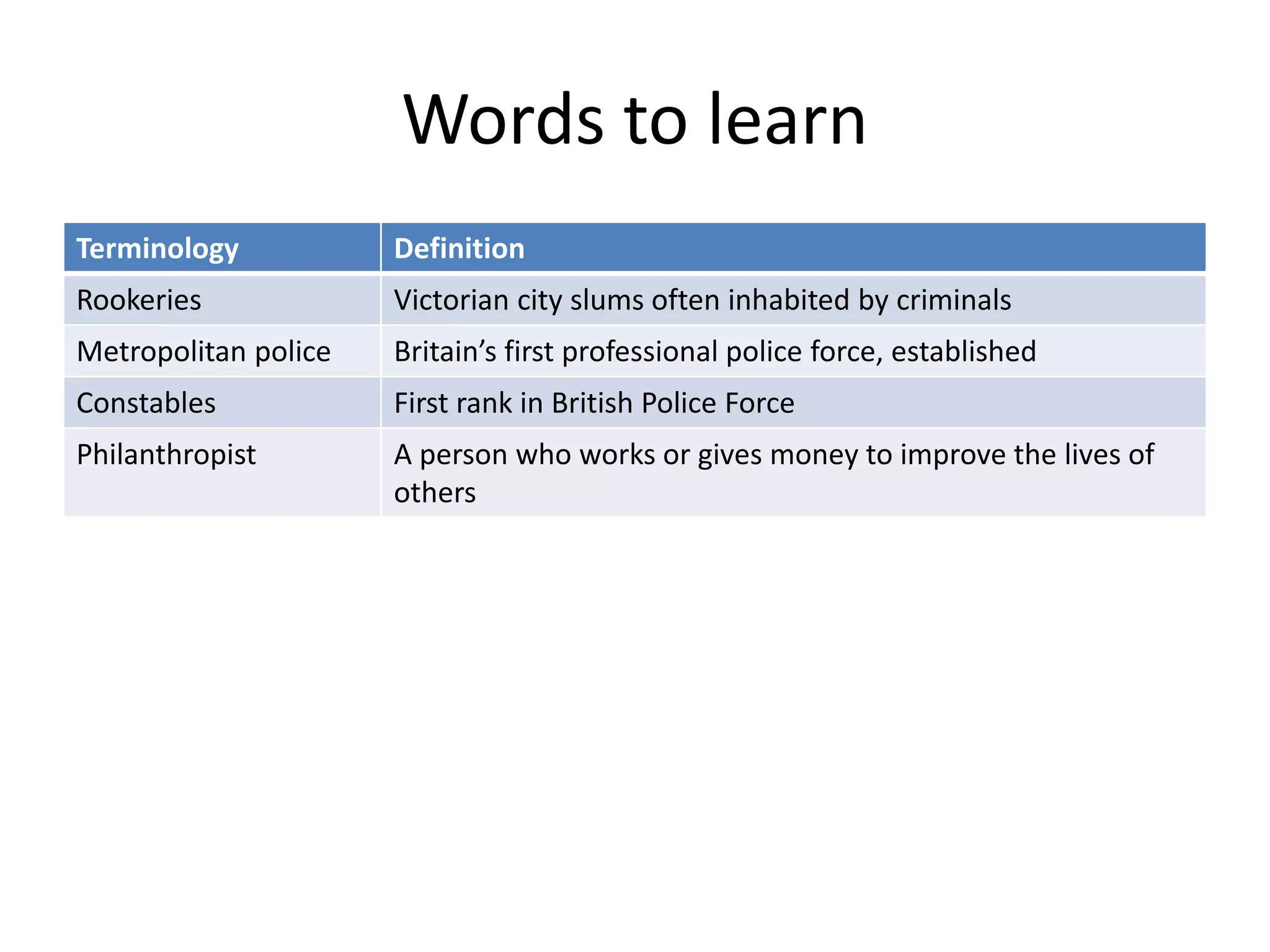
Terminology Definition
Rookeries Victorian city slums often inhabited by criminals
Metropolitan police Britain’s first professional police force, established
Constables First rank in British Police Force
Philanthropist A person who works or gives money to improve the lives of
others
Why the crime cases increase?
• As towns and cities filled
with inhabitants who were
strangers to one another,
crime became more
common
• Industrial change also
caused periodic waves of
unemployment leading to
riots and lawlessnes
• In 1812, Spencer Perceval
became Br first and Prime
Minister to be assassinated ,
shot dead by a dispossesed
businessman
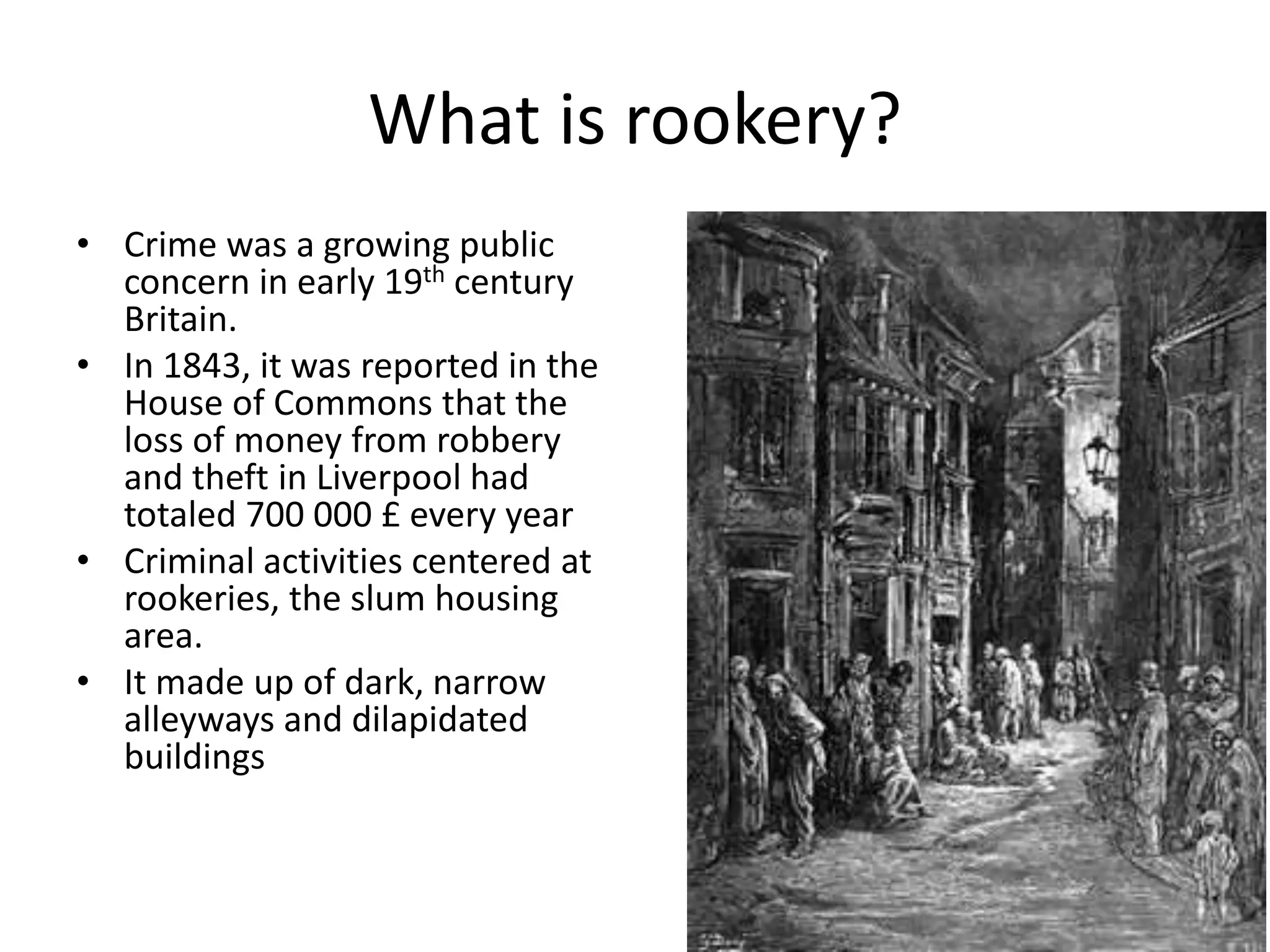
What is rookery?
• Crime was a growing public
concern in early 19th century
Britain.
• In 1843, it was reported in the
House of Commons that the
loss of money from robbery
and theft in Liverpool had
totaled 700 000 £ every year
• Criminal activities centered at
rookeries, the slum housing
area.
• It made up of dark, narrow
alleyways and dilapidated
buildings
What is it like living in rookery?
• According to Charles
Dickens, a London rookery
containing men and women
in every variety of scanty
(cheaply),
• and dirty apparel (dirty
clothes) ,
• lounging (sit and stand in
lazy way),
• scolding, drinking, smoking,
• squabbling (noises from
quarreling),
• fighting and swearing.
Police in Village - Nightwatchmen
• Throughout history,
urbanization has been
associated with increases in
crime and social disorder.
Britain in the 19th century
was no different.
• In Br rural towns and
villages, small communities
were largely able to police
themselves by appointing
night watchmen.
• They patrolling at night and
sometimes watch over
villagers crops from thieves.
Parish Constable
• also known as a petty constable,
was a law enforcement officer,
usually unpaid and part-time,
serving a parish.
• prevent crime within their parish;
beggars , disbanding rioters, and
take the criminal to courts
• Other duties (non safety)- Parish
constables were expected to
monitor trading
standards and pubs, catch rats,
restrain loose animals, light signal
beacons, provide local lodging and
transport for the military,
perform building control,
attend trials, and collect the parish
rates(tax).
Metropolitan Police Force
• Sir Robert Peel was the son
of a Lancashire cotton
manufacturer and a brilliant
politician.
• At the age of 34 he was
appointed Home Secretary.
• In 1829, Peel passed the
Metropolitan Police Act and
enforce 1000 full time
policemen in London street.
Metropolitan police and its duties
• Metropolitan Police Force had to
be over 5 foot 7 inches
• They were given blue tailcoat, belt,
and metal lined top hat
• Their tailcoats had stiff collars
preventing officers from being
strangled.
• Not to be seen as military forces,
Robert Peel suggested them not to
have fire arm instead they have
truncheons
• They were also known as bobbies
or peelers in honour of their
founder Robert Peel
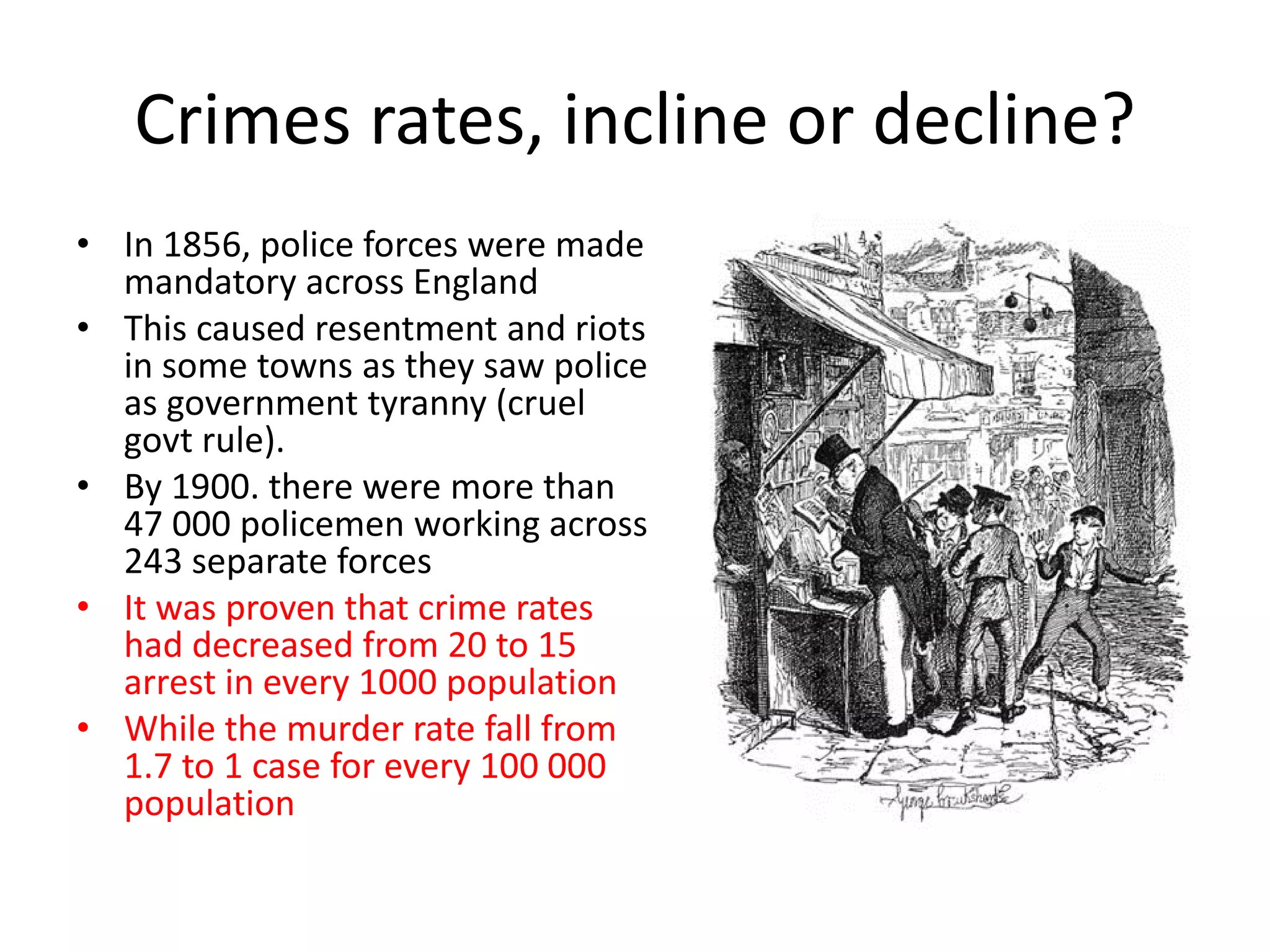
Crimes rates, incline or decline?
• In 1856, police forces were made
mandatory across England
• This caused resentment and riots
in some towns as they saw police
as government tyranny (cruel
govt rule).
• By 1900. there were more than
47 000 policemen working across
243 separate forces
• It was proven that crime rates
had decreased from 20 to 15
arrest in every 1000 population
• While the murder rate fall from
1.7 to 1 case for every 100 000
population
Notorious prison in Newgate
• In 1813, the Quaker philantropist
called Elizabeth Fry visited Newgate
prison (one of the most notorious
prison in London)
• She was outraged for what she
witnessed : 300 female prisoners
were cooking, washing and living in
just 2 cells
• Poorly clothed, slept on the floor line
with straws
• Some gave birth in prison and looking
after their babies, naked and crying in
cold
• The following day, she returned with
some food and clothes for them
Prison reform – Elizabeth Fry
• Fry encouraged Newgate prison
to establish a school for children
in prison and to keep female
prisoners occupied with
productive works such as sewing
and knitting
• She travelled the country to
promote prison reform.
• In 1818, parliament hold several
investigation in prisons and she
was invited to present evidence
in parliament and to be the first
woman in parliament to do so
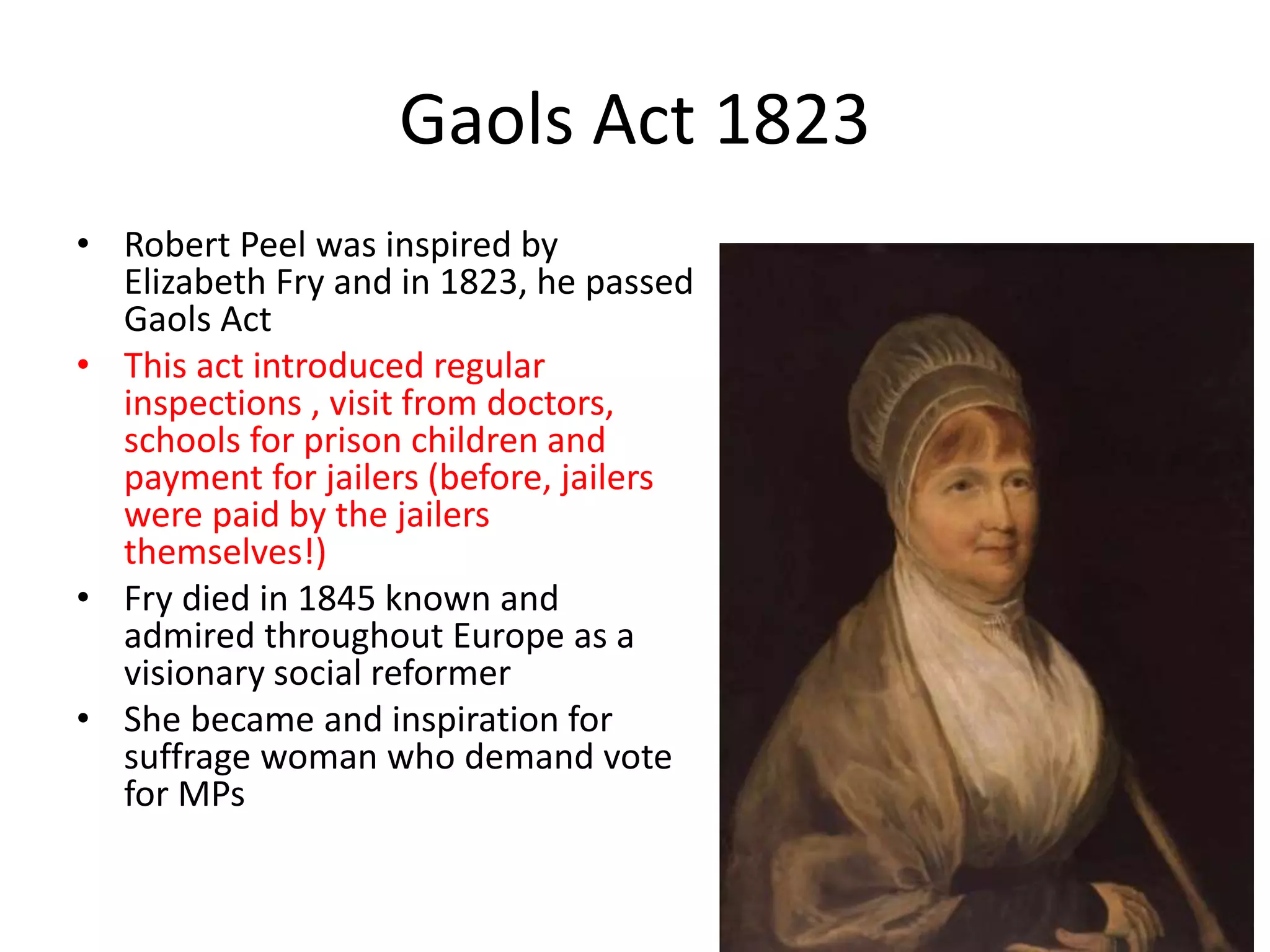
Gaols Act 1823
• Robert Peel was inspired by
Elizabeth Fry and in 1823, he passed
Gaols Act
• This act introduced regular
inspections , visit from doctors,
schools for prison children and
payment for jailers (before, jailers
were paid by the jailers
themselves!)
• Fry died in 1845 known and
admired throughout Europe as a
visionary social reformer
• She became and inspiration for
suffrage woman who demand vote
for MPs
Jack the ripper
• Between August and November
1888, 5 prostitutes were
murdered brutally
disembowelled in the east
London
• After the 2 murder, Scotland
yard (police force) received
letter claimed from the
murdered himself mocking the
police
• The letter ended in “good luck,
your truly, Jack the Ripper”
• The murdered was never
arrested and Jack the Ripper’s
identity is still debated until
today
Jack the Ripper’s victim
The End

Unit 5.5 law and order

  • 1.
    5.5 Law andorder The Age of Reform
  • 2.
    Words to learn TerminologyDefinition Rookeries Victorian city slums often inhabited by criminals Metropolitan police Britain’s first professional police force, established Constables First rank in British Police Force Philanthropist A person who works or gives money to improve the lives of others
  • 3.
    Why the crimecases increase? • As towns and cities filled with inhabitants who were strangers to one another, crime became more common • Industrial change also caused periodic waves of unemployment leading to riots and lawlessnes • In 1812, Spencer Perceval became Br first and Prime Minister to be assassinated , shot dead by a dispossesed businessman
  • 4.
    What is rookery? •Crime was a growing public concern in early 19th century Britain. • In 1843, it was reported in the House of Commons that the loss of money from robbery and theft in Liverpool had totaled 700 000 £ every year • Criminal activities centered at rookeries, the slum housing area. • It made up of dark, narrow alleyways and dilapidated buildings
  • 5.
    What is itlike living in rookery? • According to Charles Dickens, a London rookery containing men and women in every variety of scanty (cheaply), • and dirty apparel (dirty clothes) , • lounging (sit and stand in lazy way), • scolding, drinking, smoking, • squabbling (noises from quarreling), • fighting and swearing.
  • 6.
    Police in Village- Nightwatchmen • Throughout history, urbanization has been associated with increases in crime and social disorder. Britain in the 19th century was no different. • In Br rural towns and villages, small communities were largely able to police themselves by appointing night watchmen. • They patrolling at night and sometimes watch over villagers crops from thieves.
  • 7.
    Parish Constable • alsoknown as a petty constable, was a law enforcement officer, usually unpaid and part-time, serving a parish. • prevent crime within their parish; beggars , disbanding rioters, and take the criminal to courts • Other duties (non safety)- Parish constables were expected to monitor trading standards and pubs, catch rats, restrain loose animals, light signal beacons, provide local lodging and transport for the military, perform building control, attend trials, and collect the parish rates(tax).
  • 8.
    Metropolitan Police Force •Sir Robert Peel was the son of a Lancashire cotton manufacturer and a brilliant politician. • At the age of 34 he was appointed Home Secretary. • In 1829, Peel passed the Metropolitan Police Act and enforce 1000 full time policemen in London street.
  • 9.
    Metropolitan police andits duties • Metropolitan Police Force had to be over 5 foot 7 inches • They were given blue tailcoat, belt, and metal lined top hat • Their tailcoats had stiff collars preventing officers from being strangled. • Not to be seen as military forces, Robert Peel suggested them not to have fire arm instead they have truncheons • They were also known as bobbies or peelers in honour of their founder Robert Peel
  • 10.
    Crimes rates, inclineor decline? • In 1856, police forces were made mandatory across England • This caused resentment and riots in some towns as they saw police as government tyranny (cruel govt rule). • By 1900. there were more than 47 000 policemen working across 243 separate forces • It was proven that crime rates had decreased from 20 to 15 arrest in every 1000 population • While the murder rate fall from 1.7 to 1 case for every 100 000 population
  • 11.
    Notorious prison inNewgate • In 1813, the Quaker philantropist called Elizabeth Fry visited Newgate prison (one of the most notorious prison in London) • She was outraged for what she witnessed : 300 female prisoners were cooking, washing and living in just 2 cells • Poorly clothed, slept on the floor line with straws • Some gave birth in prison and looking after their babies, naked and crying in cold • The following day, she returned with some food and clothes for them
  • 12.
    Prison reform –Elizabeth Fry • Fry encouraged Newgate prison to establish a school for children in prison and to keep female prisoners occupied with productive works such as sewing and knitting • She travelled the country to promote prison reform. • In 1818, parliament hold several investigation in prisons and she was invited to present evidence in parliament and to be the first woman in parliament to do so
  • 13.
    Gaols Act 1823 •Robert Peel was inspired by Elizabeth Fry and in 1823, he passed Gaols Act • This act introduced regular inspections , visit from doctors, schools for prison children and payment for jailers (before, jailers were paid by the jailers themselves!) • Fry died in 1845 known and admired throughout Europe as a visionary social reformer • She became and inspiration for suffrage woman who demand vote for MPs
  • 14.
    Jack the ripper •Between August and November 1888, 5 prostitutes were murdered brutally disembowelled in the east London • After the 2 murder, Scotland yard (police force) received letter claimed from the murdered himself mocking the police • The letter ended in “good luck, your truly, Jack the Ripper” • The murdered was never arrested and Jack the Ripper’s identity is still debated until today
  • 15.
  • 16.