Unit 6.2 The Peasants Revolt
Unit 6 : Late medieval England
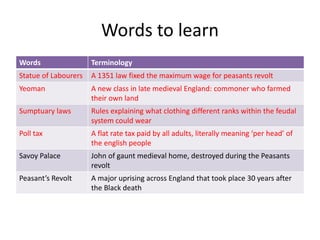
Words to learn
Words Terminology
Statue of Labourers A 1351 law fixed the maximum wage for peasants revolt
Yeoman A new class in late medieval England: commoner who farmed
their own land
Sumptuary laws Rules explaining what clothing different ranks within the feudal
system could wear
Poll tax A flat rate tax paid by all adults, literally meaning ‘per head’ of
the english people
Savoy Palace John of gaunt medieval home, destroyed during the Peasants
revolt
Peasant’s Revolt A major uprising across England that took place 30 years after
the Black death
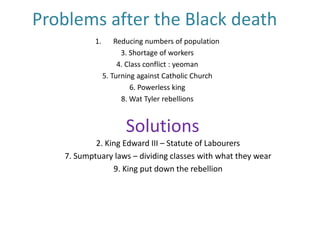
Problems after the Black death
1. Reducing numbers of population
3. Shortage of workers
4. Class conflict : yeoman
5. Turning against Catholic Church
6. Powerless king
8. Wat Tyler rebellions
Solutions
2. King Edward III – Statute of Labourers
7. Sumptuary laws – dividing classes with what they wear
9. King put down the rebellion
Problems after the black death
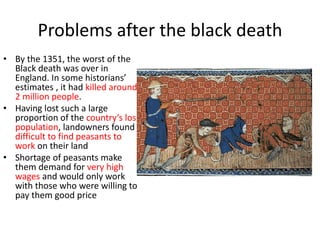
• By the 1351, the worst of the
Black death was over in
England. In some historians’
estimates , it had killed around
2 million people.
• Having lost such a large
proportion of the country’s loss
population, landowners found it
difficult to find peasants to
work on their land
• Shortage of peasants make
them demand for very high
wages and would only work
with those who were willing to
pay them good price
Was the solution effective?
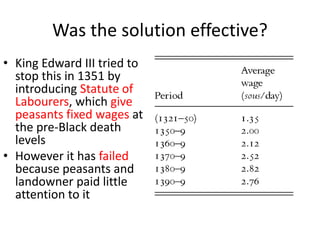
• King Edward III tried to
stop this in 1351 by
introducing Statute of
Labourers, which give
peasants fixed wages at
the pre-Black death
levels
• However it has failed
because peasants and
landowner paid little
attention to it
Class Conflict
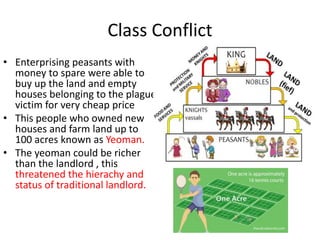
• Enterprising peasants with
money to spare were able to
buy up the land and empty
houses belonging to the plague
victim for very cheap price
• This people who owned new
houses and farm land up to
100 acres known as Yeoman.
• The yeoman could be richer
than the landlord , this
threatened the hierachy and
status of traditional landlord.
Turning against Catholic Church
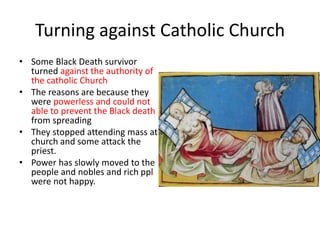
• Some Black Death survivor
turned against the authority of
the catholic Church
• The reasons are because they
were powerless and could not
able to prevent the Black death
from spreading
• They stopped attending mass at
church and some attack the
priest.
• Power has slowly moved to the
people and nobles and rich ppl
were not happy.
Dividing classes
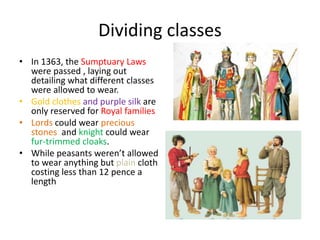
• In 1363, the Sumptuary Laws
were passed , laying out
detailing what different classes
were allowed to wear.
• Gold clothes and purple silk are
only reserved for Royal families
• Lords could wear precious
stones and knight could wear
fur-trimmed cloaks.
• While peasants weren’t allowed
to wear anything but plain cloth
costing less than 12 pence a
length
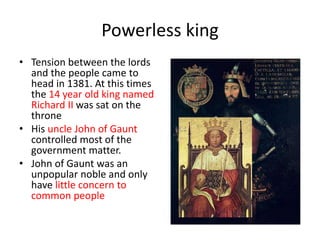
Powerless king
• Tension between the lords
and the people came to
head in 1381. At this times
the 14 year old king named
Richard II was sat on the
throne
• His uncle John of Gaunt
controlled most of the
government matter.
• John of Gaunt was an
unpopular noble and only
have little concern to
common people
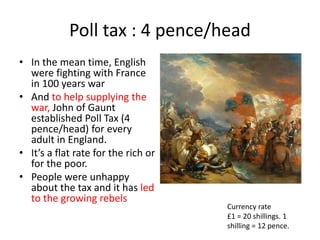
Poll tax : 4 pence/head
• In the mean time, English
were fighting with France
in 100 years war
• And to help supplying the
war, John of Gaunt
established Poll Tax (4
pence/head) for every
adult in England.
• It’s a flat rate for the rich or
for the poor.
• People were unhappy
about the tax and it has led
to the growing rebels
Currency rate
£1 = 20 shillings. 1
shilling = 12 pence.
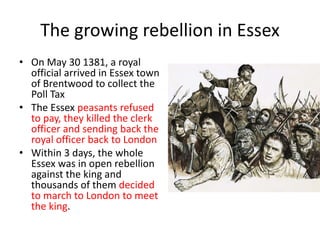
The growing rebellion in Essex
• On May 30 1381, a royal
official arrived in Essex town
of Brentwood to collect the
Poll Tax
• The Essex peasants refused
to pay, they killed the clerk
officer and sending back the
royal officer back to London
• Within 3 days, the whole
Essex was in open rebellion
against the king and
thousands of them decided
to march to London to meet
the king.
The rebellion’s leader : Wat Tyler
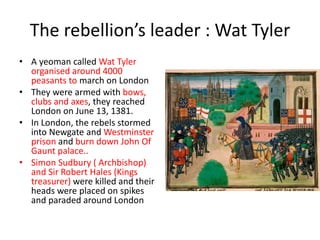
• A yeoman called Wat Tyler
organised around 4000
peasants to march on London
• They were armed with bows,
clubs and axes, they reached
London on June 13, 1381.
• In London, the rebels stormed
into Newgate and Westminster
prison and burn down John Of
Gaunt palace..
• Simon Sudbury ( Archbishop)
and Sir Robert Hales (Kings
treasurer) were killed and their
heads were placed on spikes
and paraded around London
Wat Tyler was killed
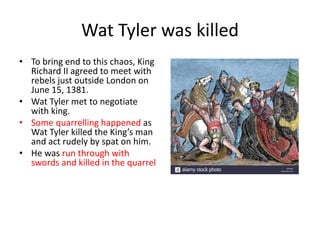
• To bring end to this chaos, King
Richard II agreed to meet with
rebels just outside London on
June 15, 1381.
• Wat Tyler met to negotiate
with king.
• Some quarrelling happened as
Wat Tyler killed the King’s man
and act rudely by spat on him.
• He was run through with
swords and killed in the quarrel
Richard Response
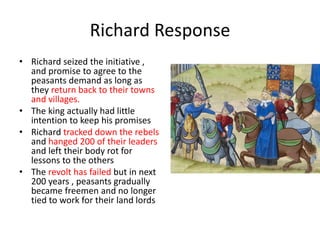
• Richard seized the initiative ,
and promise to agree to the
peasants demand as long as
they return back to their towns
and villages.
• The king actually had little
intention to keep his promises
• Richard tracked down the rebels
and hanged 200 of their leaders
and left their body rot for
lessons to the others
• The revolt has failed but in next
200 years , peasants gradually
became freemen and no longer
tied to work for their land lords

Unit 6.2 the peasants revolt

  • 1.
    Unit 6.2 ThePeasants Revolt Unit 6 : Late medieval England
  • 2.
    Words to learn WordsTerminology Statue of Labourers A 1351 law fixed the maximum wage for peasants revolt Yeoman A new class in late medieval England: commoner who farmed their own land Sumptuary laws Rules explaining what clothing different ranks within the feudal system could wear Poll tax A flat rate tax paid by all adults, literally meaning ‘per head’ of the english people Savoy Palace John of gaunt medieval home, destroyed during the Peasants revolt Peasant’s Revolt A major uprising across England that took place 30 years after the Black death
  • 3.
    Problems after theBlack death 1. Reducing numbers of population 3. Shortage of workers 4. Class conflict : yeoman 5. Turning against Catholic Church 6. Powerless king 8. Wat Tyler rebellions Solutions 2. King Edward III – Statute of Labourers 7. Sumptuary laws – dividing classes with what they wear 9. King put down the rebellion
  • 4.
    Problems after theblack death • By the 1351, the worst of the Black death was over in England. In some historians’ estimates , it had killed around 2 million people. • Having lost such a large proportion of the country’s loss population, landowners found it difficult to find peasants to work on their land • Shortage of peasants make them demand for very high wages and would only work with those who were willing to pay them good price
  • 5.
    Was the solutioneffective? • King Edward III tried to stop this in 1351 by introducing Statute of Labourers, which give peasants fixed wages at the pre-Black death levels • However it has failed because peasants and landowner paid little attention to it
  • 6.
    Class Conflict • Enterprisingpeasants with money to spare were able to buy up the land and empty houses belonging to the plague victim for very cheap price • This people who owned new houses and farm land up to 100 acres known as Yeoman. • The yeoman could be richer than the landlord , this threatened the hierachy and status of traditional landlord.
  • 7.
    Turning against CatholicChurch • Some Black Death survivor turned against the authority of the catholic Church • The reasons are because they were powerless and could not able to prevent the Black death from spreading • They stopped attending mass at church and some attack the priest. • Power has slowly moved to the people and nobles and rich ppl were not happy.
  • 8.
    Dividing classes • In1363, the Sumptuary Laws were passed , laying out detailing what different classes were allowed to wear. • Gold clothes and purple silk are only reserved for Royal families • Lords could wear precious stones and knight could wear fur-trimmed cloaks. • While peasants weren’t allowed to wear anything but plain cloth costing less than 12 pence a length
  • 9.
    Powerless king • Tensionbetween the lords and the people came to head in 1381. At this times the 14 year old king named Richard II was sat on the throne • His uncle John of Gaunt controlled most of the government matter. • John of Gaunt was an unpopular noble and only have little concern to common people
  • 10.
    Poll tax :4 pence/head • In the mean time, English were fighting with France in 100 years war • And to help supplying the war, John of Gaunt established Poll Tax (4 pence/head) for every adult in England. • It’s a flat rate for the rich or for the poor. • People were unhappy about the tax and it has led to the growing rebels Currency rate £1 = 20 shillings. 1 shilling = 12 pence.
  • 11.
    The growing rebellionin Essex • On May 30 1381, a royal official arrived in Essex town of Brentwood to collect the Poll Tax • The Essex peasants refused to pay, they killed the clerk officer and sending back the royal officer back to London • Within 3 days, the whole Essex was in open rebellion against the king and thousands of them decided to march to London to meet the king.
  • 12.
    The rebellion’s leader: Wat Tyler • A yeoman called Wat Tyler organised around 4000 peasants to march on London • They were armed with bows, clubs and axes, they reached London on June 13, 1381. • In London, the rebels stormed into Newgate and Westminster prison and burn down John Of Gaunt palace.. • Simon Sudbury ( Archbishop) and Sir Robert Hales (Kings treasurer) were killed and their heads were placed on spikes and paraded around London
  • 13.
    Wat Tyler waskilled • To bring end to this chaos, King Richard II agreed to meet with rebels just outside London on June 15, 1381. • Wat Tyler met to negotiate with king. • Some quarrelling happened as Wat Tyler killed the King’s man and act rudely by spat on him. • He was run through with swords and killed in the quarrel
  • 14.
    Richard Response • Richardseized the initiative , and promise to agree to the peasants demand as long as they return back to their towns and villages. • The king actually had little intention to keep his promises • Richard tracked down the rebels and hanged 200 of their leaders and left their body rot for lessons to the others • The revolt has failed but in next 200 years , peasants gradually became freemen and no longer tied to work for their land lords