The Islamic Civilization
Reported by:
Ms. Rodmie Colene M. Tamang
BSED-SS II-1
The Coming
of Islam
Arabia
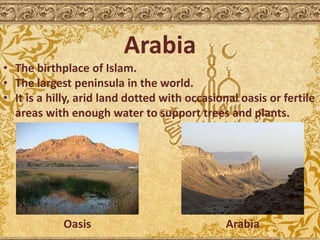
• The birthplace of Islam.
• The largest peninsula in the world.
• It is a hilly, arid land dotted with occasional oasis or fertile
areas with enough water to support trees and plants.
Oasis Arabia
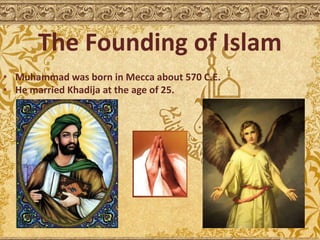
The Founding of Islam
• Muhammad was born in Mecca about 570 C.E.
• He married Khadija at the age of 25.
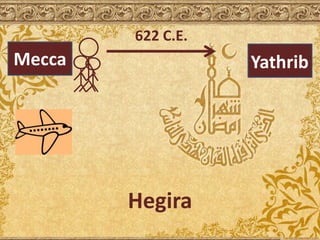
Mecca Yathrib
Hegira
622 C.E.
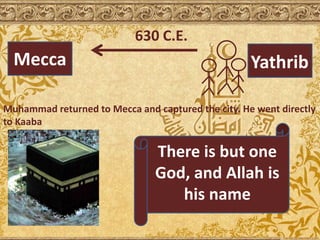
Mecca Yathrib
630 C.E.
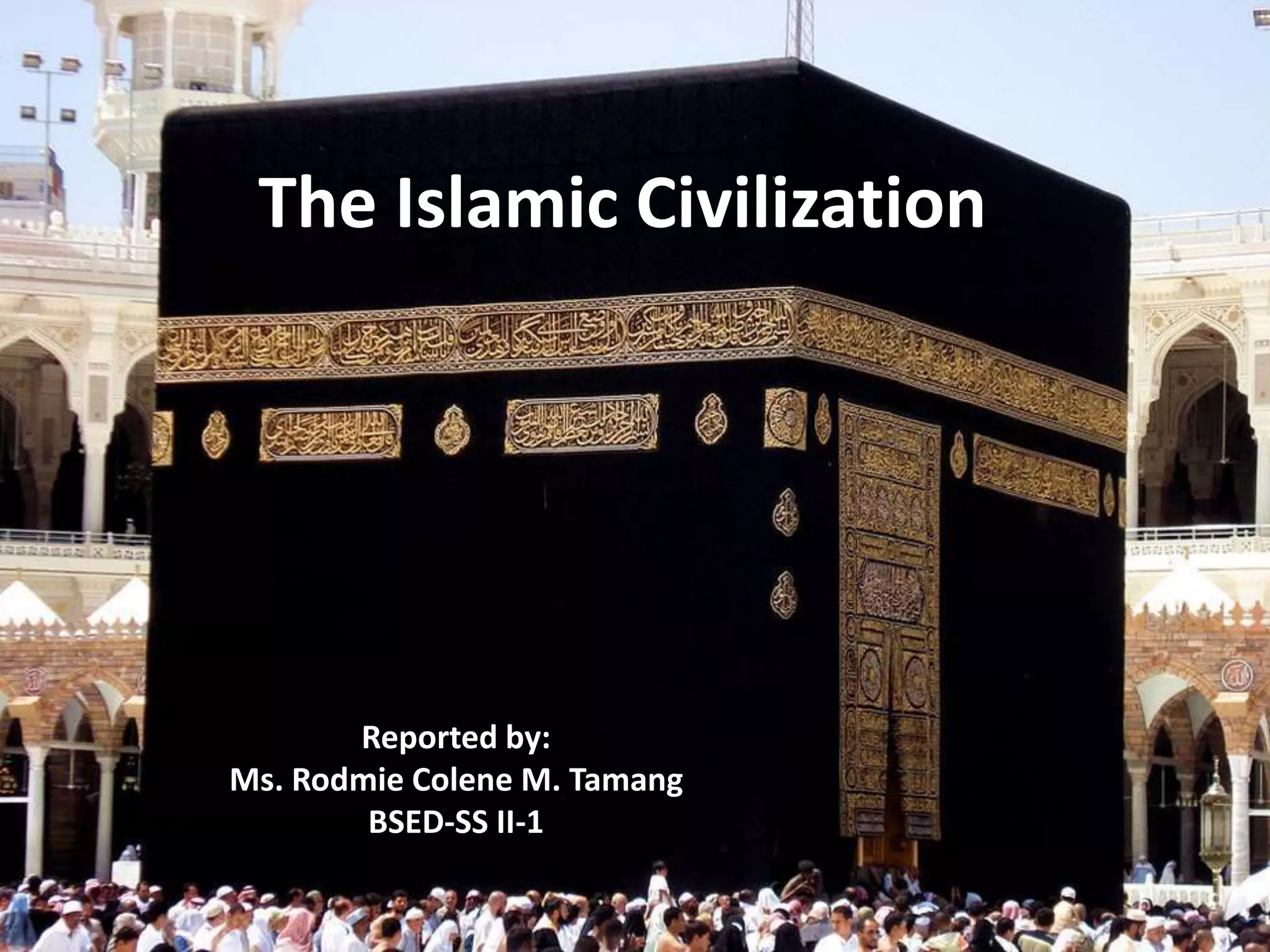
Muhammad returned to Mecca and captured the city. He went directly
to Kaaba
There is but one
God, and Allah is
his name
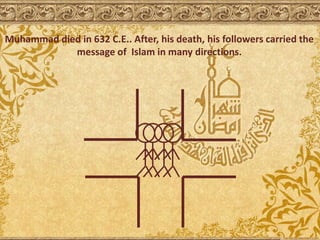
Muhammad died in 632 C.E.. After, his death, his followers carried the
message of Islam in many directions.
Teaching of Islam
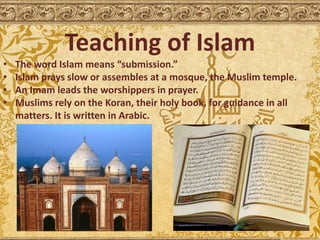
• The word Islam means “submission.”
• Islam prays slow or assembles at a mosque, the Muslim temple.
• An Imam leads the worshippers in prayer.
• Muslims rely on the Koran, their holy book, for guidance in all
matters. It is written in Arabic.
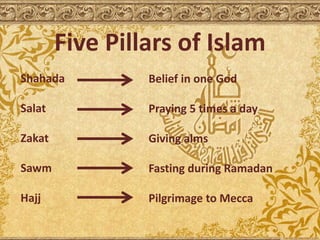
Five Pillars of Islam
Shahada
Salat
Zakat
Sawm
Hajj
Belief in one God
Praying 5 times a day
Giving alms
Fasting during Ramadan
Pilgrimage to Mecca
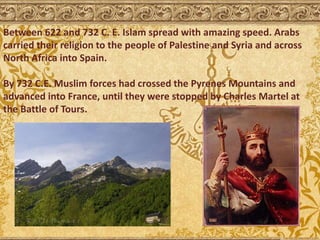
Between 622 and 732 C. E. Islam spread with amazing speed. Arabs
carried their religion to the people of Palestine and Syria and across
North Africa into Spain.
By 732 C.E. Muslim forces had crossed the Pyrenes Mountains and
advanced into France, until they were stopped by Charles Martel at
the Battle of Tours.
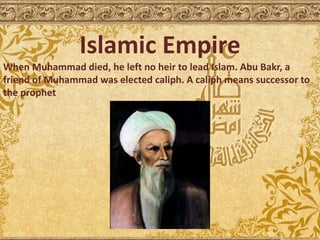
Islamic Empire
When Muhammad died, he left no heir to lead Islam. Abu Bakr, a
friend of Muhammad was elected caliph. A caliph means successor to
the prophet
The Umayyad Dynasty
• In 661 C.E. a leading family of Mecca established the Umayyad
Dynasty.
• The Umayyad made Damascus in Syria the capital of the Islamic
Empire.
• Mecca remained as the spiritual center of Islam.
Problems appeared within the Islamic Empire. Some of the people
who have been absorbed into the empire began to assert their
independence. And at the same time, two competing branches
developed within Islam.
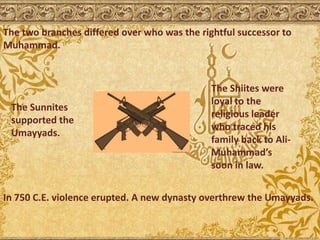
The two branches differed over who was the rightful successor to
Muhammad.
The Sunnites
supported the
Umayyads.
The Shiites were
loyal to the
religious leader
who traced his
family back to Ali-
Muhammad’s
soon in law.
In 750 C.E. violence erupted. A new dynasty overthrew the Umayyads.
The Abbasids Dynasty
The early Abbasid rulers were strong leaders. They build a splendid
new capital in Baghdad.
Around the year 700 under Harun Al-Rashid, the Islamic Empire
enjoyed the Golden Age. Later, Abbasid rulers left the rule of the
government to corrupt officials; and after 100 C.E., the empire
weakened.
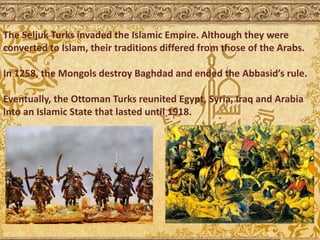
The Seljuk Turks invaded the Islamic Empire. Although they were
converted to Islam, their traditions differed from those of the Arabs.
In 1258, the Mongols destroy Baghdad and ended the Abbasid’s rule.
Eventually, the Ottoman Turks reunited Egypt, Syria, Iraq and Arabia
into an Islamic State that lasted until 1918.
The
Contribution
of Islam
Medicine
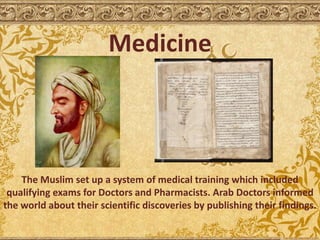
The Muslim set up a system of medical training which included
qualifying exams for Doctors and Pharmacists. Arab Doctors informed
the world about their scientific discoveries by publishing their findings.
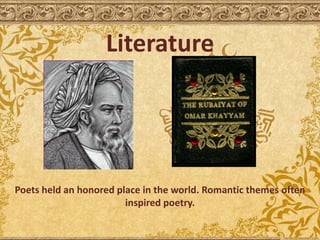
Literature
Poets held an honored place in the world. Romantic themes often
inspired poetry.
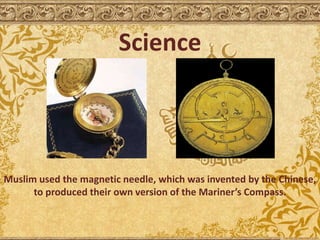
Science
Muslim used the magnetic needle, which was invented by the Chinese,
to produced their own version of the Mariner’s Compass.
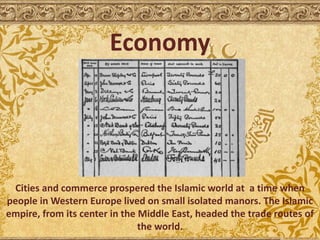
Economy
Cities and commerce prospered the Islamic world at a time when
people in Western Europe lived on small isolated manors. The Islamic
empire, from its center in the Middle East, headed the trade routes of
the world.
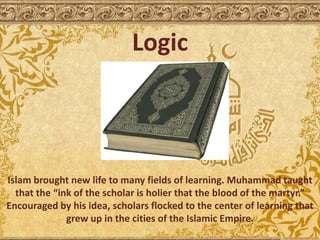
Logic
Islam brought new life to many fields of learning. Muhammad taught
that the “ink of the scholar is holier that the blood of the martyr.”
Encouraged by his idea, scholars flocked to the center of learning that
grew up in the cities of the Islamic Empire.
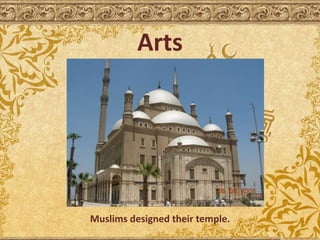
Arts
Muslims designed their temple.
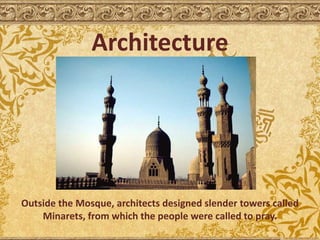
Architecture
Outside the Mosque, architects designed slender towers called
Minarets, from which the people were called to pray.
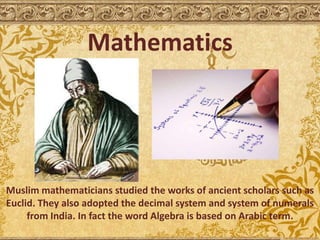
Mathematics
Muslim mathematicians studied the works of ancient scholars such as
Euclid. They also adopted the decimal system and system of numerals
from India. In fact the word Algebra is based on Arabic term.
The END 

The islamic civilization

  • 1.
    The Islamic Civilization Reportedby: Ms. Rodmie Colene M. Tamang BSED-SS II-1
  • 2.
  • 3.
    Arabia • The birthplaceof Islam. • The largest peninsula in the world. • It is a hilly, arid land dotted with occasional oasis or fertile areas with enough water to support trees and plants. Oasis Arabia
  • 4.
    The Founding ofIslam • Muhammad was born in Mecca about 570 C.E. • He married Khadija at the age of 25.
  • 5.
  • 6.
    Mecca Yathrib 630 C.E. Muhammadreturned to Mecca and captured the city. He went directly to Kaaba There is but one God, and Allah is his name
  • 7.
    Muhammad died in632 C.E.. After, his death, his followers carried the message of Islam in many directions.
  • 8.
    Teaching of Islam •The word Islam means “submission.” • Islam prays slow or assembles at a mosque, the Muslim temple. • An Imam leads the worshippers in prayer. • Muslims rely on the Koran, their holy book, for guidance in all matters. It is written in Arabic.
  • 9.
    Five Pillars ofIslam Shahada Salat Zakat Sawm Hajj Belief in one God Praying 5 times a day Giving alms Fasting during Ramadan Pilgrimage to Mecca
  • 10.
    Between 622 and732 C. E. Islam spread with amazing speed. Arabs carried their religion to the people of Palestine and Syria and across North Africa into Spain. By 732 C.E. Muslim forces had crossed the Pyrenes Mountains and advanced into France, until they were stopped by Charles Martel at the Battle of Tours.
  • 11.
    Islamic Empire When Muhammaddied, he left no heir to lead Islam. Abu Bakr, a friend of Muhammad was elected caliph. A caliph means successor to the prophet
  • 12.
    The Umayyad Dynasty •In 661 C.E. a leading family of Mecca established the Umayyad Dynasty. • The Umayyad made Damascus in Syria the capital of the Islamic Empire. • Mecca remained as the spiritual center of Islam. Problems appeared within the Islamic Empire. Some of the people who have been absorbed into the empire began to assert their independence. And at the same time, two competing branches developed within Islam.
  • 13.
    The two branchesdiffered over who was the rightful successor to Muhammad. The Sunnites supported the Umayyads. The Shiites were loyal to the religious leader who traced his family back to Ali- Muhammad’s soon in law. In 750 C.E. violence erupted. A new dynasty overthrew the Umayyads.
  • 14.
    The Abbasids Dynasty Theearly Abbasid rulers were strong leaders. They build a splendid new capital in Baghdad. Around the year 700 under Harun Al-Rashid, the Islamic Empire enjoyed the Golden Age. Later, Abbasid rulers left the rule of the government to corrupt officials; and after 100 C.E., the empire weakened.
  • 15.
    The Seljuk Turksinvaded the Islamic Empire. Although they were converted to Islam, their traditions differed from those of the Arabs. In 1258, the Mongols destroy Baghdad and ended the Abbasid’s rule. Eventually, the Ottoman Turks reunited Egypt, Syria, Iraq and Arabia into an Islamic State that lasted until 1918.
  • 16.
  • 17.
    Medicine The Muslim setup a system of medical training which included qualifying exams for Doctors and Pharmacists. Arab Doctors informed the world about their scientific discoveries by publishing their findings.
  • 18.
    Literature Poets held anhonored place in the world. Romantic themes often inspired poetry.
  • 19.
    Science Muslim used themagnetic needle, which was invented by the Chinese, to produced their own version of the Mariner’s Compass.
  • 20.
    Economy Cities and commerceprospered the Islamic world at a time when people in Western Europe lived on small isolated manors. The Islamic empire, from its center in the Middle East, headed the trade routes of the world.
  • 21.
    Logic Islam brought newlife to many fields of learning. Muhammad taught that the “ink of the scholar is holier that the blood of the martyr.” Encouraged by his idea, scholars flocked to the center of learning that grew up in the cities of the Islamic Empire.
  • 22.
  • 23.
    Architecture Outside the Mosque,architects designed slender towers called Minarets, from which the people were called to pray.
  • 24.
    Mathematics Muslim mathematicians studiedthe works of ancient scholars such as Euclid. They also adopted the decimal system and system of numerals from India. In fact the word Algebra is based on Arabic term.
  • 25.