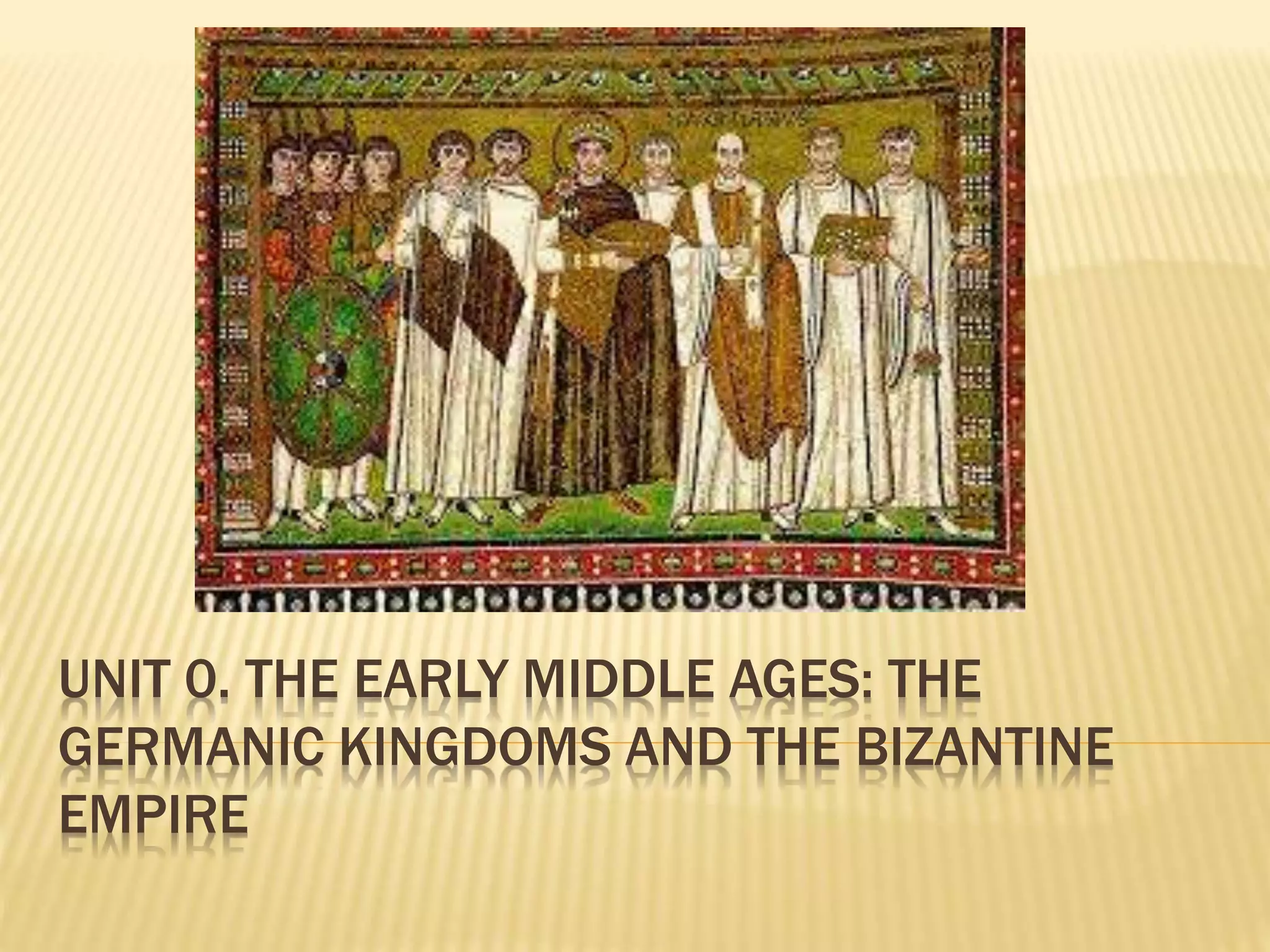
UNIT 0. THE EARLY MIDDLE AGES: THE
GERMANIC KINGDOMS AND THE BIZANTINE
EMPIRE
INDEX
1. The Decline of the Occidental Roman
Empire
2. The Germanics Migrations
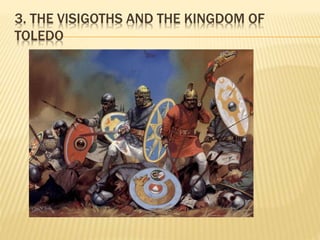
3. The visigoths and the Kingdom of
Toledo
4. Bizantine Empire
5. Art and Religion Bizantine and
Visigothic.
VOCABULARY OF THE UNIT
 Germanic Tribes  Tribus germánicas
 Barbarians  Bárbaros
 Foreigners  Extranjeros
 Frontier  Frontera
 Invasions  Invasiones
 Wester Roman Empire  Imperio Romano de Occidente
 Eastern Roman Empire  Imperio Romano de Oriente
 Middle Ages  Edad Media
 Weak –> Débil
 Weakness  Debilidad
 The Limes  Was a border defense that delimited the
Roman Empire in the north. And protected them from the
barbarians.
 Troops: tropas.
 Army: ejército
 Legion: legión
VOCABULARY: THE GERMANIC KINGDOMS
 Franks: francos
 Visigoths: visigodos
 Ostrogoths: ostrogodos
 Lombards: lombardos
 Angles: anglos
 Saxons: sajones
 Alans: alanos
 Suevi: suevos
 Vandals: vándalos
 Huns: hunos  They came from China
All of
them
were
different
Germanic
Kingdoms
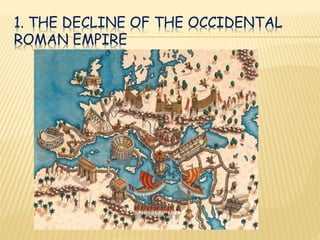
1. THE DECLINE OF THE OCCIDENTAL
ROMAN EMPIRE
1.1. THE PARTITION OF ROMAN EMPIRE
 During the IV century the Roman Empire
was suffering an internal crisis:
 Economical crisis
 The Germanic Tribes called barbarians by
the Romans were invading their territory.
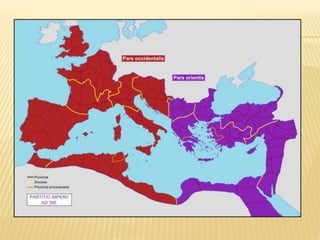
 His emperor Theodosius, in 395 divided the
empire between his two sons to make it
easier to defend.
 He created the Western Roman Empire and
the Easter Roman Empire
1.2. THE FALL OF THE ROMANS
 When Theodosius died, he left the Roman
Empire to his two sons in 395.
 Honorius took the West Empire
 Arcadius took the East Empire
 But the new emperors were weak, for this
reason the Germanic tribes thought that it
was a good time to attack.
 Roman generals also saw the weakness and
they revolted. One of them was
Constantine III. He wanted to declare to
himself emperor in 405. During his revolt a
big problem was approaching to the
occidental empire.
1.3. BARBARIANS INVASIONS
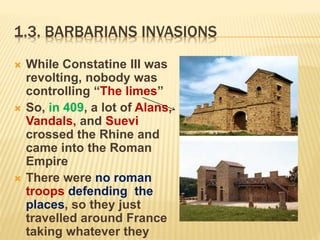
 While Constatine III was
revolting, nobody was
controlling “The limes”
 So, in 409, a lot of Alans,
Vandals, and Suevi
crossed the Rhine and
came into the Roman
Empire
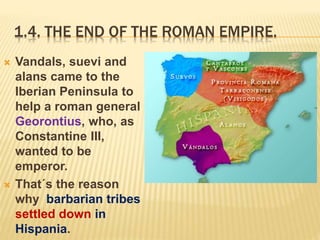
 There were no roman
troops defending the
places, so they just
travelled around France
taking whatever they
1.4. THE END OF THE ROMAN EMPIRE.
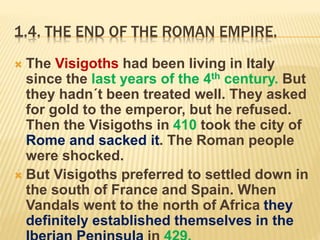
 Vandals, suevi and
alans came to the
Iberian Peninsula to
help a roman general
Georontius, who, as
Constantine III,
wanted to be
emperor.
 That´s the reason
why barbarian tribes
settled down in
Hispania.
1.4. THE END OF THE ROMAN EMPIRE.
 The Visigoths had been living in Italy
since the last years of the 4th century. But
they hadn´t been treated well. They asked
for gold to the emperor, but he refused.
Then the Visigoths in 410 took the city of
Rome and sacked it. The Roman people
were shocked.
 But Visigoths preferred to settled down in
the south of France and Spain. When
Vandals went to the north of Africa they
definitely established themselves in the
 The Germanic Attacks were bigger and
more frequent during the 5th century.
 For example: Atila, the hun, went to Rome
in 452 and it was on the verge of collapse.
 The last emperor: Romulus Augustulus
was finally deposed in 476. That date
mark the finish of the Ancient Ages and
the beginning of the Middle Ages.
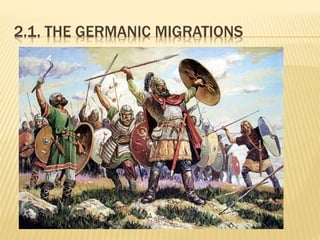
2.1. THE GERMANIC MIGRATIONS
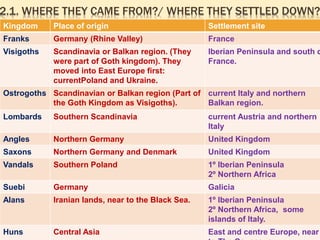
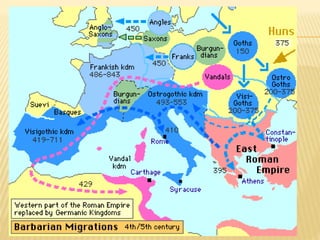
2.1. WHERE THEY CAME FROM?/ WHERE THEY SETTLED DOWN?
Kingdom Place of origin Settlement site
Franks Germany (Rhine Valley) France
Visigoths Scandinavia or Balkan region. (They
were part of Goth kingdom). They
moved into East Europe first:
currentPoland and Ukraine.
Iberian Peninsula and south o
France.
Ostrogoths Scandinavian or Balkan region (Part of
the Goth Kingdom as Visigoths).
current Italy and northern
Balkan region.
Lombards Southern Scandinavia current Austria and northern
Italy
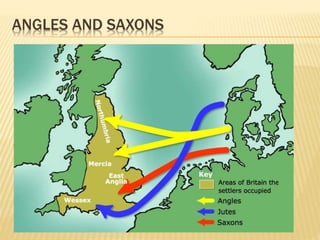
Angles Northern Germany United Kingdom
Saxons Northern Germany and Denmark United Kingdom
Vandals Southern Poland 1º Iberian Peninsula
2º Northern Africa
Suebi Germany Galicia
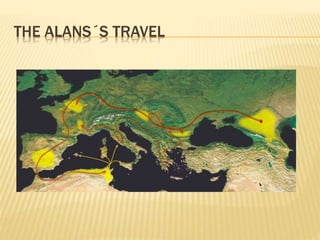
Alans Iranian lands, near to the Black Sea. 1º Iberian Peninsula
2º Northern Africa, some
islands of Italy.
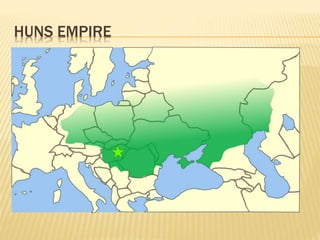
Huns Central Asia East and centre Europe, near
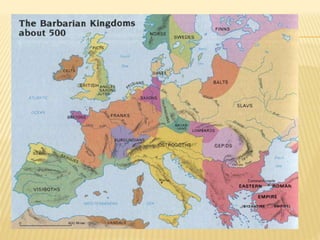
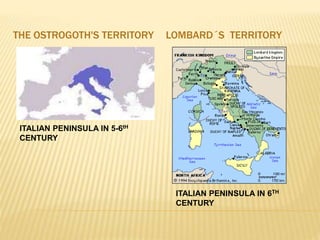
THE OSTROGOTH'S TERRITORY LOMBARD´S TERRITORY
ITALIAN PENINSULA IN 5-6tH
CENTURY
ITALIAN PENINSULA IN 6TH
CENTURY
ANGLES AND SAXONS
THE ALANS´S TRAVEL
HUNS EMPIRE
2.2. SOCIETY AND ECONOMY
 The Germanic Kingdoms inherited the
organization of the Empire. But, their
lifestyle was completely different.
 It was difficult to travel along so many
different tribes. Consequently, there was
very little long-distance trade, and many
industries disappeared. (Trade decreased)
 Cities declined, and people moved to the
countryside for safety and more job
opportunities.
 Rural lifestyle
 The main economical activities were:
2.3. CULTURE, RELIGION AND JUSTICE
 They had a war
culture. Tribes were
always fighting each
other.
 Barbarian Religion:
 Polytheistic: Gods
from nature
 Valhalla – warriors´
heaven
 Animal and human
sacrifices
JUSTICE:
 Trial by combat: the
winner of the fight
was innocent or
winner of the dispute.
 Trial by ordeal: the
guilt or innocence of
the accused was
determined by an
unpleasant, and
dangerous
experience.
2.3. HOW WAS THEIR CULTURE?
 Cultural activity also declined.
 At first, Germanic tribes had different
laws, customs and religions.
 By the sixth century some Germanic
Kingdoms assumed features from the
Romans like the language Latin, the law:
roman law, and the religion: Christianity.
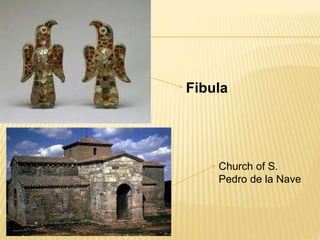
 Some examples of Germanic art have
survived, such as small churches and
jewellery.
Fibula
Church of S.
Pedro de la Nave
3. THE VISIGOTHS AND THE KINGDOM OF
TOLEDO
3.1. WHO WERE THE VISIGOTHS?
 The Visigoths entered the Roman Empire at
the end of the 4th century to escape from the
Huns.
 In 410, the Visigoths attacked and sacked
Rome.
 Years later, they firmed a foedus deal. It
consisted on a treatment between Romans
and Visigoths for what Romans allowed
German People to establish in a concrete
area of the Empire, and visigoths helped
them to expel other Germanic people
 In exchange they received lands in south-
east of France.
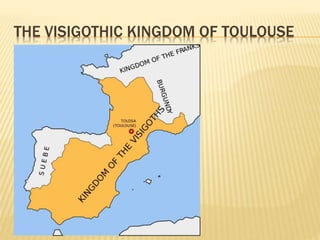
 The Visigoths formed a kingdom in the
south of France and the north of Iberian
Peninsula, whose capital was Toulouse.
 But, the Franks, in 507 expelled the
Visigoths from this part and they went to
the Iberian Peninsula. They founded a
new Kingdom, and made Toledo its
capital.
THE VISIGOTHIC KINGDOM OF TOULOUSE
3.3. THE KINGDOM OF TOLEDO (507-711)
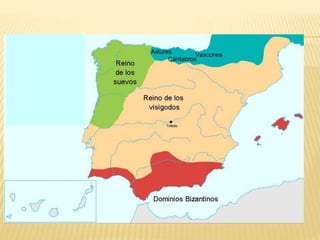
 Between the 6th and 7th century reached
its peak, they controlled the current Spain
with some exceptions.
 In Galicia were the Suevi, and the
southeast was controlled by the
Byzantine Empire.
 There was a territory that had never been
conquered: cantabrians and basques.
 The kings more relevant were
LEOVIGILD, who extended his territory
fighting the Byzantines, and conquered some
of its territories. And they definitely expelled
the suevi in 585
RECCARED became a Catholic in 589,
and his Kingdom also became Catholic.
 RECESVINTO: he created a legal code in
which all citizens were equal.
 RODRIGO was the last of the king.
WHAT´S THE FINAL OF THE KINGDOM OF
TOLEDO?
 Since the Witiza´s reign the visigothic
monarchy entered a process of decline.
 The sons of Witiza: Rodrigo and Agila
faced each other for the crown. The
winner was Rodrigo.
 Immediately after, they faced again in a
civil war. Agila asked help from muslims.
 The muslims came and defeated Rodrigo
in the battle of Guadalete in 711, and they
began the invasion.
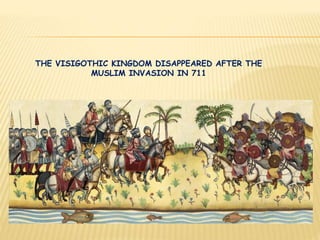
THE VISIGOTHIC KINGDOM DISAPPEARED AFTER THE
MUSLIM INVASION IN 711

Unit 0 the early middle ages

  • 1.
    UNIT 0. THEEARLY MIDDLE AGES: THE GERMANIC KINGDOMS AND THE BIZANTINE EMPIRE
  • 2.
    INDEX 1. The Declineof the Occidental Roman Empire 2. The Germanics Migrations 3. The visigoths and the Kingdom of Toledo 4. Bizantine Empire 5. Art and Religion Bizantine and Visigothic.
  • 3.
    VOCABULARY OF THEUNIT  Germanic Tribes  Tribus germánicas  Barbarians  Bárbaros  Foreigners  Extranjeros  Frontier  Frontera  Invasions  Invasiones  Wester Roman Empire  Imperio Romano de Occidente  Eastern Roman Empire  Imperio Romano de Oriente  Middle Ages  Edad Media  Weak –> Débil  Weakness  Debilidad  The Limes  Was a border defense that delimited the Roman Empire in the north. And protected them from the barbarians.  Troops: tropas.  Army: ejército  Legion: legión
  • 4.
    VOCABULARY: THE GERMANICKINGDOMS  Franks: francos  Visigoths: visigodos  Ostrogoths: ostrogodos  Lombards: lombardos  Angles: anglos  Saxons: sajones  Alans: alanos  Suevi: suevos  Vandals: vándalos  Huns: hunos  They came from China All of them were different Germanic Kingdoms
  • 5.
    1. THE DECLINEOF THE OCCIDENTAL ROMAN EMPIRE
  • 6.
    1.1. THE PARTITIONOF ROMAN EMPIRE  During the IV century the Roman Empire was suffering an internal crisis:  Economical crisis  The Germanic Tribes called barbarians by the Romans were invading their territory.  His emperor Theodosius, in 395 divided the empire between his two sons to make it easier to defend.  He created the Western Roman Empire and the Easter Roman Empire
  • 8.
    1.2. THE FALLOF THE ROMANS  When Theodosius died, he left the Roman Empire to his two sons in 395.  Honorius took the West Empire  Arcadius took the East Empire  But the new emperors were weak, for this reason the Germanic tribes thought that it was a good time to attack.  Roman generals also saw the weakness and they revolted. One of them was Constantine III. He wanted to declare to himself emperor in 405. During his revolt a big problem was approaching to the occidental empire.
  • 9.
  • 10.
    1.3. BARBARIANS INVASIONS While Constatine III was revolting, nobody was controlling “The limes”  So, in 409, a lot of Alans, Vandals, and Suevi crossed the Rhine and came into the Roman Empire  There were no roman troops defending the places, so they just travelled around France taking whatever they
  • 11.
    1.4. THE ENDOF THE ROMAN EMPIRE.  Vandals, suevi and alans came to the Iberian Peninsula to help a roman general Georontius, who, as Constantine III, wanted to be emperor.  That´s the reason why barbarian tribes settled down in Hispania.
  • 12.
    1.4. THE ENDOF THE ROMAN EMPIRE.  The Visigoths had been living in Italy since the last years of the 4th century. But they hadn´t been treated well. They asked for gold to the emperor, but he refused. Then the Visigoths in 410 took the city of Rome and sacked it. The Roman people were shocked.  But Visigoths preferred to settled down in the south of France and Spain. When Vandals went to the north of Africa they definitely established themselves in the
  • 13.
     The GermanicAttacks were bigger and more frequent during the 5th century.  For example: Atila, the hun, went to Rome in 452 and it was on the verge of collapse.  The last emperor: Romulus Augustulus was finally deposed in 476. That date mark the finish of the Ancient Ages and the beginning of the Middle Ages.
  • 14.
  • 15.
    2.1. WHERE THEYCAME FROM?/ WHERE THEY SETTLED DOWN? Kingdom Place of origin Settlement site Franks Germany (Rhine Valley) France Visigoths Scandinavia or Balkan region. (They were part of Goth kingdom). They moved into East Europe first: currentPoland and Ukraine. Iberian Peninsula and south o France. Ostrogoths Scandinavian or Balkan region (Part of the Goth Kingdom as Visigoths). current Italy and northern Balkan region. Lombards Southern Scandinavia current Austria and northern Italy Angles Northern Germany United Kingdom Saxons Northern Germany and Denmark United Kingdom Vandals Southern Poland 1º Iberian Peninsula 2º Northern Africa Suebi Germany Galicia Alans Iranian lands, near to the Black Sea. 1º Iberian Peninsula 2º Northern Africa, some islands of Italy. Huns Central Asia East and centre Europe, near
  • 18.
    THE OSTROGOTH'S TERRITORYLOMBARD´S TERRITORY ITALIAN PENINSULA IN 5-6tH CENTURY ITALIAN PENINSULA IN 6TH CENTURY
  • 19.
  • 20.
  • 21.
  • 22.
    2.2. SOCIETY ANDECONOMY  The Germanic Kingdoms inherited the organization of the Empire. But, their lifestyle was completely different.  It was difficult to travel along so many different tribes. Consequently, there was very little long-distance trade, and many industries disappeared. (Trade decreased)  Cities declined, and people moved to the countryside for safety and more job opportunities.  Rural lifestyle  The main economical activities were:
  • 23.
    2.3. CULTURE, RELIGIONAND JUSTICE  They had a war culture. Tribes were always fighting each other.  Barbarian Religion:  Polytheistic: Gods from nature  Valhalla – warriors´ heaven  Animal and human sacrifices JUSTICE:  Trial by combat: the winner of the fight was innocent or winner of the dispute.  Trial by ordeal: the guilt or innocence of the accused was determined by an unpleasant, and dangerous experience.
  • 24.
    2.3. HOW WASTHEIR CULTURE?  Cultural activity also declined.  At first, Germanic tribes had different laws, customs and religions.  By the sixth century some Germanic Kingdoms assumed features from the Romans like the language Latin, the law: roman law, and the religion: Christianity.  Some examples of Germanic art have survived, such as small churches and jewellery.
  • 25.
  • 26.
    3. THE VISIGOTHSAND THE KINGDOM OF TOLEDO
  • 27.
    3.1. WHO WERETHE VISIGOTHS?  The Visigoths entered the Roman Empire at the end of the 4th century to escape from the Huns.  In 410, the Visigoths attacked and sacked Rome.  Years later, they firmed a foedus deal. It consisted on a treatment between Romans and Visigoths for what Romans allowed German People to establish in a concrete area of the Empire, and visigoths helped them to expel other Germanic people
  • 28.
     In exchangethey received lands in south- east of France.  The Visigoths formed a kingdom in the south of France and the north of Iberian Peninsula, whose capital was Toulouse.  But, the Franks, in 507 expelled the Visigoths from this part and they went to the Iberian Peninsula. They founded a new Kingdom, and made Toledo its capital.
  • 29.
  • 30.
    3.3. THE KINGDOMOF TOLEDO (507-711)  Between the 6th and 7th century reached its peak, they controlled the current Spain with some exceptions.  In Galicia were the Suevi, and the southeast was controlled by the Byzantine Empire.  There was a territory that had never been conquered: cantabrians and basques.
  • 32.
     The kingsmore relevant were LEOVIGILD, who extended his territory fighting the Byzantines, and conquered some of its territories. And they definitely expelled the suevi in 585 RECCARED became a Catholic in 589, and his Kingdom also became Catholic.  RECESVINTO: he created a legal code in which all citizens were equal.  RODRIGO was the last of the king.
  • 33.
    WHAT´S THE FINALOF THE KINGDOM OF TOLEDO?  Since the Witiza´s reign the visigothic monarchy entered a process of decline.  The sons of Witiza: Rodrigo and Agila faced each other for the crown. The winner was Rodrigo.  Immediately after, they faced again in a civil war. Agila asked help from muslims.  The muslims came and defeated Rodrigo in the battle of Guadalete in 711, and they began the invasion.
  • 34.
    THE VISIGOTHIC KINGDOMDISAPPEARED AFTER THE MUSLIM INVASION IN 711