SOFTWARE
DEFINED
RADIO
PRESENTATION OVERVIEW
Definition
History
SDR advantages
Motivation toward SDR
Technical overview
Architecture
Software Overview
DEFINITION
What’s SDR
Software-defined radio (SDR) is a radio communication system where
components that have been typically implemented in hardware
(e.g. mixers ,filters , amplifiers , modulators /demodulators
, detectors , etc.) are instead implemented by means of software on
a personal computer or embedded system.
HISTORY OF SDR
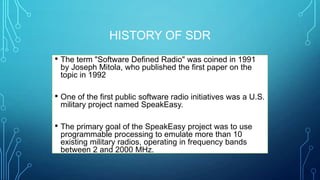
• The term "Software Defined Radio" was coined in 1991
by Joseph Mitola, who published the first paper on the
topic in 1992
• One of the first public software radio initiatives was a U.S.
military project named SpeakEasy.
• The primary goal of the SpeakEasy project was to use
programmable processing to emulate more than 10
existing military radios, operating in frequency bands
between 2 and 2000 MHz.
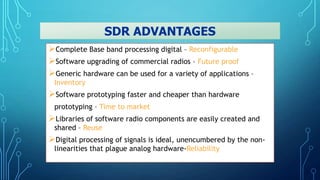
Complete Base band processing digital – Reconfigurable
Software upgrading of commercial radios – Future proof
Generic hardware can be used for a variety of applications –
Inventory
Software prototyping faster and cheaper than hardware
prototyping – Time to market
Libraries of software radio components are easily created and
shared – Reuse
Digital processing of signals is ideal, unencumbered by the non-
linearities that plague analog hardware-Reliability
SDR ADVANTAGES
MOTIVATION TOWARDS SDR
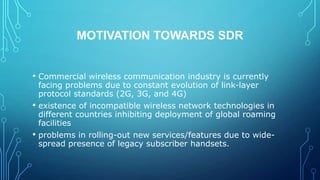
• Commercial wireless communication industry is currently
facing problems due to constant evolution of link-layer
protocol standards (2G, 3G, and 4G)
• existence of incompatible wireless network technologies in
different countries inhibiting deployment of global roaming
facilities
• problems in rolling-out new services/features due to wide-
spread presence of legacy subscriber handsets.
TECHNICAL OVERVIEW
• IDEAL SDR
• IDEAL RECEIVER
• IDEAL TRANSMITTER
• PRACTICAL RECEIVERS
• TYPICAL COMPONENTS
IDEAL SDR
• The ideal SDR will cover all frequencies from 9kHz to 300GHz.
• •It will receive/transmit and modulate/demodulate all modulation
modes and bandwidths
• •It will configure itself automatically.
•
IDEAL TRANSMITTER AND
RECEIVER
• The ideal receiver scheme would be to attach an analog-to-
digital converter to an antenna to directly convert RF to digital.
• A digital signal processor would read the converter, and then its
software would transform the stream of data from the converter
to any other form the application requires.
• An ideal transmitter would be similar.
• A digital signal processor would generate a stream of numbers.
These would be sent to a digital-to-analog converter connected
to a radio antenna.
PRACTICAL RECEIVERS
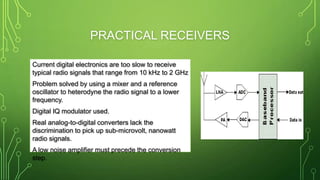
Current digital electronics are too slow to receive
typical radio signals that range from 10 kHz to 2 GHz
Problem solved by using a mixer and a reference
oscillator to heterodyne the radio signal to a lower
frequency.
Digital IQ modulator used.
Real analog-to-digital converters lack the
discrimination to pick up sub-microvolt, nanowatt
radio signals.
A low noise amplifier must precede the conversion
step.
Typical Components of SDR
 Analog Radio Frequency (RF) receiver/transmitter in the 200 MHz to
multi-gigahertz range.
 High-speed A/D and D/A converters to digitize a wide portion of the
spectrum at 25 to 210 Msamples/sec.
 High-speed front-end signal processing including Digital Down
Conversion (DDC) consisting of one or more chains of mix + filter +
decimate or up conversion.
 Spread spectrum and ultra wideband techniques allow several
transmitters to transmit in the same place on the same frequency
with very little interference
 PC equipped with sound card
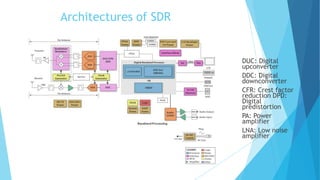
Architectures of SDR
DUC: Digital
upconverter
DDC: Digital
downconverter
CFR: Crest factor
reduction DPD:
Digital
predistortion
PA: Power
amplifier
LNA: Low noise
amplifier
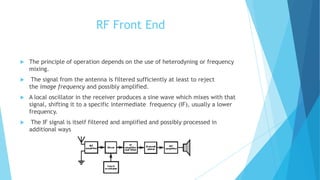
RF Front End
 The principle of operation depends on the use of heterodyning or frequency
mixing.
 The signal from the antenna is filtered sufficiently at least to reject
the image frequency and possibly amplified.
 A local oscillator in the receiver produces a sine wave which mixes with that
signal, shifting it to a specific intermediate frequency (IF), usually a lower
frequency.
 The IF signal is itself filtered and amplified and possibly processed in
additional ways
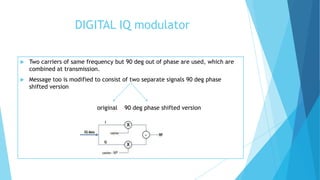
DIGITAL IQ modulator
 Two carriers of same frequency but 90 deg out of phase are used, which are
combined at transmission.
 Message too is modified to consist of two separate signals 90 deg phase
shifted version
original 90 deg phase shifted version
ADC & DAC
 ADC- Sampling ( Nyquist theorem)
Quantisation
Flash ADC is the fastest of all.
 DAC- weighted resistor
R-2R ladder V(out)= V( ref)* (D/2^N)
The main problem in both directions is the difficulty of conversion between the
digital and the analog domains at a high enough rate and a high enough accuracy
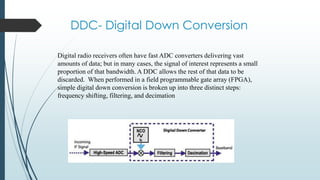
DDC- Digital Down Conversion
Digital radio receivers often have fast ADC converters delivering vast
amounts of data; but in many cases, the signal of interest represents a small
proportion of that bandwidth. A DDC allows the rest of that data to be
discarded. When performed in a field programmable gate array (FPGA),
simple digital down conversion is broken up into three distinct steps:
frequency shifting, filtering, and decimation
DUC-Digital Up Conversion
 Digital radio transmitters use DAC, A DUC is used to generate an IF signal
and increase the sampling rate. The DUC process is the exact inverse of the
DDC process. Instead of down conversion and decimation, a DUC uses
interpolation and up conversion.
 Interpolation, or up sampling, translates a low sample rate modulated
signal into a much higher sample rate signal that is ready for up conversion.
This step, often performed in software, can multiply the overall waveform
size by any factor.
 Finally, the modulated, interpolated data mixes with a carrier that
upconverts the baseband signal to the required carrier frequency.
Crest factor REDUCTION (CFR)
 Crest factor is a measure of a waveform, such as alternating current or
sound, showing the ratio of peak values to the average value. In other
words, crest factor indicates how extreme the peaks are in a waveform
 modulation techniques that have smaller crest factors usually transmit more
bits per second than modulation techniques that have higher crest factors.
 Crest factor reduction (CFR) reduces the output peak-to-average ratio by
clipping . We can operate closer to the amplifier compression
point, therefore it is more efficient.
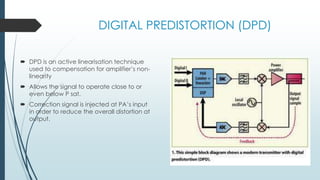
DIGITAL PREDISTORTION (DPD)
 DPD is an active linearisation technique
used to compensation for amplifier’s non-
linearity
 Allows the signal to operate close to or
even below P sat.
 Correction signal is injected at PA’s input
in order to reduce the overall distortion at
output.
FPGA
 SDR system uses a generic hardware platform with programmable modules
(DSPs, FPGAs, microprocessors) and analog RF modules
 FPGAs (Field Programmable Gate Arrays) are amazing devices that now
allow the average person to create their very own digital circuits.
 It is an IC that could contain million of logic gates that can be electrically
configured to perform a certain task using HDL ( Hardware Description
Languages)
 More flexible than microcontroller.
Software Overview
 Digital Signal Processing (DSP) software applications
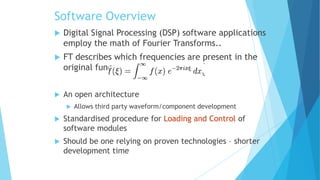
employ the math of Fourier Transforms..
 FT describes which frequencies are present in the
original function.
 An open architecture
 Allows third party waveform/component development
 Standardised procedure for Loading and Control of
software modules
 Should be one relying on proven technologies – shorter
development time
QUESTIONS

Sdr seminar

  • 1.
  • 2.
    PRESENTATION OVERVIEW Definition History SDR advantages Motivationtoward SDR Technical overview Architecture Software Overview
  • 3.
    DEFINITION What’s SDR Software-defined radio(SDR) is a radio communication system where components that have been typically implemented in hardware (e.g. mixers ,filters , amplifiers , modulators /demodulators , detectors , etc.) are instead implemented by means of software on a personal computer or embedded system.
  • 4.
    HISTORY OF SDR •The term "Software Defined Radio" was coined in 1991 by Joseph Mitola, who published the first paper on the topic in 1992 • One of the first public software radio initiatives was a U.S. military project named SpeakEasy. • The primary goal of the SpeakEasy project was to use programmable processing to emulate more than 10 existing military radios, operating in frequency bands between 2 and 2000 MHz.
  • 5.
    Complete Base bandprocessing digital – Reconfigurable Software upgrading of commercial radios – Future proof Generic hardware can be used for a variety of applications – Inventory Software prototyping faster and cheaper than hardware prototyping – Time to market Libraries of software radio components are easily created and shared – Reuse Digital processing of signals is ideal, unencumbered by the non- linearities that plague analog hardware-Reliability SDR ADVANTAGES
  • 6.
    MOTIVATION TOWARDS SDR •Commercial wireless communication industry is currently facing problems due to constant evolution of link-layer protocol standards (2G, 3G, and 4G) • existence of incompatible wireless network technologies in different countries inhibiting deployment of global roaming facilities • problems in rolling-out new services/features due to wide- spread presence of legacy subscriber handsets.
  • 7.
    TECHNICAL OVERVIEW • IDEALSDR • IDEAL RECEIVER • IDEAL TRANSMITTER • PRACTICAL RECEIVERS • TYPICAL COMPONENTS
  • 8.
    IDEAL SDR • Theideal SDR will cover all frequencies from 9kHz to 300GHz. • •It will receive/transmit and modulate/demodulate all modulation modes and bandwidths • •It will configure itself automatically. •
  • 9.
    IDEAL TRANSMITTER AND RECEIVER •The ideal receiver scheme would be to attach an analog-to- digital converter to an antenna to directly convert RF to digital. • A digital signal processor would read the converter, and then its software would transform the stream of data from the converter to any other form the application requires. • An ideal transmitter would be similar. • A digital signal processor would generate a stream of numbers. These would be sent to a digital-to-analog converter connected to a radio antenna.
  • 10.
    PRACTICAL RECEIVERS Current digitalelectronics are too slow to receive typical radio signals that range from 10 kHz to 2 GHz Problem solved by using a mixer and a reference oscillator to heterodyne the radio signal to a lower frequency. Digital IQ modulator used. Real analog-to-digital converters lack the discrimination to pick up sub-microvolt, nanowatt radio signals. A low noise amplifier must precede the conversion step.
  • 11.
    Typical Components ofSDR  Analog Radio Frequency (RF) receiver/transmitter in the 200 MHz to multi-gigahertz range.  High-speed A/D and D/A converters to digitize a wide portion of the spectrum at 25 to 210 Msamples/sec.  High-speed front-end signal processing including Digital Down Conversion (DDC) consisting of one or more chains of mix + filter + decimate or up conversion.  Spread spectrum and ultra wideband techniques allow several transmitters to transmit in the same place on the same frequency with very little interference  PC equipped with sound card
  • 12.
    Architectures of SDR DUC:Digital upconverter DDC: Digital downconverter CFR: Crest factor reduction DPD: Digital predistortion PA: Power amplifier LNA: Low noise amplifier
  • 13.
    RF Front End The principle of operation depends on the use of heterodyning or frequency mixing.  The signal from the antenna is filtered sufficiently at least to reject the image frequency and possibly amplified.  A local oscillator in the receiver produces a sine wave which mixes with that signal, shifting it to a specific intermediate frequency (IF), usually a lower frequency.  The IF signal is itself filtered and amplified and possibly processed in additional ways
  • 14.
    DIGITAL IQ modulator Two carriers of same frequency but 90 deg out of phase are used, which are combined at transmission.  Message too is modified to consist of two separate signals 90 deg phase shifted version original 90 deg phase shifted version
  • 15.
    ADC & DAC ADC- Sampling ( Nyquist theorem) Quantisation Flash ADC is the fastest of all.  DAC- weighted resistor R-2R ladder V(out)= V( ref)* (D/2^N) The main problem in both directions is the difficulty of conversion between the digital and the analog domains at a high enough rate and a high enough accuracy
  • 16.
    DDC- Digital DownConversion Digital radio receivers often have fast ADC converters delivering vast amounts of data; but in many cases, the signal of interest represents a small proportion of that bandwidth. A DDC allows the rest of that data to be discarded. When performed in a field programmable gate array (FPGA), simple digital down conversion is broken up into three distinct steps: frequency shifting, filtering, and decimation
  • 17.
    DUC-Digital Up Conversion Digital radio transmitters use DAC, A DUC is used to generate an IF signal and increase the sampling rate. The DUC process is the exact inverse of the DDC process. Instead of down conversion and decimation, a DUC uses interpolation and up conversion.  Interpolation, or up sampling, translates a low sample rate modulated signal into a much higher sample rate signal that is ready for up conversion. This step, often performed in software, can multiply the overall waveform size by any factor.  Finally, the modulated, interpolated data mixes with a carrier that upconverts the baseband signal to the required carrier frequency.
  • 18.
    Crest factor REDUCTION(CFR)  Crest factor is a measure of a waveform, such as alternating current or sound, showing the ratio of peak values to the average value. In other words, crest factor indicates how extreme the peaks are in a waveform  modulation techniques that have smaller crest factors usually transmit more bits per second than modulation techniques that have higher crest factors.  Crest factor reduction (CFR) reduces the output peak-to-average ratio by clipping . We can operate closer to the amplifier compression point, therefore it is more efficient.
  • 19.
    DIGITAL PREDISTORTION (DPD) DPD is an active linearisation technique used to compensation for amplifier’s non- linearity  Allows the signal to operate close to or even below P sat.  Correction signal is injected at PA’s input in order to reduce the overall distortion at output.
  • 20.
    FPGA  SDR systemuses a generic hardware platform with programmable modules (DSPs, FPGAs, microprocessors) and analog RF modules  FPGAs (Field Programmable Gate Arrays) are amazing devices that now allow the average person to create their very own digital circuits.  It is an IC that could contain million of logic gates that can be electrically configured to perform a certain task using HDL ( Hardware Description Languages)  More flexible than microcontroller.
  • 21.
    Software Overview  DigitalSignal Processing (DSP) software applications employ the math of Fourier Transforms..  FT describes which frequencies are present in the original function.  An open architecture  Allows third party waveform/component development  Standardised procedure for Loading and Control of software modules  Should be one relying on proven technologies – shorter development time
  • 22.