UNIT-II(PART-2)
MAGNETIC PARTICLE
TESTING
PRESENTED BY-
SHIVAM SHARMA
Magnetic Particle Testing
This method is suitable for the detection of
surface and near surface discontinuities in
magnetic material, mainly ferrite steel and
iron. Magnetic particle Testing (MPT) is a
nondestructive testing method used for
defect detection. MPT is fast and relatively
easy to apply, and material surface
preparation is not as critical as it is for
some other NDT methods.
2
6/3/2021 SHIVAM SHARMA
In the first figure the magnetized metal has no crack and there only two
poles that is north pole and south pole. And in second figure the
magnetized metal has a crack and at the crack point there creates
another north and south pole for the magnetic flux leakage.
S
N
S N
N S
Magnetic Flux Line
Fig.1: Magnetized Metal with no crack Fig.2: Magnetized Metal with crack
Crack
Magnetic Flux Leakage
Basic Principle of MPT
6/3/2021 SHIVAM SHARMA 3
4
Magnetic Particle Testing
Process
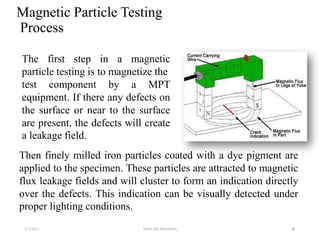
The first step in a magnetic
particle testing is to magnetize the
test component by a MPT
equipment. If there any defects on
the surface or near to the surface
are present, the defects will create
a leakage field.
Then finely milled iron particles coated with a dye pigment are
applied to the specimen. These particles are attracted to magnetic
flux leakage fields and will cluster to form an indication directly
over the defects. This indication can be visually detected under
proper lighting conditions.
6/3/2021 SHIVAM SHARMA
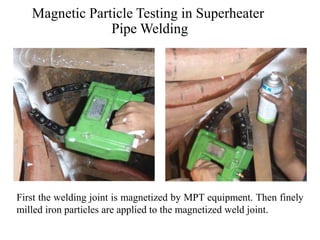
Magnetic Particle Testing in Superheater
Pipe Welding
First the welding joint is magnetized by MPT equipment. Then finely
milled iron particles are applied to the magnetized weld joint.
Magnetic Particle Testing in Gas
Pipe Welding
6
Iron particles make a
cluster at the welding
joint for magnetic
flux leakage because
of welding defects.
Cluster
6/3/2021 SHIVAM SHARMA
It does not need very stringent pre-cleaning operation.
It is the best method for the detection of surface and near to the
surface cracks in ferromagnetic materials.
Fast and relatively simple NDT method.
Generally inexpensive.
Will work through thin coating.
Highly portable NDT method.
It is quicker.
7
Advantages Magnetic Particle
Testing
6/3/2021 SHIVAM SHARMA
Limitations of Magnetic Particle
Testing
Material must be ferromagnetic.
Orientation and strength of magnetic field is critical.
Detects surface and near-to-surface discontinuities only.
Large currents sometimes require.
.
8
6/3/2021 SHIVAM SHARMA
2. Magnetic Particle Inspection (MPI)
2.1 Introduction
• A nondestructive testing method used for defect detection. Fast and relatively
easy to apply and part surface preparation is not as critical as for some other
NDT methods. – MPI one of the most widely utilized nondestructive testing
methods.
• MPI uses magnetic fields and small magnetic particles, such as iron filings to
detect flaws in components. The only requirement from an inspectability
standpoint is that the component being inspected must be made of a
ferromagnetic material such as iron, nickel, cobalt, or some of their alloys.
Ferromagnetic materials are materials that can be magnetized to a level that
will allow the inspection to be affective.
• The method is used to inspect a variety of product forms such as castings,
forgings, and weldments. Many different industries use magnetic particle
inspection for determining a component's fitness-for-use. Some examples of
industries that use magnetic particle inspection are the structural steel,
automotive, petrochemical, power generation, and aerospace industries.
Underwater inspection is another area where magnetic particle inspection may
be used to test such things as offshore structures and underwater pipelines.
6/3/2021 SHIVAM SHARMA 9
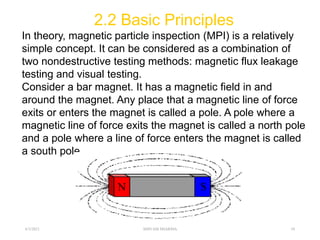
2.2 Basic Principles
In theory, magnetic particle inspection (MPI) is a relatively
simple concept. It can be considered as a combination of
two nondestructive testing methods: magnetic flux leakage
testing and visual testing.
Consider a bar magnet. It has a magnetic field in and
around the magnet. Any place that a magnetic line of force
exits or enters the magnet is called a pole. A pole where a
magnetic line of force exits the magnet is called a north pole
and a pole where a line of force enters the magnet is called
a south pole.
6/3/2021 SHIVAM SHARMA 10
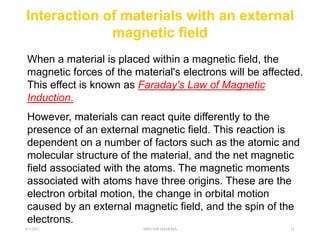
Interaction of materials with an external
magnetic field
When a material is placed within a magnetic field, the
magnetic forces of the material's electrons will be affected.
This effect is known as Faraday's Law of Magnetic
Induction.
However, materials can react quite differently to the
presence of an external magnetic field. This reaction is
dependent on a number of factors such as the atomic and
molecular structure of the material, and the net magnetic
field associated with the atoms. The magnetic moments
associated with atoms have three origins. These are the
electron orbital motion, the change in orbital motion
caused by an external magnetic field, and the spin of the
electrons.
6/3/2021 SHIVAM SHARMA 11
Diamagnetic, Paramagnetic, and
Ferromagnetic Materials
Diamagnetic metals: very weak and negative susceptibility
to magnetic fields. Diamagnetic materials are slightly
repelled by a magnetic field and the material does not retain
the magnetic properties when the external field is removed.
Paramagnetic metals: small and positive susceptibility to
magnetic fields. These materials are slightly attracted by a
magnetic field and the material does not retain the magnetic
properties when the external field is removed.
Ferromagnetic materials: large and positive susceptibility
to an external magnetic field. They exhibit a strong
attraction to magnetic fields and are able to retain their
magnetic properties after the external field has been
removed.
6/3/2021 SHIVAM SHARMA 12
Ferromagnetic materials become magnetized when the
magnetic domains within the material are aligned. This can be
done by placing the material in a strong external magnetic field or
by passes electrical current through the material. Some or all of
the domains can become aligned. The more domains that are
aligned, the stronger the magnetic field in the material. When all
of the domains are aligned, the material is said to be magnetically
saturated. When a material is magnetically saturated, no
additional amount of external magnetization force will cause an
increase in its internal level of magnetization.
Unmagnetized material Magnetized material
6/3/2021 SHIVAM SHARMA 13
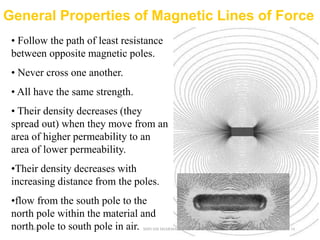
General Properties of Magnetic Lines of Force
• Follow the path of least resistance
between opposite magnetic poles.
• Never cross one another.
• All have the same strength.
• Their density decreases (they
spread out) when they move from an
area of higher permeability to an
area of lower permeability.
•Their density decreases with
increasing distance from the poles.
•flow from the south pole to the
north pole within the material and
north pole to south pole in air.
6/3/2021 SHIVAM SHARMA 14
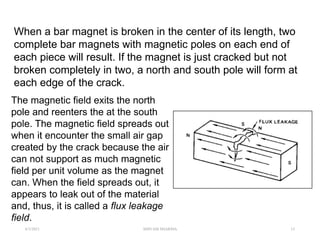
When a bar magnet is broken in the center of its length, two
complete bar magnets with magnetic poles on each end of
each piece will result. If the magnet is just cracked but not
broken completely in two, a north and south pole will form at
each edge of the crack.
The magnetic field exits the north
pole and reenters the at the south
pole. The magnetic field spreads out
when it encounter the small air gap
created by the crack because the air
can not support as much magnetic
field per unit volume as the magnet
can. When the field spreads out, it
appears to leak out of the material
and, thus, it is called a flux leakage
field.
6/3/2021 SHIVAM SHARMA 15
If iron particles are sprinkled on a cracked magnet, the particles will
be attracted to and cluster not only at the poles at the ends of the
magnet but also at the poles at the edges of the crack. This cluster
of particles is much easier to see than the actual crack and this is
the basis for magnetic particle inspection.
6/3/2021 SHIVAM SHARMA 16
Magnetic Particle Inspection
• The magnetic flux line close to the surface of a
ferromagnetic material tends to follow the surface
profile of the material
• Discontinuities (cracks or voids) of the material
perpendicular to the flux lines cause fringing of
the magnetic flux lines, i.e. flux leakage
• The leakage field can attract other ferromagnetic
particles
6/3/2021 SHIVAM SHARMA 17
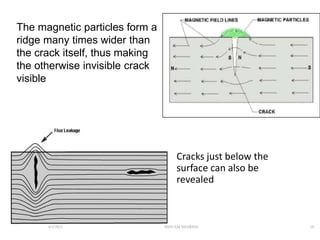
Cracks just below the
surface can also be
revealed
The magnetic particles form a
ridge many times wider than
the crack itself, thus making
the otherwise invisible crack
visible
6/3/2021 SHIVAM SHARMA 18
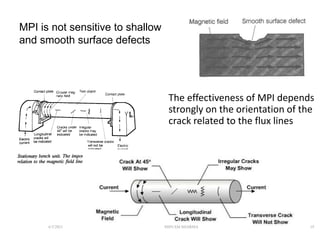
The effectiveness of MPI depends
strongly on the orientation of the
crack related to the flux lines
MPI is not sensitive to shallow
and smooth surface defects
6/3/2021 SHIVAM SHARMA 19
2.3 Testing Procedure of MPI
•Cleaning
•Demagnetization
•Contrast dyes (e.g. white paint for dark particles)
•Magnetizing the object
•Addition of magnetic particles
•Illumination during inspection (e.g. UV lamp)
•Interpretation
•Demagnetization - prevent accumulation of iron
particles or influence to sensitive instruments
6/3/2021 SHIVAM SHARMA 20
• Indirect magnetization: using a strong external magnetic
field to establish a magnetic field within the component
(a) permanent magnets
(b) Electromagnets
(c) coil shot
6/3/2021 SHIVAM SHARMA 22
Some Standards for MPI Procedure
• British Standards
• BS M.35: Aerospace Series: Magnetic Particle Flaw Detection of
Materials and Components
• BS 4397: Methods for magnetic particle testing of welds
• ASTM Standards
• ASTM E 709-80: Standard Practice for Magnetic Particle Examination
• ASTM E 125-63: Standard reference photographs for magnetic
particle indications on ferrous castings
• etc….
6/3/2021 SHIVAM SHARMA 27
2.4 Advantages of MPI
• One of the most dependable and sensitive methods for
surface defects
• fast, simple and inexpensive
• direct, visible indication on surface
• unaffected by possible deposits, e.g. oil, grease or other
metals chips, in the cracks
• can be used on painted objects
• surface preparation not required
• results readily documented with photo or tape impression
6/3/2021 SHIVAM SHARMA 28
2.5 Limitations of MPI
• Only good for ferromagnetic materials
• sub-surface defects will not always be indicated
• relative direction between the magnetic field and the
defect line is important
• objects must be demagnetized before and after the
examination
• the current magnetization may cause burn scars on the
item examined
6/3/2021 SHIVAM SHARMA 29
Examples of visible dry magnetic particle indications
Indication of a crack in a saw blade Indication of cracks in a weldment
Before and after inspection pictures of
Indication of cracks running between
attachment holes in a hinge
6/3/2021 SHIVAM SHARMA 30
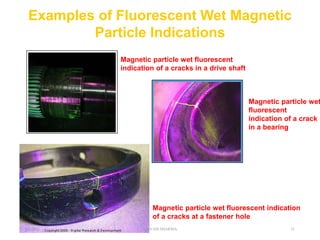
Examples of Fluorescent Wet Magnetic
Particle Indications
Magnetic particle wet fluorescent
indication of a cracks in a drive shaft
Magnetic particle wet
fluorescent
indication of a crack
in a bearing
Magnetic particle wet fluorescent indication
of a cracks at a fastener hole
6/3/2021 SHIVAM SHARMA 31
6/3/2021 SHIVAM SHARMA 32

Unit 2 magnetic particle testing part 2

  • 1.
  • 2.
    Magnetic Particle Testing Thismethod is suitable for the detection of surface and near surface discontinuities in magnetic material, mainly ferrite steel and iron. Magnetic particle Testing (MPT) is a nondestructive testing method used for defect detection. MPT is fast and relatively easy to apply, and material surface preparation is not as critical as it is for some other NDT methods. 2 6/3/2021 SHIVAM SHARMA
  • 3.
    In the firstfigure the magnetized metal has no crack and there only two poles that is north pole and south pole. And in second figure the magnetized metal has a crack and at the crack point there creates another north and south pole for the magnetic flux leakage. S N S N N S Magnetic Flux Line Fig.1: Magnetized Metal with no crack Fig.2: Magnetized Metal with crack Crack Magnetic Flux Leakage Basic Principle of MPT 6/3/2021 SHIVAM SHARMA 3
  • 4.
    4 Magnetic Particle Testing Process Thefirst step in a magnetic particle testing is to magnetize the test component by a MPT equipment. If there any defects on the surface or near to the surface are present, the defects will create a leakage field. Then finely milled iron particles coated with a dye pigment are applied to the specimen. These particles are attracted to magnetic flux leakage fields and will cluster to form an indication directly over the defects. This indication can be visually detected under proper lighting conditions. 6/3/2021 SHIVAM SHARMA
  • 5.
    Magnetic Particle Testingin Superheater Pipe Welding First the welding joint is magnetized by MPT equipment. Then finely milled iron particles are applied to the magnetized weld joint.
  • 6.
    Magnetic Particle Testingin Gas Pipe Welding 6 Iron particles make a cluster at the welding joint for magnetic flux leakage because of welding defects. Cluster 6/3/2021 SHIVAM SHARMA
  • 7.
    It does notneed very stringent pre-cleaning operation. It is the best method for the detection of surface and near to the surface cracks in ferromagnetic materials. Fast and relatively simple NDT method. Generally inexpensive. Will work through thin coating. Highly portable NDT method. It is quicker. 7 Advantages Magnetic Particle Testing 6/3/2021 SHIVAM SHARMA
  • 8.
    Limitations of MagneticParticle Testing Material must be ferromagnetic. Orientation and strength of magnetic field is critical. Detects surface and near-to-surface discontinuities only. Large currents sometimes require. . 8 6/3/2021 SHIVAM SHARMA
  • 9.
    2. Magnetic ParticleInspection (MPI) 2.1 Introduction • A nondestructive testing method used for defect detection. Fast and relatively easy to apply and part surface preparation is not as critical as for some other NDT methods. – MPI one of the most widely utilized nondestructive testing methods. • MPI uses magnetic fields and small magnetic particles, such as iron filings to detect flaws in components. The only requirement from an inspectability standpoint is that the component being inspected must be made of a ferromagnetic material such as iron, nickel, cobalt, or some of their alloys. Ferromagnetic materials are materials that can be magnetized to a level that will allow the inspection to be affective. • The method is used to inspect a variety of product forms such as castings, forgings, and weldments. Many different industries use magnetic particle inspection for determining a component's fitness-for-use. Some examples of industries that use magnetic particle inspection are the structural steel, automotive, petrochemical, power generation, and aerospace industries. Underwater inspection is another area where magnetic particle inspection may be used to test such things as offshore structures and underwater pipelines. 6/3/2021 SHIVAM SHARMA 9
  • 10.
    2.2 Basic Principles Intheory, magnetic particle inspection (MPI) is a relatively simple concept. It can be considered as a combination of two nondestructive testing methods: magnetic flux leakage testing and visual testing. Consider a bar magnet. It has a magnetic field in and around the magnet. Any place that a magnetic line of force exits or enters the magnet is called a pole. A pole where a magnetic line of force exits the magnet is called a north pole and a pole where a line of force enters the magnet is called a south pole. 6/3/2021 SHIVAM SHARMA 10
  • 11.
    Interaction of materialswith an external magnetic field When a material is placed within a magnetic field, the magnetic forces of the material's electrons will be affected. This effect is known as Faraday's Law of Magnetic Induction. However, materials can react quite differently to the presence of an external magnetic field. This reaction is dependent on a number of factors such as the atomic and molecular structure of the material, and the net magnetic field associated with the atoms. The magnetic moments associated with atoms have three origins. These are the electron orbital motion, the change in orbital motion caused by an external magnetic field, and the spin of the electrons. 6/3/2021 SHIVAM SHARMA 11
  • 12.
    Diamagnetic, Paramagnetic, and FerromagneticMaterials Diamagnetic metals: very weak and negative susceptibility to magnetic fields. Diamagnetic materials are slightly repelled by a magnetic field and the material does not retain the magnetic properties when the external field is removed. Paramagnetic metals: small and positive susceptibility to magnetic fields. These materials are slightly attracted by a magnetic field and the material does not retain the magnetic properties when the external field is removed. Ferromagnetic materials: large and positive susceptibility to an external magnetic field. They exhibit a strong attraction to magnetic fields and are able to retain their magnetic properties after the external field has been removed. 6/3/2021 SHIVAM SHARMA 12
  • 13.
    Ferromagnetic materials becomemagnetized when the magnetic domains within the material are aligned. This can be done by placing the material in a strong external magnetic field or by passes electrical current through the material. Some or all of the domains can become aligned. The more domains that are aligned, the stronger the magnetic field in the material. When all of the domains are aligned, the material is said to be magnetically saturated. When a material is magnetically saturated, no additional amount of external magnetization force will cause an increase in its internal level of magnetization. Unmagnetized material Magnetized material 6/3/2021 SHIVAM SHARMA 13
  • 14.
    General Properties ofMagnetic Lines of Force • Follow the path of least resistance between opposite magnetic poles. • Never cross one another. • All have the same strength. • Their density decreases (they spread out) when they move from an area of higher permeability to an area of lower permeability. •Their density decreases with increasing distance from the poles. •flow from the south pole to the north pole within the material and north pole to south pole in air. 6/3/2021 SHIVAM SHARMA 14
  • 15.
    When a barmagnet is broken in the center of its length, two complete bar magnets with magnetic poles on each end of each piece will result. If the magnet is just cracked but not broken completely in two, a north and south pole will form at each edge of the crack. The magnetic field exits the north pole and reenters the at the south pole. The magnetic field spreads out when it encounter the small air gap created by the crack because the air can not support as much magnetic field per unit volume as the magnet can. When the field spreads out, it appears to leak out of the material and, thus, it is called a flux leakage field. 6/3/2021 SHIVAM SHARMA 15
  • 16.
    If iron particlesare sprinkled on a cracked magnet, the particles will be attracted to and cluster not only at the poles at the ends of the magnet but also at the poles at the edges of the crack. This cluster of particles is much easier to see than the actual crack and this is the basis for magnetic particle inspection. 6/3/2021 SHIVAM SHARMA 16
  • 17.
    Magnetic Particle Inspection •The magnetic flux line close to the surface of a ferromagnetic material tends to follow the surface profile of the material • Discontinuities (cracks or voids) of the material perpendicular to the flux lines cause fringing of the magnetic flux lines, i.e. flux leakage • The leakage field can attract other ferromagnetic particles 6/3/2021 SHIVAM SHARMA 17
  • 18.
    Cracks just belowthe surface can also be revealed The magnetic particles form a ridge many times wider than the crack itself, thus making the otherwise invisible crack visible 6/3/2021 SHIVAM SHARMA 18
  • 19.
    The effectiveness ofMPI depends strongly on the orientation of the crack related to the flux lines MPI is not sensitive to shallow and smooth surface defects 6/3/2021 SHIVAM SHARMA 19
  • 20.
    2.3 Testing Procedureof MPI •Cleaning •Demagnetization •Contrast dyes (e.g. white paint for dark particles) •Magnetizing the object •Addition of magnetic particles •Illumination during inspection (e.g. UV lamp) •Interpretation •Demagnetization - prevent accumulation of iron particles or influence to sensitive instruments 6/3/2021 SHIVAM SHARMA 20
  • 21.
    • Indirect magnetization:using a strong external magnetic field to establish a magnetic field within the component (a) permanent magnets (b) Electromagnets (c) coil shot 6/3/2021 SHIVAM SHARMA 22
  • 22.
    Some Standards forMPI Procedure • British Standards • BS M.35: Aerospace Series: Magnetic Particle Flaw Detection of Materials and Components • BS 4397: Methods for magnetic particle testing of welds • ASTM Standards • ASTM E 709-80: Standard Practice for Magnetic Particle Examination • ASTM E 125-63: Standard reference photographs for magnetic particle indications on ferrous castings • etc…. 6/3/2021 SHIVAM SHARMA 27
  • 23.
    2.4 Advantages ofMPI • One of the most dependable and sensitive methods for surface defects • fast, simple and inexpensive • direct, visible indication on surface • unaffected by possible deposits, e.g. oil, grease or other metals chips, in the cracks • can be used on painted objects • surface preparation not required • results readily documented with photo or tape impression 6/3/2021 SHIVAM SHARMA 28
  • 24.
    2.5 Limitations ofMPI • Only good for ferromagnetic materials • sub-surface defects will not always be indicated • relative direction between the magnetic field and the defect line is important • objects must be demagnetized before and after the examination • the current magnetization may cause burn scars on the item examined 6/3/2021 SHIVAM SHARMA 29
  • 25.
    Examples of visibledry magnetic particle indications Indication of a crack in a saw blade Indication of cracks in a weldment Before and after inspection pictures of Indication of cracks running between attachment holes in a hinge 6/3/2021 SHIVAM SHARMA 30
  • 26.
    Examples of FluorescentWet Magnetic Particle Indications Magnetic particle wet fluorescent indication of a cracks in a drive shaft Magnetic particle wet fluorescent indication of a crack in a bearing Magnetic particle wet fluorescent indication of a cracks at a fastener hole 6/3/2021 SHIVAM SHARMA 31
  • 27.