Magnetic Particle Testing
Overview of Magnetic Particle Testing (MT)/Inspection:
 What is MT?
 Theory of Magnetism
 MT Materials/Equipment
 Certification Requirements
Magnetic Particle Testing
Definition: An NDT method for location of discontinuities in
ferromagnetic materials through utilization of flux leakage
that forms magnetic poles to attract finely divided magnetic
particles.
• One of the oldest and most widely used NDT methods
• Its use is limited to ferromagnetic materials
– Ferromagnetic materials are materials that can be
magnetized to a level that will allow the inspection to be
effective
– Ex. Iron, nickel, cobalt, and their alloys
– “Ferro” is Latin for iron
Magnetic Particle Testing
Uses in Industry
• Used for inspection of castings, forgings, and weldments on
bridges, storage tanks, etc.
• Used by the structural steel, automotive, petrochemical,
power generation, and aerospace industries
• Even used for underwater inspections
Magnetic Particle Testing
Basic Steps in an MT Inspection
1) Magnetization of the article
2) Application of the particles (iron filings)
3) Interpretation of the patterns formed by the particles as
they are attracted by magnetic leakage fields
4) Demagnetization of the article if required
Magnetic Particle Testing
What is a Magnet?
• A magnet is a material that has its north and south poles
aligned and will attract iron
• Magnetism may be naturally present in a material or the
material may be artificially magnetized by various methods
• Magnets may be permanent or temporary
Magnetic Particle Testing
Magnetic Poles
• A magnetic pole is any place where magnetic lines of force
enter or exit a magnet
• A magnet has two opposite poles that are attracted by the
Earth’s magnetic poles
• If a magnet has poles it exhibits polarity
• Lines of force
– Called magnetic flux
– Exit the magnet at the north pole
– Enter the magnet at the south pole
– Never cross
– Seek the path of least magnetic resistance
Magnetic Particle Testing
More About Magnetic Poles
• Like poles repel (N and N, S and S)
• Opposite poles attract (N and S)
• Longitudinal magnetization occurs in bar magnets which have
two poles
• No external poles exist in a circular magnetic field
Magnetic Particle Testing
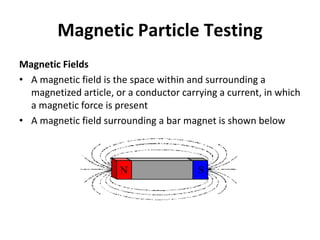
Magnetic Fields
• A magnetic field is the space within and surrounding a
magnetized article, or a conductor carrying a current, in which
a magnetic force is present
• A magnetic field surrounding a bar magnet is shown below
Magnetic Particle Testing
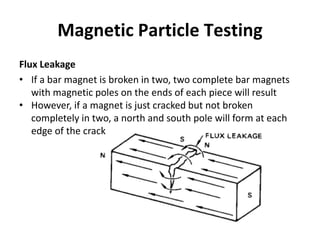
Flux Leakage
• If a bar magnet is broken in two, two complete bar magnets
with magnetic poles on the ends of each piece will result
• However, if a magnet is just cracked but not broken
completely in two, a north and south pole will form at each
edge of the crack
Magnetic Particle Testing
Flux Leakage (Continued)
• A magnetic field exists at the crack – it exits at the north pole,
re-enters at the south pole
• It spreads out when it encounters the small air gap created by
the crack because the air cannot support as much magnetic
field per unit volume as the magnet can
• When the field spreads out, it appears to leak out of the
material and, thus is called a flux leakage field.
Magnetic Particle Testing
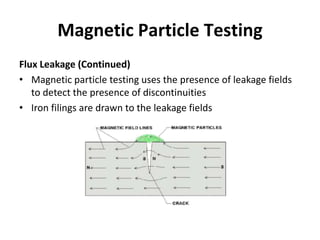
Flux Leakage (Continued)
• Magnetic particle testing uses the presence of leakage fields
to detect the presence of discontinuities
• Iron filings are drawn to the leakage fields
Magnetic Particle Testing
Brief History of MT
• 1868 – earliest known use of magnetism to inspect an object
– Use of compasses to check for defects along a cannon
barrel that had been magnetized
• 1920s – William Hoke noticed that metallic grindings from
hard steel parts (held by a magnetic chuck while being
ground) formed patterns on the face of the parts which
corresponded to the cracks in the surface
• 1930s – MT replaced the “oil-and-whiting” method in the
railroad industry
Magnetic Particle Testing
Material Definitions
Diamagnetic materials (have paired electrons)
• Cannot be magnetized and are repelled by magnetism
• Include most elements (copper, gold, and silver)
Paramagnetic materials
• Have a weak magnetic field and do not retain magnetic
properties once external field removed
• Ex. Magnesium, molybdenum, lithium, and tantalum
Ferromagnetic materials
• Can be strongly magnetized and retain magnetic properties
once external field removed
• Can be tested by MT
Magnetic Particle Testing
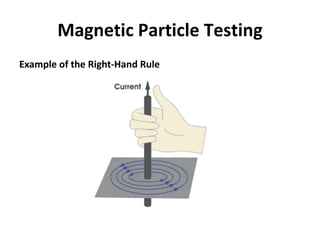
Electromagnetic Fields
When an electric current is passed through a conductor a
magnetic field is formed
• Field is strongest at surface of the conductor
• Field strength decreases with distance from conductor
Direction of magnetic field (lines of force) perpendicular to
current
• If current travels in a straight line, the lines of force will be
circular
• If current travels in a loop (a coil), the lines of force will be in a
straight line
– Field strength proportional to number of coil loops and
amount of current
Magnetic Particle Testing
Example of the Right-Hand Rule
Magnetic Particle Testing
Units
• Magnetizing force - the total electrical force required to set up
a flux in a magnetic circuit
– H (ampere/meter)
• Magnetic flux - the total number of lines of magnetic force in
a material
– Ф (weber = tesla/square meter in SI; maxwell in CGS)
• Flux density – flux per unit area through an element
– B (tesla in SI units; gauss in CGS)
Magnetic Particle Testing
Other Definitions
• Permeability – the ease with which a material can be
magnetized
– Can be calculated by B/H (ratio of flux density to
magnetizing force)
• Reluctance - the opposition of a magnetic material to the
establishment of a magnetic field
– High permeability means low reluctance (and vice versa)
– Analogous to resistance in an electrical circuit
Magnetic Particle Testing
Other Definitions Continued
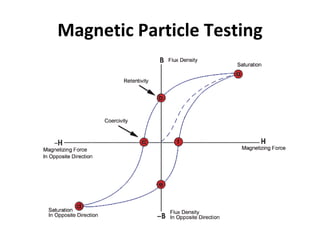
• Residual magnetism – the amount of magnetism that remains
in a material after removal of the magnetizing force (also
called its retentivity)
– High residual magnetism calls for demagnetization
• Coercive force – the reverse magnetizing force necessary to
remove the residual magnetism so as to demagnetize an
article
Magnetic Particle Testing
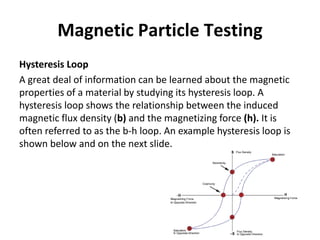
Hysteresis Loop
A great deal of information can be learned about the magnetic
properties of a material by studying its hysteresis loop. A
hysteresis loop shows the relationship between the induced
magnetic flux density (b) and the magnetizing force (h). It is
often referred to as the b-h loop. An example hysteresis loop is
shown below and on the next slide.
Magnetic Particle Testing
Hysteresis Loop
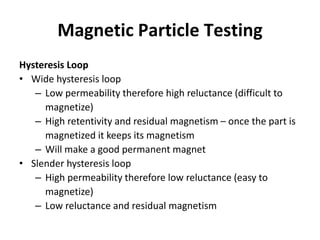
• Wide hysteresis loop
– Low permeability therefore high reluctance (difficult to
magnetize)
– High retentivity and residual magnetism – once the part is
magnetized it keeps its magnetism
– Will make a good permanent magnet
• Slender hysteresis loop
– High permeability therefore low reluctance (easy to
magnetize)
– Low reluctance and residual magnetism
Magnetic Particle Testing
Direct Vs. Indirect Magnetization
There are two methods for inducing a magnetic field into a part:
• Direct Magnetization
– Electric current is passed directly through the part
• “head shot”
• prods
• Indirect Magnetization
– Electric current does not pass through the part
• coil
• central conductor
• yoke
Magnetic Particle Testing
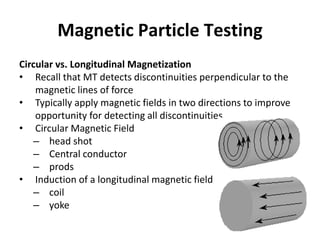
Circular vs. Longitudinal Magnetization
• Recall that MT detects discontinuities perpendicular to the
magnetic lines of force
• Typically apply magnetic fields in two directions to improve
opportunity for detecting all discontinuities
• Circular Magnetic Field
– head shot
– Central conductor
– prods
• Induction of a longitudinal magnetic field
– coil
– yoke
Magnetic Particle Testing
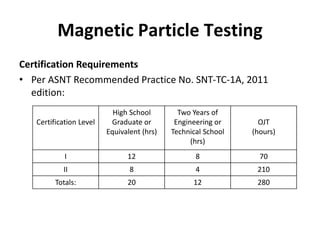
Certification Requirements
• Per ASNT Recommended Practice No. SNT-TC-1A, 2011
edition:
Certification Level
High School
Graduate or
Equivalent (hrs)
Two Years of
Engineering or
Technical School
(hrs)
OJT
(hours)
I 12 8 70
II 8 4 210
Totals: 20 12 280

slidereadcom-magnetic-partic-6040521ed94ab.pptx.ppt

  • 1.
  • 2.
    Magnetic Particle Testing Overviewof Magnetic Particle Testing (MT)/Inspection:  What is MT?  Theory of Magnetism  MT Materials/Equipment  Certification Requirements
  • 3.
    Magnetic Particle Testing Definition:An NDT method for location of discontinuities in ferromagnetic materials through utilization of flux leakage that forms magnetic poles to attract finely divided magnetic particles. • One of the oldest and most widely used NDT methods • Its use is limited to ferromagnetic materials – Ferromagnetic materials are materials that can be magnetized to a level that will allow the inspection to be effective – Ex. Iron, nickel, cobalt, and their alloys – “Ferro” is Latin for iron
  • 4.
    Magnetic Particle Testing Usesin Industry • Used for inspection of castings, forgings, and weldments on bridges, storage tanks, etc. • Used by the structural steel, automotive, petrochemical, power generation, and aerospace industries • Even used for underwater inspections
  • 5.
    Magnetic Particle Testing BasicSteps in an MT Inspection 1) Magnetization of the article 2) Application of the particles (iron filings) 3) Interpretation of the patterns formed by the particles as they are attracted by magnetic leakage fields 4) Demagnetization of the article if required
  • 6.
    Magnetic Particle Testing Whatis a Magnet? • A magnet is a material that has its north and south poles aligned and will attract iron • Magnetism may be naturally present in a material or the material may be artificially magnetized by various methods • Magnets may be permanent or temporary
  • 7.
    Magnetic Particle Testing MagneticPoles • A magnetic pole is any place where magnetic lines of force enter or exit a magnet • A magnet has two opposite poles that are attracted by the Earth’s magnetic poles • If a magnet has poles it exhibits polarity • Lines of force – Called magnetic flux – Exit the magnet at the north pole – Enter the magnet at the south pole – Never cross – Seek the path of least magnetic resistance
  • 8.
    Magnetic Particle Testing MoreAbout Magnetic Poles • Like poles repel (N and N, S and S) • Opposite poles attract (N and S) • Longitudinal magnetization occurs in bar magnets which have two poles • No external poles exist in a circular magnetic field
  • 9.
    Magnetic Particle Testing MagneticFields • A magnetic field is the space within and surrounding a magnetized article, or a conductor carrying a current, in which a magnetic force is present • A magnetic field surrounding a bar magnet is shown below
  • 10.
    Magnetic Particle Testing FluxLeakage • If a bar magnet is broken in two, two complete bar magnets with magnetic poles on the ends of each piece will result • However, if a magnet is just cracked but not broken completely in two, a north and south pole will form at each edge of the crack
  • 11.
    Magnetic Particle Testing FluxLeakage (Continued) • A magnetic field exists at the crack – it exits at the north pole, re-enters at the south pole • It spreads out when it encounters the small air gap created by the crack because the air cannot support as much magnetic field per unit volume as the magnet can • When the field spreads out, it appears to leak out of the material and, thus is called a flux leakage field.
  • 12.
    Magnetic Particle Testing FluxLeakage (Continued) • Magnetic particle testing uses the presence of leakage fields to detect the presence of discontinuities • Iron filings are drawn to the leakage fields
  • 13.
    Magnetic Particle Testing BriefHistory of MT • 1868 – earliest known use of magnetism to inspect an object – Use of compasses to check for defects along a cannon barrel that had been magnetized • 1920s – William Hoke noticed that metallic grindings from hard steel parts (held by a magnetic chuck while being ground) formed patterns on the face of the parts which corresponded to the cracks in the surface • 1930s – MT replaced the “oil-and-whiting” method in the railroad industry
  • 14.
    Magnetic Particle Testing MaterialDefinitions Diamagnetic materials (have paired electrons) • Cannot be magnetized and are repelled by magnetism • Include most elements (copper, gold, and silver) Paramagnetic materials • Have a weak magnetic field and do not retain magnetic properties once external field removed • Ex. Magnesium, molybdenum, lithium, and tantalum Ferromagnetic materials • Can be strongly magnetized and retain magnetic properties once external field removed • Can be tested by MT
  • 15.
    Magnetic Particle Testing ElectromagneticFields When an electric current is passed through a conductor a magnetic field is formed • Field is strongest at surface of the conductor • Field strength decreases with distance from conductor Direction of magnetic field (lines of force) perpendicular to current • If current travels in a straight line, the lines of force will be circular • If current travels in a loop (a coil), the lines of force will be in a straight line – Field strength proportional to number of coil loops and amount of current
  • 16.
    Magnetic Particle Testing Exampleof the Right-Hand Rule
  • 17.
    Magnetic Particle Testing Units •Magnetizing force - the total electrical force required to set up a flux in a magnetic circuit – H (ampere/meter) • Magnetic flux - the total number of lines of magnetic force in a material – Ф (weber = tesla/square meter in SI; maxwell in CGS) • Flux density – flux per unit area through an element – B (tesla in SI units; gauss in CGS)
  • 18.
    Magnetic Particle Testing OtherDefinitions • Permeability – the ease with which a material can be magnetized – Can be calculated by B/H (ratio of flux density to magnetizing force) • Reluctance - the opposition of a magnetic material to the establishment of a magnetic field – High permeability means low reluctance (and vice versa) – Analogous to resistance in an electrical circuit
  • 19.
    Magnetic Particle Testing OtherDefinitions Continued • Residual magnetism – the amount of magnetism that remains in a material after removal of the magnetizing force (also called its retentivity) – High residual magnetism calls for demagnetization • Coercive force – the reverse magnetizing force necessary to remove the residual magnetism so as to demagnetize an article
  • 20.
    Magnetic Particle Testing HysteresisLoop A great deal of information can be learned about the magnetic properties of a material by studying its hysteresis loop. A hysteresis loop shows the relationship between the induced magnetic flux density (b) and the magnetizing force (h). It is often referred to as the b-h loop. An example hysteresis loop is shown below and on the next slide.
  • 21.
  • 22.
    Magnetic Particle Testing HysteresisLoop • Wide hysteresis loop – Low permeability therefore high reluctance (difficult to magnetize) – High retentivity and residual magnetism – once the part is magnetized it keeps its magnetism – Will make a good permanent magnet • Slender hysteresis loop – High permeability therefore low reluctance (easy to magnetize) – Low reluctance and residual magnetism
  • 23.
    Magnetic Particle Testing DirectVs. Indirect Magnetization There are two methods for inducing a magnetic field into a part: • Direct Magnetization – Electric current is passed directly through the part • “head shot” • prods • Indirect Magnetization – Electric current does not pass through the part • coil • central conductor • yoke
  • 24.
    Magnetic Particle Testing Circularvs. Longitudinal Magnetization • Recall that MT detects discontinuities perpendicular to the magnetic lines of force • Typically apply magnetic fields in two directions to improve opportunity for detecting all discontinuities • Circular Magnetic Field – head shot – Central conductor – prods • Induction of a longitudinal magnetic field – coil – yoke
  • 25.
    Magnetic Particle Testing CertificationRequirements • Per ASNT Recommended Practice No. SNT-TC-1A, 2011 edition: Certification Level High School Graduate or Equivalent (hrs) Two Years of Engineering or Technical School (hrs) OJT (hours) I 12 8 70 II 8 4 210 Totals: 20 12 280