Generational Differences
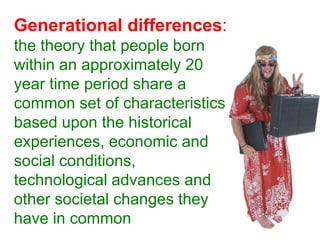
Generational differences: the theory that people born within an approximately 20 year time period share a common set of characteristics based upon the historical experiences, economic and social conditions, technological advances and other societal changes they have in common
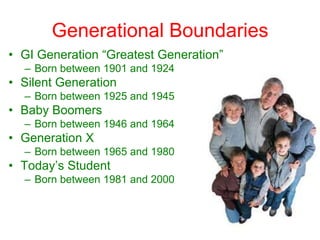
Generational BoundariesGI Generation “Greatest Generation”Born between 1901 and 1924Silent GenerationBorn between 1925 and 1945Baby BoomersBorn between 1946 and 1964Generation XBorn between 1965 and 1980Today’s StudentBorn between 1981 and 2000
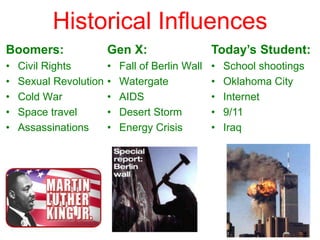
Historical InfluencesBoomers:Civil RightsSexual RevolutionCold WarSpace travelAssassinationsGen X:Fall of Berlin WallWatergateAIDSDesert StormEnergy CrisisToday’s Student:School shootings
Oklahoma City
Internet
9/11
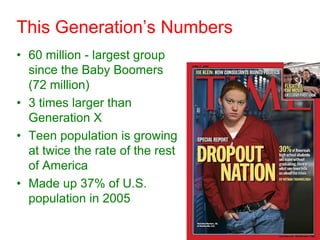
Iraq This Generation’s Numbers60 million - largest group since the Baby Boomers (72 million)3 times larger than Generation XTeen population is growing at twice the rate of the rest of AmericaMade up 37% of U.S. population in 2005
This Generation’s Numbers60 million - largest group since the Baby Boomers (72 million)3 times larger than Generation XTeen population is growing at twice the rate of the rest of AmericaMade up 37% of U.S. population in 2005
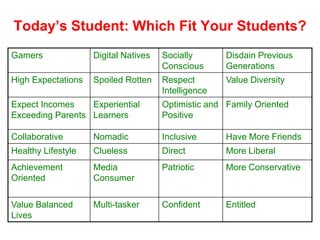
Today’s Student: Which Fit Your Students?
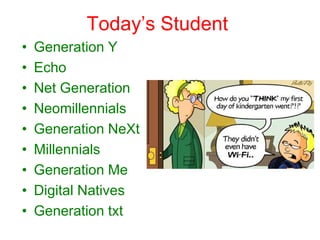
Today’s StudentGeneration YEchoNet GenerationNeomillennialsGeneration NeXtMillennialsGeneration MeDigital NativesGeneration txt
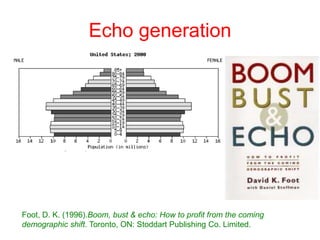
Echo generationFoot, D. K. (1996).Boom, bust & echo: How to profit from the coming demographic shift. Toronto, ON: Stoddart Publishing Co. Limited.
Net GenerationChildren of baby boomersDigital technology has had a profound impact on their personalities, including their attitudes and approach to learningGeneration gap has become a generation lapBased on web-based surveys circulated on social networking websitesTapscott, D. (1997). Growing up digital: The rise of the net generation. New York: McGraw Hill.
Millennials“…today's teens are recasting the image of youth from downbeat and alienated to upbeat and engaged.”Based upon survey research with a sample from Fairfax, VAHowe, N., & Strauss, W. (2000). Millennials rising: The next great generation. New York: Vintage Books.

IT6230_W10_Unit_2_Introduction

  • 1.
  • 2.
    Generational differences: thetheory that people born within an approximately 20 year time period share a common set of characteristics based upon the historical experiences, economic and social conditions, technological advances and other societal changes they have in common
  • 3.
    Generational BoundariesGI Generation“Greatest Generation”Born between 1901 and 1924Silent GenerationBorn between 1925 and 1945Baby BoomersBorn between 1946 and 1964Generation XBorn between 1965 and 1980Today’s StudentBorn between 1981 and 2000
  • 4.
    Historical InfluencesBoomers:Civil RightsSexualRevolutionCold WarSpace travelAssassinationsGen X:Fall of Berlin WallWatergateAIDSDesert StormEnergy CrisisToday’s Student:School shootings
  • 5.
  • 6.
  • 7.
  • 8.
    Iraq This Generation’sNumbers60 million - largest group since the Baby Boomers (72 million)3 times larger than Generation XTeen population is growing at twice the rate of the rest of AmericaMade up 37% of U.S. population in 2005
  • 9.
    This Generation’s Numbers60million - largest group since the Baby Boomers (72 million)3 times larger than Generation XTeen population is growing at twice the rate of the rest of AmericaMade up 37% of U.S. population in 2005
  • 10.
    Today’s Student: WhichFit Your Students?
  • 11.
    Today’s StudentGeneration YEchoNetGenerationNeomillennialsGeneration NeXtMillennialsGeneration MeDigital NativesGeneration txt
  • 12.
    Echo generationFoot, D.K. (1996).Boom, bust & echo: How to profit from the coming demographic shift. Toronto, ON: Stoddart Publishing Co. Limited.
  • 13.
    Net GenerationChildren ofbaby boomersDigital technology has had a profound impact on their personalities, including their attitudes and approach to learningGeneration gap has become a generation lapBased on web-based surveys circulated on social networking websitesTapscott, D. (1997). Growing up digital: The rise of the net generation. New York: McGraw Hill.
  • 14.
    Millennials“…today's teens arerecasting the image of youth from downbeat and alienated to upbeat and engaged.”Based upon survey research with a sample from Fairfax, VAHowe, N., & Strauss, W. (2000). Millennials rising: The next great generation. New York: Vintage Books.
  • 15.
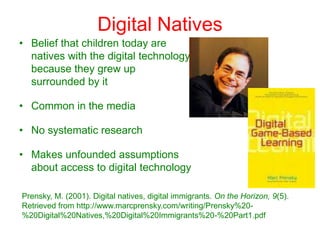
    Digital NativesBelief thatchildren today are natives with the digital technology because they grew up surrounded by itCommon in the mediaNo systematic researchMakes unfounded assumptions about access to digital technologyPrensky, M. (2001). Digital natives, digital immigrants. On the Horizon, 9(5). Retrieved from http://www.marcprensky.com/writing/Prensky%20-%20Digital%20Natives,%20Digital%20Immigrants%20-%20Part1.pdf
  • 16.
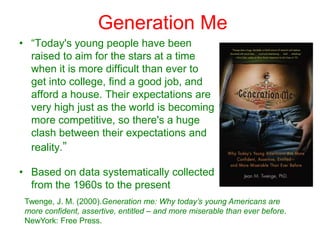
    Generation Me“Today's youngpeople have been raised to aim for the stars at a time when it is more difficult than ever to get into college, find a good job, and afford a house. Their expectations are very high just as the world is becoming more competitive, so there's a huge clash between their expectations and reality.”Based on data systematically collected from the 1960s to the presentTwenge, J. M. (2000).Generation me: Why today’s young Americans are more confident, assertive, entitled – and more miserable than ever before. NewYork: Free Press.
  • 17.
    So, let’s takea closer look at the labels ascribed to this generation of students…