1. Generational differences 
The topic of generational differences has been the subject of much debate. The authors don´t 
seem to agree on the labels that should be used or the span of years to be assigned to each 
generation (Reeves & Oh, 2008). However, many authors such as Berk (2009) acknowledge that 
“…there is legitimacy to suggesting a set of characteristics and cultural trends derived from 
sound scientific research that can guide future teaching practices...” (p.2) 
Therefore, our challenge is to identify what characterizes our new generation of students and 
which emerging cultural trends are prone to make an impact in the future of education. Being 
able to identify our generational standing point and what we take for granted is also vital if we 
are to innovate education for, as Sir Ken Robinson stated, “the great problem of transformation 
is the tyranny of common sense”.
1.1 What is a generation? 
According to Howe & Strauss (2000), a generation is defined as the aggregate of all people born 
over a span of roughly twenty years that share three criteria in common: 
Historical context 
they encounter key historical events and social trends while 
occupying the same phase of life 
• Similar behaviors 
including basic attitudes about risk taking, culture and values, 
civic engagement, family life 
• Membership 
a sense of common perceived membership in that generation 
Therefore, it can be concluded that generations are shaped much more by history 
than by chronological dates.
In their seminal book, Generations, Howe & Strauss (1992) have identified a recurring 
generational cycle in American history. They have found a sequence of four 
generational archetypes—which they call Prophet, Nomad, Hero, and Artist. Their 1997 
book, The four turnings, expands on the theory, focusing on a fourfold cycle of generational 
types and recurring mood eras in American history known as high, awakening, unraveling 
and crisis. 
This generational theory is mainly related to American history and even though many 
episodes are referred to as having a very direct effect in the rest of the world, there are 
some instances where the model cannot be applied as it is (Hole et al. 2010). For more 
information on this generational theory check the LifeCourse Associates website 
http://www.lifecourse.com/about/method/insight-overview.html and the authors’ 2007 
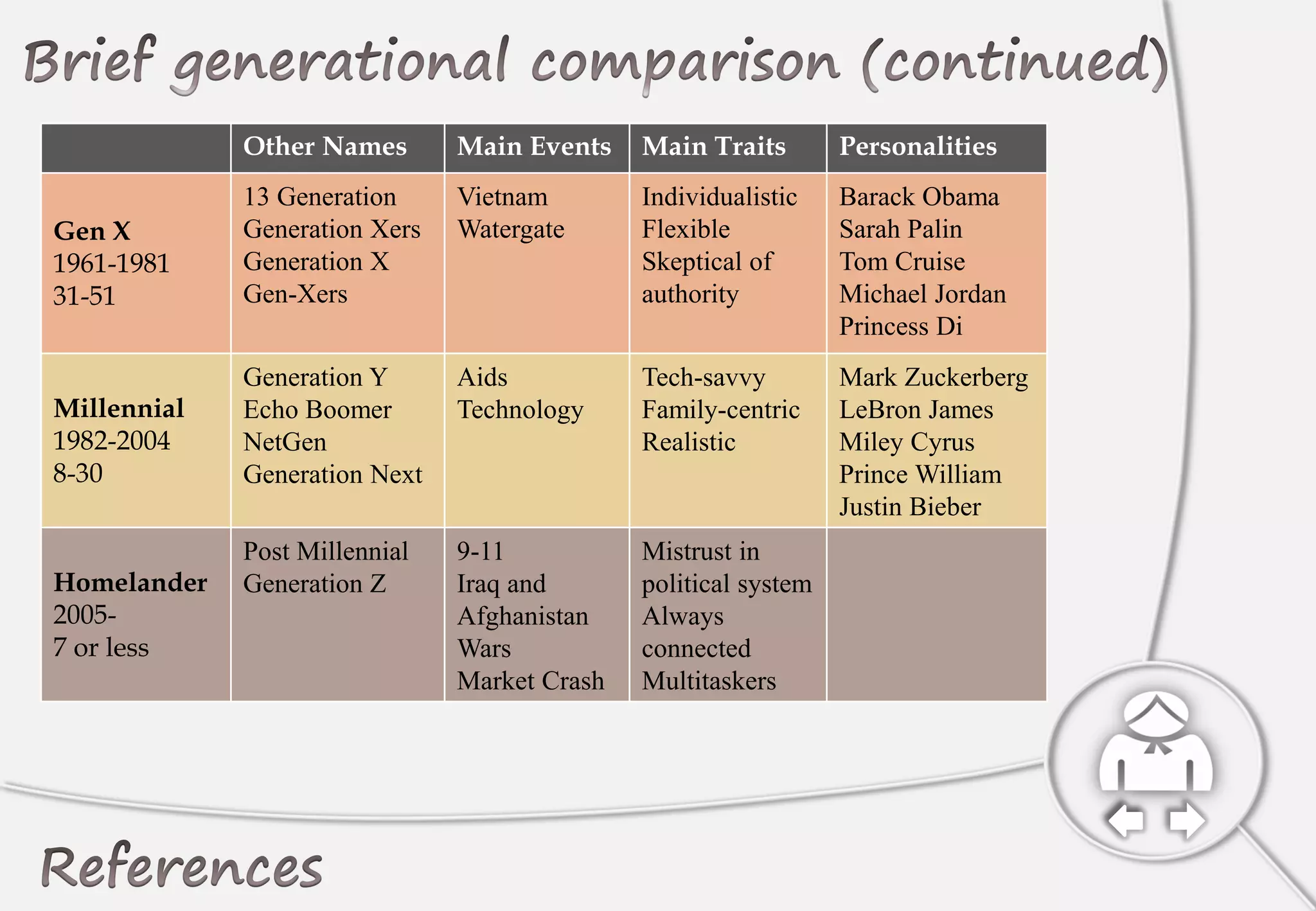
article, The next 20 years. A brief generational comparison is also provided on the 
following page.
Other Names Main Events Main Traits Personalities 
GI 
Generation 
1902-1924 
88+ 
World War I 
Women 
suffrage 
Formality 
Uniformity 
Cooperative 
Public interest 
over self 
John Kennedy 
Ronald Reagan 
Walt Disney 
Willy Brandt 
Leonid Brezhnev 
Silent 
1925-1942 
70-87 
Traditionalists 
Matures 
Veterans 
World War II 
Great 
Depression 
Respect for 
authority 
Loyalty 
Hard-work 
Woody Allen 
Martin Luther 
King Jr. 
Elvis Presley 
Anne Frank 
Baby 
Boomer 
1943-1960 
52-69 
Boom 
Generation 
Civil Rights 
Women´s 
liberation 
Cold war 
TV 
Explore 
Optimistic 
Work-centric 
Bill Clinton 
Steve Jobs 
Robin Williams 
Tony Blair
Other Names Main Events Main Traits Personalities 
Gen X 
1961-1981 
31-51 
13 Generation 
Generation Xers 
Generation X 
Gen-Xers 
Vietnam 
Watergate 
Individualistic 
Flexible 
Skeptical of 
authority 
Barack Obama 
Sarah Palin 
Tom Cruise 
Michael Jordan 
Princess Di 
Millennial 
1982-2004 
8-30 
Generation Y 
Echo Boomer 
NetGen 
Generation Next 
Aids 
Technology 
Tech-savvy 
Family-centric 
Realistic 
Mark Zuckerberg 
LeBron James 
Miley Cyrus 
Prince William 
Justin Bieber 
Homelander 
2005- 
7 or less 
Post Millennial 
Generation Z 
9-11 
Iraq and 
Afghanistan 
Wars 
Market Crash 
Mistrust in 
political system 
Always 
connected 
Multitaskers
1. 2 Millenials 
Berk (2009) lists ten different names given to the millennial generation and gives their 
rationales. Although the different terms have been coined for specific reasons, we will treat 
them as synonyms.
1. 2. 1 Millenials Characterized 
The net generation can be described as follows: 
Smart 
• Experiential 
• Practical 
• Pressured and 
achieving 
• Personalization 
customization 
of content 
Networked 
• Team-oriented 
• Collaboration 
• Embrace 
diversity 
• Emotionally 
open 
• Feedback 
dependent 
Creative 
• Confident 
• Open-minded 
• Innovative 
• Flexible 
•Adaptable 
Wired 
• Multitaskers 
• Gamers 
• Digital natives 
• Tech Savvy 
• Need for speed 
and instant 
gratification 
What are the preconceptions based on these characteristics? 
For example: 
• gamers: everything is boring unless it is gamified. 
• multitaskers: very short attention span, can´t concentrate
1 
1. 2. 1 Millenials Questioned 
Some authors such as DiLullo (2011) state that Millennials have not been properly 
characterized. This author argues that the characteristics presented previously are mostly 
opinions based on observation and surveys rather than on evidence-based analysis. 
Others like Twenge (2006) provide less positive traits to characterize the Net Generation. 
She mentions depression, loneliness and isolation, stress on college, career and 
economics, growth of externality, less likelihood to believing in moral absolutes and taking 
sex lightly. 
By the way, how Millennial are you? Take the quiz and find out! 
http://www.pewresearch.org/quiz/how-millennial-are-you/
2. Conclusion 
The purpose of this module has been to reflect on: 
• what characterizes our new generation of students 
• which emerging cultural trends are prone to make an impact in the future of education. 
• identifying our generational standing point 
Take some time to reflect on this topic and write your conclusions.
1. Generational differences 
Berk, R. A. (2009). Teaching strategies for the net generation. Transformative Dialogues: 
Teaching & Learning Journal, 3(2), 1-23. Retrieved from: 
http://www.ronberk.com/articles/2009_strategies.pdf 
Reeves, T. C., & Oh, E. J. (2008). Do generational differences matter in instructional design. 
In Instructional Technology Forum. Retrieved from: 
http://itforum.coe.uga.edu/AECT_ITF_PDFS/paper104.pdf 
Consider for example the figure 1 on page 3 which summarizes the generational labels and 
dates reported in different sources. 
Robinson, K. (2010). Sir Ken Robinson: Bring on the learning revolution![Video file]. 
http://www.ted.com/talks/sir_ken_robinson_bring_on_the_revolution.html
1.1 What is a generation? 
Hole, D., Zhong, L., & Schwartz, J. (2010). Talking about whose generation? Why Western 
generational models can't account for a global workforce. Deloitte Review, 6, 84-97. 
http://www.deloitte.com/view/en_US/us/Services/additional-services/talent-human-capital-hr/ 
5d6e2bb18ef26210VgnVCM100000ba42f00aRCRD.htm 
Consider the figure 1 on page 88 which gives a global generation overview. 
Howe, N., & Strauss, W. (1992). Generations: The history of America's future, 1584 to 2069. 
HarperCollins. 
Strauss, W. (1997). The fourth turning. Random House Digital, Inc.. 
Howe, N., & Strauss, W. (2007). The next 20 years. Harvard Business Review,85, 41-52. 
Retrieved from: 
http://www.saeculumresearch.com/assets/client-assets/files/selected-pubs/HBR-Next-20- 
Years.pdf 
Howe, N., & Strauss, W. (2009). Millennials rising: The next great generation. 
Random House Digital, Inc.
1.1 What is a generation? Brief generational comparison 
Reeves, T. C., & Oh, E. (2007). Generational differences. Handbook of research on educational 
communications and technology, 295-303. Retrieved from: 
http://faculty.ksu.edu.sa/Alhassan/Hand%20book%20on%20research%20in%20educational%20 
communication/ER5849x_C025.fm.pdf 
http://thedoorcf.org/uploads/GenerationalCharacteristics.pdf 
http://www.lifecourse.com/about/method/the-generational-constellation.html
1.2 Millennials 
Berk, R. A. (2009). Teaching strategies for the net generation. Transformative Dialogues: 
Teaching & Learning Journal, 3(2), 1-23. Retrieved from: 
http://www.ronberk.com/articles/2009_strategies.pdf
1. 2. 1 Millenials Characterized 
Sweeney, R. (2006). Millennial behaviors and demographics. Retrieved from: 
http://certi.mst.edu/media/administrative/certi/documents/Article-Millennial-Behaviors.pdf 
Howe, N., & Strauss, W. (2007). Millennials go to college. Great Falls, VA: LifeCourse 
Associates. An executive summary can be retrieved from: http://eubie.com/millennials.pdf 
Tapscott, D. (2009). Grown up digital (Vol. 361). New York: McGraw-Hill. 
An executive summary can be retrieved from: http://media.economist.com/media/pdf/grown-up- 
digital-tapscott-e.pdf 
Berk, R. A. (2009). Teaching strategies for the net generation. Transformative Dialogues: 
Teaching & Learning Journal, 3(2), 1-23. Retrieved from: 
http://www.ronberk.com/articles/2009_strategies.pdf
1.2 Millennials questioned 
DiLullo, C., McGee, P., Kriebel, R.M. 2011. Demystifying the Millennial Student: A 
Reassessment in Measures of Character and Engagement in Professional Education 
http://oai.wsu.edu/Teaching_Resources/teaching_millennial_students/DiLullo-2011- 
Millennial-student.pdf 
Twenge, Jean M. Generation me: Why today's young Americans are more confident, 
assertive, entitled--and more miserable than ever before. Simon and Schuster, 2006. 
Abstract 
http://ttosspon.wikispaces.com/file/view/REview_GenerationMe.pdf/231400618/REview_G 
enerationMe.pdf
21st century students

21st century students

  • 3.
    1. Generational differences The topic of generational differences has been the subject of much debate. The authors don´t seem to agree on the labels that should be used or the span of years to be assigned to each generation (Reeves & Oh, 2008). However, many authors such as Berk (2009) acknowledge that “…there is legitimacy to suggesting a set of characteristics and cultural trends derived from sound scientific research that can guide future teaching practices...” (p.2) Therefore, our challenge is to identify what characterizes our new generation of students and which emerging cultural trends are prone to make an impact in the future of education. Being able to identify our generational standing point and what we take for granted is also vital if we are to innovate education for, as Sir Ken Robinson stated, “the great problem of transformation is the tyranny of common sense”.
  • 4.
    1.1 What isa generation? According to Howe & Strauss (2000), a generation is defined as the aggregate of all people born over a span of roughly twenty years that share three criteria in common: Historical context they encounter key historical events and social trends while occupying the same phase of life • Similar behaviors including basic attitudes about risk taking, culture and values, civic engagement, family life • Membership a sense of common perceived membership in that generation Therefore, it can be concluded that generations are shaped much more by history than by chronological dates.
  • 5.
    In their seminalbook, Generations, Howe & Strauss (1992) have identified a recurring generational cycle in American history. They have found a sequence of four generational archetypes—which they call Prophet, Nomad, Hero, and Artist. Their 1997 book, The four turnings, expands on the theory, focusing on a fourfold cycle of generational types and recurring mood eras in American history known as high, awakening, unraveling and crisis. This generational theory is mainly related to American history and even though many episodes are referred to as having a very direct effect in the rest of the world, there are some instances where the model cannot be applied as it is (Hole et al. 2010). For more information on this generational theory check the LifeCourse Associates website http://www.lifecourse.com/about/method/insight-overview.html and the authors’ 2007 article, The next 20 years. A brief generational comparison is also provided on the following page.
  • 6.
    Other Names MainEvents Main Traits Personalities GI Generation 1902-1924 88+ World War I Women suffrage Formality Uniformity Cooperative Public interest over self John Kennedy Ronald Reagan Walt Disney Willy Brandt Leonid Brezhnev Silent 1925-1942 70-87 Traditionalists Matures Veterans World War II Great Depression Respect for authority Loyalty Hard-work Woody Allen Martin Luther King Jr. Elvis Presley Anne Frank Baby Boomer 1943-1960 52-69 Boom Generation Civil Rights Women´s liberation Cold war TV Explore Optimistic Work-centric Bill Clinton Steve Jobs Robin Williams Tony Blair
  • 7.
    Other Names MainEvents Main Traits Personalities Gen X 1961-1981 31-51 13 Generation Generation Xers Generation X Gen-Xers Vietnam Watergate Individualistic Flexible Skeptical of authority Barack Obama Sarah Palin Tom Cruise Michael Jordan Princess Di Millennial 1982-2004 8-30 Generation Y Echo Boomer NetGen Generation Next Aids Technology Tech-savvy Family-centric Realistic Mark Zuckerberg LeBron James Miley Cyrus Prince William Justin Bieber Homelander 2005- 7 or less Post Millennial Generation Z 9-11 Iraq and Afghanistan Wars Market Crash Mistrust in political system Always connected Multitaskers
  • 8.
    1. 2 Millenials Berk (2009) lists ten different names given to the millennial generation and gives their rationales. Although the different terms have been coined for specific reasons, we will treat them as synonyms.
  • 9.
    1. 2. 1Millenials Characterized The net generation can be described as follows: Smart • Experiential • Practical • Pressured and achieving • Personalization customization of content Networked • Team-oriented • Collaboration • Embrace diversity • Emotionally open • Feedback dependent Creative • Confident • Open-minded • Innovative • Flexible •Adaptable Wired • Multitaskers • Gamers • Digital natives • Tech Savvy • Need for speed and instant gratification What are the preconceptions based on these characteristics? For example: • gamers: everything is boring unless it is gamified. • multitaskers: very short attention span, can´t concentrate
  • 10.
    1 1. 2.1 Millenials Questioned Some authors such as DiLullo (2011) state that Millennials have not been properly characterized. This author argues that the characteristics presented previously are mostly opinions based on observation and surveys rather than on evidence-based analysis. Others like Twenge (2006) provide less positive traits to characterize the Net Generation. She mentions depression, loneliness and isolation, stress on college, career and economics, growth of externality, less likelihood to believing in moral absolutes and taking sex lightly. By the way, how Millennial are you? Take the quiz and find out! http://www.pewresearch.org/quiz/how-millennial-are-you/
  • 11.
    2. Conclusion Thepurpose of this module has been to reflect on: • what characterizes our new generation of students • which emerging cultural trends are prone to make an impact in the future of education. • identifying our generational standing point Take some time to reflect on this topic and write your conclusions.
  • 12.
    1. Generational differences Berk, R. A. (2009). Teaching strategies for the net generation. Transformative Dialogues: Teaching & Learning Journal, 3(2), 1-23. Retrieved from: http://www.ronberk.com/articles/2009_strategies.pdf Reeves, T. C., & Oh, E. J. (2008). Do generational differences matter in instructional design. In Instructional Technology Forum. Retrieved from: http://itforum.coe.uga.edu/AECT_ITF_PDFS/paper104.pdf Consider for example the figure 1 on page 3 which summarizes the generational labels and dates reported in different sources. Robinson, K. (2010). Sir Ken Robinson: Bring on the learning revolution![Video file]. http://www.ted.com/talks/sir_ken_robinson_bring_on_the_revolution.html
  • 13.
    1.1 What isa generation? Hole, D., Zhong, L., & Schwartz, J. (2010). Talking about whose generation? Why Western generational models can't account for a global workforce. Deloitte Review, 6, 84-97. http://www.deloitte.com/view/en_US/us/Services/additional-services/talent-human-capital-hr/ 5d6e2bb18ef26210VgnVCM100000ba42f00aRCRD.htm Consider the figure 1 on page 88 which gives a global generation overview. Howe, N., & Strauss, W. (1992). Generations: The history of America's future, 1584 to 2069. HarperCollins. Strauss, W. (1997). The fourth turning. Random House Digital, Inc.. Howe, N., & Strauss, W. (2007). The next 20 years. Harvard Business Review,85, 41-52. Retrieved from: http://www.saeculumresearch.com/assets/client-assets/files/selected-pubs/HBR-Next-20- Years.pdf Howe, N., & Strauss, W. (2009). Millennials rising: The next great generation. Random House Digital, Inc.
  • 14.
    1.1 What isa generation? Brief generational comparison Reeves, T. C., & Oh, E. (2007). Generational differences. Handbook of research on educational communications and technology, 295-303. Retrieved from: http://faculty.ksu.edu.sa/Alhassan/Hand%20book%20on%20research%20in%20educational%20 communication/ER5849x_C025.fm.pdf http://thedoorcf.org/uploads/GenerationalCharacteristics.pdf http://www.lifecourse.com/about/method/the-generational-constellation.html
  • 15.
    1.2 Millennials Berk,R. A. (2009). Teaching strategies for the net generation. Transformative Dialogues: Teaching & Learning Journal, 3(2), 1-23. Retrieved from: http://www.ronberk.com/articles/2009_strategies.pdf
  • 16.
    1. 2. 1Millenials Characterized Sweeney, R. (2006). Millennial behaviors and demographics. Retrieved from: http://certi.mst.edu/media/administrative/certi/documents/Article-Millennial-Behaviors.pdf Howe, N., & Strauss, W. (2007). Millennials go to college. Great Falls, VA: LifeCourse Associates. An executive summary can be retrieved from: http://eubie.com/millennials.pdf Tapscott, D. (2009). Grown up digital (Vol. 361). New York: McGraw-Hill. An executive summary can be retrieved from: http://media.economist.com/media/pdf/grown-up- digital-tapscott-e.pdf Berk, R. A. (2009). Teaching strategies for the net generation. Transformative Dialogues: Teaching & Learning Journal, 3(2), 1-23. Retrieved from: http://www.ronberk.com/articles/2009_strategies.pdf
  • 17.
    1.2 Millennials questioned DiLullo, C., McGee, P., Kriebel, R.M. 2011. Demystifying the Millennial Student: A Reassessment in Measures of Character and Engagement in Professional Education http://oai.wsu.edu/Teaching_Resources/teaching_millennial_students/DiLullo-2011- Millennial-student.pdf Twenge, Jean M. Generation me: Why today's young Americans are more confident, assertive, entitled--and more miserable than ever before. Simon and Schuster, 2006. Abstract http://ttosspon.wikispaces.com/file/view/REview_GenerationMe.pdf/231400618/REview_G enerationMe.pdf