Justifications 
Constructionism 
• Creation of an authentic artifact 
• “Learning by building” 
• Programming and game design with Logo, Scratch, Alice 
(Papert, 1991; Pepper & Kafai, 2007; Resnick, 2009) 
Narrative Writing 
• Science writing in everyday language in order to reduce 
‘mystique’ (Avraamidou & Osborne, 2009; Prain & Hand, 1996) 
• Narrative, microtheme, and writing-across-curriculum strategies 
have shown small, positive effects (Bangert-Drowns, Hurley, & 
Wilkinson, 2004; Stewart, Myers, & Culley, 2010) 
Question Writing 
• Students creating question, determining correct answer and 
several plausible, incorrect alternatives 
• Practice/Strategy of having students write content questions has 
been shown to improve performance (Chin & Osborne, 2008; 
Lotherington & Ronda, 2010; Rosenshine, Meister, & Chapman, 
1996; Wong, 1985) 
Introduction 
While research has often focused on how students learn by 
playing games, a separate line of research has examined the 
effects of students acting as designers of educational games. 
The idea of students learning by building an artifact, such as a 
game, has been called constructionism (Papert, 1991). Kafai 
(2006) contrasted the instructivist method of using games as a 
way to sweeten learning, where through game design students 
construct knowledge while building technological fluency 
through their design decisions. 
One of the problems associated with game design as an 
instructional strategy is the time commitment involved; in 
addition to the content, students must learn a programming 
language as well (Barbour, Thomas, Rauscher, & Rieber, 
2010). The teacher may not have the requisite skill to program, 
let alone teach how to program in a computer language. 
Therefore, researchers have looked at “low-tech” ways to have 
students create games while still using computers, getting the 
benefits believed to be associated with constructionist teaching 
without the time and resource allocation. One way teachers 
can use game design to teach is by using Microsoft PowerPoint 
as a game design tool. MS PowerPoint is ubiquitous in 
schools, and while it does not have the capabilities of many 
programming languages such as Scratch or Alice, it requires 
little additional instruction before students can begin designing 
games. 
Methods 
3 year design-based research study examining student performance on 
assessment in Environmental Chemistry (ChemCom) course. 
• Large, suburban, Midwestern high school 
• School on a trimester system 
• Students in grades 10-12 
• Many at-risk, low performing 
Compare scores on a 40-question multiple choice test in two different units 
1st iteration – repeat protocol from previous research (game project as review 
exercise in lieu of traditional review guide) 
2nd iteration – game as unit project (first trimester); game as unit project with 
more structure (second trimester) 
3rd iteration – unit project with emphasis on tying questions to narrative 
Conclusions, Implications, 
Future Directions 
Findings 
• Some changes resulted in statistically significant differences 
• Subsequent iterations often yielded small gains (better alignment to 
justifications; strategies yielded small gains in isolation) 
• Push for developing higher-order questions and ‘authentic’ practices may 
have made comparisons difficult and instrument no longer valid 
For Practitioners 
• The project must last throughout the entire unit and not only as a review 
tool 
• Provide time for instruction on question writing skills 
• Allow time for revision, editing, and teacher feedback on narratives and 
questions 
• If it can be done outside of the computer lab, do it outside of the computer 
lab 
• Create conditions where students are encouraged to integrate the 
narrative into the game as much as possible (i.e., avoid “save the 
princess” and drill-and-practice games) 
• Give students the objectives as early as possible 
Future Research 
• Shift to elementary level, where multiple disciplines can be taught 
• Examine amount of computational thinking 
• Expand to programming languages geared toward younger children 
Dr. Jason P. Siko 
Further Reading 
Siko, J.P. (2013). Are they climbing the pyramid? Rating student-generated 
questions in a game design project. Canadian Journal of Learning and 
Technology, 39(1). Retrieved from 
http://cjlt.csj.ualberta.ca/index.php/cjlt/article/view/667 
Siko, J. P., & Barbour, M. K. (2013). Game design and homemade 
PowerPoint games: An examination of the justifications and a review of 
the research. Journal of Educational Multimedia and Hypermedia, 22(1), 
335-362. 
Siko, J. P., & Barbour, M. K. (2012). Homemade PowerPoint games: Game 
design pedagogy aligned to the TPACK framework. Computers in the 
Schools, 29(4), 339-354. 
Siko, J., Barbour, M. K., & Toker, S. (2011). Beyond Jeopardy and lectures: 
Using Microsoft PowerPoint as a game design tool to teach science. 
Journal of Computers in Mathematics and Science Teaching, 30(3), 303- 
320. For further information 
Please contact Dr. Jason Siko at sikojp@gmail.com or Dr. Michael Barbour at 
mkbarbour@gmail.com. 
. 
Refining the Use of Homemade PowerPoint Games 
Dr. Michael K. Barbour 
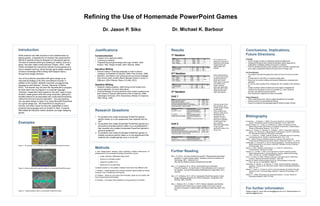
Results 
1st Iteration 
2nd Iteration 
3rd Iteration 
Unit 1 
Unit 2 
Research Questions 
1. Do students who create homemade PowerPoint games 
perform better on a unit assessment than students who do 
not? 
2. Do students who create homemade PowerPoint games as a 
structured unit project perform better on a unit assessment 
than students who created homemade PowerPoint games in 
previous iterations? 
3. Do students who create homemade PowerPoint games on 
multiple occasions perform better on a unit assessment than 
students who created games once or not at all? 
Examples 
Figure 1. An example of an introductory slide in a homemade PowerPoint Game. 
Figure 2. A slide containing the game narrative for a homemade PowerPoint game. 
Figure 3. A typical question slide in a homemade PowerPoint Game. 
Bibliography 
Avraamidou, L., & Osborne, J. (2009). The role of narrative in communicating 
science. International Journal of Science Education, 31(12), 1683-1707. 
Bangert-Drowns, R. L., Hurley, M., & Wilkinson, B. (2004). The effects of school-based 
writing-to-learn interventions on academic achievement: A Meta-Analysis. 
Review of Educational Research, 74(1), 29-58. 
Barbour, M., Thomas, G., Rauscher, D., & Rieber, L. (2010). Homemade PowerPoint 
games. In A. Hirumi (Ed.), Playing Games in Schools (pp. 333-347). Washington, 
DC: International Society for Technology in Education. 
Chin, C., & Osborne, J. (2008). Students' questions: a potential resource for teaching 
and learning science. Studies in science education, 44(1), 1-39. 
Kafai, Y. (2006). Playing and Making Games for Learning: Instructionist and 
Constructionist Perspectives for Game Studies. Games and Culture, 1(1), 36-40. 
Lotherington, H., & Ronda, N. S. (2010). Gaming geography: Educational games and 
literacy development in the Grade 4 classroom. Canadian Journal of Learning 
and Technology, 35(3). 
Papert, S. (1991). Situating constructionism. In I. Harel & S. Papert (Eds.), 
Constructionism. Norwood, NJ: Ablex. 
Peppler, K. A., & Kafai, Y. (2007). From SuperGoo to Scratch: exploring creative 
digital media production in informal learning. Learning, media and technology, 
32(2), 149-166. doi: 10.1080/17439880701343337 
Prain, V., & Hand, B. (1996). Writing for learning in secondary science: Rethinking 
practices. Teaching and teacher education, 12(6), 609. 
Resnick, M. (2009). Scratch programming for all. Communications of the ACM, 
52(11), 60. doi: 10.1145/1592761.1592779 
Rosenshine, B., Meister, C., & Chapman, S. (1996). Teaching students to generate 
questions: A review of the intervention studies. Review of Educational Research, 
66(2), 181-221. 
Stewart, T., Myers, A., & Culley, M. (2010). Enhanced learning and retention through 
"Writing to Learn" in the psychology classroom. Teaching of Psychology, 37(1), 
46-49. 
Wong, B. Y. (1985). Self-questioning instructional research: A review. Review of 
Educational Research, 55(2), 227-268. 
• As a review tool, the 
games are “as good as” 
traditional review guides. 
• Students fared only 
slightly better with 
practice. 
• When implemented as 
an unstructured project, 
students performed 
worse than control. 
• When layers of structure 
were added to the 
project, students 
performed significantly 
better than the control. 
• Students performed 
better with practice. 
• Over the course of the 
three iterations, each 
change usually resulted 
in small gains. 
• When students were 
asked to create strong 
ties between the 
questions and the 
narrative, as well as 
being given guidelines 
on the scope of the 
story, students 
performed slightly better 
in one unit and 
significantly better in the 
second unit.

AERA2013-Refining the use of homemade PowerPoint Games in a secondary science classroom

  • 1.
    Justifications Constructionism •Creation of an authentic artifact • “Learning by building” • Programming and game design with Logo, Scratch, Alice (Papert, 1991; Pepper & Kafai, 2007; Resnick, 2009) Narrative Writing • Science writing in everyday language in order to reduce ‘mystique’ (Avraamidou & Osborne, 2009; Prain & Hand, 1996) • Narrative, microtheme, and writing-across-curriculum strategies have shown small, positive effects (Bangert-Drowns, Hurley, & Wilkinson, 2004; Stewart, Myers, & Culley, 2010) Question Writing • Students creating question, determining correct answer and several plausible, incorrect alternatives • Practice/Strategy of having students write content questions has been shown to improve performance (Chin & Osborne, 2008; Lotherington & Ronda, 2010; Rosenshine, Meister, & Chapman, 1996; Wong, 1985) Introduction While research has often focused on how students learn by playing games, a separate line of research has examined the effects of students acting as designers of educational games. The idea of students learning by building an artifact, such as a game, has been called constructionism (Papert, 1991). Kafai (2006) contrasted the instructivist method of using games as a way to sweeten learning, where through game design students construct knowledge while building technological fluency through their design decisions. One of the problems associated with game design as an instructional strategy is the time commitment involved; in addition to the content, students must learn a programming language as well (Barbour, Thomas, Rauscher, & Rieber, 2010). The teacher may not have the requisite skill to program, let alone teach how to program in a computer language. Therefore, researchers have looked at “low-tech” ways to have students create games while still using computers, getting the benefits believed to be associated with constructionist teaching without the time and resource allocation. One way teachers can use game design to teach is by using Microsoft PowerPoint as a game design tool. MS PowerPoint is ubiquitous in schools, and while it does not have the capabilities of many programming languages such as Scratch or Alice, it requires little additional instruction before students can begin designing games. Methods 3 year design-based research study examining student performance on assessment in Environmental Chemistry (ChemCom) course. • Large, suburban, Midwestern high school • School on a trimester system • Students in grades 10-12 • Many at-risk, low performing Compare scores on a 40-question multiple choice test in two different units 1st iteration – repeat protocol from previous research (game project as review exercise in lieu of traditional review guide) 2nd iteration – game as unit project (first trimester); game as unit project with more structure (second trimester) 3rd iteration – unit project with emphasis on tying questions to narrative Conclusions, Implications, Future Directions Findings • Some changes resulted in statistically significant differences • Subsequent iterations often yielded small gains (better alignment to justifications; strategies yielded small gains in isolation) • Push for developing higher-order questions and ‘authentic’ practices may have made comparisons difficult and instrument no longer valid For Practitioners • The project must last throughout the entire unit and not only as a review tool • Provide time for instruction on question writing skills • Allow time for revision, editing, and teacher feedback on narratives and questions • If it can be done outside of the computer lab, do it outside of the computer lab • Create conditions where students are encouraged to integrate the narrative into the game as much as possible (i.e., avoid “save the princess” and drill-and-practice games) • Give students the objectives as early as possible Future Research • Shift to elementary level, where multiple disciplines can be taught • Examine amount of computational thinking • Expand to programming languages geared toward younger children Dr. Jason P. Siko Further Reading Siko, J.P. (2013). Are they climbing the pyramid? Rating student-generated questions in a game design project. Canadian Journal of Learning and Technology, 39(1). Retrieved from http://cjlt.csj.ualberta.ca/index.php/cjlt/article/view/667 Siko, J. P., & Barbour, M. K. (2013). Game design and homemade PowerPoint games: An examination of the justifications and a review of the research. Journal of Educational Multimedia and Hypermedia, 22(1), 335-362. Siko, J. P., & Barbour, M. K. (2012). Homemade PowerPoint games: Game design pedagogy aligned to the TPACK framework. Computers in the Schools, 29(4), 339-354. Siko, J., Barbour, M. K., & Toker, S. (2011). Beyond Jeopardy and lectures: Using Microsoft PowerPoint as a game design tool to teach science. Journal of Computers in Mathematics and Science Teaching, 30(3), 303- 320. For further information Please contact Dr. Jason Siko at sikojp@gmail.com or Dr. Michael Barbour at mkbarbour@gmail.com. . Refining the Use of Homemade PowerPoint Games Dr. Michael K. Barbour Results 1st Iteration 2nd Iteration 3rd Iteration Unit 1 Unit 2 Research Questions 1. Do students who create homemade PowerPoint games perform better on a unit assessment than students who do not? 2. Do students who create homemade PowerPoint games as a structured unit project perform better on a unit assessment than students who created homemade PowerPoint games in previous iterations? 3. Do students who create homemade PowerPoint games on multiple occasions perform better on a unit assessment than students who created games once or not at all? Examples Figure 1. An example of an introductory slide in a homemade PowerPoint Game. Figure 2. A slide containing the game narrative for a homemade PowerPoint game. Figure 3. A typical question slide in a homemade PowerPoint Game. Bibliography Avraamidou, L., & Osborne, J. (2009). The role of narrative in communicating science. International Journal of Science Education, 31(12), 1683-1707. Bangert-Drowns, R. L., Hurley, M., & Wilkinson, B. (2004). The effects of school-based writing-to-learn interventions on academic achievement: A Meta-Analysis. Review of Educational Research, 74(1), 29-58. Barbour, M., Thomas, G., Rauscher, D., & Rieber, L. (2010). Homemade PowerPoint games. In A. Hirumi (Ed.), Playing Games in Schools (pp. 333-347). Washington, DC: International Society for Technology in Education. Chin, C., & Osborne, J. (2008). Students' questions: a potential resource for teaching and learning science. Studies in science education, 44(1), 1-39. Kafai, Y. (2006). Playing and Making Games for Learning: Instructionist and Constructionist Perspectives for Game Studies. Games and Culture, 1(1), 36-40. Lotherington, H., & Ronda, N. S. (2010). Gaming geography: Educational games and literacy development in the Grade 4 classroom. Canadian Journal of Learning and Technology, 35(3). Papert, S. (1991). Situating constructionism. In I. Harel & S. Papert (Eds.), Constructionism. Norwood, NJ: Ablex. Peppler, K. A., & Kafai, Y. (2007). From SuperGoo to Scratch: exploring creative digital media production in informal learning. Learning, media and technology, 32(2), 149-166. doi: 10.1080/17439880701343337 Prain, V., & Hand, B. (1996). Writing for learning in secondary science: Rethinking practices. Teaching and teacher education, 12(6), 609. Resnick, M. (2009). Scratch programming for all. Communications of the ACM, 52(11), 60. doi: 10.1145/1592761.1592779 Rosenshine, B., Meister, C., & Chapman, S. (1996). Teaching students to generate questions: A review of the intervention studies. Review of Educational Research, 66(2), 181-221. Stewart, T., Myers, A., & Culley, M. (2010). Enhanced learning and retention through "Writing to Learn" in the psychology classroom. Teaching of Psychology, 37(1), 46-49. Wong, B. Y. (1985). Self-questioning instructional research: A review. Review of Educational Research, 55(2), 227-268. • As a review tool, the games are “as good as” traditional review guides. • Students fared only slightly better with practice. • When implemented as an unstructured project, students performed worse than control. • When layers of structure were added to the project, students performed significantly better than the control. • Students performed better with practice. • Over the course of the three iterations, each change usually resulted in small gains. • When students were asked to create strong ties between the questions and the narrative, as well as being given guidelines on the scope of the story, students performed slightly better in one unit and significantly better in the second unit.