Energy Flow
5.1 Communities and
           Ecosystems
5.1.4: Describe what is meant by a
  food chain giving three examples,
  each with at least three linkages
  (four organisms).
• A food chain is a sequence of
  relationships between trophic levels
  where each member feeds on the
  previous one.
5.1 Communities and
           Ecosystems
5.1.5: Describe what is meant by a
  food web.

• A food web is a a diagram that
  shows the feeding relationships in a
  community. The arrows indicate the
  direction of energy flow.
5.1 Communities and
           Ecosystems
5.1.6: Define trophic level.
• A trophic level is where an organism
  is positioned on a food web.
  – Producer
  – Primary consumer
  – Secondary consumer
  – Tertiary consumer
5.1 Communities and
           Ecosystems
5.1.9: State that light is the initial
  energy source for almost all
  communities.
• Reference to communities that start
  with chemical energy is not required.
   Such as deep sea ocean vents.
5.1 Communities and
           Ecosystems
5.1.10: Explain the energy flow in a
  food chain.
• Energy losses between trophic levels
  include material not consumed or
  material not assimilated, and heat
  loss through cell respiration.
5.1 Communities and
           Ecosystems
5.1.11: State that when energy
  transformations take place, including
  those in living organisms, the
  process is never 100% efficient,
  commonly being 10–20%.
5.1 Communities and
           Ecosystems
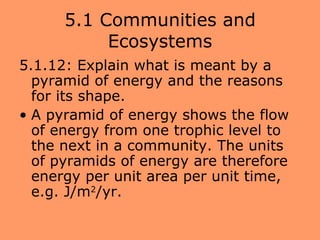
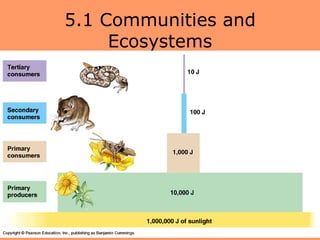
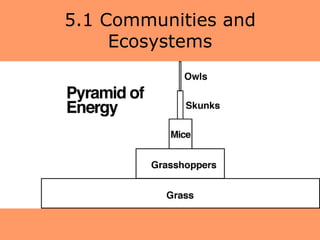
5.1.12: Explain what is meant by a
  pyramid of energy and the reasons
  for its shape.
• A pyramid of energy shows the flow
  of energy from one trophic level to
  the next in a community. The units
  of pyramids of energy are therefore
  energy per unit area per unit time,
  e.g. J/m2/yr.
5.1 Communities and
     Ecosystems
5.1 Communities and
     Ecosystems
5.1 Communities and
           Ecosystems
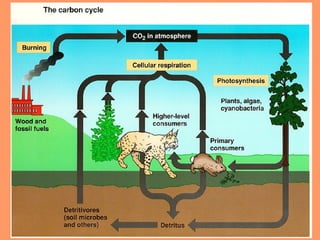
5.1.13: Explain that energy can enter
  and leave an ecosystem, but that
  nutrients must be recycled.
• Energy enters as light and usually
  leaves as heat.
• Nutrients do not usually enter an
  ecosystem and must be used again
  and again. Nutrients such as Carbon
  dioxide, Nitrogen, and Phosphorus
5.1 Communities and
           Ecosystems
5.1.14: Explain the role of
  saprotrophic bacteria and fungi
  (decomposers) in recycling nutrients.
• The digestive enzymes secreted by
  saprophytes breaks down the organic
  molecules in dead material releasing
  the nutrients that were ‘locked up’

Energy flow

  • 1.
  • 2.
    5.1 Communities and Ecosystems 5.1.4: Describe what is meant by a food chain giving three examples, each with at least three linkages (four organisms). • A food chain is a sequence of relationships between trophic levels where each member feeds on the previous one.
  • 3.
    5.1 Communities and Ecosystems 5.1.5: Describe what is meant by a food web. • A food web is a a diagram that shows the feeding relationships in a community. The arrows indicate the direction of energy flow.
  • 4.
    5.1 Communities and Ecosystems 5.1.6: Define trophic level. • A trophic level is where an organism is positioned on a food web. – Producer – Primary consumer – Secondary consumer – Tertiary consumer
  • 5.
    5.1 Communities and Ecosystems 5.1.9: State that light is the initial energy source for almost all communities. • Reference to communities that start with chemical energy is not required. Such as deep sea ocean vents.
  • 6.
    5.1 Communities and Ecosystems 5.1.10: Explain the energy flow in a food chain. • Energy losses between trophic levels include material not consumed or material not assimilated, and heat loss through cell respiration.
  • 7.
    5.1 Communities and Ecosystems 5.1.11: State that when energy transformations take place, including those in living organisms, the process is never 100% efficient, commonly being 10–20%.
  • 8.
    5.1 Communities and Ecosystems 5.1.12: Explain what is meant by a pyramid of energy and the reasons for its shape. • A pyramid of energy shows the flow of energy from one trophic level to the next in a community. The units of pyramids of energy are therefore energy per unit area per unit time, e.g. J/m2/yr.
  • 9.
  • 10.
  • 11.
    5.1 Communities and Ecosystems 5.1.13: Explain that energy can enter and leave an ecosystem, but that nutrients must be recycled. • Energy enters as light and usually leaves as heat. • Nutrients do not usually enter an ecosystem and must be used again and again. Nutrients such as Carbon dioxide, Nitrogen, and Phosphorus
  • 13.
    5.1 Communities and Ecosystems 5.1.14: Explain the role of saprotrophic bacteria and fungi (decomposers) in recycling nutrients. • The digestive enzymes secreted by saprophytes breaks down the organic molecules in dead material releasing the nutrients that were ‘locked up’