Jason Siko 
Assistant Professor of Educational Technology 
Grand Valley State University
What I’m going to do 
Share experiences teaching an advance biology course 
in a blended format 
Discuss history that led to decision to offer course in this 
format 
Design decisions 
Constraints 
Results & Perceptions
What Happened? 
IB Biology HL course 
Course Expanded in size (~doubled) 
$ for supplies/materials (e.g., gel electrophoresis) 
Space (self-designed labs) 
Scheduling Constraints 
Bye-Bye! 
District’s desire to test waters with blended 
coursework
FYI 
Online – 100% distance 
Hybrid – coursework is both online and face-to-face 
(f2f ); separation of tasks 
Blended – mix of online and f2f; content overlaps 
Synchronous – online instruction/activities occur in 
real time with teacher and students 
Asynchronous – instruction/activities occur 
whenever student accesses content
What we did... 
School on trimester system 
2nd trimester: 2 sections had same teacher, different 
hour of the day 
3rd trimester: 2 sections had different teacher, same 
hour of the day (1st Hour) 
Moved course content online (~”flipped”) 
Students came in for labs and for individualized help 
Tests/Exams were taken in class. Everyone took the test 
at the same time.
Attendance 
Because course was 1st Hour, students did not have to 
arrive and then leave in the middle of the day. 
For attendance purposes, students had to arrive for last 
5 minutes of 1st Hour and sign in. Otherwise, students 
were marked absent. 
Attendance personnel and building aides were made 
aware of situation. 
Students were not given freedom to roam; if they were in 
the building, they were in class or had planner pass to 
leave 
Attendance was “normal” on lab and exam days.
Grades and Attendance 
School had online grade and attendance program; 
thus, students/parents were aware of progress on 
demand. 
Teachers reviewed grades every 2 weeks. 
Students below a C- were required to attend class for 
tutoring. 
Once grade was above C-, student could resume normal 
schedule.
Parents 
School hosted an information night where parents 
were informed of the study and given an opportunity 
to ask questions. 
Survey data indicated some apprehension, but overall 
there was positive support for the initiative. 
Stressed self-regulation 
Given nature of IB Program, parents were open to 
opportunity to give students online course experience 
before college.
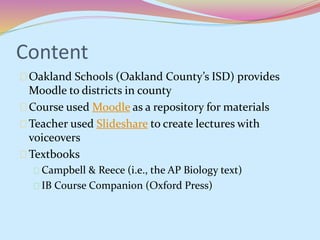
Content 
Oakland Schools (Oakland County’s ISD) provides 
Moodle to districts in county 
Course used Moodle as a repository for materials 
Teacher used Slideshare to create lectures with 
voiceovers 
Textbooks 
Campbell & Reece (i.e., the AP Biology text) 
IB Course Companion (Oxford Press)
Communication 
Email (Parents & Students) 
In-Class Announcements 
Edmodo (Students only) 
Online Gradebook (Parents & Students) 
SchoolCenter (district program for teacher web pages) 
Google Docs (district – used to share data) 
“SuperDoubleSecretFacebookPage”
Assignments 
Turn in physical copies of assignments 
Edmodo 
Edublogs
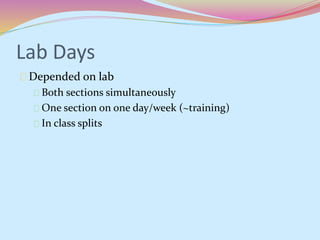
Lab Days 
Depended on lab 
Both sections simultaneously 
One section on one day/week (~training) 
In class splits
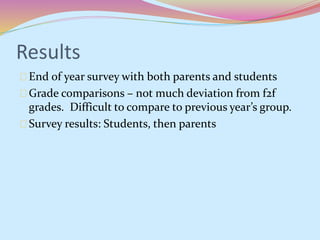
Results 
End of year survey with both parents and students 
Grade comparisons – not much deviation from f2f 
grades. Difficult to compare to previous year’s group. 
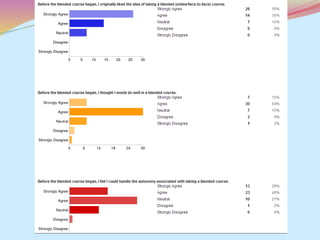
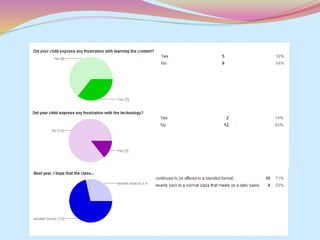
Survey results: Students, then parents
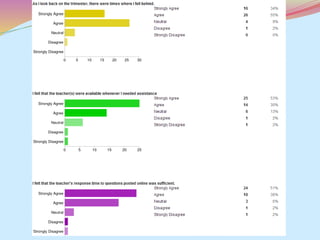
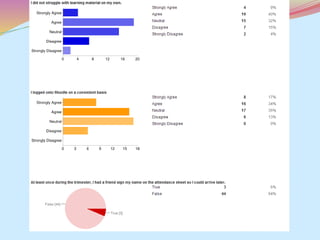
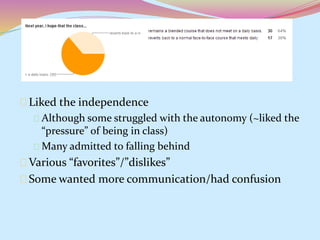
Liked the independence 
Although some struggled with the autonomy (~liked the 
“pressure” of being in class) 
Many admitted to falling behind 
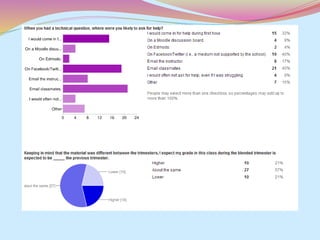
Various “favorites”/”dislikes” 
Some wanted more communication/had confusion
Parents
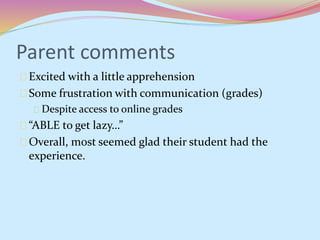
Parent comments 
Excited with a little apprehension 
Some frustration with communication (grades) 
Despite access to online grades 
“ABLE to get lazy…” 
Overall, most seemed glad their student had the 
experience.
Questions?
Thanks for Coming!!!! 
Jason Siko 
Assistant Professor of Educational Technology 
Grand Valley State University 
Grand Rapids, MI 
sikojp@gmail.com / sikoj@gvsu.edu 
http://jasonsiko.com

IB Biology Blended

  • 1.
    Jason Siko AssistantProfessor of Educational Technology Grand Valley State University
  • 2.
    What I’m goingto do Share experiences teaching an advance biology course in a blended format Discuss history that led to decision to offer course in this format Design decisions Constraints Results & Perceptions
  • 3.
    What Happened? IBBiology HL course Course Expanded in size (~doubled) $ for supplies/materials (e.g., gel electrophoresis) Space (self-designed labs) Scheduling Constraints Bye-Bye! District’s desire to test waters with blended coursework
  • 4.
    FYI Online –100% distance Hybrid – coursework is both online and face-to-face (f2f ); separation of tasks Blended – mix of online and f2f; content overlaps Synchronous – online instruction/activities occur in real time with teacher and students Asynchronous – instruction/activities occur whenever student accesses content
  • 5.
    What we did... School on trimester system 2nd trimester: 2 sections had same teacher, different hour of the day 3rd trimester: 2 sections had different teacher, same hour of the day (1st Hour) Moved course content online (~”flipped”) Students came in for labs and for individualized help Tests/Exams were taken in class. Everyone took the test at the same time.
  • 6.
    Attendance Because coursewas 1st Hour, students did not have to arrive and then leave in the middle of the day. For attendance purposes, students had to arrive for last 5 minutes of 1st Hour and sign in. Otherwise, students were marked absent. Attendance personnel and building aides were made aware of situation. Students were not given freedom to roam; if they were in the building, they were in class or had planner pass to leave Attendance was “normal” on lab and exam days.
  • 7.
    Grades and Attendance School had online grade and attendance program; thus, students/parents were aware of progress on demand. Teachers reviewed grades every 2 weeks. Students below a C- were required to attend class for tutoring. Once grade was above C-, student could resume normal schedule.
  • 8.
    Parents School hostedan information night where parents were informed of the study and given an opportunity to ask questions. Survey data indicated some apprehension, but overall there was positive support for the initiative. Stressed self-regulation Given nature of IB Program, parents were open to opportunity to give students online course experience before college.
  • 9.
    Content Oakland Schools(Oakland County’s ISD) provides Moodle to districts in county Course used Moodle as a repository for materials Teacher used Slideshare to create lectures with voiceovers Textbooks Campbell & Reece (i.e., the AP Biology text) IB Course Companion (Oxford Press)
  • 10.
    Communication Email (Parents& Students) In-Class Announcements Edmodo (Students only) Online Gradebook (Parents & Students) SchoolCenter (district program for teacher web pages) Google Docs (district – used to share data) “SuperDoubleSecretFacebookPage”
  • 11.
    Assignments Turn inphysical copies of assignments Edmodo Edublogs
  • 12.
    Lab Days Dependedon lab Both sections simultaneously One section on one day/week (~training) In class splits
  • 13.
    Results End ofyear survey with both parents and students Grade comparisons – not much deviation from f2f grades. Difficult to compare to previous year’s group. Survey results: Students, then parents
  • 19.
    Liked the independence Although some struggled with the autonomy (~liked the “pressure” of being in class) Many admitted to falling behind Various “favorites”/”dislikes” Some wanted more communication/had confusion
  • 20.
  • 23.
    Parent comments Excitedwith a little apprehension Some frustration with communication (grades) Despite access to online grades “ABLE to get lazy…” Overall, most seemed glad their student had the experience.
  • 24.
  • 25.
    Thanks for Coming!!!! Jason Siko Assistant Professor of Educational Technology Grand Valley State University Grand Rapids, MI sikojp@gmail.com / sikoj@gvsu.edu http://jasonsiko.com