PRINCIPLES OF
MANAGEMENT
Unit I
Definition
 According to Harold Koontz, "Management is
the art of getting things done through and with
people in formally organised groups.“
 According to Henri Fayol, "To manage is to
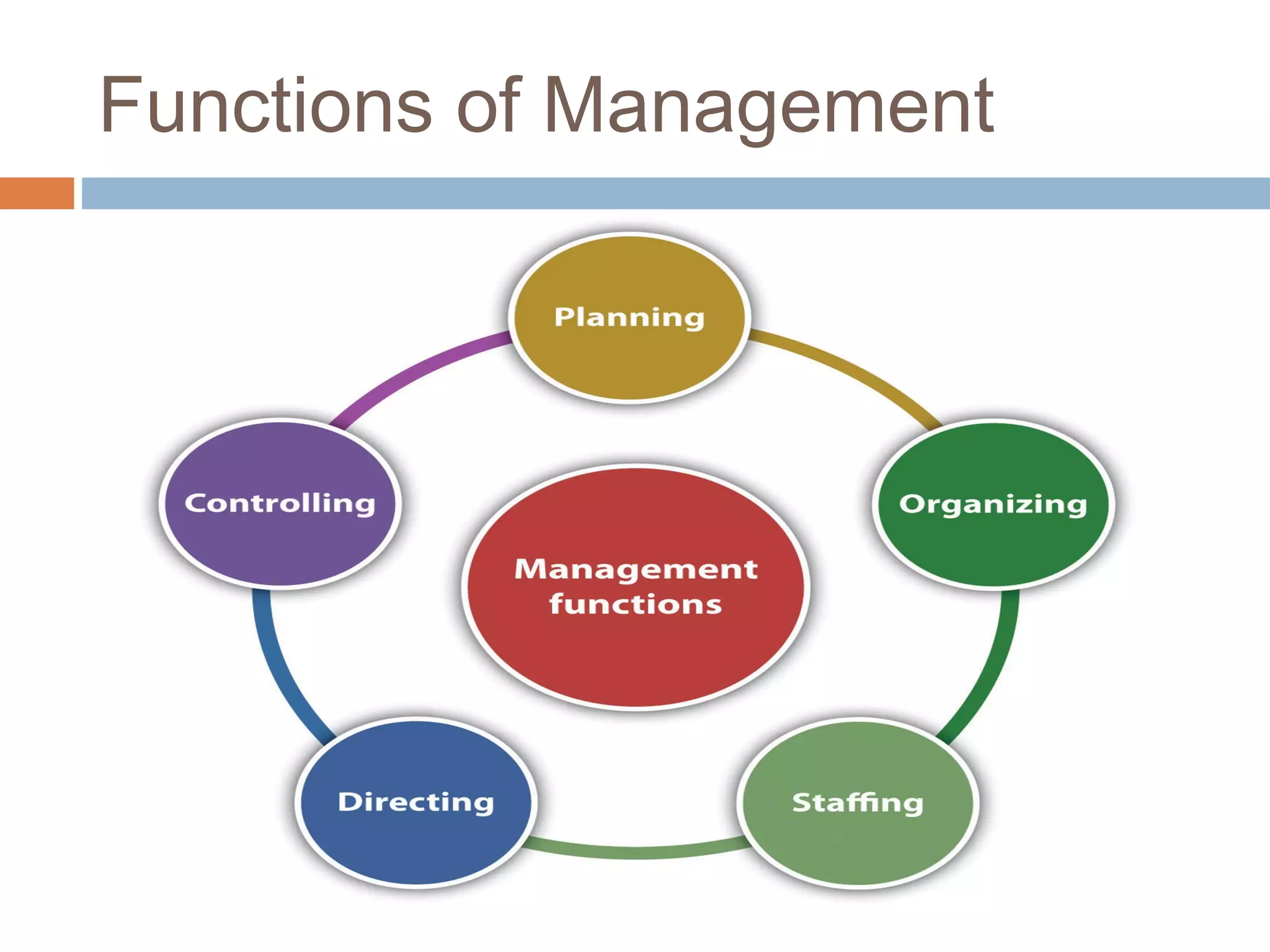
forecast and to plan, to organise, to command,
to co-ordinate and to control."
Management - Art
According to Mary Parker,” management is an art
of getting things done through others.
Management enables a manager to get thongs
done through employees.”
• Management performs non programmed and non
routine work using creativity and innovations
• Management accomplishes any job within time
and budget to achieve organizational goals with
ease.
• Managerial activities are practices by using
knowledge, ability and skill to solve the problems.
Management - Art
• Managers must posses practical knowledge
not only theoretical acquired from experiences
which helps in working according to situation
• Managers apply their interest, ability and skills
for solving contemporary issues through
decisions which ignite their creativity. They
can use their skills in field of job performance,
solving exceptional issues, forming objectives
etc.
Management - Science
• Management as a science, it has systematized
body of knowledge, concept and principles.
Management deals different problems and issues
by using quantitative models and decision making
techniques and issues by using quantitative
models and decision making techniques to arrive
at right decisions. As a science management
contains concepts, hypothesis, theories,
experimentation all verified and tested
accordingly to clarify about cause and effect
relationship between many facts or events
Management - Science
• Management is systematic body of knowledge
with theories, concepts, principles,
experiments and functions which are
systematically and logically analyzed
• The theories related to management are
applicable and used in all types of organization
irrespective of size, type, capital and so on.
However, the usage and method may vary
according to the situation of organization and
time.
• Management is not a pure science but a social
science
Management - Science
• All the managerial knowledge and practices are
developed through various observations and
experiments which are researched and experiment
based
• Tests of management theories are applied in
situational and judgmental cases which help in
prediction of future events.
• Management relates itself to cause and effect
relationship. Results of modern management are
acceptable to all employees. Good and efficient
management system enhances the purity in
organization.
Management - Profession
• Profession means occupation. Occupation is
rendering service. Similarly management is a
distinct profession backed up by specialization. As
a professional activity all management efficient
people should have academic qualification and
personal qualification from any body. Here
profession is not only an occupation of specialized
skill but these skills should be applicable in large
scale and interest of society as a whole.
• Management is a separate discipline which
includes research, observations and practice
• Management requires formal education and
training with updates of professionalism.
Management - Profession
• Professional managers must be joined in an
association that follow rules and regulation
according to the objectives set.
• A professional association requires code of conduct
to maintain self discipline ethical behavior. Violation
of code must be punishable
• Organizations should be responsible towards
society. An organization gets its birth in a society,
lives and grows in a society and finally liquidates or
dissolves in a society. Thu, an organization has
responsibility towards members of society such as
consumer, investors, employees and shareholders.
Functions of Management
S.No.
Bases of
Difference
Entrepreneur Manager
1 Motive
The main motive of an entrepre­neur is
to start a venture by setting up an
enterprise. He understands the venture
for his personal gratification.
The main motive of a manager is to
render his services in an enterprise
already set up by someone else i.e.,
entrepreneur.
2 Status
An entrepreneur is the owner of the
enterprise.
A manager is the servant in the
enterprise owned by the entrepreneur.
3 Risk Bearing
An entrepreneur being the owner of the
enterprise assumes all risks and
uncertainty involved in run­ning the
enterprise.
A manager as a servant does not bear
any risk involved in the enterprise.
4 Rewards
The reward an entrepreneur gets for
bearing risks involved in the enterprise
is profit which is highly uncertain.
A manager gets salary as reward for
the services rendered by him in the
enterprise. Salary of a manager is
certain and fixed.
5 Innovation
Entrepreneur himself thinks over what
and how to produce goods to meet the
changing demands of the customers.
Hence, he acts as an innovator also
called a ‘change agent’
But, what a manager does is simply to
execute the plans prepared by the
entrepreneur. Thus, a manager simply
translates the entrepreneur’s ideas into
practice.
6 Qualification
An entrepreneur needs to possess
qualities and qualifications like high
achievement motive, origi­nality in
thinking, foresight, risk -bearing ability
and so on.
On the contrary, a manager needs to
possess distinct qualifications in terms
of sound knowledge in management
theory and practice.
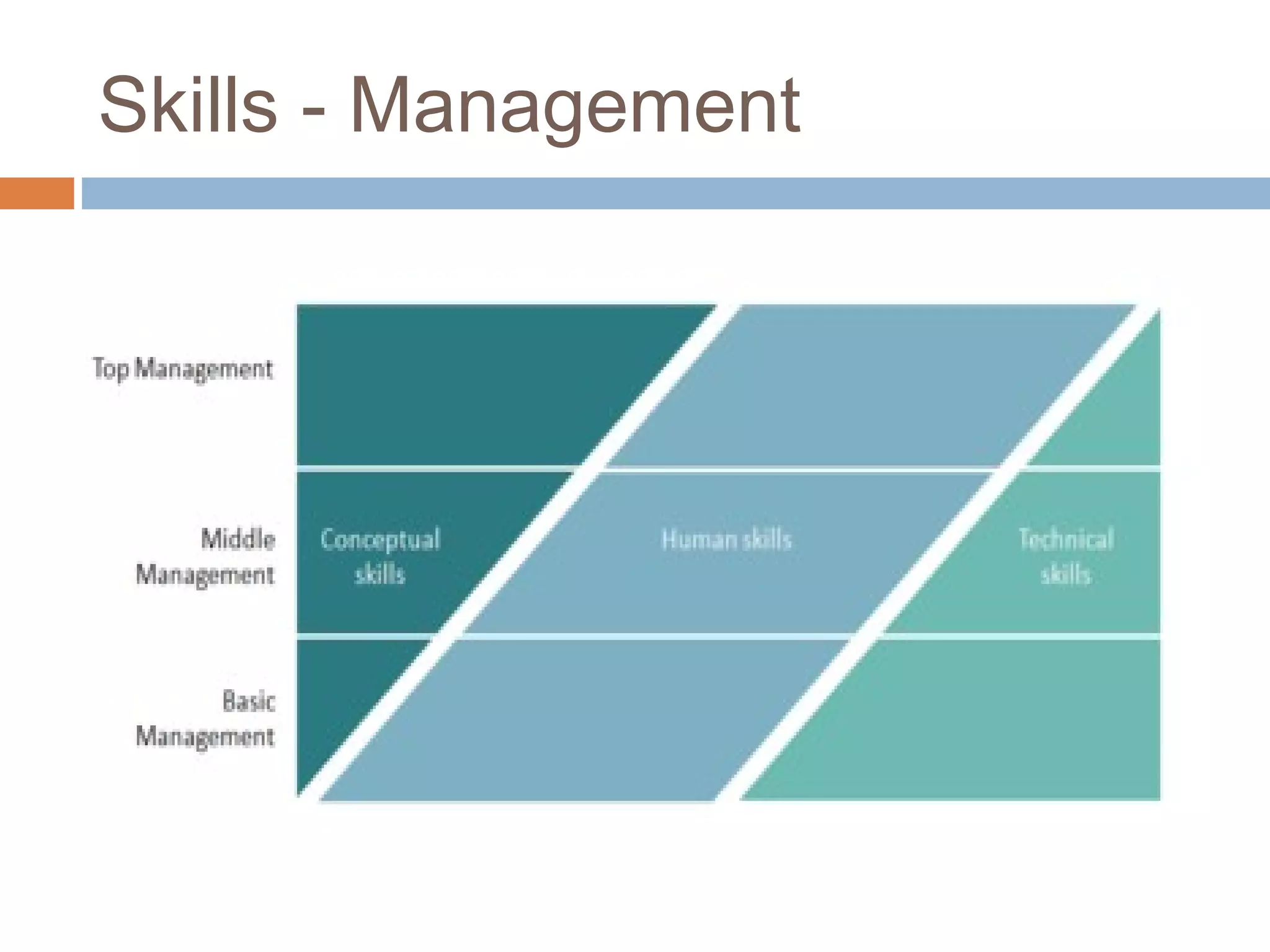
Skills - Management
Characteristics of Management
 Goal oriented process
 All - pervasive
 Multi - dimensional (Management of work,
people, operations)
 Continuous process
 Group Activity
 Dynamic Function
 Intangible force
Difference between Administration
and Management
Basis of Distinction Administration Management
Policy and Objectives Determines policy to be
followed and decide the
objectives to be
achieved.
Implements the policy
and achieve the
objectives
Directing of human
efforts
Not directly involves in
the execution of plan
and achievement of
objectives
Directly involves in the
execution of plan and
achievement of
objectives
Main Functions Planning, Organizing
and Staffing
Directing, Motivation and
Controling
Levels of Executives Top level executives
(Owners and Board of
Directors)
Middle and Lower Level
Executives
Position Acts as a Principal Acts as an Agency
Knowledge Requires administrative
ability more than
Requires technical ability
more than administrative
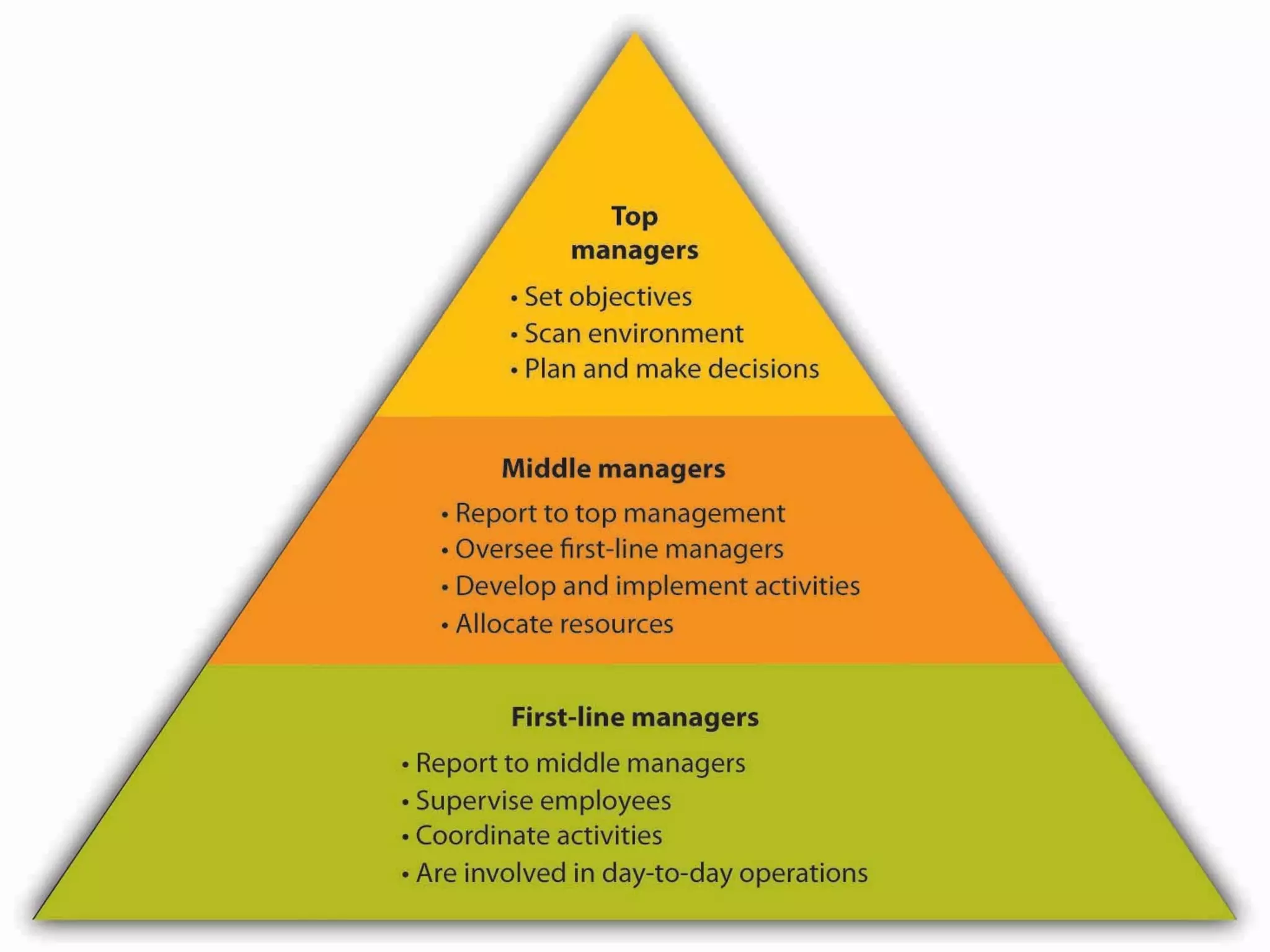
Role of Managers -
Mintzberg
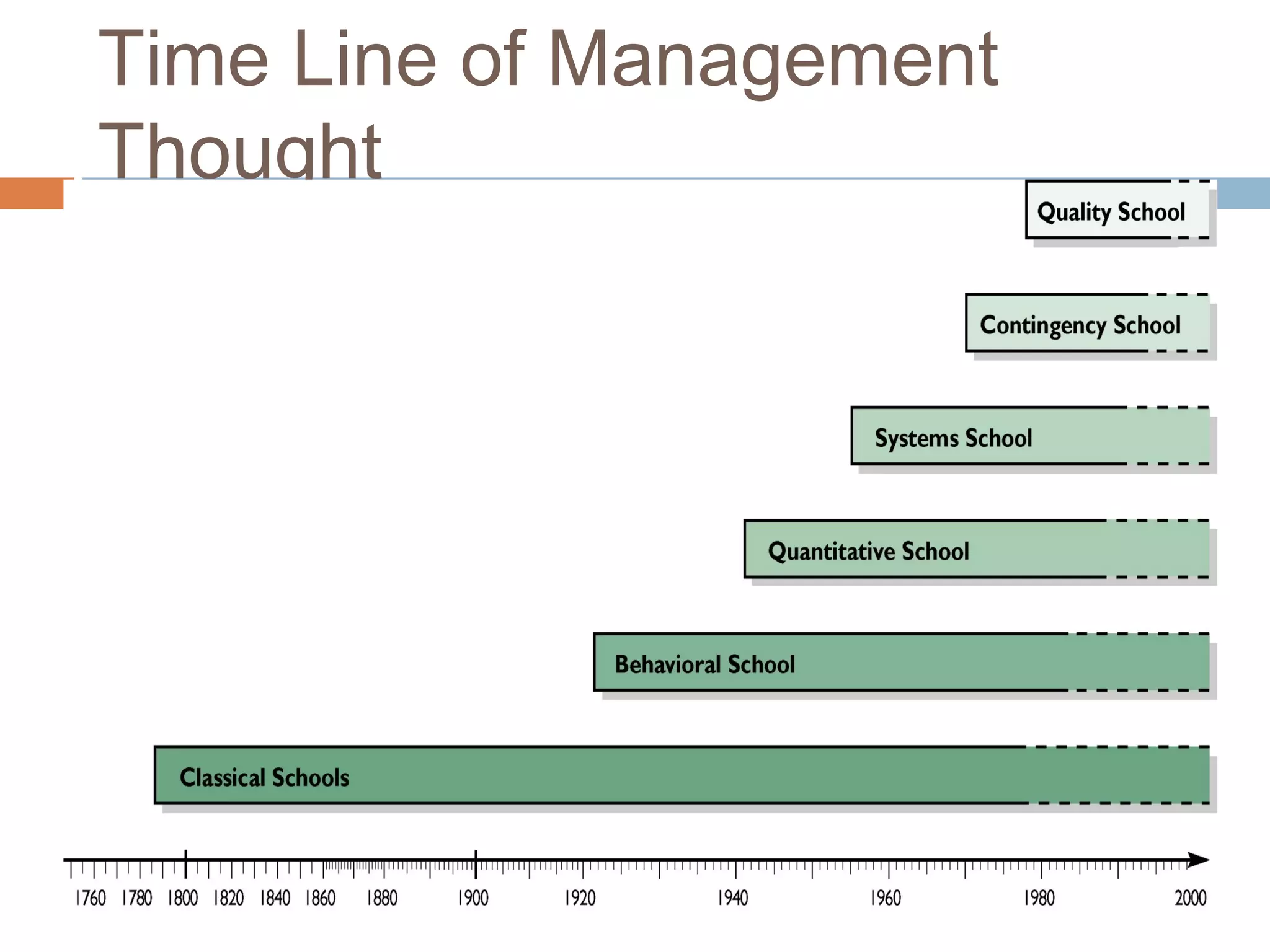
Time Line of Management
Thought
Classical School
 Originated during England’s Industrial Revolution
 Manufacturers began mass-producing goods
in factories; Textile industry was among the first
 Allowed production of standardized goods
 Depended on a constant flow of labor and
materials
 Owners needed to plan, organize, lead, control
 Focused on finding the “one best way”
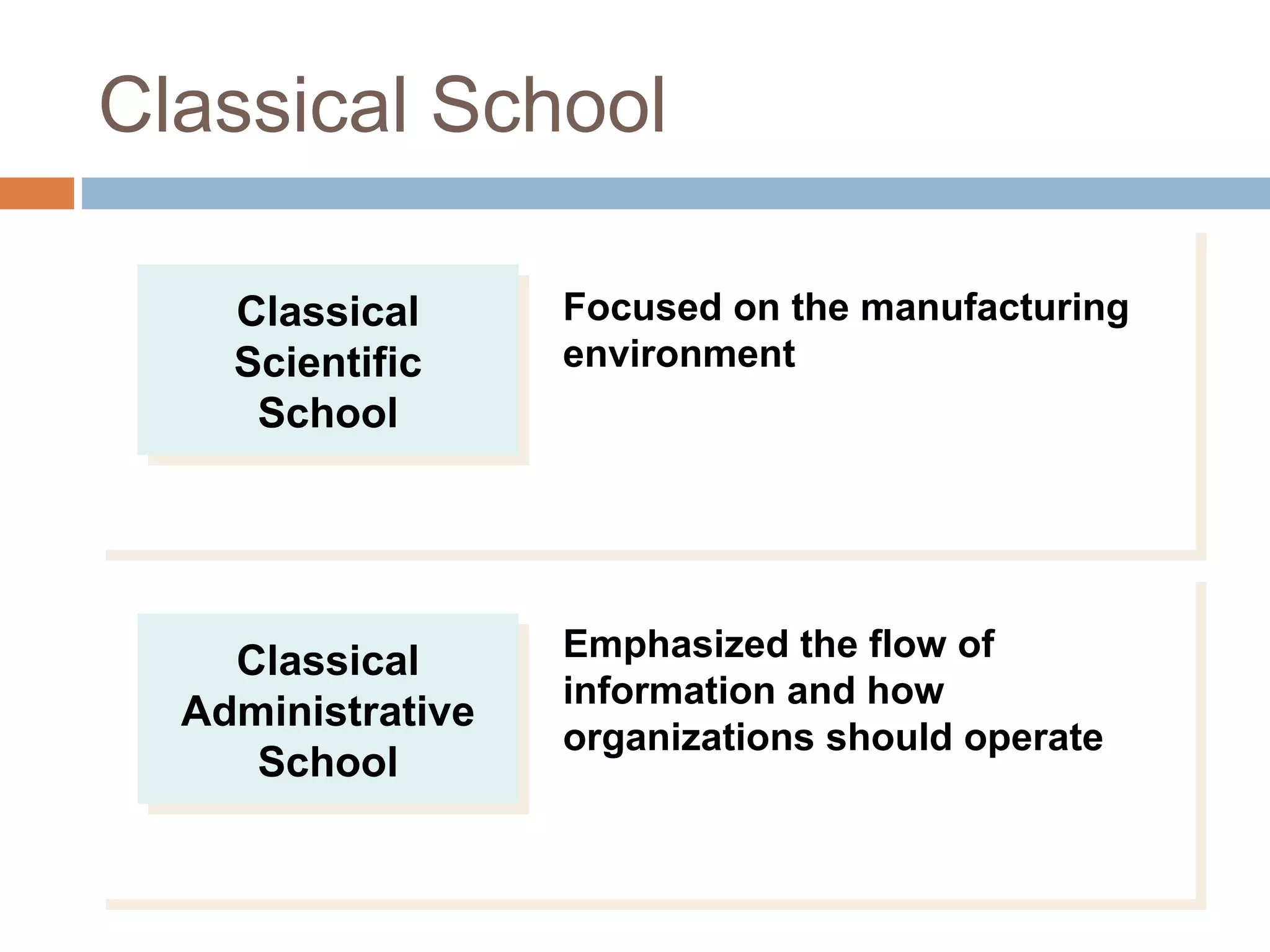
Classical School
Classical
Scientific
School
Classical
Scientific
School
Focused on the manufacturing
environment
Classical
Administrative
School
Classical
Administrative
School
Emphasized the flow of
information and how
organizations should operate
Classical Scientific School
Fre de rick W. Taylo r : The Father of Scientific
Management
• Pursued four key goals:
• Develop a science of management
• Select workers scientifically
• Develop and train workers scientifically
• Create cooperation between management
and labor
• Determined the quickest ways to perform tasks
Classical Scientific School
He nry Gantt
 Invented the Gantt chart
 Moved away from authoritarian management
 Advocated a bonus system to reward workers
 Classical Scientific School
 Analyze everything
 Teach effective methods to others
 Constantly monitor workers
 Plan responsibly
 Control the work and the workers
Classical Administrative School
He nri Fayo l
 Believed specific management skills could be
learned and taught
 Fayol believed that the manager’s job could be
divided into five functions, or areas, of
managerial responsibility—planning,
organizing, command, coordination, and
control—that are essential to managerial
success.
Classical Administrative School
Mary Parke r Fo lle tt
 Focused on how organizations cope with
conflict and the importance of sharing goals
 Emphasized the need to discover and enlist
individual and group motivation
 The first principle for individual and group
success is the “capacity for organized
thinking”
Classical Administrative School
Che ste r Barnard
 Argued that managers must gain acceptance
for their authority
 Advocated the use of basic management
principles
 Cautioned managers to issue no order that
could not or would not be obeyed
Behavioral School
 Recognized employees as individuals with
concrete, human needs, as parts of work
groups, and as members of a larger society
Ro be rt O we n : The father of modern personnel
management
 The quality and quantity of workers’ output
influenced by conditions on and off the job
Behavioral School
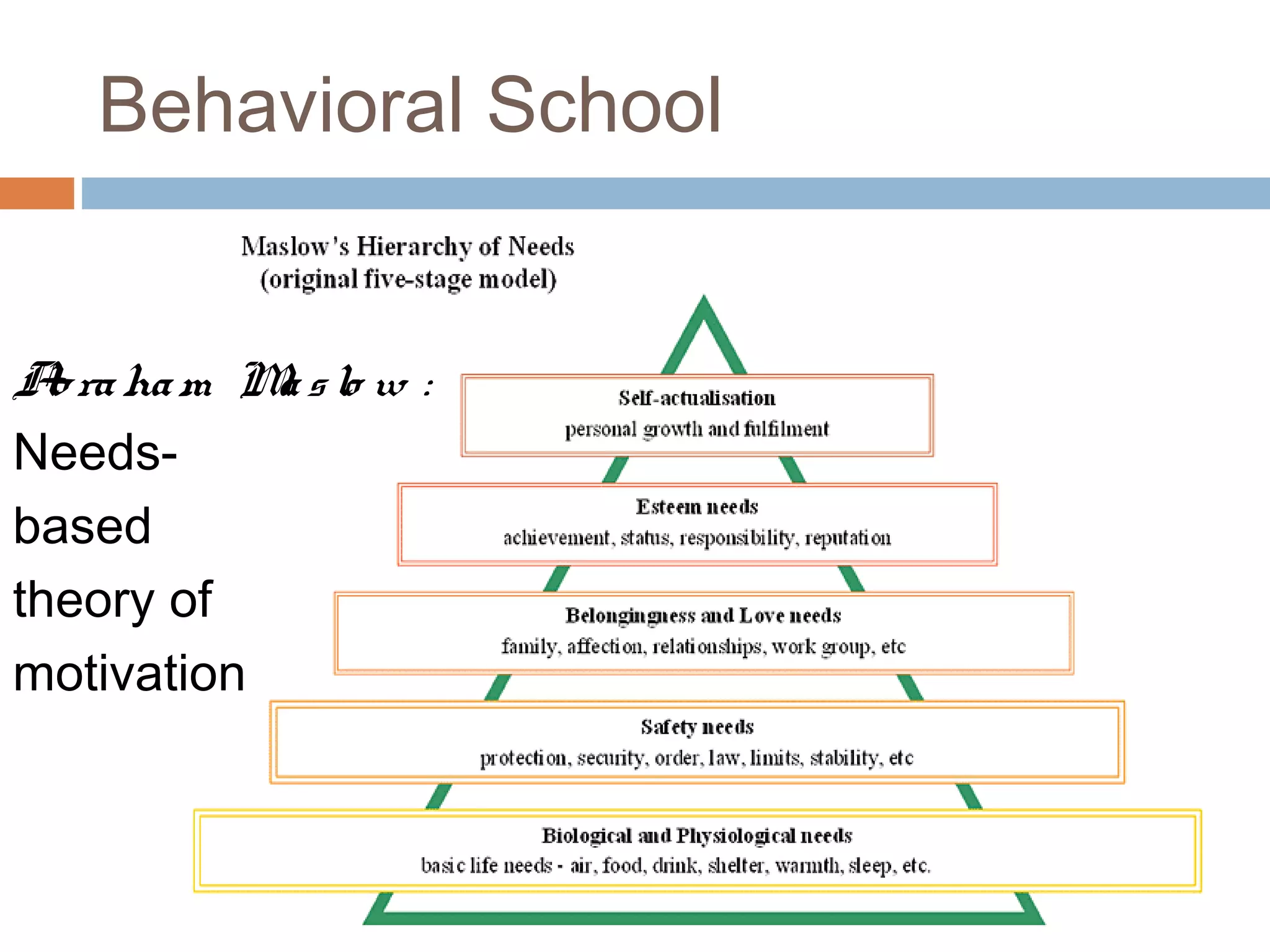
Abraham Maslo w :
Needs-
based
theory of
motivation
Behavioral School
Hawthorne Studies : Illumination studies
 Measured Light Intensity vs. Worker Output
 Result :
 Higher worker productivity and satisfaction at all
light levels
 Conclusions:
 Light intensity has no conclusive effect on output
 Productivity has a psychological component
Behavioral School
Hawthorne Studies : Relay assembly room study
 Manipulated factors of production to measure
effect on output: Pay Incentives; Length of Work
Day & Work Week; Use of Rest Periods;
Company Sponsored Meals
 Results:
 Higher output and greater employee satisfaction
 Conclusions:
 Positive effects even with negative influences –
workers’ output will increase as a response to
attention
 Strong social bonds were created within the test
group. Workers are influenced by need for
recognition, security and sense of belonging
Behavioral School
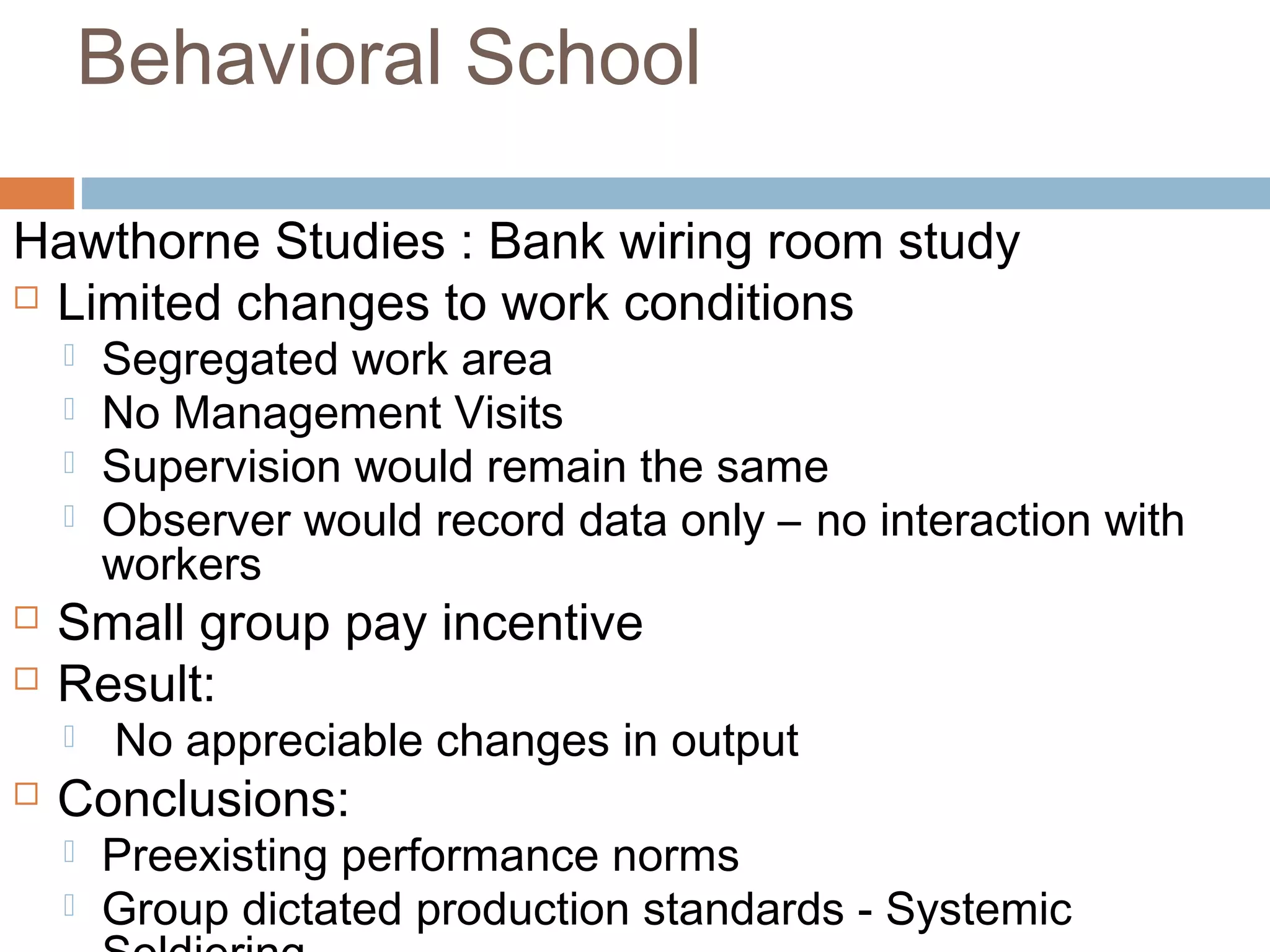
Hawthorne Studies : Bank wiring room study
 Limited changes to work conditions
 Segregated work area
 No Management Visits
 Supervision would remain the same
 Observer would record data only – no interaction with
workers
 Small group pay incentive
 Result:
 No appreciable changes in output
 Conclusions:
 Preexisting performance norms
 Group dictated production standards - Systemic
Behavioral School
Manag e rs disco ve r…
 What employees want from work
 How to enlist cooperation and commitment
 How to unleash talents, energy, and creativity
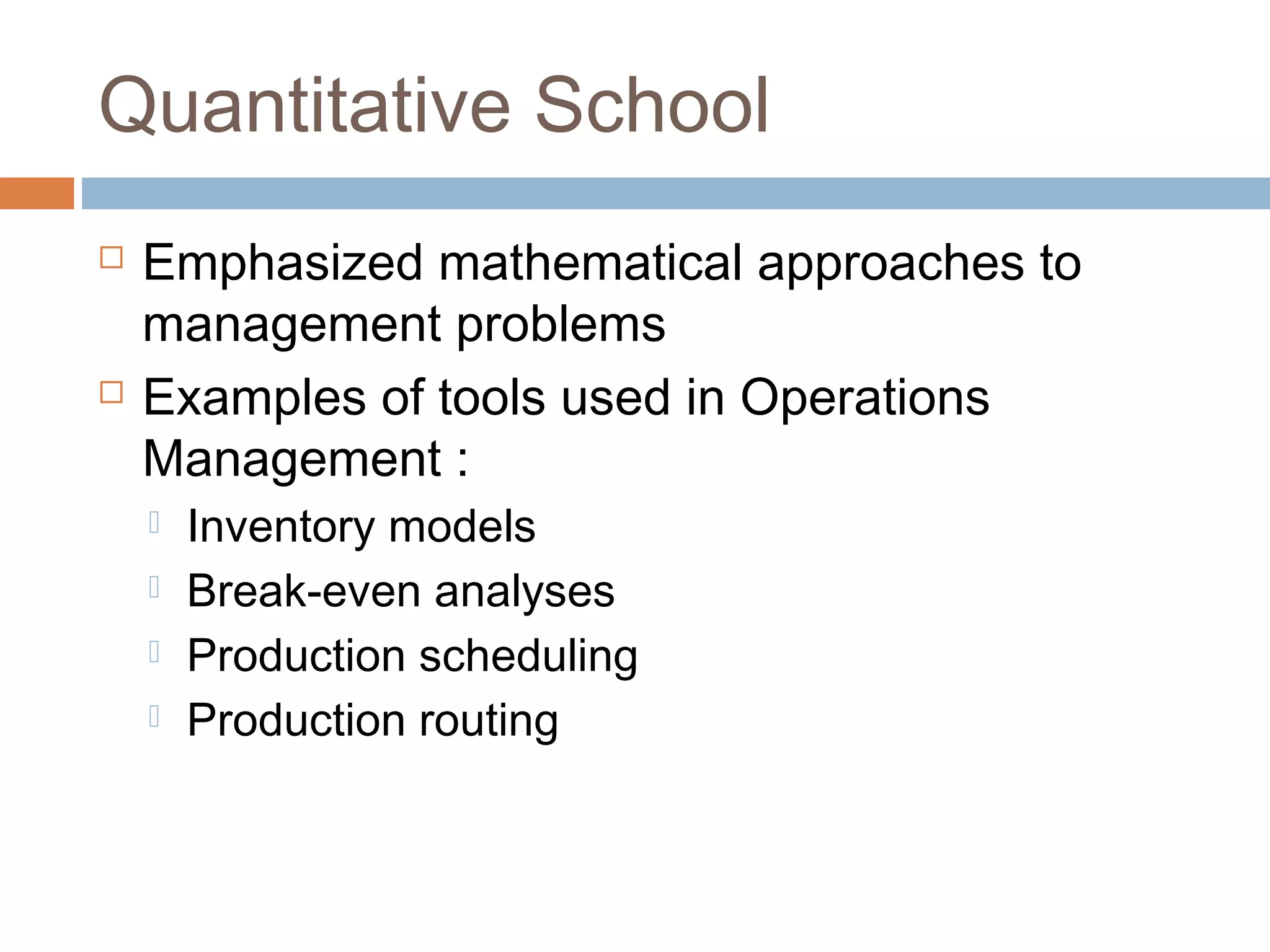
Quantitative School
 Emphasized mathematical approaches to
management problems
 Examples of tools used in Operations
Management :
 Inventory models
 Break-even analyses
 Production scheduling
 Production routing
Systems School
 The systems theory emphasizes that an
organization comprises various parts that must
perform tasks necessary for the survival and
proper functioning of the system
Systems School
Resources
 Men
 Materials
 Money
 Machinery
 Methods
 Information
Managerial and
Technological
Abilities
 Planning
 Organizing
 Staffing
 Leading
 Coordinating
 Controlling
 Technology
 Goods
 Services
 Profits and
losses
 Employee
satisfaction
Inputs
Transformation process Outputs
Feedback
Contingency School
 This theory is based on the premise that
managers’ preferred actions or approaches
depend on the variables of the situation they
face
Quality School
 Quality Management is a management
approach that directs the efforts of
management towards bringing about
continuous improvement in product and
service quality to achieve higher levels of
customer satisfaction and build customer
loyalty.
 Its roots are in the behavioral, quantitative,
systems, and contingency schools
 People are key to commitments and
Organizational Environment
 Internal Environment
 External Environment
 Direct Action Environment
 Indirect Action Environment
Organizational Environment
Managing Globally
 Global activities are simplified and encouraged
by trade agreements among nations.
 As these trends and arrangements encourage
international trade, they increase and change
demands on human resource management.
 Organizations need employees who understand
the customers and suppliers in foreign
countries.
 Organizations need to understand the laws and
customs that apply to employees in other
countries.
Employees in an International
Workforce
 Parent-countrynational – employee who was born
and works in the country in which an
organization’s headquarters is located.
 Host-countrynational – employee who is a citizen
of the country (other than parent country) in which
an organization operates a facility.
 Third-countrynational – employee who is a
citizen of a country that is neither the parent
country nor the host country of the employer.
Employers in the Global
Marketplace
 International organization– an organization that
sets up one or a few facilities in one or a few
foreign countries.
 Multinational company– an organization that
builds facilities in a number of different countries
in an effort to minimize production and
distribution costs.
 Global organization– an organization that
chooses to locate a facility based on the ability
to effectively, efficiently, and flexibly produce a
product or service using cultural differences as
an advantage.
Challenges faced - General
 Need for Vision
 Need for Ethics
 Need for Responsiveness to cultural diversity
 Globalization
 Emphasis on Technology
 Society Expectations
Challenges faced – Company
issues
 Flexibility
 Family Friendly
 Conversion of permanent to temporary job
 Outsourcing
 Empowering employees

Principles of Management - Basics

  • 1.
  • 2.
    Definition  According to HaroldKoontz, "Management is the art of getting things done through and with people in formally organised groups.“  According to Henri Fayol, "To manage is to forecast and to plan, to organise, to command, to co-ordinate and to control."
  • 3.
    Management - Art Accordingto Mary Parker,” management is an art of getting things done through others. Management enables a manager to get thongs done through employees.” • Management performs non programmed and non routine work using creativity and innovations • Management accomplishes any job within time and budget to achieve organizational goals with ease. • Managerial activities are practices by using knowledge, ability and skill to solve the problems.
  • 4.
    Management - Art •Managers must posses practical knowledge not only theoretical acquired from experiences which helps in working according to situation • Managers apply their interest, ability and skills for solving contemporary issues through decisions which ignite their creativity. They can use their skills in field of job performance, solving exceptional issues, forming objectives etc.
  • 5.
    Management - Science •Management as a science, it has systematized body of knowledge, concept and principles. Management deals different problems and issues by using quantitative models and decision making techniques and issues by using quantitative models and decision making techniques to arrive at right decisions. As a science management contains concepts, hypothesis, theories, experimentation all verified and tested accordingly to clarify about cause and effect relationship between many facts or events
  • 6.
    Management - Science •Management is systematic body of knowledge with theories, concepts, principles, experiments and functions which are systematically and logically analyzed • The theories related to management are applicable and used in all types of organization irrespective of size, type, capital and so on. However, the usage and method may vary according to the situation of organization and time. • Management is not a pure science but a social science
  • 7.
    Management - Science •All the managerial knowledge and practices are developed through various observations and experiments which are researched and experiment based • Tests of management theories are applied in situational and judgmental cases which help in prediction of future events. • Management relates itself to cause and effect relationship. Results of modern management are acceptable to all employees. Good and efficient management system enhances the purity in organization.
  • 8.
    Management - Profession •Profession means occupation. Occupation is rendering service. Similarly management is a distinct profession backed up by specialization. As a professional activity all management efficient people should have academic qualification and personal qualification from any body. Here profession is not only an occupation of specialized skill but these skills should be applicable in large scale and interest of society as a whole. • Management is a separate discipline which includes research, observations and practice • Management requires formal education and training with updates of professionalism.
  • 9.
    Management - Profession •Professional managers must be joined in an association that follow rules and regulation according to the objectives set. • A professional association requires code of conduct to maintain self discipline ethical behavior. Violation of code must be punishable • Organizations should be responsible towards society. An organization gets its birth in a society, lives and grows in a society and finally liquidates or dissolves in a society. Thu, an organization has responsibility towards members of society such as consumer, investors, employees and shareholders.
  • 10.
  • 12.
    S.No. Bases of Difference Entrepreneur Manager 1Motive The main motive of an entrepre­neur is to start a venture by setting up an enterprise. He understands the venture for his personal gratification. The main motive of a manager is to render his services in an enterprise already set up by someone else i.e., entrepreneur. 2 Status An entrepreneur is the owner of the enterprise. A manager is the servant in the enterprise owned by the entrepreneur. 3 Risk Bearing An entrepreneur being the owner of the enterprise assumes all risks and uncertainty involved in run­ning the enterprise. A manager as a servant does not bear any risk involved in the enterprise. 4 Rewards The reward an entrepreneur gets for bearing risks involved in the enterprise is profit which is highly uncertain. A manager gets salary as reward for the services rendered by him in the enterprise. Salary of a manager is certain and fixed. 5 Innovation Entrepreneur himself thinks over what and how to produce goods to meet the changing demands of the customers. Hence, he acts as an innovator also called a ‘change agent’ But, what a manager does is simply to execute the plans prepared by the entrepreneur. Thus, a manager simply translates the entrepreneur’s ideas into practice. 6 Qualification An entrepreneur needs to possess qualities and qualifications like high achievement motive, origi­nality in thinking, foresight, risk -bearing ability and so on. On the contrary, a manager needs to possess distinct qualifications in terms of sound knowledge in management theory and practice.
  • 14.
  • 15.
    Characteristics of Management Goal oriented process  All - pervasive  Multi - dimensional (Management of work, people, operations)  Continuous process  Group Activity  Dynamic Function  Intangible force
  • 16.
    Difference between Administration andManagement Basis of Distinction Administration Management Policy and Objectives Determines policy to be followed and decide the objectives to be achieved. Implements the policy and achieve the objectives Directing of human efforts Not directly involves in the execution of plan and achievement of objectives Directly involves in the execution of plan and achievement of objectives Main Functions Planning, Organizing and Staffing Directing, Motivation and Controling Levels of Executives Top level executives (Owners and Board of Directors) Middle and Lower Level Executives Position Acts as a Principal Acts as an Agency Knowledge Requires administrative ability more than Requires technical ability more than administrative
  • 18.
    Role of Managers- Mintzberg
  • 19.
    Time Line ofManagement Thought
  • 21.
    Classical School  Originatedduring England’s Industrial Revolution  Manufacturers began mass-producing goods in factories; Textile industry was among the first  Allowed production of standardized goods  Depended on a constant flow of labor and materials  Owners needed to plan, organize, lead, control  Focused on finding the “one best way”
  • 22.
    Classical School Classical Scientific School Classical Scientific School Focused onthe manufacturing environment Classical Administrative School Classical Administrative School Emphasized the flow of information and how organizations should operate
  • 23.
    Classical Scientific School Frede rick W. Taylo r : The Father of Scientific Management • Pursued four key goals: • Develop a science of management • Select workers scientifically • Develop and train workers scientifically • Create cooperation between management and labor • Determined the quickest ways to perform tasks
  • 24.
    Classical Scientific School Henry Gantt  Invented the Gantt chart  Moved away from authoritarian management  Advocated a bonus system to reward workers  Classical Scientific School  Analyze everything  Teach effective methods to others  Constantly monitor workers  Plan responsibly  Control the work and the workers
  • 25.
    Classical Administrative School Henri Fayo l  Believed specific management skills could be learned and taught  Fayol believed that the manager’s job could be divided into five functions, or areas, of managerial responsibility—planning, organizing, command, coordination, and control—that are essential to managerial success.
  • 27.
    Classical Administrative School MaryParke r Fo lle tt  Focused on how organizations cope with conflict and the importance of sharing goals  Emphasized the need to discover and enlist individual and group motivation  The first principle for individual and group success is the “capacity for organized thinking”
  • 28.
    Classical Administrative School Cheste r Barnard  Argued that managers must gain acceptance for their authority  Advocated the use of basic management principles  Cautioned managers to issue no order that could not or would not be obeyed
  • 29.
    Behavioral School  Recognizedemployees as individuals with concrete, human needs, as parts of work groups, and as members of a larger society Ro be rt O we n : The father of modern personnel management  The quality and quantity of workers’ output influenced by conditions on and off the job
  • 30.
    Behavioral School Abraham Maslow : Needs- based theory of motivation
  • 31.
    Behavioral School Hawthorne Studies: Illumination studies  Measured Light Intensity vs. Worker Output  Result :  Higher worker productivity and satisfaction at all light levels  Conclusions:  Light intensity has no conclusive effect on output  Productivity has a psychological component
  • 32.
    Behavioral School Hawthorne Studies: Relay assembly room study  Manipulated factors of production to measure effect on output: Pay Incentives; Length of Work Day & Work Week; Use of Rest Periods; Company Sponsored Meals  Results:  Higher output and greater employee satisfaction  Conclusions:  Positive effects even with negative influences – workers’ output will increase as a response to attention  Strong social bonds were created within the test group. Workers are influenced by need for recognition, security and sense of belonging
  • 33.
    Behavioral School Hawthorne Studies: Bank wiring room study  Limited changes to work conditions  Segregated work area  No Management Visits  Supervision would remain the same  Observer would record data only – no interaction with workers  Small group pay incentive  Result:  No appreciable changes in output  Conclusions:  Preexisting performance norms  Group dictated production standards - Systemic
  • 34.
    Behavioral School Manag ers disco ve r…  What employees want from work  How to enlist cooperation and commitment  How to unleash talents, energy, and creativity
  • 35.
    Quantitative School  Emphasizedmathematical approaches to management problems  Examples of tools used in Operations Management :  Inventory models  Break-even analyses  Production scheduling  Production routing
  • 36.
    Systems School  Thesystems theory emphasizes that an organization comprises various parts that must perform tasks necessary for the survival and proper functioning of the system
  • 37.
    Systems School Resources  Men Materials  Money  Machinery  Methods  Information Managerial and Technological Abilities  Planning  Organizing  Staffing  Leading  Coordinating  Controlling  Technology  Goods  Services  Profits and losses  Employee satisfaction Inputs Transformation process Outputs Feedback
  • 38.
    Contingency School  Thistheory is based on the premise that managers’ preferred actions or approaches depend on the variables of the situation they face
  • 39.
    Quality School  QualityManagement is a management approach that directs the efforts of management towards bringing about continuous improvement in product and service quality to achieve higher levels of customer satisfaction and build customer loyalty.  Its roots are in the behavioral, quantitative, systems, and contingency schools  People are key to commitments and
  • 40.
    Organizational Environment  InternalEnvironment  External Environment  Direct Action Environment  Indirect Action Environment
  • 41.
  • 42.
    Managing Globally  Globalactivities are simplified and encouraged by trade agreements among nations.  As these trends and arrangements encourage international trade, they increase and change demands on human resource management.  Organizations need employees who understand the customers and suppliers in foreign countries.  Organizations need to understand the laws and customs that apply to employees in other countries.
  • 43.
    Employees in anInternational Workforce  Parent-countrynational – employee who was born and works in the country in which an organization’s headquarters is located.  Host-countrynational – employee who is a citizen of the country (other than parent country) in which an organization operates a facility.  Third-countrynational – employee who is a citizen of a country that is neither the parent country nor the host country of the employer.
  • 44.
    Employers in theGlobal Marketplace  International organization– an organization that sets up one or a few facilities in one or a few foreign countries.  Multinational company– an organization that builds facilities in a number of different countries in an effort to minimize production and distribution costs.  Global organization– an organization that chooses to locate a facility based on the ability to effectively, efficiently, and flexibly produce a product or service using cultural differences as an advantage.
  • 45.
    Challenges faced -General  Need for Vision  Need for Ethics  Need for Responsiveness to cultural diversity  Globalization  Emphasis on Technology  Society Expectations
  • 46.
    Challenges faced –Company issues  Flexibility  Family Friendly  Conversion of permanent to temporary job  Outsourcing  Empowering employees