Section 1: The Geosphere
Standards: SEV1a, SEV1e

THE DYNAMIC EARTH
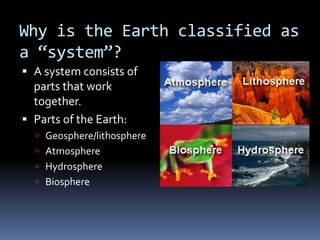
Why is the Earth classified as
a “system”?
 A system consists of
  parts that work
  together.
 Parts of the Earth:
   Geosphere/lithosphere
   Atmosphere
   Hydrosphere
   Biosphere
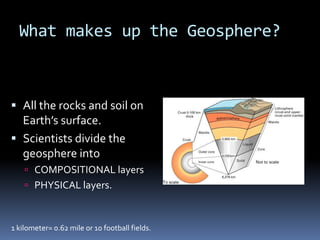
What makes up the Geosphere?


 All the rocks and soil on
  Earth’s surface.
 Scientists divide the
  geosphere into
     COMPOSITIONAL layers
     PHYSICAL layers.


1 kilometer= 0.62 mile or 10 football fields.
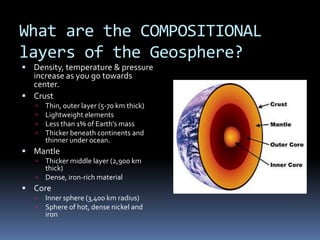
What are the COMPOSITIONAL
layers of the Geosphere?
 Density, temperature & pressure
  increase as you go towards
  center.
 Crust
      Thin, outer layer (5-70 km thick)
      Lightweight elements
      Less than 1% of Earth’s mass
      Thicker beneath continents and
       thinner under ocean.
 Mantle
    Thicker middle layer (2,900 km
     thick)
    Dense, iron-rich material
 Core
      Inner sphere (3,400 km radius)
      Sphere of hot, dense nickel and
       iron
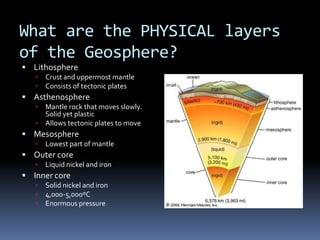
What are the PHYSICAL layers
of the Geosphere?
 Lithosphere
      Crust and uppermost mantle
      Consists of tectonic plates
 Asthenosphere
    Mantle rock that moves slowly.
     Solid yet plastic
    Allows tectonic plates to move
 Mesosphere
      Lowest part of mantle
 Outer core
      Liquid nickel and iron
 Inner core
      Solid nickel and iron
      4,000-5,000ºC
      Enormous pressure
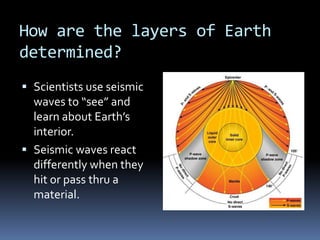
How are the layers of Earth
determined?
 Scientists use seismic
  waves to “see” and
  learn about Earth’s
  interior.
 Seismic waves react
  differently when they
  hit or pass thru a
  material.
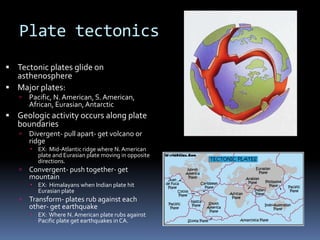
Plate tectonics
 Tectonic plates glide on
  asthenosphere
 Major plates:
      Pacific, N. American, S. American,
       African, Eurasian, Antarctic
 Geologic activity occurs along plate
   boundaries
      Divergent- pull apart- get volcano or
       ridge
        EX: Mid-Atlantic ridge where N. American
         plate and Eurasian plate moving in opposite
         directions.
      Convergent- push together- get
       mountain
        EX: Himalayans when Indian plate hit
         Eurasian plate
      Transform- plates rub against each
       other- get earthquake
        EX: Where N. American plate rubs against
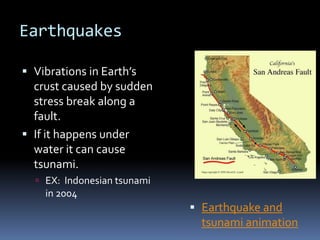
         Pacific plate get earthquakes in CA.
Earthquakes

 Vibrations in Earth’s
  crust caused by sudden
  stress break along a
  fault.
 If it happens under
  water it can cause
  tsunami.
   EX: Indonesian tsunami
    in 2004
                              Earthquake and
                               tsunami animation
Earthquakes
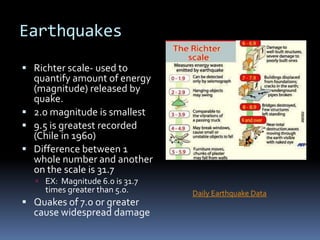
 Richter scale- used to
  quantify amount of energy
  (magnitude) released by
  quake.
 2.0 magnitude is smallest
 9.5 is greatest recorded
  (Chile in 1960)
 Difference between 1
  whole number and another
  on the scale is 31.7
    EX: Magnitude 6.0 is 31.7
     times greater than 5.0.     Daily Earthquake Data
 Quakes of 7.0 or greater
  cause widespread damage
Earthquakes

 Hazards
   Can’t predict when will
    happen
   Damage depends on
    type of soil
     Sandy soil = more damage
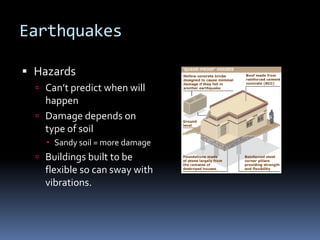
   Buildings built to be
    flexible so can sway with
    vibrations.
Comparison of Haiti & Chile
2010 Earthquakes
 Haiti                                Chile
  ‒ Magnitude 7                          Magnitude 8.8
  ‒ 8 miles below surface                21 miles below surface
  ‒ Right outside Port-Au-Prince
                                         200 miles outside city
  ‒ 220,000 people killed
                                         100’s killed
  ‒ Buildings leveled b/c not built
    to earthquake code- have no          Buildings built to
    codes- poorer country                 earthquake code so not
  ‒ People not educated about             leveled- wealthier country
    how to react
                                         People are educated
  ‒ Last major earthquake in Port-
    Au-Prince was 250 years ago.         Has experienced many
                                          earthquakes
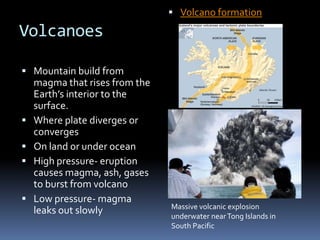
 Volcano formation

Volcanoes

 Mountain build from
    magma that rises from the
    Earth’s interior to the
    surface.
   Where plate diverges or
    converges
   On land or under ocean
   High pressure- eruption
    causes magma, ash, gases
    to burst from volcano
   Low pressure- magma
                                Massive volcanic explosion
    leaks out slowly            underwater near Tong Islands in
                                South Pacific
Volcanoes
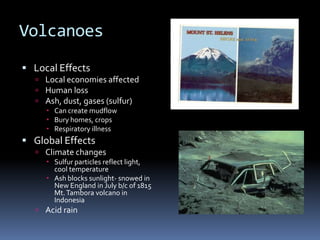
 Local Effects
   Local economies affected
   Human loss
   Ash, dust, gases (sulfur)
      Can create mudflow
      Bury homes, crops
      Respiratory illness
 Global Effects
   Climate changes
      Sulfur particles reflect light,
       cool temperature
      Ash blocks sunlight- snowed in
       New England in July b/c of 1815
       Mt. Tambora volcano in
       Indonesia
   Acid rain
Erosion

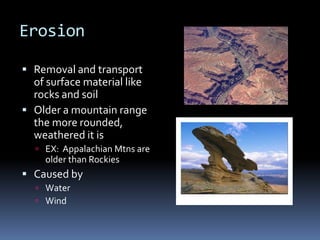
 Removal and transport
  of surface material like
  rocks and soil
 Older a mountain range
  the more rounded,
  weathered it is
   EX: Appalachian Mtns are
    older than Rockies
 Caused by
   Water
   Wind

Unit 1 ch3 s1 the geosphere

  • 1.
    Section 1: TheGeosphere Standards: SEV1a, SEV1e THE DYNAMIC EARTH
  • 2.
    Why is theEarth classified as a “system”?  A system consists of parts that work together.  Parts of the Earth:  Geosphere/lithosphere  Atmosphere  Hydrosphere  Biosphere
  • 3.
    What makes upthe Geosphere?  All the rocks and soil on Earth’s surface.  Scientists divide the geosphere into  COMPOSITIONAL layers  PHYSICAL layers. 1 kilometer= 0.62 mile or 10 football fields.
  • 4.
    What are theCOMPOSITIONAL layers of the Geosphere?  Density, temperature & pressure increase as you go towards center.  Crust  Thin, outer layer (5-70 km thick)  Lightweight elements  Less than 1% of Earth’s mass  Thicker beneath continents and thinner under ocean.  Mantle  Thicker middle layer (2,900 km thick)  Dense, iron-rich material  Core  Inner sphere (3,400 km radius)  Sphere of hot, dense nickel and iron
  • 5.
    What are thePHYSICAL layers of the Geosphere?  Lithosphere  Crust and uppermost mantle  Consists of tectonic plates  Asthenosphere  Mantle rock that moves slowly. Solid yet plastic  Allows tectonic plates to move  Mesosphere  Lowest part of mantle  Outer core  Liquid nickel and iron  Inner core  Solid nickel and iron  4,000-5,000ºC  Enormous pressure
  • 6.
    How are thelayers of Earth determined?  Scientists use seismic waves to “see” and learn about Earth’s interior.  Seismic waves react differently when they hit or pass thru a material.
  • 7.
    Plate tectonics  Tectonicplates glide on asthenosphere  Major plates:  Pacific, N. American, S. American, African, Eurasian, Antarctic  Geologic activity occurs along plate boundaries  Divergent- pull apart- get volcano or ridge  EX: Mid-Atlantic ridge where N. American plate and Eurasian plate moving in opposite directions.  Convergent- push together- get mountain  EX: Himalayans when Indian plate hit Eurasian plate  Transform- plates rub against each other- get earthquake  EX: Where N. American plate rubs against Pacific plate get earthquakes in CA.
  • 8.
    Earthquakes  Vibrations inEarth’s crust caused by sudden stress break along a fault.  If it happens under water it can cause tsunami.  EX: Indonesian tsunami in 2004  Earthquake and tsunami animation
  • 9.
    Earthquakes  Richter scale-used to quantify amount of energy (magnitude) released by quake.  2.0 magnitude is smallest  9.5 is greatest recorded (Chile in 1960)  Difference between 1 whole number and another on the scale is 31.7  EX: Magnitude 6.0 is 31.7 times greater than 5.0. Daily Earthquake Data  Quakes of 7.0 or greater cause widespread damage
  • 10.
    Earthquakes  Hazards  Can’t predict when will happen  Damage depends on type of soil  Sandy soil = more damage  Buildings built to be flexible so can sway with vibrations.
  • 11.
    Comparison of Haiti& Chile 2010 Earthquakes  Haiti  Chile ‒ Magnitude 7  Magnitude 8.8 ‒ 8 miles below surface  21 miles below surface ‒ Right outside Port-Au-Prince  200 miles outside city ‒ 220,000 people killed  100’s killed ‒ Buildings leveled b/c not built to earthquake code- have no  Buildings built to codes- poorer country earthquake code so not ‒ People not educated about leveled- wealthier country how to react  People are educated ‒ Last major earthquake in Port- Au-Prince was 250 years ago.  Has experienced many earthquakes
  • 12.
     Volcano formation Volcanoes Mountain build from magma that rises from the Earth’s interior to the surface.  Where plate diverges or converges  On land or under ocean  High pressure- eruption causes magma, ash, gases to burst from volcano  Low pressure- magma Massive volcanic explosion leaks out slowly underwater near Tong Islands in South Pacific
  • 13.
    Volcanoes  Local Effects  Local economies affected  Human loss  Ash, dust, gases (sulfur)  Can create mudflow  Bury homes, crops  Respiratory illness  Global Effects  Climate changes  Sulfur particles reflect light, cool temperature  Ash blocks sunlight- snowed in New England in July b/c of 1815 Mt. Tambora volcano in Indonesia  Acid rain
  • 14.
    Erosion  Removal andtransport of surface material like rocks and soil  Older a mountain range the more rounded, weathered it is  EX: Appalachian Mtns are older than Rockies  Caused by  Water  Wind

Editor's Notes

  • #4 Compositional layers are on the right and physical layers are on the left.
  • #6 Plasticity is somewhere between a semi-solid and a liquid.
  • #13 Eyjafjallajokull eruption in Iceland back in 2010 disrupted air travel b/c of all the ash and smoke that was spewing into atmosphere. This volcano is forming under the ocean and has built up so much now that it has breached the surface of the ocean and is now forming a new island near Iceland. This is a good example of two plates pulling apart, magma comes to surface, hardens, forms land (ridge).