Emergence of the City-
          States
Social Studies for 9th E.G.B. | Teacher: Mauricio Torres
Background
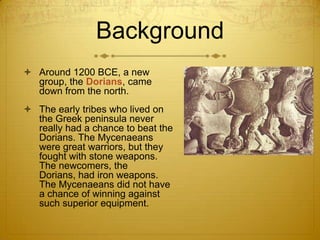
 Around 1200 BCE, a new
  group, the Dorians, came
  down from the north.
 The early tribes who lived on
  the Greek peninsula never
  really had a chance to beat the
  Dorians. The Mycenaeans
  were great warriors, but they
  fought with stone weapons.
  The newcomers, the
  Dorians, had iron weapons.
  The Mycenaeans did not have
  a chance of winning against
  such superior equipment.
The Dark Ages
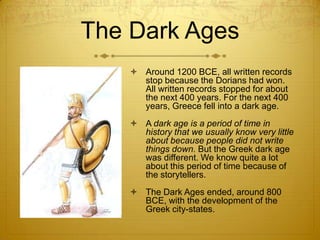
     Around 1200 BCE, all written records
      stop because the Dorians had won.
      All written records stopped for about
      the next 400 years. For the next 400
      years, Greece fell into a dark age.
     A dark age is a period of time in
      history that we usually know very little
      about because people did not write
      things down. But the Greek dark age
      was different. We know quite a lot
      about this period of time because of
      the storytellers.
     The Dark Ages ended, around 800
      BCE, with the development of the
      Greek city-states.
City-States
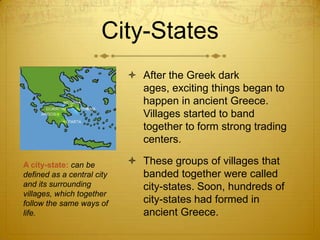
                             After the Greek dark
                              ages, exciting things began to
                              happen in ancient Greece.
                              Villages started to band
                              together to form strong trading
                              centers.

A city-state: can be         These groups of villages that
defined as a central city     banded together were called
and its surrounding           city-states. Soon, hundreds of
villages, which together
follow the same ways of       city-states had formed in
life.                         ancient Greece.
Citizenship

 “the link between a person and a state or
           an association of states”


 In ancient Greece, you had to “earn” your citizenship.

 In Athens, for example, Only adult male Athenian
  citizens who had completed their military training as
  ephebes had the right to vote.
Citizenship
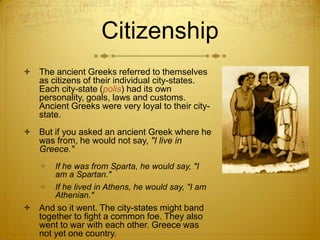
 The ancient Greeks referred to themselves
  as citizens of their individual city-states.
  Each city-state (polis) had its own
  personality, goals, laws and customs.
  Ancient Greeks were very loyal to their city-
  state.
 But if you asked an ancient Greek where he
  was from, he would not say, "I live in
  Greece."
       If he was from Sparta, he would say, "I
        am a Spartan."
       If he lived in Athens, he would say, "I am
        Athenian."
 And so it went. The city-states might band
  together to fight a common foe. They also
  went to war with each other. Greece was
  not yet one country.
What was Greece?
 Because Greece was not yet one country, there was no
  central government in ancient Greece.
 It was just one big collection of city states with many things
  in common:
    They all believed in the same gods.
    They all spoke the same language.
 Each city-state had its own form of government. Some city-
  states, like Corinth, were ruled by kings. Some, like Sparta,
  were ruled by a small group of men. Others, like Athens,
  experimented with new forms of government.
Acropolis & Parthenon
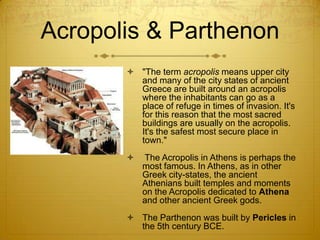
        "The term acropolis means upper city
         and many of the city states of ancient
         Greece are built around an acropolis
         where the inhabitants can go as a
         place of refuge in times of invasion. It's
         for this reason that the most sacred
         buildings are usually on the acropolis.
         It's the safest most secure place in
         town."
          The Acropolis in Athens is perhaps the
           most famous. In Athens, as in other
           Greek city-states, the ancient
           Athenians built temples and moments
           on the Acropolis dedicated to Athena
           and other ancient Greek gods.
        The Parthenon was built by Pericles in
         the 5th century BCE.
Ask Yourselves
 Explain:
    What is citizenship and how do you become one?
    What was the importance of the Acropolis?
 Analyze:
    Why was there a period of time called “Dark Ages”?
    Why can’t we say that Greece was not an Empire or State?
 Infer:
    Why did small independent villages band together to form
     city-states?
The Dorians
 Find out at home more about the Dorians. Use your
  own words to build to paragraphs by answering the
  following questions:
      Who were they?
      Where did they come from?
      Why are they so important?
      How did they begin the Dark Ages?
      What is their legacy?

 Print it and bring it to school next class.

Greek City States

  • 1.
    Emergence of theCity- States Social Studies for 9th E.G.B. | Teacher: Mauricio Torres
  • 2.
    Background  Around 1200BCE, a new group, the Dorians, came down from the north.  The early tribes who lived on the Greek peninsula never really had a chance to beat the Dorians. The Mycenaeans were great warriors, but they fought with stone weapons. The newcomers, the Dorians, had iron weapons. The Mycenaeans did not have a chance of winning against such superior equipment.
  • 3.
    The Dark Ages  Around 1200 BCE, all written records stop because the Dorians had won. All written records stopped for about the next 400 years. For the next 400 years, Greece fell into a dark age.  A dark age is a period of time in history that we usually know very little about because people did not write things down. But the Greek dark age was different. We know quite a lot about this period of time because of the storytellers.  The Dark Ages ended, around 800 BCE, with the development of the Greek city-states.
  • 4.
    City-States  After the Greek dark ages, exciting things began to happen in ancient Greece. Villages started to band together to form strong trading centers. A city-state: can be  These groups of villages that defined as a central city banded together were called and its surrounding city-states. Soon, hundreds of villages, which together follow the same ways of city-states had formed in life. ancient Greece.
  • 5.
    Citizenship “the linkbetween a person and a state or an association of states”  In ancient Greece, you had to “earn” your citizenship.  In Athens, for example, Only adult male Athenian citizens who had completed their military training as ephebes had the right to vote.
  • 6.
    Citizenship  The ancientGreeks referred to themselves as citizens of their individual city-states. Each city-state (polis) had its own personality, goals, laws and customs. Ancient Greeks were very loyal to their city- state.  But if you asked an ancient Greek where he was from, he would not say, "I live in Greece."  If he was from Sparta, he would say, "I am a Spartan."  If he lived in Athens, he would say, "I am Athenian."  And so it went. The city-states might band together to fight a common foe. They also went to war with each other. Greece was not yet one country.
  • 7.
    What was Greece? Because Greece was not yet one country, there was no central government in ancient Greece.  It was just one big collection of city states with many things in common:  They all believed in the same gods.  They all spoke the same language.  Each city-state had its own form of government. Some city- states, like Corinth, were ruled by kings. Some, like Sparta, were ruled by a small group of men. Others, like Athens, experimented with new forms of government.
  • 8.
    Acropolis & Parthenon  "The term acropolis means upper city and many of the city states of ancient Greece are built around an acropolis where the inhabitants can go as a place of refuge in times of invasion. It's for this reason that the most sacred buildings are usually on the acropolis. It's the safest most secure place in town."  The Acropolis in Athens is perhaps the most famous. In Athens, as in other Greek city-states, the ancient Athenians built temples and moments on the Acropolis dedicated to Athena and other ancient Greek gods.  The Parthenon was built by Pericles in the 5th century BCE.
  • 9.
    Ask Yourselves  Explain:  What is citizenship and how do you become one?  What was the importance of the Acropolis?  Analyze:  Why was there a period of time called “Dark Ages”?  Why can’t we say that Greece was not an Empire or State?  Infer:  Why did small independent villages band together to form city-states?
  • 10.
    The Dorians  Findout at home more about the Dorians. Use your own words to build to paragraphs by answering the following questions:  Who were they?  Where did they come from?  Why are they so important?  How did they begin the Dark Ages?  What is their legacy?  Print it and bring it to school next class.