ANCIENT
CIVILIZATIONS
THE CIVILIZATIONS OF
THE GREAT RIVERS
Mgr. Aneta Crkoňová, SSAG
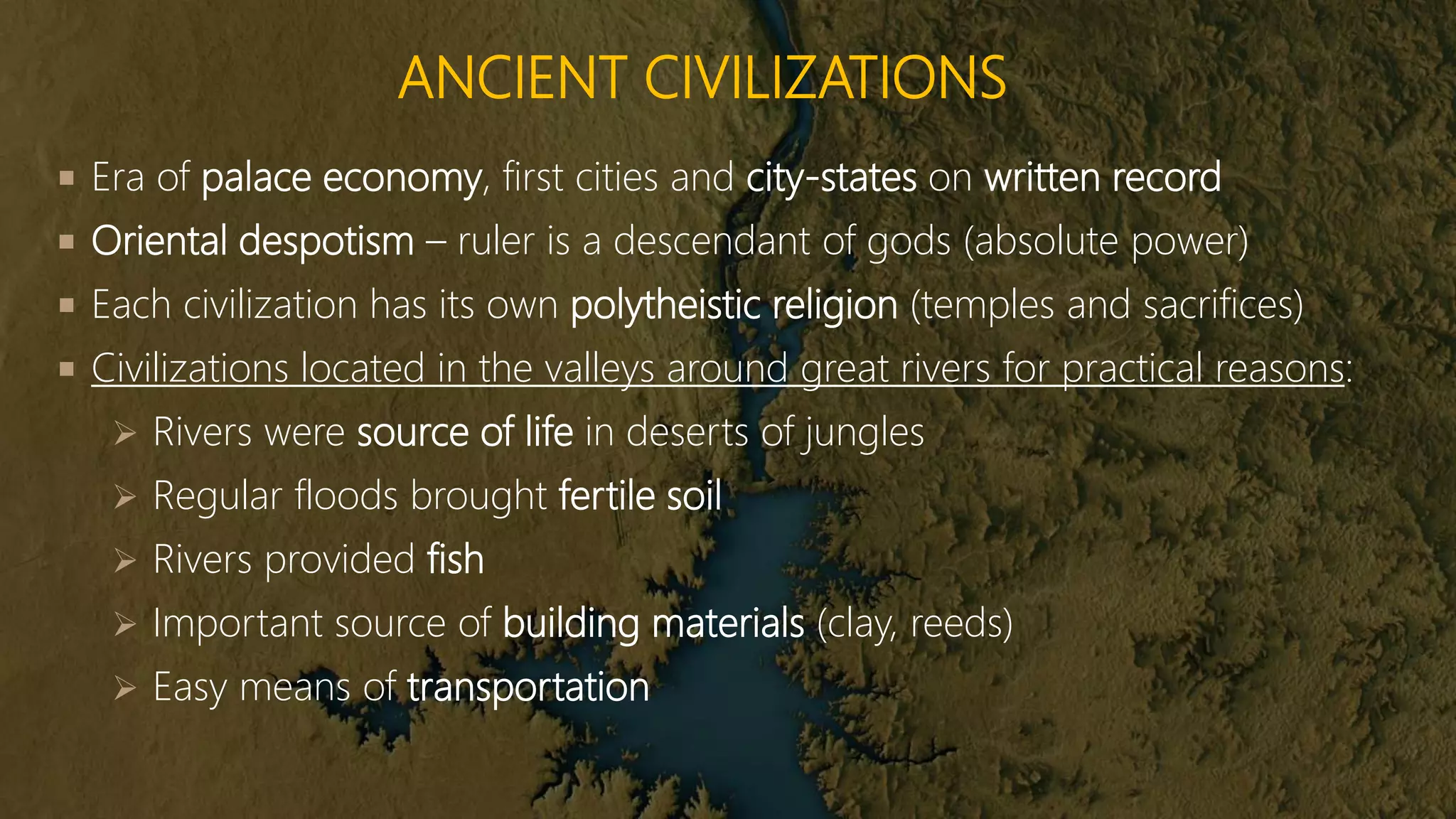
ANCIENT CIVILIZATIONS
 Era of palace economy, first cities and city-states on written record
 Oriental despotism – ruler is a descendant of gods (absolute power)
 Each civilization has its own polytheistic religion (temples and sacrifices)
 Civilizations located in the valleys around great rivers for practical reasons:
 Rivers were source of life in deserts of jungles
 Regular floods brought fertile soil
 Rivers provided fish
 Important source of building materials (clay, reeds)
 Easy means of transportation
DIVISION OF ANCIENT CIVILIZATIONS
 ANCIENT ORIENTAL CIVILIZATIONS
a) STATES WITH IRRIGATION SYSTEM:
MESOPOTAMIA, EGYPT, INDIA, CHINA
a) STATES WITHOUT IRRIGATION SYSTEM:
PHOENICIA, PALESTINE, PERSIA,
HITTITE
 CLASSICAL CIVILIZATIONS: GREECE AND ROMAN EMPIRE
(ANTIQUITY)
MESOPOTAMIA
• Euphrates and Tigris = cradle of the civilization
• Part of FERTILE CRESCENT (modern Iraq, Syria, Turkey and Iran)
• Agriculture: barley, wheat, sesame, fruit (apple, plum, cherry, pear), onion,
garlic, ...
• Inhabitants were tribes of Semitic nomads that settled (free peasants,
craftsmen, traders, slaves, warriors, priests and scribes)
Mesopotamia was divided into 3 areas:
 SUMER (south)
 BABYLONIA (middle)
 ASSYRIA (north)
https://www.youtube.com/watch?v=xVf5kZA0
HtQ
SUMER
3 500 BC – 2 300 BC
SUMERIAN CONTRIBUTIONS:
 IRRIGATION SYSTEM – Clever system of canals, ditches and dykes
 CALENDAR/SYSTEM OF METROLOGY – lunar way of counting time, number
system based on the number 60
 BUILDING TECHNIQUES – sun-dried bricks (adobe)
 METAL-WORKING TECHNOLOGY – bronze tools and weapons
 WHEEL – transport cart and potter‘s wheel
 SCRIPT – cuneiform (scratching in a wet clay with the pointed end of a reed)
- City states: UR, URUK, LAGASH,
KISH, LARSA, ERIDU AND
- In the middle of the city was
ZIGGURAT (centre of religious
and economic life)
- Society divided into 4 classes:
NOBILITY, CLIENTS,
COMMONERS, SLAVES)
- Around 2 300 BC Semitic people
led by SARGON conquered Uruk
and created AKKAD EMPIRE
1st MULTINATIONAL EMPIRE
(contrast to city-states) = AKKAD
EMPIRE
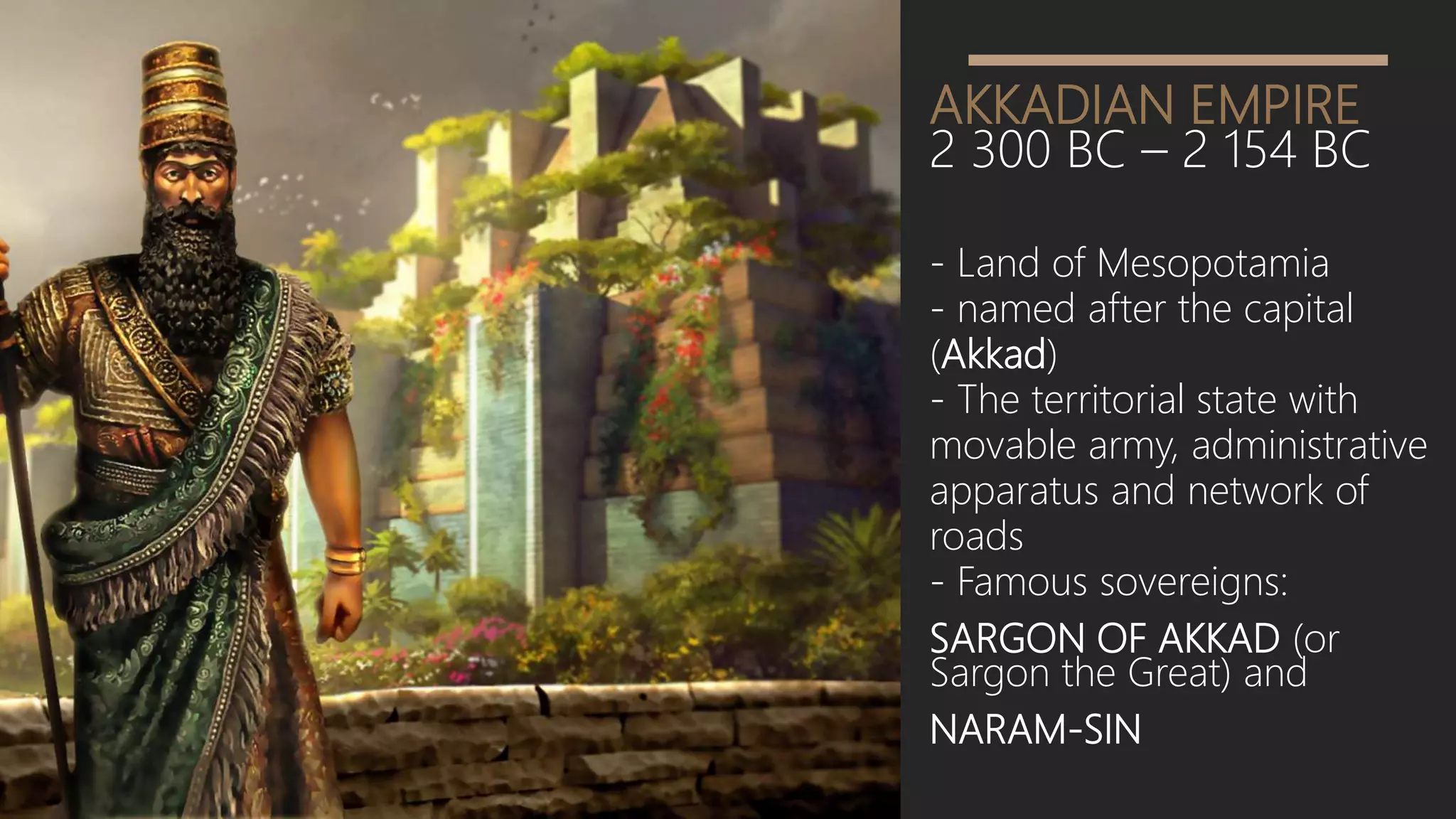
AKKADIAN EMPIRE
2 300 BC – 2 154 BC
- Land of Mesopotamia
- named after the capital
(Akkad)
- The territorial state with
movable army, administrative
apparatus and network of
roads
- Famous sovereigns:
SARGON OF AKKAD (or
Sargon the Great) and
NARAM-SIN
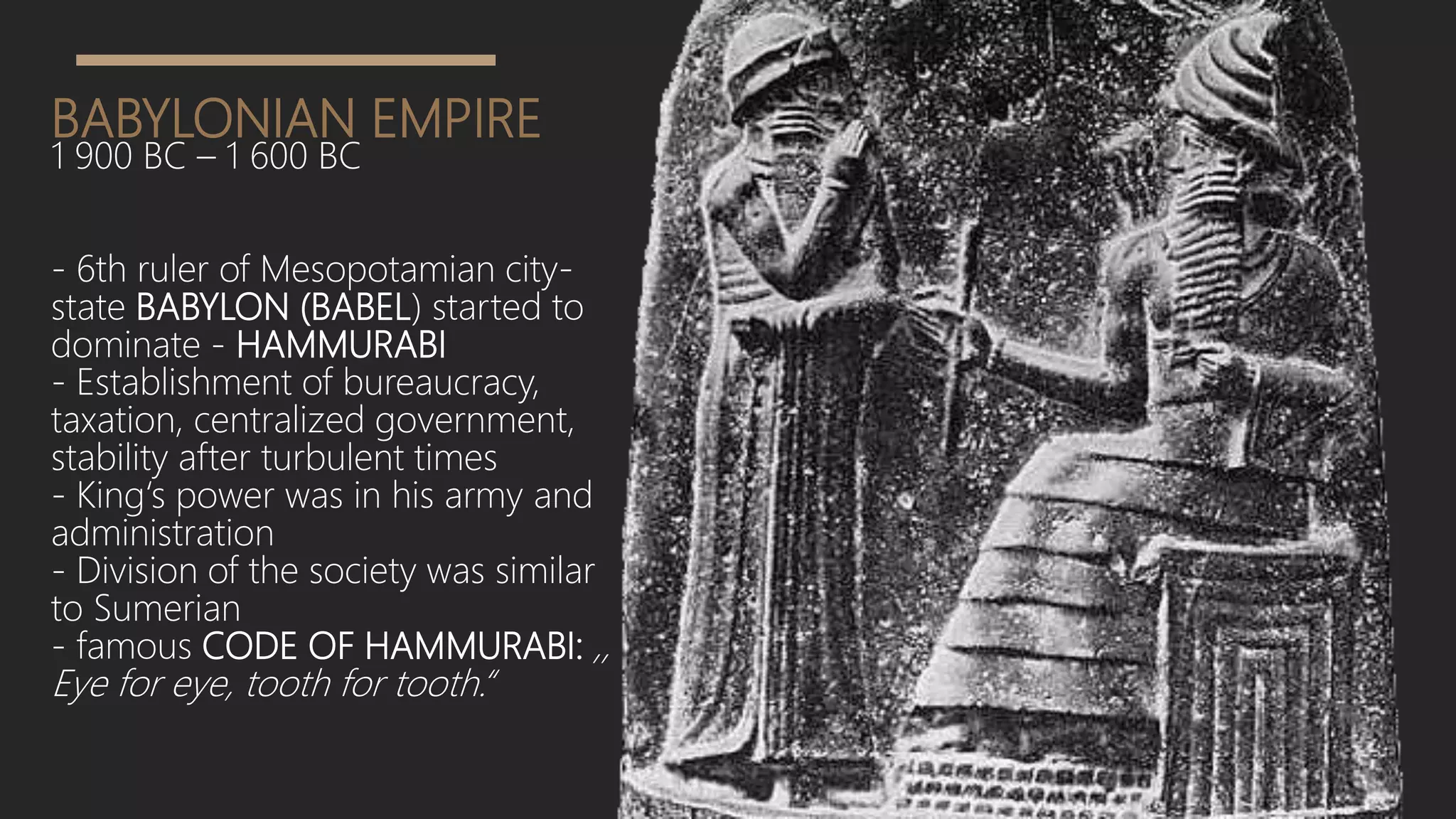
BABYLONIAN EMPIRE
1 900 BC – 1 600 BC
- 6th ruler of Mesopotamian city-
state BABYLON (BABEL) started to
dominate - HAMMURABI
- Establishment of bureaucracy,
taxation, centralized government,
stability after turbulent times
- King‘s power was in his army and
administration
- Division of the society was similar
to Sumerian
- famous CODE OF HAMMURABI: ,,
Eye for eye, tooth for tooth.“
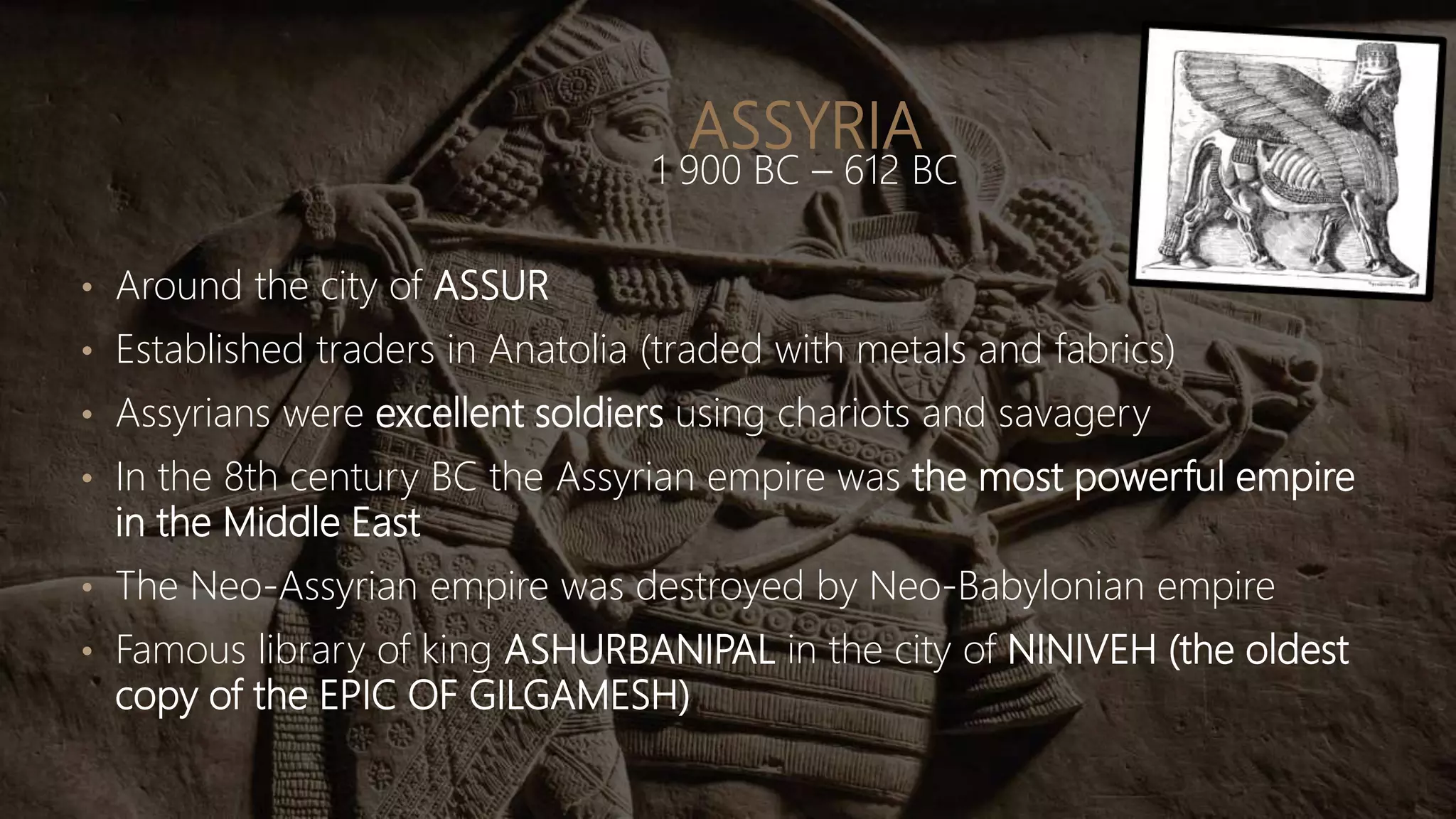
ASSYRIA
1 900 BC – 612 BC
• Around the city of ASSUR
• Established traders in Anatolia (traded with metals and fabrics)
• Assyrians were excellent soldiers using chariots and savagery
• In the 8th century BC the Assyrian empire was the most powerful empire
in the Middle East
• The Neo-Assyrian empire was destroyed by Neo-Babylonian empire
• Famous library of king ASHURBANIPAL in the city of NINIVEH (the oldest
copy of the EPIC OF GILGAMESH)
NEO-BABYLONIAN
EMPIRE
626 BC – 538 BC
 Represented by the CHALDEANS
(tribe)
 The last empire before the rise of
PERSIA
 ISHTAR GATE, THE HANGING
GARDENS OF SEMIRAMIS,
MARDUK TEMPLE
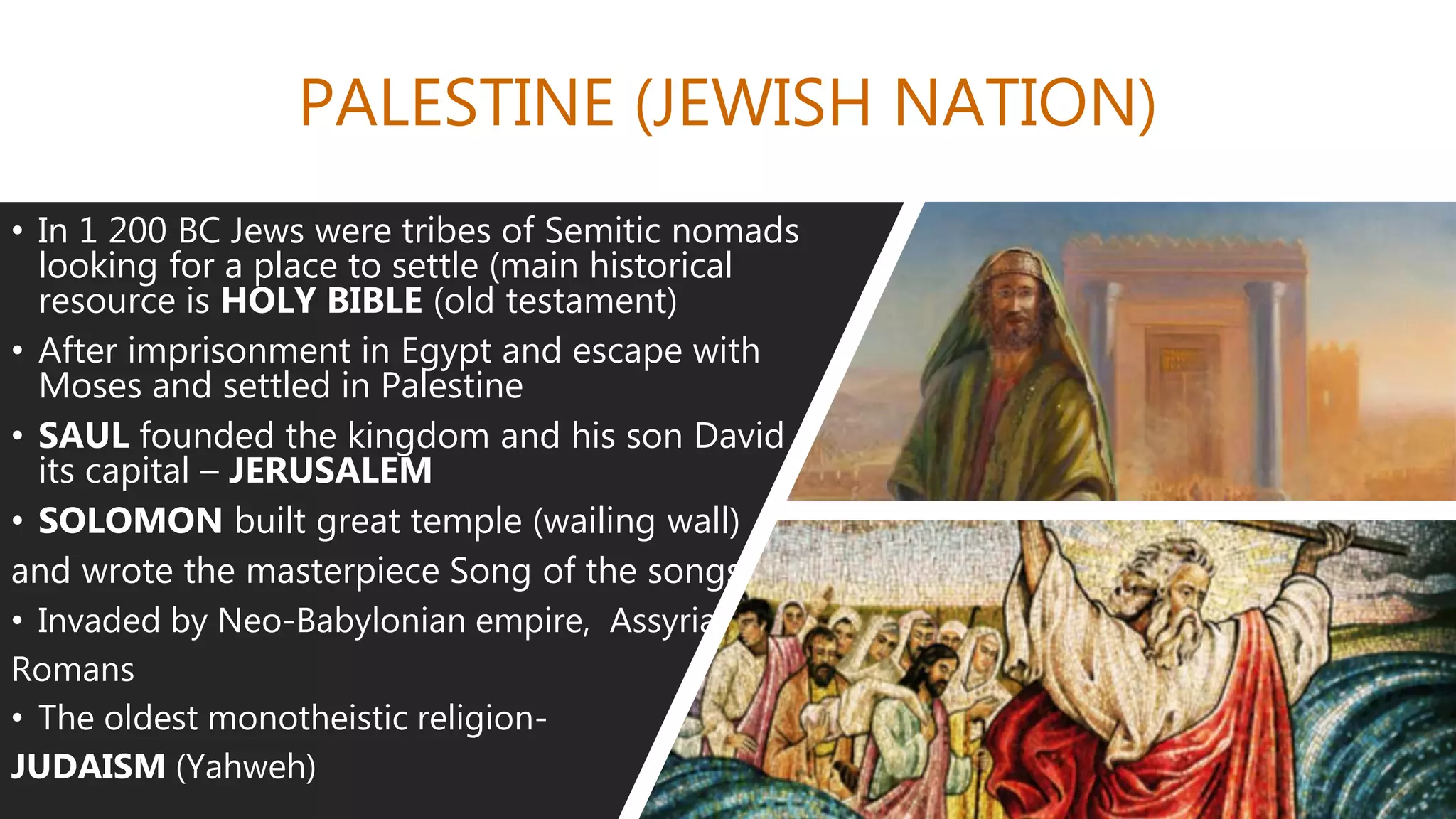
PALESTINE (JEWISH NATION)
• In 1 200 BC Jews were tribes of Semitic nomads
looking for a place to settle (main historical
resource is HOLY BIBLE (old testament)
• After imprisonment in Egypt and escape with
Moses and settled in Palestine
• SAUL founded the kingdom and his son David
its capital – JERUSALEM
• SOLOMON built great temple (wailing wall)
and wrote the masterpiece Song of the songs
• Invaded by Neo-Babylonian empire, Assyria,
Romans
• The oldest monotheistic religion-
JUDAISM (Yahweh)
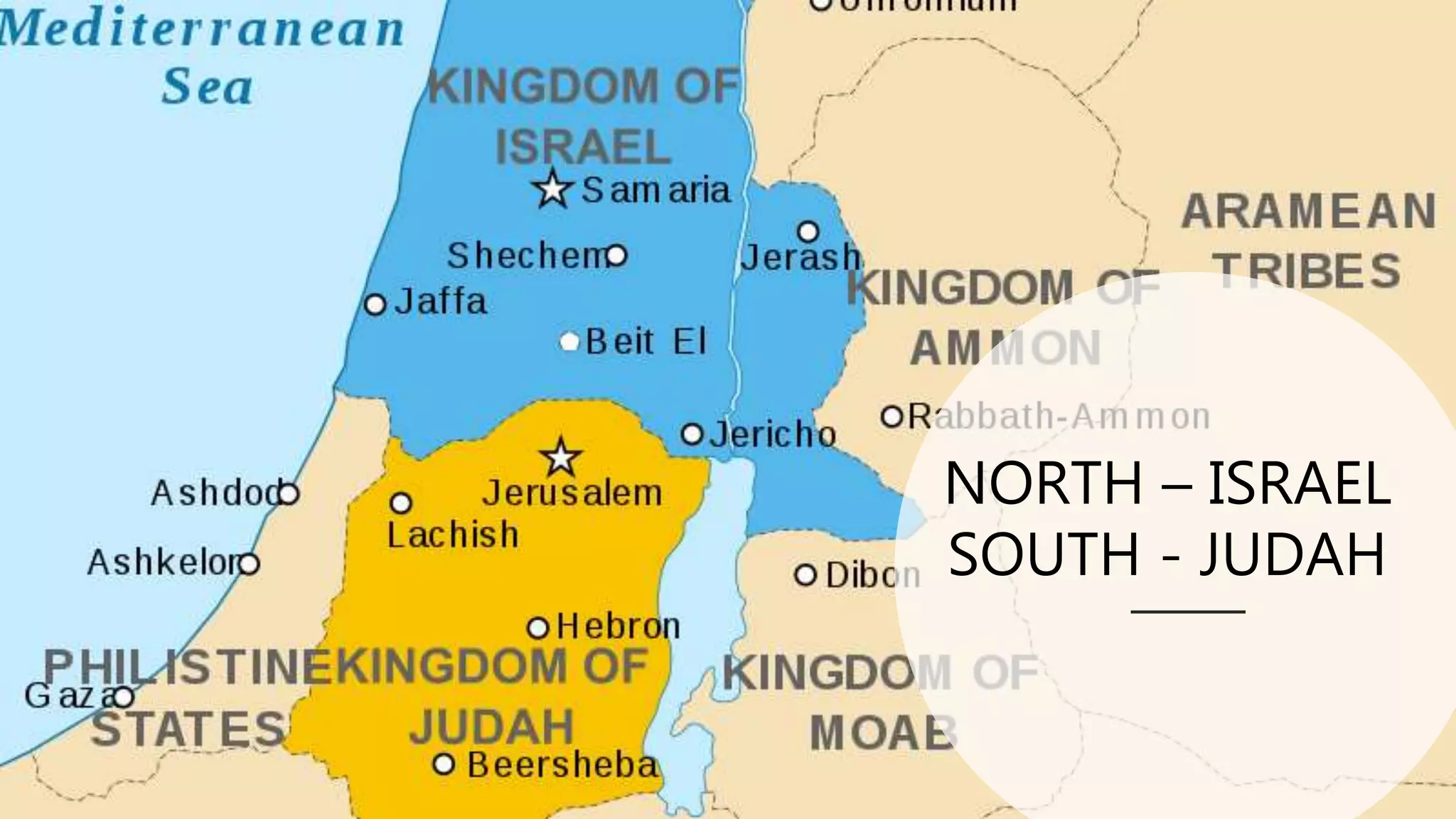
NORTH – ISRAEL
SOUTH - JUDAH
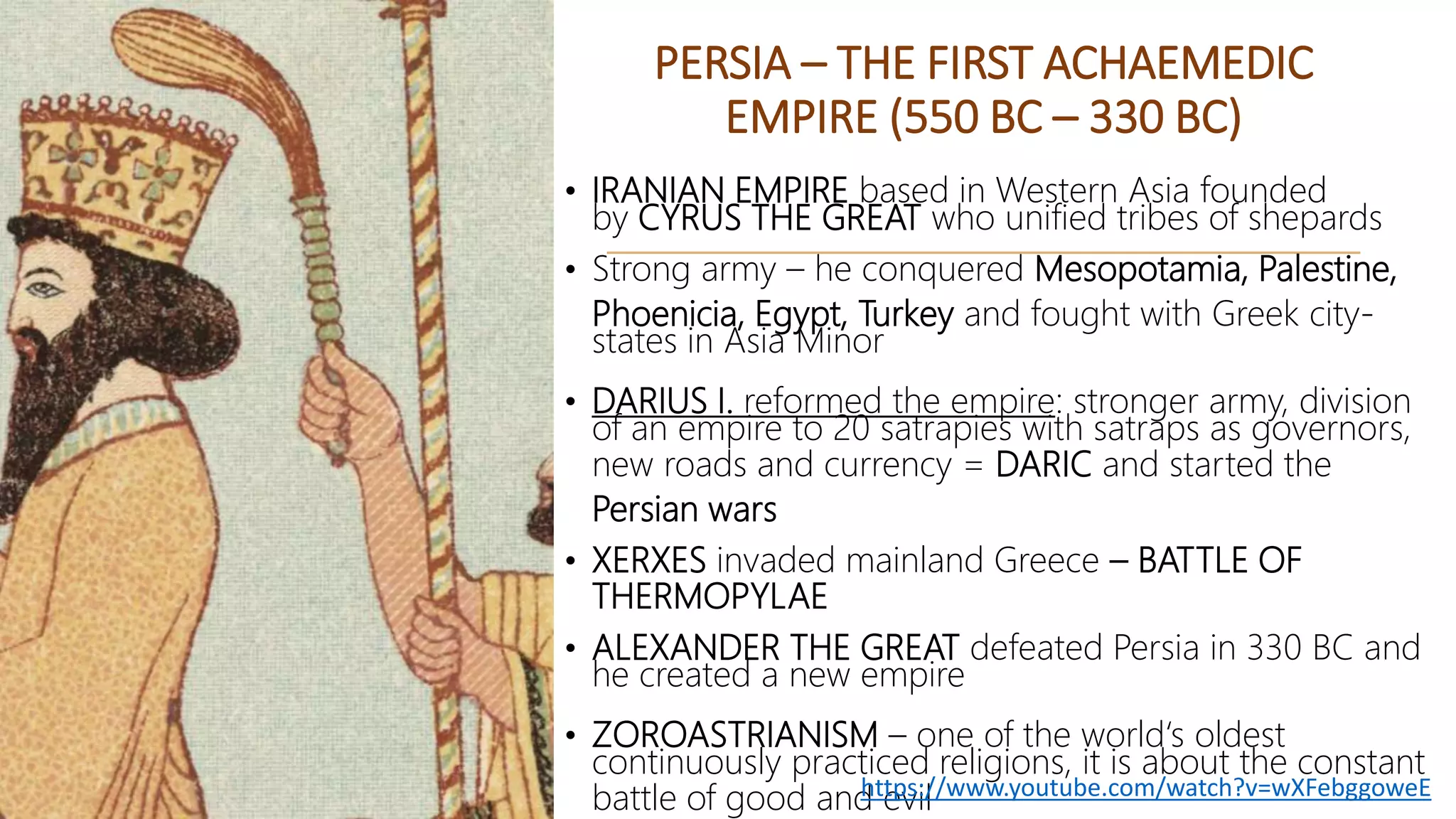
PERSIA – THE FIRST ACHAEMEDIC
EMPIRE (550 BC – 330 BC)
• IRANIAN EMPIRE based in Western Asia founded
by CYRUS THE GREAT who unified tribes of shepards
• Strong army – he conquered Mesopotamia, Palestine,
Phoenicia, Egypt, Turkey and fought with Greek city-
states in Asia Minor
• DARIUS I. reformed the empire: stronger army, division
of an empire to 20 satrapies with satraps as governors,
new roads and currency = DARIC and started the
Persian wars
• XERXES invaded mainland Greece – BATTLE OF
THERMOPYLAE
• ALEXANDER THE GREAT defeated Persia in 330 BC and
he created a new empire
• ZOROASTRIANISM – one of the world‘s oldest
continuously practiced religions, it is about the constant
battle of good and evilhttps://www.youtube.com/watch?v=wXFebggoweE
Periodization of
ancient egypt
E
G
Y
P
T
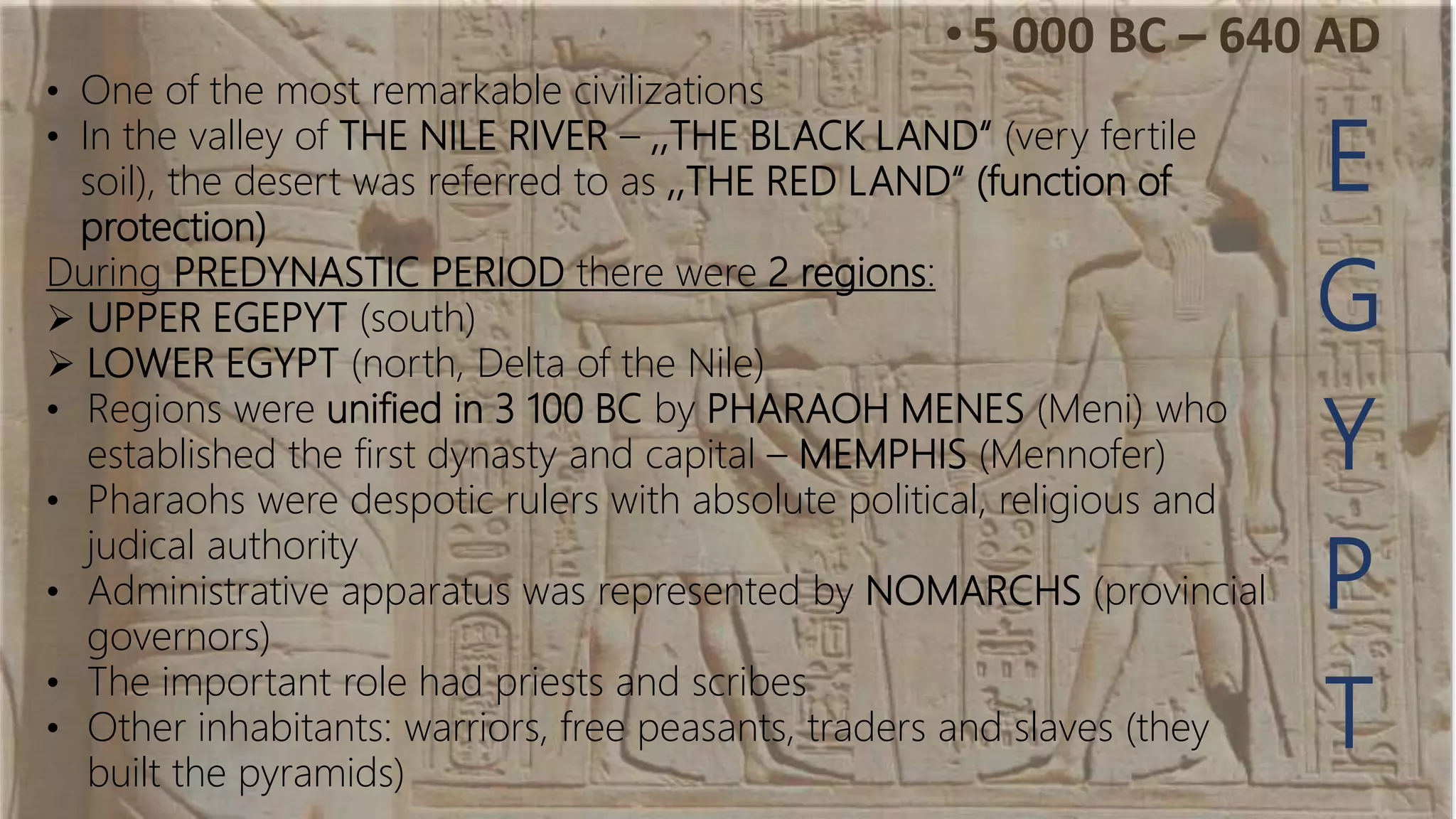
• One of the most remarkable civilizations
• In the valley of THE NILE RIVER – ,,THE BLACK LAND“ (very fertile
soil), the desert was referred to as ,,THE RED LAND“ (function of
protection)
During PREDYNASTIC PERIOD there were 2 regions:
 UPPER EGEPYT (south)
 LOWER EGYPT (north, Delta of the Nile)
• Regions were unified in 3 100 BC by PHARAOH MENES (Meni) who
established the first dynasty and capital – MEMPHIS (Mennofer)
• Pharaohs were despotic rulers with absolute political, religious and
judical authority
• Administrative apparatus was represented by NOMARCHS (provincial
governors)
• The important role had priests and scribes
• Other inhabitants: warriors, free peasants, traders and slaves (they
built the pyramids)
•5 000 BC – 640 AD
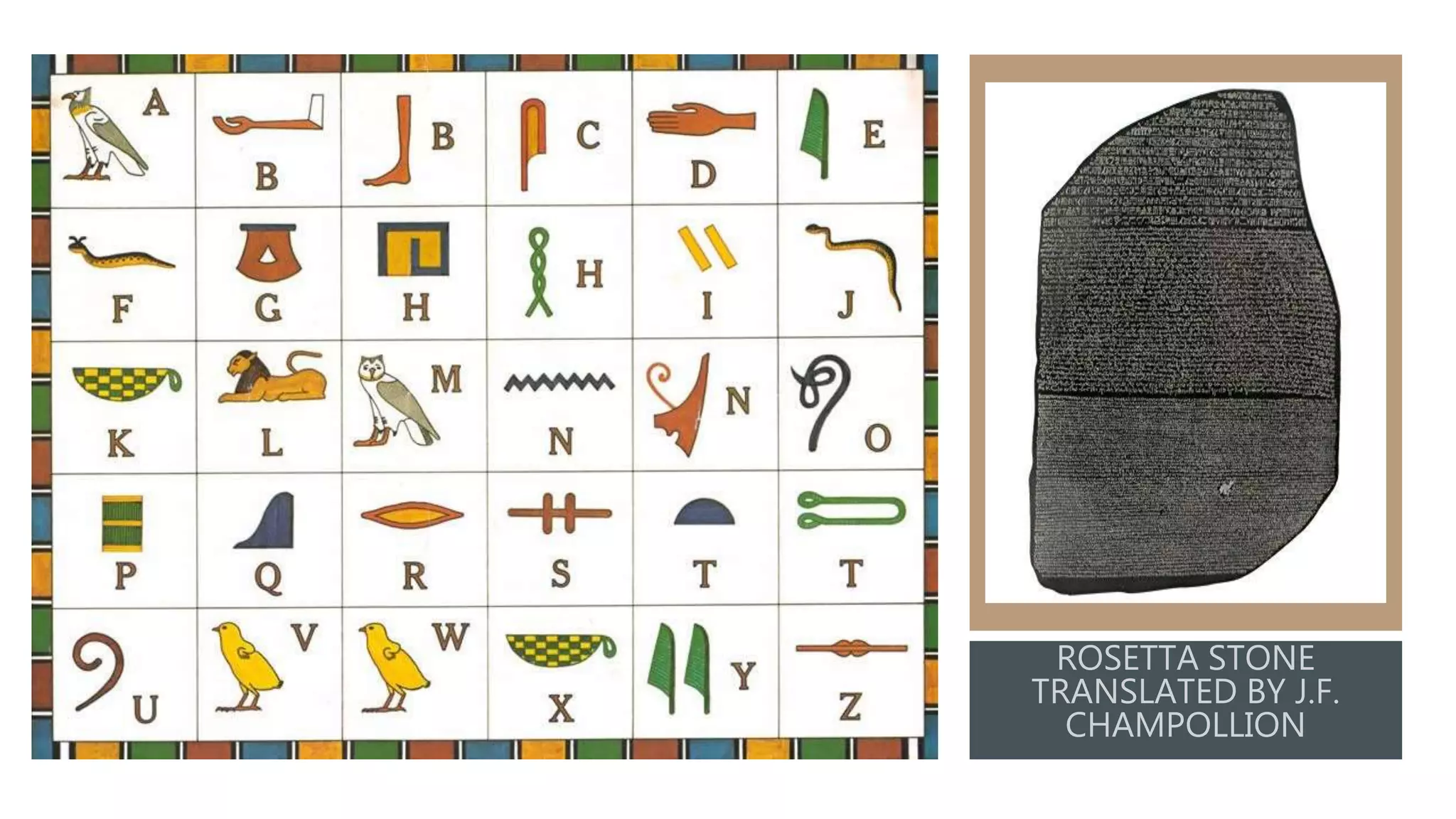
• Egyptian script used more then 2 000 HIEROGLYPHIC characters and was written
on PAPYRUS
• The tombs of pharaohs were in the VALLEY OF THE KINGS and in PYRAMIDS
built during the period of OLD KINGDOM with SPHINX (head of human and body
of a lion)
• The 1st pyramid was DJOSER (step pyramid) and the best known are the pyramids
of KHUFU (Cheops), KHAFRA and MENKAURE in GIZA
• 150 year of chaos during the 1ST INTERMEDIATE PERIOD unified in MIDDLE
KINGDOM
• Egypt was usually under attacks from sea nations and in 2ND INTERMEDIATE
PERIOD = ERA OF HYKSOS (Semitic people who conquered Egypt)
• New weapons: horse-drawn chariot, sword, new arrowheads, shield, metal helmet
• Unification in NEW KINGDOM under THUTMOSE III.
• AKHENATEN founded a new city AKHETATEN and established the new religion –
AMUN (polytheism)-> ATEN the Sun god (monotheism)
Egyptians believed in afterlife and reincarnation in case when
body of the dead stayed preserved – MUMMIFICATION
The organs were removed from the body and put into a
CANOPY and the body put into SARCOPHAGUS with amulets
They also wrote BOOK OF THE DEAD – funerary text, to assist
the dead person on his/her journey
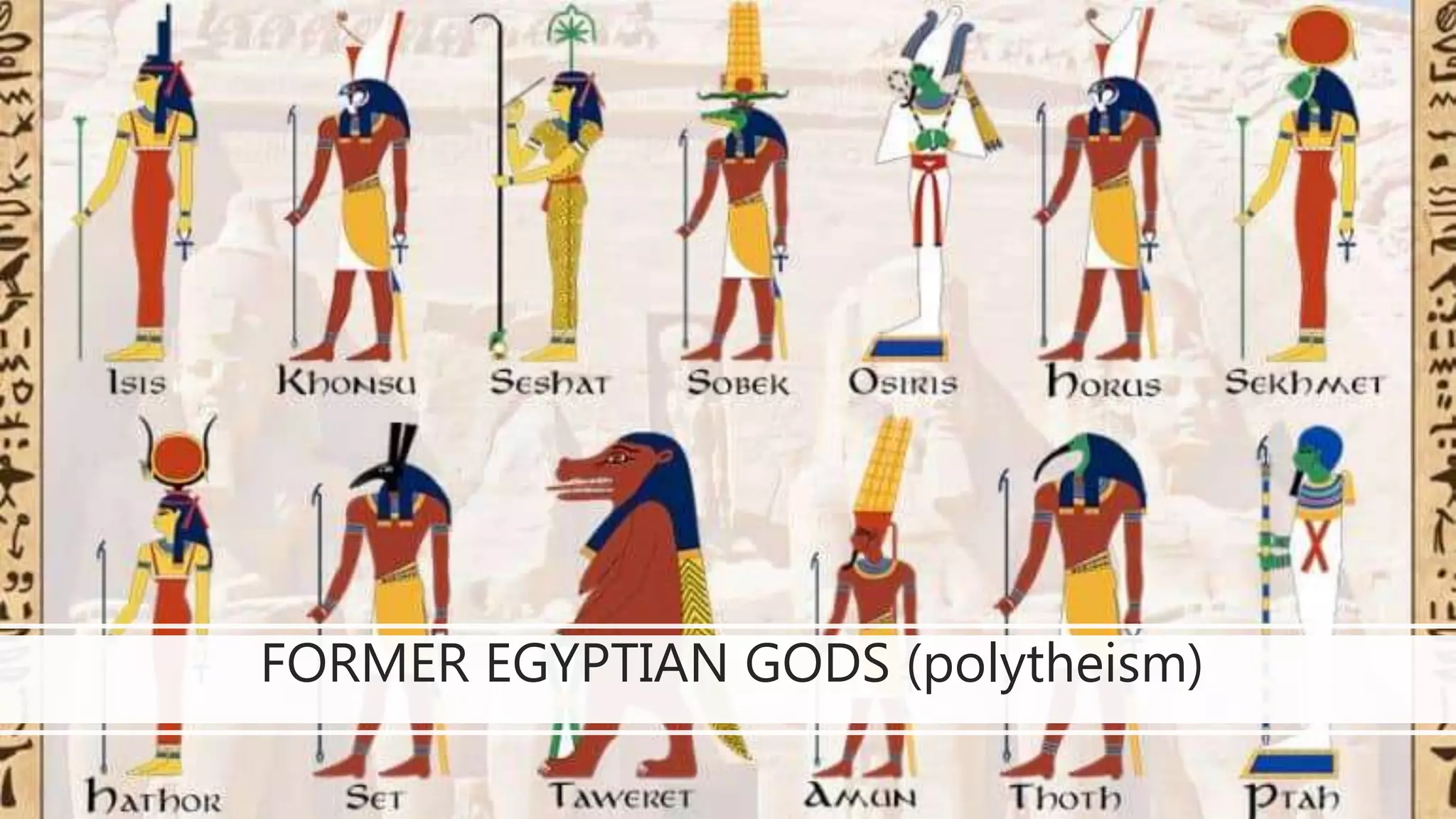
FORMER EGYPTIAN GODS (polytheism)
• New kingdom was the golden age of Egypt
• Most famous pharaohs were TUTANKHAMUN
(the richest tomb discovered by HOWARD
CARTER) and RAMESSES II. (The most
powerful of the Egyptian empire)
• Ramesses II. got to war with the HITTITE
EMPIRE (Anatolia) and after the BATTLE OF
KADESH (1285 BC) – the biggest battle of
ancient history, they reached the agreement
• Later the Hittite empire was destroyed by the
SEA PEOPLE who also caused decline of New
kingdom -> 3RD INTERMEDIATE PERIOD
• LATE PERIOD was the restoration of the
Egyptian kingdom. In 525 BC conquered by
ACHAEMENID EMPIRE under CAMBYSES
• Legacy: mathematics, geometry,
architecture, astronomy, medicine https://www.youtube.com/watch?v=QYVZFWHKWKI
INDIA
INDUS VALLEY CIVILIZATION
(3 300 BC – 1 300 BC)
https://www.youtube.com/watch?v=QYVZFWHKWKI
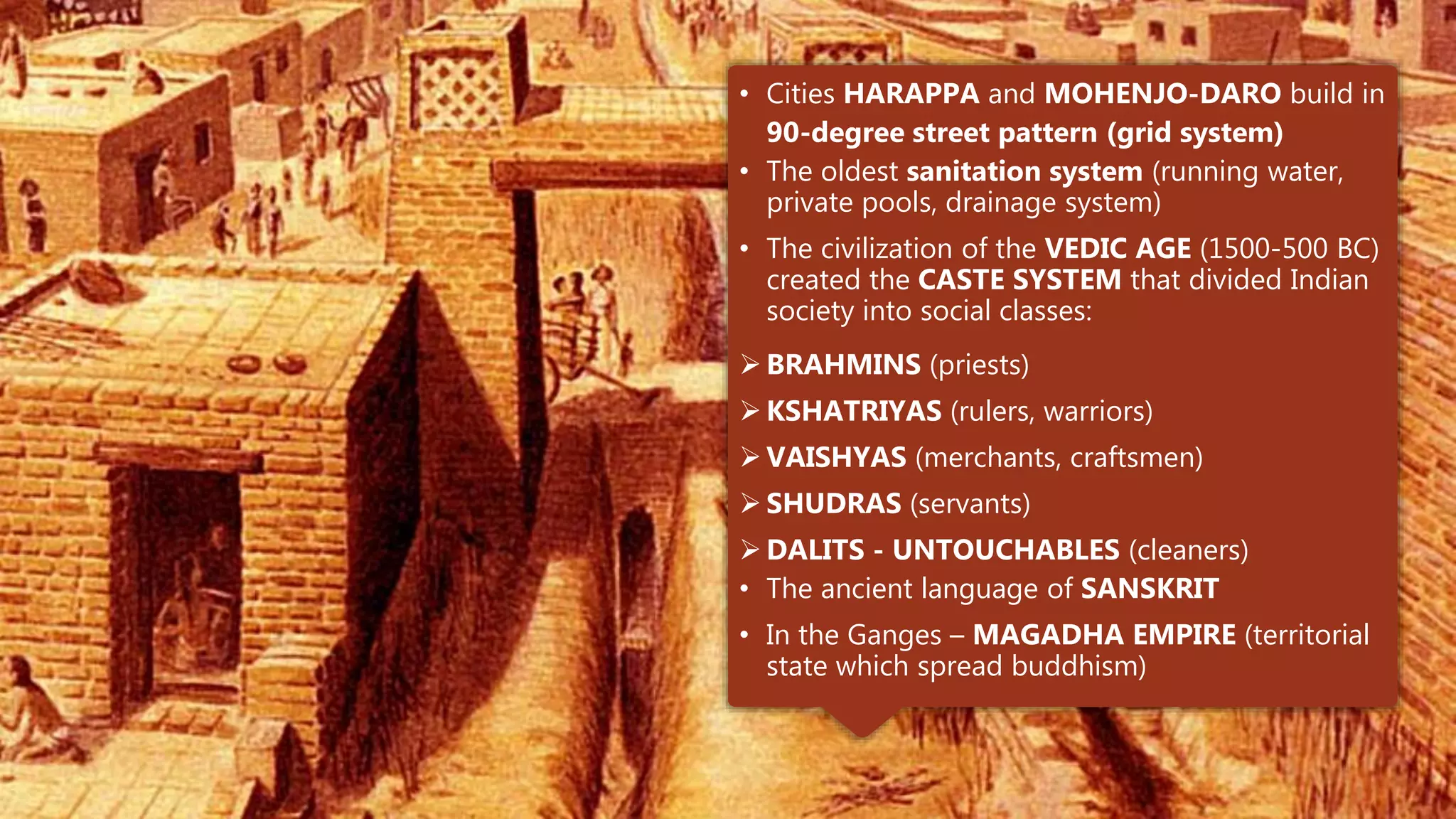
• Cities HARAPPA and MOHENJO-DARO build in
90-degree street pattern (grid system)
• The oldest sanitation system (running water,
private pools, drainage system)
• The civilization of the VEDIC AGE (1500-500 BC)
created the CASTE SYSTEM that divided Indian
society into social classes:
 BRAHMINS (priests)
 KSHATRIYAS (rulers, warriors)
 VAISHYAS (merchants, craftsmen)
 SHUDRAS (servants)
 DALITS - UNTOUCHABLES (cleaners)
• The ancient language of SANSKRIT
• In the Ganges – MAGADHA EMPIRE (territorial
state which spread buddhism)
Ancient India was the birthplace of 2 of the world‘s religions –
BUDDHISM AND HINDUISM
- Buddhism, one of the oldest world religions was founded by PRINCE
SIDDHARTA GAUTAMA in 6th century BC worships no God, but aims to reach
the enlightment - nirvana
CENTRAL AMERICA
THE INCAS (PERU)
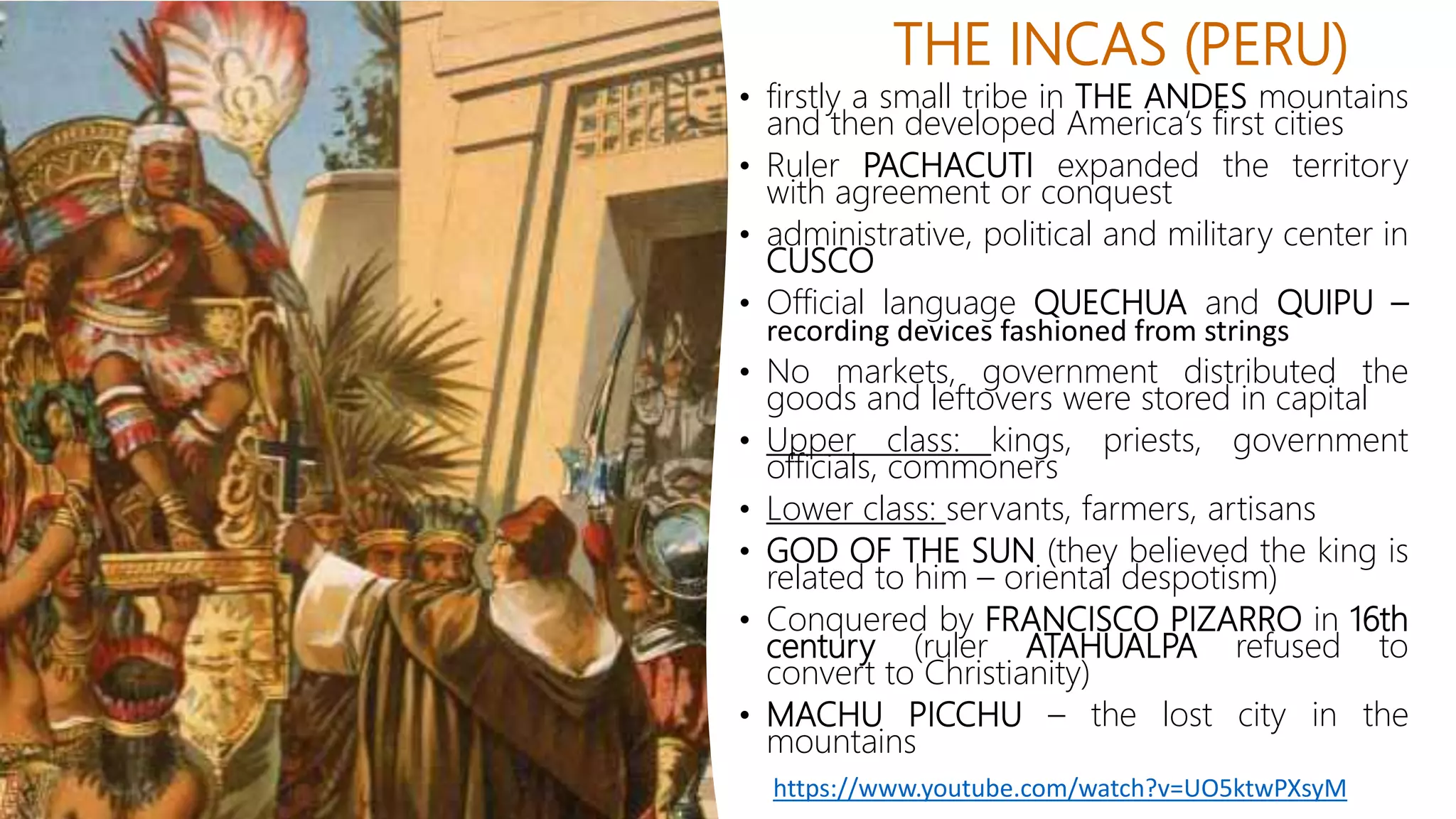
• firstly a small tribe in THE ANDES mountains
and then developed America‘s first cities
• Ruler PACHACUTI expanded the territory
with agreement or conquest
• administrative, political and military center in
CUSCO
• Official language QUECHUA and QUIPU –
recording devices fashioned from strings
• No markets, government distributed the
goods and leftovers were stored in capital
• Upper class: kings, priests, government
officials, commoners
• Lower class: servants, farmers, artisans
• GOD OF THE SUN (they believed the king is
related to him – oriental despotism)
• Conquered by FRANCISCO PIZARRO in 16th
century (ruler ATAHUALPA refused to
convert to Christianity)
• MACHU PICCHU – the lost city in the
mountains
https://www.youtube.com/watch?v=UO5ktwPXsyM
THE AZTECS (MEXICO)
• According to their legends origin is in a place
AZTLAN somewhere in NW Mexico
• Class system: king or high priest, nobility,
merchants, artisants, commoners, farmers, slaves
• Commoners had to pay tribute in goods or services
(crops, jewellery, clothing, or labour)
• Boys were trained to combat from early age
• The more captives they took, the higher social rank
would be
• They held human sacrifices (they cut the beating
heart out )
• AZTEC CODICES (law, history, prophesy,
astronomy, ritual calendar) books made from tree
bark and painted on deerskin or agave fiber paper,
it was burnt by the Spanish for pagan content
• Conquested by HERNANDO CORTES in 16th
century https://www.youtube.com/watch?v=TaWDXwmjf_Q
THE MAYANS
(YUCATAN)
• Todays GUATEMALA and BELIZE
• They had no political center
• Society was organized into a number
of independent states
• Agriculture: maize, beans, squashes,
chilli peppers
• Temples (CHICHEN ITZA), El Castillo
– Temple of Kukulcan (feathered
serpent)
• Mayan calendar predicted the end of
the world
• Human sacrifices (e.g. Well of
Sacrifice where the victims were
drowned for the Rain God)
https://www.youtube.com/watch?v=sK9yv5wAoY0&t=312s
CHINA
DYNASTIC
HISTORY BEGAN
AROUND 1 500 BC
VALLEY OF YELLOW
RIVER AND YANGTZI
(LONG) RIVER
• QUIN SHI HUANG unified the city
states and founded the empire
he ruled as the first emperor in 221
221 BC
• He passed many reforms: common
law code, administration, banned
and burned many books, built the
GREAT WALL OF CHINA and a
massive new national road system,
as well as the city-
sized mausoleum guarded by
the TERRACOTTA ARMY
• FORTUNE-TELLING and the
WORSHIP OF ANCESTORS are the
oldest customs of Chinese
civilization
https://www.youtube.com/watch?v=tpy5BMhMYYw
• Agriculture was based on a millet grown in
the north and rice grown in artificial pools –
paddies
• The fertile soil of Chinese Yellow river is
called loess
• CHINESE SCRIPT is the oldest script that has
been used with few changes
• Inventions: compass, paper, ink, silk, tea,
porcelain, gunpowder
• Mandate of Heaven – the idea that
someone is in power because god wants
them to be
• CONFUCIANISM – philosophy founded by
CONFUCIUS, based on education, family and
and traditions, the system has a hierarchy
• TAOISM – founded by LAOZI, philosophy
about living in a harmony and the natural
way
PHOENICIA (3 200 BC – 2 750 BC)
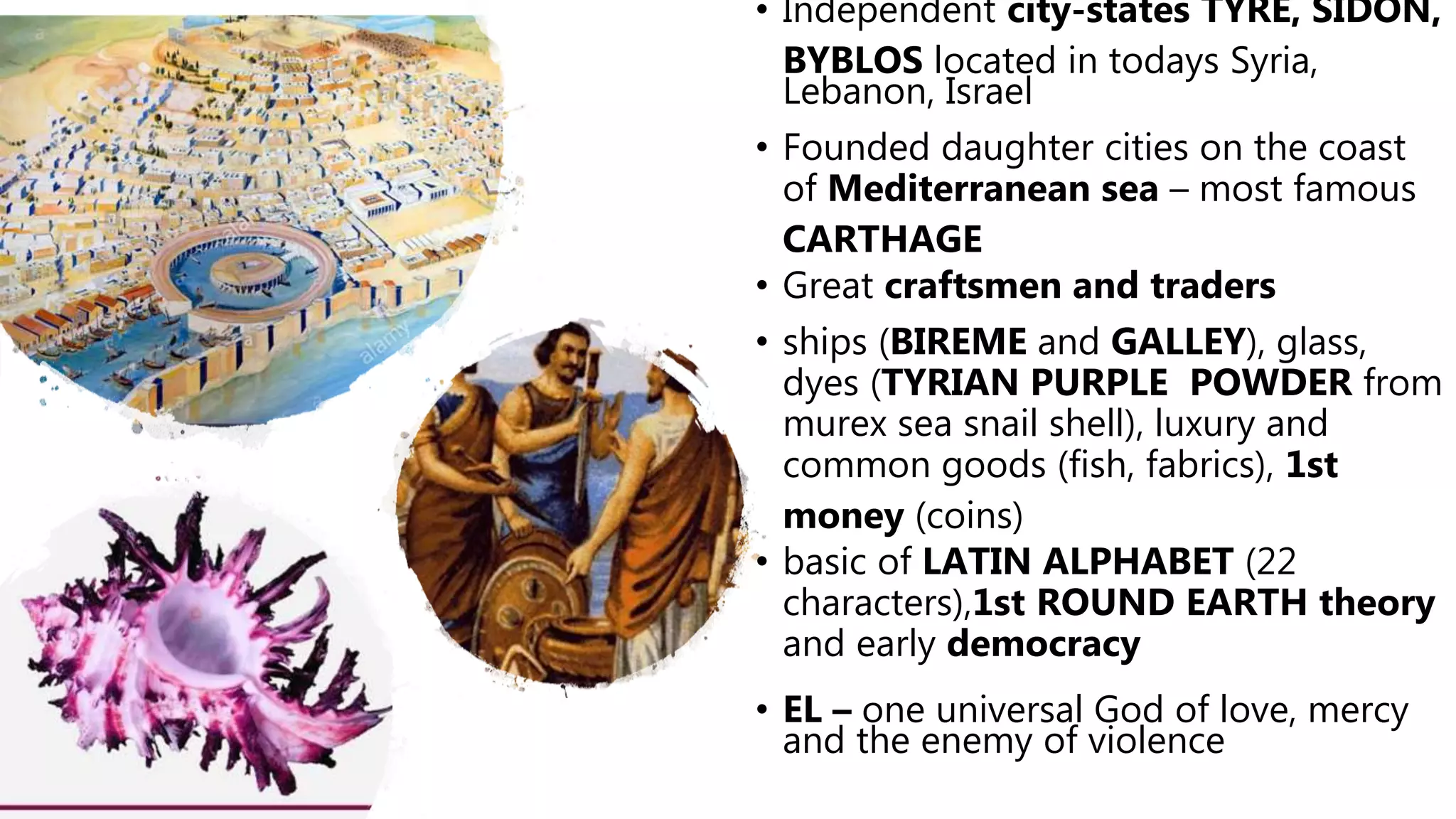
• Independent city-states TYRE, SIDON,
BYBLOS located in todays Syria,
Lebanon, Israel
• Founded daughter cities on the coast
of Mediterranean sea – most famous
CARTHAGE
• Great craftsmen and traders
• ships (BIREME and GALLEY), glass,
dyes (TYRIAN PURPLE POWDER from
murex sea snail shell), luxury and
common goods (fish, fabrics), 1st
money (coins)
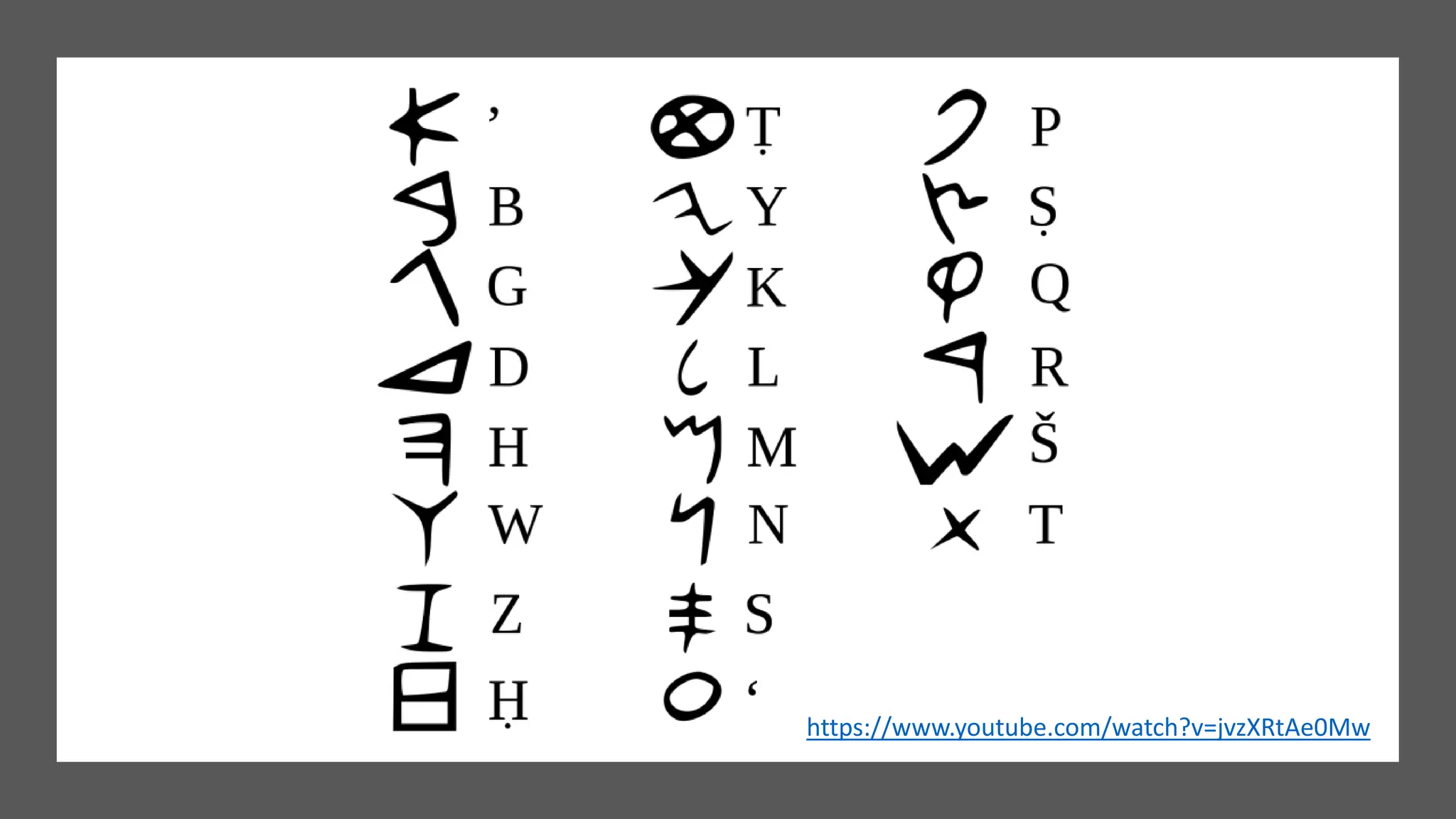
• basic of LATIN ALPHABET (22
characters),1st ROUND EARTH theory
and early democracy
• EL – one universal God of love, mercy
and the enemy of violence
https://www.youtube.com/watch?v=jvzXRtAe0Mw
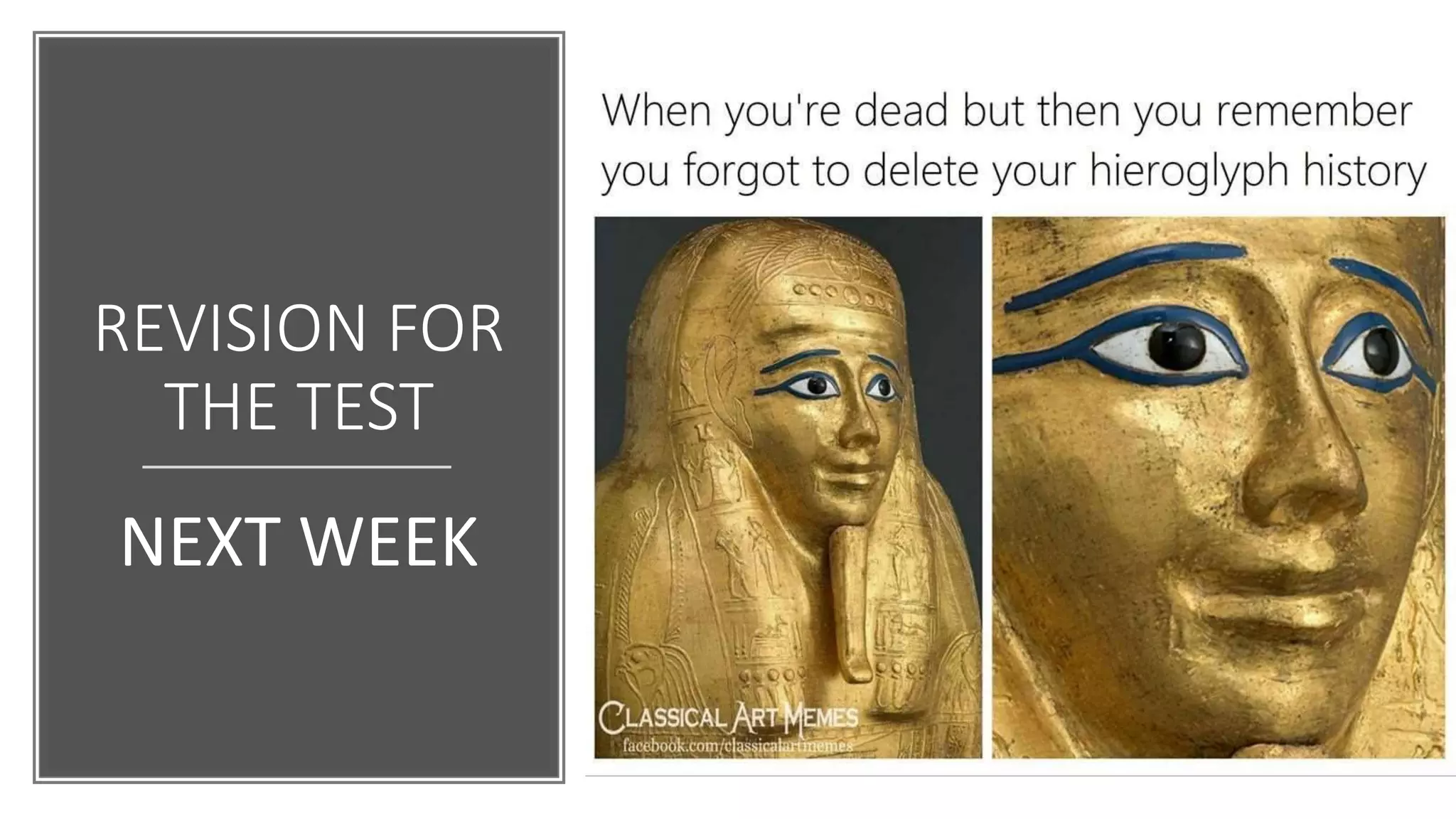
REVISION FOR
THE TEST
NEXT WEEK

Ancient river civilizations

  • 1.
    ANCIENT CIVILIZATIONS THE CIVILIZATIONS OF THEGREAT RIVERS Mgr. Aneta Crkoňová, SSAG
  • 2.
    ANCIENT CIVILIZATIONS  Eraof palace economy, first cities and city-states on written record  Oriental despotism – ruler is a descendant of gods (absolute power)  Each civilization has its own polytheistic religion (temples and sacrifices)  Civilizations located in the valleys around great rivers for practical reasons:  Rivers were source of life in deserts of jungles  Regular floods brought fertile soil  Rivers provided fish  Important source of building materials (clay, reeds)  Easy means of transportation
  • 3.
    DIVISION OF ANCIENTCIVILIZATIONS  ANCIENT ORIENTAL CIVILIZATIONS a) STATES WITH IRRIGATION SYSTEM: MESOPOTAMIA, EGYPT, INDIA, CHINA a) STATES WITHOUT IRRIGATION SYSTEM: PHOENICIA, PALESTINE, PERSIA, HITTITE  CLASSICAL CIVILIZATIONS: GREECE AND ROMAN EMPIRE (ANTIQUITY)
  • 4.
    MESOPOTAMIA • Euphrates andTigris = cradle of the civilization • Part of FERTILE CRESCENT (modern Iraq, Syria, Turkey and Iran) • Agriculture: barley, wheat, sesame, fruit (apple, plum, cherry, pear), onion, garlic, ... • Inhabitants were tribes of Semitic nomads that settled (free peasants, craftsmen, traders, slaves, warriors, priests and scribes) Mesopotamia was divided into 3 areas:  SUMER (south)  BABYLONIA (middle)  ASSYRIA (north) https://www.youtube.com/watch?v=xVf5kZA0 HtQ
  • 6.
    SUMER 3 500 BC– 2 300 BC SUMERIAN CONTRIBUTIONS:  IRRIGATION SYSTEM – Clever system of canals, ditches and dykes  CALENDAR/SYSTEM OF METROLOGY – lunar way of counting time, number system based on the number 60  BUILDING TECHNIQUES – sun-dried bricks (adobe)  METAL-WORKING TECHNOLOGY – bronze tools and weapons  WHEEL – transport cart and potter‘s wheel  SCRIPT – cuneiform (scratching in a wet clay with the pointed end of a reed)
  • 7.
    - City states:UR, URUK, LAGASH, KISH, LARSA, ERIDU AND - In the middle of the city was ZIGGURAT (centre of religious and economic life) - Society divided into 4 classes: NOBILITY, CLIENTS, COMMONERS, SLAVES) - Around 2 300 BC Semitic people led by SARGON conquered Uruk and created AKKAD EMPIRE 1st MULTINATIONAL EMPIRE (contrast to city-states) = AKKAD EMPIRE
  • 8.
    AKKADIAN EMPIRE 2 300BC – 2 154 BC - Land of Mesopotamia - named after the capital (Akkad) - The territorial state with movable army, administrative apparatus and network of roads - Famous sovereigns: SARGON OF AKKAD (or Sargon the Great) and NARAM-SIN
  • 9.
    BABYLONIAN EMPIRE 1 900BC – 1 600 BC - 6th ruler of Mesopotamian city- state BABYLON (BABEL) started to dominate - HAMMURABI - Establishment of bureaucracy, taxation, centralized government, stability after turbulent times - King‘s power was in his army and administration - Division of the society was similar to Sumerian - famous CODE OF HAMMURABI: ,, Eye for eye, tooth for tooth.“
  • 11.
    ASSYRIA 1 900 BC– 612 BC • Around the city of ASSUR • Established traders in Anatolia (traded with metals and fabrics) • Assyrians were excellent soldiers using chariots and savagery • In the 8th century BC the Assyrian empire was the most powerful empire in the Middle East • The Neo-Assyrian empire was destroyed by Neo-Babylonian empire • Famous library of king ASHURBANIPAL in the city of NINIVEH (the oldest copy of the EPIC OF GILGAMESH)
  • 12.
    NEO-BABYLONIAN EMPIRE 626 BC –538 BC  Represented by the CHALDEANS (tribe)  The last empire before the rise of PERSIA  ISHTAR GATE, THE HANGING GARDENS OF SEMIRAMIS, MARDUK TEMPLE
  • 13.
    PALESTINE (JEWISH NATION) •In 1 200 BC Jews were tribes of Semitic nomads looking for a place to settle (main historical resource is HOLY BIBLE (old testament) • After imprisonment in Egypt and escape with Moses and settled in Palestine • SAUL founded the kingdom and his son David its capital – JERUSALEM • SOLOMON built great temple (wailing wall) and wrote the masterpiece Song of the songs • Invaded by Neo-Babylonian empire, Assyria, Romans • The oldest monotheistic religion- JUDAISM (Yahweh)
  • 14.
  • 15.
    PERSIA – THEFIRST ACHAEMEDIC EMPIRE (550 BC – 330 BC) • IRANIAN EMPIRE based in Western Asia founded by CYRUS THE GREAT who unified tribes of shepards • Strong army – he conquered Mesopotamia, Palestine, Phoenicia, Egypt, Turkey and fought with Greek city- states in Asia Minor • DARIUS I. reformed the empire: stronger army, division of an empire to 20 satrapies with satraps as governors, new roads and currency = DARIC and started the Persian wars • XERXES invaded mainland Greece – BATTLE OF THERMOPYLAE • ALEXANDER THE GREAT defeated Persia in 330 BC and he created a new empire • ZOROASTRIANISM – one of the world‘s oldest continuously practiced religions, it is about the constant battle of good and evilhttps://www.youtube.com/watch?v=wXFebggoweE
  • 17.
  • 18.
    E G Y P T • One ofthe most remarkable civilizations • In the valley of THE NILE RIVER – ,,THE BLACK LAND“ (very fertile soil), the desert was referred to as ,,THE RED LAND“ (function of protection) During PREDYNASTIC PERIOD there were 2 regions:  UPPER EGEPYT (south)  LOWER EGYPT (north, Delta of the Nile) • Regions were unified in 3 100 BC by PHARAOH MENES (Meni) who established the first dynasty and capital – MEMPHIS (Mennofer) • Pharaohs were despotic rulers with absolute political, religious and judical authority • Administrative apparatus was represented by NOMARCHS (provincial governors) • The important role had priests and scribes • Other inhabitants: warriors, free peasants, traders and slaves (they built the pyramids) •5 000 BC – 640 AD
  • 20.
    • Egyptian scriptused more then 2 000 HIEROGLYPHIC characters and was written on PAPYRUS • The tombs of pharaohs were in the VALLEY OF THE KINGS and in PYRAMIDS built during the period of OLD KINGDOM with SPHINX (head of human and body of a lion) • The 1st pyramid was DJOSER (step pyramid) and the best known are the pyramids of KHUFU (Cheops), KHAFRA and MENKAURE in GIZA • 150 year of chaos during the 1ST INTERMEDIATE PERIOD unified in MIDDLE KINGDOM • Egypt was usually under attacks from sea nations and in 2ND INTERMEDIATE PERIOD = ERA OF HYKSOS (Semitic people who conquered Egypt) • New weapons: horse-drawn chariot, sword, new arrowheads, shield, metal helmet • Unification in NEW KINGDOM under THUTMOSE III. • AKHENATEN founded a new city AKHETATEN and established the new religion – AMUN (polytheism)-> ATEN the Sun god (monotheism)
  • 22.
    Egyptians believed inafterlife and reincarnation in case when body of the dead stayed preserved – MUMMIFICATION The organs were removed from the body and put into a CANOPY and the body put into SARCOPHAGUS with amulets They also wrote BOOK OF THE DEAD – funerary text, to assist the dead person on his/her journey
  • 23.
  • 25.
    • New kingdomwas the golden age of Egypt • Most famous pharaohs were TUTANKHAMUN (the richest tomb discovered by HOWARD CARTER) and RAMESSES II. (The most powerful of the Egyptian empire) • Ramesses II. got to war with the HITTITE EMPIRE (Anatolia) and after the BATTLE OF KADESH (1285 BC) – the biggest battle of ancient history, they reached the agreement • Later the Hittite empire was destroyed by the SEA PEOPLE who also caused decline of New kingdom -> 3RD INTERMEDIATE PERIOD • LATE PERIOD was the restoration of the Egyptian kingdom. In 525 BC conquered by ACHAEMENID EMPIRE under CAMBYSES • Legacy: mathematics, geometry, architecture, astronomy, medicine https://www.youtube.com/watch?v=QYVZFWHKWKI
  • 26.
    INDIA INDUS VALLEY CIVILIZATION (3300 BC – 1 300 BC) https://www.youtube.com/watch?v=QYVZFWHKWKI
  • 27.
    • Cities HARAPPAand MOHENJO-DARO build in 90-degree street pattern (grid system) • The oldest sanitation system (running water, private pools, drainage system) • The civilization of the VEDIC AGE (1500-500 BC) created the CASTE SYSTEM that divided Indian society into social classes:  BRAHMINS (priests)  KSHATRIYAS (rulers, warriors)  VAISHYAS (merchants, craftsmen)  SHUDRAS (servants)  DALITS - UNTOUCHABLES (cleaners) • The ancient language of SANSKRIT • In the Ganges – MAGADHA EMPIRE (territorial state which spread buddhism)
  • 28.
    Ancient India wasthe birthplace of 2 of the world‘s religions – BUDDHISM AND HINDUISM - Buddhism, one of the oldest world religions was founded by PRINCE SIDDHARTA GAUTAMA in 6th century BC worships no God, but aims to reach the enlightment - nirvana
  • 29.
  • 30.
    THE INCAS (PERU) •firstly a small tribe in THE ANDES mountains and then developed America‘s first cities • Ruler PACHACUTI expanded the territory with agreement or conquest • administrative, political and military center in CUSCO • Official language QUECHUA and QUIPU – recording devices fashioned from strings • No markets, government distributed the goods and leftovers were stored in capital • Upper class: kings, priests, government officials, commoners • Lower class: servants, farmers, artisans • GOD OF THE SUN (they believed the king is related to him – oriental despotism) • Conquered by FRANCISCO PIZARRO in 16th century (ruler ATAHUALPA refused to convert to Christianity) • MACHU PICCHU – the lost city in the mountains https://www.youtube.com/watch?v=UO5ktwPXsyM
  • 31.
    THE AZTECS (MEXICO) •According to their legends origin is in a place AZTLAN somewhere in NW Mexico • Class system: king or high priest, nobility, merchants, artisants, commoners, farmers, slaves • Commoners had to pay tribute in goods or services (crops, jewellery, clothing, or labour) • Boys were trained to combat from early age • The more captives they took, the higher social rank would be • They held human sacrifices (they cut the beating heart out ) • AZTEC CODICES (law, history, prophesy, astronomy, ritual calendar) books made from tree bark and painted on deerskin or agave fiber paper, it was burnt by the Spanish for pagan content • Conquested by HERNANDO CORTES in 16th century https://www.youtube.com/watch?v=TaWDXwmjf_Q
  • 32.
    THE MAYANS (YUCATAN) • TodaysGUATEMALA and BELIZE • They had no political center • Society was organized into a number of independent states • Agriculture: maize, beans, squashes, chilli peppers • Temples (CHICHEN ITZA), El Castillo – Temple of Kukulcan (feathered serpent) • Mayan calendar predicted the end of the world • Human sacrifices (e.g. Well of Sacrifice where the victims were drowned for the Rain God) https://www.youtube.com/watch?v=sK9yv5wAoY0&t=312s
  • 33.
    CHINA DYNASTIC HISTORY BEGAN AROUND 1500 BC VALLEY OF YELLOW RIVER AND YANGTZI (LONG) RIVER
  • 34.
    • QUIN SHIHUANG unified the city states and founded the empire he ruled as the first emperor in 221 221 BC • He passed many reforms: common law code, administration, banned and burned many books, built the GREAT WALL OF CHINA and a massive new national road system, as well as the city- sized mausoleum guarded by the TERRACOTTA ARMY • FORTUNE-TELLING and the WORSHIP OF ANCESTORS are the oldest customs of Chinese civilization
  • 35.
  • 36.
    • Agriculture wasbased on a millet grown in the north and rice grown in artificial pools – paddies • The fertile soil of Chinese Yellow river is called loess • CHINESE SCRIPT is the oldest script that has been used with few changes • Inventions: compass, paper, ink, silk, tea, porcelain, gunpowder • Mandate of Heaven – the idea that someone is in power because god wants them to be • CONFUCIANISM – philosophy founded by CONFUCIUS, based on education, family and and traditions, the system has a hierarchy • TAOISM – founded by LAOZI, philosophy about living in a harmony and the natural way
  • 37.
    PHOENICIA (3 200BC – 2 750 BC)
  • 38.
    • Independent city-statesTYRE, SIDON, BYBLOS located in todays Syria, Lebanon, Israel • Founded daughter cities on the coast of Mediterranean sea – most famous CARTHAGE • Great craftsmen and traders • ships (BIREME and GALLEY), glass, dyes (TYRIAN PURPLE POWDER from murex sea snail shell), luxury and common goods (fish, fabrics), 1st money (coins) • basic of LATIN ALPHABET (22 characters),1st ROUND EARTH theory and early democracy • EL – one universal God of love, mercy and the enemy of violence
  • 39.
  • 40.