Operations Management –
ICWA – Inter - Notes
Presentation by:
Ulhas D Wadivkar - BE (Electrical), MBA ( Finance)
Retired Vice President, Graphite India Limited
Satpur, Nashik, Maharashtra.
Chief Executive Adviser – Nirman Group - Nashik
Guest Faculty in MBA Institutions in Nashik
Operations Management
• Management:
• "To manage is to forecast and to plan, to organise, to
command, to co-ordinate and to control." – Henry Fayol
• "Management is a multi-purpose organ that manages
business and manages managers and manages workers
and work." – Peter Drucker
• "Management is the art of getting things done through
people." - Mary Parker Follet,
• Operation Management is the management of that part of
an organization that is responsible for producing goods and
/ or services.
• An Operating System is defined as a configuration of
resources combined for the provision of goods or services.
Operating System
• Any operating system converts inputs, using physical
resources, to create outputs, to satisfy customer`s wants.
• The creation of goods or services involves transforming
or converting inputs into outputs. Various inputs such as
capital, labour, and information are used to create goods
or services using one or more transformation processes
(e.g., storing, transporting, and cutting).
• To ensure that the desired output are obtained, an
organization takes measurements at various points in the
transformation process (feedback) and then compares
with them with previously established standards to
determine whether corrective action is needed (control).
Resources in an operating system
• The physical resources generally utilized by operating
systems can be categorized for convenience in the in
the following manner:-
• Materials: Physical items that are consumed or
converted by the system. e.g. - raw
materials, fuel, indirect materials, etc.
• Machines/ (Facilities): Those physical items that are
utilized by the system, so that the consumption /
conversion of materials can be done in an optimum
manner. e.g. - plant, tools vehicles, buildings etc.
• Labour: The people who provide or contribute to the
operation of the system and ensure that the machines
and materials are effectively used.
Principal functions of an Operating System - 1
• The functions of an operating system are a reflection of the
purpose it serves for its customers. The following four
principal functions identified below also relate to the basic
four operations done in any organization:
• 1) Manufacture: Manufacturing function is the one which
involves some physical transformation or a change in the form
utility of the resources. Something is physically created and
the output consists of goods which differ physical (e.g., in
terms of form, content etc.) from those materials input to the
system.
• 2) Transport: This function of operating system provides a
change in the place utility of something or someone in order
to satisfy customer. The customer or something belonging to
the customer is moved from place to place and thus results in
the change in location. There is no major change in the form
of resources. …….contd.
Principal functions of an Operating System - 2
3) Supply: This function provides a change in the
possession utility of a resource, i.e., the ownership or
possession of goods is changed. Unlike manufacture,
outputs of the system are physically same as the
inputs.
4) Service: This function primarily results in a change in
the state utility of a resource. The principal common
characteristic is the treatment or accommodation of
something or someone. The state or condition of the
physical outputs will differ from the inputs as they
have undergone same kind of treatment.
• Most large and complex organizations have to perform all
the principal four functions of operating
systems, discussed above. Thus we may redefine
operating system as a configuration of resources
combined for the function of
manufacture, transport, supply or service.
Structures for operating systems:
• S = Stock, O = Operation, D = Direct,
Q = Customer Queue, C = Customer direct Input
• (a) SOS - ‘Make from stock, to stock, to customer’, i.e. all input resources
are stocked and the customer is served from a stock of finished goods.
• (b) DOS - ‘Make from source, to stock, to customer’, i.e. no input
resource stocks are held, but goods are produced to stock.
• (c) SOD - ‘Make from stock, direct to customer’, i.e. all input resources
are stocked but goods are made only against and on receipt of customers’
orders.
• (d) DOD - ‘Make from source, direct to customer’, i.e. no input resource
stocks are held and all goods are made only against and on receipt of
customers’ orders.
• (e) SCO - ‘Function from stock, and from customer’, i.e. input resources
are stocked, except in the case of customer inputs where no queuing
exists.
• (f) DOQ - ‘Function from source, and from customer queue’, i.e. no input
resources are stocked although customer inputs accumulate in a queue (or
stock).
• (g) SQO - ‘Function from stock and from customer queue’, in which all
inputs are stocked and/or allowed to accumulate in stocks.
• The customers exert some ‘push’ on the system.
• In manufacture and supply the customers act directly
on output: they ‘pull’ the system, in that they pull
goods out of the system whether direct from the
function (structures (c) and (d)) or from output stock
(structures (a) and (b)).
• In transport and service the customers push the
system: they act directly on input. In such
systems, therefore, some part of the resource input is
not directly under the control of operations
management. In these ‘push’ systems the customers
control an input channel, and we must therefore
distinguish this channel when developing models of
systems.
Operation Management is defined as the management which is
concerned with the design and the operation of systems for
manufacture, transport, supply or service.
• Manufacture: Goods at given Specification, acceptable
cost, delivered at desired time.
• Transport: Movements from destination to destination at given
cost, delivered at given time.
• Supply: Procurement of Goods at given Specification at
reasonable price at required time.
• Service: Providing a service (Treatment) at given desired
specification of Customer in given time at given cost in required
time.
Operation Management has also a responsibility of being effective. The
effectiveness is the difference between Input Cost plus cost of value
adding costs and also non value adding costs i.e. the cost of output
goods and Price available in Market.
The scope of operations management:
• Design & Planning: Involvement in design / specification of the goods /
services, design / specification of process / system, location of facilities
1) Layout of facilities / resources and materials handling . 2 ) Determination
of capacity / capability 3) Design of work or jobs 4) Involvement in
determination of remuneration system and work standards
Operation and control: Planning and-scheduling of activities
Control and planning of inventories
Control of quality
Scheduling and-control of maintenance
Replacement of facilities
Involvement in performance measurement
Capacity Management and Demand Matching operating system:
: Activity Scheduling
: Planning
: Timing the conversion activities
: Inventory Management
: Planning and controlling physical stocks
Responsibilities for Operation Management
• Inventories, Quality,
• Maintenance and replacement of facilities,
• Scheduling of activities, Location,
• layout, Capacity determination and staffing.
• Goods / Services Design and Specification,
• Process / System Design and Specification,
• Location of Facilities,
• Layout of Facilities Resources and Materials Handling,
• The Design of Work and of Jobs,
• Remuneration System Design,
• Operations Control,
• Quality Control and Reliability,
• Maintenance and Replacement, Performance Measurement
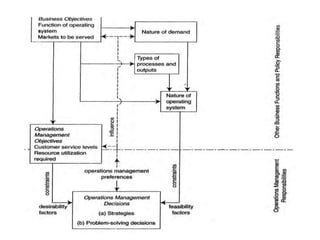
The operations management decision-making process
• Operations management decision-making process is ‘the
formulation of overall strategies for operations, typically
involving interrelated areas of responsibility within
operations management, and the making of decisions in
these areas in pursuit of these strategies within the broader
business context.
• Quality-based strategy that focuses on quality in all phases
of an organization: Quality-based Strategies:
• : Attracting and retaining Customers
• : Catch up with competition
• : Maintain existing image
• : Cost reduction
• : Increased Productivity
• : Reduced delivery Time
• Time-based strategy that focuses on reduction of time needed to
accomplish tasks:
• : Planning time: The time needed to react to a competitive threat, to
develop strategies and select tactics.
• : Product / service design time: The time needed to develop and
market new or redesigned products or services.
• : Processing time: The time needed to produce goods or provide
services. This can involve scheduling repairing equipment, methods
used, inventories, quality, and training
• : Changeover time: The time needed to change from producing one
type of product or service to another. This may involve new
equipment settings and attachments, different
methods, equipment, schedules, or materials.
• : Delivery time: The time needed to fill orders.
• : Response time for complaints: These might be customer complaints
about quality, timing of deliveries, and incorrect shipments. These
might also be complaints from employees about working conditions
(e.g., safety, lighting, heat or cold), equipment problems, or quality
problems.
Strategic operations management decisions:
1. Product and service design: Costs, quality, liability and
environmental issues
2. Capacity: Cost structure, flexibility
3. Process selection and layout: Costs, flexibility, skill level
needed, capacity
4. Work design: Quality of work life, employee
safety, productivity
5. Location: Costs, visibility
6. Quality: Ability to meet or exceed
customer expectations
7. Inventory: Costs, shortages
8. Maintenance: Costs, equipment reliability,
productivity
9. Scheduling: Flexibility, efficiency
10. Supply chains
Costs, quality, agility, shortages,
vendor relations:
11. Projects: Costs, new products, services,
or operating systems
The Role of Operations in Designing of a new Product
Preliminary Stages: Information and Intelligence from
Markets, Suppliers, Competitors, Regulators etc.
Stage 1: Ideas Generation:
• Operations has a contribution to make in stages 2, 3, 4, 5, 6 and
7 for there is little benefit in conceiving a product which cannot
efficiently, fully or economically be provided. Hence operations
must enter into the design dialogue as follows:
• Market-or technology-oriented ideas
• New concepts or incremental developments
• Internally or externally generated
Stage 2: Screening and selection:
• Can the product / service be provided by the operating system?
• Do we have the processes, technology and skill?
• Do we have the capacity?
• Market analysis test, Technological feasibility, Competitive
advantage, Risk assessment
Stage 3: Initial design:
• What is the most appropriate design required for providing, at the required
quality and probable cost?
• Specification of major aspects/features, Initial model/’mock-up’
Stage 4: Economic analysis:
• How much would it cost to make the appropriate volumes, and at the
required quality?
• Estimate of development cost, Estimate of provision cost, Estimate of final
cost
• Estimate of price
Stage 5: Prototype testing:
• Check providability through operating system
• Performance / function testing, Consumer tests, Test of Providability’
Stage 6: Redesigning / modification:
• Introduce modifications to providability, Improvements, corrections and
modifications, Retesting if necessary, Approval for final design
Stage 7: Final specification:
• Future appropriate quality specifications. Begin process specification in
marketing the above contribution, operations must have regard to the
following: Full detailed specification of content, structure, function and
performance
(a) Computer Aided Design: Computers are increasingly
used for product design. CAD uses computer graphics for product
design.
• The design can be maneuvered on the screen, it can be rotated
to provide the designer different views of the product, it can be
split apart to have a view of the inside and a position of the
product can be enlarged for closer view. The printed version of
the completed design can be taken and also the design can be
stored electronically.
• Also a database can be created for manufacturing which can
supply required information on product geometry and
dimensions, tolerances, material specifications etc.
• Also, some CAD systems facilitate engineering and cost analyses
on proposed designs, for example, calculation of volume and
weight and also stress analysis can be done using CAD systems.
• It is possible to generate a number of alternative designs using
computer aided design systems and identify the best alternative
which meets the designer’s criteria.
Value Engineering / Value Analysis in Product Design:
• Value engineering or value analysis is concerned with the improvement of
design and specifications at various stages such as research, design and
product development. Benefits of value engineering are:
• Cost reduction.
• Less complex products.
• Use of standard parts/components.
• Improvement in functions of the product.
• Better job design and job safety.
• Better maintainability and serviceability.
• Robust design.
• Value engineering aims at cost reduction at equivalent performance. It
can reduce costs to the extent of 15% to 70% without reducing quality.
• While value engineering focuses on preproduction design
improvement, value analysis, a related technique seeks improvements
during the production process.
• Once launched, even good products have limited lives and, to remain
viable, the organization seeks a flow of new product possibilities. Let’s
examine the product’s birth-to-mortality pattern.
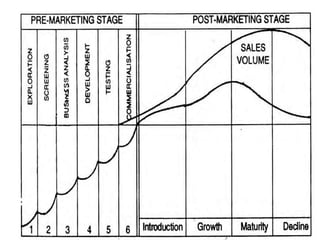
Product Life Cycle
• Products, like men, are mortal. They flourish for a time, then
decline and die.
• A product that has not built up its potential during its
formative years is likely to be relatively unsuccessful on its
maturity.
• The product, thus, has “life cycles” just as human beings
have. From its birth, a product passes through various
stages, until it is finally abandoned, i.e. discontinued from the
market.
• These stages taken together are referred, to as “The product
life cycle”.
• This life cycle of the product comprises four stages:
Introduction, Growth, Maturity and Decline.
• The introduction stage is preceded by ‘production planning and
development’. This period requires greater investment. This
investment should be gradually recouped as the sales pick up. The
concept of life cycle would give the management an idea as to the
time within which the original investment could be recouped.
• In the growth stage, both sales and profits will begin to increase. It
is here that similar other new products begin to appear in the
market as substitutes and offer competition. At the end of this
stage, the distribution arrangement is likely to get completed and
the prices, if necessary, are reduced a little.
• The third stage is the maturity stage. During this stage the
manufacturers introduce new or modified models or adopt
methods to retain their position in the market. The number of
buyers will continue to grow, but more slowly. In economic terms
this is the stage where supply exceeds demand. Some of the
promotional efforts may lengthen the span of this stage but they
will not offer a permanent solution.
• At the final stage of decline, profit margins touch a low
level, competition becomes severe and customers start using newer
and better products. It is here that the story of a product ends-a
natural but hard end.
Process Planning and Process Design:
• At the time of designing and developing a product, due consideration
is given for the manufacturability or producibility of the product using
the current process technology and the capability of the firm to
manufacture the product.
• If the firm already has the required technology, the facilities
(machines and equipments) and the manufacturing processes, and
the firm has sufficient capacity or can acquire the needed capacity to
manufacture the product, then decision is taken to go ahead with the
product design.
• After the final design of the product has been approved and released
for production, the production planning and control department takes
the responsibility of process planning and process design for
converting the product design into a tangible product. As the process
plans are firmly established, the processing time required for carrying
out the production operations on the equipments and machines
selected are estimated. These processing times are compared with
the available machine and labour capacities and also against the cost
of acquiring new machines and equipments required before a final
decision is made to manufacture the product completely in house or
any parts or sub-assemblies must be outsourced.
What is a Process?
• A process is a sequence of activities that is intended to
achieve some result, typically to create added value for
the customers.
• A process converts inputs into outputs in a production
system. It involves the use of organisation’s resources to
provide something of value. No product can be made and
no service can be provided without a process and no
process can exist without a product or service.
• Processes underlie all work activities and are found in all
organisations and in all functions of an organisation.
Deciding what processes to use is an essential issue in the
design of a production system.
• Process decisions involve many different choices in
selecting human resources, equipment and
machinery, and materials. Process decisions are strategic
and can affect an organisation’s ability to compete in the
long run.
• Types of Processes: Basically, processes can be categorised as:
• (i) Conversion processes, i.e., converting the raw materials into
finished products (for example, converting iron ore into iron and then
to steel). The conversion processes could be metallurgical or chemical
or manufacturing or construction processes.
a) Forming processes include foundry processes (to produce
castings) and other processes such as forging, stamping, embossing and
spinning. These processes change the shape of the raw material (a metal)
into the shape of the work piece without removing or adding material.
b) Machining processes comprise metal removal operations such as
turning, milling, drilling, grinding, shaping, planing, boring etc.
c) Assembly processes involve joining of parts or components to
produce assemblies having specific functions. Examples of assembly
processes are welding, brazing, soldering, riveting, fastening with bolts
and nuts and joining using adhesives.
• (ii) Manufacturing processes can be categorised into (a) Forming
processes, (b) Machining processes and (c) Assembly processes.
• (iii) Testing processes which involve inspection and testing of products
(sometimes considered as part of the manufacturing processes).
Process Planning:
• Process planning is concerned with planning the
conversion processes needed to convert the raw material
into finished products. It consists of two parts:
• Process design and
• Operations design.
• Process Design is concerned with the overall sequences
of operations required to achieve the product
specifications. It specifies the type of work stations to be
used, the machines and equipments necessary to carry
out the operations.
• The sequence of operations are determined by
(a) The nature of the product,
(b) The materials used,
(c) The quantities to be produced and
(d) The existing physical layout of the plant.
Operations Design
Operations Design is concerned with the design of the individual
manufacturing operation. It examines the man-machine relationship in
the manufacturing process. Operations design must specify how much
labour and machine time is required to produce each unit of the
product. Framework for Process Design
• The process design is concerned with the following:
• Characteristics of the product or service offered to the customers.
• Expected volume of output.
• Kinds of equipments and machines available in the firm.
• Whether equipments and machines should be of special purpose or
general purpose.
• Cost of equipments and machines needed.
• Kind of labour skills available, amount of labour available and their
wage rates.
• Expenditure to be incurred for manufacturing processes.
• Whether the process should be capital-intensive or labour-
intensive.
• Make or buy decision.
• Method of handling materials economically.
Process Selection
• Process selection refers to the way production of
goods or services is organised. It is the basis for
decisions regarding capacity planning, facilities (or
plant) layout, equipments and design of work
systems. Process selection is necessary when a firm
takes up production of new products or services to
be offered to the customers.
• Three primary questions to be addressed before
deciding on process selection are:
(i) How much variety of products or services will
the system need to handle?
(ii) What degree of equipment flexibility will be
needed?
(iii) What is the expected volume of output?
Process Strategy
• A process strategy is an organisation’s approach to process selection for the
purpose of transforming resource inputs into goods and services (outputs). The
objective of a process strategy is to find a way to produce goods and services
that meet customer requirement and product specification (i.e., design
specifications) within the constraints of cost and other managerial limitations.
• The process selected will have a long-term effect on efficiency and production
as well as flexibility, cost, and quality of the goods produced. Hence it is
necessary that a firm has a sound process strategy at the time of selecting the
process.
Key aspects in process strategy include:
(i) Make or buy decisions : Make or buy decisions refer to the extent to
which a firm will produce goods or provide services in-house or go for
outsourcing (buying or subcontracting).
(ii) Capital intensity : Capital intensity refers to the mix of equipment and
labour which will be used by the firm.
(iii) Process flexibility : Process Flexibility refers to the degree to which
the system can be adjusted to changes in processing requirements due to
such factors as changes in product or service design, changes in volume
of products produced and changes in technology.
• Three process strategies:
• Virtually every good or service is made by using some variation of
one of three process strategies. They are:
(i) Process focus (ii) Repetitive focus and (iii) Product focus.
• (i) Process Focus: Majority (about 75 per cent) of global
production is devoted to low volume, high variety products in
manufacturing facilities called job shops. Such facilities are
organised around performing processes. For example, the
processes might be welding, grinding or painting carried out in
departments devoted to these processes. Such facilities are
process focussed in terms of equipment, machines, layout and
supervision. They provide a high degree of product flexibility as
products move intermittently between processes. Each process is
designed to perform a wide variety of activities and handle
frequent changes. Such processes are called intermittent
processes. These facilities have high variable costs and low
utilisation of facilities.
(ii) Repetitive Focus: A repetitive process is a product oriented
production process that uses modules. It falls between
product focus and process focus. It uses modules which are
parts or components prepared often in a continuous or
mass production process. A good example of repetitive
process is the assembly line which is used for assembling
automobiles and household appliances and is less flexible than
process-focused facility. Personal computer is an example of a
repetitive process using modules in which the modules are
assembled to get a custom product with the desired
configuration.
(iii) Product Focus: It is a facility organised around products, a product
oriented, high-volume low variety process. It is also referred to
as continuous process because it has very long continuous
production run. Examples of product focussed processes are
steel, glass, paper, electric bulbs, chemicals and
pharmaceutical products, bolts and nuts etc. Product-focussed
facilities need standardisation and effective quality control.
The specialised nature of the facility requires high fixed cost,
but low variable costs reward high facility utilisation.
• Process Management:
• Process management is concerned with the selection of
inputs, operations, work flows and methods that transform
inputs into outputs. The starting point of input selection is the
make-or-buy decision (i.e., deciding which parts and
components are to be produced in-house and which are to be
purchased from outside suppliers). Process decisions are
concerned with the proper mix of human skills and
equipments needed to produce the parts in-house and which
part of the processes are to be performed by each equipment
and worker.
• Process decisions: It must be made when:
(i) A new or modified product or service is being offered.
(ii) Quality must be improved.
(iii) Competitive priorities have changed.
(iv) Demand for a product or service is changing.
(v) Cost or availability of materials has changed
(vi) Competitors are doing better by using a new technology or
a new process.
Major Process Decisions:
• Process Choice: The production manager has to choose from
five basic process types — (i) job shop, (ii) batch, (iii) repetitive
or assembly line, (iv) continuous and (v) project.
• (i) Job shop process: It is used in job shops when a low volume
of high-variety goods are needed. Processing is
intermittent, each job requires somewhat different processing
requirements. A job shop is characterised by high customisation
(made to order), high flexibility of equipment and skilled labour
and low volume. A tool and die shop is an example of job
shop, where job process is carried out to produce one-of-a kind
of tools. Firms having job shops often carry out job works for
other firms. A job shop uses a flexible flow strategy, with
resources organised around the process.
• (ii) Batch process: Batch processing is used when a moderate
volume of goods or services is required and also a moderate
variety in products or services. A batch process differs from the
job process with respect to volume and variety. In batch
processing, volumes are higher because same or similar
products or services are repeatedly provided, examples of
products produced in batches include paint, ice cream, soft
drinks, books and magazines.
(iii) Repetitive process: This is used when higher volumes of more
standardised goods or services are needed. This type of process is
characterised by slight flexibility of equipment (as products are
standardised) and generally low labour skills. Products produced include
automobiles, home appliances, television sets, computers, toys etc.
Repetitive process is also referred to as line processes as it include
production lines and assembly lines in mass production. Resources are
organised around a product or service and materials move in a line flow
from one operation to the next according to a fixed sequence with little
work-in-progress inventory. This kind of process is suitable to
“manufacture-to-stock” strategy with standard products held in finished
goods inventory. However, “assemble-to-order” strategy and “mass
customisation” are also possible in repetitive process.
(iv) Continuous process: This is used when a very highly standardised
product is desired in high volumes. These systems have almost no variety
in output and hence there is no need for equipment flexibility. A
continuous process is the extreme end of high volume, standardized
production with rigid line flows. The process often is capital intensive
and operate round the clock to maximise equipment utilisation and to
avoid expensive shut downs and shut ups. Examples of products made in
continuous process systems include petroleum
products, steel, sugar, flour, paper, cement, fertilisers etc.
• (v) Project process: It is characterised by high
degree of job customisation, the large scope for
each project and need for substantial resources
to complete the project. Examples of projects are
building a shopping centre, a dam, a
bridge, construction of a
factory, hospital, developing a new
product, publishing a new book etc. Projects tend
to be complex, take a long time and consist of a
large number of complex activities. Equipment
flexibility and labour skills can range from low to
high depending on the type of projects.
• Vertical Integration: Vertical integration is the amount of the
production and distribution chain, from suppliers of components to
the delivery of products/services to customers, which is brought
under the ownership of a firm. The management decides the level or
degree of integration by considering all the activities performed from
the acquisition of raw materials to the delivery of finished products to
customers. The degree to which a firm decides to be vertically
integrated determines how many production processes need to be
planned and designed to be carried out in-house and how many by
outsourcing. When managers decide to have more vertical
integration, there is less outsourcing.
• The vertical integration is based on “make-or-buy” decisions, with
make decisions meaning more integration and a buy decision
meaning less integration and more outsourcing. Two directions of
vertical integration are
(a) Backward integration which represents moving upstream
toward the sources of raw materials and parts, for example a steel mill
going for backward integration by owning iron ore and coal mines and a
large fleet of transport vehicles to move these raw materials to the steel
plant,
(b) Forward integration in which the firm acquires the channel
of distribution (such as having its own warehouses, and retail outlets).
• Advantages of vertical integration are:
• Can sometimes increase market share and allow the
firm enter foreign markets more easily.
• Can achieve savings in production cost and produce
higher quality goods.
• Can achieve more timely delivery.
• Better utilisation of all types of resources.
• Disadvantages of vertical integration are:
• Not attractive for low volumes.
• High capital investment and operating costs.
• Less ability to react more quickly to changes in
customer demands, competitive actions and new
techniques.
3. Resource flexibility:
• The choices that management makes concerning competitive
priorities determine the degree of flexibility required of a
firm’s resources — its employees, facilities and equipment.
Production managers must decide whether to have flexible
workforce which will provide reliable customer service and
avoid capacity bottlenecks. Flexible workforce is useful with
flexible flow strategy to even out fluctuating workloads.
• Also when volume flexibility is required, instead of laying-off
and hiring workforce to match varying demands, it is better to
have certain amount of permanent workforce having multiple
skills. This will facilitate movement of surplus workforce from
low-load work centres to higher-load work centres.
• When a firm’s product has a short life cycle and a high degree
of customisation, low production volumes mean that the firm
should select flexible general purpose machines and
equipments.
• 4. Customer-involvement is the extent to which customers
interact with the process. A firm which competes on
customisation allows customers to come up with their own
product specification or even become involved in the
designing process for the product (quality function
deployment approach to design for incorporating the voice of
the customer).
• 5. Capital intensity means the predominant resource used in
manufacturing, i.e., capital equipments and machines rather
than labour. Decision regarding the amount of capital
investment needed for equipments and machines is
important for the design of a new process or the redesign of
an existing one. As the capabilities of technology increase
(for example automation), costs also will increase and
managers have to decide about the extent of automation
needed. While one advantage of adding capital intensity is
significant increase in product quality and productivity, one
big disadvantage can be high investment cost for low-volume
operations.
• The list of manufacturing environments is never-ending and an indication of
the range and length is given in the following list, adapted from Government
statistical publications under the classification ‘Production
• Industries’ / ‘Manufacturing Industry’:
• Mining and quarrying
• Food processing and manufacture
• Food consumption
• Drink and tobacco
• Coal and petroleum products
• Chemical and allied industries.
• Metal manufacture
• Mechanical engineering
• Instrumental and electrical engineering
• Shipbuilding, vehicles and other metal goods
• Textiles, leather, leather goods and fur.
• Clothing and footwear.
• Bricks, pottery, glass, cement, etc.
• Paper, printing and publishing
• Construction.
• Gas, electricity and water.
• Among these few are regulated & thus covered under cost
audit report rules by government rest are unregulated
• Under the provisions of Cost and Works Accounts Act, 1959
(23 of 1959) : The regulated industries are –
• i) Pharmaceutical Industry
• ii) Fertilizers Industry
• iii) Sugar & Alcohol Industry
• iv) Electricity Industry
• v) Petroleum Industry
• vi) Telecommunication Industry
• Amongst these regulated industries, most are
manufacturing, except the telecommunication.
Measuring Process Performance -1
• Efficiency is a ratio of the actual output of a process relative to some
standard. For example, consider a machine designed to package cereal
at a rate of 30 boxes per minute. If during a shift the operators actually
produce at a rate of 36 boxes per minute, then the efficiency of the
machine is 120 percent (36/30).
• Run time is the time required to produce a batch of parts.
This is calculated by multiplying the time required to produce
each unit by the batch size. Example: Package cereal at a rate of
30 boxes per minute. Therefore Run Time will be 60 Seconds / 30 = 2
Seconds
• The Setup time is the time required to prepare a machine to make a
particular item. Machines that have significant setup time will typically
run parts in batches.
• The Operation time is the sum of the setup time and run time for a
batch of parts that are run on a machine.
• Consider the cereal-boxing machine that is designed to produce at a
rate of 30 boxes per minute.
• The run time for each box is 2 seconds.
• To switch the machine from 16-ounce boxes to 12-ounce boxes
requires a setup time of 30 minutes.
• The operation time to make a batch of 10,000, 12-ounce boxes is
21,800 seconds
(30 minutes’ setup = 30 x 60 = 1800 seconds) + (2 seconds / box
x 10,000 boxes) = 21800 Seconds or 363.33 minutes.
• The cycle time is the elapsed time between starting and completing a
job.
Example: For a Batch of 10,000 Boxes the Cycle time is 20,000
Seconds or 333.33 Minutes
• Throughput time includes the time that the unit spends actually
being worked on together with the time spent waiting in a queue.
• The Throughput rate is the output rate that the process is expected
to produce over a period of time.
• Process velocity (also known as throughput ratio) is the ratio of the
total throughput time to the value added time.
• Value-added time is the time in which useful work is actually being
done on the unit.
Measuring Process Performance -2
• Little’s Law states a mathematical relationship between throughput
rate, throughput time, and the amount of work-in-process inventory. Little’s
Law estimates the time that spend in work-in-process inventory, which can
be useful for calculating the total throughput time for a process. Using the
terminology defined in this section, Little’s Law is defined as follows-
• Throughput time = Work-in-Progress divided by Throughput rate
• This formula holds for any process that is operating at a Steady Rate.
• By Steady Rate we mean that work is entering and exiting the system at the
same rate over the time period being analyzed. Our assembly line has 120
units entering and 120 units exiting the process each hour. If, for
example, 150 units were entering the system each hour but only 120 units
were exiting, then the system would not be operating at a steady rate since
30 additional units would be accumulating in the system each hour. These 30
units add to work-in-process, which would cause the throughput time to
increase each hour. The actual increase in throughput time would be 15
minutes per hour (30 units/120 units per hour = 0.25 hour)
Study Note – 2: PRODUCTION PLANNING:
• All the activities in the manufacturing or production cycle must be
planned, coordinated, organised, and controlled to achieve the
objective “Delivery of products to “customers” or to “inventory” stocks
according to some predetermined schedule.”
• Long-term Production Planning (usually from seven to ten years or
more) deals with plant construction and location and with product-
line, design and development.
• Short range Production Planning (from several months to a year)
focuses on such areas as inventory goals and wage budgets
• Production consists of a sequence of operations that transform
materials from a given form to a desired form (products). The highest
efficiency in production is obtained by manufacturing the required
quantity of products, of the required quality, at the required time, by
the best and cheapest method.
Three stages in PPC
• (i) Planning: The choice from several alternatives of
the best means of utilising the resource available to
achieve the desired objectives in the most efficient
and economic manner.
• (ii) Operations: Performance in accordance with the
details set out in the production plan.
• (iii) Control: The monitoring of performance through
a feed-back by comparing the result achieved with
the planned targets so that performance can be
improved through proper corrective action by
subsequent adjusting, modifying and redefining plans
and targets in order to ensure the attainment of
goals.
• The functions of PPC can be classified under the following:
• Materials: Raw materials, spare parts and components which
must be available in the correct quantities and specifications at
the right time. Planning for procurement of raw
materials, components and spare parts in the right quantities
and specifications at ·the right time from the right source at the
right price. Purchasing, storage, inventory
control, standardisation, variety reduction, value analysis and
inspection are the other activities associated with materials.
• Methods: It involves deciding the best sequence of operations
for manufacturing the parts, building up subassemblies and
major assemblies which in turn will make up the finished
product, within the limitations of existing layout and workflow.
Includes choosing the best method of processing from several
alternatives. It also includes determining the best sequence of
operations (process plans) and planning for tooling, jigs and
fixtures etc.
The functions of PPC -1
• Machines and Equipments: PPC is concerned with selection of machines
and equipments and also with maintenance policy, procedure and
schedules, replacement policy and tooling. (Design and manufacture of
tools). Manufacturing methods are related to production facilities
available in the production system. It involves facilities planning, capacity
planning, allocation and utilization of plant and equipments, machines
etc. It also involves equipments replacement policy, maintenance policy
and maintenance schedules, tools manufacture and maintenance of tools
etc.
• Manpower: Planning for man power (labour, supervisory and managerial
levels) having appropriate skills and expertise.
• Routing: Routing prescribes the flow of work in the plant and is related to
consideration of layout, of temporary storage locations for raw
materials, components and semi processed parts, and of material
handling systems. Routing is a basic PPC function. Determining the flow of
work, material handling in the plant, and sequence of operations or
processing steps. This is related to considerations of appropriate shop
layout and plant layout, temporary storage locations for raw
materials, components and semi-finished goods, and of materials
handling systems
The functions of PPC - 2
• Estimating: The processing times (both set up time and
operation time per piece) required for the parts to be
manufactured in-house are estimated and the standard time
(both machine time and labour time) are established as
performance standards. Establishing operation times leading to
fixation of performance standards both for workers and
machines.
• Loading and Scheduling: Machines have to be loaded according
to their capacity and capability. Machine loading is carried out in
conjunction with routing (as indicated in process layouts or
operations analysis and routing sheets) to ensure smooth
workflow and the prescribed feeds. Speeds of machines are
adhered to as well as the estimated time (standard time which is
the allowed time to do a job). Machine loading is allocation of
jobs to machines in conjunction with routing and with due
consideration for capacity of machines and priority for jobs in
order to utilize the machines to the maximum possible extent.
The functions of PPC - 3
• Scheduling: Determines the utilisation of equipment and manpower and
hence the efficiency of the plant. Scheduling determines the starting
time and completion time for each and every operation for each and
every part to be manufactured and sub-unit to be assembled so that the
finish product is ready to be shipped to the customer as per the
predetermined delivery schedules.
• Dispatching: This is concerned with the execution of planning functions.
Production orders and instructions are released according to the
schedule, sequences indicated in route sheets, and machine loading
schedules are adhered to and authorisation is given for release of
materials and tools to the operators to carry out the work. This is
concerned with the execution of the planning functions. It gives
necessary authority to start a particular work which has already been
planned under routing and scheduling functions. Dispatching is release of
orders and instructions for the starting of production in accordance with
the route sheets and schedule charts.
• Expediting or Progressing: This means follow-up or keeping track of the
progress made in completing the production as per schedules. This
follows dispatching function logically. Means chasing, follow up or
progressing which is done after dispatching function. It keeps a close
liaison with scheduling in order to provide an efficient feedback and
prompt review of targets and schedules.
The functions of PPC - 4
• Inspection: This function relates to checking the quality of
production and of evaluating the efficiency of the
processes, methods and workers so that improvements can be
made to achieve the desired level of quality. This function is
related to maintenance of quality in production and of
evaluating the efficiency of the processes, methods and labour
so that improvements can be made to achieve the quality
standards set by product design
• Evaluating or Controlling: The objective of evaluation or
controlling is to improve performance. Methods and facilities are
evaluated to improve their performance. To sum up, we can
state that PPC is a management tool, employed for the direction
of the manufacturing operations and their co-ordination with
other activities of the firm. The objective of evaluation is to
improve performance. Performance of machines, processes and
labour is evaluated to improve the same.
• Cost Control: Manufacturing cost is controlled by wastage
reduction, value analysis, inventory control and efficient
utilization of all resources.
Objectives of Production Planning and Control:
1. To deliver quality goods in required quantities to the customer in the
required delivery schedule to achieve maximum customer satisfaction
and minimum possible cost.
2. To ensure maximum utilization of all resources.
3. To ensure production of quality products.
4. To minimise the product through-put time or production/manufacturing
cycle time.
5. To maintain optimum inventory levels.
6. To maintain flexibility in manufacturing operations.
7. To co-ordinate, between labour and machines and various supporting
departments.
8. To plan for plant capacities for future requirements.
9. To remove bottle-necks at all stages of production and to solve problems
related to production.
10. To ensure effective cost reduction and cost control.
11. To prepare production schedules and ensure that promised delivery
dates are met.
12. To produce effective results for least total cost
Basic types of Production Control:
• Block control: This type of control is most prominent in textiles and book and
magazine printing. In these industries it is necessary to keep things separated
and this is the fundamental reason why industries resort to block control.
• Flow control: This type of control is commonly applied in industries like
chemicals, petroleum, glass, and some areas of food manufacturing and
processing. Once the production system is thoroughly designed, the production
planning and control department controls the rate of flow of work into the
system and checks it as it comes out of the system. But, under this
method, routing and scheduling are done when the plant is laid out. That is to
say, the production line which is established is well balanced and sequenced
before production operations begin; this type of control is more prevalent in
continuous production systems.
• Load control: Load control is typically found wherever a particular bottleneck
machine exists in the process of manufacturing.
• Order control: The most, common type of production control is called order
control. This type of control is commonly employed in companies with
intermittent production systems, the so-called job-lot shops. Under this
method, orders come into the shop for different quantities for different products.
Therefore, production planning and control must be based on the individual
orders.
• Special project control: Special production control is necessary in certain
projects like the construction of bridges, office
buildings, schools, colleges, universities, hospitals and any other construction
industries. Under this
Requirements of Production Planning and Control System
1. Sound organizational structure with mechanism for proper delegation of authority
and fixation of responsibility at all levels.
2. Information feedback system should provide reliable and up-to-date information to
all persons carrying out PPC functions.
3. Standardisation of materials, tools, equipments, labour, quality, workmanship etc.
4. Trained personnel for using the special tools, equipments and manufacturing
processes.
5. Flexibility to accommodate changes and bottle-necks such as shortage of materials,
power failures, machine break downs and absenteeism of employees.
6. Appropriate management policies regarding production and inventory levels,
product -mix and inventory turnover.
7. Accurate assessment of manufacturing lead times and procurement lead times.
8. Plant capacity should be adequate to meet the demand. The plant should be
flexible in order to respond to the introduction of new products, changes in
product-mix and production rate.
Limitations of PPC
(a) Production planning and control function is based on certain
assumptions or forecasts of customers demand, plant
capacity, availability of materials, power etc. If these
assumptions go wrong, PPC becomes ineffective.
(b) Employees may resist changes is production levels set as per
production plans if such plans are rigid.
(c) The production planning process is time consuming when it is
necessary to carry out routing and scheduling functions for
large and complex products consisting of a large no. of
parts going into the product.
(d) Production planning and control function becomes extremely
difficult when the environmental factors change very rapidly
such as technology, customers’ taste regarding fashion or style
of products needed, Government policy and controls
stoppages of power supply by electricity boards due to
power cuts, break in supply chain due to natural calamities
such as floods, earthquakes, war etc.
2.2 Economics and Optimization :
• Economic person always takes rational decisions with
respect to economic matters. The rationality is defined in
terms of optimizing behaviour.
• Market perfect competition, Marginal Revenue, Marginal
Cost, Resources required to produce
output, Space, Inventory, warehousing problems etc. are
required to be considered to decide “Profit Maximising
Output”. The constraint of being able to sell maximised
product fully in Market, price constraint, constraint due to
consumers not having product knowledge are also
required to be considered.
• Economic theory believes in “unbounded maximizing
behaviour and the whole theoretical infrastructure is
geared to achieve the objectives based on the same. It
is, therefore, natural that economic literature is
exceptionally rich in optimization models.
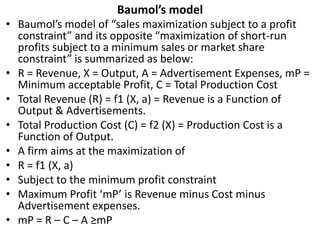
Baumol’s model
• Baumol’s model of “sales maximization subject to a profit
constraint” and its opposite “maximization of short-run
profits subject to a minimum sales or market share
constraint” is summarized as below:
• R = Revenue, X = Output, A = Advertisement Expenses, mP =
Minimum acceptable Profit, C = Total Production Cost
• Total Revenue (R) = f1 (X, a) = Revenue is a Function of
Output & Advertisements.
• Total Production Cost (C) = f2 (X) = Production Cost is a
Function of Output.
• A firm aims at the maximization of
• R = f1 (X, a)
• Subject to the minimum profit constraint
• Maximum Profit ‘mP’ is Revenue minus Cost minus
Advertisement expenses.
• mP = R – C – A ≥mP
Economic Problems and Optimization Techniques
• The process of finding, the best or optimal strategies is called optimization
and includes the problems related to both maximization and minimization.
These objectives have to be optimized under two conditions: (a) without any
constraints and (b) with constraints. They can be divided further.
• 1. Unconstrained optimization into (i) functions with the (independent)
variable and (ii) multi-variate functions.
• 2. Constrained optimization into (i) equality constrained optimization, (ii)
inequality constrained optimization, (iii) static optimization (Kuhn-Tucker
conditions), and (iv) dynamic optimization (Hamiltonian conditions)
• Equality constrained problems can, again, be of two kinds. In Economics, the
popular examples are:
• (a) the maximization of the utility subject to a budget constraint and
• (b) the minimization of the cost subject to a production (technology)
constraint
• (c) or maximization of output subject to a resource (cost) constraint.
Optimization Techniques
Economic model Example Optimization technique
1. Unconstrained Optimization
(a) A single variable without constraint
(b) a multi-variate function without
constraints
Max R or sales = f (P)
Minimize C = f(x)
Max π (R – C) = f(x)
Max π = f (price and advertisement)
Differential calculus
First derivative should be equal to zero.
Partial derivative with respect to one
variable assuming other as constant
2. Constrained optimization
(a) With Equality constraint
(b) With Inequality
constraints
(a) Max utility subject to
a budget constraint.
Minimize cost subject to a production
function.
(b) Max profit subject to
energy, budget capacity,
or time constraints
a) Lagrangian multipliers
(b) Linear programming and its
extensions
3. Optimization with multiple goals Max more than one objective in order of
sequence
(i) Multi-criteria decision
making
(ii) Goal programming (as
one of the techniques)
4. Dynamic optimization Max net profit stream; Max utility
stream; Max social welfare in the
presence of pollution from production
(i) Optimal control theory in the case of
continuous time optimization problems.
(ii) Dynamic programming in the case
of discrete-time optimization problems
Limitations of Linear Programming
• But Linear programming itself suffered from several limitations:
1. It assumes all functions to be linear which implies perfect
competition. Take, for example, the maximization of profit, sales, or
revenue. When an objective function is expressed in a linear form, if is
assumed that all the output can be sold at a given (constant) price.
This is possible only when a firm faces “Horizontal Straight Line”
demand curve, a feature of perfect competition.
2. It deals with a single objective and given constraints.
3. It is confined to non-negative values only.
4. It accepts rational values, which sometimes an awkward situation.
For example, it may be difficult to acquire half a machine or truck or
warehouse.
5. It is a “deterministic” technique, which means that the values of all
the variables and all the coefficients must be known with certainty.
6. There are several practical limitations particularly related to: (a)
difficulties in calculation and (b) the exorbitant cost of gathering data.
7. It also suffers from several other limitations common to operations
research techniques as a group.
2.3 Work Study
• The British Standards Institution defines work study as ‘a generic term
for those techniques, particularly method study and work
measurement, which are used in the examination of human work in all
its contexts, and which lead systematically to the investigation of all the
factors which affect the efficiency and economy of the situations being
reviewed, in order to effect improvements’.
• Time Study & Method Study can be defined to be a searching scientific
analysis the methods and equipments used in doing a piece of
work, developing a method in practical detail and of the best manner of
doing it and determination of time required.
• The aims of work study are, by analysis of work methods and the
materials and equipment used, to:
(a) Establish the most economical way of doing the work;
(b) Standardise this method, and the materials and equipment involved;
(c) Establish the time required by a qualified and adequately trained
worker to do the job while working at a defined level of performance;
(d) Install this work method as standard practice.
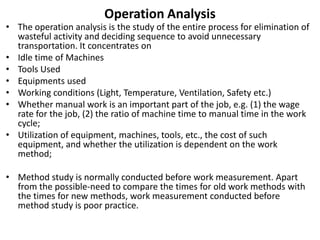
Operation Analysis
• The operation analysis is the study of the entire process for elimination of
wasteful activity and deciding sequence to avoid unnecessary
transportation. It concentrates on
• Idle time of Machines
• Tools Used
• Equipments used
• Working conditions (Light, Temperature, Ventilation, Safety etc.)
• Whether manual work is an important part of the job, e.g. (1) the wage
rate for the job, (2) the ratio of machine time to manual time in the work
cycle;
• Utilization of equipment, machines, tools, etc., the cost of such
equipment, and whether the utilization is dependent on the work
method;
• Method study is normally conducted before work measurement. Apart
from the possible-need to compare the times for old work methods with
the times for new methods, work measurement conducted before
method study is poor practice.
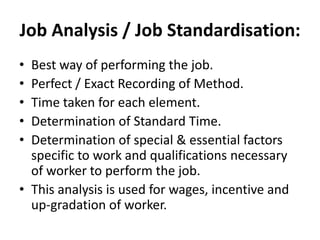
Job Analysis / Job Standardisation:
• Best way of performing the job.
• Perfect / Exact Recording of Method.
• Time taken for each element.
• Determination of Standard Time.
• Determination of special & essential factors
specific to work and qualifications necessary
of worker to perform the job.
• This analysis is used for wages, incentive and
up-gradation of worker.
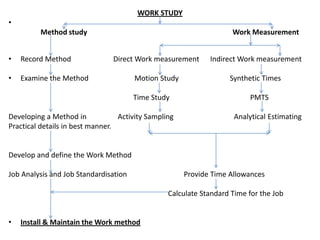
WORK STUDY
•
Method study Work Measurement
• Record Method Direct Work measurement Indirect Work measurement
• Examine the Method Motion Study Synthetic Times
Time Study PMTS
Developing a Method in Activity Sampling Analytical Estimating
Practical details in best manner.
Develop and define the Work Method
Job Analysis and Job Standardisation Provide Time Allowances
Calculate Standard Time for the Job
• Install & Maintain the Work method
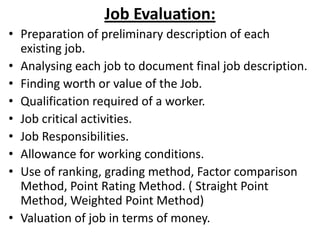
Job Evaluation:
• Preparation of preliminary description of each
existing job.
• Analysing each job to document final job description.
• Finding worth or value of the Job.
• Qualification required of a worker.
• Job critical activities.
• Job Responsibilities.
• Allowance for working conditions.
• Use of ranking, grading method, Factor comparison
Method, Point Rating Method. ( Straight Point
Method, Weighted Point Method)
• Valuation of job in terms of money.
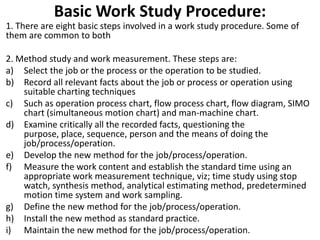
Basic Work Study Procedure:
1. There are eight basic steps involved in a work study procedure. Some of
them are common to both
2. Method study and work measurement. These steps are:
a) Select the job or the process or the operation to be studied.
b) Record all relevant facts about the job or process or operation using
suitable charting techniques
c) Such as operation process chart, flow process chart, flow diagram, SIMO
chart (simultaneous motion chart) and man-machine chart.
d) Examine critically all the recorded facts, questioning the
purpose, place, sequence, person and the means of doing the
job/process/operation.
e) Develop the new method for the job/process/operation.
f) Measure the work content and establish the standard time using an
appropriate work measurement technique, viz; time study using stop
watch, synthesis method, analytical estimating method, predetermined
motion time system and work sampling.
g) Define the new method for the job/process/operation.
h) Install the new method as standard practice.
i) Maintain the new method for the job/process/operation.
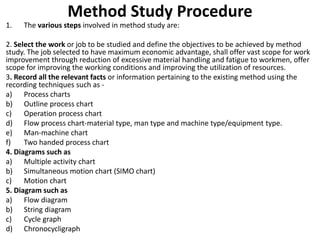
Method Study Procedure
1. The various steps involved in method study are:
2. Select the work or job to be studied and define the objectives to be achieved by method
study. The job selected to have maximum economic advantage, shall offer vast scope for work
improvement through reduction of excessive material handling and fatigue to workmen, offer
scope for improving the working conditions and improving the utilization of resources.
3. Record all the relevant facts or information pertaining to the existing method using the
recording techniques such as -
a) Process charts
b) Outline process chart
c) Operation process chart
d) Flow process chart-material type, man type and machine type/equipment type.
e) Man-machine chart
f) Two handed process chart
4. Diagrams such as
a) Multiple activity chart
b) Simultaneous motion chart (SIMO chart)
c) Motion chart
5. Diagram such as
a) Flow diagram
b) String diagram
c) Cycle graph
d) Chronocycligraph
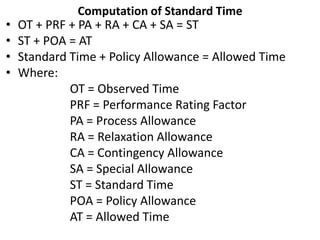
Computation of Standard Time
• OT + PRF + PA + RA + CA + SA = ST
• ST + POA = AT
• Standard Time + Policy Allowance = Allowed Time
• Where:
OT = Observed Time
PRF = Performance Rating Factor
PA = Process Allowance
RA = Relaxation Allowance
CA = Contingency Allowance
SA = Special Allowance
ST = Standard Time
POA = Policy Allowance
AT = Allowed Time
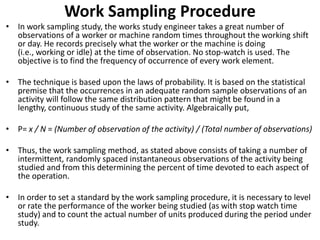
Work Sampling Procedure
• In work sampling study, the works study engineer takes a great number of
observations of a worker or machine random times throughout the working shift
or day. He records precisely what the worker or the machine is doing
(i.e., working or idle) at the time of observation. No stop-watch is used. The
objective is to find the frequency of occurrence of every work element.
• The technique is based upon the laws of probability. It is based on the statistical
premise that the occurrences in an adequate random sample observations of an
activity will follow the same distribution pattern that might be found in a
lengthy, continuous study of the same activity. Algebraically put,
• P= x / N = (Number of observation of the activity) / (Total number of observations)
• Thus, the work sampling method, as stated above consists of taking a number of
intermittent, randomly spaced instantaneous observations of the activity being
studied and from this determining the percent of time devoted to each aspect of
the operation.
• In order to set a standard by the work sampling procedure, it is necessary to level
or rate the performance of the worker being studied (as with stop watch time
study) and to count the actual number of units produced during the period under
study.
Steps in Work Sampling
• The work sampling study consists of essentially the following steps:
1. Determine the objective of the study, including definitions of
the states of activity to be observed.
2. Plan the sampling procedure including:
(a) An estimate of the percentage of time being devoted to
each phase of the activity.
(b) The setting of accuracy limits.
(c) An estimation of the number of observations required.
(d) The selection of the length of the study period and the
programming of the number of readings over this period.
(e) The establishment of the mechanics of making the
observations, the route to follow and the recording of data.
3. Collect the data as planned.
4. Process the data and present the results.
Advantages of Work Sampling over Conventional
Work Measurement Methods
1. Economical to use and usually costs considerably less than
a continuous time study.
2. Can be used to measure many activities that are impractical
to measure by time study.
3. Not necessary to use a trained work measurement analyst
to make the observations.
4. Work sampling measurements may be made with a pre-
assigned degree of reliability.
5. Measures the utilization of people and equipment directly.
6. Eliminates the necessity of using stop watch for
measurements.
7. Provides observation over a sufficiently long period of time
to decrease the chance of day to day variation affecting the
results.
2.4 FORECASTING
• Planning is fundamental to management. Forecasting, which involves a study of the present and
past, with a view to estimate the future activities, which forms the basis of planning.
• Forecasting is important to production and operations management in a number of decisions; to
make an annual plan of production / operations, to make a weekly or daily schedule of production or
service operations, to procure or manufacture the raw materials or components and to plan the
manpower, requirement amongst various other things.
• Advantages of forecasting are stated as under:
• Past data provides guidance for future and is a tool to train. Forecasts based on past data helps in
correct planning.
• Forecasting of customer’s demand help in strategy planning, capacity planning, location planning and
layout planning.
• Past data provides trends, which are used to forecast the future trends and helps to decide on
products or services pursued or to be stopped or abandoned.
• Forecast of manufacturing is essential to ensure the availability of materials for sub-assemblies and
final assemblies.
• Forecasting by specifying future demands reduce the costs of readjustment of operations in response
to the unexpected deviation.
• Accurate estimation of future demands of goods and services through forecasting increases the
operating efficiency.
• Forecasting is an important component of strategic and operational planning.
• Utilization of the plant is improved with correct forecasts.
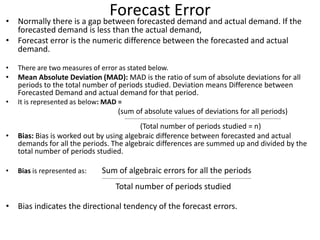
Forecast Error• Normally there is a gap between forecasted demand and actual demand. If the
forecasted demand is less than the actual demand,
• Forecast error is the numeric difference between the forecasted and actual
demand.
• There are two measures of error as stated below.
• Mean Absolute Deviation (MAD): MAD is the ratio of sum of absolute deviations for all
periods to the total number of periods studied. Deviation means Difference between
Forecasted Demand and actual demand for that period.
• It is represented as below: MAD =
(sum of absolute values of deviations for all periods)
---------------------------------------------------------------------------------------------------------------------
(Total number of periods studied = n)
• Bias: Bias is worked out by using algebraic difference between forecasted and actual
demands for all the periods. The algebraic differences are summed up and divided by the
total number of periods studied.
• Bias is represented as: Sum of algebraic errors for all the periods
----------------------------------------------------------------------------------------------------------------
Total number of periods studied
• Bias indicates the directional tendency of the forecast errors.
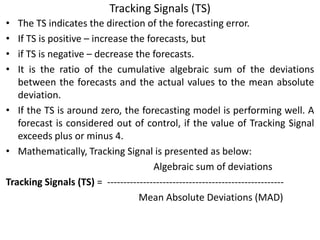
Tracking Signals (TS)
• The TS indicates the direction of the forecasting error.
• If TS is positive – increase the forecasts, but
• if TS is negative – decrease the forecasts.
• It is the ratio of the cumulative algebraic sum of the deviations
between the forecasts and the actual values to the mean absolute
deviation.
• If the TS is around zero, the forecasting model is performing well. A
forecast is considered out of control, if the value of Tracking Signal
exceeds plus or minus 4.
• Mathematically, Tracking Signal is presented as below:
Algebraic sum of deviations
Tracking Signals (TS) = ------------------------------------------------------
Mean Absolute Deviations (MAD)
Forecasting Approaches
• Qualitative Approaches: Qualitative approaches include five forecasting techniques:
• Grass-root Forecasting: People at the grass-root level in the organization, who are in
direct contact with the phenomenon under study, are asked to give inputs in forecasting.
For example, sales representatives could be asked to give information on current market
conditions. These inputs are satisfactory for short term planning.
• Focused Forecasting: This method integrates common sense, grass-root inputs and
computer simulation processes to assess the forecasts. For example, an Income-tax
Inspector would forecast the earning of a store from the number of customers entering
the store. He would multiply the number of customers with an expected average value of
purchases made by each customer. This gives him a rough estimate of the earnings of the
store.
• Historical Analogy: Information of past events is used to give insights into prediction on
related future developments. It is assumed that the future events would follow similar
pattern as of the past events. This approach gives inaccurate forecasts as the past events
might not have had similar conditions as that which the future events could encounter.
For example, demand for laptop computers based on the past sales of desktop computers
does not give a correct forecast
• Panel Consensus: A group of knowledgeable persons are invited for an open discussion on
a topic selected for forecasting. It is believed that a single person might not be able to
consider all the aspects on the topic. Collective effort of the group invited to interact and
come to a consensus on a subject, is considered as the acceptable approach for
forecasting. The group could have persons from marketing, engineering, sales, materials
management, etc. The basic objective of this approach is to use the creatively of the
members of the group. This process is not sophisticated, and works well as the group
members have a true sense of participation and bring out workable solutions.
• Delphi Method: A number of experts associated with the subject are asked to
give their response to pre-selected questions, which would help in forecasting. The
experts could be persons from within the organization or from outside the organization.
• The coordinator for forecasting obtains the responses from the experts, complies and
analyses the responses and gives feedback to the experts involved in the process.
• The coordinator again formulates new questions to obtain the response from the experts
again. The process of obtaining responses is repeated in few rounds until the coordinator
is satisfied that a good conclusion is reached on the subject.
• As the experts come from diverse backgrounds, they look at the issue independently from
their own perspectives. On getting the feedback, they are able to appreciate the views of
the experts from other expertise fields also. This gives them better understanding of the
issue. The result of Delphi is arrived by pooling up the knowledge of various experts and
brings very good results.
Merits of Delphi: Delphi is preferred for the following reasons:
• It involves knowledgeable persons on the subject.
• Members in Delphi exercise come from different backgrounds and therefore the method
is able to consider and pool up various aspects of the issue.
• Since the members do not meet each other, their views are not influenced by the views of
others.
• No conflict of personality is seen in the process.
• No dominance by any influential expert on the other experts.
• It gives quick results as compared to quantitative techniques and helps in timely decisions.
Quantitative Forecasting
• Quantitative forecasting techniques use the past numerical data for forecasting
the future events. The quantitative techniques use time series, which includes the
following:
• Simple Average.
• Simple Moving Average: In this method, the number of past periods is selected.
The average of the selected number of periods is calculated instead of average of
all the periods taken together. In this case, the average is changing as we move
forward and reflects the demand of the recent period more closely. As the one
period elapses, the demand for the oldest period is not counted and the demand
for the most recent period is added for the next calculation.
• Weighted Moving Average: In case the planner wants to give different weights to
different periods, he could use weighted moving average method by incorporating
some weight for old demand instead of equal weightage for all past periods under
consideration. Weighted Moving Average (WMA) = Sum of the product of weight
factor and demand for the month
• Exponential Smoothing: This method is more popular. The pattern of weight is
exponential in form. In this method, the demand for the most recent period is
weighted most heavily and the weights of just preceding periods are lowered
exponentially. As we go back in time, the weight is decreased exponentially. This
method cannot be used for an item, which has trend or seasonal pattern. This is
best suited for independent demand with no trend and seasonality.
• A new forecast is presented as under: N F = OF+ α (AD-OF) Where NF = New
Forecast, OF = Old Forecast, α = Weight Factor, normally called smoothing
coefficient and A D = Actual Demand.
Trend Projection
• To forecast a time series that has a long-term linear trend. The type of time series for which the trend
projection method is applicable shows a consistent increase or decrease over time; because it is not stable;
following Techniques are used:
• Equation for Linear Trend Tt = b0 + b1t
• Calculating the Seasonal Indexes
• De-seasonalizing the Time Series
• Seasonal Adjustments
• Cyclical Component
• Regression Analysis
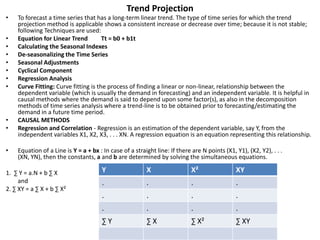
• Curve Fitting: Curve fitting is the process of finding a linear or non-linear, relationship between the
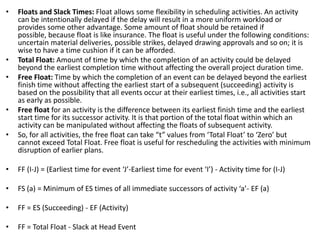
dependent variable (which is usually the demand in forecasting) and an independent variable. It is helpful in
causal methods where the demand is said to depend upon some factor(s), as also in the decomposition
methods of time series analysis where a trend-line is to be obtained prior to forecasting/estimating the
demand in a future time period.
• CAUSAL METHODS
• Regression and Correlation - Regression is an estimation of the dependent variable, say Y, from the
independent variables X1, X2, X3, . . . XN. A regression equation is an equation representing this relationship.
• Equation of a Line is Y = a + bx : In case of a straight line: If there are N points (X1, Y1), (X2, Y2), . . .
(XN, YN), then the constants, a and b are determined by solving the simultaneous equations.
1. ∑ Y = a.N + b ∑ X
and
2. ∑ XY = a ∑ X + b ∑ X²
Y X X² XY
. . . .
. . . .
. . . .
∑ Y ∑ X ∑ X² ∑ XY
2.5 Capacity planning
• Capacity of a facility is referred to as its capability to produce.
• Definition of Capacity: Capacity is the rate of output from an operating system per unit
time. Capacity is based on the output that the system can produce, store, and transport.
• For example, a cement plant could be capable to produce 3000 tons per day (tpd) of
cement. Output is also measured in terms of number of products that could be produced
from the process.
• Capacity is classified in many ways such as
budgeted, dedicated, productive, protective, rated, safety, standing, and demonstrated.
Mainly, the classification of capacity is talked in terms of:
• Designed or rated capacity
• Planned capacity
• Demonstrated capacity
• Designed or Rated Capacity: Designed capacity is also the maximum capacity, which a
facility can achieve. It defines the highest normal output that a process could achieve.
Designed capacity is usually higher than the normal output rate.
• The designed capacity of a process is calculated by taking into account the following:
• • Number of machines available.
• • Capacity of each machine.
• • Number of shifts operated.
• • Duration of each shift.
• • Number of workdays in the period under consideration.
• Planned Capacity: Planned capacity is the capacity, which is maintained
or achieved in normal operations. Production plans and schedules are
worked out based on planned capacity. Planned capacity is usually less
than the designed capacity due to the following reasons:
• Unexpected demand comes from some customers. Important
customers often ask for shorter delivery to meet their urgent
requirements, which need quick response and disturbs the planned
programme.
• Preventive and predictive maintenance need time and influence
the available time for production. Any variation in the time taken in
completing the preventive and predictive maintenance would adversely
affect the planned capacity. Preventive and predictive maintenance are
important for uninterrupted work as the possibilities of breakdowns are
reduced.
• Corrective repairs need time to take care of the unexpected
breakdowns, which adversely affect the capacity of the process.
• Running at maximum capacity could be sustained for short time as
both men and machines are strained, if they have to operate at the
maximum capacity. If it is not taken care, the effect is harmful to both men
and the machines. Therefore a reasonable efficiency is taken into
consideration while determining the planned capacity. Normally it is 85 to 90
percent
• Demonstrated Capacity
• The actual level of output for a process over a period of time is known as the
demonstrated capacity. Demonstrated capacity deals with the actual production
over a time rather than the calculated designed capacity or planned capacity.
Demonstrated capacity is determined by averaging the recorded figures of actual
output over a period of time.
• Demonstrated Capacity might differ from both the designed and the planned
capacities for various reasons, such as:
• Product mix
• Operator skill and experience
• Health of equipment or machines
• Type of jobs
• Quality of materials
• Inaccurate standards for process performance
• Idling time
• Blockages
• Rejection due to poor quality
• Training time of the operators
• Other factor
• Efficiency = Standard time / Actual time
• Utilization = Actual hours/Scheduled available hours
• Planned capacity = Designed capacity × Efficiency × Utilization factor
• Productivity = Efficiency x Utilization
• Illustration : A worker is employed for 12 hours. During this period he
takes 8 hours to complete a job with the standard time of 7 hours. Calculate
the productivity of the workers as a percentage.
• Efficiency = Actual hours used / Standard time allowed
= (7 /8) x100 = 87.5%
• Utilization = Actual time worked / Hours available
= (8 / 12) x100 = 66.67%
• Productivity = Efficiency x Utilization
= 87.5% x 66.67% = 58.83%
• Productivity = Standard hours of output / Clock time scheduled
= (7 / 12) x 100 = 58.33%
• Capacity Requirement Plans: Forecast for demand of the product is the base for
estimating the short-term workload on the facility. Companies make plans for a
period of about one year and workout the expected output of different products
or services based on the forecast. Capacity Requirement Plans (CRP) looks into
the individual operations by using the routine information. Each operation is
valued in standard hours, which results in total hours required per work center
per time period.
• Rough Cut Capacity Plans: Rough Cut Capacity Plans (RCCP) serves the Master
Production Schedule (MPS) for one or two years. RCCP is used to check the
balance of scheduled items, normally finished goods, and time period. RCCP
looks at the workload for each critical area by time period.
• Resource Requirement Planning: Resource Requirement Planning (RRP) serves
the production plan and covers a number of years. Longer-term capacity
requirements are difficult to determine due to the uncertainties in the future
market demand and technologies. RRP is interactive. What-if module is used.
• Input /Output control and operation sequencing: Input /Output control and
operation sequencing are related to the daily plan and provides the means to
control the volume of work and determines the priority sequence in which it is
required to be produced.
• Input /Output Control: It is a control technique where the planned and actual
inputs are monitored. Actual input is compared to planned inputs to identify
where work center output might vary from the plan because work is not
available at the work center. Actual output is also compared to the planned
output to identify problems within the work center. Planned and actual inputs as
well as outputs have an impact on the Work-in-Process (WIP) inventory.
• Calculation of Capacity: Following steps are taken in the calculation of capacity:
1. Prepare a flow chart for the process. Stream line the operation or plan parallel operations as
needed.
2. Assign time for every activity in the process over the same time period for which the capacity of the
process is to be measured; say year, month, week or a day.
3. Use a common unit of measurement for the entire process.
4. Determine the designed capacity of the process. Designed capacity of individual activity as well as
the overall capacity of the process should be worked out. This would require consideration of
operation whether in sequence or in parallel.
5. Work out planned capacity for the overall process based on utilization factor and efficiency.
6. Determine the demonstrated capacity based on the observed results over time.
7. Compare demonstrated, planned and designed capacities and decide on
1. Reducing the input rate.
2. Adding resources to increase the upper limit on process capacity.
3. Evaluating the current uses of capacity.
• The management of capacity is the key planning responsibility of operations managers. All other
operations planning takes place within the framework set by capacity decisions. Capacity management
is concerned with the matching of the capacity of the operating system and the demand placed on
that system. A Systematic Approach to Capacity Decisions
• Although each situation is somewhat different, a four-step procedure generally can help managers
make sound capacity decisions. In describing this procedure, we assume that management has already
performed the preliminary step of determining existing capacity.
1. Estimate future capacity requirements.
2. Identify gaps by comparing requirements with available capacity.
3. Develop alternative plans for filing the gaps.
4. Evaluate each alternative, both qualitative and quantitative, and make a final choice.
• The demand forecast has to be converted to a number that can be compared directly
with the capacity measure being used. Suppose that capacity is expressed as the
number of available machines at an operation. When just one product (service) is being
processed, the number of machines required, M, is
• Number of machines required =
• Processing hours required for year's demand
• Hours available from one machine per year after deducting desired cushion
• DP
• M = -----------------
• N (1 – (C/100))
• Where D = number of units (customers) forecasts per year
• P = processing time (in hours per unit or customers)
• N = total number of hours per year during which the process operates
• C = desired capacity cushion
• If multiple products or services are involved, extra time is needed to change over from
one product or service to the next. Setup time is the time required to change a
machine from making one product or service to making another.
Number of machines required=
Processing and setup hours required for year's demand, summed over all products
• M = ----------------------------------------------------------------------------------------
Hours available from one machine per year after deducting desired
cushion
(Dp1 + (D/Q)s) + (Dp2 + (D/Q)s) + ……..(Dpn + (D/Q)s)
• M = ----------------------------------------------------------------------
N (1 – (C/100))
• Where Q = number of units in each lot & s = setup time (in hours) per lot
• Always round up the fractional part unless it is cost efficient to use short-term
conditions such as overtime or stock outs to cover any shortfalls.
2.6 Process Planning:
• Process Planning is defined as the systematic determination of methods by which a
product is to be manufactured economically and competitively. It consists of selecting the
proper machines, determining the sequence of operations, specifying the inspection
stages, and tools, jigs and fixtures such that the product can be manufactured as per the
required specification. The detailed process planning is done at each component level. :
The activities that are associated with process planning are:
• List of operations to be performed and their sequence.
• Specifications of the machines and equipment required.
• Necessary tooling, jigs and fixtures. • Gives the manufacturing details with respect
to feed, speed, and depth of cut for each operation to be performed.
• It gives the estimated or processing time of operations.
• Steps in Process Planning
1. Detailed study of the component drawings to identify the salient features that influence
process selection, machine selection, inspection stages and tooling required.
2. List the surfaces to be machined.
3. The surfaces to be machined are combined into basic operations. This step helps in
selection of machines for operation.
4. Determine the work centre, tools, cutting tools, jigs and fixtures and inspection stages
and equipment.
5. Determine the speed, feed and depth of cut for each operation.
6. Estimate the operation time.
7. Find the total time to complete the job taking into account the loading and unloading
times, handling times, and other allowances.
8. Represent the details on the process sheet.
• A number of tools help production manager to understand the complexities of process design
and redesign. Flow Diagrams: It is a drawing used to analyse the movement of people or
material or product to understand, analyse and communicate the process to others.
• Assembly Charts: Assembly charts are used to provide an overall macro view of how
materials and sub-assemblies are assembled to form finished products. These charts list all
major materials, components, sub-assembly operations, inspections and assembly
operations.
• Process Charts: A process chart is understood as a graphic representation of events and
information relating to them during a series of actions or operations
• Application of BCA (Break-even Cost Analysis) in the choice of machines or process, this
analysis is the most convenient method for selecting the optimum method of manufacture or
machine amongst the competing ones. The cost estimates of the competing methods (both
fixed and variable costs) are prepared and a particular quantity N is determined at which the
alternatives give the same cost.
• If the quantity to be manufactured is less than N the process with lower fixed cost is selected
and if the quantity to be produced is more than N the process with lower variable cost is
selected.
• Let FA = the Annual Fixed Cost of Machine A & FB = the Annual Fixed Cost of Machine B
• VA = Variable Cost per unit for Machine A & VB = Variable Cost per unit for Machine B
• N = Quantity at which costs on both machines will be equal. Flow Diagrams: It is a drawing
used to analyse the movement of people or material or product to understand, analyse and
communicate the process to others.
Total cost on machine A = Total cost on Machine B for Quantity N
F A + VA.N = FB+VB.N & N (VA-VB) = (FB- FA), therefore, N = (FB – FA) / (VA – VB)
Principles of Layout
• Plant Layout: Meaning, Definition and Scope: A plant layout refers to the arrangement of
machinery, equipment and other industrial facilities – such as receiving and shipping
departments, tools rooms, maintenance rooms, employee amenities, etc., for the purpose
of achieving the quickest and smoothest production at the least cost.
(i) The Principle of Minimum Travel: Men and materials should travel the shortest distance
between operations so as to avoid waste of labour and time and minimize the cost of
materials handling.
(ii) Principle of Sequence: Machinery and operations should be arranged in a sequential
order. This principle is best achieved in product layout, and efforts should be made to
have it adopted in the process layout.
(iii) Principle of Usage: Every foot of available space should be effectively utilized. This
principle should receive top consideration in towns and cities where land is costly.
(iv) Principle of Compactness: There should be a harmonious fusion of all the relevant
factors so that the final layout looks well integrated and compact.
(v) Principle of Safety and Satisfaction: The layout should contain built in revisions for
safety for the workmen. It should also be planned on the basis of the comfort and
convenience of the workmen so that they feel satisfied.
(vi) Principle of Flexibility: The layout should permit revisions with the least difficulty and at
minimum cost.
(vii) Principle of Minimum Investment: The layout should result in savings in fixed capital
investment, not by avoiding installation of the necessary facilities but by an intensive use
of available facility
• Process Layout : Also called the functional layout, layout for job lot manufacture
on batch production layout, the process layout involves grouping together of like
machines in one department. For example, machines performing drilling
operations are fixed in the drilling department machines performing casting
operations are grouped in the casting department;
• Product Layout: Also called the straight-line layout or layout for serialized
manufacture (the term straight-line, as applied to production, refers to the
movements which do not involve backtracking of crossing of the line of movement of
the product), the product layout involves the arrangement of machines in one line
Process Layout Product Layout
1. Reduction in the investment on
machines as they are general purpose
machines.
1. Mechanisation of materials handling
and consequent reduction in materials
handling cost.
2. Greater flexibility in production. 2. Avoidance of bottlenecks.
3. Better and more efficient supervision
possible through specialization.
3. Economy in manufacturing time.
4. Better scope for expansion. 4. Better production control.
5. Better utilization of men and
machines.
5. Less floor area required per unit of
production
6. Easier to handle breakdowns of
equipment by transferring work to
another machine or station.
6. Minimum investment in work-in-
progress
7. Full utilization of the plant. 7. Early detection of mistakes or badly
produced items.
8. Greater incentive to individual
workers to raise the level of their
performance.
8. Greater incentive to a group of
workers to raise their performance.
Cellular Manufacturing (CM) Layouts
• In cellular manufacturing (CM), machines are grouped into cells, and the
cells function somewhat like a product layout within a larger shop or
process layout. Figure is an illustration of CM. Each cell in the CM layout is
formed to produce a single parts family – a few parts all with common
characteristics, which usually means that they require the same machines
and have similar machine settings.
Fixed Position Layout
• As the term itself implies, the fixed position layout involves the movement of
men and machines to the product which remains stationary. In this type of
layout, the material or major component remains in a fixed location, and
tools, machinery and men as well as other pieces of material are brought to this
location. The movement of men and machines to the product is advisable
because the cost of moving them would be less than the cost of moving the
product which is very bulky.
Criteria for Selection and Design of Layouts
• The various methods used for selecting the best layout among
several alternatives layouts are illustrated below with example:
1. Travel Chart Method
• The travel chart which is also known as from-to-chart is helpful in
analysing the overall flow of material. It shows the number of
moves made between departments and identifies the most
active departments.
2. Load-Distance Analysis Method
• Load-distance analysis is useful in comparing alternative layouts
to identify the one with the least product or material travel time
per period. This method helps to minimise transportation costs
by evaluating alternate layouts on the basis of the total of the
product of actual distance moved and the load (the units moved)
for each layout alternative. Alternatively, the material handling
costs can be computed directly by multiplying the number of
loads by the material-handling cost per load. The layout with the
lowest total (load x distance) or total (load x cost) is the best
choice.
PROJECT MANAGEMENT – DEFINITION
• Project is a activity for development product in time, within
specified budget, in conformance with the pre-determined
performance specifications. It is a set of finite activities that
are usually prepared only once and have well designed
objectives, using a combination of human and non-human
resources within limits of time. It consists of a series of non-
routine, interrelated activities with a goal that must be
completed with a set amount of resources and within a set
time limit.
• Project Management is a scientific way of
planning, implementing, monitoring and controlling the
various aspects of project, such as time, money, materials and
other resources (e.g., manpower) with the intention of
achieving the basic objectives or goals (technical, costs, time)
while formulating a project.
Project Management
• Project Management Institute (PMI) identifies six basic
functions that project management must address. These
are:
• Manage the project’s scope to define-the goals and the
work to be done in sufficient detail to facilitate
understanding and correct performance by participants,
• Manage the human resources involved in a project
effectively,
• Managing communications to see that appropriate parties
are informed and have sufficient information to keep the
project coordinated,
• Manage time by planning and meeting schedules,
• Manage quality so that project results are satisfactory, and
• Manage costs to see that project is performed at the
minimum possible cost and within the budget, if possible.
Project Life Cycle steps:
1. Market Needs 1. Conception phase
2. Definition Proposal 2. Definition phase
3. Feasibility Studies
4. Planning Estimating 3. Planning and
organising phase
5. Experimenting
6. Design Development
7. Prototype Testing 4. Implementation
phase
8. Commissioning 5. Project clean-up
phase
A Framework for Project Management Issues:
Element Description
• Strategy The high-level requirements of the project and
means to achieve them.
• Structure The organisational arrangement to carry out the
project
• Systems The methods for work to be designed
monitored and controlled.
• Staff Selection, recruitment, management and
leadership of staff working on the project staff
working on the project.
• Skills The management and technical tools available
to the project manager and the staff.
• Style/culture The underlying way of working and
interrelating within he work team or
organisation.
• Stakeholders Individuals and groups who have an
interest in the project process and outcome.
Project Selection Technique :
• Cost benefit analysis • Risk and sensitivity analysis
• Project Execution Planning Techniques
• Work breakdown structure (WBS),
• Project execution plan (PEP),
• Project responsibility matrix, and Project management manual.
• Project Scheduling and Coordinating Techniques
• Bar chart, • Project life cycle ,
• Line of balance (LOB), Networking techniques (PERT/CPM).
• Project Monitoring and Progressing
• Progress measurement technique,
• Performance monitoring technique,
• Updating, reviewing and reporting technique.
• Project Cost and Productivity Control • Productivity budgeting
technique,
• Value engineering, and Cost calculation using WBS.
• Project Communications and Clean-up Techniques Control
Room, and Computerised information systems.
• Bar Chart: This is a pictorial device in which the activities are
represented by horizontal bars on the time axis. The left-hand end of
the bar shows the beginning time, the right-hand end the ending time.
The duration of the activity is indicated by the length of the bar. The
manpower required for the activity is shown by a number on the bar.
• Gantt chart is one of the oldest techniques used for
planning, scheduling and controlling of projects. Gantt chart was
developed by H.L. Gantt in 1917 and is in use till today. Gantt charts
were used even before computer came on the scene. Even
today, Gantt chart applies to manufacturing as well as service
organizations.
• Gantt chart is a graphical representation of a series of activities drawn
to a. time scale. Horizontal axis (X-axis) represents time and vertical
axis (Y-axis) shows the activities to be performed. The Gantt chart
shows activities to specific jobs at individual / work centers by
horizontal bars. Also known as a ‘bar chart’ because of its graphic
presentation of the information, the position and the length of the
horizontal bar indicates the start and completion date of the activity
Network Techniques:
• These are more sophisticated than the traditional bar chart. In these
techniques, the activities, events, and their inter-relationships are represented
by a network diagram, also called an arrow diagram.
• Network-Based Scheduling Techniques: These techniques are the Program
Evaluation and Review Technique (PERT) and the Critical Path Method (CPM).
Both are based on the use of a network or graphical model to depict the work
tasks being scheduled. Both were designed to schedule long-duration projects
that were to be performed only once or in low volume. These are more
sophisticated than the traditional bar chart. In these techniques, the
activities, events, and their inter-relationships are represented by a network
diagram, also called an arrow diagram.
• Network-Based Scheduling Techniques: These techniques are the Program
Evaluation and Review Technique (PERT) and the Critical Path Method (CPM).
Both are based on the use of a network or graphical model to depict the work
tasks being scheduled. Both were designed to schedule long-duration projects
that were to be performed only once or in low volume.
• Computer programs are available for both PERT and CPM, which are helpful in
developing timely information about large projects, particularly those that are to
be updated and revised several times before completion. Following techniques
can be used to solve a problem through a network:
Symbols Used in Network
• 1. Activity by → (arrow): Arrow can have any size or slope. It starts from tail and ends at
the head of arrow, e.g., assembly of parts, mixing of concrete, preparing budget, etc.
• 2. Dummy activity ---------> (broken arrow): These activities consume no time. This is
introduced to prevent dangling. This happens when an activity ends without being joined
to end event, thus breaking continuity.
• 3. Event O (circle or node): Event is represented by node. Event takes no time but it
connects two or more activities. Events may be classified into three categories: merge
event, burst event, merge and burst event, e.g. design completed, pipe line laid, started
issue, tested.
• Earliest start time (ES): This is the earliest occurrence time for the event from which the
activity arrow originates.
• Earliest finish time (EF): This is the earliest occurrence time for the event from which
activity arrow originates plus duration for the activity : EF (a) = ES (a) +t
• Latest start time (LS): This is the latest occurrence time for the node at which activity
arrow terminates minus the duration for the activity: LS = LF-t
• Latest finish time (LF): This is the latest occurrence time for the node at which activity
arrow terminates.
Ability to measure uncertainty in estimating
• a = Optimistic Time, b= Pessimistic Time, m = Most Likely Time
• Single Time Estimate (Expected Time) “te” = (a + 4m + b) / 6
• Variance: (square of sigma) = Square of ((b-a)/6)
• Standard Deviation ( ) = Σ*Square of ,(b − a)/6- + and under root of the sum
• Floats and Slack Times: Float allows some flexibility in scheduling activities. An activity
can be intentionally delayed if the delay will result in a more uniform workload or
provides some other advantage. Some amount of float should be retained if
possible, because float is like insurance. The float is useful under the following conditions:
uncertain material deliveries, possible strikes, delayed drawing approvals and so on; it is
wise to have a time cushion if it can be afforded.
• Total Float: Amount of time by which the completion of an activity could be delayed
beyond the earliest completion time without affecting the overall project duration time.
• Free Float: Time by which the completion of an event can be delayed beyond the earliest
finish time without affecting the earliest start of a subsequent (succeeding) activity is
based on the possibility that all events occur at their earliest times, i.e., all activities start
as early as possible.
• Free float for an activity is the difference between its earliest finish time and the earliest
start time for its successor activity. It is that portion of the total float within which an
activity can be manipulated without affecting the floats of subsequent activity.
• So, for all activities, the free float can take “t” values from ‘Total Float’ to ‘Zero’ but
cannot exceed Total Float. Free float is useful for rescheduling the activities with minimum
disruption of earlier plans.
• FF (I-J) = (Earliest time for event ‘J’-Earliest time for event ‘I’) - Activity time for (I-J)
• FS (a) = Minimum of ES times of all immediate successors of activity ‘a’- EF (a)
• FF = ES (Succeeding) - EF (Activity)
• FF = Total Float - Slack at Head Event
Difference between CPM and PERT
• CPM originated from construction project while PERT evolved from R & D projects. Both CPM and
PERT share the same approach for constructing the project network and for determining the critical
path of the network.
• There is some basic differences between PERT and CPM. PERT is associated with uncertainty in the
time estimates for activity while in CPM these estimates are treated as fairly deterministic. CPM is
also extended to cost-time trade-off decisions. As the project completion time is squeezed, the time
for the lowest project cost is the optional decision for project planning PERT is considered event
oriented while CPM is mainly activity oriented.
PERT CPM
1 Time estimate is probabilistic with
uncertainty in time duration Three time
estimates
Time estimate is deterministic with known time
durations. Single time estimate
2 Event oriented Activity oriented
3 Focused on time Focused on time-cost trade off
4 More suitable for new projects More suited for repetitive projects
5 Most costly to maintain Easy to maintain
6 Suitable for complex projects where
uncertain timing is like research
programmes
Suitable where problems of resource
allocation exist like construction projects
7 Dummy activity required for proper
sequencing
Use of dummy activity not necessary
• Economic Batch Quantity (EBQ) or Economic Run Length (ERL): Two types of costs associated with lot
manufacture are: (a) Set-up costs i.e., costs/unit which decrease with batch size. (b) Inventory carrying cost
which increases with batch size.
• Economic Batch Qty. (EBQ) or Economic Run Length (ERL) =
2 x Annual demand x Set-up cost
Under root of -------------------------------------------
Unit cost x Inventory carrying cost (%)
• If inventory carrying cost is expressed as carrying cost per unit per year for an item instead of as a
percentage of the value of its inventory, then, Carrying cost per unit per year Cc = C x l (Rupees) (i.e., unit
cost x carrying cost as %age)
• 2 x A x S
• The EBQ formula can be rewritten as EBQ = UNDER ROOT OF ----------
• Cc
• Economic Batch Quantity 2 x Annual Cost x Setup cost
= Under Root of --------------------------------------------------------------
Unit cost Inventory carrying cost per unit per year (Rs)
• Considering the case where production and consumption of an item takes place simultaneously
• Let A = Annual demand for an item & d = demand or consumption rate (unit/time period (say weekly)
• p = production rate (units/time period (say weekly)] & S = set up cost per set up
• C = cost per unit of item produced & I = Inventory carrying cost per year per unit as a % ge of value of
inventory
• Economic batch quantity (Non-instantaneous supply)
• Economic Batch Quantity 2 x A x S
= Under Root of ---------------------------------------
C x I x (1 – d / p)
Just-in-Time:
• JIT is defined as “a philosophy of manufacturing based
on planned elimination of all waste and continuous
improvement of productivity.”
• It encompasses the successful execution of all
manufacturing activities required to produce a final
product, from design engineering to delivery and
including all stages of conversion from raw materials
onward. The primary elements of JIT are to have only
the required inventory when needed, to improve
quality to zero defects, to reduce lead times by
reducing set-up times, queue lengths and lot sizes, to
incrementally revise the operations themselves and to
accomplish these things at minimum cost. In the broad
sense, it applies to all forms of manufacturing, job-
shop, process as well as repetitive
• Not all companies use the term JIT.
• IBM uses the term continuous flow manufacture;
• Hewlett-Packard calls it both stock-less production and the repetitive
manufacturing system,
• GE calls it management by sight,
• Boeing calls it lean manufacturing,
• Motorola calls it short cycle manufacturing and
• Several Japanese use the term “The Toyota System”.
• Some companies use the term time based competition (TBC).
• Just-in-time systems are also known as “zero inventory”, “synchronous
manufacturing”, “material as needed” and “Kan-ban system”.
• Lean Production and JIT
• Lean production has its roots in the Toyota Automobile Co., of Japan,
where waste was to be avoided at all costs:
• (i) the waste in time caused by having to repair faulty products
• (ii) the waste of investment in keeping high inventories and
• (iii) the waste of having idle workers.
• The elements of lean production are: -
(i) To consider the organisation in terms of a supply chain of value
streams that extends from suppliers of raw materials, through
transformation to the final customer.
(ii) To organise workers in teams and to have everyone in the
organisation conscious of his or her work(iii) To produce products of
perfect quality and to have continuous quality
(iii) improvement as a goal.
(IV) To organise the operation by product or cellular
manufacturing, rather than using a functional or process lay-out.
(v) To operate the facility in a just-in-time mode.
• Just-in-time is a key element of lean production, (conceived by Taiichi
Ohno, the former president of Toyota Motor Co. of Japan in the 1980s).
• The Japanese manufacturing success, with increased productivity, low
product cost and often superior quality products which is very much be
attributed to JIT manufacturing.
JIT means
(1) the waste of investment in keeping high inventories and
(2) the waste of having idle workers.
The elements of lean production are: -
(i) To consider the organisation in terms of a supply chain of value streams that
extends from suppliers of raw materials, through transformation to the final customer.
(ii) To organise workers in teams and to have everyone in the organisation conscious
of his or her work
(iii) To produce products of perfect quality and to have continuous quality
improvement as a goal.
(IV) To organise the operation by product or cellular manufacturing, rather than
using a functional or process lay-out.
v) To operate the facility in a just-in-time mode.
JIT means
(i) Producing the quantity of units that is needed, no more, no less.
(ii) Producing them on the date and at the time required, not before and not after.
(iii) That a supplier delivers the exact quantity demanded, at the scheduled time
and date.
• Any deviations from these requirements mean that either ‘resources’ are being
unnecessarily wasted or that ‘customer’s needs’ are not being respected.
• JIT is simply an acronym for being efficient, organised and rigorous, having the ability to
be flexible, with an ultimate objective of satisfying the customer, respecting delivery time,
having the specified quality and producing at minimum cost.
Just-in-time Philosophy
• JIT is a philosophy of continuous and forced problem solving. With
JIT, supplies and components are “pulled” through a system to arrive
where they are needed and when they are needed. When good units do
not arrive in time (just as needed), a “problem” has been identified.
• This makes JIT an excellent tool to help operations managers add value
by driving out waste and unwanted variability. Because there is no excess
inventory or excess time in a JIT system, costs associated with unneeded
inventory are eliminated and throughput improved. Consequently, any
deviations from these requirements mean that either ‘resources’ are
being unnecessarily wasted or that ‘customer’s needs’ are not being
respected.
Concepts of JIT
The three fundamental concepts of JIT are:
(i) Elimination of waste and variability
(ii) “Pull” versus “Push” system and
(iii) Manufacturing cycle time (or “throughput” time).
Overview of JIT manufacturing
JIT manufacturing includes many activities:
(i) Inventory reduction: JIT is a system for reducing inventory levels at all
stages of production viz. raw materials, work-in-progress and finished goods.
(ii) Quality improvement: JIT provides a procedure for improving quality
both within the firm and outside the firm.
(iii) Lead time reduction: With JIT, lead time components such as set-up
and move times are significantly reduced.
(IV) Vendor control / Performance improvement: JIT gives the buying
organisation greater power in buyer supplier relationship. The firm moves from a
situation where multiple suppliers are used to a situation where only one or two
suppliers are used for supplying most parts. With fewer suppliers; the buying
organisation has more power because it is making larger purchases from each
vendor. Also, the buying organisation can now impose higher requirements on each
supplier in terms of delivery and quality.
(v) Continuous Improvement: In the JIT system, existing problems are
corrected and new problems identified in a never-ending: approach to operations
management.
(VI) Total Preventive Maintenance: JIT emphasises preventive maintenance
to reduce the risk of equipment break-downs which may cause production hold ups
and increase in manufacturing cycle time due to delays.
(vii) Strategic Gain: JIT provides the firm’s management with a means of
developing, implementing and maintaining a sustainable competitive advantage in
the market place.
Replacement of Machine and Other Relevant Concept:
• Machines are purchased and replacement of old machines is made mainly for two
reasons:
1. To increase the productive capacity and
2. To reduce cost of production.
• Various other reasons for replacement are the following:
1. To get rid of worn out, broken down or obsolete machines,
2. To accommodate larger sizes of work and increase the machine capacity,
3. To reduce labour cost by introducing semi-automatic machines or
machines more than one of which can be operated by a single operator,
4. To simplify operations by using automatic machines which are capable of
performing variety of work usually performed by a number of different machines,
5. To minimise repair cost and reduce idle time.
• An analysis of the above five reasons will lead to either increase in capacity or
reduction in cost or both.
• Replacement Program: It is prudent to have phased policies of machine
replacement plans than to wait until breakdown occurs, causing production hold
ups. There are different forms of the programme.
Replacement Program:
It is prudent to have phased policies of machine replacement plans than to wait until
breakdown occurs, causing production hold ups. There are different forms of the
programme.
1. A definite amount of money or a certain percentage of earning of
the company is used each year to replace existing machines which are either
superseded by improved models or are not in tip top condition or are having
insufficient capacity
2. Replacement is made of the oldest or most inadequate machine
each year by up to date machines of greater accuracy or higher capacity. Sometimes
automatic machines are gradually introduced in this way which is capable of doing
several operations with lesser number of operators.
3. The economy of working on various machines are studied .and
replacement of machines are made only to have a definite cost reduction. Whatever
may be the programme, replacement question is to be carefully considered in
prosperous and normal years only. In slump or dull periods, replacement should not
be done unless it is unavoidable.
• The basic concept of ‘Replacement Theory’ is to take decision about the time
when an item of ‘Capital Asset’ should be replaced by another of the same type
or by a different one. In other words ‘Replacement Theory’ concerns about
‘optimum period of replacement’.
• For the purpose of ‘Replacement Theory’ Capital equipment are
basically divided under two broad categories:
• 1. Replacement policy for Equipment which deteriorates with time
gradually;
• 2. Items which fail suddenly and cannot be made workable by incurring
repairing costs.
• Again, replacement of Capital equipment which gradually deteriorates
with time can be worked-out under two different ways: Ignoring the
concept of time value of money and considering the time value of
money.
• (i) When time value of money is not considered: Determination of
optimum period of ‘Replacement’ Let us, consider the following formula
• T® = C – S + ∑ Mt and A® = 1/r (C – S + ∑ Mt)
• where, T(r) denotes owning and maintaining cost of keeping an
equipment for ‘r years’
• C = Capital cost of the equipment
• S = Salvage value of the equipment at the end of ‘r years’
• Mt = Summation of Cost of maintenance in year t for r years
• The optimal replacement period would be the year, in which A(r) = Year
in which the Average cost is minimum.
3.1 PRODUCTIVITY
• The I.L.O. publication, “Higher Productivity in Manufacturing Industries” has
defined productivity as the ratio between output of wealth and the input of
resources used in the process of production.
• The Organisation for European Economic Co-operation (OEEC) has defined the
concept of productivity as follows: “In its widest sense, it may be said that
productivity is the measurement of the economic soundness of the means.”
• The organised labour has tried to interpret productivity as the value of all output
divided by man-hours of work.
• The term productivity can be defined in two ways. In simple terms, productivity
is defined as a ratio between the output and input – between what is produced
and what is required to produce it.
• Effectiveness = Target Achieved / Target Achievable
• Productivity = Output obtained / inputs consumed
• Productivity = Value of Gross Output / Total Value
• Productivity = Performance achieved / Resources consumed
• Productivity = Effectiveness / Economy in Consumption
• Productivity = Gross Output = Value Added
• All Variables Main Variables
• Production Efficiency = Maximum Effectiveness
Minimum Cost
• Input Efficiency = Actual Consumption
Desired or Standard Consumption
• Organisational Effectiveness = Achieved Performance Target
Desired Target or Performance
• Thus, organizational effectiveness at the minimum cost may be
called organizational efficiency. Efficiency enters into the picture
only when monetary values (prices) are involved. In case the
input and output data are available in value terms, not in
physical units, productivity can be calculated after deflating
them. Just like the estimation of production functions with
deflated values, it will serve the purpose of estimating
productivity in physical terms.
KAIZEN and Productivity
• No matter what the definition of the productivity be (quality based or
cost based) either side of this is KAIZEN. It becomes much easier to
remove the differing perception of management and labour since no one
can dispute the value of improvements.
• The KAIZEN simply means improvements, on-going improvements
involving everyone in the organisation from door-man to the chairman.
One should have a religious feel in promoting the KAIZEN strategy. KAIZEN
is a religion in order to lay a long term foundation for a sustained business
activity as against a short-term approach for immediate pay off.
• Whenever you need to manage people, then you need to manage them
from the heart, not with your head. If everyone starts changing with,
team spirit, cooperation, support self-commitment comes automatically.
This thinking requires ‘Change of Heart’ on the part of the chief executive
first, it is then followed by ‘Change of Heart’ of the employees and even
the labour-unions too.
• Different companies have different approaches to overcome hurdles in
the management of productivity improvements. These are as follows:
(a) Management by internal motivation (i.e., KAIZEN).
(b) Management by incentives.
(c) Management by fear.
Quality Circles:
• Japan was worst hit during World War II and the industrial units in Japan
were going from bad to worse and it was necessary for Japan to put their
shattered economy back on the rails. To do so they had to wipe out their
poor image of quality. Later with the help of American quality
management experts Dr. Deming and Dr. Juran, the Japanese managers
learnt the quality control techniques and different aspects of quality
management. It was at this point, Dr. K. Ishikawa added a new dimension
to this effort by involving task performers at the grass root levels to work
towards the improvement of quality. He motivated the workmen to
follow quality control technique in their shop floors by forming small
groups and sought their help in solving the daily problems of the
company. After all the persons who are actually doing the job knows the
job best. This is the basic philosophy behind forming QUALITY CIRCLES.
Japan swears by PDCA - Deming Wheel/Deming Cycle/P-D-C-A Cycle
Deming Wheel/Deming Cycle/P-D-C-A Cycle
• P - Plan (process) the improvement
• D - Do - Implement the plan
• C - Check - Check how closely result meets goals
• A - Act - Use the improved process as standard practice
• According to the formal definition given by Union of Japanese Scientists
and Engineers (JUSE) “Quality Circle is a small group formed to perform
voluntarily QC activities leading to self-development within the work
place”.
Structure
• The success of a QC mainly depends upon the structure and the main
feature of a QC principle lies in that form top management to a small
worker are tied up. The following basic elements constitute the structure
of a QC: (i) Top Management., (ii) Steering Committee. ,(iii) Coordinating
Agency., (iv) Facilitates. ,(v) Leaders/Deputy Leaders. , (vi) Members.
Quality Circle Technique: It is necessary for QC to adopt
following technique in order to smooth working of QC.
1. Team is necessary for QC to adopt following technique in order to
smooth working of QC.
2. Pareto Principle
3. Collection of Data
4. Analysis of Problem
5. Problem Selection and Solution
6. Presentation to Management
7. Code of Conduct.
TQM Concepts - 1
• The above principles are bandied freely around in the above discussion.
Its worth dwelling with each for a moment.
• Be customer-focused means everything you do will be done by placing
the customer in the centre. The company should regularly check
customer’s attitudes. This will include the external and internal customer
concept.
• Do it right first time so that there is no rework. This essentially means
cutting down on the amount of defective work.
• Constantly improve, this allows the company gradually to get better. One
of the axioms use by TQM people is “A 5% improvement in 100% of the
areas is easier than a 100% improvement in 5% of the areas.
• Quality is an attitude The attitude is what differentiates between
excellence and mediocrity. Therefore it’s very important to change the
attitude of the entire workforce i.e., basically the way the company works
company’s work culture.
• Communication: Telling the staff what is going on means keeping the
entire workforce informed about the general direction the company is
headed in typically this includes them briefings, one of the main elements
to TQM.
TQM Concepts - 2
• Training and education of the workforce is a vital ingredient, as
untrained staff tend to commit mistakes. Enlarging the skill base of the
staff essentially makes them do a wider range of jobs and do them
better. In the new system of working under TQM educating the staff is
one of the principles.
• Measurement of work allows the company to make decisions based on
facts, it also helps them to maintain standards and keep processes
within the agreed tolerance levels.
• The involvement of senior management is essential. The lack of which
will cause the TQM program to fail.
• Getting employees to make decision on the spot so that the customer
does not face any inconvenience in empowering the employees.
• Making it a good place to work.
• In many an organisation there exists a lot of fear in the staff. The fear of
the boss, fear of mistakes of being sacked. TQM program in any
company filled with fear cannot work, therefore fear has to be driven
out of the company before starting of TQM program.
• Introduce team working, its boosts employee morale. It also reduces conflict among the
staff. It reduces the role of authority and responsibility, and it provides better more
balanced solutions. In a lot of companies teamwork is discouraged, so TQM programs
must encourage it.
• Organise by process, not by function. This concentrates on getting the product to the
customer by reducing the barriers between the different departments.
Basic Approach : TQM requires six basic concepts:
1. A committed and involved management to provide long-term top-to-bottom
organizational support.
2. An unwavering focus on the customer, both internally and externally.
3. Effective involvement and utilization of the entire work force.
4. Continuous improvement of the business and production process.
5. Treating suppliers as partners
6. Establish performance measures
for the processes
Five Principles of TQM
What is Quality? - Quality is:
1. Conformance to specifications.
2. Conformance to requirements.
3. What the customer thinks it is.
4. Measure of the conformance of the product/service to the
customer’s needs.
5. Combination of aesthetics features and design.
6. Value for money.
7. The ability of a product to meet customer’s needs.
8. Meeting or exceeding customer requirements now and in
the future.
9. Fitness for use of a product/service by the intended
customer.
10. A customer’s perception of the degree to which the
product/service meets his/her expectations.
11. Totality of features and characteristics of a product/service
that bears on its ability to satisfy a stated or implied need.
• New Thinking about Quality
Old Quality is “small q” New Quality is “Big Q”
About products About organisations
Technical Strategic
For inspectors For everyone
Led by experts Led by Management
High grade The appropriate grade
About control About improvement
• Eight Dimensions of Product Quality
1. Performance 2. Features
3. Reliability 4. Serviceability
5. Aesthetics (appearance)
6. Durability 7. Customer service
8. Safety
Principles of Total Quality Control (TQC)
1. Top management policies - Zero defects, continuous improvement etc.
2. Quality control training for everyone
3. Quality at product/service design stage
4. Quality materials from suppliers
5. Quality control in production (SQC)
6. Quality-control in distribution, installation and usage.
• Preparing Managers for TQM: While preparing managers for TQM the following
three factors have to be considered.
1. Managers must be empowered. They are expected to further delegate
this and if they don’t have power and resources at their disposal, how will they
delegate it.
2. Manager must evaluate their style. They will have to consider the way
they are doing their jobs currently and how they will have to change as TQM is
introduced.
3. Management training at TQM has to be given careful attention. This will
acquaint manager with TQM, dispose them favourably towards TQM, show them
ways of gradually introducing TQM ideas, and convince them of TQM’s benefits and
gains.
TQM ORGANIZATION
Increased profits
Reduced Costs Increased Sales
Reduce waste and error Satisfaction of Customer’s
Needs
Continuous Improvement
TQM Programme
Total Quality Management Organisation
SIX SIGMA (6σ) QUALITY:
• An Overview: ‘Sigma’ is used to designate the distribution or spread
about the mean (average) of any process. Sigma (σ) is another word for
standard deviation. For a business or manufacturing process, the Sigma
value is a metric that indicates how well that process is performing.
• The higher the sigma value, (2 σ, 3 σ, 4 σ etc.) the better the process.
Sigma measures the capability of the process to perform defect-free-
work. A defect is anything that results in customer dissatisfaction. With
6 σ, the common measurement index is ‘defects-per-unit’, where unit can
be virtually anything-a component, a piece of a material, a line of
code, an administrative form, a time frame, a distance, etc.
• The sigma value indicates how often defects are likely to occur. The higher
the sigma value, the less likely a process will produce defects. As sigma
value increases, costs go down, cycle time goes down, and customer
satisfaction goes up.
• A 6σ process simply means that between the target specification and the
tolerance limit six standard deviations can be fitted-in, 3 σ = 93.3193% , 5
σ = 99.9767% and the 6 σ process capability means 3.4 ppm defects or
99.99966% good.
• First, it is a statistical measurement. It tells us how good our products, services and
processes really are. It allows us to draw comparisons with other similar or dissimilar
products, services and processes. We can see where we need to go and what we must do
to get there. In other words, 6s helps us establish our course and gauge our pace in the
race for total customer satisfaction.
• Second, it is a business strategy. It can greatly help us gain a competitive, edge. The
reason for this is very simple — as you improve the sigma rating of a process, the product
quality improves and costs go down. Naturally, the customer becomes more satisfied as a
result.
• Third, it is a philosophy. It is an outlook, a way that we perceive and work within the
business world around us. Essentially, the philosophy is one of working smarter, not
harder. This translates to making fewer and fewer mistakes in everything we do — from
the way we manufacture products to the way we fill out a purchase order.
• As we discover and neutralize harmful sources of variation, our sigma rating goes up.
Again, this means that our process capability improves and the defects (mistakes) go
away. 6 σ is a disciplined Quality Improvement methodology that focuses on moving every
process that touches the customers — every product and service — towards near perfect
Quality. It is a measure of the Company’s Quality.
If you have to successfully implement 6s:
• The Company should be: – Open to change
• – Hungry to learn and
• – Anxious to move quickly on a good idea
• It is ‘6 σ quality, along with a culture of learning, sharing and unending excitement.
The DMAIC methodology for 6 σ consists of five steps namely:
• Define (D), Measure (M), Analyse (A), Improve (I) and Control (C).
Benchmarking
• Benchmarking is the process of comparing one's business processes and
performance metrics to industry bests or best practices from other industries.
Dimensions typically measured are quality, time and cost. In the process of best
practice benchmarking, management identifies the best firms in their industry,
or in another industry where similar processes exist, and compares the results
and processes of those studied (the "targets") to one's own results and
processes. In this way, they learn how well the targets perform and, more
importantly, the business processes that explain why these firms are successful.
• Benchmarking is used to measure performance using a specific indicator (cost
per unit of measure, productivity per unit of measure, cycle time of x per unit of
measure or defects per unit of measure) resulting in a metric of performance
that is then compared to others.[
• A measurement of the quality of an organization's policies, products, programs,
strategies, etc., and their comparison with standard measurements, or similar
measurements of its peers.
• The objectives of benchmarking are (1) to determine what and where
improvements are called for, (2) to analyze how other organizations achieve
their high performance levels, and (3)to use this information to improve
performance.
• The Benchmarking process has three categories of partners that can be selected
• : Internal organisations,
• : direct competitors, or
• : non-competitors.
Eight Steps Benchmarking Process
• There are two forms of Benchmarking: strategic and functional or operational.
• Operational Benchmarking focuses on the operational processes and practices
and service offered by an organisation.
• Strategic benchmarking focuses on strategic marketing, financial, organisational
and technological issues facing an organisation.
• The Benchmarking process consists of three general activities:
Planning, Analysis, and Integration/action.
• Overall, the process follows the Plan-Do-Study-Act Cycle of all quality processes.
• It is recommended to use eight steps of benchmarking:
• Planning: 1. Select Benchmarking subject and
appropriate team
2. Identify performance indicators and Drivers
3. Select Benchmark partners
4. Determine data collection method and
collect data
• Analysis: 5. Analyse performance gaps.
• Integration: 6. Communicate Findings and identify projects
to close gaps
• Action: 7. Implement plans and monitor results !
• 8. Recalibrate benchmarks
Benchmarking and TQM
• Benchmarking is a tool that can be exceptionally useful in a TQM program. It is closely
related to customer orientation. The companies that you select as benchmarking partners
are those, which excel at satisfying customer in a given area.
• Benchmarking is an excellent source of ideas for quality improvement projects. It provides
both ideas about ways of accomplishing tasks, and specific goals in terms of levels of
performance.
• Benchmarking Purpose:
• To establish a superior performance in the organisation by filling the gaps in performance
by putting in place the best available practice.
• When to Use: Benchmarking is a tool used while the organisation wants to implement
and ensure the prevalence of TQM. This is done when each process is looked at
independently and the performance is compared to that of others.
• How to Use: To progressively stimulate an improvement a company can use the foil types
of benchmarking.
• Internal Benchmarking: The main aim of IB is to optimize performance through removal
of errors the comparison in case of IB is generally between functions and similar
organisation.
• Competitive Benchmarking: This type of benchmarking can be carried out on the basis of
product, functions department or on a co. wide basis this is a cross comparison with in
one industrial sector aimed at establishing best practice through the identification of gaps
between your own and your competitors performance.
• Comparative Benchmarking: This type is one where comparison takes place across all
business sectors aimed at establishing the practice in all areas.
Quality Management Systems
• Quality is not a chance occurrence. It has to be built up
consciously and stage by stage through suitable
processes, procedures, resources responsibilities and an
appropriate organisation structure that knits all these
factors together. The amalgamation of all these factors
which are aimed at achieving desired quality levels
consistently in what is termed as a Quality Management
System (QMS).
• A formal quality system helps remove uncertainty by
formalizing the Who, Why, Where, What and How of Quality
so that processes for achieving quality are
established, whereby customer satisfaction can be achieved
consistently irrespective of the personnel involved. A quality
system standard helps to check or implement a system
against standard checkpoints, which ensure that all aspects
of managing quality have been looked into. It also indicates
to the customers, the quality status of the supplier’s
organisation, which these days is becoming as important as
the quality status of the product.
• Uses of the ISO 9000 Standards: The standard can be used for these purposes
Internal Audit. An organisation can audit its existing systems with reference to
the standard to provide feedback to management regarding the deficiencies of
the system.
• Vendor Assessment: To assess and ensure a vendor’s capability to consistently
meet the quality standards for products standards desired by the organisation.
• Supplier Capability: To provide confidence to its customers regarding its
capability to consistently meet the quality standards desired by the customer.
• Contents of ISO 9000: The ISO 9000 is a series of five standards. A brief
description of each is given on next page to highlight the essential difference
between them.
• ISO 9000: This contains guidelines on the selection and use of this series of
standards, along with definitions of key terms and explanation of basic quality
concepts.
• ISO 9001: This is the most comprehensive standard in the series. It specifies
system requirements in purchase, Design and
Development, Production, Installation and Servicing.
• This standard is not necessary for all organisations having an in house
design/development department. It is necessary only for those organisations
who design or develop at least a few of their product specifically tailored to
customers’ requirements.
Essence of the Standard:
• To put it in the simplest of terms the standard (9001-3) recommends that
an organisation should:
• Decide its Quality Policy
• Determine how the policy is to be implemented and design a system
accordingly
• Implement the system
• Review the system regularly to gauge its effectiveness
• The 9004 provide guidelines to the organisation on all the above
activities.
• Quality system has to be tailor-made to suit the organisation’s
requirements, so as to be effective. Therefore, the standard only provides
the basic framework for the system and offers unlimited freedom within
the basic framework.
• Employee participation, morale, attitudinal change etc., though all these
are mentioned in the form of guidelines in the 9004; all of which are
important ingredients of the TQM philosophy. Therefore, an ISO 9004 has
only taken one more step towards being the TQM Company and is not
necessarily a TQM company. However, a TQM company will always
conform to a Quality System standard, which may either be the ISO 9000
or an equivalent Certification. Certification is not mandatory for all
organisations that conform to the standard.
• For example, if an organisation decides that vendors for a particular
product should conform to the ISO 9000. It can send its own team of
qualified auditors to assess the vendor’s organisation. However, an ISO
9000 certificate is a proof of conformance, which therefore obviates such
individual assessments.
• Accreditation’s to the standard is achieved only after the QMS of an
organisation is assessed and approved by a recognized third party
certifying body. After certification the organization is assessed at regular
intervals by the same certifying body to ensure continuous conformance.
• The body has to be accredited to the ‘National Accreditation Council for
Certification Bodies”, (NACCS), UK, or the Dutch Government’s “Radd
Voorde Certificate.” Presently there are no approved certifying bodies in
India. More likely, organisations such as the Bureau of Indian
Standards, the Confederation of Engineering Industry (CEI) may get
themselves credited for the same. Until then, Indian as the British
Standards Institute, Lloyd’s Register Quality Assurance Limited
(LRCA), Bureau Veritas Quality International (BVQI) etc., or similar
organisations is other countries.
(A) Implementation ISO:9000:
• There are a number of steps that are necessary to implement a quality
management system.
1. Senior Management Commitment: The most important step in
implementing a quality system that will meet or exceed an ISO 9000
standard is to acquire the full support of upper management The Chief
Excessive Officer (CEO) must be willing to commit the resources necessary to
achieve certification.
2. Appoint the Management Representative: Once the commitment has
been made, the process can proceed by adopting a project team approach
and treating the same as other business undertaking and then management
representative. This person is responsible for co-coordinating the
implementation and maintenance of the quality system and is the contact
person for all parties involved in the process, both internal and external. The
implementation of the quality system should involve everyone in the
organization. The standard requires the management representative be a
person who is able to ensure that the quality system is effectively
implemented and maintained irrespective of other responsibilities.
3. Awareness: This step requires an awareness program. Because the
process is going to affect every member of the organization as well as
require their input, and everyone should understand the quality system.
They should know how it will affect day-to-day operation and the potential
benefits.
(B) Implementation ISO:9000:
4. Appoint an Implementation Team: After everyone has been
informed of the organizations intentions to develop the quality system, an
implementation team should be assembled. This team should be drawn from
all levels and areas of the organizations.
5. Training: The implementation team, supervisors and internal audit
team should be trained. This activity can be accomplished by sending team
leaders for training and by bringing the training in house for all team
members through a one or two day seminar.
6. Time Schedule: This activity develops a time schedule, for
implementation and registration of the system. The time frame will very
demanding on the size and type of organizations and the extent of its existing
quality system.
7. Select Element Owners: The implementation team selects owners
for each of the system elements. Many of these owners will be members of
the implementation team. Owners may has be assigned more than one
elements. Each owner has the option of selecting a team to assist in the
process.
8. Review & Record all the present-quality system. Copies of quality
manuals, procedures, work instructions and forms presently in use are
obtained. These documents are sorted into system elements to determine
what is available and what is needed to complete the system.
(C) Implementation ISO:9000:
9. Write the Documents: Before written quality and
procedure manuals — they can be combined into one document.
Write appropriate work instructions to maintain the quality of
specific functions. This process should involve every
employee, because the best person to write work instructions is
the one who performs the job on a regular basis.
10. Install the New System: Integrate the
policies, procedures and work instructions into the day-to-day
workings of the organizational and document what is being done. It
is not necessary for all elements to be implemented at the same
time.
11. Internal Audit: Conduct an internal audit of the quality
system. This step is necessary to ensure that the system is working
efficiency and to provide management with information for the
comprehensive management review.
12. Management Review: Conduct a management
review, the management review is used to determine the
effectiveness of the system in achieving the stated quality goals.
13. Pre-assessment: If a good job has been done on the
(D) Implementation ISO:9000:
14. Registration & Certification: This step requires
three parts, choosing a registrar, submitting an application and
conducting the registrar system audit. Choosing a registrar
include cost, lead time, your customer’s acceptance of the
registrar, the registrar’s accreditation and similarity with your
industry. The application for registration should also include
supplying the registrar with the policy and procedure manuals
for their review. The time involved in the registrar’s system
audit and procedure manuals for their review. The time
involved in the register’s system audit will vary depending on
the size and complexity of the organization and the number of
auditors involved. It is usually one to three days and will
consist of an opening meeting to describe the process the
auditors will follow, the audit itself and a closing meeting to
discuss the finding of the auditors will follow, the audit itself
and a closing meeting to discuss the finding of the audit.
Quality Function Deployment
• Quality Function Deployment can be an aid to achieving our goals of:
• Quality
• Cost
• Timeliness
• Value
• Definition of QFD
• “QFD is a very systematic and organised approach of taking customer
needs and demands into consideration when designing new product and
services or when improving existing products and services.” Another name
for this approach is “customer-driven engineering” because the voice of
the customer is diffused throughout the product (or service) development
life cycle.
• QFD is a planning tool that defines a process for developing products or
services. The aptitude to plan is rare in the human race. Managers are
evaluated on short-term results, which further inhabit this aptitude for
planning. It is difficult to use Deming’s PDCA (Plan, Do, Check, Act) cycle to
improve the product development process if the P of PDCA Cycle is weak.
QFD is applying TQM philosophy to product development by focusing on P.
Using QFD counteracts the inherent weakness embedded in human nature
— that of avoiding planning.
4. Economics of Maintenance and Spares Management
• Maintenance is defined as “that function of production management that
is concerned with the day to day problem of keeping the physical plant in
good operating condition. It is an essential activity in every manufacturing
firm, because it is necessary to ensure the availability of the
machines, buildings and services needed by other parts of the
organisation for the performance of their function at an optimum return
on investment in machines, materials and employees”. Maintenance
Engineering
• Maintenance Engineering: is that function of production management
that is concerned with the day to day problems of keeping the physical
plant in good operating condition.
• Maintenance Management: Maintenance Management is concerned
with the direction and organisation of resources in order to control the
availability and performance of the industrial plants to some specified
level. It is a function supporting production function and is entrusted with
the task of keeping the machinery/equipment and plant services in
proper working condition. It also involves maintenance
planning, maintenance scheduling, execution of maintenance activities
(repair, breakdown and preventive maintenance) and also controlling
costs of maintenance.
Scope of Maintenance
(a) Primary functions
(i) Maintenance of existing plant and equipments.
(ii) Maintenance of existing plant buildings and grounds.
(iii) Equipment inspection and lubrication.
(iv) Utilities generation and distribution.
(v) Alterations to existing equipments and buildings,
(vi) New installations of equipments and buildings.
(b) Secondary functions
(i) Storekeeping (keeping stock of spare parts)
(ii) Plant protection including fire protection.
(iii) Waste disposal.
(iv) Salvage.
(v) Insurance administration (against fire, theft, etc.).
(vi) Janitorial services.
(vii) Property accounting
(viii) Pollution and noise abatement or control.
(ix) Any other service delegated to maintenance by plant management.
Types of Maintenance
1. Break Down Maintenance or Corrective Maintenance
As the name suggests, corrective maintenance occurs when there is a work
stoppage because of machine breakdown. In this sense, maintenance becomes repair work.
Repairs are made after the equipment is out of order - an electric motor will not start, a
conveyor belt is ripped, or a shaft has broken. In cases such as these, the maintenance
department checks into the difficulty and makes the necessary repairs. Role of the
department is almost passive. Nevertheless, corrective maintenance seeks to achieve the
following objectives :
1. To get equipment back into operation as quickly as possible in order to minimise
interruption to production. This objective can directly affect production
capacity, production costs, product quality and customer satisfaction.
2. To control the cost of repair crews, including regular time and overtime labour costs.
3. To control the cost of the operation of repair shops.
4. To control the investment in replacement spare parts that are used when machines
are repaired.
5. To control the investment in replacement spare machines which are also called
standup or backup machines. These replace manufacturing machines until the needed
repairs are completed.
6. To perform the appropriate amount of repairs at each malfunction. The decision about
how far to go with a repair ranges from a band-aid and bubble gum fix to a complete
overhaul. Some parts can be replaced early to extend the time until the next repair is
required.
2. Preventive Maintenance
In marked contrast to corrective maintenance is preventive
maintenance, which is undertaken before the need arises and aims to
minimise the possibility of unanticipated production interruptions or major
breakdowns. Preventive maintenance consists of :
1. Proper design and installation of equipment,
2. Periodic inspection of plant and equipment to prevent break downs
before they occur,
3. Repetitive servicing, upkeep and overhaul of equipment, and
4. Adequate lubrication, cleaning and painting of buildings and
equipment.
The key to all good preventive maintenance is inspection.
Inspection should cover virtually everything, including production
machinery, motors, controls, materials handling equipment, process
equipment, lighting, buildings and plant services. Some organisations
inspect only costly items, but others cover almost all. As a rule, if a failure in
upkeep may harm an employee, stop production, or waste plant assets,
then consideration should be given to including it in the preventive
maintenance programme. Suitable statistical techniques have been
developed for determining how often to inspect.
• A well-conceived preventive maintenance programme should contain the
following features:
1. Proper identification of all items to be included in the programme.
2. Adequate records covering, volume of work, cost and so forth.
3. Inspections on a definite schedule with standing orders on specific
assignments.
4. Use of checklists by inspectors.
5. An inspection frequency schedule may vary from as often as once every six
hours to as little as once a year.
6. Well-qualified inspectors have craftsmen familiar with items being inspected
and capable of making simple repairs as soon as a trouble is noticed.
7. Use of repair budgets for major items of equipment.
8. Administrative procedures that provide necessary fulfillment and follow-up
on programme.
Benefits of Preventive Maintenance
Preventive maintenance offers several benefits to the users. They include
greater safety for workers,decreased production downtime, fewer large scale and
repetitive repairs, less cost for simple repairs made before breakdown, less
standby equipment required, better spare parts control, identification of items
with high maintenance costs, and lower unit cost of manufacture.
Planning and Scheduling of Maintenance
• Steps in Maintenance Planning
1. Know the equipment to be maintained, available technique for maintenance and
the facilities available to carry out maintenance work.
2. Establish the priorities of maintenance activities by categorising the activities as
emergency work, priority work and non priority work.
3. Investigate the maintenance work to be done at the workstation to ascertain
physical access and space limitations, facilities for lifting and handling
(moving), facilities for disposal of water, oil, gas and other hazardous
materials, space for keeping the dismantled parts etc.
4. Develop the repair plan on the basis of
(a) Recommendation of original equipment manufacturer,
(b) Technical experience,
(c) Equipment history and
(d) Management decision for a new technique of maintenance work.
5. Prepare a list of maintenance materials and spare parts required.
6. Prepare a list of special tools and special facilities such as material handling
equipments (such as crane) required.
7. Estimate the time required to do the maintenance work.
8. Provide for necessary safety devices and safety instructions.
Knowledge regarding equipments and machines and how the maintenance work has to be carried out
can be obtained from maintenance manuals, design drawings of the machines or equipments, instruction
manuals for installation and repair etc. The maintenance manuals give in detail the procedures for
dismantling, servicing, carrying out repairs/replacing spare parts, tools to be used etc., which are followed by
maintenance mechanics or crew.
Control of Maintenance
• Maintenance involves cost, and the cost is quite high. Hence the need for
control. Control is facilitated by the following measures:
(a) Maintenance work must commence only after it has been authorised by a
responsible official.
(b) Maintenance schedule must be prepared stipulating the timing of maintenance
and number of staff required.
(c) Materials such as bearings must be issued by the storekeeper against proper
authorisation from the maintenance department.
(d) Maintenance budgets must be prepared and used to determine whether the
actual expenses are within estimates.
(e) Equipment records must be maintained. Information from the records will be
useful when ordering parts or when seeking clarification from the equipment
supplier.
(f) Management should give serious thought to certain issues -issues which have
bearing on maintenance costs. The questions are:
(i) How much maintenance is needed?
(ii) What size maintenance crews should be used?
(iii) Can maintenance be sub-contracted?
(iv) Should maintenance staff be covered by wage incentive schemes?
(v) Can effective use be made of computers for analysing and scheduling
activities?
Steps in Preventive Maintenance Programme
(i) Job identification or preparing facility register : A facility
register defines what is to be maintained. It gives a list of plant, equipments
and machinery and other facilities which are to be brought under the
purview of preventive maintenance.
(ii) Preparation of preventive maintenance schedule : A
maintenance schedule indicates ! the method, time and place of carrying
out maintenance work, it gives information about maintenance crew
available and the time phasing of maintenance loading on maintenance
crew.
(iii) Preparation of history card : Machine history card gives
complete record of all repairs, replacement and engineering changes
carried out on equipment or machinery during its service period. It also
gives frequency of occurrence of break downs, rate of wear of different
components, total machine or equipment down time due to failure and
repair.
(iv) Preparation of job specification : Job specification is a
document which provides useful information about the maintenance work
to be done. They are prepared for each maintenance job and serve as guide
for maintenance crew.
(v) Preparation of preventive maintenance program : It is a list
which indicates allocation of specific maintenance work to a specific period.
• Preparation of preventive maintenance schedule (weekly
or monthly): According to the importance of
machines/equipments, their maintenance frequency is
decided and the weekly or monthly maintenance schedule
is prepared.
The maintenance programme includes the following :
(a) Reconditioning or replacing of worn out parts or tools.
(b) Repairing or replacing worn out parts or tools.
(c) Checking all electrical connection of the machine or
equipment.
(d) Checking the performance of each part of the machine or
equipment.
(e) Cleaning of interior parts such as gear box, radiator
etc., of transport and material handling equipments.
(f) Checking of control systems.
(g) Complete overhauling.
Advantages of Preventive Maintenance
(i) Increase in life of machines and equipments by reduction of wear
and tear.
(ii) Reduction in frequency of breakdowns.
(iii) Improvement in productivity due to lesser machine down-time
and consequent loss of production.
(iv) High reliability of production system due to lesser breakdown and
repairs.
(v) Higher worker safety while using the plant and equipment.
(vi) Planned shutdowns and start-ups of plant and equipment
possible.
(vii) Lesser requirement of stand-by machines due to lesser
breakdowns,
(viii) Minimum work-in-progress inventory due to reduced production
hold ups due to equipment breakdowns.
(ix) Lesser rejection and better quality control.
(x) Less serious consequences of breakdowns and lesser breakdown
maintenance costs.
Maintenance Effectiveness :
(Annual Maintenance Cost) ×100
(i) Maintenance cost index (as a percentage) = (Cost of Production)
(Number of break downs per week)
(ii) Frequency of break downs = (Available machine hours per week)
(Down time per week) X 100
(iii) Down time index (as a percentage)= (Available machine hours per week)
Available machine hours = (Weekly working days) × Hours per day× Number of machines
(iv) Break-down Maintenance index (as a percentage) =
(Labour hour spent on break-down maintenance) X 100
(Labour hours spent on all forms of maintenance)
(v) Labour cost of planned maintenance index (as a percentage) =
(Labour hour spent on planned maintenance) X100
(Labour hours spent on all maintenance)
(vi) Equipment availability =
(Operating time) X 100
(Operating time + Maintenance time)
TOTAL PRODUCTIVE MAINTENANCE
• Total Productive Maintenance (TPM) is an approach which brings the concept of
total quality management in the practice of preventive maintenance. It involves
the concept of reducing variability through employee involvement and excellent
maintenance records.
• Total productive maintenance is a method designed to eliminate the losses
caused by breakdown of machines and equipments by identifying and attacking
all causes of equipment breakdowns and system down-time. It places a high
value on teamwork, consensus building and continuous improvement.
• Specific actions of TPM require the following :
(i) Restoring equipment to a like-new condition,
(ii) Having operators involved in the maintenance of the equipment or machine,
(iii) Improving maintenance efficiency and effectiveness,
(iv) Training the labour force to improve their job skills,
(v) The effective use of preventive and predictive maintenance technology.
• TPM aims at “Zero breakdown” or “Zero down time”. The philosophy of TPM is
that if equipment is in good condition and producing what it is designed to
produce, most problems then arise only from human error. In such cases, the
firms should aim to employ equipment that is easy to use correctly but difficult
to use incorrectly under this approach, TPM focuses on improving the reliability
of the complete manufacturing.
Total productive maintenance approach
• Total productive maintenance approach has the potential of
providing almost a seamless integration of production and
maintenance through development of strong partnership
between production personnel and maintenance personnel.
Work culture oriented towards excellence, presence of effective
work teams and a basic maintenance management system
functioning well will enhance and accelerate TPM
implementation.
• Total in “Total Production Maintenance” means :
(i) Total employee involvement,
(ii) Total equipment effectiveness (i.e., Zero breakdown) and
(iii) Total maintenance delivery system.
• The crux of TPM is that production equipment operators share
the preventive maintenance efforts, assist maintenance
mechanics with repairs when equipments breakdown and they
work together on equipment and process improvements in
team activities.
• TPM is a comprehensive system of equipment maintenance that
encompasses all activities with any influence on equipment up time
(i.e., working time). These activities are :
(i) Regulating basic conditions : TPM advocates keeping a well organised
shop floor which should be very clean.
(ii) Adhering to proper operating procedures : The most significant cause
of failure is operators deviating from procedures and introduce errors
and variance into the process.
(iii) Restoring deterioration : TPM requires diligent efforts to discover and
predict deterioration in equipment and then follow standard repair
methods to eliminate any source of variation in the system.
(iv) Improving weaknesses in design : TPM tries to identify and correct
any defects in equipment designs that contribute to break-downs or
complicate maintenance.
(v) Improving operation and maintenance skills : Equipment users
(i.e., workers) contribute to TPM by learning and following correct
operating procedures to prevent errors and correct any problems on
the first attempt. TPM enhances the skill of both users and
maintenance workers through education and training.
• Through these activities TPM attacks, variances and waste created by
breakdowns by preventing problem and eliminating causes of defects.
Obsolescence & Replacement
• In any establishment, sooner or later all equipment needs to be replaced. A
replacement is called for whenever new equipment offers more efficient or
economical service than the old, existing one. For example, the old equipment
might fail and work no more, or is worn out and needs higher expenditure on its
maintenance. The problem, in such situations, is to determine the best policy to
be adopted with respect to replacement of the equipment. The replacement
theory provides answer to this question in terms of optimal replacement period.
(a) Replacement policy for equipment which deteriorates gradually:
We know that the cost of a piece of equipment over a given time period, say n
years, has three
elements:
Purchase price - Value remaining after n years + Maintenance cost for n years
Let C = the purchase price of the equipment,
S = the scrap value of the equipment at the end of n years, and
Mt = the maintenance cost of the equipment in year t.
The total cost, T(n), of owning and maintaining the equipment for n years shall be
T (n) C- S + ∑ Mt (for t from 1 to n years)
Correspondingly, the average cost, A(n), would be defined as,
A(n) = 1 C – S + ∑ Mt
n
(b) Replacement of items that fail suddenly: Optimal policy for replacing items used in
large numbers which do not deteriorate gradually but fail all of a sudden. They may not
involve any maintenance cost, but fail without warning. Light bulbs and fluorescent tubes
are examples of this type. It may, however, be observed that although the failure of a
single unit, a bulb for instance, is random, the behaviour of the group as a whole is
expected to be fairly stable.
Generally, in such situations, the replacement of individual units, upon their failure, costs
relatively high, whereas if the entire group is replaced, the unit cost works out to be
comparatively a much lower value. Thus, we might be inclined to replace the whole lot at
certain intervals together with the individual replacements as and when needed.
GR represents the sum of the cost of group replacement per unit of time (G/T) and the
cost of individual replacement of items which fail during the replacement interval (also
per unit of time) and, hence, equal to
GR = 1 G + I (T)
T
(c) Staff replacement As mentioned earlier, the staff of an organisation calls for
replacements because people leave the organisation for several reasons. For planning a
suitable recruitment policy, historical data are collected to estimate the likely stay of
individuals with the organisation through time. Here also, the stay of an individual
employee may be a random variable but the characteristics of the group of employees
are likely to be fairly stable. We use this fact for the purpose at hand.
4.9 Failure
• The phenomenon of breakdown or failure is very important in
Maintenance Management. A vital information in this regard relates to
Failure Statistics. An important statistic is the relative frequency of failure
or probability density of failure with respect to the age of the item in
question. It has been observed that there are three prominent kinds of
failure probability distribution:
(a) Normal Distribution
(b) Negative exponential Distribution
(c) Hyper-exponential Distribution
• Most wear-out phenomena show Normal Failure Behaviour, the items
failing at some mean operating age, with some failing sooner and some
later. Some items fail, not because they wear out, but due to overload or
defect in the system external to them; e.g., an electrical fuse. The failure
rate, here, is not age-specific; it is constant. The Negative Exponential
distribution fits well in this case. For many equipments the probability
density of failure is much higher during the initial ‘teething’ periods than
during their subsequent life. Hyper-exponential distribution fits these
types of failure behaviours.
• The above information on failure behaviour will be of much help in
planning various maintenance actions. The fact can be illustrated through
various problems.
4.11 Preventive Replacement
• Preventive replacement of parts and equipments at a certain
periodicity, before they fail is many a time a prudent policy
as the costs of replacement/repair following a breakdown of
the components or equipment, outweigh that of preventive
replacement. Thus, a cost comparison between preventive
replacement and breakdown replacement/repair would
many a time favour the choice of the former.
• The following examples illustrate such comparisons and
consequent decisions. Breakdown repair/ replacement is
generally more costly as (a) breakdowns occur randomly and
suddenly thus injecting an element of chaos and (b) a
breakdown or failure of one component may lead to
breakdowns or extra-wear of other components thus
complicating or accentuating the situation. However, it
should be noted that there are factors such as human safety
which should also be kept in view while making a decision in
such cases although such factors are usually non-
quantifiable.
4.12 Queueing Theory Applications in Maintenance
• Some of the problems in the management of maintenance, particularly those pertaining
to the determination of the size of the maintenance resources, can be represented in a
queueing format. For instance, machines may await (a) repairs by the available
maintenance crew or (b) the replacement of the damaged parts by reconditioned spares.
Thus, the machine breakdowns are the “arrivals” in the queue and they may have their
own frequency distribution. The service times of the maintenance crew for the repairs of
the machines, or the servicing times taken for the reconditioning of the reconditionable
spares may constitute a particular frequency distribution. From the view-point of policy
considerations, some characteristics of the queueing system such as
(a) the average waiting time of the failed machines;
(b) the average number of machines waiting in the queue, and
(c) The utilisation of the repair crew or of the reconditioning facilities would be useful. This
information will help the maintenance manager in:
1. Determining cost trade-offs between down-time of machines and the number of
maintenance hands or spares,
2. Determining the queue discipline which will improve the breakdown maintenance
service, and
3. Appropriately improving preventive maintenance, thereby reducing the breakdown
rate, etc.
Many of the problems mentioned above fall into the category of Multiple Channel Single
Service queue systems. While some of these are likely to have a large number of ‘arrivals’
which can be approximated to infinite arrivals, some of the situations represent finite arrivals
as the number machines (population) may be small.
4.13 Planning and Control of Spare Parts
• However, no amount of preventive maintenance can completely eliminate failures
necessitating breakdown maintenance. Spare parts are required for this purpose also.
Therefore the planning for a spare part item requires that, based on the failure
pattern we compute the number of spares to be stocked, having decided on the
availability or service-level for that spare-part item.
• Failure statistics are useful in the calculation of both, (a) the spares for preventive
maintenance and (b) the spares for breakdown maintenance. However, the latter is
uncertain or stochastic and, therefore, requires the use of the concept of service level
or the down time/ under-stocking cost.
• For stocking policy analysis, the spares may be classified as follows:
SPARE PARTS
Regular Spares Insurance Spares Capital Spares Rotable Spares
• Regular Spares : (Also called as Maintenance spares and Breakdown spares) These
are required regularly and so, in substantial numbers. Both the reliability and the per
unit cost of these items are not very high. The service level as mentioned The
breakdown rates occur either according to a Normal distribution (wear-out of the
parts) or according to a Poisson distribution (system overloads).
• Insurance Spares: Spares of this class have a very high reliability and are required rarely,
if ever, during the life time of an equipment besides being a high cost item. Thus, a
company or organisation which decides to buy such a spare does so only to keep it for
the life time of the equipment. Now if the spare was not expensive, But our insurance
spare is also a critical item whose non-availability has a very heavy down-time cost.
• Capital Spares: Regular spares and Insurance spares are two ends of the spectrum;
Capital spares fall somewhere in between. A few—say five or ten—of these spares are
required, over the lifetime of an equipment. These spares are expensive and therefore it
would be desirable to keep only as many as would be required from the viewpoint of
service level. This decision is guided by the probability that a certain number of them are
required over the life of the equipment.
• Rotable Spares: These are repairable and re-usable spares, such as a jet engine or an
electric motor which can be reconditioned after failure and put back in operation. This
situation can be visualised in a Multiple Channel Single Service Queueing theory format,
where the defective equipments are the arrivals and the spares are the servers. The
service times are given by the distribution of time to recondition a spare. The inter-arrival
times of the defective items can also be modelled in terms of a probability distribution.
An equipment is down only when no spare is available from the spares bank. The average
waiting time for this situation can be found from the Queueing tables for an infinite or a
finite source (as the situation may be) for a Multiple Channel Single Service queue
system. These downtimes and associated costs can be calculated for various stocking
policies for the spares (i.e. various assumed number of spares).
• The total costs of any policy are the downtime costs and the costs of stocking the spares.
Examples to refer - 1
1. Illustration -1: Page 2.14 2. Illustration -3: Page 2.15
3. Illustration-7: Page 2.18 4.Illustration-8: Page 2.19
5. Illustration-1: Page 2.25 6.Illustration-3: Page 2.27
7. Illustration-6: Page 2.28 8.Illustration-8: Page 2.31
9. Illustration-11: Page 2.33 10.Illustration-17: Page 2.37
11. Illustration-18: Page 2.39 12. Illustration-25: Page 2.42
13. Illustration-1: Page 2.84 14.Illustration-2: Page 2.84
15. Illustration-4: Page 2.84 16. Illustration-5: Page 2.85
17. Illustration-6: Page 2.86 18. Illustration-12:Page 2.89
19. Illustration-18: Page 2.94 20. Illustration-23: Page 2.100
21. Illustration-23: Page 2.101 22. Illustration-7: Page 2.196
23. Illustration-10: Page 2.199 24. Illustration-12 : Page 2.199
25. Illustration-13: Page 2.201 26. Illustration-19 : Page 2.204
27. Illustration-2: Page 2.238 28. Illustration-3: Page 2.240
29. Illustration-4: Page 2.242 30. Illustration-4: Page 2.294
31. Illustration-7: Page 2.300 32. Illustration-10: Page 2.304
33. Illustration-11: Page 2.306 34. Illustration-14: Page 2.318
Examples to refer -2
35. Illustration -24: Page 2.391 36. Illustration -25: Page 2.398
37. Illustration-27: Page 2.400 38. Illustration-3: Page 2.431
39. Illustration-39: Page 2.551 40. Illustration-40: Page 2.553
41. Illustration- 41: Page 2.554 42. Illustration-47: Page 2.558
43. Illustration-1: Page 4.15 44. Illustration-2: Page 4.16
45. Illustration-3: Page 4.17 46. Illustration-4: Page 4.18
47. Illustration-5: Page 4.20 48. Illustration-8: Page 4.23
49. Illustration-11: Page 4.28 50. Illustration-12: Page 4.30
51. Illustration-13: Page 4.31 52. Illustration-5: Page 4.20
53. Illustration-7: Page 4.21 54. Illustration-9: Page 4.26
55. Illustration-16: Page 4.33 56. Illustration-18: Page 4.38
57. Illustration-19: Page 4.40 58. Illustration-20 : Page 4.43
59. Illustration-23: Page 4.50 60. Illustration-18 : Page 4.38
61. Illustration-26: Page 4.52 62. Illustration-29: Page 4.57
63. Illustration- 31: Page 4.59

Operation management icwa inter

  • 1.
    Operations Management – ICWA– Inter - Notes Presentation by: Ulhas D Wadivkar - BE (Electrical), MBA ( Finance) Retired Vice President, Graphite India Limited Satpur, Nashik, Maharashtra. Chief Executive Adviser – Nirman Group - Nashik Guest Faculty in MBA Institutions in Nashik
  • 2.
    Operations Management • Management: •"To manage is to forecast and to plan, to organise, to command, to co-ordinate and to control." – Henry Fayol • "Management is a multi-purpose organ that manages business and manages managers and manages workers and work." – Peter Drucker • "Management is the art of getting things done through people." - Mary Parker Follet, • Operation Management is the management of that part of an organization that is responsible for producing goods and / or services. • An Operating System is defined as a configuration of resources combined for the provision of goods or services.
  • 3.
    Operating System • Anyoperating system converts inputs, using physical resources, to create outputs, to satisfy customer`s wants. • The creation of goods or services involves transforming or converting inputs into outputs. Various inputs such as capital, labour, and information are used to create goods or services using one or more transformation processes (e.g., storing, transporting, and cutting). • To ensure that the desired output are obtained, an organization takes measurements at various points in the transformation process (feedback) and then compares with them with previously established standards to determine whether corrective action is needed (control).
  • 4.
    Resources in anoperating system • The physical resources generally utilized by operating systems can be categorized for convenience in the in the following manner:- • Materials: Physical items that are consumed or converted by the system. e.g. - raw materials, fuel, indirect materials, etc. • Machines/ (Facilities): Those physical items that are utilized by the system, so that the consumption / conversion of materials can be done in an optimum manner. e.g. - plant, tools vehicles, buildings etc. • Labour: The people who provide or contribute to the operation of the system and ensure that the machines and materials are effectively used.
  • 5.
    Principal functions ofan Operating System - 1 • The functions of an operating system are a reflection of the purpose it serves for its customers. The following four principal functions identified below also relate to the basic four operations done in any organization: • 1) Manufacture: Manufacturing function is the one which involves some physical transformation or a change in the form utility of the resources. Something is physically created and the output consists of goods which differ physical (e.g., in terms of form, content etc.) from those materials input to the system. • 2) Transport: This function of operating system provides a change in the place utility of something or someone in order to satisfy customer. The customer or something belonging to the customer is moved from place to place and thus results in the change in location. There is no major change in the form of resources. …….contd.
  • 6.
    Principal functions ofan Operating System - 2 3) Supply: This function provides a change in the possession utility of a resource, i.e., the ownership or possession of goods is changed. Unlike manufacture, outputs of the system are physically same as the inputs. 4) Service: This function primarily results in a change in the state utility of a resource. The principal common characteristic is the treatment or accommodation of something or someone. The state or condition of the physical outputs will differ from the inputs as they have undergone same kind of treatment. • Most large and complex organizations have to perform all the principal four functions of operating systems, discussed above. Thus we may redefine operating system as a configuration of resources combined for the function of manufacture, transport, supply or service.
  • 7.
    Structures for operatingsystems: • S = Stock, O = Operation, D = Direct, Q = Customer Queue, C = Customer direct Input • (a) SOS - ‘Make from stock, to stock, to customer’, i.e. all input resources are stocked and the customer is served from a stock of finished goods. • (b) DOS - ‘Make from source, to stock, to customer’, i.e. no input resource stocks are held, but goods are produced to stock. • (c) SOD - ‘Make from stock, direct to customer’, i.e. all input resources are stocked but goods are made only against and on receipt of customers’ orders. • (d) DOD - ‘Make from source, direct to customer’, i.e. no input resource stocks are held and all goods are made only against and on receipt of customers’ orders. • (e) SCO - ‘Function from stock, and from customer’, i.e. input resources are stocked, except in the case of customer inputs where no queuing exists. • (f) DOQ - ‘Function from source, and from customer queue’, i.e. no input resources are stocked although customer inputs accumulate in a queue (or stock). • (g) SQO - ‘Function from stock and from customer queue’, in which all inputs are stocked and/or allowed to accumulate in stocks.
  • 8.
    • The customersexert some ‘push’ on the system. • In manufacture and supply the customers act directly on output: they ‘pull’ the system, in that they pull goods out of the system whether direct from the function (structures (c) and (d)) or from output stock (structures (a) and (b)). • In transport and service the customers push the system: they act directly on input. In such systems, therefore, some part of the resource input is not directly under the control of operations management. In these ‘push’ systems the customers control an input channel, and we must therefore distinguish this channel when developing models of systems.
  • 9.
    Operation Management isdefined as the management which is concerned with the design and the operation of systems for manufacture, transport, supply or service. • Manufacture: Goods at given Specification, acceptable cost, delivered at desired time. • Transport: Movements from destination to destination at given cost, delivered at given time. • Supply: Procurement of Goods at given Specification at reasonable price at required time. • Service: Providing a service (Treatment) at given desired specification of Customer in given time at given cost in required time. Operation Management has also a responsibility of being effective. The effectiveness is the difference between Input Cost plus cost of value adding costs and also non value adding costs i.e. the cost of output goods and Price available in Market.
  • 10.
    The scope ofoperations management: • Design & Planning: Involvement in design / specification of the goods / services, design / specification of process / system, location of facilities 1) Layout of facilities / resources and materials handling . 2 ) Determination of capacity / capability 3) Design of work or jobs 4) Involvement in determination of remuneration system and work standards Operation and control: Planning and-scheduling of activities Control and planning of inventories Control of quality Scheduling and-control of maintenance Replacement of facilities Involvement in performance measurement Capacity Management and Demand Matching operating system: : Activity Scheduling : Planning : Timing the conversion activities : Inventory Management : Planning and controlling physical stocks
  • 11.
    Responsibilities for OperationManagement • Inventories, Quality, • Maintenance and replacement of facilities, • Scheduling of activities, Location, • layout, Capacity determination and staffing. • Goods / Services Design and Specification, • Process / System Design and Specification, • Location of Facilities, • Layout of Facilities Resources and Materials Handling, • The Design of Work and of Jobs, • Remuneration System Design, • Operations Control, • Quality Control and Reliability, • Maintenance and Replacement, Performance Measurement
  • 13.
    The operations managementdecision-making process • Operations management decision-making process is ‘the formulation of overall strategies for operations, typically involving interrelated areas of responsibility within operations management, and the making of decisions in these areas in pursuit of these strategies within the broader business context. • Quality-based strategy that focuses on quality in all phases of an organization: Quality-based Strategies: • : Attracting and retaining Customers • : Catch up with competition • : Maintain existing image • : Cost reduction • : Increased Productivity • : Reduced delivery Time
  • 14.
    • Time-based strategythat focuses on reduction of time needed to accomplish tasks: • : Planning time: The time needed to react to a competitive threat, to develop strategies and select tactics. • : Product / service design time: The time needed to develop and market new or redesigned products or services. • : Processing time: The time needed to produce goods or provide services. This can involve scheduling repairing equipment, methods used, inventories, quality, and training • : Changeover time: The time needed to change from producing one type of product or service to another. This may involve new equipment settings and attachments, different methods, equipment, schedules, or materials. • : Delivery time: The time needed to fill orders. • : Response time for complaints: These might be customer complaints about quality, timing of deliveries, and incorrect shipments. These might also be complaints from employees about working conditions (e.g., safety, lighting, heat or cold), equipment problems, or quality problems.
  • 15.
    Strategic operations managementdecisions: 1. Product and service design: Costs, quality, liability and environmental issues 2. Capacity: Cost structure, flexibility 3. Process selection and layout: Costs, flexibility, skill level needed, capacity 4. Work design: Quality of work life, employee safety, productivity 5. Location: Costs, visibility 6. Quality: Ability to meet or exceed customer expectations 7. Inventory: Costs, shortages 8. Maintenance: Costs, equipment reliability, productivity 9. Scheduling: Flexibility, efficiency 10. Supply chains Costs, quality, agility, shortages, vendor relations: 11. Projects: Costs, new products, services, or operating systems
  • 16.
    The Role ofOperations in Designing of a new Product Preliminary Stages: Information and Intelligence from Markets, Suppliers, Competitors, Regulators etc. Stage 1: Ideas Generation: • Operations has a contribution to make in stages 2, 3, 4, 5, 6 and 7 for there is little benefit in conceiving a product which cannot efficiently, fully or economically be provided. Hence operations must enter into the design dialogue as follows: • Market-or technology-oriented ideas • New concepts or incremental developments • Internally or externally generated Stage 2: Screening and selection: • Can the product / service be provided by the operating system? • Do we have the processes, technology and skill? • Do we have the capacity? • Market analysis test, Technological feasibility, Competitive advantage, Risk assessment
  • 17.
    Stage 3: Initialdesign: • What is the most appropriate design required for providing, at the required quality and probable cost? • Specification of major aspects/features, Initial model/’mock-up’ Stage 4: Economic analysis: • How much would it cost to make the appropriate volumes, and at the required quality? • Estimate of development cost, Estimate of provision cost, Estimate of final cost • Estimate of price Stage 5: Prototype testing: • Check providability through operating system • Performance / function testing, Consumer tests, Test of Providability’ Stage 6: Redesigning / modification: • Introduce modifications to providability, Improvements, corrections and modifications, Retesting if necessary, Approval for final design Stage 7: Final specification: • Future appropriate quality specifications. Begin process specification in marketing the above contribution, operations must have regard to the following: Full detailed specification of content, structure, function and performance
  • 18.
    (a) Computer AidedDesign: Computers are increasingly used for product design. CAD uses computer graphics for product design. • The design can be maneuvered on the screen, it can be rotated to provide the designer different views of the product, it can be split apart to have a view of the inside and a position of the product can be enlarged for closer view. The printed version of the completed design can be taken and also the design can be stored electronically. • Also a database can be created for manufacturing which can supply required information on product geometry and dimensions, tolerances, material specifications etc. • Also, some CAD systems facilitate engineering and cost analyses on proposed designs, for example, calculation of volume and weight and also stress analysis can be done using CAD systems. • It is possible to generate a number of alternative designs using computer aided design systems and identify the best alternative which meets the designer’s criteria.
  • 19.
    Value Engineering /Value Analysis in Product Design: • Value engineering or value analysis is concerned with the improvement of design and specifications at various stages such as research, design and product development. Benefits of value engineering are: • Cost reduction. • Less complex products. • Use of standard parts/components. • Improvement in functions of the product. • Better job design and job safety. • Better maintainability and serviceability. • Robust design. • Value engineering aims at cost reduction at equivalent performance. It can reduce costs to the extent of 15% to 70% without reducing quality. • While value engineering focuses on preproduction design improvement, value analysis, a related technique seeks improvements during the production process. • Once launched, even good products have limited lives and, to remain viable, the organization seeks a flow of new product possibilities. Let’s examine the product’s birth-to-mortality pattern.
  • 20.
    Product Life Cycle •Products, like men, are mortal. They flourish for a time, then decline and die. • A product that has not built up its potential during its formative years is likely to be relatively unsuccessful on its maturity. • The product, thus, has “life cycles” just as human beings have. From its birth, a product passes through various stages, until it is finally abandoned, i.e. discontinued from the market. • These stages taken together are referred, to as “The product life cycle”. • This life cycle of the product comprises four stages: Introduction, Growth, Maturity and Decline.
  • 21.
    • The introductionstage is preceded by ‘production planning and development’. This period requires greater investment. This investment should be gradually recouped as the sales pick up. The concept of life cycle would give the management an idea as to the time within which the original investment could be recouped. • In the growth stage, both sales and profits will begin to increase. It is here that similar other new products begin to appear in the market as substitutes and offer competition. At the end of this stage, the distribution arrangement is likely to get completed and the prices, if necessary, are reduced a little. • The third stage is the maturity stage. During this stage the manufacturers introduce new or modified models or adopt methods to retain their position in the market. The number of buyers will continue to grow, but more slowly. In economic terms this is the stage where supply exceeds demand. Some of the promotional efforts may lengthen the span of this stage but they will not offer a permanent solution. • At the final stage of decline, profit margins touch a low level, competition becomes severe and customers start using newer and better products. It is here that the story of a product ends-a natural but hard end.
  • 23.
    Process Planning andProcess Design: • At the time of designing and developing a product, due consideration is given for the manufacturability or producibility of the product using the current process technology and the capability of the firm to manufacture the product. • If the firm already has the required technology, the facilities (machines and equipments) and the manufacturing processes, and the firm has sufficient capacity or can acquire the needed capacity to manufacture the product, then decision is taken to go ahead with the product design. • After the final design of the product has been approved and released for production, the production planning and control department takes the responsibility of process planning and process design for converting the product design into a tangible product. As the process plans are firmly established, the processing time required for carrying out the production operations on the equipments and machines selected are estimated. These processing times are compared with the available machine and labour capacities and also against the cost of acquiring new machines and equipments required before a final decision is made to manufacture the product completely in house or any parts or sub-assemblies must be outsourced.
  • 24.
    What is aProcess? • A process is a sequence of activities that is intended to achieve some result, typically to create added value for the customers. • A process converts inputs into outputs in a production system. It involves the use of organisation’s resources to provide something of value. No product can be made and no service can be provided without a process and no process can exist without a product or service. • Processes underlie all work activities and are found in all organisations and in all functions of an organisation. Deciding what processes to use is an essential issue in the design of a production system. • Process decisions involve many different choices in selecting human resources, equipment and machinery, and materials. Process decisions are strategic and can affect an organisation’s ability to compete in the long run.
  • 25.
    • Types ofProcesses: Basically, processes can be categorised as: • (i) Conversion processes, i.e., converting the raw materials into finished products (for example, converting iron ore into iron and then to steel). The conversion processes could be metallurgical or chemical or manufacturing or construction processes. a) Forming processes include foundry processes (to produce castings) and other processes such as forging, stamping, embossing and spinning. These processes change the shape of the raw material (a metal) into the shape of the work piece without removing or adding material. b) Machining processes comprise metal removal operations such as turning, milling, drilling, grinding, shaping, planing, boring etc. c) Assembly processes involve joining of parts or components to produce assemblies having specific functions. Examples of assembly processes are welding, brazing, soldering, riveting, fastening with bolts and nuts and joining using adhesives. • (ii) Manufacturing processes can be categorised into (a) Forming processes, (b) Machining processes and (c) Assembly processes. • (iii) Testing processes which involve inspection and testing of products (sometimes considered as part of the manufacturing processes).
  • 26.
    Process Planning: • Processplanning is concerned with planning the conversion processes needed to convert the raw material into finished products. It consists of two parts: • Process design and • Operations design. • Process Design is concerned with the overall sequences of operations required to achieve the product specifications. It specifies the type of work stations to be used, the machines and equipments necessary to carry out the operations. • The sequence of operations are determined by (a) The nature of the product, (b) The materials used, (c) The quantities to be produced and (d) The existing physical layout of the plant.
  • 27.
    Operations Design Operations Designis concerned with the design of the individual manufacturing operation. It examines the man-machine relationship in the manufacturing process. Operations design must specify how much labour and machine time is required to produce each unit of the product. Framework for Process Design • The process design is concerned with the following: • Characteristics of the product or service offered to the customers. • Expected volume of output. • Kinds of equipments and machines available in the firm. • Whether equipments and machines should be of special purpose or general purpose. • Cost of equipments and machines needed. • Kind of labour skills available, amount of labour available and their wage rates. • Expenditure to be incurred for manufacturing processes. • Whether the process should be capital-intensive or labour- intensive. • Make or buy decision. • Method of handling materials economically.
  • 28.
    Process Selection • Processselection refers to the way production of goods or services is organised. It is the basis for decisions regarding capacity planning, facilities (or plant) layout, equipments and design of work systems. Process selection is necessary when a firm takes up production of new products or services to be offered to the customers. • Three primary questions to be addressed before deciding on process selection are: (i) How much variety of products or services will the system need to handle? (ii) What degree of equipment flexibility will be needed? (iii) What is the expected volume of output?
  • 29.
    Process Strategy • Aprocess strategy is an organisation’s approach to process selection for the purpose of transforming resource inputs into goods and services (outputs). The objective of a process strategy is to find a way to produce goods and services that meet customer requirement and product specification (i.e., design specifications) within the constraints of cost and other managerial limitations. • The process selected will have a long-term effect on efficiency and production as well as flexibility, cost, and quality of the goods produced. Hence it is necessary that a firm has a sound process strategy at the time of selecting the process. Key aspects in process strategy include: (i) Make or buy decisions : Make or buy decisions refer to the extent to which a firm will produce goods or provide services in-house or go for outsourcing (buying or subcontracting). (ii) Capital intensity : Capital intensity refers to the mix of equipment and labour which will be used by the firm. (iii) Process flexibility : Process Flexibility refers to the degree to which the system can be adjusted to changes in processing requirements due to such factors as changes in product or service design, changes in volume of products produced and changes in technology.
  • 30.
    • Three processstrategies: • Virtually every good or service is made by using some variation of one of three process strategies. They are: (i) Process focus (ii) Repetitive focus and (iii) Product focus. • (i) Process Focus: Majority (about 75 per cent) of global production is devoted to low volume, high variety products in manufacturing facilities called job shops. Such facilities are organised around performing processes. For example, the processes might be welding, grinding or painting carried out in departments devoted to these processes. Such facilities are process focussed in terms of equipment, machines, layout and supervision. They provide a high degree of product flexibility as products move intermittently between processes. Each process is designed to perform a wide variety of activities and handle frequent changes. Such processes are called intermittent processes. These facilities have high variable costs and low utilisation of facilities.
  • 31.
    (ii) Repetitive Focus:A repetitive process is a product oriented production process that uses modules. It falls between product focus and process focus. It uses modules which are parts or components prepared often in a continuous or mass production process. A good example of repetitive process is the assembly line which is used for assembling automobiles and household appliances and is less flexible than process-focused facility. Personal computer is an example of a repetitive process using modules in which the modules are assembled to get a custom product with the desired configuration. (iii) Product Focus: It is a facility organised around products, a product oriented, high-volume low variety process. It is also referred to as continuous process because it has very long continuous production run. Examples of product focussed processes are steel, glass, paper, electric bulbs, chemicals and pharmaceutical products, bolts and nuts etc. Product-focussed facilities need standardisation and effective quality control. The specialised nature of the facility requires high fixed cost, but low variable costs reward high facility utilisation.
  • 32.
    • Process Management: •Process management is concerned with the selection of inputs, operations, work flows and methods that transform inputs into outputs. The starting point of input selection is the make-or-buy decision (i.e., deciding which parts and components are to be produced in-house and which are to be purchased from outside suppliers). Process decisions are concerned with the proper mix of human skills and equipments needed to produce the parts in-house and which part of the processes are to be performed by each equipment and worker. • Process decisions: It must be made when: (i) A new or modified product or service is being offered. (ii) Quality must be improved. (iii) Competitive priorities have changed. (iv) Demand for a product or service is changing. (v) Cost or availability of materials has changed (vi) Competitors are doing better by using a new technology or a new process.
  • 33.
    Major Process Decisions: •Process Choice: The production manager has to choose from five basic process types — (i) job shop, (ii) batch, (iii) repetitive or assembly line, (iv) continuous and (v) project. • (i) Job shop process: It is used in job shops when a low volume of high-variety goods are needed. Processing is intermittent, each job requires somewhat different processing requirements. A job shop is characterised by high customisation (made to order), high flexibility of equipment and skilled labour and low volume. A tool and die shop is an example of job shop, where job process is carried out to produce one-of-a kind of tools. Firms having job shops often carry out job works for other firms. A job shop uses a flexible flow strategy, with resources organised around the process. • (ii) Batch process: Batch processing is used when a moderate volume of goods or services is required and also a moderate variety in products or services. A batch process differs from the job process with respect to volume and variety. In batch processing, volumes are higher because same or similar products or services are repeatedly provided, examples of products produced in batches include paint, ice cream, soft drinks, books and magazines.
  • 34.
    (iii) Repetitive process:This is used when higher volumes of more standardised goods or services are needed. This type of process is characterised by slight flexibility of equipment (as products are standardised) and generally low labour skills. Products produced include automobiles, home appliances, television sets, computers, toys etc. Repetitive process is also referred to as line processes as it include production lines and assembly lines in mass production. Resources are organised around a product or service and materials move in a line flow from one operation to the next according to a fixed sequence with little work-in-progress inventory. This kind of process is suitable to “manufacture-to-stock” strategy with standard products held in finished goods inventory. However, “assemble-to-order” strategy and “mass customisation” are also possible in repetitive process. (iv) Continuous process: This is used when a very highly standardised product is desired in high volumes. These systems have almost no variety in output and hence there is no need for equipment flexibility. A continuous process is the extreme end of high volume, standardized production with rigid line flows. The process often is capital intensive and operate round the clock to maximise equipment utilisation and to avoid expensive shut downs and shut ups. Examples of products made in continuous process systems include petroleum products, steel, sugar, flour, paper, cement, fertilisers etc.
  • 35.
    • (v) Projectprocess: It is characterised by high degree of job customisation, the large scope for each project and need for substantial resources to complete the project. Examples of projects are building a shopping centre, a dam, a bridge, construction of a factory, hospital, developing a new product, publishing a new book etc. Projects tend to be complex, take a long time and consist of a large number of complex activities. Equipment flexibility and labour skills can range from low to high depending on the type of projects.
  • 36.
    • Vertical Integration:Vertical integration is the amount of the production and distribution chain, from suppliers of components to the delivery of products/services to customers, which is brought under the ownership of a firm. The management decides the level or degree of integration by considering all the activities performed from the acquisition of raw materials to the delivery of finished products to customers. The degree to which a firm decides to be vertically integrated determines how many production processes need to be planned and designed to be carried out in-house and how many by outsourcing. When managers decide to have more vertical integration, there is less outsourcing. • The vertical integration is based on “make-or-buy” decisions, with make decisions meaning more integration and a buy decision meaning less integration and more outsourcing. Two directions of vertical integration are (a) Backward integration which represents moving upstream toward the sources of raw materials and parts, for example a steel mill going for backward integration by owning iron ore and coal mines and a large fleet of transport vehicles to move these raw materials to the steel plant, (b) Forward integration in which the firm acquires the channel of distribution (such as having its own warehouses, and retail outlets).
  • 37.
    • Advantages ofvertical integration are: • Can sometimes increase market share and allow the firm enter foreign markets more easily. • Can achieve savings in production cost and produce higher quality goods. • Can achieve more timely delivery. • Better utilisation of all types of resources. • Disadvantages of vertical integration are: • Not attractive for low volumes. • High capital investment and operating costs. • Less ability to react more quickly to changes in customer demands, competitive actions and new techniques.
  • 38.
    3. Resource flexibility: •The choices that management makes concerning competitive priorities determine the degree of flexibility required of a firm’s resources — its employees, facilities and equipment. Production managers must decide whether to have flexible workforce which will provide reliable customer service and avoid capacity bottlenecks. Flexible workforce is useful with flexible flow strategy to even out fluctuating workloads. • Also when volume flexibility is required, instead of laying-off and hiring workforce to match varying demands, it is better to have certain amount of permanent workforce having multiple skills. This will facilitate movement of surplus workforce from low-load work centres to higher-load work centres. • When a firm’s product has a short life cycle and a high degree of customisation, low production volumes mean that the firm should select flexible general purpose machines and equipments.
  • 39.
    • 4. Customer-involvementis the extent to which customers interact with the process. A firm which competes on customisation allows customers to come up with their own product specification or even become involved in the designing process for the product (quality function deployment approach to design for incorporating the voice of the customer). • 5. Capital intensity means the predominant resource used in manufacturing, i.e., capital equipments and machines rather than labour. Decision regarding the amount of capital investment needed for equipments and machines is important for the design of a new process or the redesign of an existing one. As the capabilities of technology increase (for example automation), costs also will increase and managers have to decide about the extent of automation needed. While one advantage of adding capital intensity is significant increase in product quality and productivity, one big disadvantage can be high investment cost for low-volume operations.
  • 40.
    • The listof manufacturing environments is never-ending and an indication of the range and length is given in the following list, adapted from Government statistical publications under the classification ‘Production • Industries’ / ‘Manufacturing Industry’: • Mining and quarrying • Food processing and manufacture • Food consumption • Drink and tobacco • Coal and petroleum products • Chemical and allied industries. • Metal manufacture • Mechanical engineering • Instrumental and electrical engineering • Shipbuilding, vehicles and other metal goods • Textiles, leather, leather goods and fur. • Clothing and footwear. • Bricks, pottery, glass, cement, etc. • Paper, printing and publishing • Construction. • Gas, electricity and water.
  • 41.
    • Among thesefew are regulated & thus covered under cost audit report rules by government rest are unregulated • Under the provisions of Cost and Works Accounts Act, 1959 (23 of 1959) : The regulated industries are – • i) Pharmaceutical Industry • ii) Fertilizers Industry • iii) Sugar & Alcohol Industry • iv) Electricity Industry • v) Petroleum Industry • vi) Telecommunication Industry • Amongst these regulated industries, most are manufacturing, except the telecommunication.
  • 42.
    Measuring Process Performance-1 • Efficiency is a ratio of the actual output of a process relative to some standard. For example, consider a machine designed to package cereal at a rate of 30 boxes per minute. If during a shift the operators actually produce at a rate of 36 boxes per minute, then the efficiency of the machine is 120 percent (36/30). • Run time is the time required to produce a batch of parts. This is calculated by multiplying the time required to produce each unit by the batch size. Example: Package cereal at a rate of 30 boxes per minute. Therefore Run Time will be 60 Seconds / 30 = 2 Seconds • The Setup time is the time required to prepare a machine to make a particular item. Machines that have significant setup time will typically run parts in batches. • The Operation time is the sum of the setup time and run time for a batch of parts that are run on a machine. • Consider the cereal-boxing machine that is designed to produce at a rate of 30 boxes per minute. • The run time for each box is 2 seconds.
  • 43.
    • To switchthe machine from 16-ounce boxes to 12-ounce boxes requires a setup time of 30 minutes. • The operation time to make a batch of 10,000, 12-ounce boxes is 21,800 seconds (30 minutes’ setup = 30 x 60 = 1800 seconds) + (2 seconds / box x 10,000 boxes) = 21800 Seconds or 363.33 minutes. • The cycle time is the elapsed time between starting and completing a job. Example: For a Batch of 10,000 Boxes the Cycle time is 20,000 Seconds or 333.33 Minutes • Throughput time includes the time that the unit spends actually being worked on together with the time spent waiting in a queue. • The Throughput rate is the output rate that the process is expected to produce over a period of time. • Process velocity (also known as throughput ratio) is the ratio of the total throughput time to the value added time. • Value-added time is the time in which useful work is actually being done on the unit.
  • 44.
    Measuring Process Performance-2 • Little’s Law states a mathematical relationship between throughput rate, throughput time, and the amount of work-in-process inventory. Little’s Law estimates the time that spend in work-in-process inventory, which can be useful for calculating the total throughput time for a process. Using the terminology defined in this section, Little’s Law is defined as follows- • Throughput time = Work-in-Progress divided by Throughput rate • This formula holds for any process that is operating at a Steady Rate. • By Steady Rate we mean that work is entering and exiting the system at the same rate over the time period being analyzed. Our assembly line has 120 units entering and 120 units exiting the process each hour. If, for example, 150 units were entering the system each hour but only 120 units were exiting, then the system would not be operating at a steady rate since 30 additional units would be accumulating in the system each hour. These 30 units add to work-in-process, which would cause the throughput time to increase each hour. The actual increase in throughput time would be 15 minutes per hour (30 units/120 units per hour = 0.25 hour)
  • 45.
    Study Note –2: PRODUCTION PLANNING: • All the activities in the manufacturing or production cycle must be planned, coordinated, organised, and controlled to achieve the objective “Delivery of products to “customers” or to “inventory” stocks according to some predetermined schedule.” • Long-term Production Planning (usually from seven to ten years or more) deals with plant construction and location and with product- line, design and development. • Short range Production Planning (from several months to a year) focuses on such areas as inventory goals and wage budgets • Production consists of a sequence of operations that transform materials from a given form to a desired form (products). The highest efficiency in production is obtained by manufacturing the required quantity of products, of the required quality, at the required time, by the best and cheapest method.
  • 46.
    Three stages inPPC • (i) Planning: The choice from several alternatives of the best means of utilising the resource available to achieve the desired objectives in the most efficient and economic manner. • (ii) Operations: Performance in accordance with the details set out in the production plan. • (iii) Control: The monitoring of performance through a feed-back by comparing the result achieved with the planned targets so that performance can be improved through proper corrective action by subsequent adjusting, modifying and redefining plans and targets in order to ensure the attainment of goals.
  • 47.
    • The functionsof PPC can be classified under the following: • Materials: Raw materials, spare parts and components which must be available in the correct quantities and specifications at the right time. Planning for procurement of raw materials, components and spare parts in the right quantities and specifications at ·the right time from the right source at the right price. Purchasing, storage, inventory control, standardisation, variety reduction, value analysis and inspection are the other activities associated with materials. • Methods: It involves deciding the best sequence of operations for manufacturing the parts, building up subassemblies and major assemblies which in turn will make up the finished product, within the limitations of existing layout and workflow. Includes choosing the best method of processing from several alternatives. It also includes determining the best sequence of operations (process plans) and planning for tooling, jigs and fixtures etc.
  • 48.
    The functions ofPPC -1 • Machines and Equipments: PPC is concerned with selection of machines and equipments and also with maintenance policy, procedure and schedules, replacement policy and tooling. (Design and manufacture of tools). Manufacturing methods are related to production facilities available in the production system. It involves facilities planning, capacity planning, allocation and utilization of plant and equipments, machines etc. It also involves equipments replacement policy, maintenance policy and maintenance schedules, tools manufacture and maintenance of tools etc. • Manpower: Planning for man power (labour, supervisory and managerial levels) having appropriate skills and expertise. • Routing: Routing prescribes the flow of work in the plant and is related to consideration of layout, of temporary storage locations for raw materials, components and semi processed parts, and of material handling systems. Routing is a basic PPC function. Determining the flow of work, material handling in the plant, and sequence of operations or processing steps. This is related to considerations of appropriate shop layout and plant layout, temporary storage locations for raw materials, components and semi-finished goods, and of materials handling systems
  • 49.
    The functions ofPPC - 2 • Estimating: The processing times (both set up time and operation time per piece) required for the parts to be manufactured in-house are estimated and the standard time (both machine time and labour time) are established as performance standards. Establishing operation times leading to fixation of performance standards both for workers and machines. • Loading and Scheduling: Machines have to be loaded according to their capacity and capability. Machine loading is carried out in conjunction with routing (as indicated in process layouts or operations analysis and routing sheets) to ensure smooth workflow and the prescribed feeds. Speeds of machines are adhered to as well as the estimated time (standard time which is the allowed time to do a job). Machine loading is allocation of jobs to machines in conjunction with routing and with due consideration for capacity of machines and priority for jobs in order to utilize the machines to the maximum possible extent.
  • 50.
    The functions ofPPC - 3 • Scheduling: Determines the utilisation of equipment and manpower and hence the efficiency of the plant. Scheduling determines the starting time and completion time for each and every operation for each and every part to be manufactured and sub-unit to be assembled so that the finish product is ready to be shipped to the customer as per the predetermined delivery schedules. • Dispatching: This is concerned with the execution of planning functions. Production orders and instructions are released according to the schedule, sequences indicated in route sheets, and machine loading schedules are adhered to and authorisation is given for release of materials and tools to the operators to carry out the work. This is concerned with the execution of the planning functions. It gives necessary authority to start a particular work which has already been planned under routing and scheduling functions. Dispatching is release of orders and instructions for the starting of production in accordance with the route sheets and schedule charts. • Expediting or Progressing: This means follow-up or keeping track of the progress made in completing the production as per schedules. This follows dispatching function logically. Means chasing, follow up or progressing which is done after dispatching function. It keeps a close liaison with scheduling in order to provide an efficient feedback and prompt review of targets and schedules.
  • 51.
    The functions ofPPC - 4 • Inspection: This function relates to checking the quality of production and of evaluating the efficiency of the processes, methods and workers so that improvements can be made to achieve the desired level of quality. This function is related to maintenance of quality in production and of evaluating the efficiency of the processes, methods and labour so that improvements can be made to achieve the quality standards set by product design • Evaluating or Controlling: The objective of evaluation or controlling is to improve performance. Methods and facilities are evaluated to improve their performance. To sum up, we can state that PPC is a management tool, employed for the direction of the manufacturing operations and their co-ordination with other activities of the firm. The objective of evaluation is to improve performance. Performance of machines, processes and labour is evaluated to improve the same. • Cost Control: Manufacturing cost is controlled by wastage reduction, value analysis, inventory control and efficient utilization of all resources.
  • 52.
    Objectives of ProductionPlanning and Control: 1. To deliver quality goods in required quantities to the customer in the required delivery schedule to achieve maximum customer satisfaction and minimum possible cost. 2. To ensure maximum utilization of all resources. 3. To ensure production of quality products. 4. To minimise the product through-put time or production/manufacturing cycle time. 5. To maintain optimum inventory levels. 6. To maintain flexibility in manufacturing operations. 7. To co-ordinate, between labour and machines and various supporting departments. 8. To plan for plant capacities for future requirements. 9. To remove bottle-necks at all stages of production and to solve problems related to production. 10. To ensure effective cost reduction and cost control. 11. To prepare production schedules and ensure that promised delivery dates are met. 12. To produce effective results for least total cost
  • 53.
    Basic types ofProduction Control: • Block control: This type of control is most prominent in textiles and book and magazine printing. In these industries it is necessary to keep things separated and this is the fundamental reason why industries resort to block control. • Flow control: This type of control is commonly applied in industries like chemicals, petroleum, glass, and some areas of food manufacturing and processing. Once the production system is thoroughly designed, the production planning and control department controls the rate of flow of work into the system and checks it as it comes out of the system. But, under this method, routing and scheduling are done when the plant is laid out. That is to say, the production line which is established is well balanced and sequenced before production operations begin; this type of control is more prevalent in continuous production systems. • Load control: Load control is typically found wherever a particular bottleneck machine exists in the process of manufacturing. • Order control: The most, common type of production control is called order control. This type of control is commonly employed in companies with intermittent production systems, the so-called job-lot shops. Under this method, orders come into the shop for different quantities for different products. Therefore, production planning and control must be based on the individual orders. • Special project control: Special production control is necessary in certain projects like the construction of bridges, office buildings, schools, colleges, universities, hospitals and any other construction industries. Under this
  • 54.
    Requirements of ProductionPlanning and Control System 1. Sound organizational structure with mechanism for proper delegation of authority and fixation of responsibility at all levels. 2. Information feedback system should provide reliable and up-to-date information to all persons carrying out PPC functions. 3. Standardisation of materials, tools, equipments, labour, quality, workmanship etc. 4. Trained personnel for using the special tools, equipments and manufacturing processes. 5. Flexibility to accommodate changes and bottle-necks such as shortage of materials, power failures, machine break downs and absenteeism of employees. 6. Appropriate management policies regarding production and inventory levels, product -mix and inventory turnover. 7. Accurate assessment of manufacturing lead times and procurement lead times. 8. Plant capacity should be adequate to meet the demand. The plant should be flexible in order to respond to the introduction of new products, changes in product-mix and production rate.
  • 55.
    Limitations of PPC (a)Production planning and control function is based on certain assumptions or forecasts of customers demand, plant capacity, availability of materials, power etc. If these assumptions go wrong, PPC becomes ineffective. (b) Employees may resist changes is production levels set as per production plans if such plans are rigid. (c) The production planning process is time consuming when it is necessary to carry out routing and scheduling functions for large and complex products consisting of a large no. of parts going into the product. (d) Production planning and control function becomes extremely difficult when the environmental factors change very rapidly such as technology, customers’ taste regarding fashion or style of products needed, Government policy and controls stoppages of power supply by electricity boards due to power cuts, break in supply chain due to natural calamities such as floods, earthquakes, war etc.
  • 56.
    2.2 Economics andOptimization : • Economic person always takes rational decisions with respect to economic matters. The rationality is defined in terms of optimizing behaviour. • Market perfect competition, Marginal Revenue, Marginal Cost, Resources required to produce output, Space, Inventory, warehousing problems etc. are required to be considered to decide “Profit Maximising Output”. The constraint of being able to sell maximised product fully in Market, price constraint, constraint due to consumers not having product knowledge are also required to be considered. • Economic theory believes in “unbounded maximizing behaviour and the whole theoretical infrastructure is geared to achieve the objectives based on the same. It is, therefore, natural that economic literature is exceptionally rich in optimization models.
  • 57.
    Baumol’s model • Baumol’smodel of “sales maximization subject to a profit constraint” and its opposite “maximization of short-run profits subject to a minimum sales or market share constraint” is summarized as below: • R = Revenue, X = Output, A = Advertisement Expenses, mP = Minimum acceptable Profit, C = Total Production Cost • Total Revenue (R) = f1 (X, a) = Revenue is a Function of Output & Advertisements. • Total Production Cost (C) = f2 (X) = Production Cost is a Function of Output. • A firm aims at the maximization of • R = f1 (X, a) • Subject to the minimum profit constraint • Maximum Profit ‘mP’ is Revenue minus Cost minus Advertisement expenses. • mP = R – C – A ≥mP
  • 58.
    Economic Problems andOptimization Techniques • The process of finding, the best or optimal strategies is called optimization and includes the problems related to both maximization and minimization. These objectives have to be optimized under two conditions: (a) without any constraints and (b) with constraints. They can be divided further. • 1. Unconstrained optimization into (i) functions with the (independent) variable and (ii) multi-variate functions. • 2. Constrained optimization into (i) equality constrained optimization, (ii) inequality constrained optimization, (iii) static optimization (Kuhn-Tucker conditions), and (iv) dynamic optimization (Hamiltonian conditions) • Equality constrained problems can, again, be of two kinds. In Economics, the popular examples are: • (a) the maximization of the utility subject to a budget constraint and • (b) the minimization of the cost subject to a production (technology) constraint • (c) or maximization of output subject to a resource (cost) constraint.
  • 59.
    Optimization Techniques Economic modelExample Optimization technique 1. Unconstrained Optimization (a) A single variable without constraint (b) a multi-variate function without constraints Max R or sales = f (P) Minimize C = f(x) Max π (R – C) = f(x) Max π = f (price and advertisement) Differential calculus First derivative should be equal to zero. Partial derivative with respect to one variable assuming other as constant 2. Constrained optimization (a) With Equality constraint (b) With Inequality constraints (a) Max utility subject to a budget constraint. Minimize cost subject to a production function. (b) Max profit subject to energy, budget capacity, or time constraints a) Lagrangian multipliers (b) Linear programming and its extensions 3. Optimization with multiple goals Max more than one objective in order of sequence (i) Multi-criteria decision making (ii) Goal programming (as one of the techniques) 4. Dynamic optimization Max net profit stream; Max utility stream; Max social welfare in the presence of pollution from production (i) Optimal control theory in the case of continuous time optimization problems. (ii) Dynamic programming in the case of discrete-time optimization problems
  • 60.
    Limitations of LinearProgramming • But Linear programming itself suffered from several limitations: 1. It assumes all functions to be linear which implies perfect competition. Take, for example, the maximization of profit, sales, or revenue. When an objective function is expressed in a linear form, if is assumed that all the output can be sold at a given (constant) price. This is possible only when a firm faces “Horizontal Straight Line” demand curve, a feature of perfect competition. 2. It deals with a single objective and given constraints. 3. It is confined to non-negative values only. 4. It accepts rational values, which sometimes an awkward situation. For example, it may be difficult to acquire half a machine or truck or warehouse. 5. It is a “deterministic” technique, which means that the values of all the variables and all the coefficients must be known with certainty. 6. There are several practical limitations particularly related to: (a) difficulties in calculation and (b) the exorbitant cost of gathering data. 7. It also suffers from several other limitations common to operations research techniques as a group.
  • 61.
    2.3 Work Study •The British Standards Institution defines work study as ‘a generic term for those techniques, particularly method study and work measurement, which are used in the examination of human work in all its contexts, and which lead systematically to the investigation of all the factors which affect the efficiency and economy of the situations being reviewed, in order to effect improvements’. • Time Study & Method Study can be defined to be a searching scientific analysis the methods and equipments used in doing a piece of work, developing a method in practical detail and of the best manner of doing it and determination of time required. • The aims of work study are, by analysis of work methods and the materials and equipment used, to: (a) Establish the most economical way of doing the work; (b) Standardise this method, and the materials and equipment involved; (c) Establish the time required by a qualified and adequately trained worker to do the job while working at a defined level of performance; (d) Install this work method as standard practice.
  • 62.
    Operation Analysis • Theoperation analysis is the study of the entire process for elimination of wasteful activity and deciding sequence to avoid unnecessary transportation. It concentrates on • Idle time of Machines • Tools Used • Equipments used • Working conditions (Light, Temperature, Ventilation, Safety etc.) • Whether manual work is an important part of the job, e.g. (1) the wage rate for the job, (2) the ratio of machine time to manual time in the work cycle; • Utilization of equipment, machines, tools, etc., the cost of such equipment, and whether the utilization is dependent on the work method; • Method study is normally conducted before work measurement. Apart from the possible-need to compare the times for old work methods with the times for new methods, work measurement conducted before method study is poor practice.
  • 63.
    Job Analysis /Job Standardisation: • Best way of performing the job. • Perfect / Exact Recording of Method. • Time taken for each element. • Determination of Standard Time. • Determination of special & essential factors specific to work and qualifications necessary of worker to perform the job. • This analysis is used for wages, incentive and up-gradation of worker.
  • 64.
    WORK STUDY • Method studyWork Measurement • Record Method Direct Work measurement Indirect Work measurement • Examine the Method Motion Study Synthetic Times Time Study PMTS Developing a Method in Activity Sampling Analytical Estimating Practical details in best manner. Develop and define the Work Method Job Analysis and Job Standardisation Provide Time Allowances Calculate Standard Time for the Job • Install & Maintain the Work method
  • 65.
    Job Evaluation: • Preparationof preliminary description of each existing job. • Analysing each job to document final job description. • Finding worth or value of the Job. • Qualification required of a worker. • Job critical activities. • Job Responsibilities. • Allowance for working conditions. • Use of ranking, grading method, Factor comparison Method, Point Rating Method. ( Straight Point Method, Weighted Point Method) • Valuation of job in terms of money.
  • 66.
    Basic Work StudyProcedure: 1. There are eight basic steps involved in a work study procedure. Some of them are common to both 2. Method study and work measurement. These steps are: a) Select the job or the process or the operation to be studied. b) Record all relevant facts about the job or process or operation using suitable charting techniques c) Such as operation process chart, flow process chart, flow diagram, SIMO chart (simultaneous motion chart) and man-machine chart. d) Examine critically all the recorded facts, questioning the purpose, place, sequence, person and the means of doing the job/process/operation. e) Develop the new method for the job/process/operation. f) Measure the work content and establish the standard time using an appropriate work measurement technique, viz; time study using stop watch, synthesis method, analytical estimating method, predetermined motion time system and work sampling. g) Define the new method for the job/process/operation. h) Install the new method as standard practice. i) Maintain the new method for the job/process/operation.
  • 67.
    Method Study Procedure 1.The various steps involved in method study are: 2. Select the work or job to be studied and define the objectives to be achieved by method study. The job selected to have maximum economic advantage, shall offer vast scope for work improvement through reduction of excessive material handling and fatigue to workmen, offer scope for improving the working conditions and improving the utilization of resources. 3. Record all the relevant facts or information pertaining to the existing method using the recording techniques such as - a) Process charts b) Outline process chart c) Operation process chart d) Flow process chart-material type, man type and machine type/equipment type. e) Man-machine chart f) Two handed process chart 4. Diagrams such as a) Multiple activity chart b) Simultaneous motion chart (SIMO chart) c) Motion chart 5. Diagram such as a) Flow diagram b) String diagram c) Cycle graph d) Chronocycligraph
  • 68.
    Computation of StandardTime • OT + PRF + PA + RA + CA + SA = ST • ST + POA = AT • Standard Time + Policy Allowance = Allowed Time • Where: OT = Observed Time PRF = Performance Rating Factor PA = Process Allowance RA = Relaxation Allowance CA = Contingency Allowance SA = Special Allowance ST = Standard Time POA = Policy Allowance AT = Allowed Time
  • 69.
    Work Sampling Procedure •In work sampling study, the works study engineer takes a great number of observations of a worker or machine random times throughout the working shift or day. He records precisely what the worker or the machine is doing (i.e., working or idle) at the time of observation. No stop-watch is used. The objective is to find the frequency of occurrence of every work element. • The technique is based upon the laws of probability. It is based on the statistical premise that the occurrences in an adequate random sample observations of an activity will follow the same distribution pattern that might be found in a lengthy, continuous study of the same activity. Algebraically put, • P= x / N = (Number of observation of the activity) / (Total number of observations) • Thus, the work sampling method, as stated above consists of taking a number of intermittent, randomly spaced instantaneous observations of the activity being studied and from this determining the percent of time devoted to each aspect of the operation. • In order to set a standard by the work sampling procedure, it is necessary to level or rate the performance of the worker being studied (as with stop watch time study) and to count the actual number of units produced during the period under study.
  • 70.
    Steps in WorkSampling • The work sampling study consists of essentially the following steps: 1. Determine the objective of the study, including definitions of the states of activity to be observed. 2. Plan the sampling procedure including: (a) An estimate of the percentage of time being devoted to each phase of the activity. (b) The setting of accuracy limits. (c) An estimation of the number of observations required. (d) The selection of the length of the study period and the programming of the number of readings over this period. (e) The establishment of the mechanics of making the observations, the route to follow and the recording of data. 3. Collect the data as planned. 4. Process the data and present the results.
  • 71.
    Advantages of WorkSampling over Conventional Work Measurement Methods 1. Economical to use and usually costs considerably less than a continuous time study. 2. Can be used to measure many activities that are impractical to measure by time study. 3. Not necessary to use a trained work measurement analyst to make the observations. 4. Work sampling measurements may be made with a pre- assigned degree of reliability. 5. Measures the utilization of people and equipment directly. 6. Eliminates the necessity of using stop watch for measurements. 7. Provides observation over a sufficiently long period of time to decrease the chance of day to day variation affecting the results.
  • 72.
    2.4 FORECASTING • Planningis fundamental to management. Forecasting, which involves a study of the present and past, with a view to estimate the future activities, which forms the basis of planning. • Forecasting is important to production and operations management in a number of decisions; to make an annual plan of production / operations, to make a weekly or daily schedule of production or service operations, to procure or manufacture the raw materials or components and to plan the manpower, requirement amongst various other things. • Advantages of forecasting are stated as under: • Past data provides guidance for future and is a tool to train. Forecasts based on past data helps in correct planning. • Forecasting of customer’s demand help in strategy planning, capacity planning, location planning and layout planning. • Past data provides trends, which are used to forecast the future trends and helps to decide on products or services pursued or to be stopped or abandoned. • Forecast of manufacturing is essential to ensure the availability of materials for sub-assemblies and final assemblies. • Forecasting by specifying future demands reduce the costs of readjustment of operations in response to the unexpected deviation. • Accurate estimation of future demands of goods and services through forecasting increases the operating efficiency. • Forecasting is an important component of strategic and operational planning. • Utilization of the plant is improved with correct forecasts.
  • 73.
    Forecast Error• Normallythere is a gap between forecasted demand and actual demand. If the forecasted demand is less than the actual demand, • Forecast error is the numeric difference between the forecasted and actual demand. • There are two measures of error as stated below. • Mean Absolute Deviation (MAD): MAD is the ratio of sum of absolute deviations for all periods to the total number of periods studied. Deviation means Difference between Forecasted Demand and actual demand for that period. • It is represented as below: MAD = (sum of absolute values of deviations for all periods) --------------------------------------------------------------------------------------------------------------------- (Total number of periods studied = n) • Bias: Bias is worked out by using algebraic difference between forecasted and actual demands for all the periods. The algebraic differences are summed up and divided by the total number of periods studied. • Bias is represented as: Sum of algebraic errors for all the periods ---------------------------------------------------------------------------------------------------------------- Total number of periods studied • Bias indicates the directional tendency of the forecast errors.
  • 74.
    Tracking Signals (TS) •The TS indicates the direction of the forecasting error. • If TS is positive – increase the forecasts, but • if TS is negative – decrease the forecasts. • It is the ratio of the cumulative algebraic sum of the deviations between the forecasts and the actual values to the mean absolute deviation. • If the TS is around zero, the forecasting model is performing well. A forecast is considered out of control, if the value of Tracking Signal exceeds plus or minus 4. • Mathematically, Tracking Signal is presented as below: Algebraic sum of deviations Tracking Signals (TS) = ------------------------------------------------------ Mean Absolute Deviations (MAD)
  • 75.
    Forecasting Approaches • QualitativeApproaches: Qualitative approaches include five forecasting techniques: • Grass-root Forecasting: People at the grass-root level in the organization, who are in direct contact with the phenomenon under study, are asked to give inputs in forecasting. For example, sales representatives could be asked to give information on current market conditions. These inputs are satisfactory for short term planning. • Focused Forecasting: This method integrates common sense, grass-root inputs and computer simulation processes to assess the forecasts. For example, an Income-tax Inspector would forecast the earning of a store from the number of customers entering the store. He would multiply the number of customers with an expected average value of purchases made by each customer. This gives him a rough estimate of the earnings of the store. • Historical Analogy: Information of past events is used to give insights into prediction on related future developments. It is assumed that the future events would follow similar pattern as of the past events. This approach gives inaccurate forecasts as the past events might not have had similar conditions as that which the future events could encounter. For example, demand for laptop computers based on the past sales of desktop computers does not give a correct forecast • Panel Consensus: A group of knowledgeable persons are invited for an open discussion on a topic selected for forecasting. It is believed that a single person might not be able to consider all the aspects on the topic. Collective effort of the group invited to interact and come to a consensus on a subject, is considered as the acceptable approach for forecasting. The group could have persons from marketing, engineering, sales, materials management, etc. The basic objective of this approach is to use the creatively of the members of the group. This process is not sophisticated, and works well as the group members have a true sense of participation and bring out workable solutions.
  • 76.
    • Delphi Method:A number of experts associated with the subject are asked to give their response to pre-selected questions, which would help in forecasting. The experts could be persons from within the organization or from outside the organization. • The coordinator for forecasting obtains the responses from the experts, complies and analyses the responses and gives feedback to the experts involved in the process. • The coordinator again formulates new questions to obtain the response from the experts again. The process of obtaining responses is repeated in few rounds until the coordinator is satisfied that a good conclusion is reached on the subject. • As the experts come from diverse backgrounds, they look at the issue independently from their own perspectives. On getting the feedback, they are able to appreciate the views of the experts from other expertise fields also. This gives them better understanding of the issue. The result of Delphi is arrived by pooling up the knowledge of various experts and brings very good results. Merits of Delphi: Delphi is preferred for the following reasons: • It involves knowledgeable persons on the subject. • Members in Delphi exercise come from different backgrounds and therefore the method is able to consider and pool up various aspects of the issue. • Since the members do not meet each other, their views are not influenced by the views of others. • No conflict of personality is seen in the process. • No dominance by any influential expert on the other experts. • It gives quick results as compared to quantitative techniques and helps in timely decisions.
  • 77.
    Quantitative Forecasting • Quantitativeforecasting techniques use the past numerical data for forecasting the future events. The quantitative techniques use time series, which includes the following: • Simple Average. • Simple Moving Average: In this method, the number of past periods is selected. The average of the selected number of periods is calculated instead of average of all the periods taken together. In this case, the average is changing as we move forward and reflects the demand of the recent period more closely. As the one period elapses, the demand for the oldest period is not counted and the demand for the most recent period is added for the next calculation. • Weighted Moving Average: In case the planner wants to give different weights to different periods, he could use weighted moving average method by incorporating some weight for old demand instead of equal weightage for all past periods under consideration. Weighted Moving Average (WMA) = Sum of the product of weight factor and demand for the month • Exponential Smoothing: This method is more popular. The pattern of weight is exponential in form. In this method, the demand for the most recent period is weighted most heavily and the weights of just preceding periods are lowered exponentially. As we go back in time, the weight is decreased exponentially. This method cannot be used for an item, which has trend or seasonal pattern. This is best suited for independent demand with no trend and seasonality. • A new forecast is presented as under: N F = OF+ α (AD-OF) Where NF = New Forecast, OF = Old Forecast, α = Weight Factor, normally called smoothing coefficient and A D = Actual Demand.
  • 78.
    Trend Projection • Toforecast a time series that has a long-term linear trend. The type of time series for which the trend projection method is applicable shows a consistent increase or decrease over time; because it is not stable; following Techniques are used: • Equation for Linear Trend Tt = b0 + b1t • Calculating the Seasonal Indexes • De-seasonalizing the Time Series • Seasonal Adjustments • Cyclical Component • Regression Analysis • Curve Fitting: Curve fitting is the process of finding a linear or non-linear, relationship between the dependent variable (which is usually the demand in forecasting) and an independent variable. It is helpful in causal methods where the demand is said to depend upon some factor(s), as also in the decomposition methods of time series analysis where a trend-line is to be obtained prior to forecasting/estimating the demand in a future time period. • CAUSAL METHODS • Regression and Correlation - Regression is an estimation of the dependent variable, say Y, from the independent variables X1, X2, X3, . . . XN. A regression equation is an equation representing this relationship. • Equation of a Line is Y = a + bx : In case of a straight line: If there are N points (X1, Y1), (X2, Y2), . . . (XN, YN), then the constants, a and b are determined by solving the simultaneous equations. 1. ∑ Y = a.N + b ∑ X and 2. ∑ XY = a ∑ X + b ∑ X² Y X X² XY . . . . . . . . . . . . ∑ Y ∑ X ∑ X² ∑ XY
  • 79.
    2.5 Capacity planning •Capacity of a facility is referred to as its capability to produce. • Definition of Capacity: Capacity is the rate of output from an operating system per unit time. Capacity is based on the output that the system can produce, store, and transport. • For example, a cement plant could be capable to produce 3000 tons per day (tpd) of cement. Output is also measured in terms of number of products that could be produced from the process. • Capacity is classified in many ways such as budgeted, dedicated, productive, protective, rated, safety, standing, and demonstrated. Mainly, the classification of capacity is talked in terms of: • Designed or rated capacity • Planned capacity • Demonstrated capacity • Designed or Rated Capacity: Designed capacity is also the maximum capacity, which a facility can achieve. It defines the highest normal output that a process could achieve. Designed capacity is usually higher than the normal output rate. • The designed capacity of a process is calculated by taking into account the following: • • Number of machines available. • • Capacity of each machine. • • Number of shifts operated. • • Duration of each shift. • • Number of workdays in the period under consideration.
  • 80.
    • Planned Capacity:Planned capacity is the capacity, which is maintained or achieved in normal operations. Production plans and schedules are worked out based on planned capacity. Planned capacity is usually less than the designed capacity due to the following reasons: • Unexpected demand comes from some customers. Important customers often ask for shorter delivery to meet their urgent requirements, which need quick response and disturbs the planned programme. • Preventive and predictive maintenance need time and influence the available time for production. Any variation in the time taken in completing the preventive and predictive maintenance would adversely affect the planned capacity. Preventive and predictive maintenance are important for uninterrupted work as the possibilities of breakdowns are reduced. • Corrective repairs need time to take care of the unexpected breakdowns, which adversely affect the capacity of the process. • Running at maximum capacity could be sustained for short time as both men and machines are strained, if they have to operate at the maximum capacity. If it is not taken care, the effect is harmful to both men and the machines. Therefore a reasonable efficiency is taken into consideration while determining the planned capacity. Normally it is 85 to 90 percent
  • 81.
    • Demonstrated Capacity •The actual level of output for a process over a period of time is known as the demonstrated capacity. Demonstrated capacity deals with the actual production over a time rather than the calculated designed capacity or planned capacity. Demonstrated capacity is determined by averaging the recorded figures of actual output over a period of time. • Demonstrated Capacity might differ from both the designed and the planned capacities for various reasons, such as: • Product mix • Operator skill and experience • Health of equipment or machines • Type of jobs • Quality of materials • Inaccurate standards for process performance • Idling time • Blockages • Rejection due to poor quality • Training time of the operators • Other factor
  • 82.
    • Efficiency =Standard time / Actual time • Utilization = Actual hours/Scheduled available hours • Planned capacity = Designed capacity × Efficiency × Utilization factor • Productivity = Efficiency x Utilization • Illustration : A worker is employed for 12 hours. During this period he takes 8 hours to complete a job with the standard time of 7 hours. Calculate the productivity of the workers as a percentage. • Efficiency = Actual hours used / Standard time allowed = (7 /8) x100 = 87.5% • Utilization = Actual time worked / Hours available = (8 / 12) x100 = 66.67% • Productivity = Efficiency x Utilization = 87.5% x 66.67% = 58.83% • Productivity = Standard hours of output / Clock time scheduled = (7 / 12) x 100 = 58.33%
  • 83.
    • Capacity RequirementPlans: Forecast for demand of the product is the base for estimating the short-term workload on the facility. Companies make plans for a period of about one year and workout the expected output of different products or services based on the forecast. Capacity Requirement Plans (CRP) looks into the individual operations by using the routine information. Each operation is valued in standard hours, which results in total hours required per work center per time period. • Rough Cut Capacity Plans: Rough Cut Capacity Plans (RCCP) serves the Master Production Schedule (MPS) for one or two years. RCCP is used to check the balance of scheduled items, normally finished goods, and time period. RCCP looks at the workload for each critical area by time period. • Resource Requirement Planning: Resource Requirement Planning (RRP) serves the production plan and covers a number of years. Longer-term capacity requirements are difficult to determine due to the uncertainties in the future market demand and technologies. RRP is interactive. What-if module is used. • Input /Output control and operation sequencing: Input /Output control and operation sequencing are related to the daily plan and provides the means to control the volume of work and determines the priority sequence in which it is required to be produced. • Input /Output Control: It is a control technique where the planned and actual inputs are monitored. Actual input is compared to planned inputs to identify where work center output might vary from the plan because work is not available at the work center. Actual output is also compared to the planned output to identify problems within the work center. Planned and actual inputs as well as outputs have an impact on the Work-in-Process (WIP) inventory.
  • 84.
    • Calculation ofCapacity: Following steps are taken in the calculation of capacity: 1. Prepare a flow chart for the process. Stream line the operation or plan parallel operations as needed. 2. Assign time for every activity in the process over the same time period for which the capacity of the process is to be measured; say year, month, week or a day. 3. Use a common unit of measurement for the entire process. 4. Determine the designed capacity of the process. Designed capacity of individual activity as well as the overall capacity of the process should be worked out. This would require consideration of operation whether in sequence or in parallel. 5. Work out planned capacity for the overall process based on utilization factor and efficiency. 6. Determine the demonstrated capacity based on the observed results over time. 7. Compare demonstrated, planned and designed capacities and decide on 1. Reducing the input rate. 2. Adding resources to increase the upper limit on process capacity. 3. Evaluating the current uses of capacity. • The management of capacity is the key planning responsibility of operations managers. All other operations planning takes place within the framework set by capacity decisions. Capacity management is concerned with the matching of the capacity of the operating system and the demand placed on that system. A Systematic Approach to Capacity Decisions • Although each situation is somewhat different, a four-step procedure generally can help managers make sound capacity decisions. In describing this procedure, we assume that management has already performed the preliminary step of determining existing capacity. 1. Estimate future capacity requirements. 2. Identify gaps by comparing requirements with available capacity. 3. Develop alternative plans for filing the gaps. 4. Evaluate each alternative, both qualitative and quantitative, and make a final choice.
  • 85.
    • The demandforecast has to be converted to a number that can be compared directly with the capacity measure being used. Suppose that capacity is expressed as the number of available machines at an operation. When just one product (service) is being processed, the number of machines required, M, is • Number of machines required = • Processing hours required for year's demand • Hours available from one machine per year after deducting desired cushion • DP • M = ----------------- • N (1 – (C/100)) • Where D = number of units (customers) forecasts per year • P = processing time (in hours per unit or customers) • N = total number of hours per year during which the process operates • C = desired capacity cushion • If multiple products or services are involved, extra time is needed to change over from one product or service to the next. Setup time is the time required to change a machine from making one product or service to making another. Number of machines required= Processing and setup hours required for year's demand, summed over all products • M = ---------------------------------------------------------------------------------------- Hours available from one machine per year after deducting desired cushion (Dp1 + (D/Q)s) + (Dp2 + (D/Q)s) + ……..(Dpn + (D/Q)s) • M = ---------------------------------------------------------------------- N (1 – (C/100)) • Where Q = number of units in each lot & s = setup time (in hours) per lot • Always round up the fractional part unless it is cost efficient to use short-term conditions such as overtime or stock outs to cover any shortfalls.
  • 86.
    2.6 Process Planning: •Process Planning is defined as the systematic determination of methods by which a product is to be manufactured economically and competitively. It consists of selecting the proper machines, determining the sequence of operations, specifying the inspection stages, and tools, jigs and fixtures such that the product can be manufactured as per the required specification. The detailed process planning is done at each component level. : The activities that are associated with process planning are: • List of operations to be performed and their sequence. • Specifications of the machines and equipment required. • Necessary tooling, jigs and fixtures. • Gives the manufacturing details with respect to feed, speed, and depth of cut for each operation to be performed. • It gives the estimated or processing time of operations. • Steps in Process Planning 1. Detailed study of the component drawings to identify the salient features that influence process selection, machine selection, inspection stages and tooling required. 2. List the surfaces to be machined. 3. The surfaces to be machined are combined into basic operations. This step helps in selection of machines for operation. 4. Determine the work centre, tools, cutting tools, jigs and fixtures and inspection stages and equipment. 5. Determine the speed, feed and depth of cut for each operation. 6. Estimate the operation time. 7. Find the total time to complete the job taking into account the loading and unloading times, handling times, and other allowances. 8. Represent the details on the process sheet.
  • 87.
    • A numberof tools help production manager to understand the complexities of process design and redesign. Flow Diagrams: It is a drawing used to analyse the movement of people or material or product to understand, analyse and communicate the process to others. • Assembly Charts: Assembly charts are used to provide an overall macro view of how materials and sub-assemblies are assembled to form finished products. These charts list all major materials, components, sub-assembly operations, inspections and assembly operations. • Process Charts: A process chart is understood as a graphic representation of events and information relating to them during a series of actions or operations • Application of BCA (Break-even Cost Analysis) in the choice of machines or process, this analysis is the most convenient method for selecting the optimum method of manufacture or machine amongst the competing ones. The cost estimates of the competing methods (both fixed and variable costs) are prepared and a particular quantity N is determined at which the alternatives give the same cost. • If the quantity to be manufactured is less than N the process with lower fixed cost is selected and if the quantity to be produced is more than N the process with lower variable cost is selected. • Let FA = the Annual Fixed Cost of Machine A & FB = the Annual Fixed Cost of Machine B • VA = Variable Cost per unit for Machine A & VB = Variable Cost per unit for Machine B • N = Quantity at which costs on both machines will be equal. Flow Diagrams: It is a drawing used to analyse the movement of people or material or product to understand, analyse and communicate the process to others. Total cost on machine A = Total cost on Machine B for Quantity N F A + VA.N = FB+VB.N & N (VA-VB) = (FB- FA), therefore, N = (FB – FA) / (VA – VB)
  • 88.
    Principles of Layout •Plant Layout: Meaning, Definition and Scope: A plant layout refers to the arrangement of machinery, equipment and other industrial facilities – such as receiving and shipping departments, tools rooms, maintenance rooms, employee amenities, etc., for the purpose of achieving the quickest and smoothest production at the least cost. (i) The Principle of Minimum Travel: Men and materials should travel the shortest distance between operations so as to avoid waste of labour and time and minimize the cost of materials handling. (ii) Principle of Sequence: Machinery and operations should be arranged in a sequential order. This principle is best achieved in product layout, and efforts should be made to have it adopted in the process layout. (iii) Principle of Usage: Every foot of available space should be effectively utilized. This principle should receive top consideration in towns and cities where land is costly. (iv) Principle of Compactness: There should be a harmonious fusion of all the relevant factors so that the final layout looks well integrated and compact. (v) Principle of Safety and Satisfaction: The layout should contain built in revisions for safety for the workmen. It should also be planned on the basis of the comfort and convenience of the workmen so that they feel satisfied. (vi) Principle of Flexibility: The layout should permit revisions with the least difficulty and at minimum cost. (vii) Principle of Minimum Investment: The layout should result in savings in fixed capital investment, not by avoiding installation of the necessary facilities but by an intensive use of available facility
  • 89.
    • Process Layout: Also called the functional layout, layout for job lot manufacture on batch production layout, the process layout involves grouping together of like machines in one department. For example, machines performing drilling operations are fixed in the drilling department machines performing casting operations are grouped in the casting department; • Product Layout: Also called the straight-line layout or layout for serialized manufacture (the term straight-line, as applied to production, refers to the movements which do not involve backtracking of crossing of the line of movement of the product), the product layout involves the arrangement of machines in one line
  • 90.
    Process Layout ProductLayout 1. Reduction in the investment on machines as they are general purpose machines. 1. Mechanisation of materials handling and consequent reduction in materials handling cost. 2. Greater flexibility in production. 2. Avoidance of bottlenecks. 3. Better and more efficient supervision possible through specialization. 3. Economy in manufacturing time. 4. Better scope for expansion. 4. Better production control. 5. Better utilization of men and machines. 5. Less floor area required per unit of production 6. Easier to handle breakdowns of equipment by transferring work to another machine or station. 6. Minimum investment in work-in- progress 7. Full utilization of the plant. 7. Early detection of mistakes or badly produced items. 8. Greater incentive to individual workers to raise the level of their performance. 8. Greater incentive to a group of workers to raise their performance.
  • 91.
    Cellular Manufacturing (CM)Layouts • In cellular manufacturing (CM), machines are grouped into cells, and the cells function somewhat like a product layout within a larger shop or process layout. Figure is an illustration of CM. Each cell in the CM layout is formed to produce a single parts family – a few parts all with common characteristics, which usually means that they require the same machines and have similar machine settings.
  • 92.
    Fixed Position Layout •As the term itself implies, the fixed position layout involves the movement of men and machines to the product which remains stationary. In this type of layout, the material or major component remains in a fixed location, and tools, machinery and men as well as other pieces of material are brought to this location. The movement of men and machines to the product is advisable because the cost of moving them would be less than the cost of moving the product which is very bulky.
  • 93.
    Criteria for Selectionand Design of Layouts • The various methods used for selecting the best layout among several alternatives layouts are illustrated below with example: 1. Travel Chart Method • The travel chart which is also known as from-to-chart is helpful in analysing the overall flow of material. It shows the number of moves made between departments and identifies the most active departments. 2. Load-Distance Analysis Method • Load-distance analysis is useful in comparing alternative layouts to identify the one with the least product or material travel time per period. This method helps to minimise transportation costs by evaluating alternate layouts on the basis of the total of the product of actual distance moved and the load (the units moved) for each layout alternative. Alternatively, the material handling costs can be computed directly by multiplying the number of loads by the material-handling cost per load. The layout with the lowest total (load x distance) or total (load x cost) is the best choice.
  • 94.
    PROJECT MANAGEMENT –DEFINITION • Project is a activity for development product in time, within specified budget, in conformance with the pre-determined performance specifications. It is a set of finite activities that are usually prepared only once and have well designed objectives, using a combination of human and non-human resources within limits of time. It consists of a series of non- routine, interrelated activities with a goal that must be completed with a set amount of resources and within a set time limit. • Project Management is a scientific way of planning, implementing, monitoring and controlling the various aspects of project, such as time, money, materials and other resources (e.g., manpower) with the intention of achieving the basic objectives or goals (technical, costs, time) while formulating a project.
  • 95.
    Project Management • ProjectManagement Institute (PMI) identifies six basic functions that project management must address. These are: • Manage the project’s scope to define-the goals and the work to be done in sufficient detail to facilitate understanding and correct performance by participants, • Manage the human resources involved in a project effectively, • Managing communications to see that appropriate parties are informed and have sufficient information to keep the project coordinated, • Manage time by planning and meeting schedules, • Manage quality so that project results are satisfactory, and • Manage costs to see that project is performed at the minimum possible cost and within the budget, if possible.
  • 96.
    Project Life Cyclesteps: 1. Market Needs 1. Conception phase 2. Definition Proposal 2. Definition phase 3. Feasibility Studies 4. Planning Estimating 3. Planning and organising phase 5. Experimenting 6. Design Development 7. Prototype Testing 4. Implementation phase 8. Commissioning 5. Project clean-up phase
  • 97.
    A Framework forProject Management Issues: Element Description • Strategy The high-level requirements of the project and means to achieve them. • Structure The organisational arrangement to carry out the project • Systems The methods for work to be designed monitored and controlled. • Staff Selection, recruitment, management and leadership of staff working on the project staff working on the project. • Skills The management and technical tools available to the project manager and the staff. • Style/culture The underlying way of working and interrelating within he work team or organisation. • Stakeholders Individuals and groups who have an interest in the project process and outcome.
  • 98.
    Project Selection Technique: • Cost benefit analysis • Risk and sensitivity analysis • Project Execution Planning Techniques • Work breakdown structure (WBS), • Project execution plan (PEP), • Project responsibility matrix, and Project management manual. • Project Scheduling and Coordinating Techniques • Bar chart, • Project life cycle , • Line of balance (LOB), Networking techniques (PERT/CPM). • Project Monitoring and Progressing • Progress measurement technique, • Performance monitoring technique, • Updating, reviewing and reporting technique. • Project Cost and Productivity Control • Productivity budgeting technique, • Value engineering, and Cost calculation using WBS. • Project Communications and Clean-up Techniques Control Room, and Computerised information systems.
  • 99.
    • Bar Chart:This is a pictorial device in which the activities are represented by horizontal bars on the time axis. The left-hand end of the bar shows the beginning time, the right-hand end the ending time. The duration of the activity is indicated by the length of the bar. The manpower required for the activity is shown by a number on the bar. • Gantt chart is one of the oldest techniques used for planning, scheduling and controlling of projects. Gantt chart was developed by H.L. Gantt in 1917 and is in use till today. Gantt charts were used even before computer came on the scene. Even today, Gantt chart applies to manufacturing as well as service organizations. • Gantt chart is a graphical representation of a series of activities drawn to a. time scale. Horizontal axis (X-axis) represents time and vertical axis (Y-axis) shows the activities to be performed. The Gantt chart shows activities to specific jobs at individual / work centers by horizontal bars. Also known as a ‘bar chart’ because of its graphic presentation of the information, the position and the length of the horizontal bar indicates the start and completion date of the activity
  • 100.
    Network Techniques: • Theseare more sophisticated than the traditional bar chart. In these techniques, the activities, events, and their inter-relationships are represented by a network diagram, also called an arrow diagram. • Network-Based Scheduling Techniques: These techniques are the Program Evaluation and Review Technique (PERT) and the Critical Path Method (CPM). Both are based on the use of a network or graphical model to depict the work tasks being scheduled. Both were designed to schedule long-duration projects that were to be performed only once or in low volume. These are more sophisticated than the traditional bar chart. In these techniques, the activities, events, and their inter-relationships are represented by a network diagram, also called an arrow diagram. • Network-Based Scheduling Techniques: These techniques are the Program Evaluation and Review Technique (PERT) and the Critical Path Method (CPM). Both are based on the use of a network or graphical model to depict the work tasks being scheduled. Both were designed to schedule long-duration projects that were to be performed only once or in low volume. • Computer programs are available for both PERT and CPM, which are helpful in developing timely information about large projects, particularly those that are to be updated and revised several times before completion. Following techniques can be used to solve a problem through a network:
  • 101.
    Symbols Used inNetwork • 1. Activity by → (arrow): Arrow can have any size or slope. It starts from tail and ends at the head of arrow, e.g., assembly of parts, mixing of concrete, preparing budget, etc. • 2. Dummy activity ---------> (broken arrow): These activities consume no time. This is introduced to prevent dangling. This happens when an activity ends without being joined to end event, thus breaking continuity. • 3. Event O (circle or node): Event is represented by node. Event takes no time but it connects two or more activities. Events may be classified into three categories: merge event, burst event, merge and burst event, e.g. design completed, pipe line laid, started issue, tested. • Earliest start time (ES): This is the earliest occurrence time for the event from which the activity arrow originates. • Earliest finish time (EF): This is the earliest occurrence time for the event from which activity arrow originates plus duration for the activity : EF (a) = ES (a) +t • Latest start time (LS): This is the latest occurrence time for the node at which activity arrow terminates minus the duration for the activity: LS = LF-t • Latest finish time (LF): This is the latest occurrence time for the node at which activity arrow terminates. Ability to measure uncertainty in estimating • a = Optimistic Time, b= Pessimistic Time, m = Most Likely Time • Single Time Estimate (Expected Time) “te” = (a + 4m + b) / 6 • Variance: (square of sigma) = Square of ((b-a)/6) • Standard Deviation ( ) = Σ*Square of ,(b − a)/6- + and under root of the sum
  • 102.
    • Floats andSlack Times: Float allows some flexibility in scheduling activities. An activity can be intentionally delayed if the delay will result in a more uniform workload or provides some other advantage. Some amount of float should be retained if possible, because float is like insurance. The float is useful under the following conditions: uncertain material deliveries, possible strikes, delayed drawing approvals and so on; it is wise to have a time cushion if it can be afforded. • Total Float: Amount of time by which the completion of an activity could be delayed beyond the earliest completion time without affecting the overall project duration time. • Free Float: Time by which the completion of an event can be delayed beyond the earliest finish time without affecting the earliest start of a subsequent (succeeding) activity is based on the possibility that all events occur at their earliest times, i.e., all activities start as early as possible. • Free float for an activity is the difference between its earliest finish time and the earliest start time for its successor activity. It is that portion of the total float within which an activity can be manipulated without affecting the floats of subsequent activity. • So, for all activities, the free float can take “t” values from ‘Total Float’ to ‘Zero’ but cannot exceed Total Float. Free float is useful for rescheduling the activities with minimum disruption of earlier plans. • FF (I-J) = (Earliest time for event ‘J’-Earliest time for event ‘I’) - Activity time for (I-J) • FS (a) = Minimum of ES times of all immediate successors of activity ‘a’- EF (a) • FF = ES (Succeeding) - EF (Activity) • FF = Total Float - Slack at Head Event
  • 103.
    Difference between CPMand PERT • CPM originated from construction project while PERT evolved from R & D projects. Both CPM and PERT share the same approach for constructing the project network and for determining the critical path of the network. • There is some basic differences between PERT and CPM. PERT is associated with uncertainty in the time estimates for activity while in CPM these estimates are treated as fairly deterministic. CPM is also extended to cost-time trade-off decisions. As the project completion time is squeezed, the time for the lowest project cost is the optional decision for project planning PERT is considered event oriented while CPM is mainly activity oriented. PERT CPM 1 Time estimate is probabilistic with uncertainty in time duration Three time estimates Time estimate is deterministic with known time durations. Single time estimate 2 Event oriented Activity oriented 3 Focused on time Focused on time-cost trade off 4 More suitable for new projects More suited for repetitive projects 5 Most costly to maintain Easy to maintain 6 Suitable for complex projects where uncertain timing is like research programmes Suitable where problems of resource allocation exist like construction projects 7 Dummy activity required for proper sequencing Use of dummy activity not necessary
  • 104.
    • Economic BatchQuantity (EBQ) or Economic Run Length (ERL): Two types of costs associated with lot manufacture are: (a) Set-up costs i.e., costs/unit which decrease with batch size. (b) Inventory carrying cost which increases with batch size. • Economic Batch Qty. (EBQ) or Economic Run Length (ERL) = 2 x Annual demand x Set-up cost Under root of ------------------------------------------- Unit cost x Inventory carrying cost (%) • If inventory carrying cost is expressed as carrying cost per unit per year for an item instead of as a percentage of the value of its inventory, then, Carrying cost per unit per year Cc = C x l (Rupees) (i.e., unit cost x carrying cost as %age) • 2 x A x S • The EBQ formula can be rewritten as EBQ = UNDER ROOT OF ---------- • Cc • Economic Batch Quantity 2 x Annual Cost x Setup cost = Under Root of -------------------------------------------------------------- Unit cost Inventory carrying cost per unit per year (Rs) • Considering the case where production and consumption of an item takes place simultaneously • Let A = Annual demand for an item & d = demand or consumption rate (unit/time period (say weekly) • p = production rate (units/time period (say weekly)] & S = set up cost per set up • C = cost per unit of item produced & I = Inventory carrying cost per year per unit as a % ge of value of inventory • Economic batch quantity (Non-instantaneous supply) • Economic Batch Quantity 2 x A x S = Under Root of --------------------------------------- C x I x (1 – d / p)
  • 105.
    Just-in-Time: • JIT isdefined as “a philosophy of manufacturing based on planned elimination of all waste and continuous improvement of productivity.” • It encompasses the successful execution of all manufacturing activities required to produce a final product, from design engineering to delivery and including all stages of conversion from raw materials onward. The primary elements of JIT are to have only the required inventory when needed, to improve quality to zero defects, to reduce lead times by reducing set-up times, queue lengths and lot sizes, to incrementally revise the operations themselves and to accomplish these things at minimum cost. In the broad sense, it applies to all forms of manufacturing, job- shop, process as well as repetitive
  • 106.
    • Not allcompanies use the term JIT. • IBM uses the term continuous flow manufacture; • Hewlett-Packard calls it both stock-less production and the repetitive manufacturing system, • GE calls it management by sight, • Boeing calls it lean manufacturing, • Motorola calls it short cycle manufacturing and • Several Japanese use the term “The Toyota System”. • Some companies use the term time based competition (TBC). • Just-in-time systems are also known as “zero inventory”, “synchronous manufacturing”, “material as needed” and “Kan-ban system”. • Lean Production and JIT • Lean production has its roots in the Toyota Automobile Co., of Japan, where waste was to be avoided at all costs: • (i) the waste in time caused by having to repair faulty products • (ii) the waste of investment in keeping high inventories and • (iii) the waste of having idle workers.
  • 107.
    • The elementsof lean production are: - (i) To consider the organisation in terms of a supply chain of value streams that extends from suppliers of raw materials, through transformation to the final customer. (ii) To organise workers in teams and to have everyone in the organisation conscious of his or her work(iii) To produce products of perfect quality and to have continuous quality (iii) improvement as a goal. (IV) To organise the operation by product or cellular manufacturing, rather than using a functional or process lay-out. (v) To operate the facility in a just-in-time mode. • Just-in-time is a key element of lean production, (conceived by Taiichi Ohno, the former president of Toyota Motor Co. of Japan in the 1980s). • The Japanese manufacturing success, with increased productivity, low product cost and often superior quality products which is very much be attributed to JIT manufacturing.
  • 108.
    JIT means (1) thewaste of investment in keeping high inventories and (2) the waste of having idle workers. The elements of lean production are: - (i) To consider the organisation in terms of a supply chain of value streams that extends from suppliers of raw materials, through transformation to the final customer. (ii) To organise workers in teams and to have everyone in the organisation conscious of his or her work (iii) To produce products of perfect quality and to have continuous quality improvement as a goal. (IV) To organise the operation by product or cellular manufacturing, rather than using a functional or process lay-out. v) To operate the facility in a just-in-time mode. JIT means (i) Producing the quantity of units that is needed, no more, no less. (ii) Producing them on the date and at the time required, not before and not after. (iii) That a supplier delivers the exact quantity demanded, at the scheduled time and date. • Any deviations from these requirements mean that either ‘resources’ are being unnecessarily wasted or that ‘customer’s needs’ are not being respected. • JIT is simply an acronym for being efficient, organised and rigorous, having the ability to be flexible, with an ultimate objective of satisfying the customer, respecting delivery time, having the specified quality and producing at minimum cost.
  • 109.
    Just-in-time Philosophy • JITis a philosophy of continuous and forced problem solving. With JIT, supplies and components are “pulled” through a system to arrive where they are needed and when they are needed. When good units do not arrive in time (just as needed), a “problem” has been identified. • This makes JIT an excellent tool to help operations managers add value by driving out waste and unwanted variability. Because there is no excess inventory or excess time in a JIT system, costs associated with unneeded inventory are eliminated and throughput improved. Consequently, any deviations from these requirements mean that either ‘resources’ are being unnecessarily wasted or that ‘customer’s needs’ are not being respected. Concepts of JIT The three fundamental concepts of JIT are: (i) Elimination of waste and variability (ii) “Pull” versus “Push” system and (iii) Manufacturing cycle time (or “throughput” time).
  • 110.
    Overview of JITmanufacturing JIT manufacturing includes many activities: (i) Inventory reduction: JIT is a system for reducing inventory levels at all stages of production viz. raw materials, work-in-progress and finished goods. (ii) Quality improvement: JIT provides a procedure for improving quality both within the firm and outside the firm. (iii) Lead time reduction: With JIT, lead time components such as set-up and move times are significantly reduced. (IV) Vendor control / Performance improvement: JIT gives the buying organisation greater power in buyer supplier relationship. The firm moves from a situation where multiple suppliers are used to a situation where only one or two suppliers are used for supplying most parts. With fewer suppliers; the buying organisation has more power because it is making larger purchases from each vendor. Also, the buying organisation can now impose higher requirements on each supplier in terms of delivery and quality. (v) Continuous Improvement: In the JIT system, existing problems are corrected and new problems identified in a never-ending: approach to operations management. (VI) Total Preventive Maintenance: JIT emphasises preventive maintenance to reduce the risk of equipment break-downs which may cause production hold ups and increase in manufacturing cycle time due to delays. (vii) Strategic Gain: JIT provides the firm’s management with a means of developing, implementing and maintaining a sustainable competitive advantage in the market place.
  • 111.
    Replacement of Machineand Other Relevant Concept: • Machines are purchased and replacement of old machines is made mainly for two reasons: 1. To increase the productive capacity and 2. To reduce cost of production. • Various other reasons for replacement are the following: 1. To get rid of worn out, broken down or obsolete machines, 2. To accommodate larger sizes of work and increase the machine capacity, 3. To reduce labour cost by introducing semi-automatic machines or machines more than one of which can be operated by a single operator, 4. To simplify operations by using automatic machines which are capable of performing variety of work usually performed by a number of different machines, 5. To minimise repair cost and reduce idle time. • An analysis of the above five reasons will lead to either increase in capacity or reduction in cost or both. • Replacement Program: It is prudent to have phased policies of machine replacement plans than to wait until breakdown occurs, causing production hold ups. There are different forms of the programme.
  • 112.
    Replacement Program: It isprudent to have phased policies of machine replacement plans than to wait until breakdown occurs, causing production hold ups. There are different forms of the programme. 1. A definite amount of money or a certain percentage of earning of the company is used each year to replace existing machines which are either superseded by improved models or are not in tip top condition or are having insufficient capacity 2. Replacement is made of the oldest or most inadequate machine each year by up to date machines of greater accuracy or higher capacity. Sometimes automatic machines are gradually introduced in this way which is capable of doing several operations with lesser number of operators. 3. The economy of working on various machines are studied .and replacement of machines are made only to have a definite cost reduction. Whatever may be the programme, replacement question is to be carefully considered in prosperous and normal years only. In slump or dull periods, replacement should not be done unless it is unavoidable. • The basic concept of ‘Replacement Theory’ is to take decision about the time when an item of ‘Capital Asset’ should be replaced by another of the same type or by a different one. In other words ‘Replacement Theory’ concerns about ‘optimum period of replacement’.
  • 113.
    • For thepurpose of ‘Replacement Theory’ Capital equipment are basically divided under two broad categories: • 1. Replacement policy for Equipment which deteriorates with time gradually; • 2. Items which fail suddenly and cannot be made workable by incurring repairing costs. • Again, replacement of Capital equipment which gradually deteriorates with time can be worked-out under two different ways: Ignoring the concept of time value of money and considering the time value of money. • (i) When time value of money is not considered: Determination of optimum period of ‘Replacement’ Let us, consider the following formula • T® = C – S + ∑ Mt and A® = 1/r (C – S + ∑ Mt) • where, T(r) denotes owning and maintaining cost of keeping an equipment for ‘r years’ • C = Capital cost of the equipment • S = Salvage value of the equipment at the end of ‘r years’ • Mt = Summation of Cost of maintenance in year t for r years • The optimal replacement period would be the year, in which A(r) = Year in which the Average cost is minimum.
  • 114.
    3.1 PRODUCTIVITY • TheI.L.O. publication, “Higher Productivity in Manufacturing Industries” has defined productivity as the ratio between output of wealth and the input of resources used in the process of production. • The Organisation for European Economic Co-operation (OEEC) has defined the concept of productivity as follows: “In its widest sense, it may be said that productivity is the measurement of the economic soundness of the means.” • The organised labour has tried to interpret productivity as the value of all output divided by man-hours of work. • The term productivity can be defined in two ways. In simple terms, productivity is defined as a ratio between the output and input – between what is produced and what is required to produce it. • Effectiveness = Target Achieved / Target Achievable • Productivity = Output obtained / inputs consumed • Productivity = Value of Gross Output / Total Value • Productivity = Performance achieved / Resources consumed • Productivity = Effectiveness / Economy in Consumption
  • 115.
    • Productivity =Gross Output = Value Added • All Variables Main Variables • Production Efficiency = Maximum Effectiveness Minimum Cost • Input Efficiency = Actual Consumption Desired or Standard Consumption • Organisational Effectiveness = Achieved Performance Target Desired Target or Performance • Thus, organizational effectiveness at the minimum cost may be called organizational efficiency. Efficiency enters into the picture only when monetary values (prices) are involved. In case the input and output data are available in value terms, not in physical units, productivity can be calculated after deflating them. Just like the estimation of production functions with deflated values, it will serve the purpose of estimating productivity in physical terms.
  • 116.
    KAIZEN and Productivity •No matter what the definition of the productivity be (quality based or cost based) either side of this is KAIZEN. It becomes much easier to remove the differing perception of management and labour since no one can dispute the value of improvements. • The KAIZEN simply means improvements, on-going improvements involving everyone in the organisation from door-man to the chairman. One should have a religious feel in promoting the KAIZEN strategy. KAIZEN is a religion in order to lay a long term foundation for a sustained business activity as against a short-term approach for immediate pay off. • Whenever you need to manage people, then you need to manage them from the heart, not with your head. If everyone starts changing with, team spirit, cooperation, support self-commitment comes automatically. This thinking requires ‘Change of Heart’ on the part of the chief executive first, it is then followed by ‘Change of Heart’ of the employees and even the labour-unions too. • Different companies have different approaches to overcome hurdles in the management of productivity improvements. These are as follows: (a) Management by internal motivation (i.e., KAIZEN). (b) Management by incentives. (c) Management by fear.
  • 117.
    Quality Circles: • Japanwas worst hit during World War II and the industrial units in Japan were going from bad to worse and it was necessary for Japan to put their shattered economy back on the rails. To do so they had to wipe out their poor image of quality. Later with the help of American quality management experts Dr. Deming and Dr. Juran, the Japanese managers learnt the quality control techniques and different aspects of quality management. It was at this point, Dr. K. Ishikawa added a new dimension to this effort by involving task performers at the grass root levels to work towards the improvement of quality. He motivated the workmen to follow quality control technique in their shop floors by forming small groups and sought their help in solving the daily problems of the company. After all the persons who are actually doing the job knows the job best. This is the basic philosophy behind forming QUALITY CIRCLES. Japan swears by PDCA - Deming Wheel/Deming Cycle/P-D-C-A Cycle Deming Wheel/Deming Cycle/P-D-C-A Cycle • P - Plan (process) the improvement • D - Do - Implement the plan • C - Check - Check how closely result meets goals • A - Act - Use the improved process as standard practice
  • 119.
    • According tothe formal definition given by Union of Japanese Scientists and Engineers (JUSE) “Quality Circle is a small group formed to perform voluntarily QC activities leading to self-development within the work place”. Structure • The success of a QC mainly depends upon the structure and the main feature of a QC principle lies in that form top management to a small worker are tied up. The following basic elements constitute the structure of a QC: (i) Top Management., (ii) Steering Committee. ,(iii) Coordinating Agency., (iv) Facilitates. ,(v) Leaders/Deputy Leaders. , (vi) Members. Quality Circle Technique: It is necessary for QC to adopt following technique in order to smooth working of QC. 1. Team is necessary for QC to adopt following technique in order to smooth working of QC. 2. Pareto Principle 3. Collection of Data 4. Analysis of Problem 5. Problem Selection and Solution 6. Presentation to Management 7. Code of Conduct.
  • 121.
    TQM Concepts -1 • The above principles are bandied freely around in the above discussion. Its worth dwelling with each for a moment. • Be customer-focused means everything you do will be done by placing the customer in the centre. The company should regularly check customer’s attitudes. This will include the external and internal customer concept. • Do it right first time so that there is no rework. This essentially means cutting down on the amount of defective work. • Constantly improve, this allows the company gradually to get better. One of the axioms use by TQM people is “A 5% improvement in 100% of the areas is easier than a 100% improvement in 5% of the areas. • Quality is an attitude The attitude is what differentiates between excellence and mediocrity. Therefore it’s very important to change the attitude of the entire workforce i.e., basically the way the company works company’s work culture. • Communication: Telling the staff what is going on means keeping the entire workforce informed about the general direction the company is headed in typically this includes them briefings, one of the main elements to TQM.
  • 122.
    TQM Concepts -2 • Training and education of the workforce is a vital ingredient, as untrained staff tend to commit mistakes. Enlarging the skill base of the staff essentially makes them do a wider range of jobs and do them better. In the new system of working under TQM educating the staff is one of the principles. • Measurement of work allows the company to make decisions based on facts, it also helps them to maintain standards and keep processes within the agreed tolerance levels. • The involvement of senior management is essential. The lack of which will cause the TQM program to fail. • Getting employees to make decision on the spot so that the customer does not face any inconvenience in empowering the employees. • Making it a good place to work. • In many an organisation there exists a lot of fear in the staff. The fear of the boss, fear of mistakes of being sacked. TQM program in any company filled with fear cannot work, therefore fear has to be driven out of the company before starting of TQM program.
  • 123.
    • Introduce teamworking, its boosts employee morale. It also reduces conflict among the staff. It reduces the role of authority and responsibility, and it provides better more balanced solutions. In a lot of companies teamwork is discouraged, so TQM programs must encourage it. • Organise by process, not by function. This concentrates on getting the product to the customer by reducing the barriers between the different departments. Basic Approach : TQM requires six basic concepts: 1. A committed and involved management to provide long-term top-to-bottom organizational support. 2. An unwavering focus on the customer, both internally and externally. 3. Effective involvement and utilization of the entire work force. 4. Continuous improvement of the business and production process. 5. Treating suppliers as partners 6. Establish performance measures for the processes Five Principles of TQM
  • 124.
    What is Quality?- Quality is: 1. Conformance to specifications. 2. Conformance to requirements. 3. What the customer thinks it is. 4. Measure of the conformance of the product/service to the customer’s needs. 5. Combination of aesthetics features and design. 6. Value for money. 7. The ability of a product to meet customer’s needs. 8. Meeting or exceeding customer requirements now and in the future. 9. Fitness for use of a product/service by the intended customer. 10. A customer’s perception of the degree to which the product/service meets his/her expectations. 11. Totality of features and characteristics of a product/service that bears on its ability to satisfy a stated or implied need.
  • 125.
    • New Thinkingabout Quality Old Quality is “small q” New Quality is “Big Q” About products About organisations Technical Strategic For inspectors For everyone Led by experts Led by Management High grade The appropriate grade About control About improvement • Eight Dimensions of Product Quality 1. Performance 2. Features 3. Reliability 4. Serviceability 5. Aesthetics (appearance) 6. Durability 7. Customer service 8. Safety
  • 126.
    Principles of TotalQuality Control (TQC) 1. Top management policies - Zero defects, continuous improvement etc. 2. Quality control training for everyone 3. Quality at product/service design stage 4. Quality materials from suppliers 5. Quality control in production (SQC) 6. Quality-control in distribution, installation and usage. • Preparing Managers for TQM: While preparing managers for TQM the following three factors have to be considered. 1. Managers must be empowered. They are expected to further delegate this and if they don’t have power and resources at their disposal, how will they delegate it. 2. Manager must evaluate their style. They will have to consider the way they are doing their jobs currently and how they will have to change as TQM is introduced. 3. Management training at TQM has to be given careful attention. This will acquaint manager with TQM, dispose them favourably towards TQM, show them ways of gradually introducing TQM ideas, and convince them of TQM’s benefits and gains.
  • 127.
    TQM ORGANIZATION Increased profits ReducedCosts Increased Sales Reduce waste and error Satisfaction of Customer’s Needs Continuous Improvement TQM Programme Total Quality Management Organisation
  • 128.
    SIX SIGMA (6σ)QUALITY: • An Overview: ‘Sigma’ is used to designate the distribution or spread about the mean (average) of any process. Sigma (σ) is another word for standard deviation. For a business or manufacturing process, the Sigma value is a metric that indicates how well that process is performing. • The higher the sigma value, (2 σ, 3 σ, 4 σ etc.) the better the process. Sigma measures the capability of the process to perform defect-free- work. A defect is anything that results in customer dissatisfaction. With 6 σ, the common measurement index is ‘defects-per-unit’, where unit can be virtually anything-a component, a piece of a material, a line of code, an administrative form, a time frame, a distance, etc. • The sigma value indicates how often defects are likely to occur. The higher the sigma value, the less likely a process will produce defects. As sigma value increases, costs go down, cycle time goes down, and customer satisfaction goes up. • A 6σ process simply means that between the target specification and the tolerance limit six standard deviations can be fitted-in, 3 σ = 93.3193% , 5 σ = 99.9767% and the 6 σ process capability means 3.4 ppm defects or 99.99966% good.
  • 129.
    • First, itis a statistical measurement. It tells us how good our products, services and processes really are. It allows us to draw comparisons with other similar or dissimilar products, services and processes. We can see where we need to go and what we must do to get there. In other words, 6s helps us establish our course and gauge our pace in the race for total customer satisfaction. • Second, it is a business strategy. It can greatly help us gain a competitive, edge. The reason for this is very simple — as you improve the sigma rating of a process, the product quality improves and costs go down. Naturally, the customer becomes more satisfied as a result. • Third, it is a philosophy. It is an outlook, a way that we perceive and work within the business world around us. Essentially, the philosophy is one of working smarter, not harder. This translates to making fewer and fewer mistakes in everything we do — from the way we manufacture products to the way we fill out a purchase order. • As we discover and neutralize harmful sources of variation, our sigma rating goes up. Again, this means that our process capability improves and the defects (mistakes) go away. 6 σ is a disciplined Quality Improvement methodology that focuses on moving every process that touches the customers — every product and service — towards near perfect Quality. It is a measure of the Company’s Quality. If you have to successfully implement 6s: • The Company should be: – Open to change • – Hungry to learn and • – Anxious to move quickly on a good idea • It is ‘6 σ quality, along with a culture of learning, sharing and unending excitement. The DMAIC methodology for 6 σ consists of five steps namely: • Define (D), Measure (M), Analyse (A), Improve (I) and Control (C).
  • 130.
    Benchmarking • Benchmarking isthe process of comparing one's business processes and performance metrics to industry bests or best practices from other industries. Dimensions typically measured are quality, time and cost. In the process of best practice benchmarking, management identifies the best firms in their industry, or in another industry where similar processes exist, and compares the results and processes of those studied (the "targets") to one's own results and processes. In this way, they learn how well the targets perform and, more importantly, the business processes that explain why these firms are successful. • Benchmarking is used to measure performance using a specific indicator (cost per unit of measure, productivity per unit of measure, cycle time of x per unit of measure or defects per unit of measure) resulting in a metric of performance that is then compared to others.[ • A measurement of the quality of an organization's policies, products, programs, strategies, etc., and their comparison with standard measurements, or similar measurements of its peers. • The objectives of benchmarking are (1) to determine what and where improvements are called for, (2) to analyze how other organizations achieve their high performance levels, and (3)to use this information to improve performance. • The Benchmarking process has three categories of partners that can be selected • : Internal organisations, • : direct competitors, or • : non-competitors.
  • 131.
    Eight Steps BenchmarkingProcess • There are two forms of Benchmarking: strategic and functional or operational. • Operational Benchmarking focuses on the operational processes and practices and service offered by an organisation. • Strategic benchmarking focuses on strategic marketing, financial, organisational and technological issues facing an organisation. • The Benchmarking process consists of three general activities: Planning, Analysis, and Integration/action. • Overall, the process follows the Plan-Do-Study-Act Cycle of all quality processes. • It is recommended to use eight steps of benchmarking: • Planning: 1. Select Benchmarking subject and appropriate team 2. Identify performance indicators and Drivers 3. Select Benchmark partners 4. Determine data collection method and collect data • Analysis: 5. Analyse performance gaps. • Integration: 6. Communicate Findings and identify projects to close gaps • Action: 7. Implement plans and monitor results ! • 8. Recalibrate benchmarks
  • 132.
    Benchmarking and TQM •Benchmarking is a tool that can be exceptionally useful in a TQM program. It is closely related to customer orientation. The companies that you select as benchmarking partners are those, which excel at satisfying customer in a given area. • Benchmarking is an excellent source of ideas for quality improvement projects. It provides both ideas about ways of accomplishing tasks, and specific goals in terms of levels of performance. • Benchmarking Purpose: • To establish a superior performance in the organisation by filling the gaps in performance by putting in place the best available practice. • When to Use: Benchmarking is a tool used while the organisation wants to implement and ensure the prevalence of TQM. This is done when each process is looked at independently and the performance is compared to that of others. • How to Use: To progressively stimulate an improvement a company can use the foil types of benchmarking. • Internal Benchmarking: The main aim of IB is to optimize performance through removal of errors the comparison in case of IB is generally between functions and similar organisation. • Competitive Benchmarking: This type of benchmarking can be carried out on the basis of product, functions department or on a co. wide basis this is a cross comparison with in one industrial sector aimed at establishing best practice through the identification of gaps between your own and your competitors performance. • Comparative Benchmarking: This type is one where comparison takes place across all business sectors aimed at establishing the practice in all areas.
  • 133.
    Quality Management Systems •Quality is not a chance occurrence. It has to be built up consciously and stage by stage through suitable processes, procedures, resources responsibilities and an appropriate organisation structure that knits all these factors together. The amalgamation of all these factors which are aimed at achieving desired quality levels consistently in what is termed as a Quality Management System (QMS). • A formal quality system helps remove uncertainty by formalizing the Who, Why, Where, What and How of Quality so that processes for achieving quality are established, whereby customer satisfaction can be achieved consistently irrespective of the personnel involved. A quality system standard helps to check or implement a system against standard checkpoints, which ensure that all aspects of managing quality have been looked into. It also indicates to the customers, the quality status of the supplier’s organisation, which these days is becoming as important as the quality status of the product.
  • 134.
    • Uses ofthe ISO 9000 Standards: The standard can be used for these purposes Internal Audit. An organisation can audit its existing systems with reference to the standard to provide feedback to management regarding the deficiencies of the system. • Vendor Assessment: To assess and ensure a vendor’s capability to consistently meet the quality standards for products standards desired by the organisation. • Supplier Capability: To provide confidence to its customers regarding its capability to consistently meet the quality standards desired by the customer. • Contents of ISO 9000: The ISO 9000 is a series of five standards. A brief description of each is given on next page to highlight the essential difference between them. • ISO 9000: This contains guidelines on the selection and use of this series of standards, along with definitions of key terms and explanation of basic quality concepts. • ISO 9001: This is the most comprehensive standard in the series. It specifies system requirements in purchase, Design and Development, Production, Installation and Servicing. • This standard is not necessary for all organisations having an in house design/development department. It is necessary only for those organisations who design or develop at least a few of their product specifically tailored to customers’ requirements.
  • 135.
    Essence of theStandard: • To put it in the simplest of terms the standard (9001-3) recommends that an organisation should: • Decide its Quality Policy • Determine how the policy is to be implemented and design a system accordingly • Implement the system • Review the system regularly to gauge its effectiveness • The 9004 provide guidelines to the organisation on all the above activities. • Quality system has to be tailor-made to suit the organisation’s requirements, so as to be effective. Therefore, the standard only provides the basic framework for the system and offers unlimited freedom within the basic framework. • Employee participation, morale, attitudinal change etc., though all these are mentioned in the form of guidelines in the 9004; all of which are important ingredients of the TQM philosophy. Therefore, an ISO 9004 has only taken one more step towards being the TQM Company and is not necessarily a TQM company. However, a TQM company will always conform to a Quality System standard, which may either be the ISO 9000 or an equivalent Certification. Certification is not mandatory for all organisations that conform to the standard.
  • 136.
    • For example,if an organisation decides that vendors for a particular product should conform to the ISO 9000. It can send its own team of qualified auditors to assess the vendor’s organisation. However, an ISO 9000 certificate is a proof of conformance, which therefore obviates such individual assessments. • Accreditation’s to the standard is achieved only after the QMS of an organisation is assessed and approved by a recognized third party certifying body. After certification the organization is assessed at regular intervals by the same certifying body to ensure continuous conformance. • The body has to be accredited to the ‘National Accreditation Council for Certification Bodies”, (NACCS), UK, or the Dutch Government’s “Radd Voorde Certificate.” Presently there are no approved certifying bodies in India. More likely, organisations such as the Bureau of Indian Standards, the Confederation of Engineering Industry (CEI) may get themselves credited for the same. Until then, Indian as the British Standards Institute, Lloyd’s Register Quality Assurance Limited (LRCA), Bureau Veritas Quality International (BVQI) etc., or similar organisations is other countries.
  • 137.
    (A) Implementation ISO:9000: •There are a number of steps that are necessary to implement a quality management system. 1. Senior Management Commitment: The most important step in implementing a quality system that will meet or exceed an ISO 9000 standard is to acquire the full support of upper management The Chief Excessive Officer (CEO) must be willing to commit the resources necessary to achieve certification. 2. Appoint the Management Representative: Once the commitment has been made, the process can proceed by adopting a project team approach and treating the same as other business undertaking and then management representative. This person is responsible for co-coordinating the implementation and maintenance of the quality system and is the contact person for all parties involved in the process, both internal and external. The implementation of the quality system should involve everyone in the organization. The standard requires the management representative be a person who is able to ensure that the quality system is effectively implemented and maintained irrespective of other responsibilities. 3. Awareness: This step requires an awareness program. Because the process is going to affect every member of the organization as well as require their input, and everyone should understand the quality system. They should know how it will affect day-to-day operation and the potential benefits.
  • 138.
    (B) Implementation ISO:9000: 4.Appoint an Implementation Team: After everyone has been informed of the organizations intentions to develop the quality system, an implementation team should be assembled. This team should be drawn from all levels and areas of the organizations. 5. Training: The implementation team, supervisors and internal audit team should be trained. This activity can be accomplished by sending team leaders for training and by bringing the training in house for all team members through a one or two day seminar. 6. Time Schedule: This activity develops a time schedule, for implementation and registration of the system. The time frame will very demanding on the size and type of organizations and the extent of its existing quality system. 7. Select Element Owners: The implementation team selects owners for each of the system elements. Many of these owners will be members of the implementation team. Owners may has be assigned more than one elements. Each owner has the option of selecting a team to assist in the process. 8. Review & Record all the present-quality system. Copies of quality manuals, procedures, work instructions and forms presently in use are obtained. These documents are sorted into system elements to determine what is available and what is needed to complete the system.
  • 139.
    (C) Implementation ISO:9000: 9.Write the Documents: Before written quality and procedure manuals — they can be combined into one document. Write appropriate work instructions to maintain the quality of specific functions. This process should involve every employee, because the best person to write work instructions is the one who performs the job on a regular basis. 10. Install the New System: Integrate the policies, procedures and work instructions into the day-to-day workings of the organizational and document what is being done. It is not necessary for all elements to be implemented at the same time. 11. Internal Audit: Conduct an internal audit of the quality system. This step is necessary to ensure that the system is working efficiency and to provide management with information for the comprehensive management review. 12. Management Review: Conduct a management review, the management review is used to determine the effectiveness of the system in achieving the stated quality goals. 13. Pre-assessment: If a good job has been done on the
  • 140.
    (D) Implementation ISO:9000: 14.Registration & Certification: This step requires three parts, choosing a registrar, submitting an application and conducting the registrar system audit. Choosing a registrar include cost, lead time, your customer’s acceptance of the registrar, the registrar’s accreditation and similarity with your industry. The application for registration should also include supplying the registrar with the policy and procedure manuals for their review. The time involved in the registrar’s system audit and procedure manuals for their review. The time involved in the register’s system audit will vary depending on the size and complexity of the organization and the number of auditors involved. It is usually one to three days and will consist of an opening meeting to describe the process the auditors will follow, the audit itself and a closing meeting to discuss the finding of the auditors will follow, the audit itself and a closing meeting to discuss the finding of the audit.
  • 141.
    Quality Function Deployment •Quality Function Deployment can be an aid to achieving our goals of: • Quality • Cost • Timeliness • Value • Definition of QFD • “QFD is a very systematic and organised approach of taking customer needs and demands into consideration when designing new product and services or when improving existing products and services.” Another name for this approach is “customer-driven engineering” because the voice of the customer is diffused throughout the product (or service) development life cycle. • QFD is a planning tool that defines a process for developing products or services. The aptitude to plan is rare in the human race. Managers are evaluated on short-term results, which further inhabit this aptitude for planning. It is difficult to use Deming’s PDCA (Plan, Do, Check, Act) cycle to improve the product development process if the P of PDCA Cycle is weak. QFD is applying TQM philosophy to product development by focusing on P. Using QFD counteracts the inherent weakness embedded in human nature — that of avoiding planning.
  • 142.
    4. Economics ofMaintenance and Spares Management • Maintenance is defined as “that function of production management that is concerned with the day to day problem of keeping the physical plant in good operating condition. It is an essential activity in every manufacturing firm, because it is necessary to ensure the availability of the machines, buildings and services needed by other parts of the organisation for the performance of their function at an optimum return on investment in machines, materials and employees”. Maintenance Engineering • Maintenance Engineering: is that function of production management that is concerned with the day to day problems of keeping the physical plant in good operating condition. • Maintenance Management: Maintenance Management is concerned with the direction and organisation of resources in order to control the availability and performance of the industrial plants to some specified level. It is a function supporting production function and is entrusted with the task of keeping the machinery/equipment and plant services in proper working condition. It also involves maintenance planning, maintenance scheduling, execution of maintenance activities (repair, breakdown and preventive maintenance) and also controlling costs of maintenance.
  • 143.
    Scope of Maintenance (a)Primary functions (i) Maintenance of existing plant and equipments. (ii) Maintenance of existing plant buildings and grounds. (iii) Equipment inspection and lubrication. (iv) Utilities generation and distribution. (v) Alterations to existing equipments and buildings, (vi) New installations of equipments and buildings. (b) Secondary functions (i) Storekeeping (keeping stock of spare parts) (ii) Plant protection including fire protection. (iii) Waste disposal. (iv) Salvage. (v) Insurance administration (against fire, theft, etc.). (vi) Janitorial services. (vii) Property accounting (viii) Pollution and noise abatement or control. (ix) Any other service delegated to maintenance by plant management.
  • 144.
    Types of Maintenance 1.Break Down Maintenance or Corrective Maintenance As the name suggests, corrective maintenance occurs when there is a work stoppage because of machine breakdown. In this sense, maintenance becomes repair work. Repairs are made after the equipment is out of order - an electric motor will not start, a conveyor belt is ripped, or a shaft has broken. In cases such as these, the maintenance department checks into the difficulty and makes the necessary repairs. Role of the department is almost passive. Nevertheless, corrective maintenance seeks to achieve the following objectives : 1. To get equipment back into operation as quickly as possible in order to minimise interruption to production. This objective can directly affect production capacity, production costs, product quality and customer satisfaction. 2. To control the cost of repair crews, including regular time and overtime labour costs. 3. To control the cost of the operation of repair shops. 4. To control the investment in replacement spare parts that are used when machines are repaired. 5. To control the investment in replacement spare machines which are also called standup or backup machines. These replace manufacturing machines until the needed repairs are completed. 6. To perform the appropriate amount of repairs at each malfunction. The decision about how far to go with a repair ranges from a band-aid and bubble gum fix to a complete overhaul. Some parts can be replaced early to extend the time until the next repair is required.
  • 145.
    2. Preventive Maintenance Inmarked contrast to corrective maintenance is preventive maintenance, which is undertaken before the need arises and aims to minimise the possibility of unanticipated production interruptions or major breakdowns. Preventive maintenance consists of : 1. Proper design and installation of equipment, 2. Periodic inspection of plant and equipment to prevent break downs before they occur, 3. Repetitive servicing, upkeep and overhaul of equipment, and 4. Adequate lubrication, cleaning and painting of buildings and equipment. The key to all good preventive maintenance is inspection. Inspection should cover virtually everything, including production machinery, motors, controls, materials handling equipment, process equipment, lighting, buildings and plant services. Some organisations inspect only costly items, but others cover almost all. As a rule, if a failure in upkeep may harm an employee, stop production, or waste plant assets, then consideration should be given to including it in the preventive maintenance programme. Suitable statistical techniques have been developed for determining how often to inspect.
  • 146.
    • A well-conceivedpreventive maintenance programme should contain the following features: 1. Proper identification of all items to be included in the programme. 2. Adequate records covering, volume of work, cost and so forth. 3. Inspections on a definite schedule with standing orders on specific assignments. 4. Use of checklists by inspectors. 5. An inspection frequency schedule may vary from as often as once every six hours to as little as once a year. 6. Well-qualified inspectors have craftsmen familiar with items being inspected and capable of making simple repairs as soon as a trouble is noticed. 7. Use of repair budgets for major items of equipment. 8. Administrative procedures that provide necessary fulfillment and follow-up on programme. Benefits of Preventive Maintenance Preventive maintenance offers several benefits to the users. They include greater safety for workers,decreased production downtime, fewer large scale and repetitive repairs, less cost for simple repairs made before breakdown, less standby equipment required, better spare parts control, identification of items with high maintenance costs, and lower unit cost of manufacture.
  • 147.
    Planning and Schedulingof Maintenance • Steps in Maintenance Planning 1. Know the equipment to be maintained, available technique for maintenance and the facilities available to carry out maintenance work. 2. Establish the priorities of maintenance activities by categorising the activities as emergency work, priority work and non priority work. 3. Investigate the maintenance work to be done at the workstation to ascertain physical access and space limitations, facilities for lifting and handling (moving), facilities for disposal of water, oil, gas and other hazardous materials, space for keeping the dismantled parts etc. 4. Develop the repair plan on the basis of (a) Recommendation of original equipment manufacturer, (b) Technical experience, (c) Equipment history and (d) Management decision for a new technique of maintenance work. 5. Prepare a list of maintenance materials and spare parts required. 6. Prepare a list of special tools and special facilities such as material handling equipments (such as crane) required. 7. Estimate the time required to do the maintenance work. 8. Provide for necessary safety devices and safety instructions. Knowledge regarding equipments and machines and how the maintenance work has to be carried out can be obtained from maintenance manuals, design drawings of the machines or equipments, instruction manuals for installation and repair etc. The maintenance manuals give in detail the procedures for dismantling, servicing, carrying out repairs/replacing spare parts, tools to be used etc., which are followed by maintenance mechanics or crew.
  • 148.
    Control of Maintenance •Maintenance involves cost, and the cost is quite high. Hence the need for control. Control is facilitated by the following measures: (a) Maintenance work must commence only after it has been authorised by a responsible official. (b) Maintenance schedule must be prepared stipulating the timing of maintenance and number of staff required. (c) Materials such as bearings must be issued by the storekeeper against proper authorisation from the maintenance department. (d) Maintenance budgets must be prepared and used to determine whether the actual expenses are within estimates. (e) Equipment records must be maintained. Information from the records will be useful when ordering parts or when seeking clarification from the equipment supplier. (f) Management should give serious thought to certain issues -issues which have bearing on maintenance costs. The questions are: (i) How much maintenance is needed? (ii) What size maintenance crews should be used? (iii) Can maintenance be sub-contracted? (iv) Should maintenance staff be covered by wage incentive schemes? (v) Can effective use be made of computers for analysing and scheduling activities?
  • 149.
    Steps in PreventiveMaintenance Programme (i) Job identification or preparing facility register : A facility register defines what is to be maintained. It gives a list of plant, equipments and machinery and other facilities which are to be brought under the purview of preventive maintenance. (ii) Preparation of preventive maintenance schedule : A maintenance schedule indicates ! the method, time and place of carrying out maintenance work, it gives information about maintenance crew available and the time phasing of maintenance loading on maintenance crew. (iii) Preparation of history card : Machine history card gives complete record of all repairs, replacement and engineering changes carried out on equipment or machinery during its service period. It also gives frequency of occurrence of break downs, rate of wear of different components, total machine or equipment down time due to failure and repair. (iv) Preparation of job specification : Job specification is a document which provides useful information about the maintenance work to be done. They are prepared for each maintenance job and serve as guide for maintenance crew. (v) Preparation of preventive maintenance program : It is a list which indicates allocation of specific maintenance work to a specific period.
  • 150.
    • Preparation ofpreventive maintenance schedule (weekly or monthly): According to the importance of machines/equipments, their maintenance frequency is decided and the weekly or monthly maintenance schedule is prepared. The maintenance programme includes the following : (a) Reconditioning or replacing of worn out parts or tools. (b) Repairing or replacing worn out parts or tools. (c) Checking all electrical connection of the machine or equipment. (d) Checking the performance of each part of the machine or equipment. (e) Cleaning of interior parts such as gear box, radiator etc., of transport and material handling equipments. (f) Checking of control systems. (g) Complete overhauling.
  • 151.
    Advantages of PreventiveMaintenance (i) Increase in life of machines and equipments by reduction of wear and tear. (ii) Reduction in frequency of breakdowns. (iii) Improvement in productivity due to lesser machine down-time and consequent loss of production. (iv) High reliability of production system due to lesser breakdown and repairs. (v) Higher worker safety while using the plant and equipment. (vi) Planned shutdowns and start-ups of plant and equipment possible. (vii) Lesser requirement of stand-by machines due to lesser breakdowns, (viii) Minimum work-in-progress inventory due to reduced production hold ups due to equipment breakdowns. (ix) Lesser rejection and better quality control. (x) Less serious consequences of breakdowns and lesser breakdown maintenance costs.
  • 152.
    Maintenance Effectiveness : (AnnualMaintenance Cost) ×100 (i) Maintenance cost index (as a percentage) = (Cost of Production) (Number of break downs per week) (ii) Frequency of break downs = (Available machine hours per week) (Down time per week) X 100 (iii) Down time index (as a percentage)= (Available machine hours per week) Available machine hours = (Weekly working days) × Hours per day× Number of machines (iv) Break-down Maintenance index (as a percentage) = (Labour hour spent on break-down maintenance) X 100 (Labour hours spent on all forms of maintenance) (v) Labour cost of planned maintenance index (as a percentage) = (Labour hour spent on planned maintenance) X100 (Labour hours spent on all maintenance) (vi) Equipment availability = (Operating time) X 100 (Operating time + Maintenance time)
  • 153.
    TOTAL PRODUCTIVE MAINTENANCE •Total Productive Maintenance (TPM) is an approach which brings the concept of total quality management in the practice of preventive maintenance. It involves the concept of reducing variability through employee involvement and excellent maintenance records. • Total productive maintenance is a method designed to eliminate the losses caused by breakdown of machines and equipments by identifying and attacking all causes of equipment breakdowns and system down-time. It places a high value on teamwork, consensus building and continuous improvement. • Specific actions of TPM require the following : (i) Restoring equipment to a like-new condition, (ii) Having operators involved in the maintenance of the equipment or machine, (iii) Improving maintenance efficiency and effectiveness, (iv) Training the labour force to improve their job skills, (v) The effective use of preventive and predictive maintenance technology. • TPM aims at “Zero breakdown” or “Zero down time”. The philosophy of TPM is that if equipment is in good condition and producing what it is designed to produce, most problems then arise only from human error. In such cases, the firms should aim to employ equipment that is easy to use correctly but difficult to use incorrectly under this approach, TPM focuses on improving the reliability of the complete manufacturing.
  • 154.
    Total productive maintenanceapproach • Total productive maintenance approach has the potential of providing almost a seamless integration of production and maintenance through development of strong partnership between production personnel and maintenance personnel. Work culture oriented towards excellence, presence of effective work teams and a basic maintenance management system functioning well will enhance and accelerate TPM implementation. • Total in “Total Production Maintenance” means : (i) Total employee involvement, (ii) Total equipment effectiveness (i.e., Zero breakdown) and (iii) Total maintenance delivery system. • The crux of TPM is that production equipment operators share the preventive maintenance efforts, assist maintenance mechanics with repairs when equipments breakdown and they work together on equipment and process improvements in team activities.
  • 155.
    • TPM isa comprehensive system of equipment maintenance that encompasses all activities with any influence on equipment up time (i.e., working time). These activities are : (i) Regulating basic conditions : TPM advocates keeping a well organised shop floor which should be very clean. (ii) Adhering to proper operating procedures : The most significant cause of failure is operators deviating from procedures and introduce errors and variance into the process. (iii) Restoring deterioration : TPM requires diligent efforts to discover and predict deterioration in equipment and then follow standard repair methods to eliminate any source of variation in the system. (iv) Improving weaknesses in design : TPM tries to identify and correct any defects in equipment designs that contribute to break-downs or complicate maintenance. (v) Improving operation and maintenance skills : Equipment users (i.e., workers) contribute to TPM by learning and following correct operating procedures to prevent errors and correct any problems on the first attempt. TPM enhances the skill of both users and maintenance workers through education and training. • Through these activities TPM attacks, variances and waste created by breakdowns by preventing problem and eliminating causes of defects.
  • 156.
    Obsolescence & Replacement •In any establishment, sooner or later all equipment needs to be replaced. A replacement is called for whenever new equipment offers more efficient or economical service than the old, existing one. For example, the old equipment might fail and work no more, or is worn out and needs higher expenditure on its maintenance. The problem, in such situations, is to determine the best policy to be adopted with respect to replacement of the equipment. The replacement theory provides answer to this question in terms of optimal replacement period. (a) Replacement policy for equipment which deteriorates gradually: We know that the cost of a piece of equipment over a given time period, say n years, has three elements: Purchase price - Value remaining after n years + Maintenance cost for n years Let C = the purchase price of the equipment, S = the scrap value of the equipment at the end of n years, and Mt = the maintenance cost of the equipment in year t. The total cost, T(n), of owning and maintaining the equipment for n years shall be T (n) C- S + ∑ Mt (for t from 1 to n years) Correspondingly, the average cost, A(n), would be defined as, A(n) = 1 C – S + ∑ Mt n
  • 157.
    (b) Replacement ofitems that fail suddenly: Optimal policy for replacing items used in large numbers which do not deteriorate gradually but fail all of a sudden. They may not involve any maintenance cost, but fail without warning. Light bulbs and fluorescent tubes are examples of this type. It may, however, be observed that although the failure of a single unit, a bulb for instance, is random, the behaviour of the group as a whole is expected to be fairly stable. Generally, in such situations, the replacement of individual units, upon their failure, costs relatively high, whereas if the entire group is replaced, the unit cost works out to be comparatively a much lower value. Thus, we might be inclined to replace the whole lot at certain intervals together with the individual replacements as and when needed. GR represents the sum of the cost of group replacement per unit of time (G/T) and the cost of individual replacement of items which fail during the replacement interval (also per unit of time) and, hence, equal to GR = 1 G + I (T) T (c) Staff replacement As mentioned earlier, the staff of an organisation calls for replacements because people leave the organisation for several reasons. For planning a suitable recruitment policy, historical data are collected to estimate the likely stay of individuals with the organisation through time. Here also, the stay of an individual employee may be a random variable but the characteristics of the group of employees are likely to be fairly stable. We use this fact for the purpose at hand.
  • 158.
    4.9 Failure • Thephenomenon of breakdown or failure is very important in Maintenance Management. A vital information in this regard relates to Failure Statistics. An important statistic is the relative frequency of failure or probability density of failure with respect to the age of the item in question. It has been observed that there are three prominent kinds of failure probability distribution: (a) Normal Distribution (b) Negative exponential Distribution (c) Hyper-exponential Distribution • Most wear-out phenomena show Normal Failure Behaviour, the items failing at some mean operating age, with some failing sooner and some later. Some items fail, not because they wear out, but due to overload or defect in the system external to them; e.g., an electrical fuse. The failure rate, here, is not age-specific; it is constant. The Negative Exponential distribution fits well in this case. For many equipments the probability density of failure is much higher during the initial ‘teething’ periods than during their subsequent life. Hyper-exponential distribution fits these types of failure behaviours. • The above information on failure behaviour will be of much help in planning various maintenance actions. The fact can be illustrated through various problems.
  • 159.
    4.11 Preventive Replacement •Preventive replacement of parts and equipments at a certain periodicity, before they fail is many a time a prudent policy as the costs of replacement/repair following a breakdown of the components or equipment, outweigh that of preventive replacement. Thus, a cost comparison between preventive replacement and breakdown replacement/repair would many a time favour the choice of the former. • The following examples illustrate such comparisons and consequent decisions. Breakdown repair/ replacement is generally more costly as (a) breakdowns occur randomly and suddenly thus injecting an element of chaos and (b) a breakdown or failure of one component may lead to breakdowns or extra-wear of other components thus complicating or accentuating the situation. However, it should be noted that there are factors such as human safety which should also be kept in view while making a decision in such cases although such factors are usually non- quantifiable.
  • 160.
    4.12 Queueing TheoryApplications in Maintenance • Some of the problems in the management of maintenance, particularly those pertaining to the determination of the size of the maintenance resources, can be represented in a queueing format. For instance, machines may await (a) repairs by the available maintenance crew or (b) the replacement of the damaged parts by reconditioned spares. Thus, the machine breakdowns are the “arrivals” in the queue and they may have their own frequency distribution. The service times of the maintenance crew for the repairs of the machines, or the servicing times taken for the reconditioning of the reconditionable spares may constitute a particular frequency distribution. From the view-point of policy considerations, some characteristics of the queueing system such as (a) the average waiting time of the failed machines; (b) the average number of machines waiting in the queue, and (c) The utilisation of the repair crew or of the reconditioning facilities would be useful. This information will help the maintenance manager in: 1. Determining cost trade-offs between down-time of machines and the number of maintenance hands or spares, 2. Determining the queue discipline which will improve the breakdown maintenance service, and 3. Appropriately improving preventive maintenance, thereby reducing the breakdown rate, etc. Many of the problems mentioned above fall into the category of Multiple Channel Single Service queue systems. While some of these are likely to have a large number of ‘arrivals’ which can be approximated to infinite arrivals, some of the situations represent finite arrivals as the number machines (population) may be small.
  • 161.
    4.13 Planning andControl of Spare Parts • However, no amount of preventive maintenance can completely eliminate failures necessitating breakdown maintenance. Spare parts are required for this purpose also. Therefore the planning for a spare part item requires that, based on the failure pattern we compute the number of spares to be stocked, having decided on the availability or service-level for that spare-part item. • Failure statistics are useful in the calculation of both, (a) the spares for preventive maintenance and (b) the spares for breakdown maintenance. However, the latter is uncertain or stochastic and, therefore, requires the use of the concept of service level or the down time/ under-stocking cost. • For stocking policy analysis, the spares may be classified as follows: SPARE PARTS Regular Spares Insurance Spares Capital Spares Rotable Spares • Regular Spares : (Also called as Maintenance spares and Breakdown spares) These are required regularly and so, in substantial numbers. Both the reliability and the per unit cost of these items are not very high. The service level as mentioned The breakdown rates occur either according to a Normal distribution (wear-out of the parts) or according to a Poisson distribution (system overloads).
  • 162.
    • Insurance Spares:Spares of this class have a very high reliability and are required rarely, if ever, during the life time of an equipment besides being a high cost item. Thus, a company or organisation which decides to buy such a spare does so only to keep it for the life time of the equipment. Now if the spare was not expensive, But our insurance spare is also a critical item whose non-availability has a very heavy down-time cost. • Capital Spares: Regular spares and Insurance spares are two ends of the spectrum; Capital spares fall somewhere in between. A few—say five or ten—of these spares are required, over the lifetime of an equipment. These spares are expensive and therefore it would be desirable to keep only as many as would be required from the viewpoint of service level. This decision is guided by the probability that a certain number of them are required over the life of the equipment. • Rotable Spares: These are repairable and re-usable spares, such as a jet engine or an electric motor which can be reconditioned after failure and put back in operation. This situation can be visualised in a Multiple Channel Single Service Queueing theory format, where the defective equipments are the arrivals and the spares are the servers. The service times are given by the distribution of time to recondition a spare. The inter-arrival times of the defective items can also be modelled in terms of a probability distribution. An equipment is down only when no spare is available from the spares bank. The average waiting time for this situation can be found from the Queueing tables for an infinite or a finite source (as the situation may be) for a Multiple Channel Single Service queue system. These downtimes and associated costs can be calculated for various stocking policies for the spares (i.e. various assumed number of spares). • The total costs of any policy are the downtime costs and the costs of stocking the spares.
  • 163.
    Examples to refer- 1 1. Illustration -1: Page 2.14 2. Illustration -3: Page 2.15 3. Illustration-7: Page 2.18 4.Illustration-8: Page 2.19 5. Illustration-1: Page 2.25 6.Illustration-3: Page 2.27 7. Illustration-6: Page 2.28 8.Illustration-8: Page 2.31 9. Illustration-11: Page 2.33 10.Illustration-17: Page 2.37 11. Illustration-18: Page 2.39 12. Illustration-25: Page 2.42 13. Illustration-1: Page 2.84 14.Illustration-2: Page 2.84 15. Illustration-4: Page 2.84 16. Illustration-5: Page 2.85 17. Illustration-6: Page 2.86 18. Illustration-12:Page 2.89 19. Illustration-18: Page 2.94 20. Illustration-23: Page 2.100 21. Illustration-23: Page 2.101 22. Illustration-7: Page 2.196 23. Illustration-10: Page 2.199 24. Illustration-12 : Page 2.199 25. Illustration-13: Page 2.201 26. Illustration-19 : Page 2.204 27. Illustration-2: Page 2.238 28. Illustration-3: Page 2.240 29. Illustration-4: Page 2.242 30. Illustration-4: Page 2.294 31. Illustration-7: Page 2.300 32. Illustration-10: Page 2.304 33. Illustration-11: Page 2.306 34. Illustration-14: Page 2.318
  • 164.
    Examples to refer-2 35. Illustration -24: Page 2.391 36. Illustration -25: Page 2.398 37. Illustration-27: Page 2.400 38. Illustration-3: Page 2.431 39. Illustration-39: Page 2.551 40. Illustration-40: Page 2.553 41. Illustration- 41: Page 2.554 42. Illustration-47: Page 2.558 43. Illustration-1: Page 4.15 44. Illustration-2: Page 4.16 45. Illustration-3: Page 4.17 46. Illustration-4: Page 4.18 47. Illustration-5: Page 4.20 48. Illustration-8: Page 4.23 49. Illustration-11: Page 4.28 50. Illustration-12: Page 4.30 51. Illustration-13: Page 4.31 52. Illustration-5: Page 4.20 53. Illustration-7: Page 4.21 54. Illustration-9: Page 4.26 55. Illustration-16: Page 4.33 56. Illustration-18: Page 4.38 57. Illustration-19: Page 4.40 58. Illustration-20 : Page 4.43 59. Illustration-23: Page 4.50 60. Illustration-18 : Page 4.38 61. Illustration-26: Page 4.52 62. Illustration-29: Page 4.57 63. Illustration- 31: Page 4.59