IMPACT OF GST ON THE LOGISTICS SECTOR
ZUBIN POONAWALLA
29th August, 2014
GST
• Stands for Goods & Service Tax
• Broad based, single, comprehensive tax levied on goods & services
consumed in an economy
• Seen as the panacea for removing the ill-effects of the tax-on-tax regime
LOGISTICS IN INDIA
• Interplay of infrastructure, technology & new types of service providers
• Rapidly Evolving
• Backbone for some key sectors like retail ,automobiles, pharmaceuticals etc.
• Contributes to around 13% of Indian GDP
• Top 10 Players in FY15:
DHL, Bluedart, UPS, FedEx,
DTDC ,Gati, Aegis, DelEx
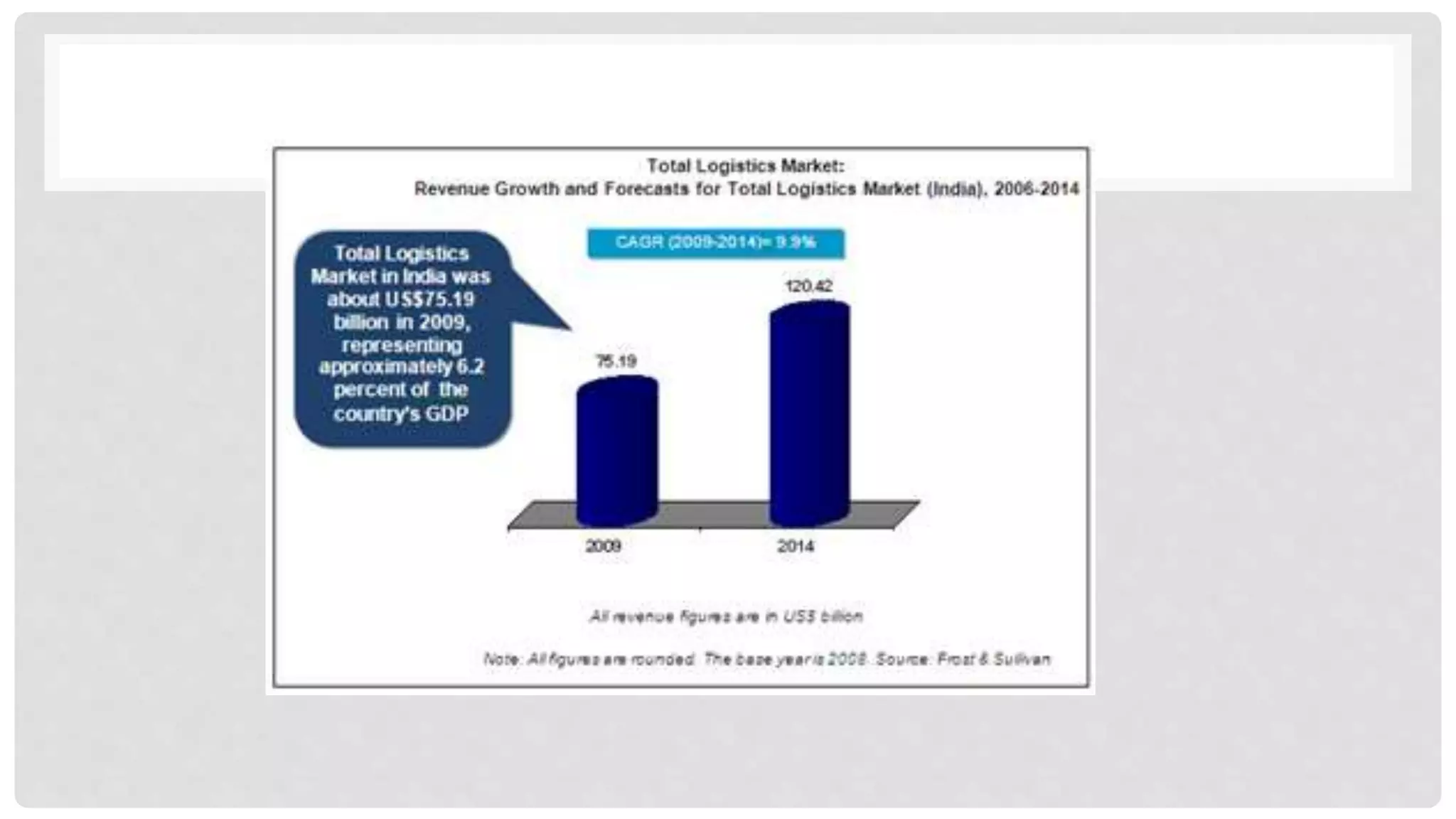
GROWTH OF LOGISTICS OVER THE NEXT 5 YEARS
Lets assume the same CAGR rate of 9.9%
0.0
20.0
40.0
60.0
80.0
100.0
120.0
140.0
160.0
180.0
1
120.4 132.3
145.4
159.8
175.7
2014 2015 2016 2017 2018
In Billion US$
THE NEW CHANGE
1) CHANGING FOR THE GOOD
• Indirect taxes played a major role in deciding the supply chain structure of
each business as some of the tax cost had no input credit option.
• The GST precisely addresses this anomaly & therefore, going forward,
tax may not be a factor for deciding on the supply chain /distribution
channel of an organization
2) WAREHOUSING
• Any large LSP, manufacturer or CPG player maintains warehouses in all
the states of operations
• With 33 states in India, that accounts to 25-40 small warehouses
(depending of regions & scale of operations) instead of 6-8 large
warehouses which would be needed for geography of this size
• Adding to this inefficiency is the fragmented structure in Indian Logistics
industry which results in extreme competition
WAREHOUSING
• Demand for warehousing is expected to grow at a CAGR of 18% in
the next 4 years - thanks to the incoming investment in the retail
sector & increasing import-export activity in India.
• So, warehouses have a lot to do with the growth of logistics sector.
• With the advent of GST & Zero CST :
The necessity of having a warehouse in each state to avoid CST &
paperwork will be eliminated in a GST regime & network decisions would
become purely cost & service driven.
• So now, we can revisit the supply chain network & identify opportunities
for consolidation of warehouses to gain from scale & save costs of double
handling
• We can club many of the small warehouses & have bigger + fewer
warehouses.
THE EXPECTED CHANGE !!
BENEFITS :
• The larger warehouses can benefit from technological sophistication by
deploying state-of-art planning & warehousing systems which are not
feasible in smaller, scattered warehouses
• IT costs of having ERPs deployed at many small warehouses can be
saved
• Transportation lot sizes will automatically increase, making way for more
efficient bigger trucks
• Lesser numbers of stocking points
3)TRUE “HUB-&-SPOKE” SYSTEM
• Organizations will now be able to explore different distribution
models such as setting up mother warehouse & regional distribution
hubs .
• Thus, it can possibly step away from traditional C&F & distributor
based models currently adopted
4) REDUCTION IN COST
.
I believe, with the introduction of GST,
logistics & distribution costs in India
could go down by 10% -15%.
Zubin Poonawalla
• Cost drop will increase Profit Before tax by 10-15 % in turn
increasing the PAT by around 7-11% .
• (Assuming tax to be around 30%)
• This means that GST will strengthen the bottom line for all the
logistic companies & thus, better margins.
• This also helps the company with better cash flows .
5) TRANSIT TIME
• GST would also improve our transit & consequently, delivery times
because state border crossings would likely be uncomplicated.
• Less of paperwork is also a big benefit.
6)FAIR PLAYING FIELD
• As a result of reduced tax liability, GST will reduce the share of the
unorganized sector in warehousing.
• Prices charged by the organized players will come down & reduce
the price advantage that the unorganized warehouses currently
enjoy.
• Thus, GST will level the playing field & create an equitable
development of the industry across India.
HOW CAN LOGISTICS ADAPT THIS NEW CHANGE
• This can be done in various ways –
• Designing a multi tiered distribution network where there is specialization
in certain functions (storage + inventory mgmt) & some functions
(software services, packaging, labelling) are outsourced.
• Another will be to partner with a 3PL logistics provider to ensure optimal
utilization of resources.
• They will need to take a fresh look at their supply chain to cater to existing
geography & should also look at the new business areas that this
impending legislation is due to bring.
HOW CAN LOGISTICS ADAPT THIS NEW CHANGE
• ERP System Changes
• Pricing Revision
• Revisiting Warehousing & Distribution Strategies
• Revisiting Purchasing & Marketing Strategy
CONCLUSION
• The impact or rather the opportunity is huge for both the logistic
companies & their customers to completely relook at their supply
chain.
• This essentially means a significant opportunity for Logistics
companies in India to revise their infrastructure to deliver as well as
reverse logistics for spares & replacements.
Thank You

Impact of GST on the logistics sector

  • 1.
    IMPACT OF GSTON THE LOGISTICS SECTOR ZUBIN POONAWALLA 29th August, 2014
  • 2.
    GST • Stands forGoods & Service Tax • Broad based, single, comprehensive tax levied on goods & services consumed in an economy • Seen as the panacea for removing the ill-effects of the tax-on-tax regime
  • 3.
    LOGISTICS IN INDIA •Interplay of infrastructure, technology & new types of service providers • Rapidly Evolving • Backbone for some key sectors like retail ,automobiles, pharmaceuticals etc. • Contributes to around 13% of Indian GDP • Top 10 Players in FY15: DHL, Bluedart, UPS, FedEx, DTDC ,Gati, Aegis, DelEx
  • 5.
    GROWTH OF LOGISTICSOVER THE NEXT 5 YEARS Lets assume the same CAGR rate of 9.9% 0.0 20.0 40.0 60.0 80.0 100.0 120.0 140.0 160.0 180.0 1 120.4 132.3 145.4 159.8 175.7 2014 2015 2016 2017 2018 In Billion US$
  • 6.
  • 7.
    1) CHANGING FORTHE GOOD • Indirect taxes played a major role in deciding the supply chain structure of each business as some of the tax cost had no input credit option. • The GST precisely addresses this anomaly & therefore, going forward, tax may not be a factor for deciding on the supply chain /distribution channel of an organization
  • 8.
    2) WAREHOUSING • Anylarge LSP, manufacturer or CPG player maintains warehouses in all the states of operations • With 33 states in India, that accounts to 25-40 small warehouses (depending of regions & scale of operations) instead of 6-8 large warehouses which would be needed for geography of this size • Adding to this inefficiency is the fragmented structure in Indian Logistics industry which results in extreme competition
  • 9.
    WAREHOUSING • Demand forwarehousing is expected to grow at a CAGR of 18% in the next 4 years - thanks to the incoming investment in the retail sector & increasing import-export activity in India. • So, warehouses have a lot to do with the growth of logistics sector.
  • 10.
    • With theadvent of GST & Zero CST : The necessity of having a warehouse in each state to avoid CST & paperwork will be eliminated in a GST regime & network decisions would become purely cost & service driven. • So now, we can revisit the supply chain network & identify opportunities for consolidation of warehouses to gain from scale & save costs of double handling • We can club many of the small warehouses & have bigger + fewer warehouses.
  • 11.
  • 12.
    BENEFITS : • Thelarger warehouses can benefit from technological sophistication by deploying state-of-art planning & warehousing systems which are not feasible in smaller, scattered warehouses • IT costs of having ERPs deployed at many small warehouses can be saved • Transportation lot sizes will automatically increase, making way for more efficient bigger trucks • Lesser numbers of stocking points
  • 13.
    3)TRUE “HUB-&-SPOKE” SYSTEM •Organizations will now be able to explore different distribution models such as setting up mother warehouse & regional distribution hubs . • Thus, it can possibly step away from traditional C&F & distributor based models currently adopted
  • 14.
    4) REDUCTION INCOST . I believe, with the introduction of GST, logistics & distribution costs in India could go down by 10% -15%. Zubin Poonawalla
  • 15.
    • Cost dropwill increase Profit Before tax by 10-15 % in turn increasing the PAT by around 7-11% . • (Assuming tax to be around 30%) • This means that GST will strengthen the bottom line for all the logistic companies & thus, better margins. • This also helps the company with better cash flows .
  • 16.
    5) TRANSIT TIME •GST would also improve our transit & consequently, delivery times because state border crossings would likely be uncomplicated. • Less of paperwork is also a big benefit.
  • 17.
    6)FAIR PLAYING FIELD •As a result of reduced tax liability, GST will reduce the share of the unorganized sector in warehousing. • Prices charged by the organized players will come down & reduce the price advantage that the unorganized warehouses currently enjoy. • Thus, GST will level the playing field & create an equitable development of the industry across India.
  • 18.
    HOW CAN LOGISTICSADAPT THIS NEW CHANGE • This can be done in various ways – • Designing a multi tiered distribution network where there is specialization in certain functions (storage + inventory mgmt) & some functions (software services, packaging, labelling) are outsourced. • Another will be to partner with a 3PL logistics provider to ensure optimal utilization of resources. • They will need to take a fresh look at their supply chain to cater to existing geography & should also look at the new business areas that this impending legislation is due to bring.
  • 19.
    HOW CAN LOGISTICSADAPT THIS NEW CHANGE • ERP System Changes • Pricing Revision • Revisiting Warehousing & Distribution Strategies • Revisiting Purchasing & Marketing Strategy
  • 20.
    CONCLUSION • The impactor rather the opportunity is huge for both the logistic companies & their customers to completely relook at their supply chain. • This essentially means a significant opportunity for Logistics companies in India to revise their infrastructure to deliver as well as reverse logistics for spares & replacements.
  • 21.