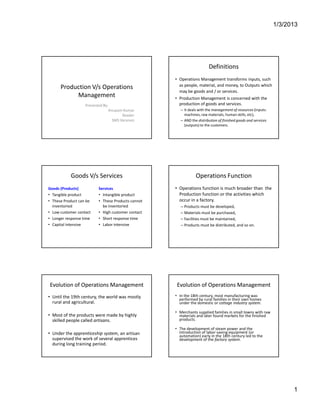
Production V/s Operations Management


                                                                                Definitions
                                                            • Operations Management transforms inputs, such
                                                              as people, material, and money, to Outputs which
              Production V/s Operations
                                                              may be goods and / or services.
                   Management                               • Production Management is concerned with the
                           Presented By:                      production of goods and services.
                                        Anupam Kumar           – It deals with the management of resources (inputs:
                                               Reader            machines, raw materials, human skills, etc),
                                          SMS Varanasi         – AND the distribution of finished goods and services
                                                                 (outputs) to the customers.


                   Goods V/s Services                                   Operations Function
        Goods (Products)          Services                  • Operations function is much broader than the
        • Tangible product        • Intangible product        Production function or the activities which
        • These Product can be    • These Products cannot     occur in a factory.
          inventoried               be inventoried             – Products must be developed,
        • Low customer contact    • High customer contact      – Materials must be purchased,
        • Longer response time    • Short response time        – Facilities must be maintained,
        • Capital intensive       • Labor intensive            – Products must be distributed, and so on.


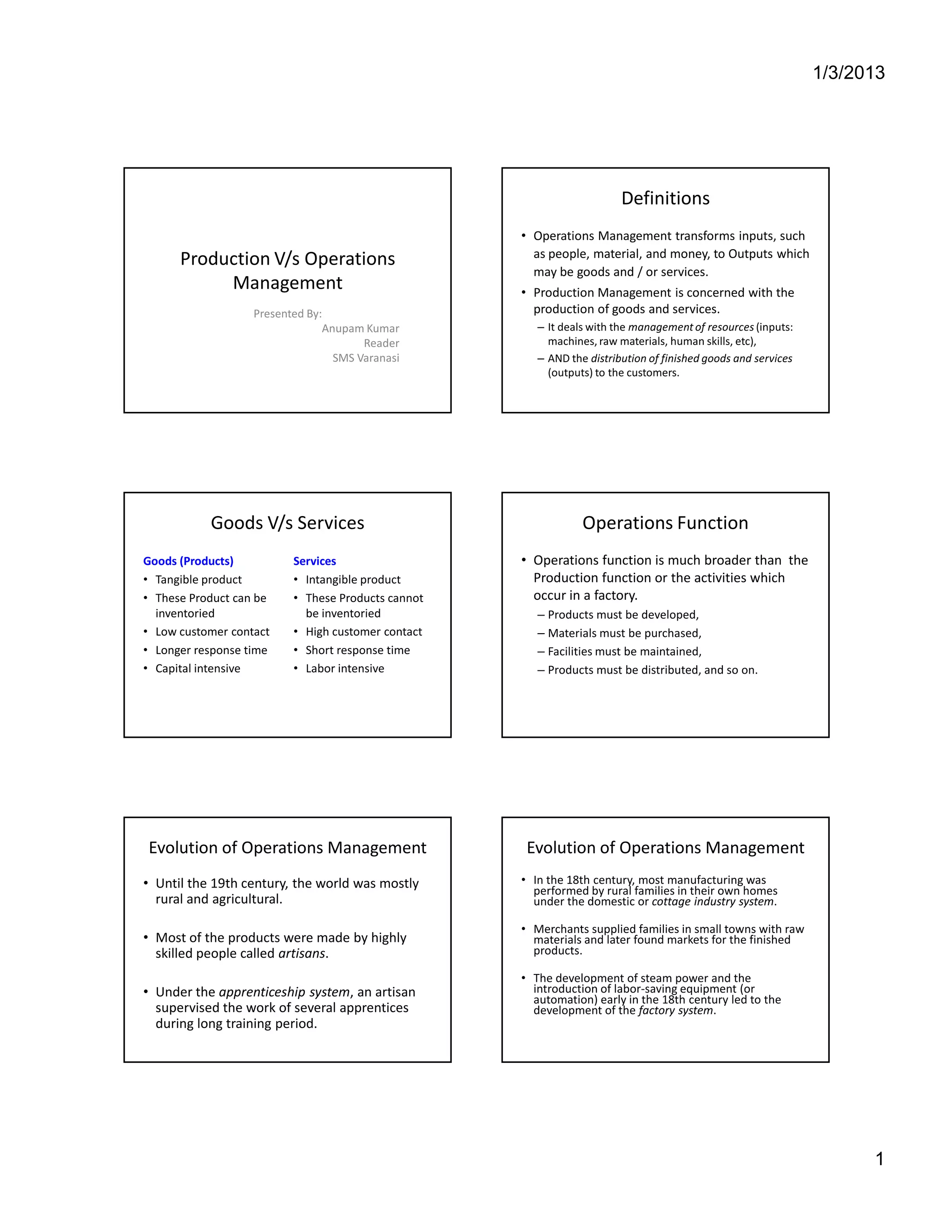
        Evolution of Operations Management                   Evolution of Operations Management
        • Until the 19th century, the world was mostly      • In the 18th century, most manufacturing was
                                                              performed by rural families in their own homes
          rural and agricultural.                             under the domestic or cottage industry system.

                                                            • Merchants supplied families in small towns with raw
        • Most of the products were made by highly            materials and later found markets for the finished
          skilled people called artisans.                     products.

                                                            • The development of steam power and the
        • Under the apprenticeship system, an artisan         introduction of labor-saving equipment (or
                                                              automation) early in the 18th century led to the
          supervised the work of several apprentices          development of the factory system.
          during long training period.


Anupam Kumar                                                                                                           1
Production V/s Operations Management


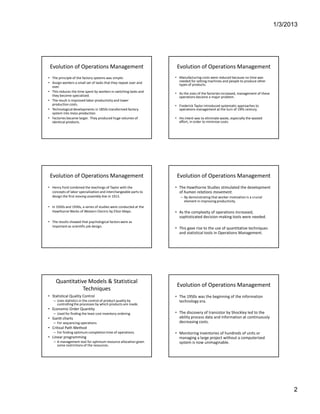
         Evolution of Operations Management                                Evolution of Operations Management
        • The principle of the factory systems was simple:                • Manufacturing costs were reduced because no time was
        • Assign workers a small set of tasks that they repeat over and     needed for setting machines and people to produce other
                                                                            types of products.
          over.
        • This reduces the time spent by workers in switching tasks and
                                                                          • As the sizes of the factories increased, management of these
          they become specialized.                                          operations became a major problem.
        • The result is improved labor productivity and lower
          production costs.                                               • Frederick Taylor introduced systematic approaches to
        • Technological developments in 1850s transformed factory           operations management at the turn of 19th century.
          system into mass-production.
        • Factories became larger. They produced huge volumes of          • His intent was to eliminate waste, especially the wasted
          identical products.                                               effort, in order to minimize costs.


         Evolution of Operations Management                                Evolution of Operations Management
        • Henry Ford combined the teachings of Taylor with the            • The Hawthorne Studies stimulated the development
          concepts of labor specialization and interchangeable parts to     of human relations movement.
          design the first moving assembly line in 1913.                     – By demonstrating that worker motivation is a crucial
                                                                               element in improving productivity.
        • In 1920s and 1930s, a series of studies were conducted at the
          Hawthorne Works of Western Electric by Elton Mayo.              • As the complexity of operations increased,
                                                                            sophisticated decision-making tools were needed.
        • The results showed that psychological factors were as
          important as scientific job design.
                                                                          • This gave rise to the use of quantitative techniques
                                                                            and statistical tools in Operations Management.


             Quantitative Models & Statistical
                                                                           Evolution of Operations Management
                        Techniques
        • Statistical Quality Control                                     • The 1950s was the beginning of the information
           – Uses statistics in the control of product quality by           technology era.
             controlling the processes by which products are made.
        • Economic Order Quantity
           – Used for finding the least cost inventory ordering           • The discovery of transistor by Shockley led to the
        • Gantt charts                                                      ability process data and information at continuously
           – For sequencing operations                                      decreasing costs.
        • Critical Path Method
           – For finding optimum completion time of operations.           • Monitoring inventories of hundreds of units or
        • Linear programming                                                managing a large project without a computerized
           – A management tool for optimum resource allocation given        system is now unimaginable.
             some restrictions of the resources.


Anupam Kumar                                                                                                                               2
Production V/s Operations Management


        Evolution of Operations Management
        • In the late 1950s and early 1960s scholars
          began to write books dealing specifically with
                                                           To Types of Production
          the problems faced by operations managers.
                                                                Processes…
        • These books also contained information
          regarding the application of quantitative
          models to operations management.


Anupam Kumar                                                                        3

Production vs operations management

  • 1.
    Production V/s OperationsManagement Definitions • Operations Management transforms inputs, such as people, material, and money, to Outputs which Production V/s Operations may be goods and / or services. Management • Production Management is concerned with the Presented By: production of goods and services. Anupam Kumar – It deals with the management of resources (inputs: Reader machines, raw materials, human skills, etc), SMS Varanasi – AND the distribution of finished goods and services (outputs) to the customers. Goods V/s Services Operations Function Goods (Products) Services • Operations function is much broader than the • Tangible product • Intangible product Production function or the activities which • These Product can be • These Products cannot occur in a factory. inventoried be inventoried – Products must be developed, • Low customer contact • High customer contact – Materials must be purchased, • Longer response time • Short response time – Facilities must be maintained, • Capital intensive • Labor intensive – Products must be distributed, and so on. Evolution of Operations Management Evolution of Operations Management • Until the 19th century, the world was mostly • In the 18th century, most manufacturing was performed by rural families in their own homes rural and agricultural. under the domestic or cottage industry system. • Merchants supplied families in small towns with raw • Most of the products were made by highly materials and later found markets for the finished skilled people called artisans. products. • The development of steam power and the • Under the apprenticeship system, an artisan introduction of labor-saving equipment (or automation) early in the 18th century led to the supervised the work of several apprentices development of the factory system. during long training period. Anupam Kumar 1
  • 2.
    Production V/s OperationsManagement Evolution of Operations Management Evolution of Operations Management • The principle of the factory systems was simple: • Manufacturing costs were reduced because no time was • Assign workers a small set of tasks that they repeat over and needed for setting machines and people to produce other types of products. over. • This reduces the time spent by workers in switching tasks and • As the sizes of the factories increased, management of these they become specialized. operations became a major problem. • The result is improved labor productivity and lower production costs. • Frederick Taylor introduced systematic approaches to • Technological developments in 1850s transformed factory operations management at the turn of 19th century. system into mass-production. • Factories became larger. They produced huge volumes of • His intent was to eliminate waste, especially the wasted identical products. effort, in order to minimize costs. Evolution of Operations Management Evolution of Operations Management • Henry Ford combined the teachings of Taylor with the • The Hawthorne Studies stimulated the development concepts of labor specialization and interchangeable parts to of human relations movement. design the first moving assembly line in 1913. – By demonstrating that worker motivation is a crucial element in improving productivity. • In 1920s and 1930s, a series of studies were conducted at the Hawthorne Works of Western Electric by Elton Mayo. • As the complexity of operations increased, sophisticated decision-making tools were needed. • The results showed that psychological factors were as important as scientific job design. • This gave rise to the use of quantitative techniques and statistical tools in Operations Management. Quantitative Models & Statistical Evolution of Operations Management Techniques • Statistical Quality Control • The 1950s was the beginning of the information – Uses statistics in the control of product quality by technology era. controlling the processes by which products are made. • Economic Order Quantity – Used for finding the least cost inventory ordering • The discovery of transistor by Shockley led to the • Gantt charts ability process data and information at continuously – For sequencing operations decreasing costs. • Critical Path Method – For finding optimum completion time of operations. • Monitoring inventories of hundreds of units or • Linear programming managing a large project without a computerized – A management tool for optimum resource allocation given system is now unimaginable. some restrictions of the resources. Anupam Kumar 2
  • 3.
    Production V/s OperationsManagement Evolution of Operations Management • In the late 1950s and early 1960s scholars began to write books dealing specifically with To Types of Production the problems faced by operations managers. Processes… • These books also contained information regarding the application of quantitative models to operations management. Anupam Kumar 3