 36 yo male involved in low

speed MVC. Pt was
restrained driver of car that
was T-boned. Pt c/o mild
midline cervical tenderness
and thoracolumbar
tenderness. Denies LOC.
Presents on back board w/
full c-spine precautions in
place. Denies any other
complaints.

 T 98.9 P 92 BP 132/78

O2 98% RA RR 18
 Gen: WDWN, NAD, no
obvious deformities
 HEENT: no facial TTP, no
dental pain, no contusions,
trachea midline
 Back: mild cervical midline
TTP, mild thoracolumbar
TTP, no step-offs, no bony
deformities
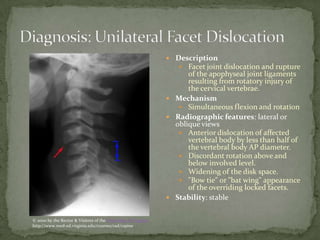
“Bowtie sign”
© 2000 by the Rector & Visitors of the University of Virginia
http://www.med-ed.virginia.edu/courses/rad/cspine/

http://radiopaedia.org/articles/facet-dislocation
 Description
 Facet joint dislocation and rupture

of the apophyseal joint ligaments
resulting from rotatory injury of
the cervical vertebrae.
 Mechanism
 Simultaneous flexion and rotation
 Radiographic features: lateral or
oblique views
 Anterior dislocation of affected
vertebral body by less than half of
the vertebral body AP diameter.
 Discordant rotation above and
below involved level.
 Widening of the disk space.
 "Bow tie" or "bat wing" appearance
of the overriding locked facets.
 Stability: stable
© 2000 by the Rector & Visitors of the University of Virginia
http://www.med-ed.virginia.edu/courses/rad/cspine
 Maintain C-spine

precautions
 Consult Spine
 Various mgmt strategies
 Closed reduction w/

axial traction
 Open reduction w/
posterior fixation
 Obtain prereduction CT

or MRI
http://radiopaedia.org/articles/facet-dislocation
 4 radiographic signs of unilateral facet dislocation

Double-diamond or “Bow tie”
2. Narrowing of the laminar space
3. Anterior slippage of the vertebral body
4. Widening of the spaces between vertebral bodies
“fanning”
1.
“Bowtie sign”
http://radiopaedia.org/articles/facet-dislocation

Unilateral Facet Dislocation

  • 2.
     36 yomale involved in low speed MVC. Pt was restrained driver of car that was T-boned. Pt c/o mild midline cervical tenderness and thoracolumbar tenderness. Denies LOC. Presents on back board w/ full c-spine precautions in place. Denies any other complaints.  T 98.9 P 92 BP 132/78 O2 98% RA RR 18  Gen: WDWN, NAD, no obvious deformities  HEENT: no facial TTP, no dental pain, no contusions, trachea midline  Back: mild cervical midline TTP, mild thoracolumbar TTP, no step-offs, no bony deformities
  • 3.
    “Bowtie sign” © 2000by the Rector & Visitors of the University of Virginia http://www.med-ed.virginia.edu/courses/rad/cspine/ http://radiopaedia.org/articles/facet-dislocation
  • 4.
     Description  Facetjoint dislocation and rupture of the apophyseal joint ligaments resulting from rotatory injury of the cervical vertebrae.  Mechanism  Simultaneous flexion and rotation  Radiographic features: lateral or oblique views  Anterior dislocation of affected vertebral body by less than half of the vertebral body AP diameter.  Discordant rotation above and below involved level.  Widening of the disk space.  "Bow tie" or "bat wing" appearance of the overriding locked facets.  Stability: stable © 2000 by the Rector & Visitors of the University of Virginia http://www.med-ed.virginia.edu/courses/rad/cspine
  • 5.
     Maintain C-spine precautions Consult Spine  Various mgmt strategies  Closed reduction w/ axial traction  Open reduction w/ posterior fixation  Obtain prereduction CT or MRI http://radiopaedia.org/articles/facet-dislocation
  • 6.
     4 radiographicsigns of unilateral facet dislocation Double-diamond or “Bow tie” 2. Narrowing of the laminar space 3. Anterior slippage of the vertebral body 4. Widening of the spaces between vertebral bodies “fanning” 1.
  • 7.

Editor's Notes

  • #4 “Bowtie sign”
  • #8 “Bowtie sign”