 18 YOF pw pain in left foot.

Pain began after she
jumped from a first story
window. Pt landed on pool
deck, instead of pool with
full weight on her left foot.
Pain is located throughout
her whole foot and ankle.
Can walk but bears weight
on her toes only. Denies
pain in left knee and
contralateral LE.

 T 97.6 P 120 BP 126/84 O2 97%
 Gen: Severe discomfort 2/2






pain, anxious, crying.
CV: Tachycardic, no m/r/g
Pulm: CTAB.
MSK: L foot w/o bony
abnormalities. NV intact.
Bruising noted along plantar
surface. TTP at calcaneus and
mid plantar surface. No TTP at
maleoli, proximal fibula, or
tibial plateau.
Back: No bony abnormalities of
CS, TS or LS.
 Strict Elevation
 Immobilize – Posterior Splint, well padded
 Non-weight bearing
 Immediate follow up with Orthopedics.
 Analgesia
 Strict Elevation
 Immobilize – Posterior Splint, well padded
 Strict Non-weight bearing
 Close follow up with Orthopedics.
 Analgesia
 These injuries require tremendous force and are often

associated with another injuries including fractures
(LS, contralateral leg)
 Gissane Angle and Boehler’s Angle help with

diagnosis.
 AKA Lover’s Fracture or Don Juan Fracture

 Management is controversial.
Bohler's angle is the compliment of the
angle at the apex of the posterior facet.
To construct Bohler's angle a line is
drawn from the superior aspect of the
anterior process to the superior aspect of
the posterior facet. A second line is
drawn from the superior aspect of the
posterior facet to the superior most
point of the calcaneal tuberosity.
Bohler's angle is the angle formed
between these two lines. A normal
Bohler's angle is approximately 25 to 40
degrees. It should be obvious that this
angle decreases as the height of the
calcaneus is lost; as this angle shrinks as
the height of the posterior facet
decreases
Angle is formed by the
intersection of the
downward slope of the
posterior facet, with the
upward slope going
anterior. This is normally
approximately 100
degrees.
Medially is the
sustentaculum tali.
Tintinalli's Emergency Medicine: A Comprehensive Study Guide.
O. John Ma, M.D., Judith E. Tintinalli, J. Stephan Stapczynski,
David M. Cline. McGraw-Hill Professional Publishing: 2010.
Wheeless Textbook of Orthopedics. Clifford R Wheeless, MD.
Current concepts review: intra-articular fractures of the calcaneus.
Epstein N, Chandran S, Chou L. Foot Ankle Int. 2012 Jan;33(1):7986.
Complications associated with open calcaneus fractures. Wiersema
B, Brokaw D, Weber T, Psaradellis T, Panero C, Weber C,
Musapatika D. Foot Ankle Int. 2011 Nov;32(11):1052-7.

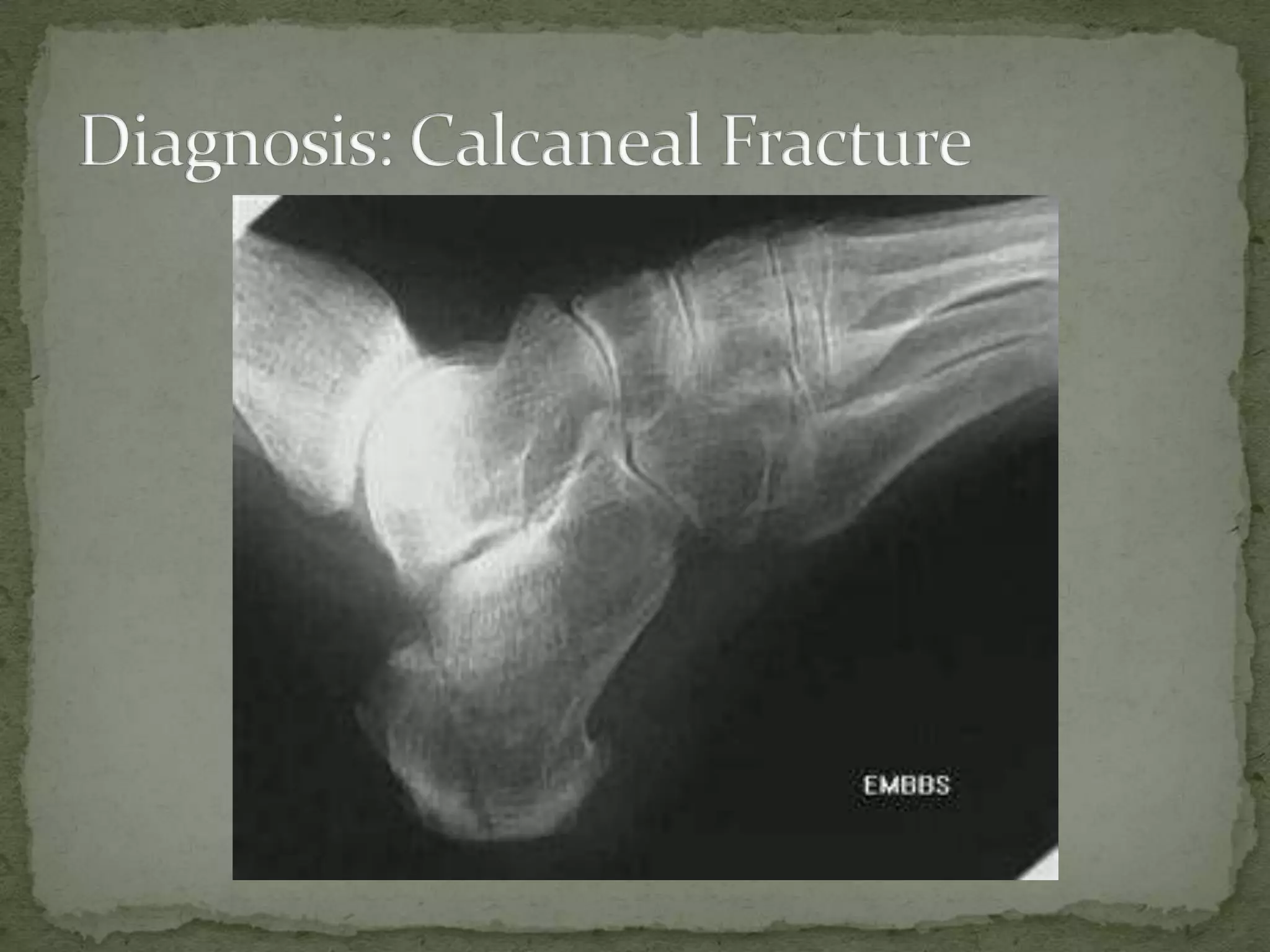
Calcaneus Fracture

  • 2.
     18 YOFpw pain in left foot. Pain began after she jumped from a first story window. Pt landed on pool deck, instead of pool with full weight on her left foot. Pain is located throughout her whole foot and ankle. Can walk but bears weight on her toes only. Denies pain in left knee and contralateral LE.  T 97.6 P 120 BP 126/84 O2 97%  Gen: Severe discomfort 2/2     pain, anxious, crying. CV: Tachycardic, no m/r/g Pulm: CTAB. MSK: L foot w/o bony abnormalities. NV intact. Bruising noted along plantar surface. TTP at calcaneus and mid plantar surface. No TTP at maleoli, proximal fibula, or tibial plateau. Back: No bony abnormalities of CS, TS or LS.
  • 5.
     Strict Elevation Immobilize – Posterior Splint, well padded  Non-weight bearing  Immediate follow up with Orthopedics.  Analgesia
  • 6.
     Strict Elevation Immobilize – Posterior Splint, well padded  Strict Non-weight bearing  Close follow up with Orthopedics.  Analgesia
  • 7.
     These injuriesrequire tremendous force and are often associated with another injuries including fractures (LS, contralateral leg)  Gissane Angle and Boehler’s Angle help with diagnosis.  AKA Lover’s Fracture or Don Juan Fracture  Management is controversial.
  • 8.
    Bohler's angle isthe compliment of the angle at the apex of the posterior facet. To construct Bohler's angle a line is drawn from the superior aspect of the anterior process to the superior aspect of the posterior facet. A second line is drawn from the superior aspect of the posterior facet to the superior most point of the calcaneal tuberosity. Bohler's angle is the angle formed between these two lines. A normal Bohler's angle is approximately 25 to 40 degrees. It should be obvious that this angle decreases as the height of the calcaneus is lost; as this angle shrinks as the height of the posterior facet decreases
  • 9.
    Angle is formedby the intersection of the downward slope of the posterior facet, with the upward slope going anterior. This is normally approximately 100 degrees. Medially is the sustentaculum tali.
  • 10.
    Tintinalli's Emergency Medicine:A Comprehensive Study Guide. O. John Ma, M.D., Judith E. Tintinalli, J. Stephan Stapczynski, David M. Cline. McGraw-Hill Professional Publishing: 2010. Wheeless Textbook of Orthopedics. Clifford R Wheeless, MD. Current concepts review: intra-articular fractures of the calcaneus. Epstein N, Chandran S, Chou L. Foot Ankle Int. 2012 Jan;33(1):7986. Complications associated with open calcaneus fractures. Wiersema B, Brokaw D, Weber T, Psaradellis T, Panero C, Weber C, Musapatika D. Foot Ankle Int. 2011 Nov;32(11):1052-7.