Lesson 12: Parallel Transformers
and Autotransformers
ET 332b Ac Motors, Generators
and Power Systems
1
Lesson 12_et332b.pptx
Learning Objectives
After this presentation you will be able to:
 Explain what causes circulating currents in parallel and
compute its value.
 Compute the load division between parallel
transformers.
 Explain how autotransformers operate
 Make calculation using ideal autotransformer model
2
Lesson 12_et332b.pptx
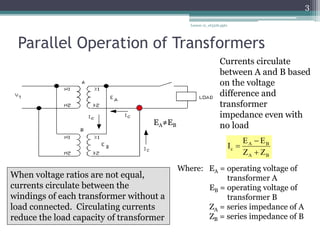
Parallel Operation of Transformers
Lesson 12_et332b.pptx
3
When voltage ratios are not equal,
currents circulate between the
windings of each transformer without a
load connected. Circulating currents
reduce the load capacity of transformer
EA≠EB
Currents circulate
between A and B based
on the voltage
difference and
transformer
impedance even with
no load
Where: EA = operating voltage of
transformer A
EB = operating voltage of
transformer B
ZA = series impedance of A
ZB = series impedance of B
B
A
B
A
c
Z
Z
E
E
I



Capacity Loss Due to Circulating
Currents
Lesson 12_et332b.pptx
4
Find effects using superposition Transformer A current
IA+Ic
c
A
TA I
I
I 

IB-Ic
c
B
TB I
I
I 

Transformer B current
Ic driven by EA – EB
Adding circulating
current to transformer
A increases total
current in winding. Not
seen in load current.
Can cause overload
ILoad
Circulating Current Example
Lesson 12_et332b.pptx
5
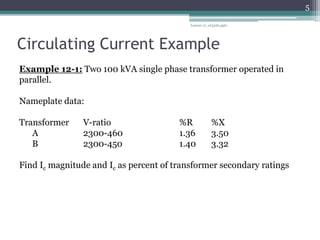
Example 12-1: Two 100 kVA single phase transformer operated in
parallel.
Nameplate data:
Transformer V-ratio %R %X
A 2300-460 1.36 3.50
B 2300-450 1.40 3.32
Find Ic magnitude and Ic as percent of transformer secondary ratings
Example 12-1 Solution (1)
Lesson 12_et332b.pptx
6
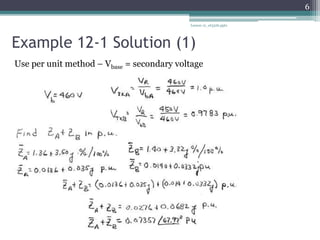
Use per unit method – Vbase = secondary voltage
Example 12-1 Solution (2)
Lesson 12_et332b.pptx
7
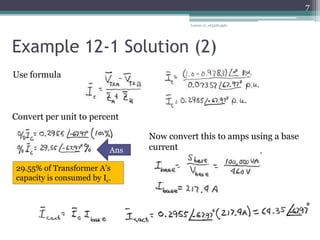
Use formula
Convert per unit to percent
29.55% of Transformer A’s
capacity is consumed by Ic.
Ans
Now convert this to amps using a base
current
Load Division Between Parallel Transformers
Lesson 12_et332b.pptx
8
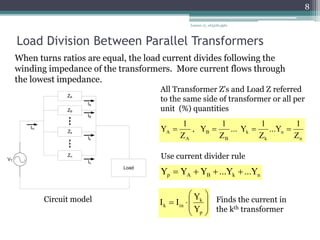
When turns ratios are equal, the load current divides following the
winding impedance of the transformers. More current flows through
the lowest impedance.
VT
ZA
ZB
Zk
Zn
Load
Iin
IA
IB
Ik
In
All Transformer Z's and Load Z referred
to the same side of transformer or all per
unit (%) quantities
Circuit model
n
n
k
k
B
B
A
A
Z
1
Y
...
Z
1
Y
...
Z
1
Y
,
Z
1
Y 



Use current divider rule
n
k
B
A
p Y
...
Y
...
Y
Y
Y 













p
k
in
k
Y
Y
I
I Finds the current in
the kth transformer
Parallel Transformer Example
Lesson 12_et332b.pptx
9
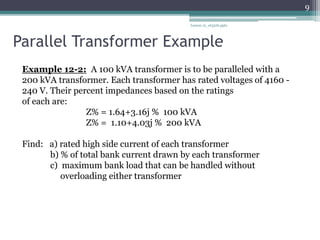
Example 12-2: A 100 kVA transformer is to be paralleled with a
200 kVA transformer. Each transformer has rated voltages of 4160 -
240 V. Their percent impedances based on the ratings
of each are:
Z% = 1.64+3.16j % 100 kVA
Z% = 1.10+4.03j % 200 kVA
Find: a) rated high side current of each transformer
b) % of total bank current drawn by each transformer
c) maximum bank load that can be handled without
overloading either transformer
Example 12-2 Solution (1)
Lesson 12_et332b.pptx
10
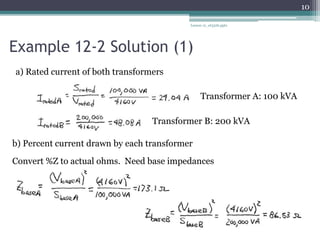
a) Rated current of both transformers
Transformer A: 100 kVA
Transformer B: 200 kVA
b) Percent current drawn by each transformer
Convert %Z to actual ohms. Need base impedances
Example 12-2 Solution (2)
Lesson 12_et332b.pptx
11
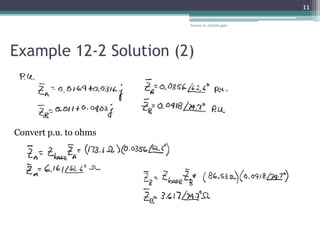
Convert p.u. to ohms
Example 12-2 Solution (3)
Lesson 12_et332b.pptx
12
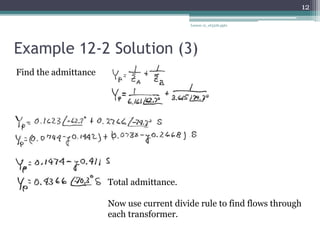
Find the admittance
Total admittance.
Now use current divide rule to find flows through
each transformer.
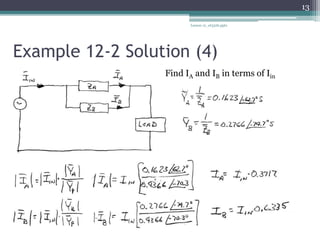
Example 12-2 Solution (4)
Lesson 12_et332b.pptx
13
Find IA and IB in terms of Iin
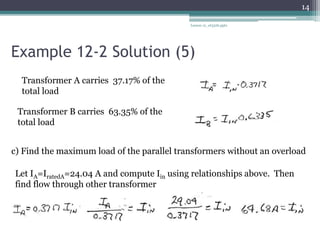
Example 12-2 Solution (5)
Lesson 12_et332b.pptx
14
Transformer A carries 37.17% of the
total load
Transformer B carries 63.35% of the
total load
c) Find the maximum load of the parallel transformers without an overload
Let IA=IratedA=24.04 A and compute Iin using relationships above. Then
find flow through other transformer
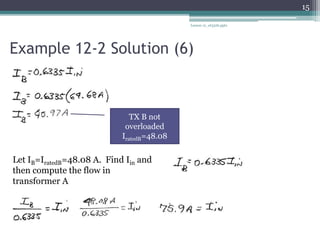
Example 12-2 Solution (6)
Lesson 12_et332b.pptx
15
TX B not
overloaded
IratedB=48.08
Let IB=IratedB=48.08 A. Find Iin and
then compute the flow in
transformer A
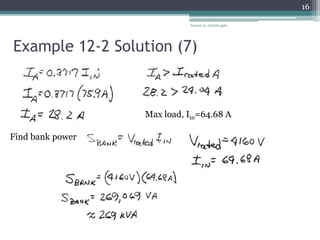
Example 12-2 Solution (7)
Lesson 12_et332b.pptx
16
Max load, Iin=64.68 A
Find bank power
Autotransformers
Lesson 12_et332b.pptx
17
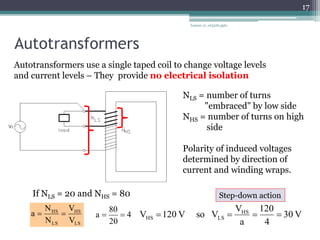
Autotransformers use a single taped coil to change voltage levels
and current levels – They provide no electrical isolation
NLS = number of turns
"embraced" by low side
NHS = number of turns on high
side
Polarity of induced voltages
determined by direction of
current and winding wraps.
If NLS = 20 and NHS = 80
LS
HS
LS
HS
V
V
N
N
a 
 4
20
80
a 
 V
30
4
120
a
V
V
so
V
120
V HS
LS
HS 



Step-down action
Autotransformers: Step-Down Operation
Lesson 12_et332b.pptx
18
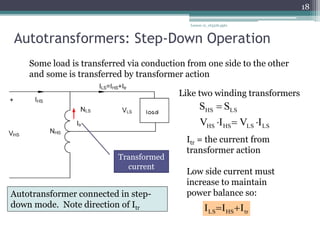
Some load is transferred via conduction from one side to the other
and some is transferred by transformer action
Autotransformer connected in step-
down mode. Note direction of Itr
Like two winding transformers
LS
LS
HS
HS
LS
HS
I
V
I
V
S
S




Itr = the current from
transformer action
Low side current must
increase to maintain
power balance so:
Transformed
current
tr
HS
LS I
I
I 

Autotransformer Current Ratio and
Step-Up Operation
Lesson 12_et332b.pptx
19
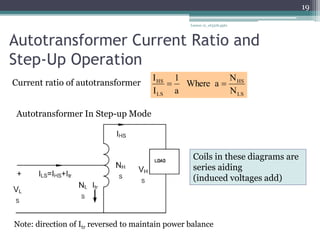
Current ratio of autotransformer
LS
HS
LS
HS
N
N
a
Where
a
1
I
I


Autotransformer In Step-up Mode
Note: direction of Itr reversed to maintain power balance
Coils in these diagrams are
series aiding
(induced voltages add)
Autotransformers from Two-Winding
Transformers
Lesson 12_et332b.pptx
20
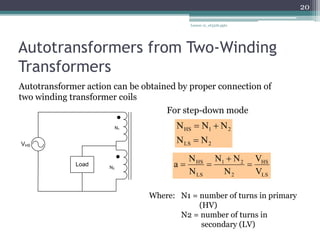
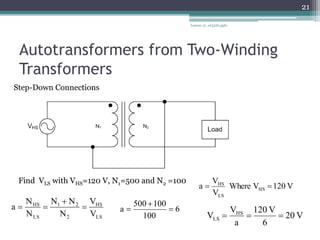
Autotransformer action can be obtained by proper connection of
two winding transformer coils
N2
N1
VHS
Load
For step-down mode
2
LS
2
1
HS
N
N
N
N
N



LS
HS
2
2
1
LS
HS
V
V
N
N
N
N
N
a 



Where: N1 = number of turns in primary
(HV)
N2 = number of turns in
secondary (LV)
Autotransformers from Two-Winding
Transformers
Lesson 12_et332b.pptx
21
Step-Down Connections
Find VLS with VHS=120 V, N1=500 and N2 =100
LS
HS
2
2
1
LS
HS
V
V
N
N
N
N
N
a 


 6
100
100
500
a 


V
120
V
Where
V
V
a HS
LS
HS


V
20
6
V
120
a
V
V HS
LS 


Autotransformer Example
Lesson 12_et332b.pptx
22
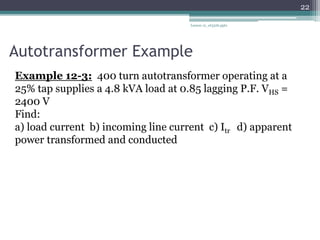
Example 12-3: 400 turn autotransformer operating at a
25% tap supplies a 4.8 kVA load at 0.85 lagging P.F. VHS =
2400 V
Find:
a) load current b) incoming line current c) Itr d) apparent
power transformed and conducted
Example 12-3 Solution (1)
Lesson 12_et332b.pptx
23
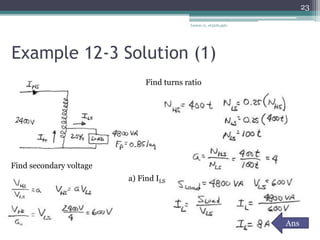
Find turns ratio
Find secondary voltage
a) Find ILS
Ans
Example 12-3 Solution (2)
Lesson 12_et332b.pptx
24
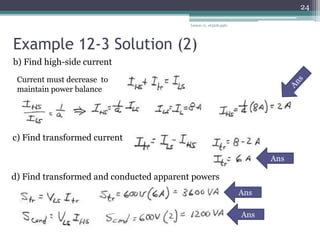
b) Find high-side current
Current must decrease to
maintain power balance
c) Find transformed current
Ans
d) Find transformed and conducted apparent powers
Ans
Ans
ET 332b Ac Motors, Generators and Power Systems
Lesson 12_et332b.pptx
25

Parall Operation Transformers

  • 1.
    Lesson 12: ParallelTransformers and Autotransformers ET 332b Ac Motors, Generators and Power Systems 1 Lesson 12_et332b.pptx
  • 2.
    Learning Objectives After thispresentation you will be able to:  Explain what causes circulating currents in parallel and compute its value.  Compute the load division between parallel transformers.  Explain how autotransformers operate  Make calculation using ideal autotransformer model 2 Lesson 12_et332b.pptx
  • 3.
    Parallel Operation ofTransformers Lesson 12_et332b.pptx 3 When voltage ratios are not equal, currents circulate between the windings of each transformer without a load connected. Circulating currents reduce the load capacity of transformer EA≠EB Currents circulate between A and B based on the voltage difference and transformer impedance even with no load Where: EA = operating voltage of transformer A EB = operating voltage of transformer B ZA = series impedance of A ZB = series impedance of B B A B A c Z Z E E I   
  • 4.
    Capacity Loss Dueto Circulating Currents Lesson 12_et332b.pptx 4 Find effects using superposition Transformer A current IA+Ic c A TA I I I   IB-Ic c B TB I I I   Transformer B current Ic driven by EA – EB Adding circulating current to transformer A increases total current in winding. Not seen in load current. Can cause overload ILoad
  • 5.
    Circulating Current Example Lesson12_et332b.pptx 5 Example 12-1: Two 100 kVA single phase transformer operated in parallel. Nameplate data: Transformer V-ratio %R %X A 2300-460 1.36 3.50 B 2300-450 1.40 3.32 Find Ic magnitude and Ic as percent of transformer secondary ratings
  • 6.
    Example 12-1 Solution(1) Lesson 12_et332b.pptx 6 Use per unit method – Vbase = secondary voltage
  • 7.
    Example 12-1 Solution(2) Lesson 12_et332b.pptx 7 Use formula Convert per unit to percent 29.55% of Transformer A’s capacity is consumed by Ic. Ans Now convert this to amps using a base current
  • 8.
    Load Division BetweenParallel Transformers Lesson 12_et332b.pptx 8 When turns ratios are equal, the load current divides following the winding impedance of the transformers. More current flows through the lowest impedance. VT ZA ZB Zk Zn Load Iin IA IB Ik In All Transformer Z's and Load Z referred to the same side of transformer or all per unit (%) quantities Circuit model n n k k B B A A Z 1 Y ... Z 1 Y ... Z 1 Y , Z 1 Y     Use current divider rule n k B A p Y ... Y ... Y Y Y               p k in k Y Y I I Finds the current in the kth transformer
  • 9.
    Parallel Transformer Example Lesson12_et332b.pptx 9 Example 12-2: A 100 kVA transformer is to be paralleled with a 200 kVA transformer. Each transformer has rated voltages of 4160 - 240 V. Their percent impedances based on the ratings of each are: Z% = 1.64+3.16j % 100 kVA Z% = 1.10+4.03j % 200 kVA Find: a) rated high side current of each transformer b) % of total bank current drawn by each transformer c) maximum bank load that can be handled without overloading either transformer
  • 10.
    Example 12-2 Solution(1) Lesson 12_et332b.pptx 10 a) Rated current of both transformers Transformer A: 100 kVA Transformer B: 200 kVA b) Percent current drawn by each transformer Convert %Z to actual ohms. Need base impedances
  • 11.
    Example 12-2 Solution(2) Lesson 12_et332b.pptx 11 Convert p.u. to ohms
  • 12.
    Example 12-2 Solution(3) Lesson 12_et332b.pptx 12 Find the admittance Total admittance. Now use current divide rule to find flows through each transformer.
  • 13.
    Example 12-2 Solution(4) Lesson 12_et332b.pptx 13 Find IA and IB in terms of Iin
  • 14.
    Example 12-2 Solution(5) Lesson 12_et332b.pptx 14 Transformer A carries 37.17% of the total load Transformer B carries 63.35% of the total load c) Find the maximum load of the parallel transformers without an overload Let IA=IratedA=24.04 A and compute Iin using relationships above. Then find flow through other transformer
  • 15.
    Example 12-2 Solution(6) Lesson 12_et332b.pptx 15 TX B not overloaded IratedB=48.08 Let IB=IratedB=48.08 A. Find Iin and then compute the flow in transformer A
  • 16.
    Example 12-2 Solution(7) Lesson 12_et332b.pptx 16 Max load, Iin=64.68 A Find bank power
  • 17.
    Autotransformers Lesson 12_et332b.pptx 17 Autotransformers usea single taped coil to change voltage levels and current levels – They provide no electrical isolation NLS = number of turns "embraced" by low side NHS = number of turns on high side Polarity of induced voltages determined by direction of current and winding wraps. If NLS = 20 and NHS = 80 LS HS LS HS V V N N a   4 20 80 a   V 30 4 120 a V V so V 120 V HS LS HS     Step-down action
  • 18.
    Autotransformers: Step-Down Operation Lesson12_et332b.pptx 18 Some load is transferred via conduction from one side to the other and some is transferred by transformer action Autotransformer connected in step- down mode. Note direction of Itr Like two winding transformers LS LS HS HS LS HS I V I V S S     Itr = the current from transformer action Low side current must increase to maintain power balance so: Transformed current tr HS LS I I I  
  • 19.
    Autotransformer Current Ratioand Step-Up Operation Lesson 12_et332b.pptx 19 Current ratio of autotransformer LS HS LS HS N N a Where a 1 I I   Autotransformer In Step-up Mode Note: direction of Itr reversed to maintain power balance Coils in these diagrams are series aiding (induced voltages add)
  • 20.
    Autotransformers from Two-Winding Transformers Lesson12_et332b.pptx 20 Autotransformer action can be obtained by proper connection of two winding transformer coils N2 N1 VHS Load For step-down mode 2 LS 2 1 HS N N N N N    LS HS 2 2 1 LS HS V V N N N N N a     Where: N1 = number of turns in primary (HV) N2 = number of turns in secondary (LV)
  • 21.
    Autotransformers from Two-Winding Transformers Lesson12_et332b.pptx 21 Step-Down Connections Find VLS with VHS=120 V, N1=500 and N2 =100 LS HS 2 2 1 LS HS V V N N N N N a     6 100 100 500 a    V 120 V Where V V a HS LS HS   V 20 6 V 120 a V V HS LS   
  • 22.
    Autotransformer Example Lesson 12_et332b.pptx 22 Example12-3: 400 turn autotransformer operating at a 25% tap supplies a 4.8 kVA load at 0.85 lagging P.F. VHS = 2400 V Find: a) load current b) incoming line current c) Itr d) apparent power transformed and conducted
  • 23.
    Example 12-3 Solution(1) Lesson 12_et332b.pptx 23 Find turns ratio Find secondary voltage a) Find ILS Ans
  • 24.
    Example 12-3 Solution(2) Lesson 12_et332b.pptx 24 b) Find high-side current Current must decrease to maintain power balance c) Find transformed current Ans d) Find transformed and conducted apparent powers Ans Ans
  • 25.
    ET 332b AcMotors, Generators and Power Systems Lesson 12_et332b.pptx 25