Dealing with Anxiety in
    the Classroom


Alexa Bagnell, MD, FRCPC
July 11, 2012
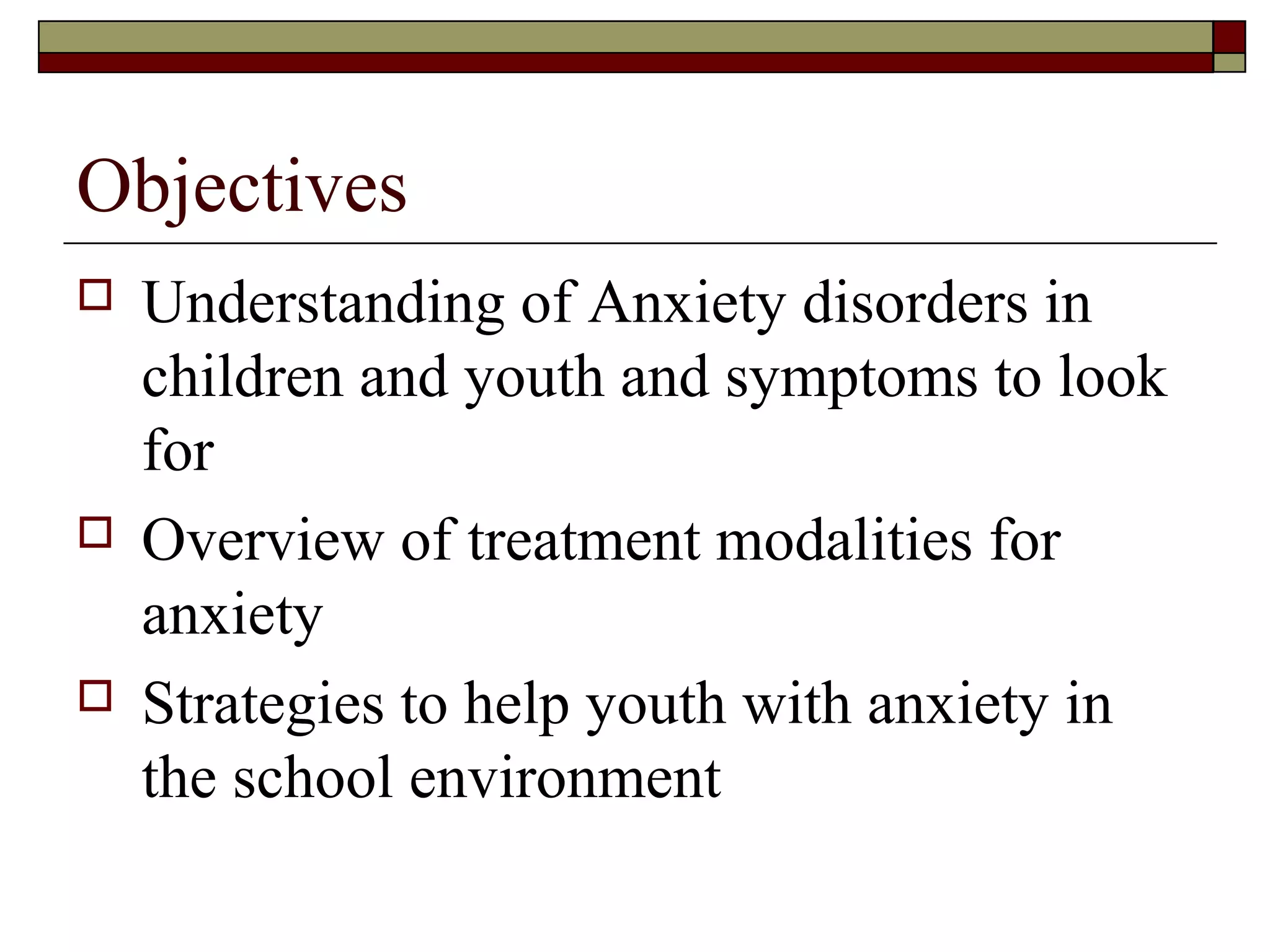
Objectives
   Understanding of Anxiety disorders in
    children and youth and symptoms to look
    for
   Overview of treatment modalities for
    anxiety
   Strategies to help youth with anxiety in
    the school environment
6 Month Prevalence Rates of Mental or
     Addictive Disorders in Children 4-17
   Anxiety Disorders                   7%
   ADHD                                5%
   Conduct Disorder                    4%
   Mood Disorders                      4%
   Substance Use Disorders             1%
   Any Disorder                        14 %
           Waddell et al, Can J Psychiatry, 2002
Whe i have a really big project
due a get so worried. I can't
sleep at night. Even if i know i
will finish it on time i get so
freaked out. Is there something
wrong with me. Non of my
friends feal this way. Can u
help me?
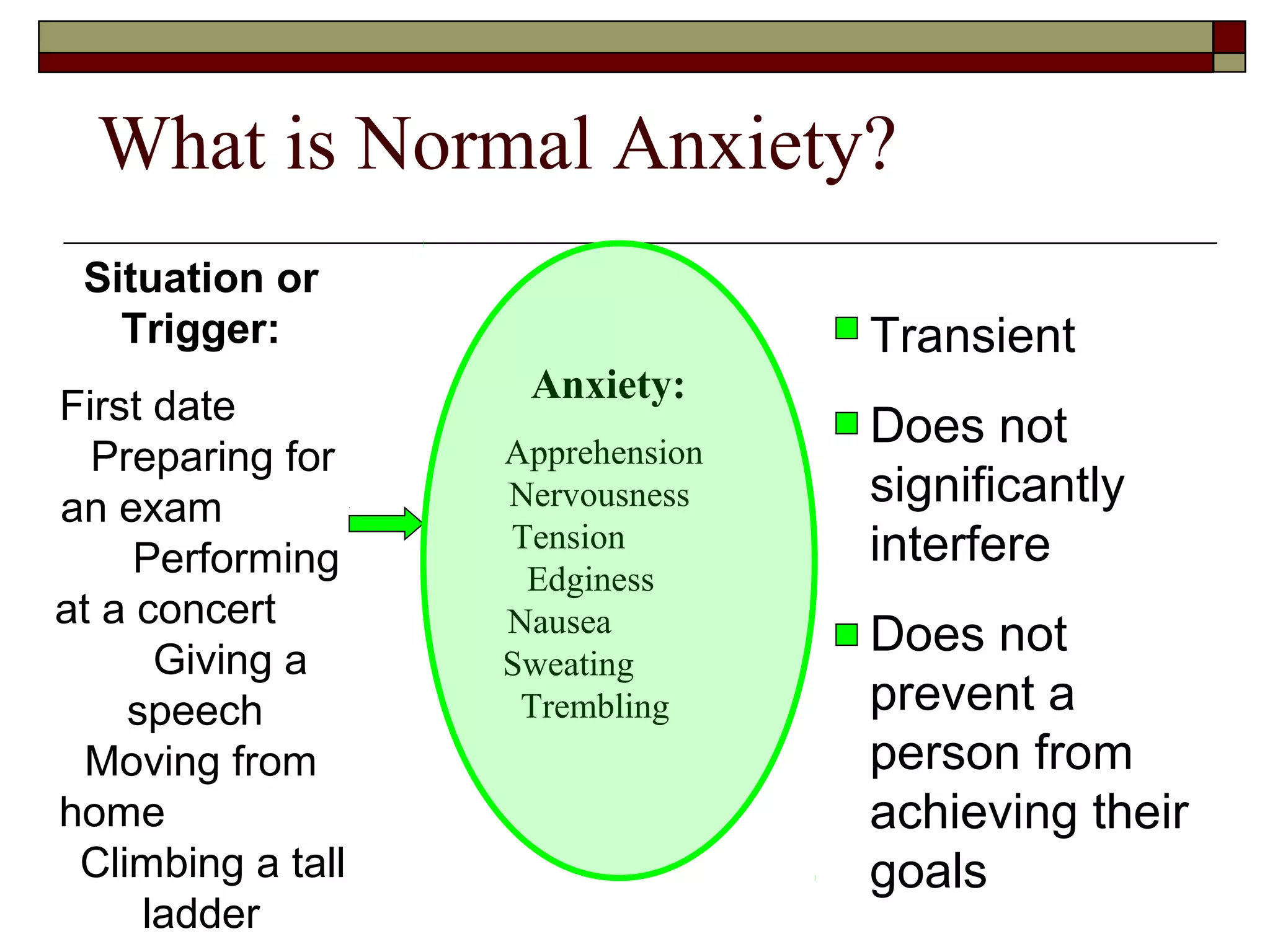
What is Normal Anxiety?
 Situation or
   Trigger:                       Transient
                    Anxiety:
First date
                   Apprehension
                                  Does not
  Preparing for
an exam            Nervousness    significantly
     Performing
                   Tension        interfere
                    Edginess
at a concert       Nausea
      Giving a
                                  Does not
                   Sweating
    speech          Trembling     prevent a
  Moving from                     person from
home                              achieving their
 Climbing a tall                  goals
     ladder
When is it a problem?
                                                            ! !? !
                           Brain Registers


                                                        !
 No                          DANGER!
Danger

                                                          ANXIETY
             Ears   Eyes
                                           Initiation
      Nose    Sensory Taste              of Physiologic
             Perception                     Cascade
                Touch

                                         ↑ Heart Rate
           Internal                       ↑ Alertness
  Thoughts Signals Physical              ↑ Perception
                                           ↑ Tension
             Emotions
When is Anxiety a Disorder?
   Most children, adolescents and adults use
    anxiety to help them make good decisions
   Anxiety becomes a problem when it makes
    the decisions for you, interferes with your life
    and/or causes distress.
   Two forms: misinterpreting threat or extreme
    response
Epidemiology of Anxiety Disorders
 Approximately 1 in 10 children
 Most prevalent mental health problem in kids

 High comorbidity with ADHD, Depression,
  ODD, substance misuse
 Functional impairments: school failure and/or
  dropout, peer/social difficulties, family
  dysfunction, restricted career opportunities
What Causes Anxiety?
   Genetics/Biological Basis
     Anxiety runs in families
     Common for at least one parent to be
      anxious
     Research has shown that what is passed on
      from parent to child is not a specific
      tendency to be shy or worry but a general
      personality type and/or cognitive style
      predisposing child to develop anxiety.
What causes anxiety?
    Parent Reaction
      Reactions to child or teen’s anxious behaviour
        might also play a role in increasing anxiety (e.g.,
        being over-protective, excessive reassurance).
    Modeling
      Children and adolescents copy their parents
        coping strategies (e.g., avoiding fearful
        situations).
    Stressors/Traumatic Life Events
      Bit by a dog, death of a loved one, being bullied,
        getting sick, academic struggles
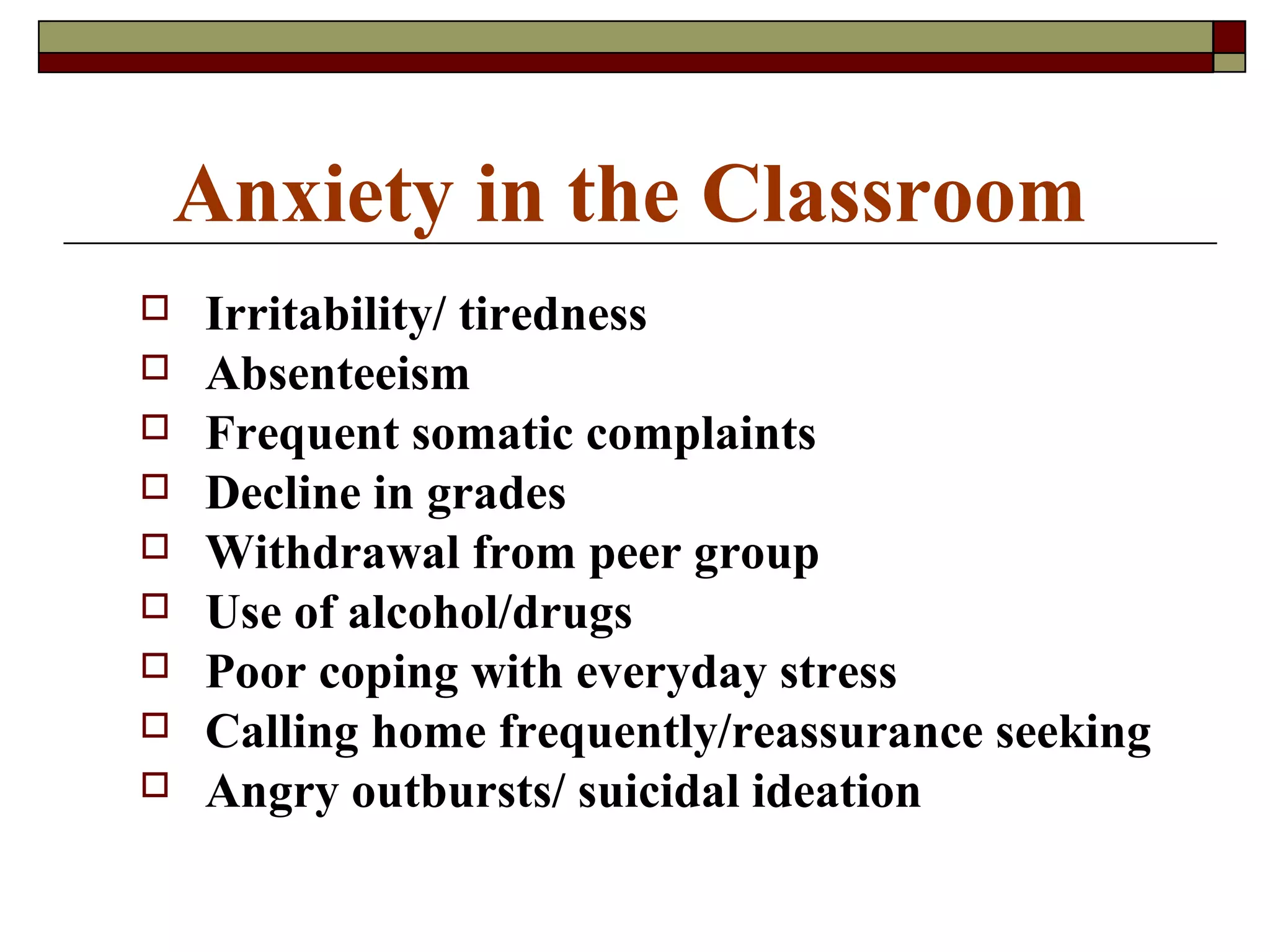
Anxiety in the Classroom
   Irritability/ tiredness
   Absenteeism
   Frequent somatic complaints
   Decline in grades
   Withdrawal from peer group
   Use of alcohol/drugs
   Poor coping with everyday stress
   Calling home frequently/reassurance seeking
   Angry outbursts/ suicidal ideation
Anxiety Performance Curve
  (Yerkes-Dodson Law)


      Hebb, D. O. (1955). Psychological Review, 62, 243-254
Anxiety Disorders in Children
   Separation Anxiety Disorder: separation from
    caregivers, concern bad things will happen to them
   Selective Mutism: Failure to speak in specific social
    situation despite speaking in others
   Generalized Anxiety Disorder: uncontrollable
    excessive worry about many areas of life functioning
    (e.g., school work, family, friends, health)
   Social Phobia: fearful of social or performance
    situations
Anxiety Disorders in Children
   Specific Phobia: fear of particular objects or situations
   Panic Disorder: misinterpret bodily changes and have
    a fear of losing control
   Obsessive Compulsive Disorder: the presence of
    intrusive repetitive thoughts (obsessions) or behaviours
    (compulsions), >1 hour/day
   Post traumatic Stress Disorder Experience traumatic
    event, reexperiencing, avoidance and numbness,
    increased arousal, >1 month
Treatment of Anxiety Disorders in
Children
   1st Line: Cognitive Behavioural Therapy-CBT

 2nd Line: Medication plus CBT
 Anxiety disorders including OCD:

    SSRI medication has strongest evidence
   (e.g. sertraline/zoloft, fluoxetine/prozac,
     fluvoxamine/luvox, citalopram/celexa)
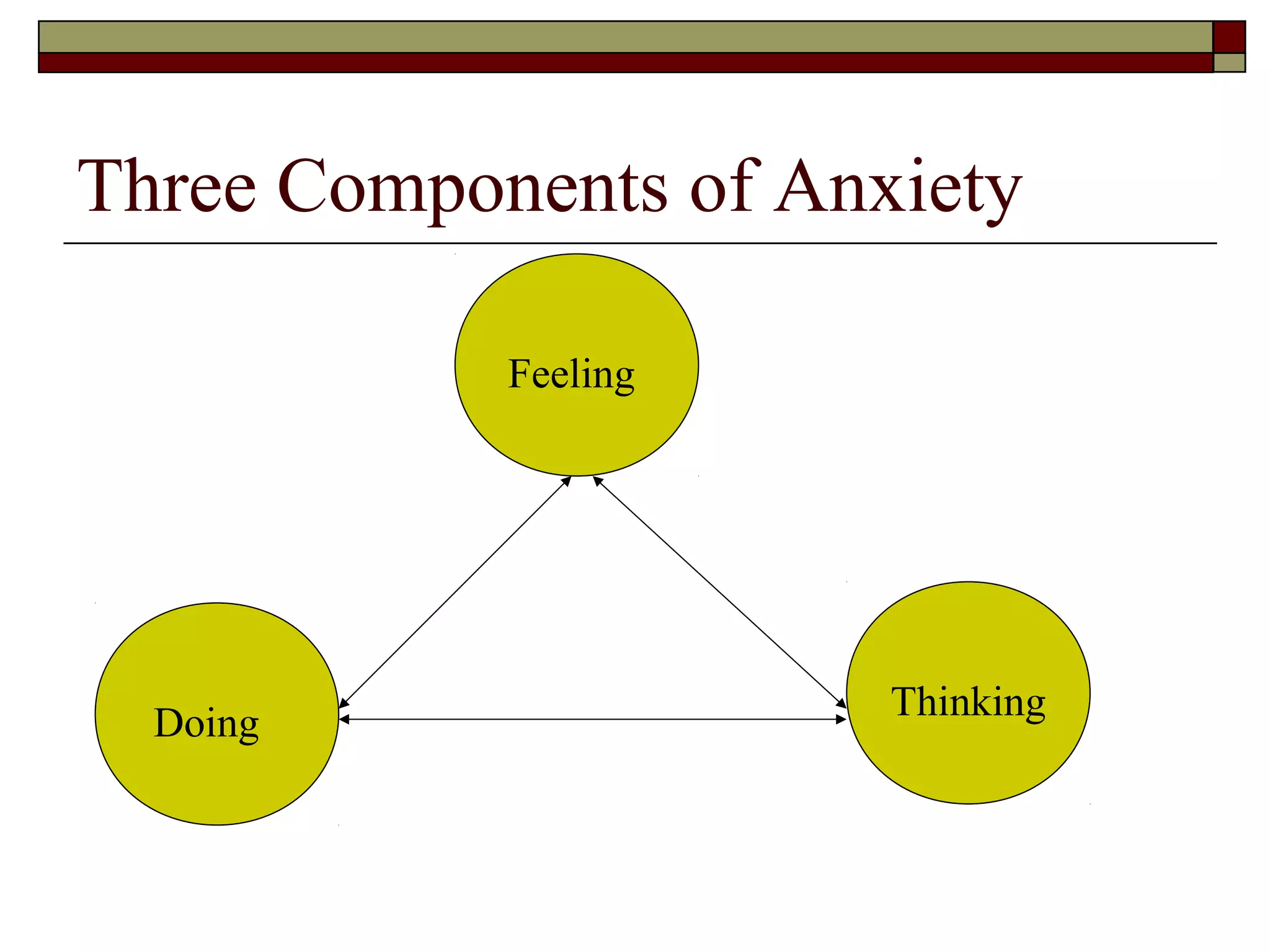
Three Components of Anxiety

            Feeling


                       Thinking
  Doing
THOUGHTS
Thinking
   Anxious children and teens have unrealistic or
    extreme thoughts that centre around harm or
    threat.
         “My mom is late, she’s been in a car accident.”
         “I can’t do this presentation because my
          classmates will think I’m dumb and laugh at me.”
         “I will get sick in school and throw up, and
          everyone will know.”
         “I will get in trouble if my work is not perfect.”
Thinking Errors
   Anxious children overestimate how
    likely it is that an unpleasant event will
    happen.
   They overestimate how bad the
    consequences will be if the event does
    happen.
   They underestimate their ability to cope
    with the anxiety and the unpleasant event
Anxiety and the Brain
Feeling
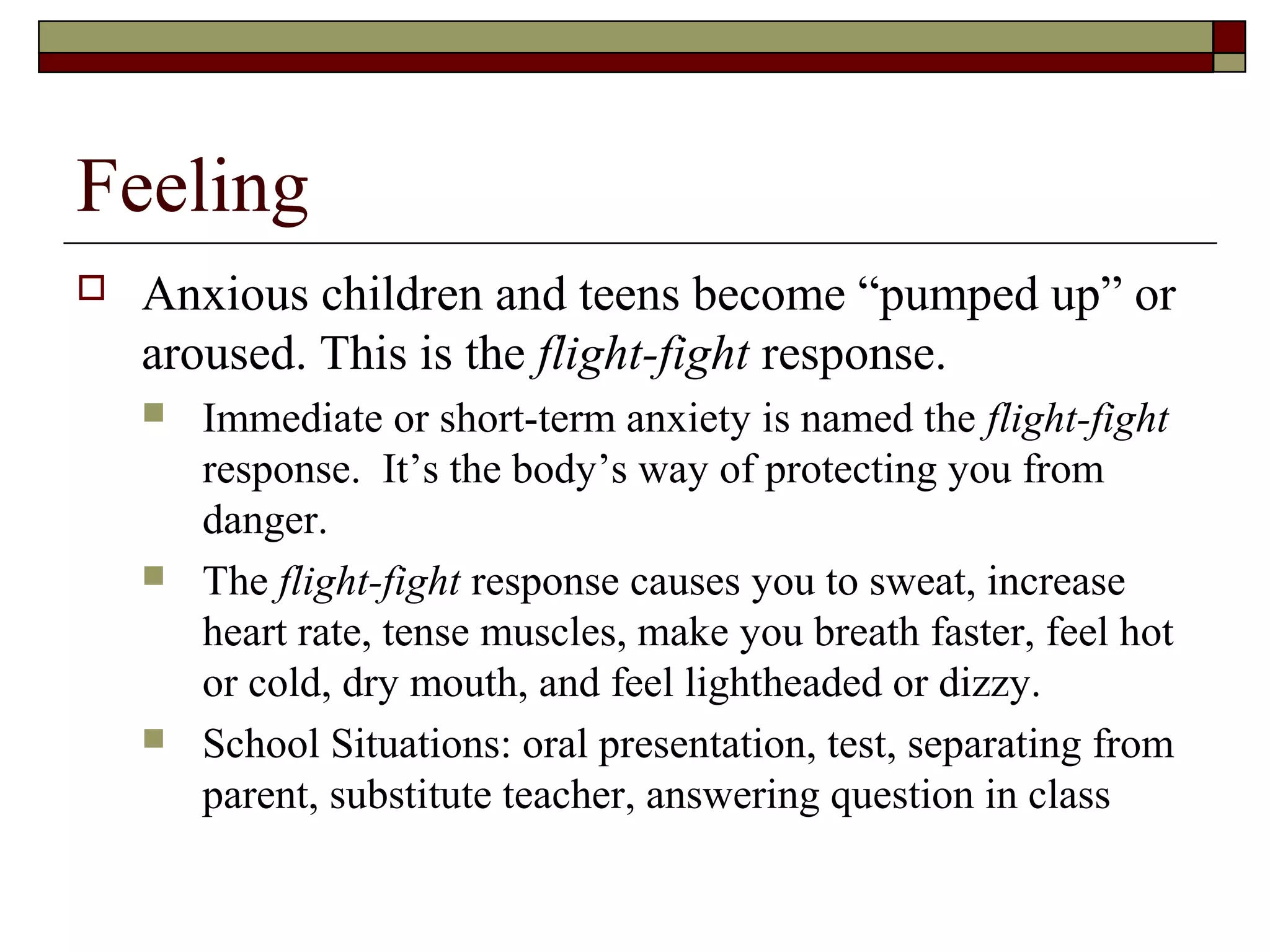
   Anxious children and teens become “pumped up” or
    aroused. This is the flight-fight response.
       Immediate or short-term anxiety is named the flight-fight
        response. It’s the body’s way of protecting you from
        danger.
       The flight-fight response causes you to sweat, increase
        heart rate, tense muscles, make you breath faster, feel hot
        or cold, dry mouth, and feel lightheaded or dizzy.
       School Situations: oral presentation, test, separating from
        parent, substitute teacher, answering question in class
Sympathetic Nervous System


Physiologic  arousal
FIGHT/FLIGHT/FRIGHT
   Signal danger

   Enhance alertness

   Prepare body for action
Doing- Anxious Behaviours
      Pace, fidget, cry, cling, shake
      Avoid
         
             Refusing to go to school or class
         
             Refusing to go somewhere alone
         
             Complain of headache or stomach ache
             to get out of doing something
      Reassurance seeking.
         
             “Am I going to die?”
            “Are you sure ________ won’t
             happen?”
      Repetitive behaviours to prevent event
BEHAVIOURS
Core Components of CBT
 Education about Anxiety
 Realistic Thinking/Cognitive
  Restructuring
 Skills Training (e.g., relaxation,
  problem solving, social skills,
  assertiveness, stress management)
 Exposure **
Cognitive Strategies
 Realistic Thinking or Detective Thinking
What is the evidence that anxious thought
  is true or false?
 Problem Solving

Identifying problem and generating
  solutions and potential outcomes
 Positive Self Talk
Realistic Thinking


Event    Thought/Belief           Emotion

Test      I will fail             worried
Test      I don’t care            irritable
Test      I can pass if I study   hopeful
Behavioural Strategies

    Coping skills
    Exposure to anxiety provoking situations and
     Response Prevention
    Encourage and reward all positive steps in
     fighting anxiety
    Modeling and parent education
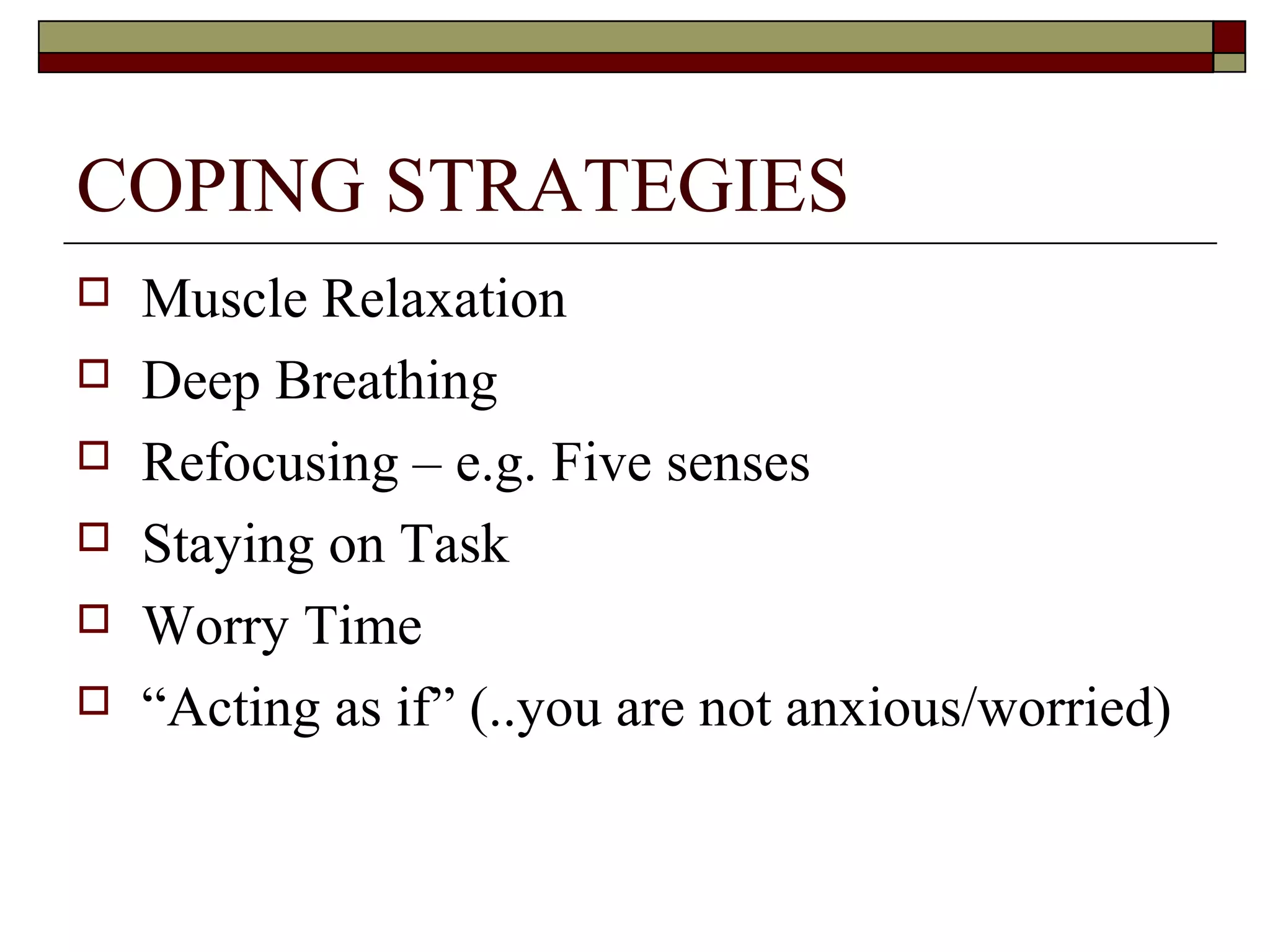
COPING STRATEGIES
   Muscle Relaxation
   Deep Breathing
   Refocusing – e.g. Five senses
   Staying on Task
   Worry Time
   “Acting as if” (..you are not anxious/worried)
Cognitive Behavioural Therapy
                 101
   Identify what is an anxious behaviour,
    thought or physical feeling. Label it for them.
        “Do  you think your stomach ache is really because you
         are anxious about the test”
        “Your heart is racing because of worry.”

   Once a behaviour is identified, help the child
    think of ways to cope on their own:
        Take a deep breath.
        Coping self talk (e.g., “Its just my worry, I am not

         going to forget everything. I can do this.”)
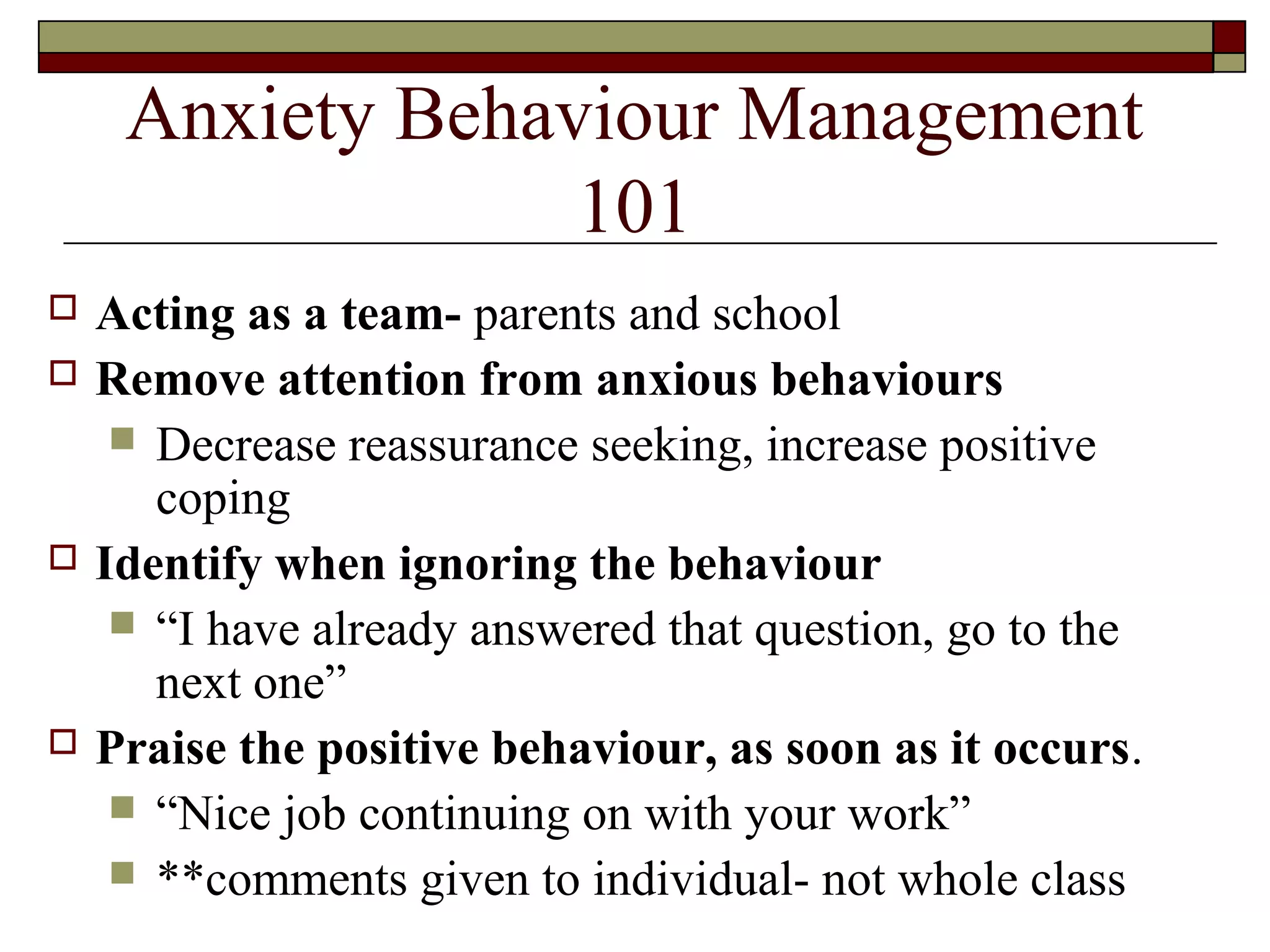
Anxiety Behaviour Management
                  101
   Acting as a team- parents and school
   Remove attention from anxious behaviours
      Decrease reassurance seeking, increase positive
       coping
   Identify when ignoring the behaviour
      “I have already answered that question, go to the
       next one”
   Praise the positive behaviour, as soon as it occurs.
      “Nice job continuing on with your work”
      **comments given to individual- not whole class
Avoidance Behaviour- Anxiety
        Curve
                                 Anxiety Exposure Curve
              100

              90

              80

              70
Worry Scale


              60                                                   Exposure
              50                                                   Avoidance
              40                                                   Anxiety
              30

              20

              10

               0
               Time 0   Time 1          Time 2       Time 3   Time 4
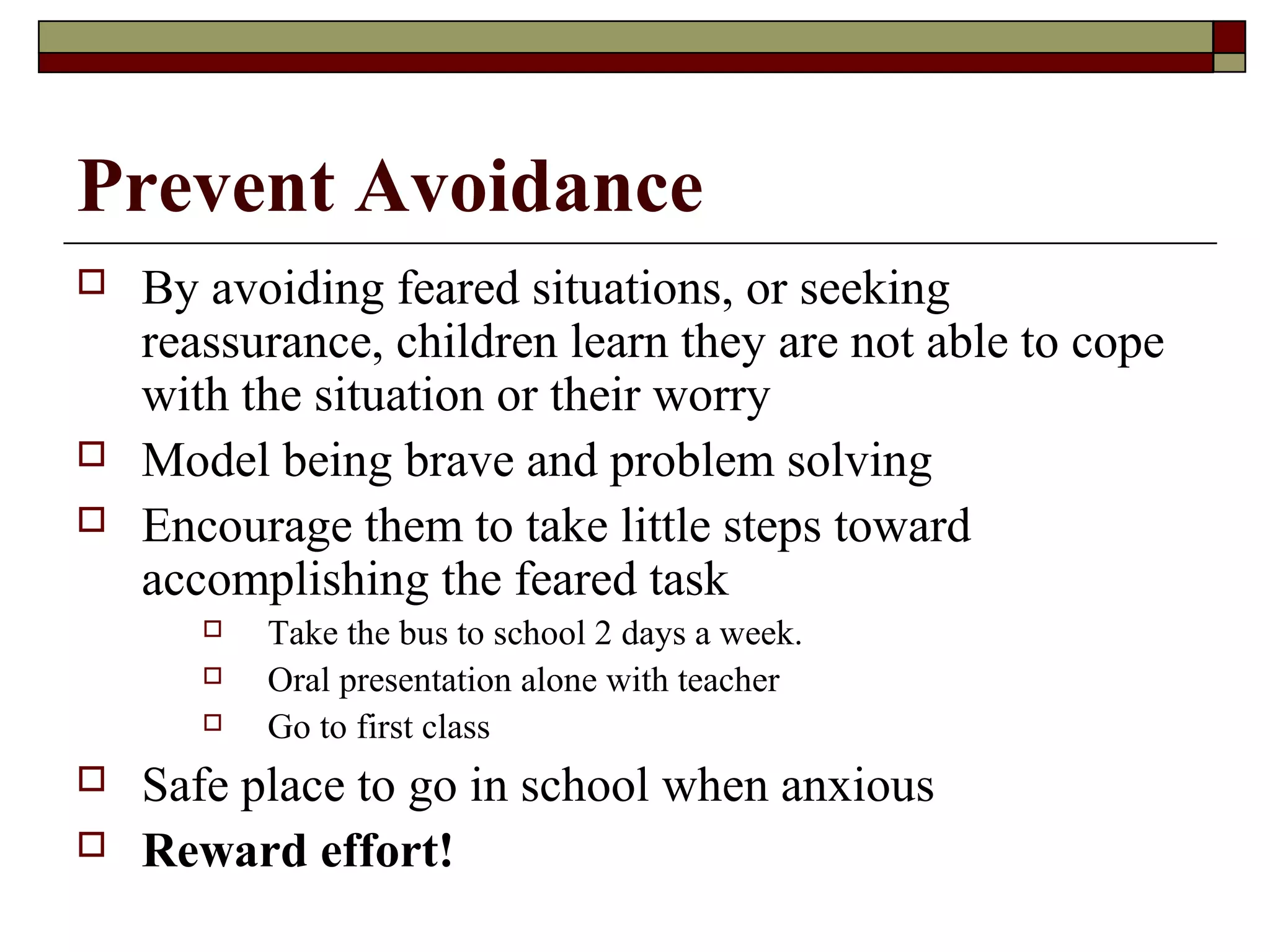
Prevent Avoidance
   By avoiding feared situations, or seeking
    reassurance, children learn they are not able to cope
    with the situation or their worry
   Model being brave and problem solving
   Encourage them to take little steps toward
    accomplishing the feared task
          Take the bus to school 2 days a week.
          Oral presentation alone with teacher
          Go to first class
   Safe place to go in school when anxious
   Reward effort!
Consultation Example 1
   10 year old girl not attending school for past 4
    weeks. Stomachaches every morning and
    thinks she is going to be sick.

   Mom informs school she is not able to force
    her to go.
Cognitive Behavioural Strategies
 a) Graded Exposures: n+1 rule
 (what is step up from current situation?)

 b) Desensitization: visit school after school hours,
    arrive early when school is quieter

 c) Flooding: force full time return (usually only
    works for absences of 2-3 weeks or less)

 d) Remove incentives for staying home
Consultation Example 2
   15 year old boy in Grade 10. Not completing
    assignments or tests, nothing handed in.

   Home info: spending 4 hours per night on
    homework, not completing or not good
    enough and so won’t hand in.
   What to do?
Mental Health Resources for Schools
   www.kidsmentalhealth.ca
   www.cprf.ca “When Something’s Wrong” series
   www.anxietybc.com
   www.teenmentalhealth.org
   www.myhealthmagazine.net
   www.schoolpsychiatry.org

   The Anxiety Workbook for Teens, Author: L. Schab
   The Relaxation and Stress Reduction Workbook for Kids:
    Help for Children to Cope with Stress, Anxiety and
    Transitions, Author: L Shapiro

Dealing with Anxiety in the Classroom

  • 1.
    Dealing with Anxietyin the Classroom Alexa Bagnell, MD, FRCPC July 11, 2012
  • 2.
    Objectives  Understanding of Anxiety disorders in children and youth and symptoms to look for  Overview of treatment modalities for anxiety  Strategies to help youth with anxiety in the school environment
  • 3.
    6 Month PrevalenceRates of Mental or Addictive Disorders in Children 4-17  Anxiety Disorders 7%  ADHD 5%  Conduct Disorder 4%  Mood Disorders 4%  Substance Use Disorders 1%  Any Disorder 14 % Waddell et al, Can J Psychiatry, 2002
  • 4.
    Whe i havea really big project due a get so worried. I can't sleep at night. Even if i know i will finish it on time i get so freaked out. Is there something wrong with me. Non of my friends feal this way. Can u help me?
  • 5.
    What is NormalAnxiety? Situation or Trigger: Transient Anxiety: First date Apprehension Does not Preparing for an exam Nervousness significantly Performing Tension interfere Edginess at a concert Nausea Giving a Does not Sweating speech Trembling prevent a Moving from person from home achieving their Climbing a tall goals ladder
  • 7.
    When is ita problem? ! !? ! Brain Registers ! No DANGER! Danger ANXIETY Ears Eyes Initiation Nose Sensory Taste of Physiologic Perception Cascade Touch ↑ Heart Rate Internal ↑ Alertness Thoughts Signals Physical ↑ Perception ↑ Tension Emotions
  • 8.
    When is Anxietya Disorder?  Most children, adolescents and adults use anxiety to help them make good decisions  Anxiety becomes a problem when it makes the decisions for you, interferes with your life and/or causes distress.  Two forms: misinterpreting threat or extreme response
  • 9.
    Epidemiology of AnxietyDisorders  Approximately 1 in 10 children  Most prevalent mental health problem in kids  High comorbidity with ADHD, Depression, ODD, substance misuse  Functional impairments: school failure and/or dropout, peer/social difficulties, family dysfunction, restricted career opportunities
  • 10.
    What Causes Anxiety?  Genetics/Biological Basis  Anxiety runs in families  Common for at least one parent to be anxious  Research has shown that what is passed on from parent to child is not a specific tendency to be shy or worry but a general personality type and/or cognitive style predisposing child to develop anxiety.
  • 11.
    What causes anxiety?  Parent Reaction  Reactions to child or teen’s anxious behaviour might also play a role in increasing anxiety (e.g., being over-protective, excessive reassurance).  Modeling  Children and adolescents copy their parents coping strategies (e.g., avoiding fearful situations).  Stressors/Traumatic Life Events  Bit by a dog, death of a loved one, being bullied, getting sick, academic struggles
  • 12.
    Anxiety in theClassroom  Irritability/ tiredness  Absenteeism  Frequent somatic complaints  Decline in grades  Withdrawal from peer group  Use of alcohol/drugs  Poor coping with everyday stress  Calling home frequently/reassurance seeking  Angry outbursts/ suicidal ideation
  • 13.
    Anxiety Performance Curve (Yerkes-Dodson Law) Hebb, D. O. (1955). Psychological Review, 62, 243-254
  • 15.
    Anxiety Disorders inChildren  Separation Anxiety Disorder: separation from caregivers, concern bad things will happen to them  Selective Mutism: Failure to speak in specific social situation despite speaking in others  Generalized Anxiety Disorder: uncontrollable excessive worry about many areas of life functioning (e.g., school work, family, friends, health)  Social Phobia: fearful of social or performance situations
  • 16.
    Anxiety Disorders inChildren  Specific Phobia: fear of particular objects or situations  Panic Disorder: misinterpret bodily changes and have a fear of losing control  Obsessive Compulsive Disorder: the presence of intrusive repetitive thoughts (obsessions) or behaviours (compulsions), >1 hour/day  Post traumatic Stress Disorder Experience traumatic event, reexperiencing, avoidance and numbness, increased arousal, >1 month
  • 17.
    Treatment of AnxietyDisorders in Children  1st Line: Cognitive Behavioural Therapy-CBT  2nd Line: Medication plus CBT  Anxiety disorders including OCD: SSRI medication has strongest evidence (e.g. sertraline/zoloft, fluoxetine/prozac, fluvoxamine/luvox, citalopram/celexa)
  • 19.
    Three Components ofAnxiety Feeling Thinking Doing
  • 20.
  • 21.
    Thinking  Anxious children and teens have unrealistic or extreme thoughts that centre around harm or threat.  “My mom is late, she’s been in a car accident.”  “I can’t do this presentation because my classmates will think I’m dumb and laugh at me.”  “I will get sick in school and throw up, and everyone will know.”  “I will get in trouble if my work is not perfect.”
  • 22.
    Thinking Errors  Anxious children overestimate how likely it is that an unpleasant event will happen.  They overestimate how bad the consequences will be if the event does happen.  They underestimate their ability to cope with the anxiety and the unpleasant event
  • 23.
  • 24.
    Feeling  Anxious children and teens become “pumped up” or aroused. This is the flight-fight response.  Immediate or short-term anxiety is named the flight-fight response. It’s the body’s way of protecting you from danger.  The flight-fight response causes you to sweat, increase heart rate, tense muscles, make you breath faster, feel hot or cold, dry mouth, and feel lightheaded or dizzy.  School Situations: oral presentation, test, separating from parent, substitute teacher, answering question in class
  • 25.
    Sympathetic Nervous System Physiologic arousal FIGHT/FLIGHT/FRIGHT Signal danger Enhance alertness Prepare body for action
  • 26.
    Doing- Anxious Behaviours  Pace, fidget, cry, cling, shake  Avoid  Refusing to go to school or class  Refusing to go somewhere alone  Complain of headache or stomach ache to get out of doing something  Reassurance seeking.  “Am I going to die?”  “Are you sure ________ won’t happen?”  Repetitive behaviours to prevent event
  • 27.
  • 28.
    Core Components ofCBT  Education about Anxiety  Realistic Thinking/Cognitive Restructuring  Skills Training (e.g., relaxation, problem solving, social skills, assertiveness, stress management)  Exposure **
  • 29.
    Cognitive Strategies  RealisticThinking or Detective Thinking What is the evidence that anxious thought is true or false?  Problem Solving Identifying problem and generating solutions and potential outcomes  Positive Self Talk
  • 30.
    Realistic Thinking Event Thought/Belief Emotion Test I will fail worried Test I don’t care irritable Test I can pass if I study hopeful
  • 31.
    Behavioural Strategies  Coping skills  Exposure to anxiety provoking situations and Response Prevention  Encourage and reward all positive steps in fighting anxiety  Modeling and parent education
  • 32.
    COPING STRATEGIES  Muscle Relaxation  Deep Breathing  Refocusing – e.g. Five senses  Staying on Task  Worry Time  “Acting as if” (..you are not anxious/worried)
  • 33.
    Cognitive Behavioural Therapy 101  Identify what is an anxious behaviour, thought or physical feeling. Label it for them.  “Do you think your stomach ache is really because you are anxious about the test”  “Your heart is racing because of worry.”  Once a behaviour is identified, help the child think of ways to cope on their own:  Take a deep breath.  Coping self talk (e.g., “Its just my worry, I am not going to forget everything. I can do this.”)
  • 34.
    Anxiety Behaviour Management 101  Acting as a team- parents and school  Remove attention from anxious behaviours  Decrease reassurance seeking, increase positive coping  Identify when ignoring the behaviour  “I have already answered that question, go to the next one”  Praise the positive behaviour, as soon as it occurs.  “Nice job continuing on with your work”  **comments given to individual- not whole class
  • 35.
    Avoidance Behaviour- Anxiety Curve Anxiety Exposure Curve 100 90 80 70 Worry Scale 60 Exposure 50 Avoidance 40 Anxiety 30 20 10 0 Time 0 Time 1 Time 2 Time 3 Time 4
  • 36.
    Prevent Avoidance  By avoiding feared situations, or seeking reassurance, children learn they are not able to cope with the situation or their worry  Model being brave and problem solving  Encourage them to take little steps toward accomplishing the feared task  Take the bus to school 2 days a week.  Oral presentation alone with teacher  Go to first class  Safe place to go in school when anxious  Reward effort!
  • 37.
    Consultation Example 1  10 year old girl not attending school for past 4 weeks. Stomachaches every morning and thinks she is going to be sick.  Mom informs school she is not able to force her to go.
  • 38.
    Cognitive Behavioural Strategies a) Graded Exposures: n+1 rule (what is step up from current situation?) b) Desensitization: visit school after school hours, arrive early when school is quieter c) Flooding: force full time return (usually only works for absences of 2-3 weeks or less) d) Remove incentives for staying home
  • 39.
    Consultation Example 2  15 year old boy in Grade 10. Not completing assignments or tests, nothing handed in.  Home info: spending 4 hours per night on homework, not completing or not good enough and so won’t hand in.  What to do?
  • 40.
    Mental Health Resourcesfor Schools  www.kidsmentalhealth.ca  www.cprf.ca “When Something’s Wrong” series  www.anxietybc.com  www.teenmentalhealth.org  www.myhealthmagazine.net  www.schoolpsychiatry.org  The Anxiety Workbook for Teens, Author: L. Schab  The Relaxation and Stress Reduction Workbook for Kids: Help for Children to Cope with Stress, Anxiety and Transitions, Author: L Shapiro

Editor's Notes

  • #6 * 07/16/96 * ## Physical Symptoms: Insomnia Palpitations Increased heart rate Suffocation Dizziness Shaking or tremors Shortness of breath Stomach upset Restlessness Diarrhea Change in appetite Flushing Blushing Sweating Faintness Chest pain Thinking/Cognitive Symptoms: Worry/Apprehension Difficulty making decisions Poor concentration Repeatedly thinking the same distressing thoughts: ie., Obsessions & Ruminations Catastrophic thinking Increased or Decreased awareness of one’s surroundings Confusion Behavioral Symptoms: Aggression Avoidance Agitation Restlessness Substance use: Alcohol Benzodiazepines Sleep Medicines Social Withdrawal Repeated behaviors (Compulsions)
  • #8 * 07/16/96 * ## Dysfunction of the danger signaling mechanism can lead to triggering of the ‘physiologic cascade’ in the absence of real danger: This is called ‘Anxiety’
  • #20 * 07/16/96 * ##
  • #22 * 07/16/96 * ##
  • #23 * 07/16/96 * ##
  • #25 * 07/16/96 * ##
  • #27 * 07/16/96 * ##
  • #28 * 07/16/96 * ##
  • #29 * 07/16/96 * ##
  • #39 * 07/16/96 * ##