Major Depressive
    Disorder
   By: Andrew Rowland
Definition
•   A mood disorder having a clinical course involving one or
    more episodes of serious psychological depression that last
    two or more weeks each, do not have intervening episodes of
    mania or hypomania, and are characterized by a loss of
    interest or pleasure in almost all activities and by some or all
    of disturbances of appetite, sleep, or psychomotor
    functioning, a decrease in energy, difficulties in thinking or
    making decisions, loss of self-esteem or feelings of guilt, and
    suicidal thoughts or attempts
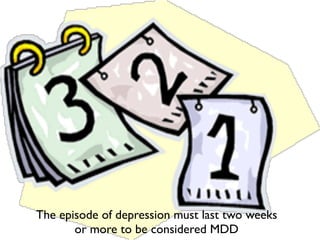
The episode of depression must last two weeks
       or more to be considered MDD
What is Major
Depressive Disorder?
•   A depressive disorder is a syndrome (group of
    symptoms) that reflects a sad and/or irritable mood
    exceeding normal sadness or grief

•   More specifically, the sadness of depression is
    characterized by a greater intensity and duration
    and by more severe symptoms and functional
    disabilities than is normal
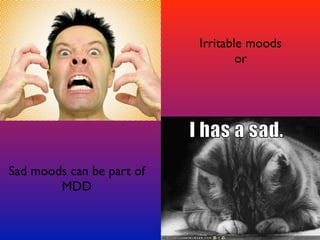
Irritable moods
                                   or


Sad moods can be part of
        MDD
“Diagnosing” MDD
•   Generally MDD consists of some or all of the following
    characteristics

    -   A long-lasting depressed mood or marked loss of
        interest or pleasure (anhedonia) in all or nearly all
        activities

    -   Children and adolescents may be irritable instead of
        sad

    -   These have to interfere significantly with one’s daily
        functioning to be considered MDD
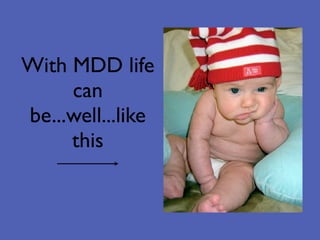
With MDD life
     can
be...well...like
     this
Causes of MDD

• The causes are generally considered to fall
  into one of these categories
  -   Intrapsychic
  -   Environmental
  -   Or Biological
Intrapsychic

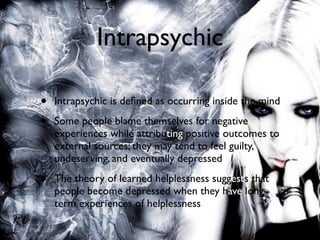
•   Intrapsychic is defined as occurring inside the mind

•   Some people blame themselves for negative
    experiences while attributing positive outcomes to
    external sources; they may tend to feel guilty,
    undeserving, and eventually depressed

•   The theory of learned helplessness suggests that
    people become depressed when they have long-
    term experiences of helplessness
Technically the voices are schizophrenia but intrapsychic is
                basically any inner conflicts
Environmental
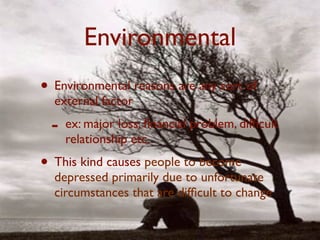
• Environmental reasons are any sort of
  external factor
 -   ex: major loss, financial problem, difficult
     relationship etc.
• This kind causes people to become
  depressed primarily due to unfortunate
  circumstances that are difficult to change
Example of a major loss
Biological

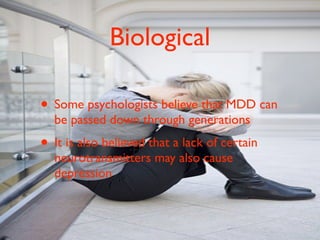
• Some psychologists believe that MDD can
  be passed down through generations
• It is also believed that a lack of certain
  neurotransmitters may also cause
  depression
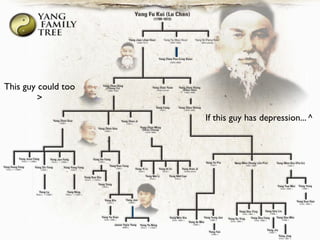
This guy could too
        >

                     If this guy has depression... ^
Miscellaneous Facts
• MDD is usually triggered by an obviously
  painful event but it can also be caused by a
  specific stressor
• Research suggests that the initial episode of
  MDD usually starts with a specific stimulus
  but later episodes can start without a
  triggering event
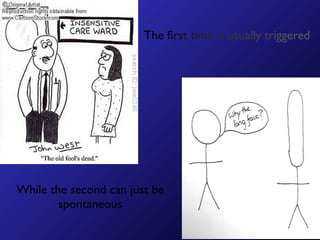
The first time is usually triggered


While the second can just be
        spontaneous
Side effects
• Find tasks difficult and burdensome
• Mental efficiency and memory are affected
• Sexual interest decreases
• Become withdrawn and avoid social contact
• Suicidal thoughts and actions
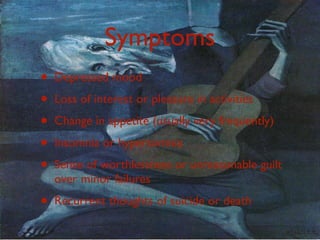
Symptoms
•   Depressed mood
•   Loss of interest or pleasure in activities
•   Change in appetite (usually very frequently)
•   Insomnia or hypersomnia
•   Sense of worthlessness or unreasonable guilt
    over minor failures
•   Recurrent thoughts of suicide or death
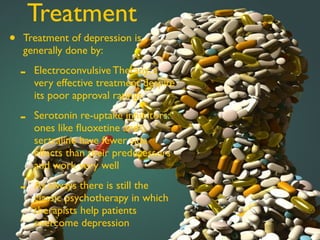
Treatment
•   Treatment of depression is
    generally done by:

    -   Electroconvulsive Therapy: a
        very effective treatment despite
        its poor approval ratings

    -   Serotonin re-uptake inhibitors:
        ones like fluoxetine and
        sertraline have fewer side
        effects than their predecessors
        and work very well

    -   As always there is still the
        classic psychotherapy in which
        therapists help patients
        overcome depression
Major depressive disorder

Major depressive disorder

  • 1.
    Major Depressive Disorder By: Andrew Rowland
  • 2.
    Definition • A mood disorder having a clinical course involving one or more episodes of serious psychological depression that last two or more weeks each, do not have intervening episodes of mania or hypomania, and are characterized by a loss of interest or pleasure in almost all activities and by some or all of disturbances of appetite, sleep, or psychomotor functioning, a decrease in energy, difficulties in thinking or making decisions, loss of self-esteem or feelings of guilt, and suicidal thoughts or attempts
  • 3.
    The episode ofdepression must last two weeks or more to be considered MDD
  • 4.
    What is Major DepressiveDisorder? • A depressive disorder is a syndrome (group of symptoms) that reflects a sad and/or irritable mood exceeding normal sadness or grief • More specifically, the sadness of depression is characterized by a greater intensity and duration and by more severe symptoms and functional disabilities than is normal
  • 5.
    Irritable moods or Sad moods can be part of MDD
  • 6.
    “Diagnosing” MDD • Generally MDD consists of some or all of the following characteristics - A long-lasting depressed mood or marked loss of interest or pleasure (anhedonia) in all or nearly all activities - Children and adolescents may be irritable instead of sad - These have to interfere significantly with one’s daily functioning to be considered MDD
  • 7.
    With MDD life can be...well...like this
  • 8.
    Causes of MDD •The causes are generally considered to fall into one of these categories - Intrapsychic - Environmental - Or Biological
  • 9.
    Intrapsychic • Intrapsychic is defined as occurring inside the mind • Some people blame themselves for negative experiences while attributing positive outcomes to external sources; they may tend to feel guilty, undeserving, and eventually depressed • The theory of learned helplessness suggests that people become depressed when they have long- term experiences of helplessness
  • 10.
    Technically the voicesare schizophrenia but intrapsychic is basically any inner conflicts
  • 11.
    Environmental • Environmental reasonsare any sort of external factor - ex: major loss, financial problem, difficult relationship etc. • This kind causes people to become depressed primarily due to unfortunate circumstances that are difficult to change
  • 12.
    Example of amajor loss
  • 13.
    Biological • Some psychologistsbelieve that MDD can be passed down through generations • It is also believed that a lack of certain neurotransmitters may also cause depression
  • 14.
    This guy couldtoo > If this guy has depression... ^
  • 15.
    Miscellaneous Facts • MDDis usually triggered by an obviously painful event but it can also be caused by a specific stressor • Research suggests that the initial episode of MDD usually starts with a specific stimulus but later episodes can start without a triggering event
  • 16.
    The first timeis usually triggered While the second can just be spontaneous
  • 17.
    Side effects • Findtasks difficult and burdensome • Mental efficiency and memory are affected • Sexual interest decreases • Become withdrawn and avoid social contact • Suicidal thoughts and actions
  • 18.
    Symptoms • Depressed mood • Loss of interest or pleasure in activities • Change in appetite (usually very frequently) • Insomnia or hypersomnia • Sense of worthlessness or unreasonable guilt over minor failures • Recurrent thoughts of suicide or death
  • 19.
    Treatment • Treatment of depression is generally done by: - Electroconvulsive Therapy: a very effective treatment despite its poor approval ratings - Serotonin re-uptake inhibitors: ones like fluoxetine and sertraline have fewer side effects than their predecessors and work very well - As always there is still the classic psychotherapy in which therapists help patients overcome depression