Understanding Epilepsy
Fareed A. Minhas
Prof. & Head
Institute of Psychiatry
Rawalpindi Medical College
Introduction
• Seizure: the result of excessive

synchronous discharge of cortical neurons

• Convulsion: violent, involuntary
contraction of voluntary muscles

• Epilepsy: a clinical condition characterized
by recurrent unprovoked seizures
Definitions
Seizure
A paroxysmal and time-limited neurological event that
results from abnormal neuronal activity in the brain

Epilepsy
Recurrent seizures
Prevalence
• 1.4 M in USA with 8.4 M visits to office-based
neurologists
• i% in Pakistan
• Chronic seizure disorder in 1-2% of general
population (6.1 per 1000)
• Ten percent of general population have at least
one seizure in their lifetime
• Minority groups may have higher rate
– Acquired (symptomatic) epilepsy
– Socioeconomic status
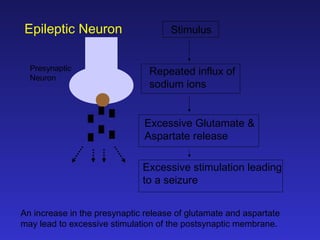
Epileptic Neuron
Presynaptic
Neuron

Stimulus

Repeated influx of
sodium ions
Excessive Glutamate &
Aspartate release
Excessive stimulation leading
to a seizure

An increase in the presynaptic release of glutamate and aspartate
may lead to excessive stimulation of the postsynaptic membrane.
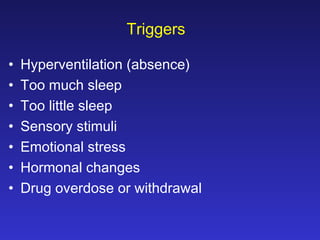
Triggers
•
•
•
•
•
•
•

Hyperventilation (absence)
Too much sleep
Too little sleep
Sensory stimuli
Emotional stress
Hormonal changes
Drug overdose or withdrawal
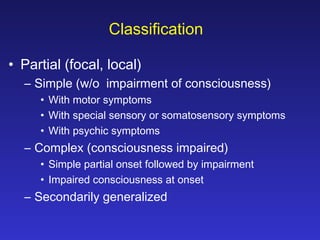
Classification
• Partial (focal, local)
– Simple (w/o impairment of consciousness)
• With motor symptoms
• With special sensory or somatosensory symptoms
• With psychic symptoms

– Complex (consciousness impaired)
• Simple partial onset followed by impairment
• Impaired consciousness at onset

– Secondarily generalized
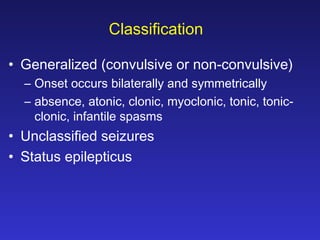
Classification
• Generalized (convulsive or non-convulsive)
– Onset occurs bilaterally and symmetrically
– absence, atonic, clonic, myoclonic, tonic, tonicclonic, infantile spasms

• Unclassified seizures
• Status epilepticus
Diagnosis of Seizure

History and observation

EEG
Diagnosis
• Seizure characteristics
–
–
–
–
–

Frequency and duration
Precipitating factors
Time of occurrence
Aura
Ictal and post-ictal state

• Laboratory
–
–
–
–

CBC
Chem panel with Mg and Ca
UA
Lumbar puncture

• PE and NE
• EEG
• MRI or CT
Features suggestive of seizure










Impairment of consciousness
Deviation of the eyes
Facial automatisms
Rhythmic jerking of body parts
Bladder or bowel incontinence
Physical injury (e.g., tongue-biting)
Pre-episode aura
Post-episode confusion
Family history of epilepsy
Role of EEG
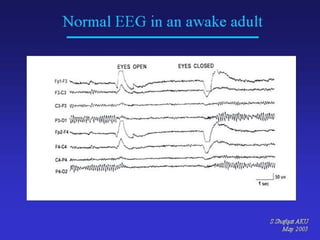
 Only test of brain function available in routine
clinical use
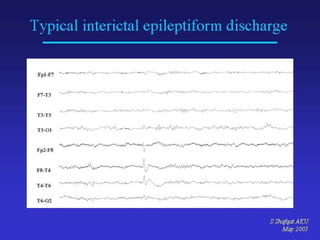
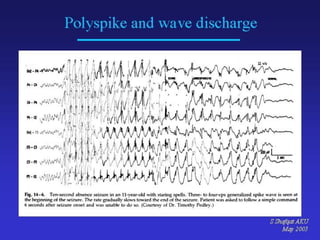
 Can reveal interictal “signature” of underlying
epilepsy through the appearance of epileptiform
discharges (spikes, sharp waves, and spike and
slow-wave complexes)
 Single EEG has sensitivity of 60%
 Sensitivity can be enhanced by repeating the test
(up to 90% for 3 EEGs) and by sleep deprivation
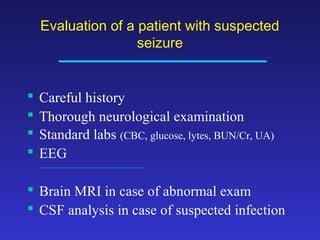
Evaluation of a patient with suspected
seizure






Careful history
Thorough neurological examination
Standard labs (CBC, glucose, lytes, BUN/Cr, UA)
EEG

 Brain MRI in case of abnormal exam
 CSF analysis in case of suspected infection
Differential diagnosis of seizures
Breathholding spells (children)
REM sleep behavior (children)
Tics
Confusional migraine
Syncope
Panic attacks
Narcolepsy
Transient ischemic attack
Transient global amnesia
Psychogenic seizures (pseudoseizures)
Management: Central issues







Destigmatization
Judicious use of AEDs
Recommendations about driving
Pregnancy and epilepsy
First-aid advice to family
Options for refractory cases
Destigmatization





Demystifying superstitions
Educating about nature of epilepsy
Counseling about marriage and pregnancy
Reassuring that epilepsy is compatible with a
normal and productive life
Driving recommendations

 No driving after a seizure until seizure-free
for 6 months
 No driving after medication decrement until
seizure-free for 6 months
 Also applies to swimming, water sports and
other activities in which seizure could be
lethal
Pregnancy & Epilepsy
 Epilepsy is compatible with marriage
and motherhood
 Pre-conception control is best predictor
of seizure control during pregnancy
 All AEDs are potentially teratogenic but
seizure may carry greater risk to fetus
 If possible, have patient controlled on
lamotrigine prior to conception and stay
the course
First-aid for acute seizure







Turn the patient on to his or her side
Remove eyeglasses if any
Clear the area of harmful objects
Do not try to restrain movements
Loosen neckwear like necktie or dupatta
Do not force anything into the patient’s mouth

No need for emergency medical help unless …
Seizure doesn’t stop in 3 min., another seizure
happens, or an injury has occurred
Options for refractory cases
 Add 2nd or, if necessary, 3rd AED
 Consider surgical treatment
 Requires specialized evaluation
 Options include temporal lobectomy,
lesionectomy (corticectomy), callosal
commissurotomy, hemispherectomy

 Consider Vagal Nerve Stimulator
 Implanted electrical stimulator of vagus,
effective as adjunct to AEDs
Treatment Goals
• Normal lifestyle
• Reduce frequency of seizures
– Balance between suppression and AEs

• Encourage compliance
• Assess the concerns of the patient
–
–
–
–
–

Driving
Education
Relationships
Housing
Social stigma

• Epilepsy Foundation of America
Principles of Pharmacotherapy
• Positive correlation between the early
initiation of therapy and the ability to control
seizure activity
• Failure to control seizures may lead to an
increase in seizure activity and also the
occurrence of other seizure types
• “No regimen like the first regimen”
Principles of Pharmacotherapy
• Drug choice is based on seizure type and side
effect profile
• Always start with monotherapy

– ~70% of patients can be maintained with one drug
– Of 35% with unsatisfactory control, 10% will be wellcontrolled on two drugs
– ~20% will be medically refractory
– 15% will become surgery candidates
• Success rate is 80-90% in properly selected patients
• Risks include learning,memory, and general intellectual
impairment
Principles of Pharmacotherapy
• Seizure control may be achieved at doses
corresponding to less than “normal”
therapeutic serum levels; likewise, doses
corresponding to higher than “normal”
therapeutic serum levels may be tolerated
and required by some patients
• Begin dosing at 1/3 to ¼ anticipated
maintenance dose and titrate over 3-4
weeks
Judicious use of AEDs
 Do not treat single uncomplicated seizure
 If AEDs are needed, use monotherapy as much
as possible (e.g: Tegral)
 Classic AEDs (phenytoin, Tegral and valproic
acid) have long experience but significant sideeffects, esp. valproic acid in women
 Newer agents very expensive & 2nd line therapy
 Gabapentin is a weaker AED but almost no
interactions and best for medically complex
patients
Treatment Failure
• Number one cause of treatment failure is
• AED is not considered ineffective until
patient has continued seizures AND some
concentration-dependent side effects
• Substitute
• Generics (Low bioavailability)
• Mixed seizure types are more likely to
require more than one AED
• Seizure chart a must
Principles of Pharmacotherapy
• Kinetics

– Plasma protein binding

• Measure free instead of total
– DPH

– Age

• Neonates
• Infants, children
• Elderly

– Metabolism

• Induction or inhibition of the CYP450 enzyme system
• Many AEDs have active metabolites
Principles of Pharmacotherapy
• Female patients
– Enzyme-inducing AEDs
• PHT, PHB, Tegral , primidone
• VPA is an inhibitor

– Seizures before or during menses or at time of
ovulation

• All female patients should take PNV with
folate
Principles of Pharmacotherapy
• Pregnancy
–
–
–
–
–

25-30% increased or decreased frequency
Increased VD and clearance
Altered protein binding
Increased incidence of adverse outcomes
Twice the incidence of congenital malformations (4-6%)
• PB and PHT – congenital heart malformations, facial clefts
• CBZ and VPA – spina bifida and hypospadias

– Monotherapy preferred
Principles of Pharmacotherapy
• Discontinuation of AEDs
–
–
–
–

Seizure-free for 2-5 years
Single type of primary GTC or partial
Neurological exam and IQ are normal
EEG normalized with treatment

–
–
–
–

High frequency
Repeated SE
Combination of seizure types
Development of abnormal functioning

• Not possible in all patients
Drugs of Choice – First Line
• Partial Seizures
– Tegral , PHT, VPA
– Lamotrigine, oxcarbazepine

• Generalized Seizures
– Tonic-Clonic
• CBZ, PHT, VPA

– Absence
• VPA, ethosuximide

– Myoclonic
• Clonazepam, VPA
Summary
 Seizures and epilepsy are a common problem
in primary care medicine
 Diagnosis relies on careful history and
examination, supplemented by EEG
 Treatment involves educating about the
illness, judicious use of AEDs, instructions
about driving and similar activities
 Treatment options exist for refractory cases
 Tegral is the first line therapy
 Tegral is effective & has low side effects
profile

Epilepsy--prof. fareed minhas

  • 1.
    Understanding Epilepsy Fareed A.Minhas Prof. & Head Institute of Psychiatry Rawalpindi Medical College
  • 2.
    Introduction • Seizure: theresult of excessive synchronous discharge of cortical neurons • Convulsion: violent, involuntary contraction of voluntary muscles • Epilepsy: a clinical condition characterized by recurrent unprovoked seizures
  • 3.
    Definitions Seizure A paroxysmal andtime-limited neurological event that results from abnormal neuronal activity in the brain Epilepsy Recurrent seizures
  • 4.
    Prevalence • 1.4 Min USA with 8.4 M visits to office-based neurologists • i% in Pakistan • Chronic seizure disorder in 1-2% of general population (6.1 per 1000) • Ten percent of general population have at least one seizure in their lifetime • Minority groups may have higher rate – Acquired (symptomatic) epilepsy – Socioeconomic status
  • 5.
    Epileptic Neuron Presynaptic Neuron Stimulus Repeated influxof sodium ions Excessive Glutamate & Aspartate release Excessive stimulation leading to a seizure An increase in the presynaptic release of glutamate and aspartate may lead to excessive stimulation of the postsynaptic membrane.
  • 6.
    Triggers • • • • • • • Hyperventilation (absence) Too muchsleep Too little sleep Sensory stimuli Emotional stress Hormonal changes Drug overdose or withdrawal
  • 7.
    Classification • Partial (focal,local) – Simple (w/o impairment of consciousness) • With motor symptoms • With special sensory or somatosensory symptoms • With psychic symptoms – Complex (consciousness impaired) • Simple partial onset followed by impairment • Impaired consciousness at onset – Secondarily generalized
  • 8.
    Classification • Generalized (convulsiveor non-convulsive) – Onset occurs bilaterally and symmetrically – absence, atonic, clonic, myoclonic, tonic, tonicclonic, infantile spasms • Unclassified seizures • Status epilepticus
  • 9.
    Diagnosis of Seizure Historyand observation EEG
  • 10.
    Diagnosis • Seizure characteristics – – – – – Frequencyand duration Precipitating factors Time of occurrence Aura Ictal and post-ictal state • Laboratory – – – – CBC Chem panel with Mg and Ca UA Lumbar puncture • PE and NE • EEG • MRI or CT
  • 11.
    Features suggestive ofseizure          Impairment of consciousness Deviation of the eyes Facial automatisms Rhythmic jerking of body parts Bladder or bowel incontinence Physical injury (e.g., tongue-biting) Pre-episode aura Post-episode confusion Family history of epilepsy
  • 12.
    Role of EEG Only test of brain function available in routine clinical use  Can reveal interictal “signature” of underlying epilepsy through the appearance of epileptiform discharges (spikes, sharp waves, and spike and slow-wave complexes)  Single EEG has sensitivity of 60%  Sensitivity can be enhanced by repeating the test (up to 90% for 3 EEGs) and by sleep deprivation
  • 13.
    Evaluation of apatient with suspected seizure     Careful history Thorough neurological examination Standard labs (CBC, glucose, lytes, BUN/Cr, UA) EEG  Brain MRI in case of abnormal exam  CSF analysis in case of suspected infection
  • 17.
    Differential diagnosis ofseizures Breathholding spells (children) REM sleep behavior (children) Tics Confusional migraine Syncope Panic attacks Narcolepsy Transient ischemic attack Transient global amnesia Psychogenic seizures (pseudoseizures)
  • 18.
    Management: Central issues       Destigmatization Judicioususe of AEDs Recommendations about driving Pregnancy and epilepsy First-aid advice to family Options for refractory cases
  • 19.
    Destigmatization     Demystifying superstitions Educating aboutnature of epilepsy Counseling about marriage and pregnancy Reassuring that epilepsy is compatible with a normal and productive life
  • 20.
    Driving recommendations  Nodriving after a seizure until seizure-free for 6 months  No driving after medication decrement until seizure-free for 6 months  Also applies to swimming, water sports and other activities in which seizure could be lethal
  • 21.
    Pregnancy & Epilepsy Epilepsy is compatible with marriage and motherhood  Pre-conception control is best predictor of seizure control during pregnancy  All AEDs are potentially teratogenic but seizure may carry greater risk to fetus  If possible, have patient controlled on lamotrigine prior to conception and stay the course
  • 22.
    First-aid for acuteseizure       Turn the patient on to his or her side Remove eyeglasses if any Clear the area of harmful objects Do not try to restrain movements Loosen neckwear like necktie or dupatta Do not force anything into the patient’s mouth No need for emergency medical help unless … Seizure doesn’t stop in 3 min., another seizure happens, or an injury has occurred
  • 23.
    Options for refractorycases  Add 2nd or, if necessary, 3rd AED  Consider surgical treatment  Requires specialized evaluation  Options include temporal lobectomy, lesionectomy (corticectomy), callosal commissurotomy, hemispherectomy  Consider Vagal Nerve Stimulator  Implanted electrical stimulator of vagus, effective as adjunct to AEDs
  • 24.
    Treatment Goals • Normallifestyle • Reduce frequency of seizures – Balance between suppression and AEs • Encourage compliance • Assess the concerns of the patient – – – – – Driving Education Relationships Housing Social stigma • Epilepsy Foundation of America
  • 25.
    Principles of Pharmacotherapy •Positive correlation between the early initiation of therapy and the ability to control seizure activity • Failure to control seizures may lead to an increase in seizure activity and also the occurrence of other seizure types • “No regimen like the first regimen”
  • 26.
    Principles of Pharmacotherapy •Drug choice is based on seizure type and side effect profile • Always start with monotherapy – ~70% of patients can be maintained with one drug – Of 35% with unsatisfactory control, 10% will be wellcontrolled on two drugs – ~20% will be medically refractory – 15% will become surgery candidates • Success rate is 80-90% in properly selected patients • Risks include learning,memory, and general intellectual impairment
  • 27.
    Principles of Pharmacotherapy •Seizure control may be achieved at doses corresponding to less than “normal” therapeutic serum levels; likewise, doses corresponding to higher than “normal” therapeutic serum levels may be tolerated and required by some patients • Begin dosing at 1/3 to ¼ anticipated maintenance dose and titrate over 3-4 weeks
  • 28.
    Judicious use ofAEDs  Do not treat single uncomplicated seizure  If AEDs are needed, use monotherapy as much as possible (e.g: Tegral)  Classic AEDs (phenytoin, Tegral and valproic acid) have long experience but significant sideeffects, esp. valproic acid in women  Newer agents very expensive & 2nd line therapy  Gabapentin is a weaker AED but almost no interactions and best for medically complex patients
  • 29.
    Treatment Failure • Numberone cause of treatment failure is • AED is not considered ineffective until patient has continued seizures AND some concentration-dependent side effects • Substitute • Generics (Low bioavailability) • Mixed seizure types are more likely to require more than one AED • Seizure chart a must
  • 30.
    Principles of Pharmacotherapy •Kinetics – Plasma protein binding • Measure free instead of total – DPH – Age • Neonates • Infants, children • Elderly – Metabolism • Induction or inhibition of the CYP450 enzyme system • Many AEDs have active metabolites
  • 31.
    Principles of Pharmacotherapy •Female patients – Enzyme-inducing AEDs • PHT, PHB, Tegral , primidone • VPA is an inhibitor – Seizures before or during menses or at time of ovulation • All female patients should take PNV with folate
  • 32.
    Principles of Pharmacotherapy •Pregnancy – – – – – 25-30% increased or decreased frequency Increased VD and clearance Altered protein binding Increased incidence of adverse outcomes Twice the incidence of congenital malformations (4-6%) • PB and PHT – congenital heart malformations, facial clefts • CBZ and VPA – spina bifida and hypospadias – Monotherapy preferred
  • 33.
    Principles of Pharmacotherapy •Discontinuation of AEDs – – – – Seizure-free for 2-5 years Single type of primary GTC or partial Neurological exam and IQ are normal EEG normalized with treatment – – – – High frequency Repeated SE Combination of seizure types Development of abnormal functioning • Not possible in all patients
  • 34.
    Drugs of Choice– First Line • Partial Seizures – Tegral , PHT, VPA – Lamotrigine, oxcarbazepine • Generalized Seizures – Tonic-Clonic • CBZ, PHT, VPA – Absence • VPA, ethosuximide – Myoclonic • Clonazepam, VPA
  • 35.
    Summary  Seizures andepilepsy are a common problem in primary care medicine  Diagnosis relies on careful history and examination, supplemented by EEG  Treatment involves educating about the illness, judicious use of AEDs, instructions about driving and similar activities  Treatment options exist for refractory cases  Tegral is the first line therapy  Tegral is effective & has low side effects profile

Editor's Notes

  • #3 Spreads locally (focal) or widely (generalized)
  • #5 Spike in newborns and young children and age >65; seizure type and cause of seizure change with age Patients with mental retardation and CP at higher risk
  • #6 Membrane instability: abnormality of (1) K conductance, (2) defect in voltage-sensitive calcium channels, or (3) deficiency in membrane ATPases linked to ion transport Normal neuronal activity: excitatory NT – glutamate, aspartate, ach, ne, histamine, crf, purines, peptides, cytokines, steroid hormones inhibitory – DA, GABA glucose, oxygen, sodium, potassium, chloride, calcium, aa, normal pH, normal receptor function Treatment strategies (1) raise the seizure threshold by stabilizing neuronal membrane (2) depress synaptic transmission and reduce nerve conduction
  • #7 Positive or negative Menses, puberty, pregnancy Licit and illicit
  • #8 Complex – may have automatisms, periods of memory loss, or aberrations of behavior; mistaken as psychotic episode
  • #9 Majority have LOC without warning Absence: sudden onset, interruption of ongoing activities, blank spare, possibly brief upward rotation of the eyes Tonic-clonic(grand mal): sudden onset, cry or moan, lose sphincter control, bite the tongue, become cyanotic; post-ictal state period of deep sleep Myoclonic: brief, shock-like contractions of the face, trunk, and extremities (isolated or rapidly repetitive) Atonic: sudden loss of muscle tone (head drop, drop limb, slump to the ground) Why is SE life-threatening?
  • #11 LP for fever, very young, very old EEG may influence treatment approach MRI or CT to identify structural or functional abnormalities Underlying disorder or idiopathic? even if a cause is elucidated, may not be correctable – use seizure meds
  • #25 Involve patient in defining that balance Misconceptions
  • #27 Start AED in patient with two or more seizures In monotherapy with older drugs, less than 50% will be seizure free Patients with partial seizures may need higher drug concentrations than those with GTC
  • #30 As many times as suitable alternative available What’s the big deal with using more than one drug? A. Frequency and severity of toxicity increased Herbal Use?
  • #31 Altered plasma protein binding: CRF, liver disease, hypoalbuminemia, burns, pregnancy, malnutrition, displacing drugs NA have low albumin!!!!! Neonates: slower metabolism Infants/children: faster metabolism Elderly: increased sensitivity to CNS drugs
  • #32 VPA inhibitor Felbamate and topiramate – inhibitors with some, inducers with others Levatiracetam and gabapentin only AEDs renally cleared >50 mcg of estrogen necessary, use supplemental form if breakthrough bleeding occurs VPA and CBZ can cause spina bifida and hypospadias
  • #33 Inc rates of stillbirth and infant mortality At the lowest dose possible to limit GTC seizures; divided doses to minimize peaks; avoid VPA
  • #34 What is the #1 cause of treatment failure?
  • #35 For alternatives, see your favorite therapeutic reference VPA, topiramate, lamotrigine are broad spectrum