Introduction to Seizures
and Epilepsy
Sarah Shalev, M.D.
Epilepsy Fellow
University of California at San Francisco
1
San Francisco VA
Epilepsy Center of
Excellence:
State-of-the-Art Diagnostic
& Therapeutic Services
Nina Garga, M.D.
John Hixson, M.D.
William Marks, M.D.
Karen L. Parko, M.D.
3
SFVA Epilepsy Center
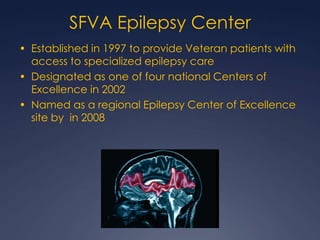
• Established in 1997 to provide Veteran patients with
access to specialized epilepsy care
• Designated as one of four national Centers of
Excellence in 2002
• Named as a regional Epilepsy Center of Excellence
site by in 2008
SFVA Epilepsy Center
• Outpatient consultation and long-term care
• Video/EEG Monitoring on inpatient Epilepsy
Monitoring Unit
• High-resolution neuroimaging
• Expert pharmacological treatment
• Device-based therapy (vagus nerve stimulation)
• Epilepsy surgery
• Experimental treatments
6
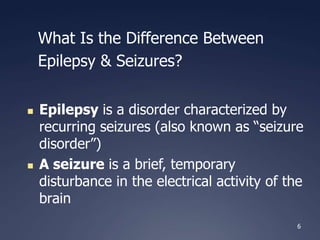
What Is the Difference Between
Epilepsy & Seizures?
 Epilepsy is a disorder characterized by
recurring seizures (also known as “seizure
disorder”)
 A seizure is a brief, temporary
disturbance in the electrical activity of the
brain
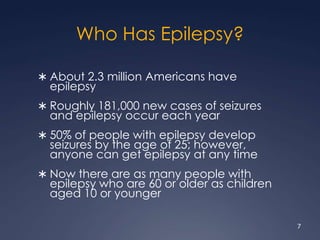
Who Has Epilepsy?
 About 2.3 million Americans have
epilepsy
 Roughly 181,000 new cases of seizures
and epilepsy occur each year
 50% of people with epilepsy develop
seizures by the age of 25; however,
anyone can get epilepsy at any time
 Now there are as many people with
epilepsy who are 60 or older as children
aged 10 or younger
7
8
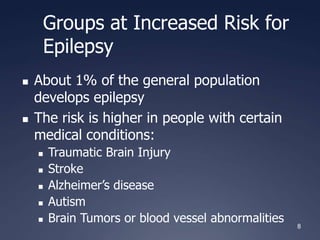
Groups at Increased Risk for
Epilepsy
 About 1% of the general population
develops epilepsy
 The risk is higher in people with certain
medical conditions:
 Traumatic Brain Injury
 Stroke
 Alzheimer’s disease
 Autism
 Brain Tumors or blood vessel abnormalities
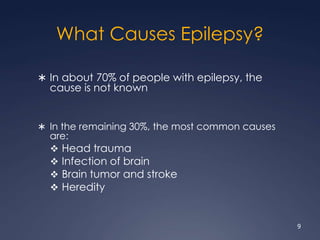
What Causes Epilepsy?
 In about 70% of people with epilepsy, the
cause is not known
 In the remaining 30%, the most common causes
are:
 Head trauma
 Infection of brain
 Brain tumor and stroke
 Heredity
9
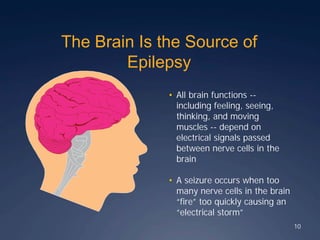
The Brain Is the Source of
Epilepsy
10
• All brain functions --
including feeling, seeing,
thinking, and moving
muscles -- depend on
electrical signals passed
between nerve cells in the
brain
• A seizure occurs when too
many nerve cells in the brain
“fire” too quickly causing an
“electrical storm”
11
Seizure Types
 A person with epilepsy may have more than one
seizure type.
 Seizures that began early in life may change as
the child grows older.
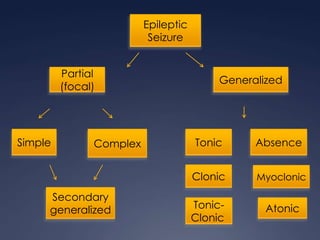
Epileptic
Seizure
Partial
(focal)
Generalized
Simple Complex
Tonic-
Clonic
Tonic Absence
Clonic
Atonic
Myoclonic
Secondary
generalized
Symptoms That May Indicate a
Seizure Disorder
 Periods of blackout or confused memory
 Occasional “fainting spells”
 Episodes of blank staring in children
 Sudden falls for no apparent reason
 Episodes of blinking or chewing at
inappropriate times
13
Seizure Triggers
* Missed medication (#1 reason)
* Stress/anxiety
* Hormonal changes
* Dehydration
* Lack of sleep/extreme fatigue
* Photosensitivity
* Drug/alcohol use; drug
interactions
14
First Aid for Seizures
 Stay calm and track time
 Do not restrain person, but help them avoid hazards
 Protect head, remove glasses, loosen tight neckwear
 Move anything hard or sharp out of the way
 Turn person on one side, position mouth to ground
 Check for epilepsy or seizure disorder ID
 Understand that verbal instructions may not be obeyed
 Stay until person is fully aware and help reorient them
 Call ambulance if seizure lasts more than 5 minutes or if it
is unknown whether the person has had prior seizures
15
Potentially Dangerous
Responses to Seizure
DO NOT
 Do not: Put anything in the person’s mouth
 Do not: Try to hold down or restrain the person
 Do not: Attempt to give oral antiseizure medication
 Do: Keep the person on their back with their face up
during the seizure
16
When to Call 911 or Emergency
Medical Services
* A convulsive seizure occurs in a person not
known to have seizures or lasts more than 5
minutes
* A complex partial seizure lasts more than 5
minutes BEYOND its usual duration for the
individual
* Another seizure begins before the person
regains consciousness
* Also call if the person:
* Is injured or pregnant
* Has diabetes/other medical condition
* Recovers slowly
* Does not resume normal breathing
17
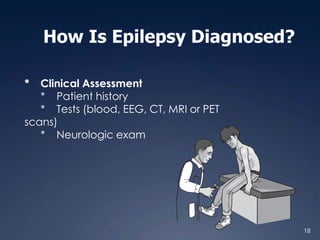
How Is Epilepsy Diagnosed?
* Clinical Assessment
* Patient history
* Tests (blood, EEG, CT, MRI or PET
scans)
* Neurologic exam
18
What to Tell Your Doctor About
Your Seizures
 Symptoms
 Seizure patterns: ? Seizure clusters
 Pre-seizure activity (if any)
 How well is your medication working?
 Medication side effects
Keep a seizure record
19
Treatment Goals in Epilepsy
 No or as few as seizures as possible
 No or acceptable side effects from anti-seizure
medication
 Help person with epilepsy lead full and
productive life
20
What factors influence our decision
to treat with medication?
 We don’t have to treat a first provoked
seizure if provoking factor removed (low
blood sugar, illicit drugs)
 For an unprovoked seizure
 Treat if first presentation was status epilepticus (i.e
a prolonged seizure)
 Most doctors will treat after second seizure:
 Consider treating after first seizure.
 Exam, EEG, MRI
 Patient preference
 Other Epilepsy risk factors including family history.
2007 21
22
Types of Treatment
 Medication
 Surgery
 Nonpharmacologic treatment
 Ketogenic diet-not useful in adults
 Vagus nerve stimulation
 Lifestyle modifications
23
Factors That Affect the
Choice of Drug
 Seizure type/
Epilepsy syndrome
 Side effects
 Patient age
 Lifestyle
 Childbearing
potential
 Other
medications
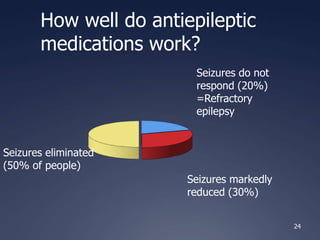
How well do antiepileptic
medications work?
Seizures eliminated
(50% of people)
Seizures markedly
reduced (30%)
Seizures do not
respond (20%)
=Refractory
epilepsy
24
What factors influence how well
patients respond to antiepileptic
medications?
 Consistent use
 Inadequate dosage or ineffective
medication
 Drug factors
 Disease
2007 25
26
Tolerating Medications
Most Common Side Effects
 Rash
 Clumsiness
 Drowsiness
 Irritability
 Nausea
Warning Signs of Possible
Serious Side Effects
 Prolonged fever
 Rash, nausea/vomiting
 Severe sore throat
 Mouth ulcers
 Easy bruising
 Pinpoint bleeding
 Weakness
 Fatigue
 Swollen glands
 Lack of appetite
 Abdominal pain
 Side effects may be related to
dose
 Care must be taken in
discontinuing drug due to risk of
seizure recurrence
27
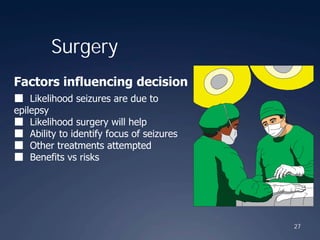
Surgery
Factors influencing decision
■ Likelihood seizures are due to
epilepsy
■ Likelihood surgery will help
■ Ability to identify focus of seizures
■ Other treatments attempted
■ Benefits vs risks
28
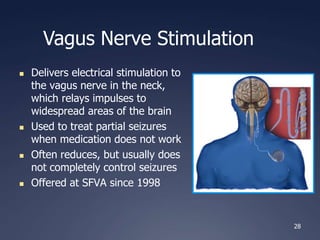
Vagus Nerve Stimulation
 Delivers electrical stimulation to
the vagus nerve in the neck,
which relays impulses to
widespread areas of the brain
 Used to treat partial seizures
when medication does not work
 Often reduces, but usually does
not completely control seizures
 Offered at SFVA since 1998

29
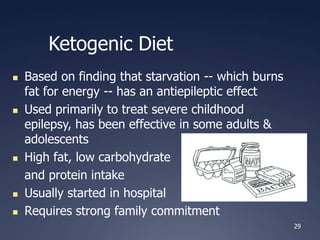
Ketogenic Diet
 Based on finding that starvation -- which burns
fat for energy -- has an antiepileptic effect
 Used primarily to treat severe childhood
epilepsy, has been effective in some adults &
adolescents
 High fat, low carbohydrate
and protein intake
 Usually started in hospital
 Requires strong family commitment
30
Effect of Epilepsy on Family
• Activity restrictions
• Financial stress
• Mood and emotions
31
Epilepsy in Women
■ Hormonal effects
■ Hormonal changes during puberty, menopause,
and the monthly cycle may affect seizure frequency
■ Polycystic ovary syndrome
■ Sexuality & contraception
■ Sexual dysfunction
■ Birth control pills may be less effective
■ Pregnancy & motherhood
■ Need to continue medication
■ Slight increased risk for birth defects
32
Epilepsy in Older Adults
■ Epilepsy is common in the elderly, and
is often unrecognized or misdiagnosed
■ Special issues:
■ increased susceptibility to side
effects
■ Interactions with other medications
Driving and Epilepsy
All states have different laws
In CA, report any seizure to the
Department of Public Health (DPH)
 DPH informs DMV, hearing arranged
 Doctor fills out Driver Med Eval (DME)
 DMV Medical Officer ultimately decides if
license gets suspended, guided by DME
Typically 6 months seizure free (on
or off AEDs) before lifting suspension
Resources
 VA Epilepsy Website
 www.epilpesy.va.gov
 Epilepsy Foundation Website
 www.epilepsynorcal.org
 Epilepsy.com
34

Introduction to Seizures and Epilepsy

  • 1.
    Introduction to Seizures andEpilepsy Sarah Shalev, M.D. Epilepsy Fellow University of California at San Francisco 1
  • 2.
    San Francisco VA EpilepsyCenter of Excellence: State-of-the-Art Diagnostic & Therapeutic Services Nina Garga, M.D. John Hixson, M.D. William Marks, M.D. Karen L. Parko, M.D.
  • 3.
  • 4.
    SFVA Epilepsy Center •Established in 1997 to provide Veteran patients with access to specialized epilepsy care • Designated as one of four national Centers of Excellence in 2002 • Named as a regional Epilepsy Center of Excellence site by in 2008
  • 5.
    SFVA Epilepsy Center •Outpatient consultation and long-term care • Video/EEG Monitoring on inpatient Epilepsy Monitoring Unit • High-resolution neuroimaging • Expert pharmacological treatment • Device-based therapy (vagus nerve stimulation) • Epilepsy surgery • Experimental treatments
  • 6.
    6 What Is theDifference Between Epilepsy & Seizures?  Epilepsy is a disorder characterized by recurring seizures (also known as “seizure disorder”)  A seizure is a brief, temporary disturbance in the electrical activity of the brain
  • 7.
    Who Has Epilepsy? About 2.3 million Americans have epilepsy  Roughly 181,000 new cases of seizures and epilepsy occur each year  50% of people with epilepsy develop seizures by the age of 25; however, anyone can get epilepsy at any time  Now there are as many people with epilepsy who are 60 or older as children aged 10 or younger 7
  • 8.
    8 Groups at IncreasedRisk for Epilepsy  About 1% of the general population develops epilepsy  The risk is higher in people with certain medical conditions:  Traumatic Brain Injury  Stroke  Alzheimer’s disease  Autism  Brain Tumors or blood vessel abnormalities
  • 9.
    What Causes Epilepsy? In about 70% of people with epilepsy, the cause is not known  In the remaining 30%, the most common causes are:  Head trauma  Infection of brain  Brain tumor and stroke  Heredity 9
  • 10.
    The Brain Isthe Source of Epilepsy 10 • All brain functions -- including feeling, seeing, thinking, and moving muscles -- depend on electrical signals passed between nerve cells in the brain • A seizure occurs when too many nerve cells in the brain “fire” too quickly causing an “electrical storm”
  • 11.
    11 Seizure Types  Aperson with epilepsy may have more than one seizure type.  Seizures that began early in life may change as the child grows older.
  • 12.
  • 13.
    Symptoms That MayIndicate a Seizure Disorder  Periods of blackout or confused memory  Occasional “fainting spells”  Episodes of blank staring in children  Sudden falls for no apparent reason  Episodes of blinking or chewing at inappropriate times 13
  • 14.
    Seizure Triggers * Missedmedication (#1 reason) * Stress/anxiety * Hormonal changes * Dehydration * Lack of sleep/extreme fatigue * Photosensitivity * Drug/alcohol use; drug interactions 14
  • 15.
    First Aid forSeizures  Stay calm and track time  Do not restrain person, but help them avoid hazards  Protect head, remove glasses, loosen tight neckwear  Move anything hard or sharp out of the way  Turn person on one side, position mouth to ground  Check for epilepsy or seizure disorder ID  Understand that verbal instructions may not be obeyed  Stay until person is fully aware and help reorient them  Call ambulance if seizure lasts more than 5 minutes or if it is unknown whether the person has had prior seizures 15
  • 16.
    Potentially Dangerous Responses toSeizure DO NOT  Do not: Put anything in the person’s mouth  Do not: Try to hold down or restrain the person  Do not: Attempt to give oral antiseizure medication  Do: Keep the person on their back with their face up during the seizure 16
  • 17.
    When to Call911 or Emergency Medical Services * A convulsive seizure occurs in a person not known to have seizures or lasts more than 5 minutes * A complex partial seizure lasts more than 5 minutes BEYOND its usual duration for the individual * Another seizure begins before the person regains consciousness * Also call if the person: * Is injured or pregnant * Has diabetes/other medical condition * Recovers slowly * Does not resume normal breathing 17
  • 18.
    How Is EpilepsyDiagnosed? * Clinical Assessment * Patient history * Tests (blood, EEG, CT, MRI or PET scans) * Neurologic exam 18
  • 19.
    What to TellYour Doctor About Your Seizures  Symptoms  Seizure patterns: ? Seizure clusters  Pre-seizure activity (if any)  How well is your medication working?  Medication side effects Keep a seizure record 19
  • 20.
    Treatment Goals inEpilepsy  No or as few as seizures as possible  No or acceptable side effects from anti-seizure medication  Help person with epilepsy lead full and productive life 20
  • 21.
    What factors influenceour decision to treat with medication?  We don’t have to treat a first provoked seizure if provoking factor removed (low blood sugar, illicit drugs)  For an unprovoked seizure  Treat if first presentation was status epilepticus (i.e a prolonged seizure)  Most doctors will treat after second seizure:  Consider treating after first seizure.  Exam, EEG, MRI  Patient preference  Other Epilepsy risk factors including family history. 2007 21
  • 22.
    22 Types of Treatment Medication  Surgery  Nonpharmacologic treatment  Ketogenic diet-not useful in adults  Vagus nerve stimulation  Lifestyle modifications
  • 23.
    23 Factors That Affectthe Choice of Drug  Seizure type/ Epilepsy syndrome  Side effects  Patient age  Lifestyle  Childbearing potential  Other medications
  • 24.
    How well doantiepileptic medications work? Seizures eliminated (50% of people) Seizures markedly reduced (30%) Seizures do not respond (20%) =Refractory epilepsy 24
  • 25.
    What factors influencehow well patients respond to antiepileptic medications?  Consistent use  Inadequate dosage or ineffective medication  Drug factors  Disease 2007 25
  • 26.
    26 Tolerating Medications Most CommonSide Effects  Rash  Clumsiness  Drowsiness  Irritability  Nausea Warning Signs of Possible Serious Side Effects  Prolonged fever  Rash, nausea/vomiting  Severe sore throat  Mouth ulcers  Easy bruising  Pinpoint bleeding  Weakness  Fatigue  Swollen glands  Lack of appetite  Abdominal pain  Side effects may be related to dose  Care must be taken in discontinuing drug due to risk of seizure recurrence
  • 27.
    27 Surgery Factors influencing decision ■Likelihood seizures are due to epilepsy ■ Likelihood surgery will help ■ Ability to identify focus of seizures ■ Other treatments attempted ■ Benefits vs risks
  • 28.
    28 Vagus Nerve Stimulation Delivers electrical stimulation to the vagus nerve in the neck, which relays impulses to widespread areas of the brain  Used to treat partial seizures when medication does not work  Often reduces, but usually does not completely control seizures  Offered at SFVA since 1998 
  • 29.
    29 Ketogenic Diet  Basedon finding that starvation -- which burns fat for energy -- has an antiepileptic effect  Used primarily to treat severe childhood epilepsy, has been effective in some adults & adolescents  High fat, low carbohydrate and protein intake  Usually started in hospital  Requires strong family commitment
  • 30.
    30 Effect of Epilepsyon Family • Activity restrictions • Financial stress • Mood and emotions
  • 31.
    31 Epilepsy in Women ■Hormonal effects ■ Hormonal changes during puberty, menopause, and the monthly cycle may affect seizure frequency ■ Polycystic ovary syndrome ■ Sexuality & contraception ■ Sexual dysfunction ■ Birth control pills may be less effective ■ Pregnancy & motherhood ■ Need to continue medication ■ Slight increased risk for birth defects
  • 32.
    32 Epilepsy in OlderAdults ■ Epilepsy is common in the elderly, and is often unrecognized or misdiagnosed ■ Special issues: ■ increased susceptibility to side effects ■ Interactions with other medications
  • 33.
    Driving and Epilepsy Allstates have different laws In CA, report any seizure to the Department of Public Health (DPH)  DPH informs DMV, hearing arranged  Doctor fills out Driver Med Eval (DME)  DMV Medical Officer ultimately decides if license gets suspended, guided by DME Typically 6 months seizure free (on or off AEDs) before lifting suspension
  • 34.
    Resources  VA EpilepsyWebsite  www.epilpesy.va.gov  Epilepsy Foundation Website  www.epilepsynorcal.org  Epilepsy.com 34