
Avinash ChandraAvinash Chandra
Annapurna Neurological Institute and AlliedAnnapurna Neurological Institute and Allied
Management of IntractableManagement of Intractable
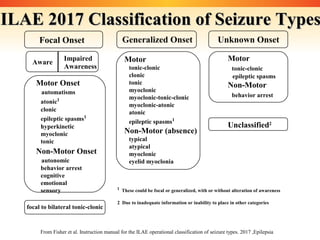
Motor
tonic-clonic
clonic
tonic
myoclonic
myoclonic-tonic-clonic
myoclonic-atonic
atonic
epileptic spasms1
Non-Motor (absence)
typical
atypical
myoclonic
eyelid myoclonia
Unknown Onset
Motor Onset
automatisms
atonic1
clonic
epileptic spasms1
hyperkinetic
myoclonic
tonic
Non-Motor Onset
autonomic
behavior arrest
cognitive
emotional
sensory
focal to bilateral tonic-clonic
Generalized OnsetFocal Onset
Aware
Impaired
Awareness
Motor
tonic-clonic
epileptic spasms
Non-Motor
behavior arrest
ILAE 2017 Classification of Seizure TypesILAE 2017 Classification of Seizure Types
Unclassified2
1
These could be focal or generalized, with or without alteration of awareness
2 Due to inadequate information or inability to place in other categories
From Fisher et al. Instruction manual for the ILAE operational classification of seizure types. 2017 ,Epilepsia
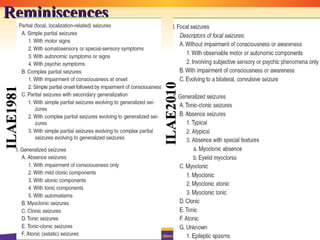
ReminiscencesReminiscencesILAE1981ILAE1981
ILAE2010ILAE2010
ClassificationClassification
Non Localized
Idiopathic
(cryptogenic)
Symptomatic
(known or CNS cause)
PathophysiologyPathophysiology
IncidenceIncidence
4% of the population
1% of the population
0.4% of the population
80% has epileptogenic focus
WHO, 2017 Feb update
Shorvon et al., 1996 Epilepsia
Epilepsy
First seizure ever
Epilepsy
(intractable)
Intractable SeizureIntractable Seizure
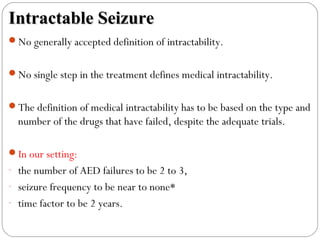
No generally accepted definition of intractability.
No single step in the treatment defines medical intractability.
The definition of medical intractability has to be based on the type and
number of the drugs that have failed, despite the adequate trials.
In our setting:
- the number of AED failures to be 2 to 3,
- seizure frequency to be near to none*
- time factor to be 2 years.
Intractable SeizureIntractable Seizure
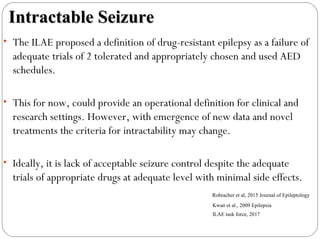
• The ILAE proposed a definition of drug-resistant epilepsy as a failure of
adequate trials of 2 tolerated and appropriately chosen and used AED
schedules.
• This for now, could provide an operational definition for clinical and
research settings. However, with emergence of new data and novel
treatments the criteria for intractability may change.
• Ideally, it is lack of acceptable seizure control despite the adequate
trials of appropriate drugs at adequate level with minimal side effects.
Rohracher et al, 2015 Journal of Epileptology
Kwan et al., 2009 Epilepsia
ILAE task force, 2017
Risk of intractibility against the time
Berg et al., 2001 Neurology
Time in months
Riskin%
Intractable SeizureIntractable Seizure
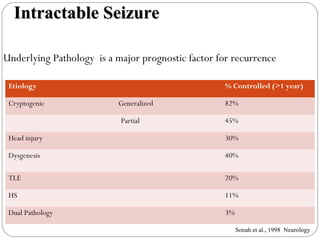
Underlying Pathology is a major prognostic factor for recurrence
Etiology % Controlled (>1 year)
Cryptogenic Generalized 82%
Partial 45%
Head injury 30%
Dysgenesis 40%
TLE 20%
HS 11%
Dual Pathology 3%
Sonah et al., 1998 Neurology
What Are Today’s Clinical Needs?What Are Today’s Clinical Needs?
Current status of epilepsy treatment
 When to consider intractable
How many of them intractable
Impact of newer drugs/ newer trials on intractable
Quantifying IntractableQuantifying Intractable
Sufficient Number of Drug Trials: 2 to 4 major drugs at maximal
tolerated drugs and 6 combinations. (Spectrum of opinions!)
If one AED doesn’t work at maximal tolerated dosage, take that out!!
Frequency change in epileptic attacks.%controlled
No. of drugs
What if Left Uncontrolled…?What if Left Uncontrolled…?
 Quality of life (psychological, social, occupational..)
 Interictal dysfunction (learning, memory..)
 Increasing risk of SUDEP
Progressive neurological dysfunction(Epileptic
encephalopathy)
Kindling Effect
Neuropsychiatric comorbities
 Placing substantial burden on the individuals, carers
Management StrategyManagement Strategy
AEDs
polypharmacotherapies
Surgical
 removal of epileptogenic foci
disconnecting inter-transmissions
Vagus nerve stimulation
Diet
ketogenic diet
An Ideal Antiepileptic DrugAn Ideal Antiepileptic Drug
Prevent or inhibit excessive pathological neuronal discharge
Does not interfere with normal physiological neuronal activity
Free of adverse effect
Does not exist!!!!
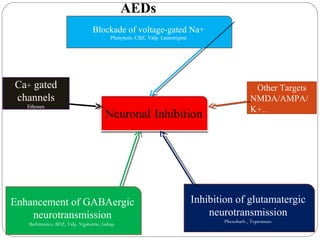
AEDs
Blockade of voltage-gated Na+
Phenytoin, CBZ, Valp. Lamotrigine
Inhibition of glutamatergic
neurotransmission
Phenobarb., Topiramate
Enhancement of GABAergic
neurotransmission
Barbiturates, BDZ, Valp. Vigabatrin, Gabap.
Ca+ gated
channels
Ethosux
Other Targets
NMDA/AMPA/
K+..
Chronological development of AEDs
Golyala et al, Seizure 2017
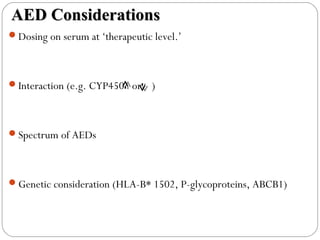
AED ConsiderationsAED Considerations
Dosing on serum at ‘therapeutic level.’
Interaction (e.g. CYP450 or )
Spectrum of AEDs
Genetic consideration (HLA-B* 1502, P-glycoproteins, ABCB1)
Adjunctive AEDs – Focal OnsetAdjunctive AEDs – Focal Onset
AAN guideline (refractory partial )Update 2017
Adult Children
Levetiracetam √
Oxcarbazepine/CBZ √ √
Lamotrigine √ √
Topiramate √ √
Zonisamide √
Tiagabine √
Gabapentin √ √
LevelALevelA
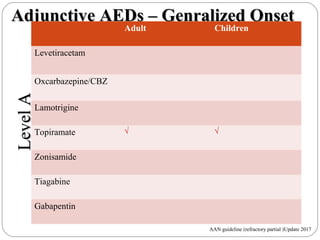
Adjunctive AEDs – Genralized OnsetAdjunctive AEDs – Genralized Onset
AAN guideline (refractory partial )Update 2017
Adult Children
Levetiracetam
Oxcarbazepine/CBZ
Lamotrigine
Topiramate √ √
Zonisamide
Tiagabine
Gabapentin
LevelALevelA
Impact of AEDs on IntractabilityImpact of AEDs on Intractability
AED Seizure Syndrome Observation
period
Seizure Free Our Experience
Levetiracetam Focal onset 16 weeks 5.7%
14 weeks 8.2% 4 out of 6
12 weeks 8.2%
Generalized onset 16 weeks 15.6%
12 weeks 3 out of 3
Vigabatrin Focal onset 12 weeks 6%
Not categorized N/A 50%
Clobazam Not categorized 48 weeks 8%
Focal/impaired awareness 12 weeks 74% 3 out of 3
Generalized onset 48 weeks 15%
12 weeks 3 out of 8
Acetazolamide Focal onset 12 weeks 44%
CBZ+Valproat
e
Focal to Genaralized tonic
clonic
48 months 38%
12 weeks 6 out of 7
Controlled Randomized Clinical Trial of EpilepsyControlled Randomized Clinical Trial of Epilepsy
SurgerySurgery
Surgical treatment for epilepsy has offered the chance of cure or greater
cure for this disorder.
• Single center trial, 116 children refractory (medical therapy group 59,
surgery group 57). Outcome, seizure free 12 months- 7 % vs 77%
• Single center trial, for TLE, 80 Adults (medical 40, TLE surgery 40).
Outcome, seizure free 12 months 58% vs 8%
Dwivedi et al., 2017 NEJM
Weibe et al., 2001 NEJM
WorkflowWorkflow
ConsiderEpilepsySurgeryiffitscriteria
Questions??Questions??

Intractable seizure

  • 1.
    Avinash ChandraAvinash Chandra AnnapurnaNeurological Institute and AlliedAnnapurna Neurological Institute and Allied Management of IntractableManagement of Intractable
  • 2.
    Motor tonic-clonic clonic tonic myoclonic myoclonic-tonic-clonic myoclonic-atonic atonic epileptic spasms1 Non-Motor (absence) typical atypical myoclonic eyelidmyoclonia Unknown Onset Motor Onset automatisms atonic1 clonic epileptic spasms1 hyperkinetic myoclonic tonic Non-Motor Onset autonomic behavior arrest cognitive emotional sensory focal to bilateral tonic-clonic Generalized OnsetFocal Onset Aware Impaired Awareness Motor tonic-clonic epileptic spasms Non-Motor behavior arrest ILAE 2017 Classification of Seizure TypesILAE 2017 Classification of Seizure Types Unclassified2 1 These could be focal or generalized, with or without alteration of awareness 2 Due to inadequate information or inability to place in other categories From Fisher et al. Instruction manual for the ILAE operational classification of seizure types. 2017 ,Epilepsia
  • 3.
  • 4.
  • 5.
  • 6.
    IncidenceIncidence 4% of thepopulation 1% of the population 0.4% of the population 80% has epileptogenic focus WHO, 2017 Feb update Shorvon et al., 1996 Epilepsia Epilepsy First seizure ever Epilepsy (intractable)
  • 7.
    Intractable SeizureIntractable Seizure Nogenerally accepted definition of intractability. No single step in the treatment defines medical intractability. The definition of medical intractability has to be based on the type and number of the drugs that have failed, despite the adequate trials. In our setting: - the number of AED failures to be 2 to 3, - seizure frequency to be near to none* - time factor to be 2 years.
  • 8.
    Intractable SeizureIntractable Seizure •The ILAE proposed a definition of drug-resistant epilepsy as a failure of adequate trials of 2 tolerated and appropriately chosen and used AED schedules. • This for now, could provide an operational definition for clinical and research settings. However, with emergence of new data and novel treatments the criteria for intractability may change. • Ideally, it is lack of acceptable seizure control despite the adequate trials of appropriate drugs at adequate level with minimal side effects. Rohracher et al, 2015 Journal of Epileptology Kwan et al., 2009 Epilepsia ILAE task force, 2017
  • 9.
    Risk of intractibilityagainst the time Berg et al., 2001 Neurology Time in months Riskin%
  • 10.
    Intractable SeizureIntractable Seizure UnderlyingPathology is a major prognostic factor for recurrence Etiology % Controlled (>1 year) Cryptogenic Generalized 82% Partial 45% Head injury 30% Dysgenesis 40% TLE 20% HS 11% Dual Pathology 3% Sonah et al., 1998 Neurology
  • 12.
    What Are Today’sClinical Needs?What Are Today’s Clinical Needs? Current status of epilepsy treatment  When to consider intractable How many of them intractable Impact of newer drugs/ newer trials on intractable
  • 13.
    Quantifying IntractableQuantifying Intractable SufficientNumber of Drug Trials: 2 to 4 major drugs at maximal tolerated drugs and 6 combinations. (Spectrum of opinions!) If one AED doesn’t work at maximal tolerated dosage, take that out!! Frequency change in epileptic attacks.%controlled No. of drugs
  • 14.
    What if LeftUncontrolled…?What if Left Uncontrolled…?  Quality of life (psychological, social, occupational..)  Interictal dysfunction (learning, memory..)  Increasing risk of SUDEP Progressive neurological dysfunction(Epileptic encephalopathy) Kindling Effect Neuropsychiatric comorbities  Placing substantial burden on the individuals, carers
  • 16.
    Management StrategyManagement Strategy AEDs polypharmacotherapies Surgical removal of epileptogenic foci disconnecting inter-transmissions Vagus nerve stimulation Diet ketogenic diet
  • 17.
    An Ideal AntiepilepticDrugAn Ideal Antiepileptic Drug Prevent or inhibit excessive pathological neuronal discharge Does not interfere with normal physiological neuronal activity Free of adverse effect Does not exist!!!!
  • 18.
    AEDs Blockade of voltage-gatedNa+ Phenytoin, CBZ, Valp. Lamotrigine Inhibition of glutamatergic neurotransmission Phenobarb., Topiramate Enhancement of GABAergic neurotransmission Barbiturates, BDZ, Valp. Vigabatrin, Gabap. Ca+ gated channels Ethosux Other Targets NMDA/AMPA/ K+..
  • 19.
    Chronological development ofAEDs Golyala et al, Seizure 2017
  • 20.
    AED ConsiderationsAED Considerations Dosingon serum at ‘therapeutic level.’ Interaction (e.g. CYP450 or ) Spectrum of AEDs Genetic consideration (HLA-B* 1502, P-glycoproteins, ABCB1)
  • 21.
    Adjunctive AEDs –Focal OnsetAdjunctive AEDs – Focal Onset AAN guideline (refractory partial )Update 2017 Adult Children Levetiracetam √ Oxcarbazepine/CBZ √ √ Lamotrigine √ √ Topiramate √ √ Zonisamide √ Tiagabine √ Gabapentin √ √ LevelALevelA
  • 22.
    Adjunctive AEDs –Genralized OnsetAdjunctive AEDs – Genralized Onset AAN guideline (refractory partial )Update 2017 Adult Children Levetiracetam Oxcarbazepine/CBZ Lamotrigine Topiramate √ √ Zonisamide Tiagabine Gabapentin LevelALevelA
  • 23.
    Impact of AEDson IntractabilityImpact of AEDs on Intractability AED Seizure Syndrome Observation period Seizure Free Our Experience Levetiracetam Focal onset 16 weeks 5.7% 14 weeks 8.2% 4 out of 6 12 weeks 8.2% Generalized onset 16 weeks 15.6% 12 weeks 3 out of 3 Vigabatrin Focal onset 12 weeks 6% Not categorized N/A 50% Clobazam Not categorized 48 weeks 8% Focal/impaired awareness 12 weeks 74% 3 out of 3 Generalized onset 48 weeks 15% 12 weeks 3 out of 8 Acetazolamide Focal onset 12 weeks 44% CBZ+Valproat e Focal to Genaralized tonic clonic 48 months 38% 12 weeks 6 out of 7
  • 24.
    Controlled Randomized ClinicalTrial of EpilepsyControlled Randomized Clinical Trial of Epilepsy SurgerySurgery Surgical treatment for epilepsy has offered the chance of cure or greater cure for this disorder. • Single center trial, 116 children refractory (medical therapy group 59, surgery group 57). Outcome, seizure free 12 months- 7 % vs 77% • Single center trial, for TLE, 80 Adults (medical 40, TLE surgery 40). Outcome, seizure free 12 months 58% vs 8% Dwivedi et al., 2017 NEJM Weibe et al., 2001 NEJM
  • 25.
  • 26.

Editor's Notes

  • #8 One could define intractability as the probability of seizure control by further steps of 5% or less, like the p-value. The certainty that a patient will remain refractory to medications can only be approached in an asymptotic manner and
  • #9 Multiple factors including number of antiepileptic drug (AED) failures, seizure frequency and duration of unresponsiveness, etiology, and epilepsy syndromes are considered in formulating the definition of pharmaco-resistant epilepsy.
  • #14 A patient who has one seizure every 2 months or a patient who has one seizure every day will not require the same amount of time for you to decide that the drug has failed.
  • #15 Studies suggest that each year there are about 1.16 cases of SUDEP for every 1,000 people with epilepsy, although estimates vary.
  • #18 Even ingle seizure can be treated !!! Since anoxic damage created by seizure
  • #21 does not necessarily control the epilepsy. It simply provides the rough guide of response
  • #24 https://www.ncbi.nlm.nih.gov/pubmed/2492225 https://www.ncbi.nlm.nih.gov/pmc/articles/PMC3401646/ https://www.ncbi.nlm.nih.gov/pubmed/20117743 https://www.ncbi.nlm.nih.gov/pubmed/7642889 http://journals.sagepub.com/doi/abs/10.1177/088307389501000306?url_ver=Z39.88-2003&rfr_id=ori:rid:crossref.org&rfr_dat=cr_pub%3dpubmed