UNDERSTANDING
BUSINESS EXCELLENCE
FROM BALDRIGE’S PERSPECTIVE
Seta A. Wicaksana - Founder and CEO of - www.humanikaconsulting.com
INTRODUCTION
• This modules provides
the gateway to business
success.
• It explains in a simple manner
what Business Excellence (BE),
BE Models (BEMs), BE
Assessments and the benefits of
BE are.
WHAT IS BUSINESS EXCELLENCE?
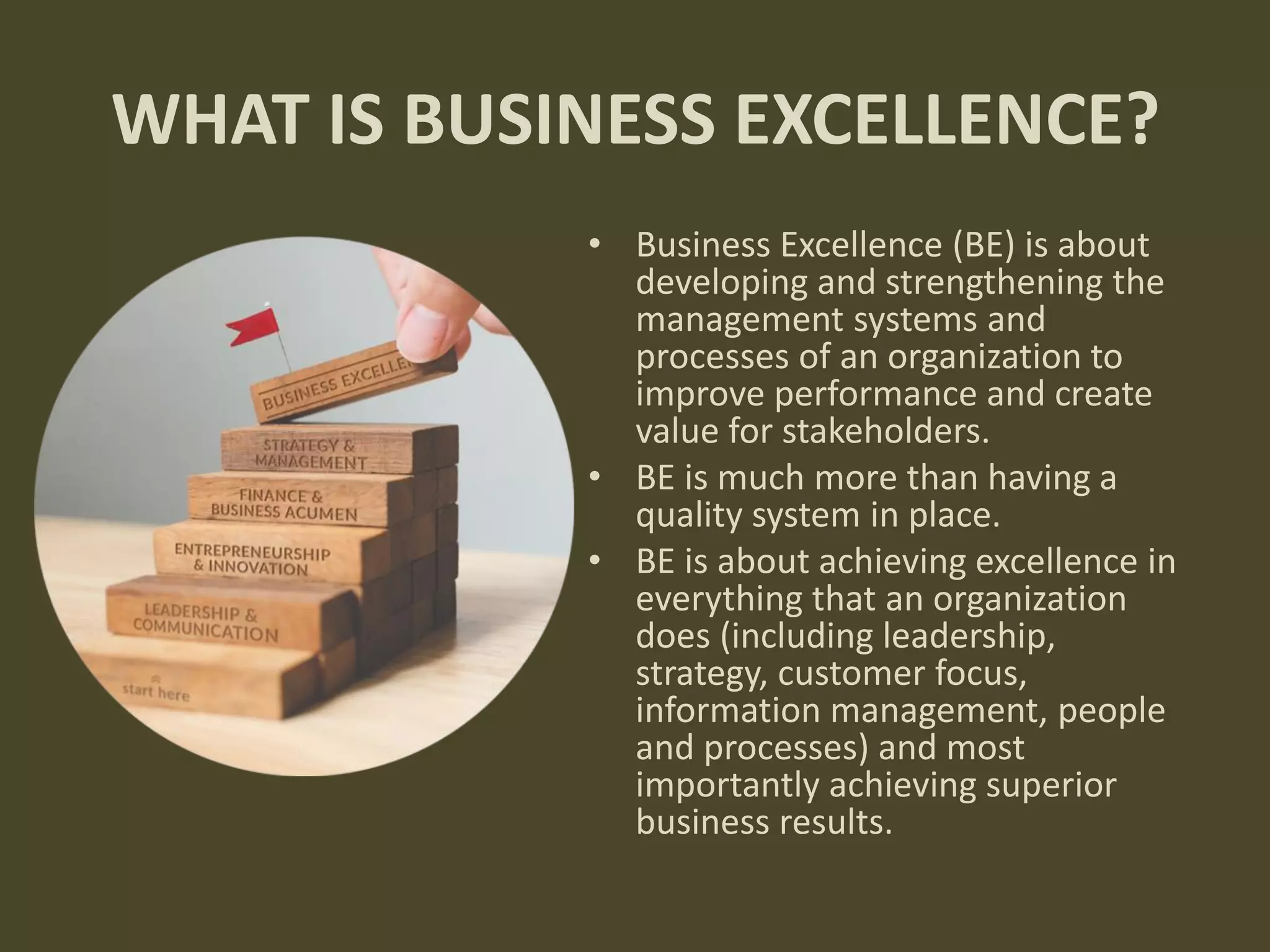
• Business Excellence (BE) is about
developing and strengthening the
management systems and
processes of an organization to
improve performance and create
value for stakeholders.
• BE is much more than having a
quality system in place.
• BE is about achieving excellence in
everything that an organization
does (including leadership,
strategy, customer focus,
information management, people
and processes) and most
importantly achieving superior
business results.
“Quality is never an
accident; it is always the
result of high intention,
sincere effort, intelligent
direction and skillful
execution; it represents
the wise choice of many
alternatives”.
William A. Foster
HOW GOOD IS YOUR ORGANIZATION?
Every organization desires to achieve higher levels of
performance. This leads to the following questions:
• Why are there high-performing
organizations? What did high-
performing organizations do to
achieve greater business results?
What do these organizations
practice that others do not? How
did they do it?
• How, then, do we achieve greater
business results for our own
organization? How and when do
we begin setting off on a brand
new journey?
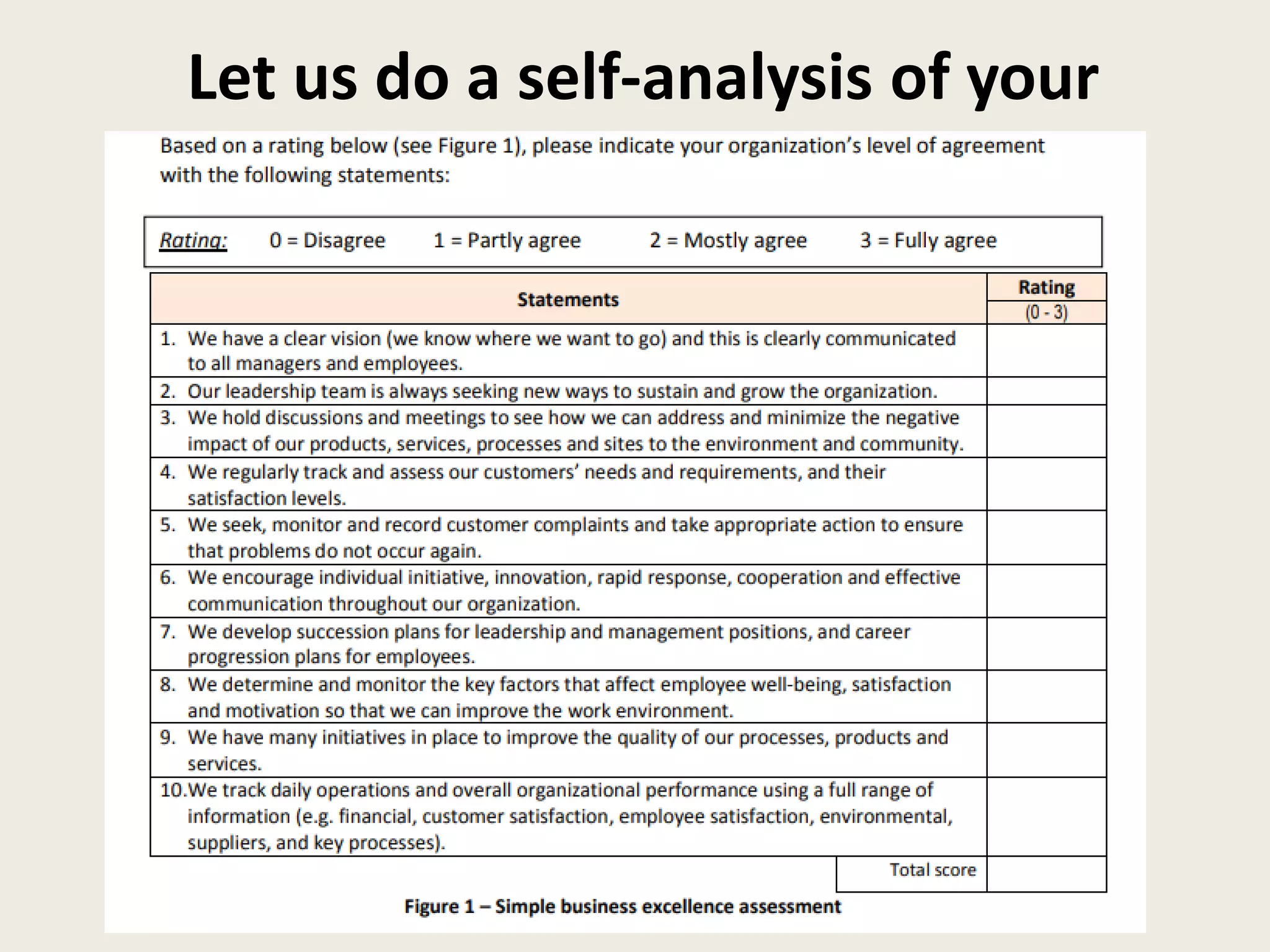
Let us do a self-analysis of your
organization
Now let us review what your score
means in terms of BE (see Figure 2).
To improve your score
consider the following:
• Review your organization’s mission and
vision with your employees, customers,
and other stakeholders. Try to make
your mission and vision inspiring and
easy to communicate.
• Have a meeting with your leaders and
managers and write down examples of
how they are implementing the mission
and vision, and discuss what more could
be done.
• Undertake a survey to assess whether
the development needs and well-being
of your people are being met. Identify a
few simple actions that can improve the
situation.
To improve your score
consider the following:
• Review the data and facts you use to support business
plans, decisions and daily management of the business. Do
you have too much data and too little time to make sense
of the data, or do you need more data so that decisions are
based on facts rather than gut feeling?
• Select one key process and assess whether it can be
improved. Begin with a blank piece of paper and consider if
you were developing the process today what should it look
like (draw a process flow chart) and the level of
performance you would expect. Compare this with what
you currently have to see if the process can be improved.
• Check that you have performance results for each key
stakeholder (shareholders, customers, employees,
suppliers, and local community). Ensure that someone is
responsible for recording and reporting these results on a
regular basis and can provide examples of actions they
have taken to improve the results. If no actions have been
taken then consider whether the measure is useful or if
someone needs to take greater responsibility for improving
performance in that area.
UNDERSTANDING
BUSINESS EXCELLENCE
it is necessary to understand
the core values and concepts
from which Business
Excellence Models (BEMs)
were derived. In this section,
the core values and
concepts, BEMs, and their
relationship are explained
along with a description of
how BE relates to the use of
other improvement
initiatives your organization
may be undertaking.
BE core values and concepts are the attributes, beliefs and/or behaviors that BE
organizations exhibit. They are the foundations of BE and are embedded into the
fabric of successful organizations. Core values and concepts of Baldrige Criteria for
Performance Excellence:
UNDERSTANDING BUSINESS EXCELLENCE:
Business Excellence Core Values and Concepts
• Visionary leadership: Your organization’s senior leaders should set directions and create a customer
focus, clear and visible organizational values, and high expectations for the workforce. The directions,
values, and expectations should balance the needs of all your stakeholders.
• Customer-driven excellence: Performance and quality are judged by an organization’s customers.
Thus, your organization must take into account all product features and characteristics and all modes
of customer access and support that contribute value to your customers.
• Organizational and personal learning: Achieving the highest levels of organizational performance
requires a well-executed approach to organizational and personal learning that includes sharing
knowledge via systematic processes. Organizational learning includes both continuous improvement
of existing approaches and significant change or innovation, leading to new goals and approaches.
• Valuing workforce members and partners: An organization’s success depends increasingly on an
engaged workforce that benefits from meaningful work, clear organizational direction, and
performance accountability and that has a safe, trusting, and cooperative environment.
• Agility: Success in today’s ever-changing, globally competitive environment demands agility - a
capacity for rapid change and flexibility.
UNDERSTANDING BUSINESS EXCELLENCE:
Business Excellence Core Values and Concepts
• Focus on the future: Ensuring an organization’s sustainability requires
understanding the short and longer term factors that affect your organization and
marketplace.
• Managing for innovation: Making meaningful change to improve an organization’s
products, services, programs, processes, operations, and business model to create
new value for the organization’s stakeholders.
• Management by fact: Organizations depend on the measurement and analysis of
performance. Such measurements should derive from business needs and
strategy, and they should provide critical data and information about key
processes, outputs, and results.
• Societal responsibility: An organization’s leaders should stress responsibilities to
the public, ethical behaviour, and the need to consider societal well-being and
benefit.
• Focus on results and creating value: An organization’s performance measurements
need to focus on key results. Results should be used to create and balance value
for your key stakeholders.
• Systems perspective: Managing your whole organization holistically and
understands how its components interact, and are aligned to achieve success.
What is a Business Excellence Model?
Business Excellence Models (BEMs)
were first called Total Quality
Management models. Today they
are usually referred to as Business
Excellence Models – this term helps
to communicate the importance of
“excellence” in all aspects of a
business, not only product and
process quality.
“If you can't describe what you are doing as a
process, you don't know what you're doing”.
W. Edwards Deming
Whilst scores are important for monitoring progress, the main value from using BEMs is that they help
organizations to clearly understand their strengths and opportunities for improvement for each
category and/or item. This information helps organizations to identify what they need to do to improve.
What is a Business Excellence Model?
1. Leadership: examines how your organization’s senior leaders’ personal actions guide and sustain your organization. Also
examined are your organization’s governance system and how your organization fulfills its legal, ethical, and societal
responsibilities and supports its key communities.
2. Strategic Planning: examines how your organization develops strategic objectives and action plans. Also examined are
how your chosen strategic objectives and action plans are implemented and changed if circumstances require, and how
progress is measured.
3. Customer Focus: examines how your organization engages its customers for long-term marketplace success. This
engagement strategy includes how your organization listens to the voice of its customers, builds customer relationships,
and uses customer information to improve and identify opportunities for innovation.
4. Measurement, Analysis, and Knowledge Management: examines how your organization selects, gathers, analyzes,
manages, and improves its data, information, and knowledge assets and how it manages its information technology. The
category also examines how your organization uses review findings to improve its performance.
5. Workforce Focus: examines your ability to assess workforce capability and capacity needs and build a workforce
environment conducive to high performance. The category also examines how your organization engages, manages, and
develops your workforce to utilize its full potential in alignment with your organization’s overall mission, strategy, and
action plans.
6. Operations Focus: examines how your organization designs, manages, and improves its work systems and work processes
to deliver customer value and achieve organizational success and sustainability. Also examined is your readiness for
emergencies.
7. Results: examines your organization’s performance and improvement in all key areas—product and process outcomes,
customer-focused outcomes, workforce-focused outcomes, leadership and governance outcomes, and financial and
market outcomes. Performance levels are examined relative to those of competitors and other organizations with similar
product offerings.
Weighting/scores Baldrige CPE
“If you want sustainability in an organization,
and you want to go from “great” to “really, really
great,” you’ve got to have some kind of a model .
. . and Baldrige is that model! . . . MidwayUSA
has benefitted tremendously from the Baldrige
Criteria: Our sales are up over 20 percent per
year over the last five years. Our profits are up
over 40 percent per year for that same time.
Customer satisfaction at 93 percent is at an all-
time high. Employee satisfaction at 82 percent is
at an alltime high also. All the winds are blowing
in the right direction at MidwayUSA and it’s all
because of our efforts in engaging the Baldrige
Criteria”.
Larry Potterfield CEO of MidwayUSA 2009
Baldrige Award recipient
http://www.nist.gov/baldrige/publications/uplo
ad/2011_2012_Business_Nonprofit_Criteria.pdf
The relationship between Business Excellence Models and Core
Values and Concepts
It is the core values and concepts that are important to embed inside an organization. The BE
processes and results are located at the outer rim of the core values. One can see from the figure
that the core values and concepts cut across and impact on all the BE processes and results. For
instance, “Managing for Innovation” is an important part of all BE processes. Therefore, it is
important to know:
1. How does the leadership team provide an
environment for innovation?
2. How do strategies encourage innovation in
products, operations, and service delivery?
3. How do operational processes enable the
achievement of innovative designs for
products and services?
4. How does listening to the customer,
identify opportunities for innovation?
5. How does comparing performance and
systems with other organizations assist
innovation and improvement?
6. How does organizational culture benefit
from the diverse ideas, cultures, and
thinking of a workforce?
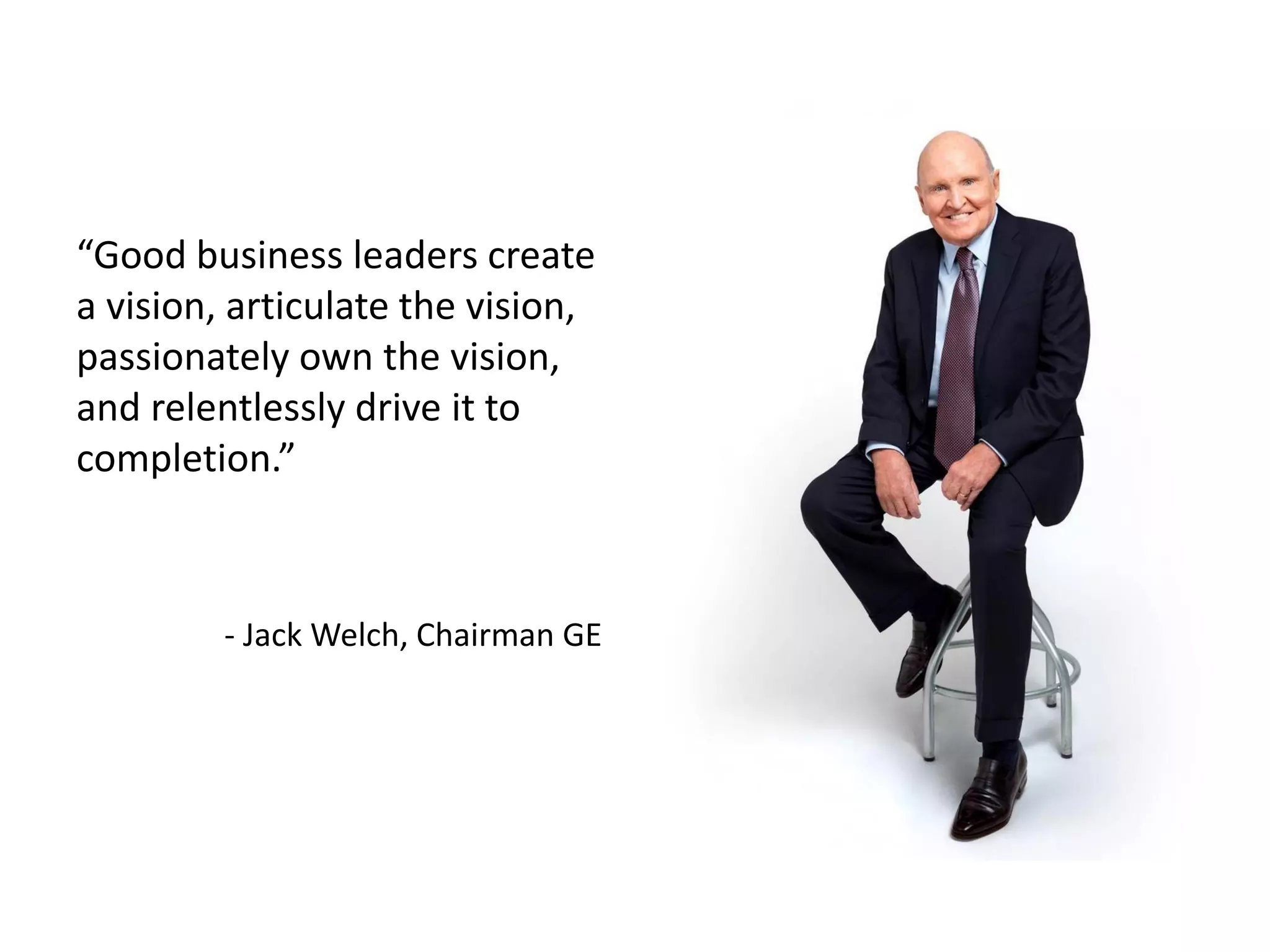
“Good business leaders create
a vision, articulate the vision,
passionately own the vision,
and relentlessly drive it to
completion.”
- Jack Welch, Chairman GE
Business Excellence Models as an
overarching framework
BE is not an initiative. BE is a management philosophy based around performance improvement and
meeting and surpassing stakeholder needs. It is a belief in a set of core values and concepts that
overtime have delivered success for many organizations. So, whether it is a large corporation, a
university, hospital or a small and medium enterprise, BE can be applied to boost organizational
performance.
THE BENEFITS OF BUSINESS EXCELLENCE FOR
SMALL AND MEDIUM ENTERPRISES
• BEMs help organizations to understand how well all the different functions, units, processes,
systems are working together to produce the desired business results. This helps managers and
employees to understand their business better and make better decisions I
• BEMs help managers and employees to have a common viewpoint on the health of their
organization and the key issues that are faced. This enables managers and employees to unite
together to tackle the issues and move the organization forward.
• BE helps SMEs to implement a cohesive improvement strategy which integrates a range of
improvement initiatives, tools and/or techniques such as Improvement Teams, Lean, Statistical
Process Control (SPC), ISO9001, ISO 14001 and Balanced Scorecard. BEMs can be used as an
overarching framework for managing and aligning various organizational improvement initiatives.
The adoption of the most appropriate improvement initiatives varies according to the
organizational situation and level of the organization’s maturity.
• BE helps organizations to address various business challenges. ‘Strategic Planning’ helps to
address changes in the business environment such as the financial crisis. 'Workforce focus' helps to
address human resources, cultural and social issues. 'Operations focus' helps to address multiple
legal requirements and international standards. 'Leadership' helps to address accountability,
corporate governance, environmental and societal issues.
• Many SMEs cannot afford to have independent directors or consultants to assess and appraise the
management and health of their organization on a regular basis. Regular BE self-assessments can
go some way in fulfilling this role and ensuring that due diligence is paid to the development of
the business and key risks are identified and addressed.
Learning and Giving for
Better Indonesia

Understanding Business Excellence

  • 1.
    UNDERSTANDING BUSINESS EXCELLENCE FROM BALDRIGE’SPERSPECTIVE Seta A. Wicaksana - Founder and CEO of - www.humanikaconsulting.com
  • 2.
    INTRODUCTION • This modulesprovides the gateway to business success. • It explains in a simple manner what Business Excellence (BE), BE Models (BEMs), BE Assessments and the benefits of BE are.
  • 3.
    WHAT IS BUSINESSEXCELLENCE? • Business Excellence (BE) is about developing and strengthening the management systems and processes of an organization to improve performance and create value for stakeholders. • BE is much more than having a quality system in place. • BE is about achieving excellence in everything that an organization does (including leadership, strategy, customer focus, information management, people and processes) and most importantly achieving superior business results.
  • 4.
    “Quality is neveran accident; it is always the result of high intention, sincere effort, intelligent direction and skillful execution; it represents the wise choice of many alternatives”. William A. Foster
  • 5.
    HOW GOOD ISYOUR ORGANIZATION? Every organization desires to achieve higher levels of performance. This leads to the following questions: • Why are there high-performing organizations? What did high- performing organizations do to achieve greater business results? What do these organizations practice that others do not? How did they do it? • How, then, do we achieve greater business results for our own organization? How and when do we begin setting off on a brand new journey?
  • 6.
    Let us doa self-analysis of your organization
  • 7.
    Now let usreview what your score means in terms of BE (see Figure 2).
  • 8.
    To improve yourscore consider the following: • Review your organization’s mission and vision with your employees, customers, and other stakeholders. Try to make your mission and vision inspiring and easy to communicate. • Have a meeting with your leaders and managers and write down examples of how they are implementing the mission and vision, and discuss what more could be done. • Undertake a survey to assess whether the development needs and well-being of your people are being met. Identify a few simple actions that can improve the situation.
  • 9.
    To improve yourscore consider the following: • Review the data and facts you use to support business plans, decisions and daily management of the business. Do you have too much data and too little time to make sense of the data, or do you need more data so that decisions are based on facts rather than gut feeling? • Select one key process and assess whether it can be improved. Begin with a blank piece of paper and consider if you were developing the process today what should it look like (draw a process flow chart) and the level of performance you would expect. Compare this with what you currently have to see if the process can be improved. • Check that you have performance results for each key stakeholder (shareholders, customers, employees, suppliers, and local community). Ensure that someone is responsible for recording and reporting these results on a regular basis and can provide examples of actions they have taken to improve the results. If no actions have been taken then consider whether the measure is useful or if someone needs to take greater responsibility for improving performance in that area.
  • 10.
    UNDERSTANDING BUSINESS EXCELLENCE it isnecessary to understand the core values and concepts from which Business Excellence Models (BEMs) were derived. In this section, the core values and concepts, BEMs, and their relationship are explained along with a description of how BE relates to the use of other improvement initiatives your organization may be undertaking.
  • 11.
    BE core valuesand concepts are the attributes, beliefs and/or behaviors that BE organizations exhibit. They are the foundations of BE and are embedded into the fabric of successful organizations. Core values and concepts of Baldrige Criteria for Performance Excellence: UNDERSTANDING BUSINESS EXCELLENCE: Business Excellence Core Values and Concepts • Visionary leadership: Your organization’s senior leaders should set directions and create a customer focus, clear and visible organizational values, and high expectations for the workforce. The directions, values, and expectations should balance the needs of all your stakeholders. • Customer-driven excellence: Performance and quality are judged by an organization’s customers. Thus, your organization must take into account all product features and characteristics and all modes of customer access and support that contribute value to your customers. • Organizational and personal learning: Achieving the highest levels of organizational performance requires a well-executed approach to organizational and personal learning that includes sharing knowledge via systematic processes. Organizational learning includes both continuous improvement of existing approaches and significant change or innovation, leading to new goals and approaches. • Valuing workforce members and partners: An organization’s success depends increasingly on an engaged workforce that benefits from meaningful work, clear organizational direction, and performance accountability and that has a safe, trusting, and cooperative environment. • Agility: Success in today’s ever-changing, globally competitive environment demands agility - a capacity for rapid change and flexibility.
  • 12.
    UNDERSTANDING BUSINESS EXCELLENCE: BusinessExcellence Core Values and Concepts • Focus on the future: Ensuring an organization’s sustainability requires understanding the short and longer term factors that affect your organization and marketplace. • Managing for innovation: Making meaningful change to improve an organization’s products, services, programs, processes, operations, and business model to create new value for the organization’s stakeholders. • Management by fact: Organizations depend on the measurement and analysis of performance. Such measurements should derive from business needs and strategy, and they should provide critical data and information about key processes, outputs, and results. • Societal responsibility: An organization’s leaders should stress responsibilities to the public, ethical behaviour, and the need to consider societal well-being and benefit. • Focus on results and creating value: An organization’s performance measurements need to focus on key results. Results should be used to create and balance value for your key stakeholders. • Systems perspective: Managing your whole organization holistically and understands how its components interact, and are aligned to achieve success.
  • 13.
    What is aBusiness Excellence Model? Business Excellence Models (BEMs) were first called Total Quality Management models. Today they are usually referred to as Business Excellence Models – this term helps to communicate the importance of “excellence” in all aspects of a business, not only product and process quality.
  • 14.
    “If you can'tdescribe what you are doing as a process, you don't know what you're doing”. W. Edwards Deming
  • 15.
    Whilst scores areimportant for monitoring progress, the main value from using BEMs is that they help organizations to clearly understand their strengths and opportunities for improvement for each category and/or item. This information helps organizations to identify what they need to do to improve. What is a Business Excellence Model? 1. Leadership: examines how your organization’s senior leaders’ personal actions guide and sustain your organization. Also examined are your organization’s governance system and how your organization fulfills its legal, ethical, and societal responsibilities and supports its key communities. 2. Strategic Planning: examines how your organization develops strategic objectives and action plans. Also examined are how your chosen strategic objectives and action plans are implemented and changed if circumstances require, and how progress is measured. 3. Customer Focus: examines how your organization engages its customers for long-term marketplace success. This engagement strategy includes how your organization listens to the voice of its customers, builds customer relationships, and uses customer information to improve and identify opportunities for innovation. 4. Measurement, Analysis, and Knowledge Management: examines how your organization selects, gathers, analyzes, manages, and improves its data, information, and knowledge assets and how it manages its information technology. The category also examines how your organization uses review findings to improve its performance. 5. Workforce Focus: examines your ability to assess workforce capability and capacity needs and build a workforce environment conducive to high performance. The category also examines how your organization engages, manages, and develops your workforce to utilize its full potential in alignment with your organization’s overall mission, strategy, and action plans. 6. Operations Focus: examines how your organization designs, manages, and improves its work systems and work processes to deliver customer value and achieve organizational success and sustainability. Also examined is your readiness for emergencies. 7. Results: examines your organization’s performance and improvement in all key areas—product and process outcomes, customer-focused outcomes, workforce-focused outcomes, leadership and governance outcomes, and financial and market outcomes. Performance levels are examined relative to those of competitors and other organizations with similar product offerings.
  • 16.
    Weighting/scores Baldrige CPE “Ifyou want sustainability in an organization, and you want to go from “great” to “really, really great,” you’ve got to have some kind of a model . . . and Baldrige is that model! . . . MidwayUSA has benefitted tremendously from the Baldrige Criteria: Our sales are up over 20 percent per year over the last five years. Our profits are up over 40 percent per year for that same time. Customer satisfaction at 93 percent is at an all- time high. Employee satisfaction at 82 percent is at an alltime high also. All the winds are blowing in the right direction at MidwayUSA and it’s all because of our efforts in engaging the Baldrige Criteria”. Larry Potterfield CEO of MidwayUSA 2009 Baldrige Award recipient http://www.nist.gov/baldrige/publications/uplo ad/2011_2012_Business_Nonprofit_Criteria.pdf
  • 17.
    The relationship betweenBusiness Excellence Models and Core Values and Concepts It is the core values and concepts that are important to embed inside an organization. The BE processes and results are located at the outer rim of the core values. One can see from the figure that the core values and concepts cut across and impact on all the BE processes and results. For instance, “Managing for Innovation” is an important part of all BE processes. Therefore, it is important to know: 1. How does the leadership team provide an environment for innovation? 2. How do strategies encourage innovation in products, operations, and service delivery? 3. How do operational processes enable the achievement of innovative designs for products and services? 4. How does listening to the customer, identify opportunities for innovation? 5. How does comparing performance and systems with other organizations assist innovation and improvement? 6. How does organizational culture benefit from the diverse ideas, cultures, and thinking of a workforce?
  • 18.
    “Good business leaderscreate a vision, articulate the vision, passionately own the vision, and relentlessly drive it to completion.” - Jack Welch, Chairman GE
  • 19.
    Business Excellence Modelsas an overarching framework BE is not an initiative. BE is a management philosophy based around performance improvement and meeting and surpassing stakeholder needs. It is a belief in a set of core values and concepts that overtime have delivered success for many organizations. So, whether it is a large corporation, a university, hospital or a small and medium enterprise, BE can be applied to boost organizational performance.
  • 20.
    THE BENEFITS OFBUSINESS EXCELLENCE FOR SMALL AND MEDIUM ENTERPRISES • BEMs help organizations to understand how well all the different functions, units, processes, systems are working together to produce the desired business results. This helps managers and employees to understand their business better and make better decisions I • BEMs help managers and employees to have a common viewpoint on the health of their organization and the key issues that are faced. This enables managers and employees to unite together to tackle the issues and move the organization forward. • BE helps SMEs to implement a cohesive improvement strategy which integrates a range of improvement initiatives, tools and/or techniques such as Improvement Teams, Lean, Statistical Process Control (SPC), ISO9001, ISO 14001 and Balanced Scorecard. BEMs can be used as an overarching framework for managing and aligning various organizational improvement initiatives. The adoption of the most appropriate improvement initiatives varies according to the organizational situation and level of the organization’s maturity. • BE helps organizations to address various business challenges. ‘Strategic Planning’ helps to address changes in the business environment such as the financial crisis. 'Workforce focus' helps to address human resources, cultural and social issues. 'Operations focus' helps to address multiple legal requirements and international standards. 'Leadership' helps to address accountability, corporate governance, environmental and societal issues. • Many SMEs cannot afford to have independent directors or consultants to assess and appraise the management and health of their organization on a regular basis. Regular BE self-assessments can go some way in fulfilling this role and ensuring that due diligence is paid to the development of the business and key risks are identified and addressed.
  • 21.
    Learning and Givingfor Better Indonesia