Good Morning
Tata Business Excellence Model 2010 Augustine Xavier [email_address] 66132166 June 28, 2011 JRDQV Winner 2005 Highest Delta Award JRDQV Winner 2007
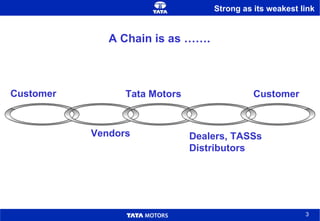
Vendors Customer Tata Motors Dealers, TASSs Distributors Customer A Chain is as ……. Strong as its weakest link
Let us move together on our  Journey to Excellence
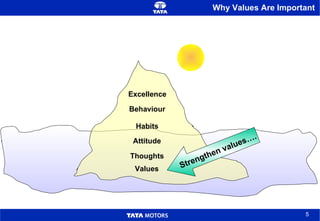
Excellence Habits Thoughts Attitude Values Behaviour Strengthen values…. Why Values Are Important
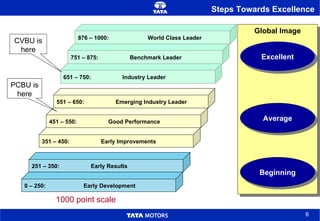
Steps Towards Excellence PCBU is here CVBU is here 1000 point scale Global Image Excellent Average Beginning 0 – 250: Early Development 251 – 350: Early Results 351 – 450: Early Improvements 451 – 550: Good Performance 551 – 650: Emerging Industry Leader 651 – 750: Industry Leader 751 – 875: Benchmark Leader 876 – 1000:  World Class Leader
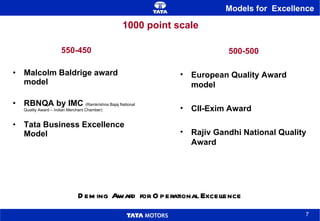
Models for  Excellence 550-450 Malcolm Baldrige award model RBNQA by IMC  (Ramkrishna Bajaj National Quality Award – Indian Merchant Chamber) Tata Business Excellence Model 500-500 European Quality Award model CII-Exim Award Rajiv Gandhi National Quality Award Deming Award for Operational Excellence 1000 point scale
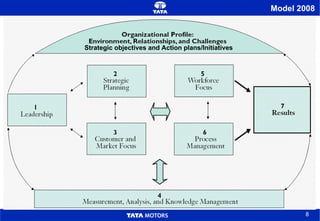
Model 2008 Strategic objectives and Action plans/Initiatives
Core Values  Applying them in performance excellence
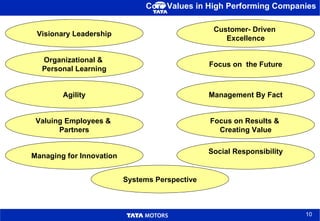
Core Values in High Performing Companies Systems Perspective Visionary Leadership Organizational &  Personal Learning Agility Valuing Employees &  Partners Managing for Innovation Customer- Driven  Excellence Focus on  the Future Management By Fact Focus on Results &  Creating Value Social Responsibility
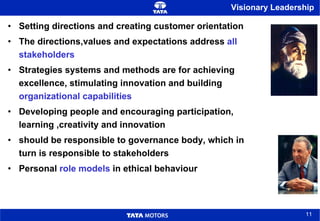
Visionary Leadership Setting directions and creating customer orientation The directions,values and expectations address  all stakeholders Strategies systems and methods are for achieving excellence, stimulating innovation and building  organizational capabilities Developing people and encouraging participation, learning ,creativity and innovation  should be responsible to governance body, which in turn is responsible to stakeholders Personal  role models  in ethical behaviour
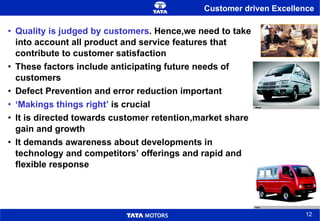
Customer driven Excellence Quality is judged by customers . Hence,we need to take into account all product and service features that contribute to customer satisfaction These factors include anticipating future needs of customers Defect Prevention and error reduction important ‘ Makings things right’  is crucial  It is directed towards customer retention,market share gain and growth It demands awareness about developments in technology and competitors’ offerings and rapid and flexible response
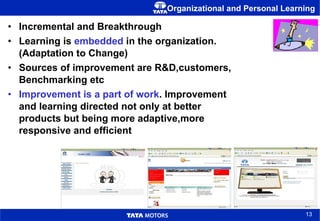
Organizational and Personal Learning Incremental and Breakthrough Learning is  embedded  in the organization. (Adaptation to Change) Sources of improvement are R&D,customers, Benchmarking etc Improvement is a part of work . Improvement and learning directed not only at better products but being more adaptive,more responsive and efficient
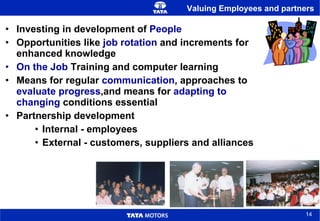
Valuing Employees and partners Investing in development of  People Opportunities like  job rotation  and increments for enhanced knowledge On the Job  Training and computer learning Means for regular  communication , approaches to  evaluate progress ,and means for  adapting to changing  conditions essential Partnership development Internal - employees  External - customers, suppliers and alliances
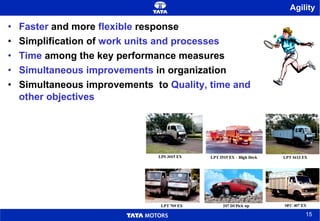
Agility Faster  and more  flexible  response Simplification of  work units and processes Time  among the key performance measures Simultaneous improvements  in organization Simultaneous improvements  to  Quality, time and other objectives
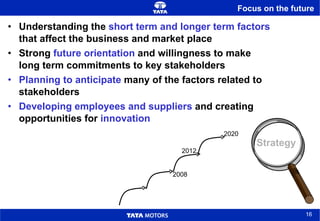
Focus on the future Understanding the  short term and longer term factors  that affect the business and market place Strong  future orientation  and willingness to make long term commitments to key stakeholders Planning to anticipate  many of the factors related to stakeholders Developing employees and suppliers  and creating opportunities for  innovation Strategy 2020 2012 2008
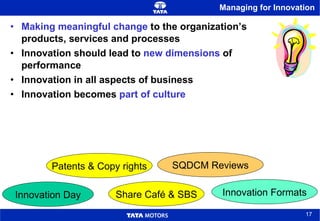
Managing for Innovation Making meaningful change  to the organization’s products, services and processes Innovation should lead to  new dimensions  of performance Innovation in all aspects of business  Innovation becomes  part of culture Innovation Day SQDCM Reviews Innovation Formats Patents & Copy rights Share Café & SBS
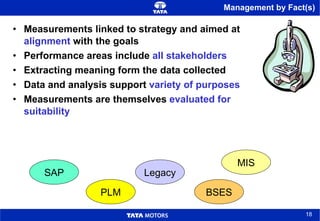
Management by Fact(s) Measurements linked to strategy and aimed at  alignment  with the goals Performance areas include  all stakeholders Extracting meaning form the data collected Data and analysis support  variety of purposes Measurements are themselves  evaluated for suitability SAP PLM Legacy BSES MIS
Social Responsibility  Basic  Expectations - ethics,environment, safety etc Applies to  products,services and operations Emphasis on  resource conservation  and waste reduction at source Prevention  is emphasized Think ”beyond mere compliance ” Ethical behaviour from leaders and monitoring by governance body Leadership and support to  communities Influencing  other organizations as partners
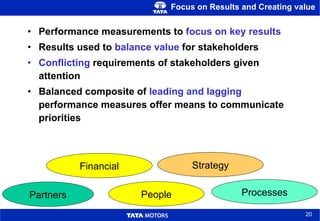
Focus on Results and Creating value Performance measurements to  focus on key results Results used to  balance value  for stakeholders Conflicting  requirements of stakeholders given attention Balanced composite of  leading and lagging  performance measures offer means to communicate priorities  Partners Strategy Processes Financial People
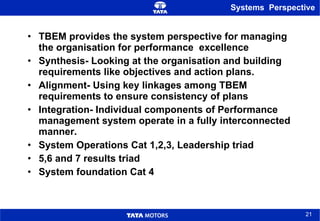
Systems  Perspective TBEM provides the system perspective for managing the organisation for performance  excellence Synthesis- Looking at the organisation and building requirements like objectives and action plans. Alignment- Using key linkages among TBEM requirements to ensure consistency of plans Integration- Individual components of Performance management system operate in a fully interconnected manner. System Operations Cat 1,2,3, Leadership triad  5,6 and 7 results triad  System foundation Cat 4
Value Driven Organization  In an organization  driven by values , we can feel the pulse running across Deployment more  natural People identify themselves with the  goals  better Integration  is ensured
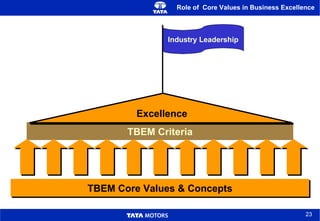
Role of  Core Values in Business Excellence TBEM Criteria Excellence TBEM Core Values & Concepts Industry Leadership
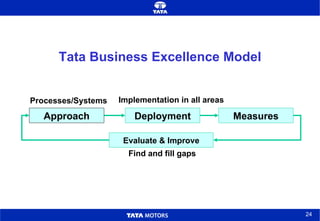
Tata Business Excellence Model Approach Processes/Systems Measures Deployment Implementation in all areas Evaluate & Improve Find and fill gaps
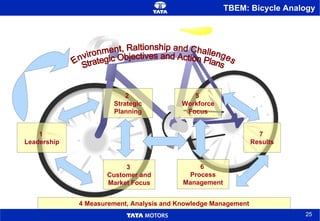
TBEM: Bicycle Analogy 3  Customer and Market Focus 1  Leadership 2  Strategic Planning 5  Workforce Focus 7  Results 6  Process Management Environment, Raltionship and Challenges Strategic Objectives and Action Plans 4 Measurement, Analysis and Knowledge Management
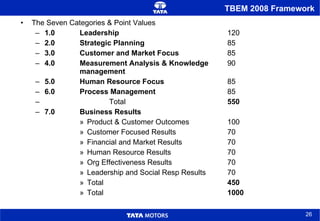
TBEM 2008 Framework The Seven Categories & Point Values 1.0 Leadership 120 2.0 Strategic Planning 85 3.0 Customer and Market Focus 85 4.0 Measurement Analysis & Knowledge  90 management 5.0 Human Resource Focus 85 6.0 Process Management 85 Total 550   7.0 Business Results Product & Customer Outcomes 100 Customer Focused Results 70 Financial and Market Results 70 Human Resource Results 70 Org Effectiveness Results 70 Leadership and Social Resp Results 70 Total 450 Total 1000
Balanced Scorecard
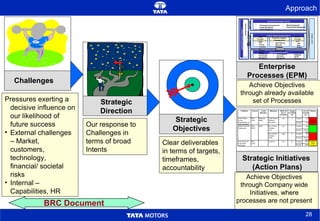
Strategic Initiatives  (Action Plans) Challenges Strategic Objectives Strategic Direction Approach Pressures exerting a decisive influence on our likelihood of future success External challenges – Market, customers, technology, financial/ societal risks Internal – Capabilities, HR Our response to Challenges in terms of broad Intents Clear deliverables in terms of targets, timeframes, accountability Enterprise Processes (EPM) Achieve Objectives through already available set of Processes Achieve Objectives through Company wide Initiatives, where processes are not present BRC Document Product / Service Processes: Item 6.1 Design Processes  (6.1a) Production / Delivery  Processes (6.1b) Service  Processes (6.1b) C U S T O M E R Leadership Processes: Category  1 Key Business Processes : Item 6.2 Internal and External Communication Strategic Planning Leadership Support Processes: Item 6.3 Facilities and Environment Management HR Management Information Management Finance and Budgeting Vehicle Financing Performance Improvement and Change Management Vendor Management  Market Development  Channel Partner Management Sales Planning  Sales and Operations Planning Manufacturing New Product Introduction Services design After Sales Service
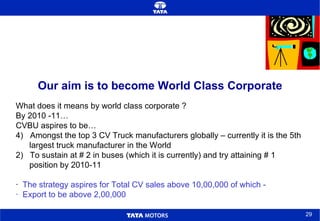
Our aim is to become World Class Corporate What does it means by world class corporate ? By 2010 -11… CVBU aspires to be…  Amongst the top 3 CV Truck manufacturers globally – currently it is the 5th  largest truck manufacturer in the World 2)  To sustain at # 2 in buses (which it is currently) and try attaining # 1  position by 2010-11 ·   The strategy aspires for Total CV sales above 10,00,000 of which -  ·  Export to be above 2,00,000
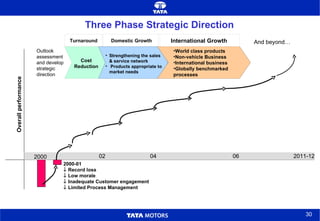
2011-12 Overall performance Outlook assessment and develop strategic direction Three Phase Strategic Direction Consistent growth in top line and bottom line 2000 Turnaround Domestic Growth International Growth World class products Non-vehicle Business International business Globally benchmarked processes 04 06 Cost Reduction Strengthening the sales & service network  Products appropriate to market needs 2000-01     Record loss    Low morale    Inadequate Customer engagement    Limited Process Management 02 And beyond…
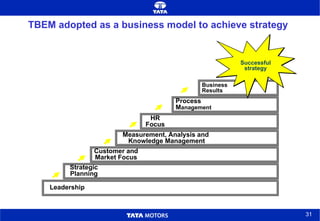
Strategic Planning Customer and Market Focus Process M anagement HR Focus Leadership Measurement, Analysis and  Knowledge Management Business  Results TBEM adopted as a business model to achieve strategy  Successful strategy
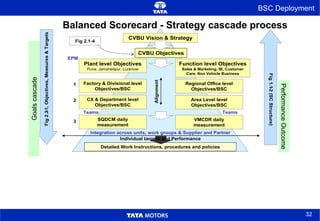
Balanced Scorecard -  Strategy cascade process Goals cascade Performance Outcome BSC Deployment
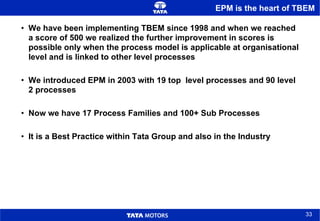
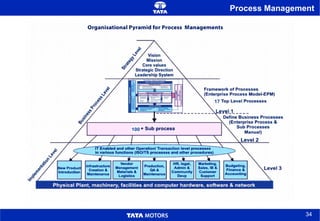
EPM is the heart of TBEM We have been implementing TBEM since 1998 and when we reached a score of 500 we realized the further improvement in scores is possible only when the process model is applicable at organisational level and is linked to other level processes We introduced EPM in 2003 with 19 top  level processes and 90 level 2 processes Now we have 17 Process Families and 100+ Sub Processes It is a Best Practice within Tata Group and also in the Industry
Process Management 17 100
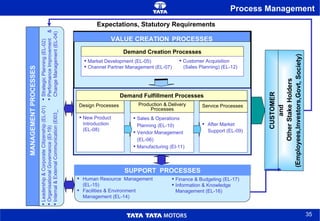
Process Management MANAGEMENT PROCESSES VALUE CREATION   PROCESSES Human Resource  Management (EL-15) Facilities & Environment Management (EL-14) Finance & Budgeting (EL-17) Information & Knowledge Management (EL-16) Leadership & Corporate Citizenship (EL-01) Organisational Governance (El-19) Internal & External Communication (El03_ Strategic Planning (EL-02) Performance Improvement  & Change Management (EL-04) CUSTOMER and Other Stake Holders (Employees,Investors,Govt, Society) Expectations, Statutory Requirements Demand Creation Processes Market Development (EL-05) Channel Partner Management (EL-07) Demand Fulfillment Processes New Product Introduction (EL-08) Design Processes Sales & Operations Planning (EL-10) Vendor Management (EL-06)  Manufacturing (El-11) Production & Delivery Processes After Market Support (EL-09) Service Processes Customer Acquisition  (Sales Planning) (EL-12) SUPPORT  PROCESSES
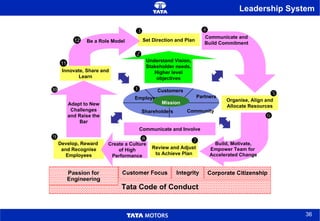
Leadership System Communicate and Involve Understand Vision, Stakeholder needs, Higher level objectives Set Direction and Plan Review and Adjust to Achieve Plan Organise, Align and Allocate Resources Develop, Reward  and Recognise Employees Create a Culture of High Performance Adapt to New Challenges and Raise the Bar Communicate and Build Commitment Build, Motivate, Empower Team for  Accelerated Change Innovate, Share and Learn Be a Role Model Tata Code of Conduct Passion for Engineering Corporate Citizenship Customer Focus Integrity Partners Community Shareholders Employees Customers Mission           11 12
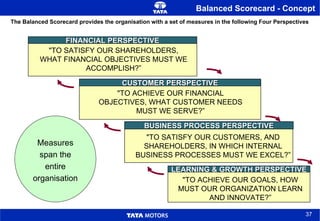
The Balanced Scorecard provides the organisation with a set of measures in the following Four Perspectives FINANCIAL PERSPECTIVE "TO SATISFY OUR SHAREHOLDERS, WHAT FINANCIAL OBJECTIVES MUST WE ACCOMPLISH?” LEARNING & GROWTH PERSPECTIVE "TO ACHIEVE OUR GOALS, HOW MUST OUR ORGANIZATION LEARN AND INNOVATE?” "TO SATISFY OUR CUSTOMERS, AND SHAREHOLDERS, IN WHICH INTERNAL BUSINESS PROCESSES MUST WE EXCEL?” BUSINESS PROCESS PERSPECTIVE "TO ACHIEVE OUR FINANCIAL OBJECTIVES, WHAT CUSTOMER NEEDS MUST WE SERVE?” CUSTOMER PERSPECTIVE Balanced Scorecard - Concept Measures span the entire organisation
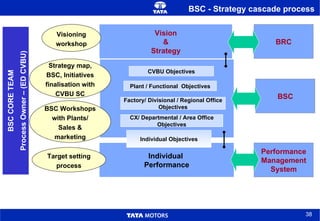
BSC -  Strategy cascade process Vision & Strategy BRC BSC Individual  Performance Performance Management System CVBU Objectives Plant / Functional  Objectives Factory/ Divisional / Regional Office Objectives Individual Objectives CX/ Departmental / Area Office Objectives BSC CORE TEAM Process Owner – (ED CVBU) Strategy map, BSC, Initiatives finalisation with CVBU SC Visioning workshop BSC Workshops with Plants/ Sales & marketing Target setting process
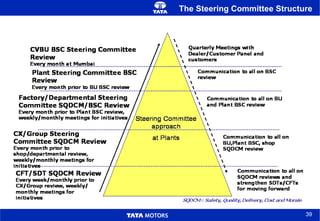
The Steering Committee Structure
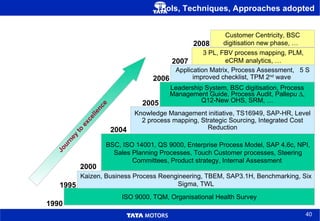
Tools, Techniques, Approaches adopted ISO 9000, TQM, Organisational Health Survey 1990 Kaizen, Business Process Reengineering, TBEM, SAP3.1H, Benchmarking, Six Sigma, TWL 1995 BSC, ISO 14001, QS 9000, Enterprise Process Model, SAP 4.6c, NPI, Sales Planning Processes, Touch Customer processes, Steering Committees, Product strategy, Internal Assessment  2000 Knowledge Management initiative, TS16949, SAP-HR, Level 2 process mapping, Strategic Sourcing, Integrated Cost Reduction 2004 Application Matrix, Process Assessment,  5 S improved checklist, TPM 2 nd  wave  Leadership System, BSC digitisation, Process Management Guide, Process Audit, Pallepu   , Q12-New OHS, SRM, … 2005 3 PL, FBV process mapping, PLM, eCRM analytics, … Journey to excellence 2006 2007 Customer Centricity, BSC digitisation new phase, …  2008
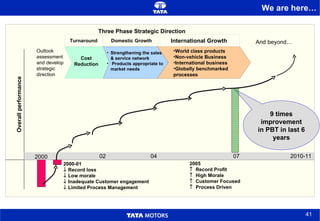
2010-11 Overall performance Outlook assessment and develop strategic direction Three Phase Strategic Direction Consistent growth in top line and bottom line 2000 Turnaround Domestic Growth International Growth World class products Non-vehicle Business International business Globally benchmarked processes 04 07 Cost Reduction Strengthening the sales & service network  Products appropriate to market needs 9 times improvement in PBT in last 6 years 2000-01     Record loss    Low morale    Inadequate Customer engagement    Limited Process Management 2005     Record Profit    High Morale    Customer Focused    Process Driven 02 And beyond… We are here…
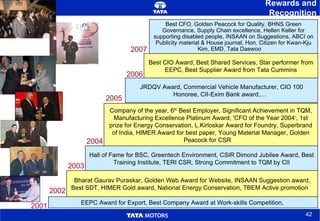
JRDQV Award, Commercial Vehicle Manufacturer, CIO 100 Honoree, CII-Exim Bank award,…  Company of the year, 6 th  Best Employer, Significant Achievement in TQM, Manufacturing Excellence  Platinum Award, 'CFO of the Year 2004‘, 1st prize for Energy Conservation, L.Kirloskar Award for Foundry, Superbrand of India, HIMER Award for best paper, Young Material Manager, Golden Peacock for CSR  Hall of Fame for BSC, Greentech Environment, CSIR Dimond Jubilee Award, Best Training Institute,  TERI CSR, Strong Commitment to TQM by CII Bharat Gaurav Puraskar, Golden Web Award for Website, INSAAN  Suggestion award, Best SDT, HIMER Gold award, National Energy Conservation, TBEM Active promotion   2005 2004 2003 EEPC Award for Export, Best Company Award at Work-skills Competition,  2002 2001 Best CIO Award, Best Shared Services, Star performer from EEPC, Best Supplier Award from Tata Cummins 2006 Rewards and Recognition Best CFO, Golden Peacock for Quality, BHNS Green Governance, Supply Chain excellence, Hellen Keller for supporting disabled people, INSAAN on Suggestions, ABCI on Publicity material & House journal, Hon. Citizen for Kwan-Kju Kim, EMD, Tata Daewoo  2007
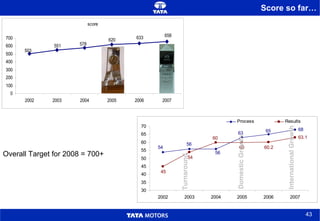
Turnaround Domestic Growth International Growth Overall Target for 2008 = 700+ Score so far…
Thank You 2005

Tbem 2009 one dayer print

  • 1.
  • 2.
    Tata Business ExcellenceModel 2010 Augustine Xavier [email_address] 66132166 June 28, 2011 JRDQV Winner 2005 Highest Delta Award JRDQV Winner 2007
  • 3.
    Vendors Customer TataMotors Dealers, TASSs Distributors Customer A Chain is as ……. Strong as its weakest link
  • 4.
    Let us movetogether on our Journey to Excellence
  • 5.
    Excellence Habits ThoughtsAttitude Values Behaviour Strengthen values…. Why Values Are Important
  • 6.
    Steps Towards ExcellencePCBU is here CVBU is here 1000 point scale Global Image Excellent Average Beginning 0 – 250: Early Development 251 – 350: Early Results 351 – 450: Early Improvements 451 – 550: Good Performance 551 – 650: Emerging Industry Leader 651 – 750: Industry Leader 751 – 875: Benchmark Leader 876 – 1000: World Class Leader
  • 7.
    Models for Excellence 550-450 Malcolm Baldrige award model RBNQA by IMC (Ramkrishna Bajaj National Quality Award – Indian Merchant Chamber) Tata Business Excellence Model 500-500 European Quality Award model CII-Exim Award Rajiv Gandhi National Quality Award Deming Award for Operational Excellence 1000 point scale
  • 8.
    Model 2008 Strategicobjectives and Action plans/Initiatives
  • 9.
    Core Values Applying them in performance excellence
  • 10.
    Core Values inHigh Performing Companies Systems Perspective Visionary Leadership Organizational & Personal Learning Agility Valuing Employees & Partners Managing for Innovation Customer- Driven Excellence Focus on the Future Management By Fact Focus on Results & Creating Value Social Responsibility
  • 11.
    Visionary Leadership Settingdirections and creating customer orientation The directions,values and expectations address all stakeholders Strategies systems and methods are for achieving excellence, stimulating innovation and building organizational capabilities Developing people and encouraging participation, learning ,creativity and innovation should be responsible to governance body, which in turn is responsible to stakeholders Personal role models in ethical behaviour
  • 12.
    Customer driven ExcellenceQuality is judged by customers . Hence,we need to take into account all product and service features that contribute to customer satisfaction These factors include anticipating future needs of customers Defect Prevention and error reduction important ‘ Makings things right’ is crucial It is directed towards customer retention,market share gain and growth It demands awareness about developments in technology and competitors’ offerings and rapid and flexible response
  • 13.
    Organizational and PersonalLearning Incremental and Breakthrough Learning is embedded in the organization. (Adaptation to Change) Sources of improvement are R&D,customers, Benchmarking etc Improvement is a part of work . Improvement and learning directed not only at better products but being more adaptive,more responsive and efficient
  • 14.
    Valuing Employees andpartners Investing in development of People Opportunities like job rotation and increments for enhanced knowledge On the Job Training and computer learning Means for regular communication , approaches to evaluate progress ,and means for adapting to changing conditions essential Partnership development Internal - employees External - customers, suppliers and alliances
  • 15.
    Agility Faster and more flexible response Simplification of work units and processes Time among the key performance measures Simultaneous improvements in organization Simultaneous improvements to Quality, time and other objectives
  • 16.
    Focus on thefuture Understanding the short term and longer term factors that affect the business and market place Strong future orientation and willingness to make long term commitments to key stakeholders Planning to anticipate many of the factors related to stakeholders Developing employees and suppliers and creating opportunities for innovation Strategy 2020 2012 2008
  • 17.
    Managing for InnovationMaking meaningful change to the organization’s products, services and processes Innovation should lead to new dimensions of performance Innovation in all aspects of business Innovation becomes part of culture Innovation Day SQDCM Reviews Innovation Formats Patents & Copy rights Share Café & SBS
  • 18.
    Management by Fact(s)Measurements linked to strategy and aimed at alignment with the goals Performance areas include all stakeholders Extracting meaning form the data collected Data and analysis support variety of purposes Measurements are themselves evaluated for suitability SAP PLM Legacy BSES MIS
  • 19.
    Social Responsibility Basic Expectations - ethics,environment, safety etc Applies to products,services and operations Emphasis on resource conservation and waste reduction at source Prevention is emphasized Think ”beyond mere compliance ” Ethical behaviour from leaders and monitoring by governance body Leadership and support to communities Influencing other organizations as partners
  • 20.
    Focus on Resultsand Creating value Performance measurements to focus on key results Results used to balance value for stakeholders Conflicting requirements of stakeholders given attention Balanced composite of leading and lagging performance measures offer means to communicate priorities Partners Strategy Processes Financial People
  • 21.
    Systems PerspectiveTBEM provides the system perspective for managing the organisation for performance excellence Synthesis- Looking at the organisation and building requirements like objectives and action plans. Alignment- Using key linkages among TBEM requirements to ensure consistency of plans Integration- Individual components of Performance management system operate in a fully interconnected manner. System Operations Cat 1,2,3, Leadership triad 5,6 and 7 results triad System foundation Cat 4
  • 22.
    Value Driven Organization In an organization driven by values , we can feel the pulse running across Deployment more natural People identify themselves with the goals better Integration is ensured
  • 23.
    Role of Core Values in Business Excellence TBEM Criteria Excellence TBEM Core Values & Concepts Industry Leadership
  • 24.
    Tata Business ExcellenceModel Approach Processes/Systems Measures Deployment Implementation in all areas Evaluate & Improve Find and fill gaps
  • 25.
    TBEM: Bicycle Analogy3 Customer and Market Focus 1 Leadership 2 Strategic Planning 5 Workforce Focus 7 Results 6 Process Management Environment, Raltionship and Challenges Strategic Objectives and Action Plans 4 Measurement, Analysis and Knowledge Management
  • 26.
    TBEM 2008 FrameworkThe Seven Categories & Point Values 1.0 Leadership 120 2.0 Strategic Planning 85 3.0 Customer and Market Focus 85 4.0 Measurement Analysis & Knowledge 90 management 5.0 Human Resource Focus 85 6.0 Process Management 85 Total 550 7.0 Business Results Product & Customer Outcomes 100 Customer Focused Results 70 Financial and Market Results 70 Human Resource Results 70 Org Effectiveness Results 70 Leadership and Social Resp Results 70 Total 450 Total 1000
  • 27.
  • 28.
    Strategic Initiatives (Action Plans) Challenges Strategic Objectives Strategic Direction Approach Pressures exerting a decisive influence on our likelihood of future success External challenges – Market, customers, technology, financial/ societal risks Internal – Capabilities, HR Our response to Challenges in terms of broad Intents Clear deliverables in terms of targets, timeframes, accountability Enterprise Processes (EPM) Achieve Objectives through already available set of Processes Achieve Objectives through Company wide Initiatives, where processes are not present BRC Document Product / Service Processes: Item 6.1 Design Processes (6.1a) Production / Delivery Processes (6.1b) Service Processes (6.1b) C U S T O M E R Leadership Processes: Category 1 Key Business Processes : Item 6.2 Internal and External Communication Strategic Planning Leadership Support Processes: Item 6.3 Facilities and Environment Management HR Management Information Management Finance and Budgeting Vehicle Financing Performance Improvement and Change Management Vendor Management Market Development Channel Partner Management Sales Planning Sales and Operations Planning Manufacturing New Product Introduction Services design After Sales Service
  • 29.
    Our aim isto become World Class Corporate What does it means by world class corporate ? By 2010 -11… CVBU aspires to be… Amongst the top 3 CV Truck manufacturers globally – currently it is the 5th largest truck manufacturer in the World 2) To sustain at # 2 in buses (which it is currently) and try attaining # 1 position by 2010-11 ·   The strategy aspires for Total CV sales above 10,00,000 of which - ·  Export to be above 2,00,000
  • 30.
    2011-12 Overall performanceOutlook assessment and develop strategic direction Three Phase Strategic Direction Consistent growth in top line and bottom line 2000 Turnaround Domestic Growth International Growth World class products Non-vehicle Business International business Globally benchmarked processes 04 06 Cost Reduction Strengthening the sales & service network Products appropriate to market needs 2000-01  Record loss  Low morale  Inadequate Customer engagement  Limited Process Management 02 And beyond…
  • 31.
    Strategic Planning Customerand Market Focus Process M anagement HR Focus Leadership Measurement, Analysis and Knowledge Management Business Results TBEM adopted as a business model to achieve strategy Successful strategy
  • 32.
    Balanced Scorecard - Strategy cascade process Goals cascade Performance Outcome BSC Deployment
  • 33.
    EPM is theheart of TBEM We have been implementing TBEM since 1998 and when we reached a score of 500 we realized the further improvement in scores is possible only when the process model is applicable at organisational level and is linked to other level processes We introduced EPM in 2003 with 19 top level processes and 90 level 2 processes Now we have 17 Process Families and 100+ Sub Processes It is a Best Practice within Tata Group and also in the Industry
  • 34.
  • 35.
    Process Management MANAGEMENTPROCESSES VALUE CREATION PROCESSES Human Resource Management (EL-15) Facilities & Environment Management (EL-14) Finance & Budgeting (EL-17) Information & Knowledge Management (EL-16) Leadership & Corporate Citizenship (EL-01) Organisational Governance (El-19) Internal & External Communication (El03_ Strategic Planning (EL-02) Performance Improvement & Change Management (EL-04) CUSTOMER and Other Stake Holders (Employees,Investors,Govt, Society) Expectations, Statutory Requirements Demand Creation Processes Market Development (EL-05) Channel Partner Management (EL-07) Demand Fulfillment Processes New Product Introduction (EL-08) Design Processes Sales & Operations Planning (EL-10) Vendor Management (EL-06) Manufacturing (El-11) Production & Delivery Processes After Market Support (EL-09) Service Processes Customer Acquisition (Sales Planning) (EL-12) SUPPORT PROCESSES
  • 36.
    Leadership System Communicateand Involve Understand Vision, Stakeholder needs, Higher level objectives Set Direction and Plan Review and Adjust to Achieve Plan Organise, Align and Allocate Resources Develop, Reward and Recognise Employees Create a Culture of High Performance Adapt to New Challenges and Raise the Bar Communicate and Build Commitment Build, Motivate, Empower Team for Accelerated Change Innovate, Share and Learn Be a Role Model Tata Code of Conduct Passion for Engineering Corporate Citizenship Customer Focus Integrity Partners Community Shareholders Employees Customers Mission           11 12
  • 37.
    The Balanced Scorecardprovides the organisation with a set of measures in the following Four Perspectives FINANCIAL PERSPECTIVE "TO SATISFY OUR SHAREHOLDERS, WHAT FINANCIAL OBJECTIVES MUST WE ACCOMPLISH?” LEARNING & GROWTH PERSPECTIVE "TO ACHIEVE OUR GOALS, HOW MUST OUR ORGANIZATION LEARN AND INNOVATE?” "TO SATISFY OUR CUSTOMERS, AND SHAREHOLDERS, IN WHICH INTERNAL BUSINESS PROCESSES MUST WE EXCEL?” BUSINESS PROCESS PERSPECTIVE "TO ACHIEVE OUR FINANCIAL OBJECTIVES, WHAT CUSTOMER NEEDS MUST WE SERVE?” CUSTOMER PERSPECTIVE Balanced Scorecard - Concept Measures span the entire organisation
  • 38.
    BSC - Strategy cascade process Vision & Strategy BRC BSC Individual Performance Performance Management System CVBU Objectives Plant / Functional Objectives Factory/ Divisional / Regional Office Objectives Individual Objectives CX/ Departmental / Area Office Objectives BSC CORE TEAM Process Owner – (ED CVBU) Strategy map, BSC, Initiatives finalisation with CVBU SC Visioning workshop BSC Workshops with Plants/ Sales & marketing Target setting process
  • 39.
  • 40.
    Tools, Techniques, Approachesadopted ISO 9000, TQM, Organisational Health Survey 1990 Kaizen, Business Process Reengineering, TBEM, SAP3.1H, Benchmarking, Six Sigma, TWL 1995 BSC, ISO 14001, QS 9000, Enterprise Process Model, SAP 4.6c, NPI, Sales Planning Processes, Touch Customer processes, Steering Committees, Product strategy, Internal Assessment 2000 Knowledge Management initiative, TS16949, SAP-HR, Level 2 process mapping, Strategic Sourcing, Integrated Cost Reduction 2004 Application Matrix, Process Assessment, 5 S improved checklist, TPM 2 nd wave Leadership System, BSC digitisation, Process Management Guide, Process Audit, Pallepu  , Q12-New OHS, SRM, … 2005 3 PL, FBV process mapping, PLM, eCRM analytics, … Journey to excellence 2006 2007 Customer Centricity, BSC digitisation new phase, … 2008
  • 41.
    2010-11 Overall performanceOutlook assessment and develop strategic direction Three Phase Strategic Direction Consistent growth in top line and bottom line 2000 Turnaround Domestic Growth International Growth World class products Non-vehicle Business International business Globally benchmarked processes 04 07 Cost Reduction Strengthening the sales & service network Products appropriate to market needs 9 times improvement in PBT in last 6 years 2000-01  Record loss  Low morale  Inadequate Customer engagement  Limited Process Management 2005  Record Profit  High Morale  Customer Focused  Process Driven 02 And beyond… We are here…
  • 42.
    JRDQV Award, CommercialVehicle Manufacturer, CIO 100 Honoree, CII-Exim Bank award,… Company of the year, 6 th Best Employer, Significant Achievement in TQM, Manufacturing Excellence Platinum Award, 'CFO of the Year 2004‘, 1st prize for Energy Conservation, L.Kirloskar Award for Foundry, Superbrand of India, HIMER Award for best paper, Young Material Manager, Golden Peacock for CSR Hall of Fame for BSC, Greentech Environment, CSIR Dimond Jubilee Award, Best Training Institute, TERI CSR, Strong Commitment to TQM by CII Bharat Gaurav Puraskar, Golden Web Award for Website, INSAAN Suggestion award, Best SDT, HIMER Gold award, National Energy Conservation, TBEM Active promotion 2005 2004 2003 EEPC Award for Export, Best Company Award at Work-skills Competition, 2002 2001 Best CIO Award, Best Shared Services, Star performer from EEPC, Best Supplier Award from Tata Cummins 2006 Rewards and Recognition Best CFO, Golden Peacock for Quality, BHNS Green Governance, Supply Chain excellence, Hellen Keller for supporting disabled people, INSAAN on Suggestions, ABCI on Publicity material & House journal, Hon. Citizen for Kwan-Kju Kim, EMD, Tata Daewoo 2007
  • 43.
    Turnaround Domestic GrowthInternational Growth Overall Target for 2008 = 700+ Score so far…
  • 44.

Editor's Notes

  • #9 The answer is simple! It is Tata Excellence Business Model We all know that 4 years back we adopted TBEM as our management model. We have given lot of importance in last two years.... Can somebody tell me....who runs our business? (Takes- Management, we, Tatas, staff, RNT,...,Customer) Yes, our friend is right it is Customer is running our business, it is he who signs our pay-cheques, yes, those are the invisible hands.... This model also starts with Customer and Market Focus. You go back to Customer and Market and take their feedback and requirements and then Leadership takes decisions and derive their strategies. The strategy helps you to deduce your action plans. Who will convert your action plans into reality..? Correct, it is Human Resource.... HR Focus....HR will make their plans for the required manpower....., how much, where needed, what skills required, their training development; well-being etc. What will convert your customer focused action plans and manpower into useful output? Process Management ! These are the processes we use, for designing, manufacturing, delivering, storing, despatching etc etc Now we have Strategy, action plans, good manpower and conversion processes...what we get out of it? Yes, Business results...results flowing from all areas like Leadership, Strategic Planning, HR Focus, Process Management etc. These are not only financial results... Another important thing in this model is Information and Analysis...This helps us in getting data converted in to information and then its analysis to enable us in taking decisions...right decisions at right time...like the market share at North India is eroding or rejection at particular line is not under control or say absenteeism is beyond permissible limits.. This kind of information and analysis helps management in running the company in efficient manner...not by only hunch or guesswork but by correct analysis. Results also flow from this to Business results This model has seven categories viz. 1. Leadership,2. Strategic Planning,3. Customer and Market Focus, 4. Information and Analysis, 5. HR Focus, 6. Process Management and 7. Business results This model is based on Malcolm Baldrige National Quality and has 1000 point scale as we have seen in earlier sessions
  • #33 Notes:
  • #39 Notes: