Introducing the
EFQM Excellence Model
             Prepared by EFQM
                 February 2011
What is EFQM?

 EFQM is a non‐profit 
 foundation, based in 
 Brussels.
 It was formed in 1988 
 by a group of leading 
 European organisations.
 We are the custodians 
 of the EFQM Excellence 
 Model.
 Together with our 
 European partners, we 
 have 30,000 member 
 organisations. 
                           ©2011 EFQM
The need for a Model

Given the complexities of today’s interconnected world, isolated efforts are no longer effective.


                                                                                                         3
                                                                                            ©2011 EFQM
EFQM Excellence Model 2010
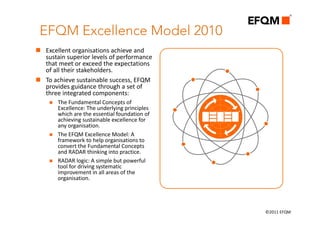
Excellent organisations achieve and 
sustain superior levels of performance 
that meet or exceed the expectations 
of all their stakeholders.
To achieve sustainable success, EFQM 
provides guidance through a set of 
three integrated components: 
    The Fundamental Concepts of 
    Excellence: The underlying principles 
    which are the essential foundation of 
    achieving sustainable excellence for 
    any organisation.
    The EFQM Excellence Model: A 
    framework to help organisations to 
    convert the Fundamental Concepts 
    and RADAR thinking into practice.
    RADAR logic: A simple but powerful 
    tool for driving systematic 
    improvement in all areas of the 
    organisation.


                                             ©2011 EFQM
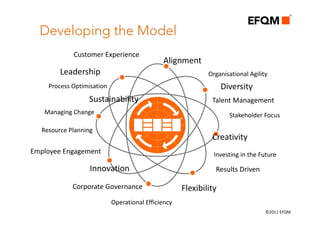
Developing the Model
            Customer Experience
                                             Alignment
        Leadership                                          Organisational Agility
    Process Optimisation                                          Diversity
                 Sustainability                              Talent Management
   Managing Change                                                  Stakeholder Focus

  Resource Planning
                                                             Creativity
Employee Engagement                                           Investing in the Future

                  Innovation                                  Results Driven

            Corporate Governance                    Flexibility
                           Operational Efficiency
                                                                                 ©2011 EFQM
The Fundamental Concepts of Excellence


                                         ©2011 EFQM
Concept Definitions (1)
 Achieving Balanced Results
   Excellent organisations meet their Mission and progress 
   towards their Vision through planning and achieving a 
   balanced set of results that meet both the short and long 
   term needs of their stakeholders and, where relevant, 
   exceed them. 
 Adding Value for Customers
   Excellent organisations know that customers are their 
   primary reason for being and strive to innovate and create 
   value for them by understanding and anticipating their 
   needs and expectations. 

                                                          ©2011 EFQM
Concept Definitions (2)
 Leading with Vision, Inspiration & Integrity
   Excellent organisations have leaders who shape the future 
   and make it happen, acting as role models for its values 
   and ethics.
 Managing by Process
   Excellent organisations are managed through structured 
   and strategically aligned processes using fact‐based 
   decision making to create balanced and sustained results. 


                                                         ©2011 EFQM
Concept Definitions (3)
 Succeeding through People
   Excellent organisations value their people and create a 
   culture of empowerment for the balanced achievement of 
   organisational and personal goals.
 Nurturing Creativity & Innovation
   Excellent organisations generate increased value and levels 
   of performance through continual and systematic 
   innovation by harnessing the creativity of their 
   stakeholders.


                                                          ©2011 EFQM
Concept Definitions (4)
 Building Partnerships
   Excellent organisations seek, develop and maintain 
   trusting relationships with various partners to ensure 
   mutual success. These partnerships may be formed with 
   customers, society, key suppliers, educational bodies or 
   Non‐Governmental Organisations (NGO).
 Taking Responsibility for a Sustainable Future
   Excellent organisations embed within their culture an 
   ethical mindset, clear values and the highest standards for 
   organisational behaviour, all of which enable them to 
   strive for economic, social and ecological sustainability.


                                                           ©2011 EFQM
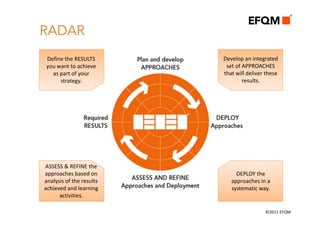
RADAR
Define the RESULTS         Develop an integrated 
you want to achieve         set of APPROACHES 
  as part of your          that will deliver these 
     strategy.                     results.


ASSESS & REFINE the 
approaches based on             DEPLOY the 
analysis of the results       approaches in a 
achieved and learning         systematic way.
      activities.

                                             ©2011 EFQM
EFQM Model Criteria
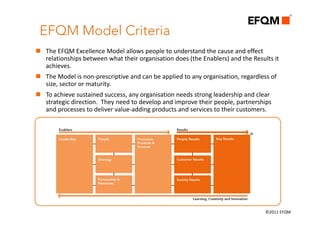
The EFQM Excellence Model allows people to understand the cause and effect 
relationships between what their organisation does (the Enablers) and the Results it 
achieves. 
The Model is non‐prescriptive and can be applied to any organisation, regardless of 
size, sector or maturity.
To achieve sustained success, any organisation needs strong leadership and clear 
strategic direction.  They need to develop and improve their people, partnerships 
and processes to deliver value‐adding products and services to their customers. 


                                                                               ©2011 EFQM
Enabler Criteria (1)
 Leadership
    Excellent organisations have leaders who shape the future and make it 
    happen, acting as role models for its values and ethics and inspiring trust 
    at all times. They are flexible, enabling the organisation to anticipate and 
    react in a timely manner to ensure the ongoing success of the 
    organisation.
 Strategy
    Excellent organisations implement their mission and vision by developing 
    a stakeholder focused strategy. Policies, plans, objectives and processes 
    are developed and deployed to deliver the strategy.
 People
    Excellent organisations value their people and create a culture that allows 
    the mutually beneficial achievement of organisational and personal goals. 
    They develop the capabilities of their people and promote fairness and 
    equality. They care for, communicate, reward and recognise, in a way that 
    motivates people, builds commitment and enables them to use their skills 
    and knowledge for the benefit of the organisation.


                                                                             ©2011 EFQM
Enabler Criteria (2)
 Partnerships & Resources
   Excellent organisations plan and manage external 
   partnerships, suppliers and internal resources in order to 
   support strategy and policies and the effective operation 
   of processes.  
 Processes, Products & Services
   Excellent organisations design, manage and improve their 
   processes, products and services to generate increasing 
   value for customers and other stakeholders.


                                                           ©2011 EFQM
Results Criteria (1)
 Customer Results
    Excellent organisations develop and agree a set of 
    performance indicators and related outcomes to 
    determine the successful deployment of their strategy and 
    supporting policies, based on the needs and expectations 
    of their customers.
 People Results
    Excellent organisations develop and agree a set of 
    performance indicators and related outcomes to 
    determine the successful deployment of their strategy and 
    supporting policies, based on the needs and expectations 
    of their people.


                                                          ©2011 EFQM
Results Criteria (2)
 Society Results
    Excellent organisations develop and agree a set of 
    performance indicators and related outcomes to 
    determine the successful deployment of their societal and 
    ecological strategy and related policies, based on the 
    needs and expectations of the relevant external 
    stakeholders.
 Key Results
    Excellent organisations develop and agree a set of key 
    financial and non‐financial results to determine the 
    successful deployment of their strategy, based on the 
    needs and expectations of their key stakeholders.


                                                              ©2011 EFQM
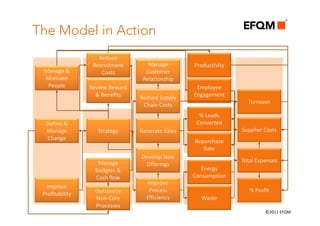
The Model in Action
                    Reduce 
                  Recruitment        Manage        Productivity
 Manage &            Costs          Customer 
 Motivate                          Relationship
  People         Review Reward                      Employee 
                   & Benefits     Reduce Supply    Engagement
                                                                    Turnover
                                   Chain Costs
                                                     % Leads 
  Define &                                          Converted
  Manage            Strategy      Generate Sales                  Supplier Costs
  Change
                                                   Repurchase 
                                                      Rate
                                  Develop New 
                    Manage                                        Total Expenses
                                   Offerings
                   Budgets &                          Energy 
                   Cash flow                       Consumption
                                     Improve 
  Improve 
                   Outsource          Process                        % Profit
 Profitability
                   Non‐Core         Efficiency       Waste
                   Processes
                                                                           ©2011 EFQM
Thank you
  info@efqm.org
   www.efqm.org

Introducing the EFQM model

  • 1.
    Introducing the EFQM ExcellenceModel Prepared by EFQM February 2011
  • 2.
    What is EFQM? EFQM is a non‐profit  foundation, based in  Brussels. It was formed in 1988  by a group of leading  European organisations. We are the custodians  of the EFQM Excellence  Model. Together with our  European partners, we  have 30,000 member  organisations.  ©2011 EFQM
  • 3.
    The need fora Model Given the complexities of today’s interconnected world, isolated efforts are no longer effective. 3 ©2011 EFQM
  • 4.
    EFQM Excellence Model2010 Excellent organisations achieve and  sustain superior levels of performance  that meet or exceed the expectations  of all their stakeholders. To achieve sustainable success, EFQM  provides guidance through a set of  three integrated components:  The Fundamental Concepts of  Excellence: The underlying principles  which are the essential foundation of  achieving sustainable excellence for  any organisation. The EFQM Excellence Model: A  framework to help organisations to  convert the Fundamental Concepts  and RADAR thinking into practice. RADAR logic: A simple but powerful  tool for driving systematic  improvement in all areas of the  organisation. ©2011 EFQM
  • 5.
    Developing the Model Customer Experience Alignment Leadership Organisational Agility Process Optimisation Diversity Sustainability Talent Management Managing Change Stakeholder Focus Resource Planning Creativity Employee Engagement Investing in the Future Innovation Results Driven Corporate Governance Flexibility Operational Efficiency ©2011 EFQM
  • 6.
    The Fundamental Conceptsof Excellence ©2011 EFQM
  • 7.
    Concept Definitions (1) Achieving Balanced Results Excellent organisations meet their Mission and progress  towards their Vision through planning and achieving a  balanced set of results that meet both the short and long  term needs of their stakeholders and, where relevant,  exceed them.  Adding Value for Customers Excellent organisations know that customers are their  primary reason for being and strive to innovate and create  value for them by understanding and anticipating their  needs and expectations.  ©2011 EFQM
  • 8.
    Concept Definitions (2) Leading with Vision, Inspiration & Integrity Excellent organisations have leaders who shape the future  and make it happen, acting as role models for its values  and ethics. Managing by Process Excellent organisations are managed through structured  and strategically aligned processes using fact‐based  decision making to create balanced and sustained results.  ©2011 EFQM
  • 9.
    Concept Definitions (3) Succeeding through People Excellent organisations value their people and create a  culture of empowerment for the balanced achievement of  organisational and personal goals. Nurturing Creativity & Innovation Excellent organisations generate increased value and levels  of performance through continual and systematic  innovation by harnessing the creativity of their  stakeholders. ©2011 EFQM
  • 10.
    Concept Definitions (4) Building Partnerships Excellent organisations seek, develop and maintain  trusting relationships with various partners to ensure  mutual success. These partnerships may be formed with  customers, society, key suppliers, educational bodies or  Non‐Governmental Organisations (NGO). Taking Responsibility for a Sustainable Future Excellent organisations embed within their culture an  ethical mindset, clear values and the highest standards for  organisational behaviour, all of which enable them to  strive for economic, social and ecological sustainability. ©2011 EFQM
  • 11.
    RADAR Define the RESULTS  Develop an integrated  you want to achieve  set of APPROACHES  as part of your  that will deliver these  strategy. results. ASSESS & REFINE the  approaches based on  DEPLOY the  analysis of the results  approaches in a  achieved and learning  systematic way. activities. ©2011 EFQM
  • 12.
  • 13.
    Enabler Criteria (1) Leadership Excellent organisations have leaders who shape the future and make it  happen, acting as role models for its values and ethics and inspiring trust  at all times. They are flexible, enabling the organisation to anticipate and  react in a timely manner to ensure the ongoing success of the  organisation. Strategy Excellent organisations implement their mission and vision by developing  a stakeholder focused strategy. Policies, plans, objectives and processes  are developed and deployed to deliver the strategy. People Excellent organisations value their people and create a culture that allows  the mutually beneficial achievement of organisational and personal goals.  They develop the capabilities of their people and promote fairness and  equality. They care for, communicate, reward and recognise, in a way that  motivates people, builds commitment and enables them to use their skills  and knowledge for the benefit of the organisation. ©2011 EFQM
  • 14.
    Enabler Criteria (2) Partnerships & Resources Excellent organisations plan and manage external  partnerships, suppliers and internal resources in order to  support strategy and policies and the effective operation  of processes.   Processes, Products & Services Excellent organisations design, manage and improve their  processes, products and services to generate increasing  value for customers and other stakeholders. ©2011 EFQM
  • 15.
    Results Criteria (1) Customer Results Excellent organisations develop and agree a set of  performance indicators and related outcomes to  determine the successful deployment of their strategy and  supporting policies, based on the needs and expectations  of their customers. People Results Excellent organisations develop and agree a set of  performance indicators and related outcomes to  determine the successful deployment of their strategy and  supporting policies, based on the needs and expectations  of their people. ©2011 EFQM
  • 16.
    Results Criteria (2) Society Results Excellent organisations develop and agree a set of  performance indicators and related outcomes to  determine the successful deployment of their societal and  ecological strategy and related policies, based on the  needs and expectations of the relevant external  stakeholders. Key Results Excellent organisations develop and agree a set of key  financial and non‐financial results to determine the  successful deployment of their strategy, based on the  needs and expectations of their key stakeholders. ©2011 EFQM
  • 17.
    The Model inAction Reduce  Recruitment  Manage  Productivity Manage &  Costs Customer  Motivate  Relationship People Review Reward  Employee  & Benefits Reduce Supply  Engagement Turnover Chain Costs % Leads  Define &  Converted Manage  Strategy Generate Sales Supplier Costs Change Repurchase  Rate Develop New  Manage  Total Expenses Offerings Budgets &  Energy  Cash flow Consumption Improve  Improve  Outsource  Process  % Profit Profitability Non‐Core  Efficiency Waste Processes ©2011 EFQM
  • 18.
    Thank you info@efqm.org www.efqm.org