• Presented by:
Amitroy Ajay Jadhav
PRN No.- 2162701612005
UNDER WATER WELDING
Karmaveer Bhaurao Patil College of Engineering, Satara.
Dr. Babasaheb Ambedkar Technological University, Lonere
Rayat Shikshan Sanstha’s
TABLE OF CONTENT
 Introduction to underwater welding
 Need for underwater welding
 Requirement of underwater welding
 Difference between normal and underwater welding
 Sea driver equipment
 Classification of underwater welding
 Wet welding
 Advantage of Wet welding
 Disadvantages of Wet welding
 Application of wet welding
 Dry Welding
 Advantages of Dry welding
 Disadvantages of Dry welding
 Application of Dry welding
 Advance in Underwater welding
 Risk involved in Underwater welding
 Dangerous and Difficulties
 Future scope and developments
INTRODUCTION TO UNDERWATER
WELDING
.
 The concept of conducting underwater welding involves welding performed below
the water surface at a certain depth, in a dry or wet environment.
 Wet underwater welding implies that the welding process is carried out directly in the
water without any kind of insulation barrier to prevent the contact of the ambient
water with the place of work, the weld pool, the electric arc, the filler material and the
welder.
NEED FOR UNDERWATER WELDING
 To repair the cracks in ships ,bridge and
submarine.
 For quick process in under water welding.
 To construction of pipe line in under sea.
 To weld any cracks in oil pipe line.
Requirement of underwater
welding
Power supply requirements 400 Amp or
larger. DC generators, motor generators and
rectifiers are acceptable power supplies.
 Power converters.
 Welding Generator, Pre-Setup.
 Diesel Driven Welding Generator Amperage
and Voltage settings.
 Gas Manifolds.
 Underwater Oxygen-Arc Welding Torches.
1.Collet or grip
2.Oxygen valve
3.Flash arrester
 Waterproofing Surface Electrodes.
1.Epoxy 152
2.Lee lac 30-l2093
3.Polyurethane
Difference between normal welding and
underwater welding
Under water welding
1 . Underwater Welding & Burning: 6,500 – 10,000° F Under the Sea.
2. Under the water, metal sounds different. It’s high pitched but muffled like a siren
entering a tunnel. It dissipates quickly out into the waves .
 Ground welding
1. In the electric arc, the temperature is very high of the order of 6,000-8,000 °C for the
GTAW, GMAW, FCAW and SAW processes.
2. It up to 10,000 20,000 °C for the PAW process and well above the boiling point of the
base and filler materials
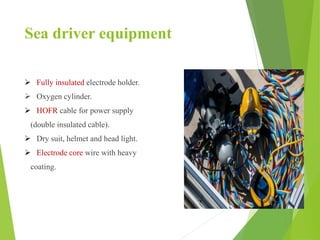
Sea driver equipment
 Fully insulated electrode holder.
 Oxygen cylinder.
 HOFR cable for power supply
(double insulated cable).
 Dry suit, helmet and head light.
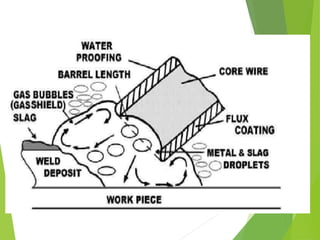
 Electrode core wire with heavy
coating.
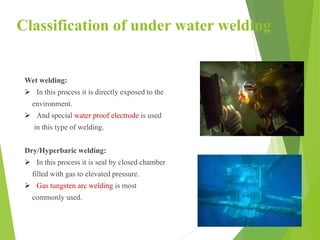
Classification of under water welding
Wet welding:
 In this process it is directly exposed to the
environment.
 And special water proof electrode is used
in this type of welding.
Dry/Hyperbaric welding:
 In this process it is seal by closed chamber
filled with gas to elevated pressure.
 Gas tungsten arc welding is most
commonly used.
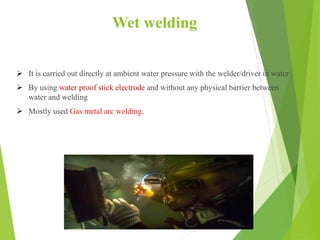
Wet welding
 It is carried out directly at ambient water pressure with the welder/driver in water
 By using water proof stick electrode and without any physical barrier between
water and welding
 Mostly used Gas metal arc welding.
Advantage of wet welding
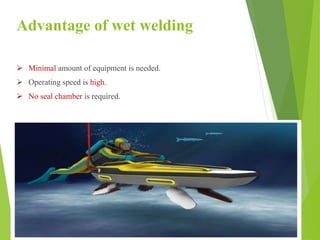
 Minimal amount of equipment is needed.
 Operating speed is high.
 No seal chamber is required.
Disadvantage of wet welding
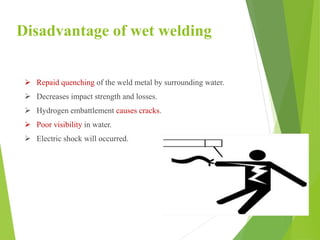
 Repaid quenching of the weld metal by surrounding water.
 Decreases impact strength and losses.
 Hydrogen embattlement causes cracks.
 Poor visibility in water.
 Electric shock will occurred.
Application of wet welding
It is key technology for repairing marine
structure .
Welding is directly performed under water is
directly exposed to the wet environment.
Increased freedom movement makes more
effective , efficient and economical.
Supply is connected to the welder / driver via
cables or hoses.
Dry welding
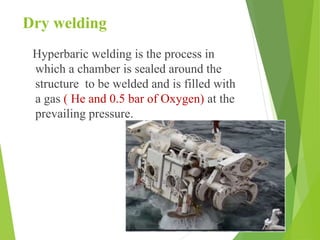
Hyperbaric welding is the process in
which a chamber is sealed around the
structure to be welded and is filled with
a gas ( He and 0.5 bar of Oxygen) at the
prevailing pressure.
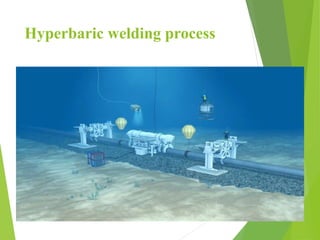
Hyperbaric welding process
Advantages of Dry welding
More safety then wet welding.
Good Quality weld.
Surface monitoring.
Non destructive testing possible.
Disadvantages of Dry welding
Higher cost of process, training, etc.
Large quantity of costly and
complex equipment.
More deep, more energy
requirement.
It should be weld only reachable
place.
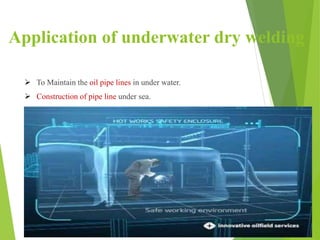
Application of underwater dry welding
 To Maintain the oil pipe lines in under water.
 Construction of pipe line under sea.
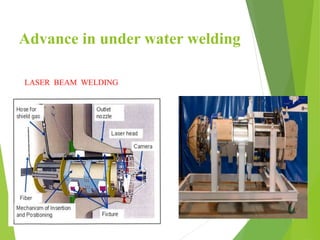
Advance in under water welding
LASER BEAM WELDING
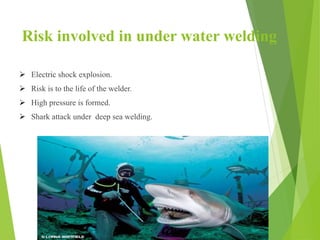
Risk involved in under water welding
 Electric shock explosion.
 Risk is to the life of the welder.
 High pressure is formed.
 Shark attack under deep sea welding.
Dangerous and difficulties
 Hydrogen and oxygen are dissociated from the water and
will travel separately as bubbles
 Oxygen cutting is about 60 percent efficient
 Above river beds, especially in mud, because trapped
methane gas in the proper concentrations can explode.
 There is a risk to the welder/diver of electric shock.
 There is a risk that defects may remain undetected
 The other main area of risk is to the life or health of the
welder/diver from nitrogen introduced into the blood
steam during exposure to air at increased pressure
Future scope and developments
 Present trend is towards automation. THOR – 1 (TIG
Hyperbaric Orbital Robot) is developed where diver
performs pipefitting, installs the track and orbital
head on the pipe and the rest process is automated.
Amitroy Jadhav-1.pptx on underwater welding

Amitroy Jadhav-1.pptx on underwater welding

  • 1.
    • Presented by: AmitroyAjay Jadhav PRN No.- 2162701612005 UNDER WATER WELDING Karmaveer Bhaurao Patil College of Engineering, Satara. Dr. Babasaheb Ambedkar Technological University, Lonere Rayat Shikshan Sanstha’s
  • 2.
    TABLE OF CONTENT Introduction to underwater welding  Need for underwater welding  Requirement of underwater welding  Difference between normal and underwater welding  Sea driver equipment  Classification of underwater welding  Wet welding  Advantage of Wet welding  Disadvantages of Wet welding  Application of wet welding  Dry Welding  Advantages of Dry welding  Disadvantages of Dry welding  Application of Dry welding  Advance in Underwater welding  Risk involved in Underwater welding  Dangerous and Difficulties  Future scope and developments
  • 3.
    INTRODUCTION TO UNDERWATER WELDING . The concept of conducting underwater welding involves welding performed below the water surface at a certain depth, in a dry or wet environment.  Wet underwater welding implies that the welding process is carried out directly in the water without any kind of insulation barrier to prevent the contact of the ambient water with the place of work, the weld pool, the electric arc, the filler material and the welder.
  • 4.
    NEED FOR UNDERWATERWELDING  To repair the cracks in ships ,bridge and submarine.  For quick process in under water welding.  To construction of pipe line in under sea.  To weld any cracks in oil pipe line.
  • 5.
    Requirement of underwater welding Powersupply requirements 400 Amp or larger. DC generators, motor generators and rectifiers are acceptable power supplies.  Power converters.  Welding Generator, Pre-Setup.  Diesel Driven Welding Generator Amperage and Voltage settings.  Gas Manifolds.
  • 6.
     Underwater Oxygen-ArcWelding Torches. 1.Collet or grip 2.Oxygen valve 3.Flash arrester  Waterproofing Surface Electrodes. 1.Epoxy 152 2.Lee lac 30-l2093 3.Polyurethane
  • 7.
    Difference between normalwelding and underwater welding Under water welding 1 . Underwater Welding & Burning: 6,500 – 10,000° F Under the Sea. 2. Under the water, metal sounds different. It’s high pitched but muffled like a siren entering a tunnel. It dissipates quickly out into the waves .  Ground welding 1. In the electric arc, the temperature is very high of the order of 6,000-8,000 °C for the GTAW, GMAW, FCAW and SAW processes. 2. It up to 10,000 20,000 °C for the PAW process and well above the boiling point of the base and filler materials
  • 8.
    Sea driver equipment Fully insulated electrode holder.  Oxygen cylinder.  HOFR cable for power supply (double insulated cable).  Dry suit, helmet and head light.  Electrode core wire with heavy coating.
  • 9.
    Classification of underwater welding Wet welding:  In this process it is directly exposed to the environment.  And special water proof electrode is used in this type of welding. Dry/Hyperbaric welding:  In this process it is seal by closed chamber filled with gas to elevated pressure.  Gas tungsten arc welding is most commonly used.
  • 10.
    Wet welding  Itis carried out directly at ambient water pressure with the welder/driver in water  By using water proof stick electrode and without any physical barrier between water and welding  Mostly used Gas metal arc welding.
  • 12.
    Advantage of wetwelding  Minimal amount of equipment is needed.  Operating speed is high.  No seal chamber is required.
  • 13.
    Disadvantage of wetwelding  Repaid quenching of the weld metal by surrounding water.  Decreases impact strength and losses.  Hydrogen embattlement causes cracks.  Poor visibility in water.  Electric shock will occurred.
  • 14.
    Application of wetwelding It is key technology for repairing marine structure . Welding is directly performed under water is directly exposed to the wet environment. Increased freedom movement makes more effective , efficient and economical. Supply is connected to the welder / driver via cables or hoses.
  • 15.
    Dry welding Hyperbaric weldingis the process in which a chamber is sealed around the structure to be welded and is filled with a gas ( He and 0.5 bar of Oxygen) at the prevailing pressure.
  • 16.
  • 17.
    Advantages of Drywelding More safety then wet welding. Good Quality weld. Surface monitoring. Non destructive testing possible.
  • 18.
    Disadvantages of Drywelding Higher cost of process, training, etc. Large quantity of costly and complex equipment. More deep, more energy requirement. It should be weld only reachable place.
  • 19.
    Application of underwaterdry welding  To Maintain the oil pipe lines in under water.  Construction of pipe line under sea.
  • 20.
    Advance in underwater welding LASER BEAM WELDING
  • 21.
    Risk involved inunder water welding  Electric shock explosion.  Risk is to the life of the welder.  High pressure is formed.  Shark attack under deep sea welding.
  • 22.
    Dangerous and difficulties Hydrogen and oxygen are dissociated from the water and will travel separately as bubbles  Oxygen cutting is about 60 percent efficient  Above river beds, especially in mud, because trapped methane gas in the proper concentrations can explode.  There is a risk to the welder/diver of electric shock.  There is a risk that defects may remain undetected  The other main area of risk is to the life or health of the welder/diver from nitrogen introduced into the blood steam during exposure to air at increased pressure
  • 23.
    Future scope anddevelopments  Present trend is towards automation. THOR – 1 (TIG Hyperbaric Orbital Robot) is developed where diver performs pipefitting, installs the track and orbital head on the pipe and the rest process is automated.