UNDER THE GUIDANCE OF
V B HIPPARGI SIR
BHARATH KODLI SIR PRESENTED BY-
MD TOUSIFUDDIN
USN: 3PD19ME043
CONTENT
 INTRODUCTION
 CLASSIFICATION OF UNDERWATER WELDING
 APPLICATIONS OF UNDERWATER WELDING
 ENVIRONMENTAL PARAMETERS
 UNDERWATER INSPECTION
 RISK INVOLVED IN UNDERWATER WELDING
 SCOPE FOR THE FURTHER DEVELOPMENT
 CONCLUSION
INTRODUCTION
• Now a days in all fabrication works welding has become a very important tool.
• It would be no exaggeration to say that there is no metal industry and no branch
of engineering that doesn’t involve the use of welding as a manufacturing tool.
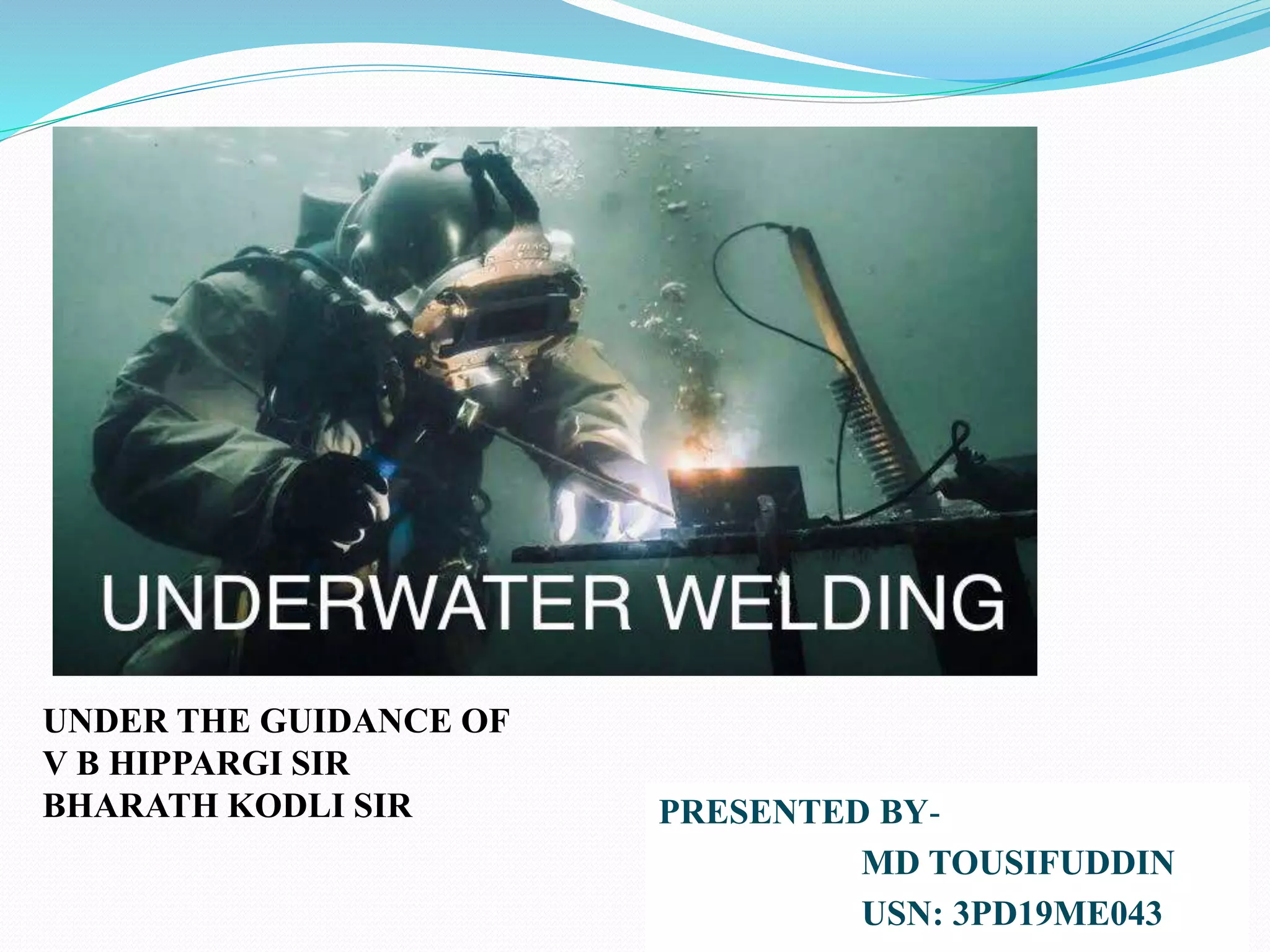
• Underwater welding began during the world war I, it was used to make
temporary repairs on the ships.
• Hence underwater welding came into existence.
• Now underwater welding is used in fabrication industry for joining the steel on
the offshore platforms , underwater structures , pipelines and ships.
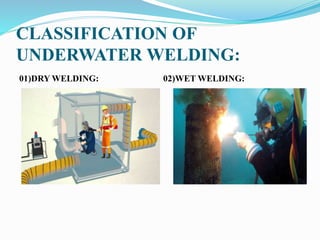
CLASSIFICATION OF
UNDERWATER WELDING:
01)DRY WELDING: 02)WET WELDING:
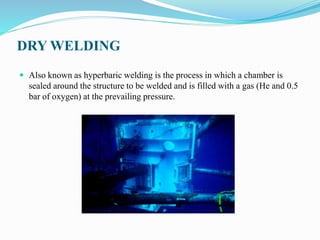
DRY WELDING
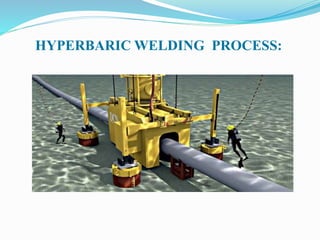
 Also known as hyperbaric welding is the process in which a chamber is
sealed around the structure to be welded and is filled with a gas (He and 0.5
bar of oxygen) at the prevailing pressure.
HYPERBARIC WELDING PROCESS:
ADVANTAGES OF DRY WELDING
 More safer than wet welding.
 Good quality weld.
 Surface monitoring.
 Non destructive testing possible.
DISADVANTAGES OF DRY WELDING
 Higher cost of process, training, etc.
 Large quantity of costly and complex equipment.
 More deep, more energy requirement.
 Work depth has an effect on habitat welding.
WET WELDING
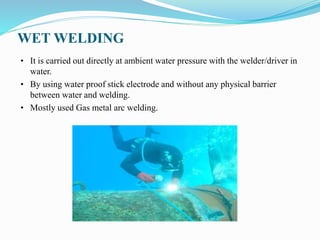
• It is carried out directly at ambient water pressure with the welder/driver in
water.
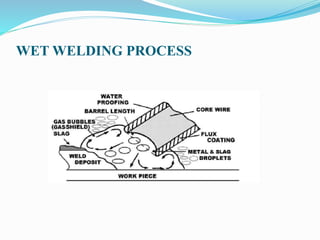
• By using water proof stick electrode and without any physical barrier
between water and welding.
• Mostly used Gas metal arc welding.
WET WELDING PROCESS
ADVANTAGES OF WET WELDING
• The versatility and low cost of wet welding makes this method highly
desirable.
• Other benefits include the speed. With which the operation is carried out.
• It is less costly compared to dry welding.
• The welder can reach portions of offshore structures that could not be
welded using other methods.
DISADVANTAGES OF WET WEDING
• Rapid quenching of the weld metal by surrounding water.
• Decreases impact strength and losses.
• Hydrogen embrittlement causes cracks.
• Poor visibility in water.
• Electric shocks will occur.
APPLICATIONS OF UNDERWATER
WELDING
The important applications of underwater welding are:
• Offshore construction for tapping sea resources.
• Temporary repair work caused by ship's collisions or unexpected accidents.
• Salvaging vessels sunk in the sea.
• Repair and maintenance of ships.
• Construction of large ships beyond the capacity of existing docks.
ENVIRONMENTAL PARAMETERS
Water Depth:
• Increased water depth constricts the welding arc resulting in an increased
weld penetration on higher rate of filler metal transfer.
• The arc constriction results in an increased voltage and current as the water
depth increases.
Water Temperature:
• The presence of water and the type of water surrounding the weld metal
affects the welding process and the resulting temperatures.
• This effect is due to the greater convective heat transfer coefficient of water
as compared to air which results in the rapid cooling in underwater welding.
UNDERWATER INSPECTION
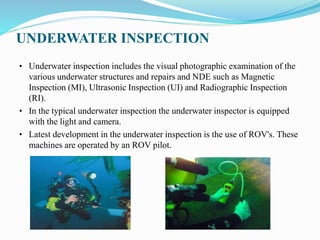
• Underwater inspection includes the visual photographic examination of the
various underwater structures and repairs and NDE such as Magnetic
Inspection (MI), Ultrasonic Inspection (UI) and Radiographic Inspection
(RI).
• In the typical underwater inspection the underwater inspector is equipped
with the light and camera.
• Latest development in the underwater inspection is the use of ROV's. These
machines are operated by an ROV pilot.
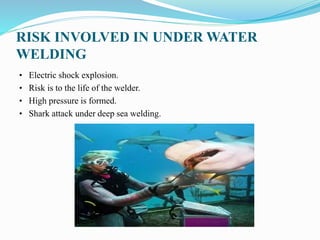
RISK INVOLVED IN UNDER WATER
WELDING
• Electric shock explosion.
• Risk is to the life of the welder.
• High pressure is formed.
• Shark attack under deep sea welding.
SCOPE FOR THE FURTHER DEVELOPMENT
• Automation of the underwater joining and inspection of the welded
structures.
• Mechanized underwater welding for actual usage of very large floating
structures.
• Invention of new welding techniques and explore the possibility of its
application in underwater welding.
• Application of advanced welding technique, like friction, laser welding and
understand the behavior of materials after the welding and process
optimization.
• The research work is carried towards the automation in which robots are
used for underwater welding & allied activities.
• Explosive and friction welding are also to be tested in deep.
CONCLUSION
• Underwater wet and dry welding, together with inspection techniques
gained credibility and professional acceptance Alternatives in underwater
welding and inspection development are in application of various
autonomous or remotely operated systems, but it must be mentioned that
divers are irreplaceable in some occasions.
• Underwater wet and dry welding and inspection are significant and
important tools for maintenance and repair of naval objects. Moreover,
through development of technology and equipment, their applicability is
further improved, especially with help of ROV.
UNDERWATER WELDING PPT 3PD19ME043.pptx

UNDERWATER WELDING PPT 3PD19ME043.pptx

  • 1.
    UNDER THE GUIDANCEOF V B HIPPARGI SIR BHARATH KODLI SIR PRESENTED BY- MD TOUSIFUDDIN USN: 3PD19ME043
  • 2.
    CONTENT  INTRODUCTION  CLASSIFICATIONOF UNDERWATER WELDING  APPLICATIONS OF UNDERWATER WELDING  ENVIRONMENTAL PARAMETERS  UNDERWATER INSPECTION  RISK INVOLVED IN UNDERWATER WELDING  SCOPE FOR THE FURTHER DEVELOPMENT  CONCLUSION
  • 3.
    INTRODUCTION • Now adays in all fabrication works welding has become a very important tool. • It would be no exaggeration to say that there is no metal industry and no branch of engineering that doesn’t involve the use of welding as a manufacturing tool. • Underwater welding began during the world war I, it was used to make temporary repairs on the ships. • Hence underwater welding came into existence. • Now underwater welding is used in fabrication industry for joining the steel on the offshore platforms , underwater structures , pipelines and ships.
  • 4.
  • 5.
    DRY WELDING  Alsoknown as hyperbaric welding is the process in which a chamber is sealed around the structure to be welded and is filled with a gas (He and 0.5 bar of oxygen) at the prevailing pressure.
  • 6.
  • 7.
    ADVANTAGES OF DRYWELDING  More safer than wet welding.  Good quality weld.  Surface monitoring.  Non destructive testing possible. DISADVANTAGES OF DRY WELDING  Higher cost of process, training, etc.  Large quantity of costly and complex equipment.  More deep, more energy requirement.  Work depth has an effect on habitat welding.
  • 8.
    WET WELDING • Itis carried out directly at ambient water pressure with the welder/driver in water. • By using water proof stick electrode and without any physical barrier between water and welding. • Mostly used Gas metal arc welding.
  • 9.
  • 10.
    ADVANTAGES OF WETWELDING • The versatility and low cost of wet welding makes this method highly desirable. • Other benefits include the speed. With which the operation is carried out. • It is less costly compared to dry welding. • The welder can reach portions of offshore structures that could not be welded using other methods. DISADVANTAGES OF WET WEDING • Rapid quenching of the weld metal by surrounding water. • Decreases impact strength and losses. • Hydrogen embrittlement causes cracks. • Poor visibility in water. • Electric shocks will occur.
  • 11.
    APPLICATIONS OF UNDERWATER WELDING Theimportant applications of underwater welding are: • Offshore construction for tapping sea resources. • Temporary repair work caused by ship's collisions or unexpected accidents. • Salvaging vessels sunk in the sea. • Repair and maintenance of ships. • Construction of large ships beyond the capacity of existing docks.
  • 12.
    ENVIRONMENTAL PARAMETERS Water Depth: •Increased water depth constricts the welding arc resulting in an increased weld penetration on higher rate of filler metal transfer. • The arc constriction results in an increased voltage and current as the water depth increases. Water Temperature: • The presence of water and the type of water surrounding the weld metal affects the welding process and the resulting temperatures. • This effect is due to the greater convective heat transfer coefficient of water as compared to air which results in the rapid cooling in underwater welding.
  • 13.
    UNDERWATER INSPECTION • Underwaterinspection includes the visual photographic examination of the various underwater structures and repairs and NDE such as Magnetic Inspection (MI), Ultrasonic Inspection (UI) and Radiographic Inspection (RI). • In the typical underwater inspection the underwater inspector is equipped with the light and camera. • Latest development in the underwater inspection is the use of ROV's. These machines are operated by an ROV pilot.
  • 14.
    RISK INVOLVED INUNDER WATER WELDING • Electric shock explosion. • Risk is to the life of the welder. • High pressure is formed. • Shark attack under deep sea welding.
  • 15.
    SCOPE FOR THEFURTHER DEVELOPMENT • Automation of the underwater joining and inspection of the welded structures. • Mechanized underwater welding for actual usage of very large floating structures. • Invention of new welding techniques and explore the possibility of its application in underwater welding. • Application of advanced welding technique, like friction, laser welding and understand the behavior of materials after the welding and process optimization. • The research work is carried towards the automation in which robots are used for underwater welding & allied activities. • Explosive and friction welding are also to be tested in deep.
  • 16.
    CONCLUSION • Underwater wetand dry welding, together with inspection techniques gained credibility and professional acceptance Alternatives in underwater welding and inspection development are in application of various autonomous or remotely operated systems, but it must be mentioned that divers are irreplaceable in some occasions. • Underwater wet and dry welding and inspection are significant and important tools for maintenance and repair of naval objects. Moreover, through development of technology and equipment, their applicability is further improved, especially with help of ROV.