UNDER-WATER WELDING
PRESENTED BY
K. ROHITH
17H61A0287
INTRODUCTION
>Underwater welding is an important tool for underwater fabrication
works. In 1946, special waterproof electrodes were developed in
Holland by ËœVander Willingen’â„¢.
>In recent years the number of offshore structures including oil drilling
rigs, pipelines, platforms are being installed significantly.
>Underwater welding is a type of welding which takes place
underwater.
NEED FOR UNDER WATER WELDING
➤To repair the cracks in ships ,bridge and submarine.
➤ For quick process in under water welding.
➤ To construction of pipe line in under sea.
➤ To weld any cracks in oil pipe line.
➤Underwater welding plays an important role in construction, the
maintenance of oil rigs and ships, and much more.
➤Underwater welding work is needed when there are any structures or ships
that require salvage. It is also needed whenever there are urgent repairs
required.
REQUIREMENT OF UNDER WATER WELDING
➤Power supply requirements 400 Amp or larger.
DC generators, motor generators and rectifiers are acceptable power
supplies.
➤Power converters.
➤ Welding Generator, Pre-Setup.
➤ Diesel Driven Welding Generator Amperageand Voltage settings.
➤Gas Manifolds.
DIFFERENCE BETWEEN NORMAL WELDING
AND UNDER WATER WELDING
➤Under water welding
1. Underwater Welding & Burning: 6,500-10,000° F Under the Sea.
2. Under the water, metal sounds different. It's high pitched but muffled like a
siren entering a tunnel. It dissipates quickly out into the waves.
➤ Ground welding
1. In the electric arc, the temperature is very high of the order of6,000-8,000 °C
for the GTAW, GMAW, FCAW and SAW processes.
2. It up to 10,000 20,000 °C for the PAW process and well above the boiling
point of the base and filler materials
CLASSIFICATION OF UNDER WATER WELDING
Wet welding:
➤ In this process it is directly exposed to the environment. And special water
proof electrode is used in this type of welding.
Dry welding:
➤ In this process it is seal by closed chamber filled with gas to elevated
pressure.
➤ Gas tungsten arc welding is most commonly used.
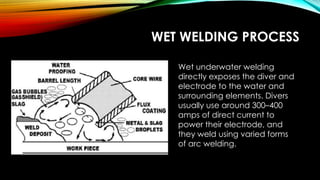
WET WELDING PROCESS
Wet underwater welding
directly exposes the diver and
electrode to the water and
surrounding elements. Divers
usually use around 300–400
amps of direct current to
power their electrode, and
they weld using varied forms
of arc welding.
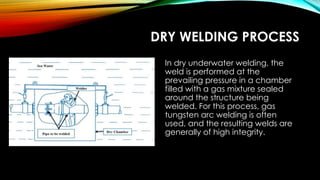
DRY WELDING PROCESS
In dry underwater welding, the
weld is performed at the
prevailing pressure in a chamber
filled with a gas mixture sealed
around the structure being
welded. For this process, gas
tungsten arc welding is often
used, and the resulting welds are
generally of high integrity.
APPLICATIONS OF UNDER WATER WELDING
►It is key technology for repairing marine structure.
➤Welding is directly performed under water is directly exposed to the wet
environment.
➤Increased freedom movement makes more effective, efficient and
economical.
➤To Maintain the oil pipe lines in under water.
➤ Construction of pipe line under sea.
➤Supply is connected to the welder / driver via cables or hoses.
FUTURE SCOPE AND DEVELOPMENTS
>Present trend is towards automation. THOR-1 (TIG Hyperbaric Orbital Robot) is
developed where diverse performs pipefitting, installs the track and orbital
headon the pipe and the rest process is automated.
>Mechanized underwater welding for actual usage of a very large floating
surface.
>Investigation by using a robot manipulator for underwater ultrasonic testing
for complex geometry.
>Application of advanced welding technique, like friction, laser welding.
>Invention of new welding techniques and explore the possibility.
THANK YOU

Presentation for the engineering btech students

  • 1.
  • 2.
    INTRODUCTION >Underwater welding isan important tool for underwater fabrication works. In 1946, special waterproof electrodes were developed in Holland by ËœVander Willingen’â„¢. >In recent years the number of offshore structures including oil drilling rigs, pipelines, platforms are being installed significantly. >Underwater welding is a type of welding which takes place underwater.
  • 3.
    NEED FOR UNDERWATER WELDING ➤To repair the cracks in ships ,bridge and submarine. ➤ For quick process in under water welding. ➤ To construction of pipe line in under sea. ➤ To weld any cracks in oil pipe line. ➤Underwater welding plays an important role in construction, the maintenance of oil rigs and ships, and much more. ➤Underwater welding work is needed when there are any structures or ships that require salvage. It is also needed whenever there are urgent repairs required.
  • 4.
    REQUIREMENT OF UNDERWATER WELDING ➤Power supply requirements 400 Amp or larger. DC generators, motor generators and rectifiers are acceptable power supplies. ➤Power converters. ➤ Welding Generator, Pre-Setup. ➤ Diesel Driven Welding Generator Amperageand Voltage settings. ➤Gas Manifolds.
  • 5.
    DIFFERENCE BETWEEN NORMALWELDING AND UNDER WATER WELDING ➤Under water welding 1. Underwater Welding & Burning: 6,500-10,000° F Under the Sea. 2. Under the water, metal sounds different. It's high pitched but muffled like a siren entering a tunnel. It dissipates quickly out into the waves. ➤ Ground welding 1. In the electric arc, the temperature is very high of the order of6,000-8,000 °C for the GTAW, GMAW, FCAW and SAW processes. 2. It up to 10,000 20,000 °C for the PAW process and well above the boiling point of the base and filler materials
  • 6.
    CLASSIFICATION OF UNDERWATER WELDING Wet welding: ➤ In this process it is directly exposed to the environment. And special water proof electrode is used in this type of welding. Dry welding: ➤ In this process it is seal by closed chamber filled with gas to elevated pressure. ➤ Gas tungsten arc welding is most commonly used.
  • 7.
    WET WELDING PROCESS Wetunderwater welding directly exposes the diver and electrode to the water and surrounding elements. Divers usually use around 300–400 amps of direct current to power their electrode, and they weld using varied forms of arc welding.
  • 8.
    DRY WELDING PROCESS Indry underwater welding, the weld is performed at the prevailing pressure in a chamber filled with a gas mixture sealed around the structure being welded. For this process, gas tungsten arc welding is often used, and the resulting welds are generally of high integrity.
  • 9.
    APPLICATIONS OF UNDERWATER WELDING ►It is key technology for repairing marine structure. ➤Welding is directly performed under water is directly exposed to the wet environment. ➤Increased freedom movement makes more effective, efficient and economical. ➤To Maintain the oil pipe lines in under water. ➤ Construction of pipe line under sea. ➤Supply is connected to the welder / driver via cables or hoses.
  • 10.
    FUTURE SCOPE ANDDEVELOPMENTS >Present trend is towards automation. THOR-1 (TIG Hyperbaric Orbital Robot) is developed where diverse performs pipefitting, installs the track and orbital headon the pipe and the rest process is automated. >Mechanized underwater welding for actual usage of a very large floating surface. >Investigation by using a robot manipulator for underwater ultrasonic testing for complex geometry. >Application of advanced welding technique, like friction, laser welding. >Invention of new welding techniques and explore the possibility.
  • 11.