UNDERWATER WELDING
Presented by,
Lara fedrick.S, Vikas.P.S,
Indra Ganesan College Of Engineering,
Trichy-12.
1
Introduction
 The fact that electric arc could operate was known for over
a 100 years
 The first ever underwater welding was carried out by
British Admiralty – Dockyard for sealing leaking ship
rivets below the water line.
 In 1946, special waterproof electrodes were developed in
Holland by ‘Van der Willingen’.
 Any repair method under the sea will require the use of
underwater welding.
2
WELDING
3
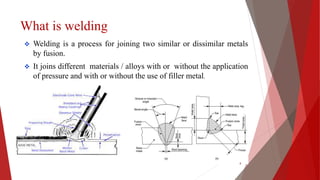
What is welding
 Welding is a process for joining two similar or dissimilar metals
by fusion.
 It joins different materials / alloys with or without the application
of pressure and with or without the use of filler metal.
4
Necessity of underwater welding
 To provide a permanent joining between two metals inside
present under the water
 High pressure pipe lines cannot be joint using temporary fasteners
such as bolts and nuts. Hence welding is compulsory in high
pressure pipe linings.
5
Principle
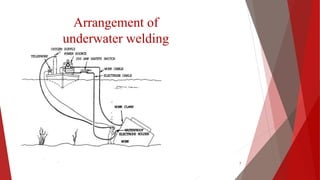
 The work to be welded is connected to one side of an electric circuit
by means of a cable. A flux-coated electrode is attached to a holder,
also connected via cable, both being attached to a power source.
 When the electrode makes contact with the work, an electrical
contact is made. The electric current jumps the gap and create a
spark (arc), which melts the base metal and the covering of the
electrode forming a common weld puddle.
 Complete insulation of the cable and hoses is essential in case to
prevent the chance for electric shock.
6
Arrangement of
underwater welding
7
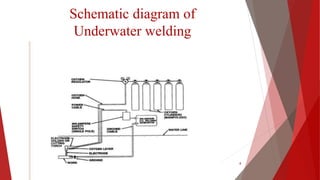
Schematic diagram of
Underwater welding
8
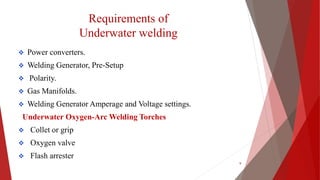
Requirements of
Underwater welding
 Power converters.
 Welding Generator, Pre-Setup
 Polarity.
 Gas Manifolds.
 Welding Generator Amperage and Voltage settings.
Underwater Oxygen-Arc Welding Torches
 Collet or grip
 Oxygen valve
 Flash arrester
9
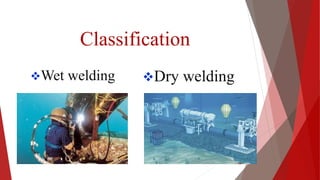
Classification
Wet welding Dry welding
10
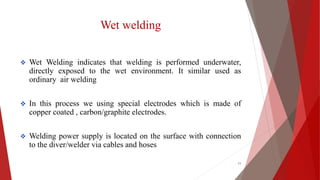
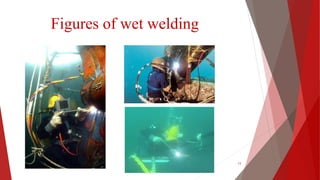
Wet welding
 Wet Welding indicates that welding is performed underwater,
directly exposed to the wet environment. It similar used as
ordinary air welding
 In this process we using special electrodes which is made of
copper coated , carbon/graphite electrodes.
 Welding power supply is located on the surface with connection
to the diver/welder via cables and hoses
11
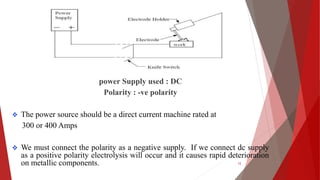
power Supply used : DC
Polarity : -ve polarity
 The power source should be a direct current machine rated at
300 or 400 Amps
 We must connect the polarity as a negative supply. If we connect dc supply
as a positive polarity electrolysis will occur and it causes rapid deterioration
on metallic components. 12
Figures of wet welding
13
Advantages
 It is economical and fastest
method
 It has a high tensile strength
 Ease to access the weld spot
 Less time consumption for
welding
Disadvantages
 Poor visibility in water
during process
 It reduce the ductility and
impact strength of welded
material.
 It increase the hydrogen
embrittlement
14
Dry welding
 In dry welding dry environment is made possible by
encompassing the area to be welded.
 The chamber is placed near the structure where to be weld.
 The chamber is filled with a gas (commonly helium containing
0.5 bar of oxygen) at the prevailing pressure
15
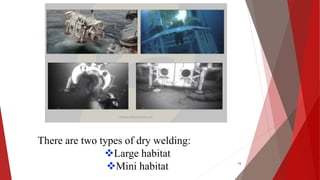
There are two types of dry welding:
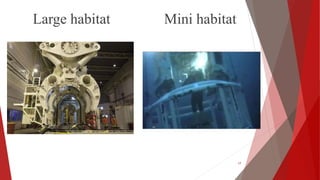
Large habitat
Mini habitat 16
Large habitat Mini habitat
17
Advantages
 Welder/diver is safety
 Good quality weld
 Surface monitoring
 Non destructive testing
Disadvantages
 Highly cost equipment.
 Skilled labour required.
 We can’t weld unreachable
spot
18
Developments of
underwater welding
 Wet welding has been used as an underwater welding technique
for a long time and is still being used.
 With recent acceleration in the construction of offshore structures
underwater welding has assumed increased importance.
 With recent acceleration in the construction of offshore structures
underwater welding has assumed increased importance.
19
Risks & precaution
 Risk of electric shock so achieving electrical insulation of
electrical welding equipment's
 Hydrogen and oxygen are produced by the arc in wet welding are
potentially explosion so precaution must be taken to avoid the
build up of pockets of gas
 The life of the welder will be risk from nitrogen introduced into
the blood stream, precaution include the provision of an
emergency air gas supply 20
Application
 Offshore construction for tapping sea source
 Temporary repair work caused by ship collision, unexpected
accident
 Maintenance of ships
 Pipelines and Tunnels
 Oil refineries
21
CONCLUSION
 Thus underwater welding facilities creating
permnant joint in a deep sea in effective way though
it may affect underwater welding habitats further
modification of developments in process can
improve effectiveness of underwater welding.
22
References
 1) D. J Keats, Manual on Wet Welding.
 2) Annon, Recent advances in dry underwater pipeline welding,
Welding Engineer, 1974.
 3) Lythall, Gibson, Dry Hyperbaric underwater welding, Welding
Institute.
 4) W.Lucas, International conference on computer technology in
welding.
 5) Stepath M. D, Underwater welding and cutting yields slowly to
research, Welding Engineer, April 1973.
 6) Silva, Hazlett, Underwater welding with iron – powder
electrodes, Welding Journal, 1971
23
Thank you
24

Under water welding PPT

  • 1.
    UNDERWATER WELDING Presented by, Larafedrick.S, Vikas.P.S, Indra Ganesan College Of Engineering, Trichy-12. 1
  • 2.
    Introduction  The factthat electric arc could operate was known for over a 100 years  The first ever underwater welding was carried out by British Admiralty – Dockyard for sealing leaking ship rivets below the water line.  In 1946, special waterproof electrodes were developed in Holland by ‘Van der Willingen’.  Any repair method under the sea will require the use of underwater welding. 2
  • 3.
  • 4.
    What is welding Welding is a process for joining two similar or dissimilar metals by fusion.  It joins different materials / alloys with or without the application of pressure and with or without the use of filler metal. 4
  • 5.
    Necessity of underwaterwelding  To provide a permanent joining between two metals inside present under the water  High pressure pipe lines cannot be joint using temporary fasteners such as bolts and nuts. Hence welding is compulsory in high pressure pipe linings. 5
  • 6.
    Principle  The workto be welded is connected to one side of an electric circuit by means of a cable. A flux-coated electrode is attached to a holder, also connected via cable, both being attached to a power source.  When the electrode makes contact with the work, an electrical contact is made. The electric current jumps the gap and create a spark (arc), which melts the base metal and the covering of the electrode forming a common weld puddle.  Complete insulation of the cable and hoses is essential in case to prevent the chance for electric shock. 6
  • 7.
  • 8.
  • 9.
    Requirements of Underwater welding Power converters.  Welding Generator, Pre-Setup  Polarity.  Gas Manifolds.  Welding Generator Amperage and Voltage settings. Underwater Oxygen-Arc Welding Torches  Collet or grip  Oxygen valve  Flash arrester 9
  • 10.
  • 11.
    Wet welding  WetWelding indicates that welding is performed underwater, directly exposed to the wet environment. It similar used as ordinary air welding  In this process we using special electrodes which is made of copper coated , carbon/graphite electrodes.  Welding power supply is located on the surface with connection to the diver/welder via cables and hoses 11
  • 12.
    power Supply used: DC Polarity : -ve polarity  The power source should be a direct current machine rated at 300 or 400 Amps  We must connect the polarity as a negative supply. If we connect dc supply as a positive polarity electrolysis will occur and it causes rapid deterioration on metallic components. 12
  • 13.
    Figures of wetwelding 13
  • 14.
    Advantages  It iseconomical and fastest method  It has a high tensile strength  Ease to access the weld spot  Less time consumption for welding Disadvantages  Poor visibility in water during process  It reduce the ductility and impact strength of welded material.  It increase the hydrogen embrittlement 14
  • 15.
    Dry welding  Indry welding dry environment is made possible by encompassing the area to be welded.  The chamber is placed near the structure where to be weld.  The chamber is filled with a gas (commonly helium containing 0.5 bar of oxygen) at the prevailing pressure 15
  • 16.
    There are twotypes of dry welding: Large habitat Mini habitat 16
  • 17.
  • 18.
    Advantages  Welder/diver issafety  Good quality weld  Surface monitoring  Non destructive testing Disadvantages  Highly cost equipment.  Skilled labour required.  We can’t weld unreachable spot 18
  • 19.
    Developments of underwater welding Wet welding has been used as an underwater welding technique for a long time and is still being used.  With recent acceleration in the construction of offshore structures underwater welding has assumed increased importance.  With recent acceleration in the construction of offshore structures underwater welding has assumed increased importance. 19
  • 20.
    Risks & precaution Risk of electric shock so achieving electrical insulation of electrical welding equipment's  Hydrogen and oxygen are produced by the arc in wet welding are potentially explosion so precaution must be taken to avoid the build up of pockets of gas  The life of the welder will be risk from nitrogen introduced into the blood stream, precaution include the provision of an emergency air gas supply 20
  • 21.
    Application  Offshore constructionfor tapping sea source  Temporary repair work caused by ship collision, unexpected accident  Maintenance of ships  Pipelines and Tunnels  Oil refineries 21
  • 22.
    CONCLUSION  Thus underwaterwelding facilities creating permnant joint in a deep sea in effective way though it may affect underwater welding habitats further modification of developments in process can improve effectiveness of underwater welding. 22
  • 23.
    References  1) D.J Keats, Manual on Wet Welding.  2) Annon, Recent advances in dry underwater pipeline welding, Welding Engineer, 1974.  3) Lythall, Gibson, Dry Hyperbaric underwater welding, Welding Institute.  4) W.Lucas, International conference on computer technology in welding.  5) Stepath M. D, Underwater welding and cutting yields slowly to research, Welding Engineer, April 1973.  6) Silva, Hazlett, Underwater welding with iron – powder electrodes, Welding Journal, 1971 23
  • 24.