
Chapter:  Clues to Earth’s Past Table of Contents Section 3:  Absolute Ages of Rocks Section 1:  Fossils Section 2:  Relative Ages of Rocks
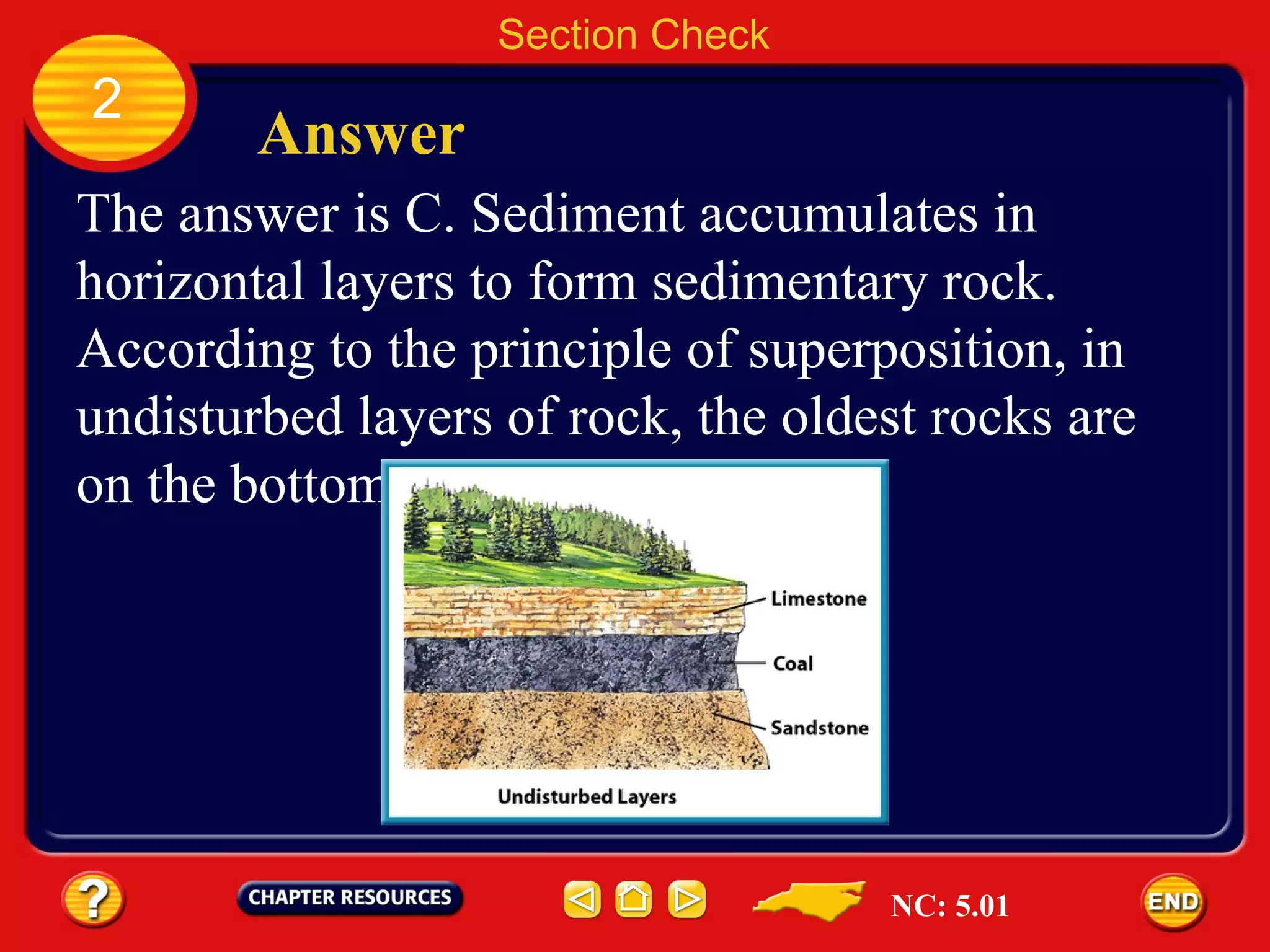
Superposition —Oldest Rocks on the Bottom According to the  principle of superposition ,   in undisturbed layers of rock, the oldest rocks are on the bottom and the rocks become progressively younger toward the top. Relative Ages of Rocks 2
When layers have been turned upside down, it’s necessary to use other clues in the rock layers to determine their original positions and relative ages. Rock Layers Sediment accumulates in horizontal beds, forming layers of sedimentary rock. Relative Ages of Rocks 2 Because of this, the oldest rocks are at the bottom.
Relative age determination doesn’t tell you anything about the age of the rock layers in actual years. Relative Ages The  relative age   of something is its age in comparison to the ages of other things. Relative Ages of Rocks 2 Geologists determine the relative ages of rocks and other structures by examining their places in a sequence.
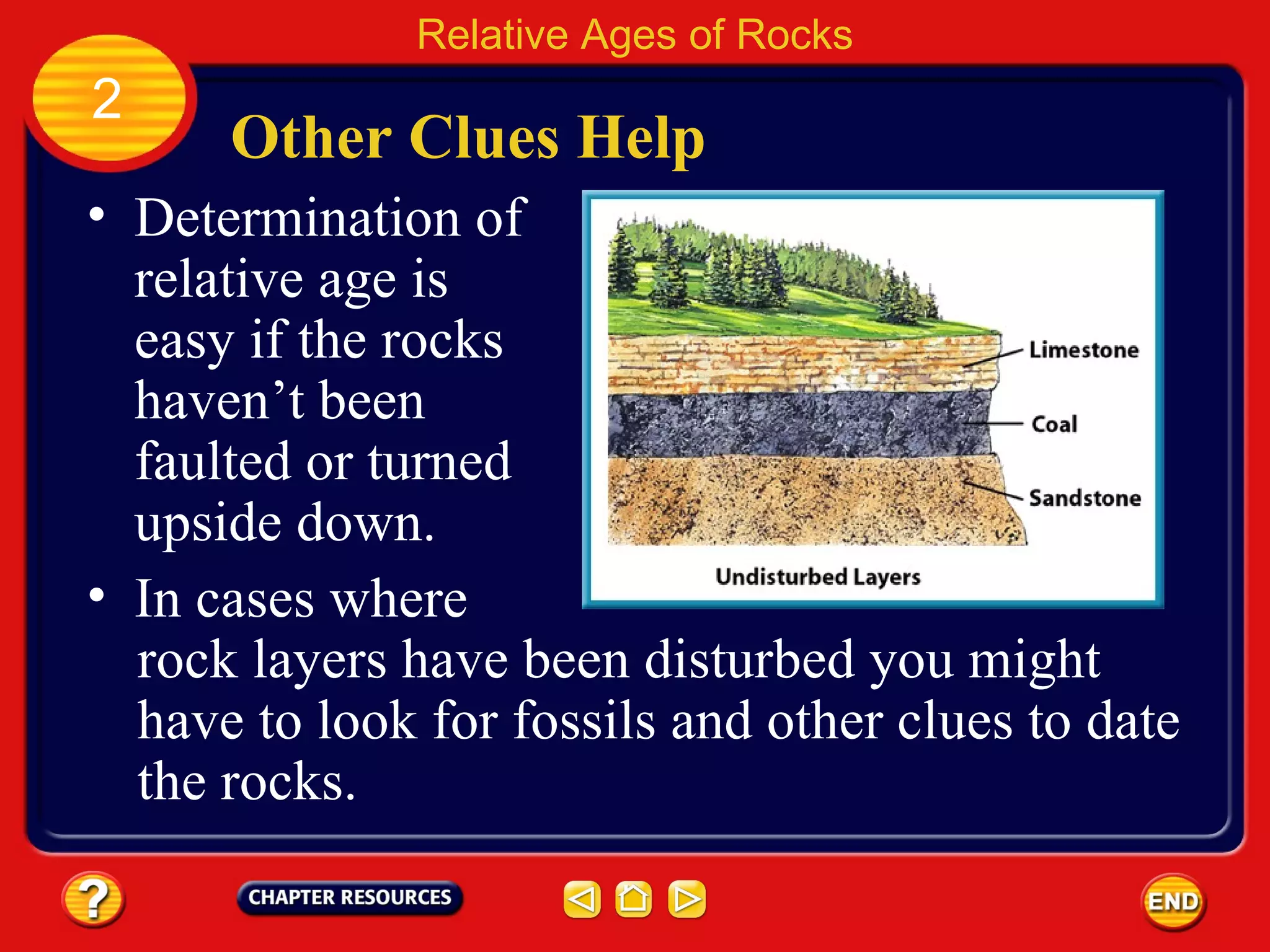
Other Clues Help Determination of relative age is easy if the rocks haven’t been faulted or turned upside down.  Relative Ages of Rocks 2 In cases where rock layers have been disturbed you might have to look for fossils and other clues to date the rocks.
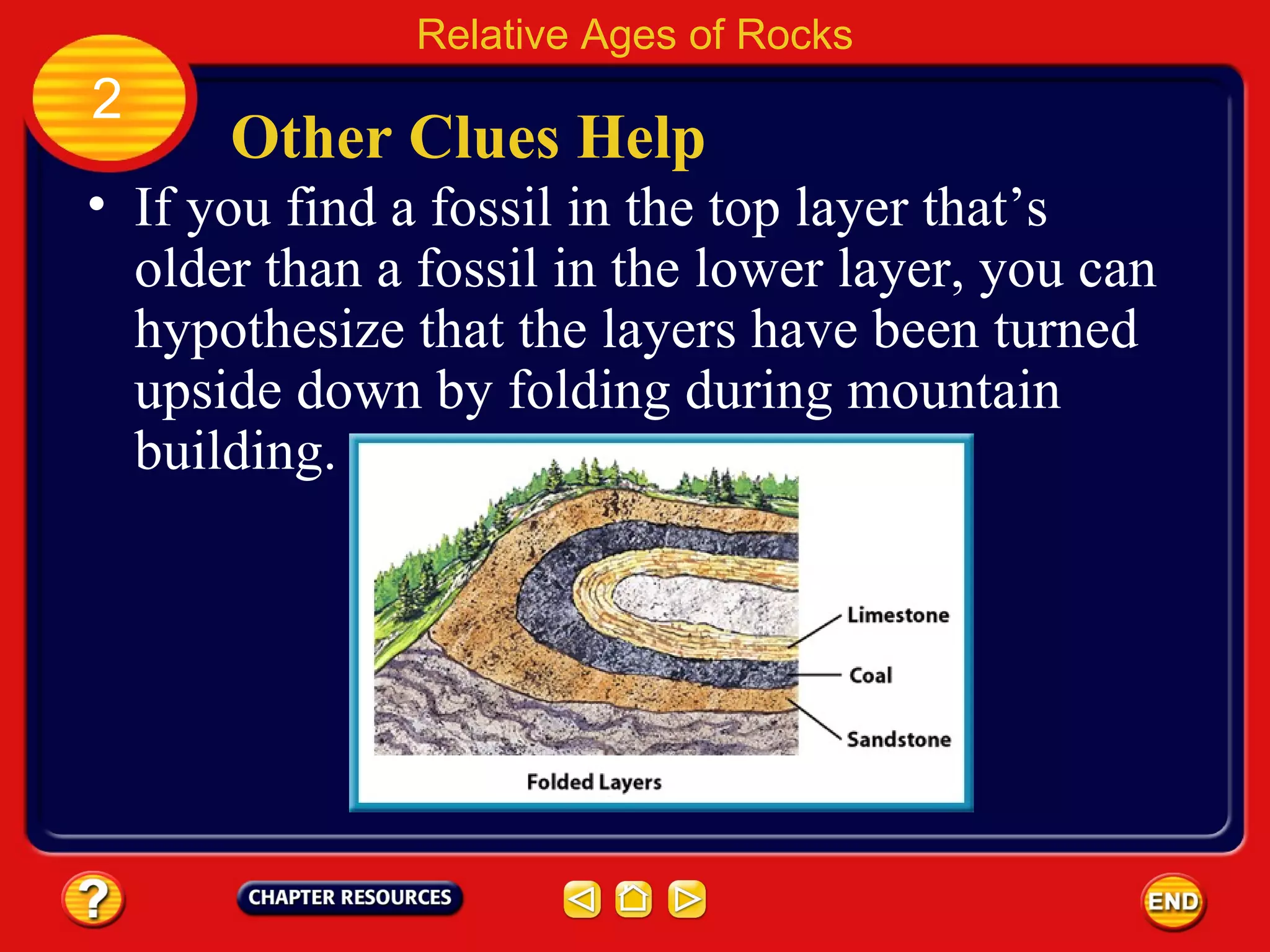
Other Clues Help If you find a fossil in the top layer that’s older than a fossil in the lower layer, you can hypothesize that the layers have been turned upside down by folding during mountain building. Relative Ages of Rocks 2
Unconformities Relative Ages of Rocks 2 Most rock sequences are incomplete—layers are missing. These gaps in rock sequences are called  unconformities . Unconformities develop when agents of erosion such as running water or glaciers remove rock layers by washing or scraping them away.
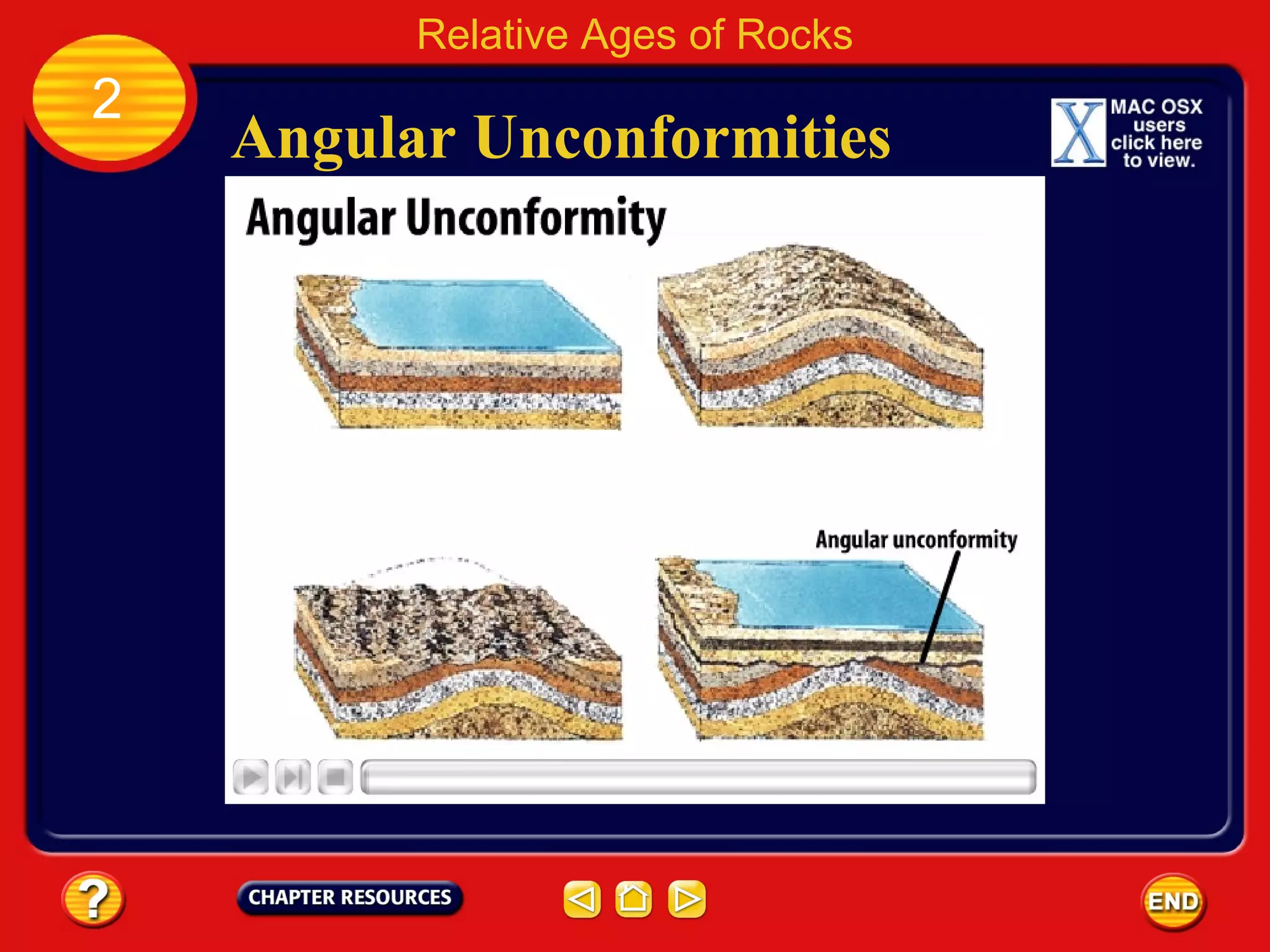
Angular Unconformities Horizontal layers of sedimentary rock often are tilted and uplifted. Relative Ages of Rocks 2 Erosion and weathering then wear down these tilted rock layers. Eventually, younger sediment layers are deposited horizontally on top of the tilted and eroded layers. Geologists call such an unconformity an angular unconformity.
Angular Unconformities Relative Ages of Rocks 2
Disconformity Suppose you’re looking at a stack of sedimentary rock layers. Relative Ages of Rocks 2 If you look closely, you might find an old surface of erosion. This records a time when the rocks were exposed and eroded. Even though all the layers are parallel, the rock record still has a gap. This type of unconformity is called a disconformity.
Nonconformity Another type of unconformity, called a nonconformity, occurs when metamorphic or igneous rocks are uplifted and eroded. Relative Ages of Rocks 2 Sedimentary rocks are then deposited on top of this erosion surface. The surface between the two rock types is a nonconformity.
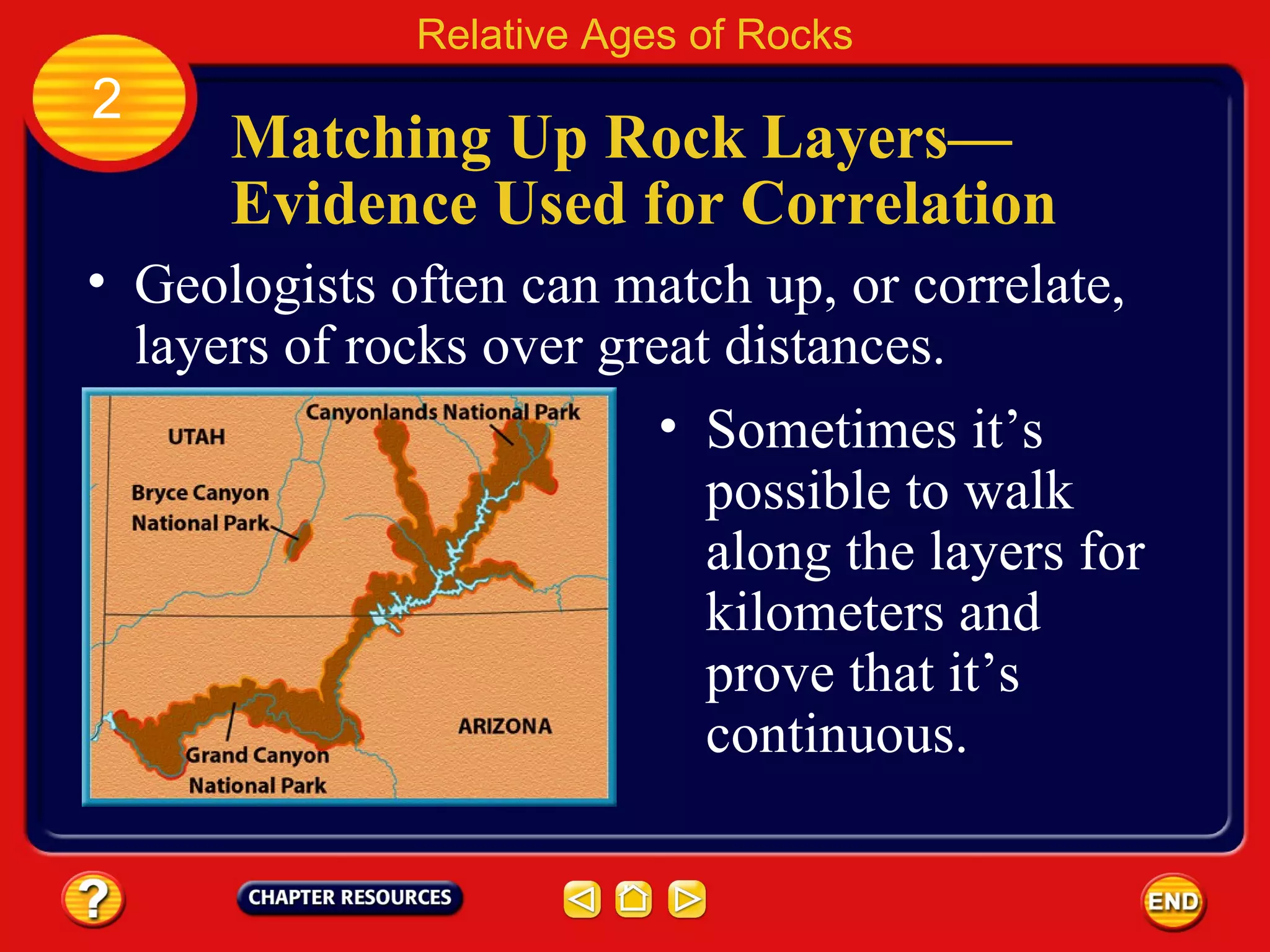
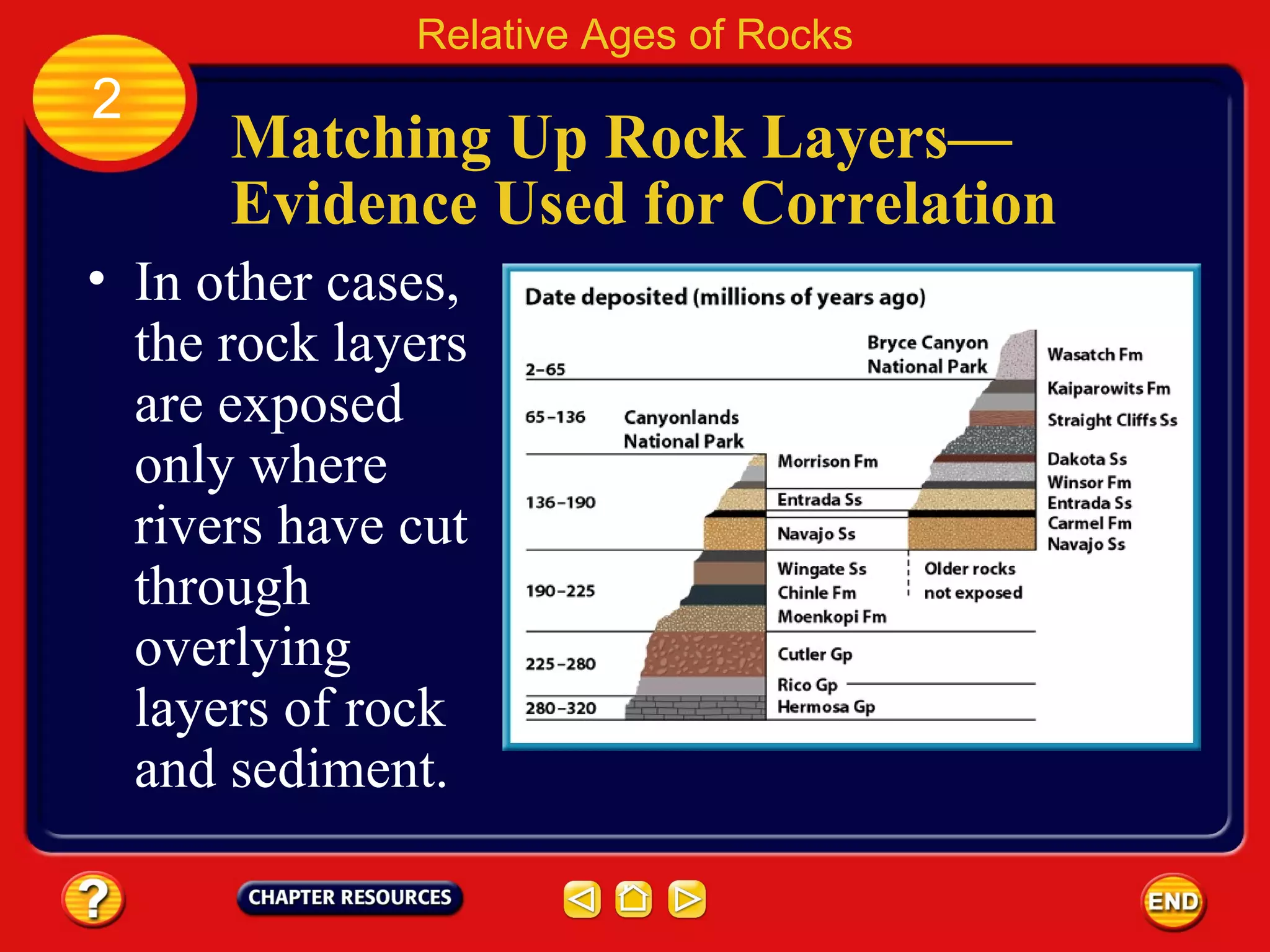
Matching Up Rock Layers — Evidence Used for Correlation Geologists often can match up, or correlate, layers of rocks over great distances. Relative Ages of Rocks 2 Sometimes it’s possible to walk along the layers for kilometers and prove that it’s continuous.
In other cases, the rock layers are exposed only where rivers have cut through overlying layers of rock and sediment. Relative Ages of Rocks 2 Matching Up Rock Layers — Evidence Used for Correlation
If the same types of fossils were found in the limestone layer in both places, it’s a good indication that the limestone at each location is the same age, and therefore, one continuous deposit. Relative Ages of Rocks 2 Matching Up Rock Layers — Evidence Used for Correlation
Section Check 2 Question 1 According to the principle of superposition, what do you expect to find in the bottom layer of undisturbed rock? A. abundant fossils  B. few fossils C. oldest rock D. youngest rock NC: 5.01
Section Check 2 Answer The answer is C. Sediment accumulates in horizontal layers to form sedimentary rock. According to the principle of superposition, in undisturbed layers of rock, the oldest rocks are on the bottom. NC: 5.01
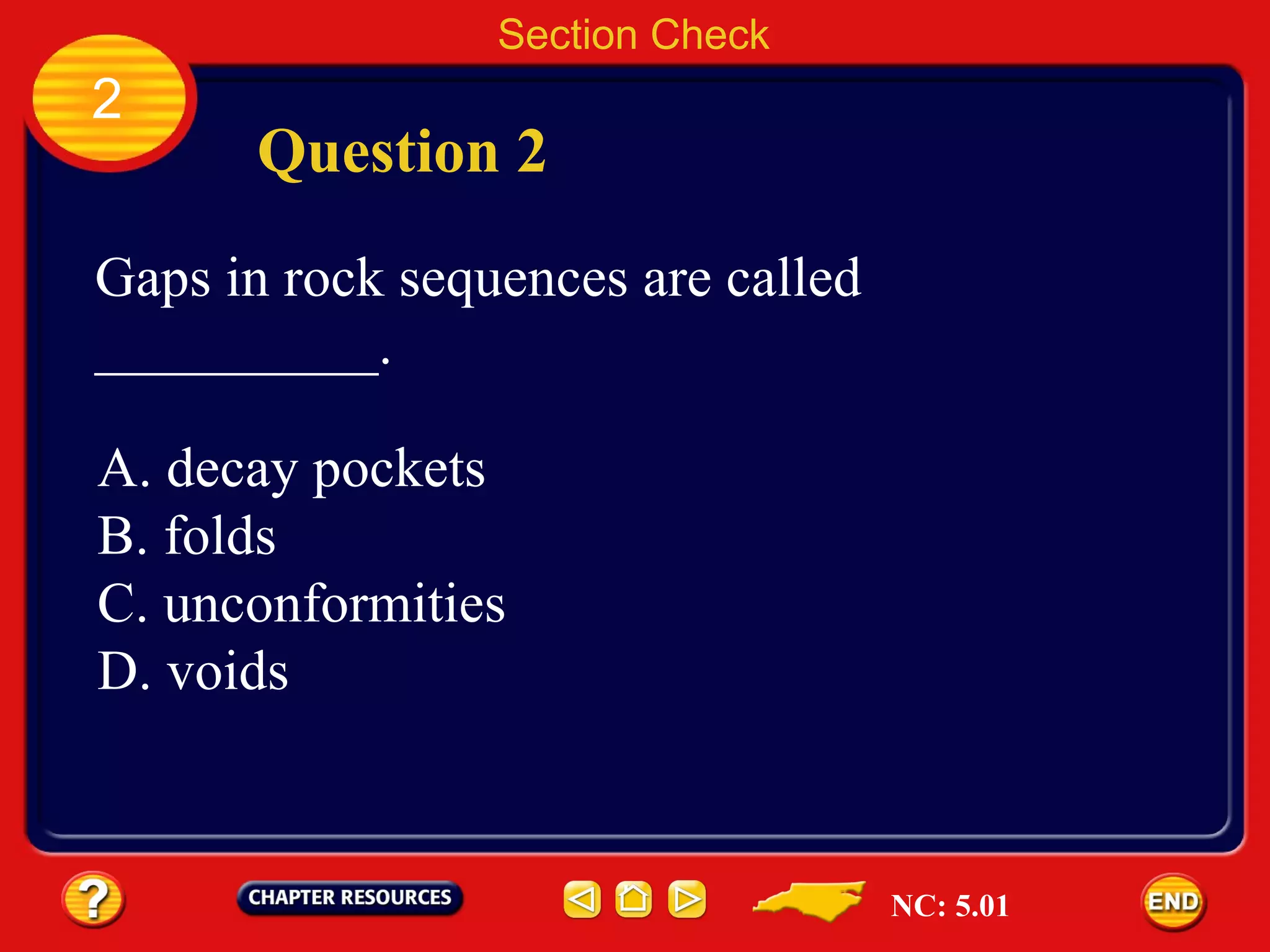
Section Check 2 Question 2 Gaps in rock sequences are called __________. A. decay pockets B. folds C. unconformities D. voids NC: 5.01
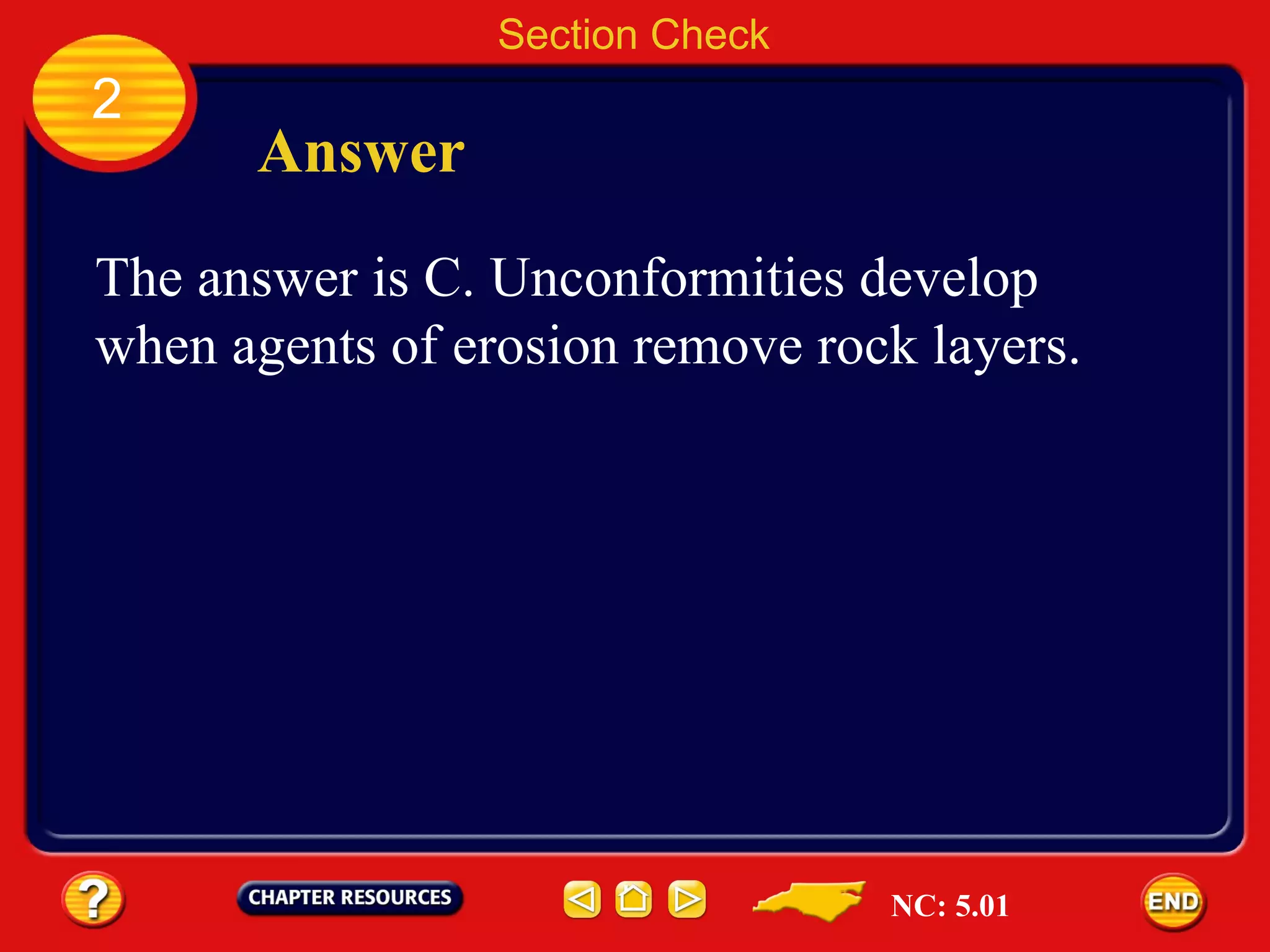
Section Check 2 Answer The answer is C. Unconformities develop when agents of erosion remove rock layers. NC: 5.01
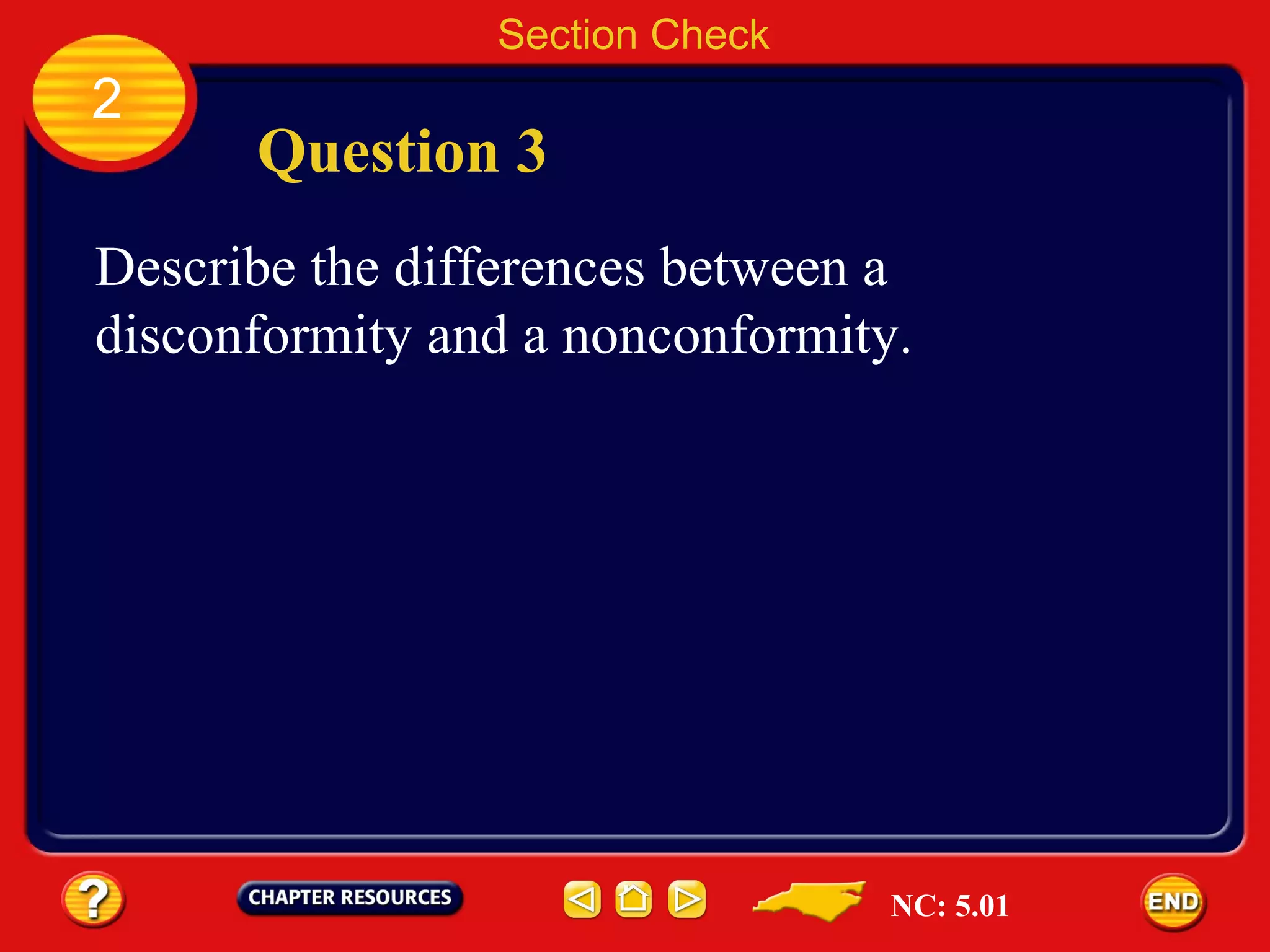
Section Check 2 Question 3 Describe the differences between a disconformity and a nonconformity. NC: 5.01
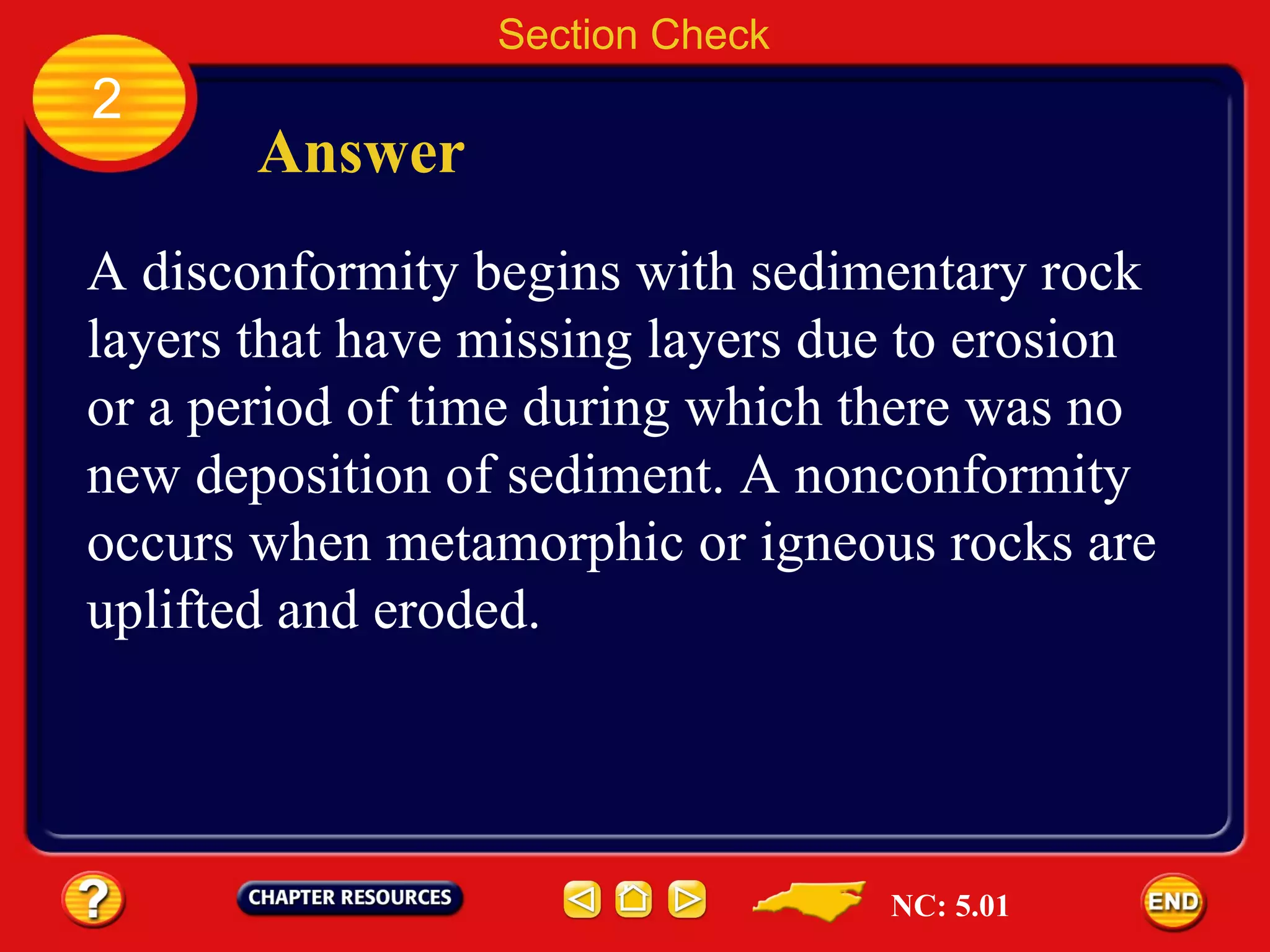
Section Check 2 Answer A disconformity begins with sedimentary rock layers that have missing layers due to erosion or a period of time during which there was no new deposition of sediment. A nonconformity occurs when metamorphic or igneous rocks are uplifted and eroded. NC: 5.01

Chapter 3:2 Relative Ages of Rocks

  • 1.
  • 2.
    Chapter: Cluesto Earth’s Past Table of Contents Section 3: Absolute Ages of Rocks Section 1: Fossils Section 2: Relative Ages of Rocks
  • 3.
    Superposition —Oldest Rockson the Bottom According to the principle of superposition , in undisturbed layers of rock, the oldest rocks are on the bottom and the rocks become progressively younger toward the top. Relative Ages of Rocks 2
  • 4.
    When layers havebeen turned upside down, it’s necessary to use other clues in the rock layers to determine their original positions and relative ages. Rock Layers Sediment accumulates in horizontal beds, forming layers of sedimentary rock. Relative Ages of Rocks 2 Because of this, the oldest rocks are at the bottom.
  • 5.
    Relative age determinationdoesn’t tell you anything about the age of the rock layers in actual years. Relative Ages The relative age of something is its age in comparison to the ages of other things. Relative Ages of Rocks 2 Geologists determine the relative ages of rocks and other structures by examining their places in a sequence.
  • 6.
    Other Clues HelpDetermination of relative age is easy if the rocks haven’t been faulted or turned upside down. Relative Ages of Rocks 2 In cases where rock layers have been disturbed you might have to look for fossils and other clues to date the rocks.
  • 7.
    Other Clues HelpIf you find a fossil in the top layer that’s older than a fossil in the lower layer, you can hypothesize that the layers have been turned upside down by folding during mountain building. Relative Ages of Rocks 2
  • 8.
    Unconformities Relative Agesof Rocks 2 Most rock sequences are incomplete—layers are missing. These gaps in rock sequences are called unconformities . Unconformities develop when agents of erosion such as running water or glaciers remove rock layers by washing or scraping them away.
  • 9.
    Angular Unconformities Horizontallayers of sedimentary rock often are tilted and uplifted. Relative Ages of Rocks 2 Erosion and weathering then wear down these tilted rock layers. Eventually, younger sediment layers are deposited horizontally on top of the tilted and eroded layers. Geologists call such an unconformity an angular unconformity.
  • 10.
  • 11.
    Disconformity Suppose you’relooking at a stack of sedimentary rock layers. Relative Ages of Rocks 2 If you look closely, you might find an old surface of erosion. This records a time when the rocks were exposed and eroded. Even though all the layers are parallel, the rock record still has a gap. This type of unconformity is called a disconformity.
  • 12.
    Nonconformity Another typeof unconformity, called a nonconformity, occurs when metamorphic or igneous rocks are uplifted and eroded. Relative Ages of Rocks 2 Sedimentary rocks are then deposited on top of this erosion surface. The surface between the two rock types is a nonconformity.
  • 13.
    Matching Up RockLayers — Evidence Used for Correlation Geologists often can match up, or correlate, layers of rocks over great distances. Relative Ages of Rocks 2 Sometimes it’s possible to walk along the layers for kilometers and prove that it’s continuous.
  • 14.
    In other cases,the rock layers are exposed only where rivers have cut through overlying layers of rock and sediment. Relative Ages of Rocks 2 Matching Up Rock Layers — Evidence Used for Correlation
  • 15.
    If the sametypes of fossils were found in the limestone layer in both places, it’s a good indication that the limestone at each location is the same age, and therefore, one continuous deposit. Relative Ages of Rocks 2 Matching Up Rock Layers — Evidence Used for Correlation
  • 16.
    Section Check 2Question 1 According to the principle of superposition, what do you expect to find in the bottom layer of undisturbed rock? A. abundant fossils B. few fossils C. oldest rock D. youngest rock NC: 5.01
  • 17.
    Section Check 2Answer The answer is C. Sediment accumulates in horizontal layers to form sedimentary rock. According to the principle of superposition, in undisturbed layers of rock, the oldest rocks are on the bottom. NC: 5.01
  • 18.
    Section Check 2Question 2 Gaps in rock sequences are called __________. A. decay pockets B. folds C. unconformities D. voids NC: 5.01
  • 19.
    Section Check 2Answer The answer is C. Unconformities develop when agents of erosion remove rock layers. NC: 5.01
  • 20.
    Section Check 2Question 3 Describe the differences between a disconformity and a nonconformity. NC: 5.01
  • 21.
    Section Check 2Answer A disconformity begins with sedimentary rock layers that have missing layers due to erosion or a period of time during which there was no new deposition of sediment. A nonconformity occurs when metamorphic or igneous rocks are uplifted and eroded. NC: 5.01