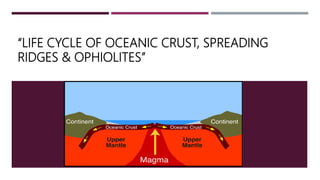
“LIFE CYCLE OF OCEANIC CRUST, SPREADING
RIDGES & OPHIOLITES”
PRESENTED BY : SARDAR OBAID-UR-REHMAN
ENROLLMENT # : 46
SEMESTER : 7TH (MORNING)
“GEO-TECTONICS”
WHAT IS OCEANIC CRUST ?
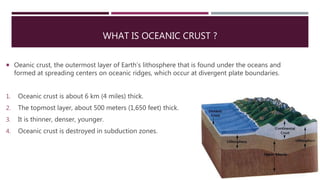
 Oeanic crust, the outermost layer of Earth’s lithosphere that is found under the oceans and
formed at spreading centers on oceanic ridges, which occur at divergent plate boundaries.
1. Oceanic crust is about 6 km (4 miles) thick.
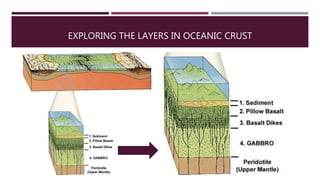
2. The topmost layer, about 500 meters (1,650 feet) thick.
3. It is thinner, denser, younger.
4. Oceanic crust is destroyed in subduction zones.
EXPLORING THE LAYERS IN OCEANIC CRUST
“LIFE CYCLE OF OCEANIC CRUST + SPREADING
RIDGES”
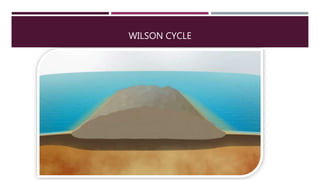
WILSON CYCLE
WHAT IS SPREADING RIDGES ?
 A spreading ridge is the fracture zone along the ocean bottom where molten mantle material
comes to the surface, thus creating new crust. This fracture can be seen beneath the ocean as
a line of ridge that form as molten rock reaches the ocean bottom and solidifies.
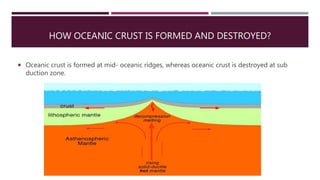
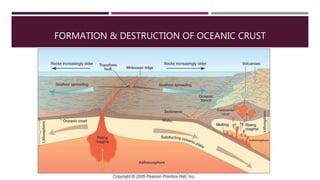
HOW OCEANIC CRUST IS FORMED AND DESTROYED?
 Oceanic crust is formed at mid- oceanic ridges, whereas oceanic crust is destroyed at sub
duction zone.
INTERESTING INFORMATION
 The speed of crust formation varies from ridge to ridge: Some fast-spreading ridges produce
up to 6 inches (15 centimeters) of new crust per year, while slower-spreading ridges creep
along at just 2 inches (5 cm) per year.
FORMATION & DESTRUCTION OF OCEANIC CRUST
“OPHIOLITES”
HISTORY OF OPHIOLITE
 “Ophio” is a Greek word which was used for “SNAKE”, Lite means “STONE” and it is also
derived from Greek word “Lithos”.
 The name is given because ophiolites have similarity in colour and texture with snakes, some
greenish colour.
DEFINITION
An ophiolite is a section of the earth’s oceanic crust and the under lying upper mantle that has
been uplifted or emplaced to be exposed within continental crustal rocks.
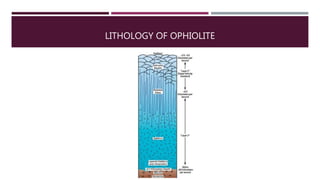
LITHOLOGY OF OPHIOLITE
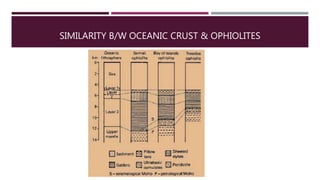
SIMILARITY B/W OCEANIC CRUST & OPHIOLITES
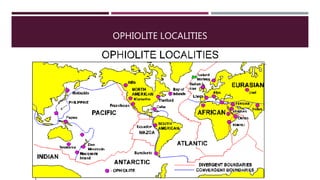
OPHIOLITE LOCALITIES
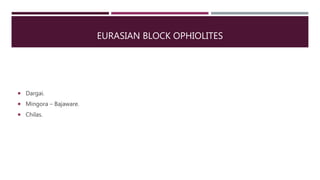
EURASIAN BLOCK OPHIOLITES
 Dargai.
 Mingora – Bajaware.
 Chilas.
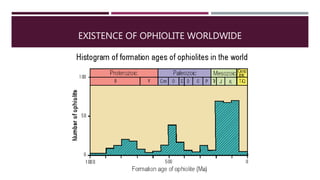
EXISTENCE OF OPHIOLITE WORLDWIDE
THE END
Thank You

Geotectonics

  • 1.
    “LIFE CYCLE OFOCEANIC CRUST, SPREADING RIDGES & OPHIOLITES”
  • 2.
    PRESENTED BY :SARDAR OBAID-UR-REHMAN ENROLLMENT # : 46 SEMESTER : 7TH (MORNING) “GEO-TECTONICS”
  • 3.
    WHAT IS OCEANICCRUST ?  Oeanic crust, the outermost layer of Earth’s lithosphere that is found under the oceans and formed at spreading centers on oceanic ridges, which occur at divergent plate boundaries. 1. Oceanic crust is about 6 km (4 miles) thick. 2. The topmost layer, about 500 meters (1,650 feet) thick. 3. It is thinner, denser, younger. 4. Oceanic crust is destroyed in subduction zones.
  • 4.
    EXPLORING THE LAYERSIN OCEANIC CRUST
  • 5.
    “LIFE CYCLE OFOCEANIC CRUST + SPREADING RIDGES”
  • 6.
  • 7.
    WHAT IS SPREADINGRIDGES ?  A spreading ridge is the fracture zone along the ocean bottom where molten mantle material comes to the surface, thus creating new crust. This fracture can be seen beneath the ocean as a line of ridge that form as molten rock reaches the ocean bottom and solidifies.
  • 8.
    HOW OCEANIC CRUSTIS FORMED AND DESTROYED?  Oceanic crust is formed at mid- oceanic ridges, whereas oceanic crust is destroyed at sub duction zone.
  • 9.
    INTERESTING INFORMATION  Thespeed of crust formation varies from ridge to ridge: Some fast-spreading ridges produce up to 6 inches (15 centimeters) of new crust per year, while slower-spreading ridges creep along at just 2 inches (5 cm) per year.
  • 10.
    FORMATION & DESTRUCTIONOF OCEANIC CRUST
  • 11.
  • 12.
    HISTORY OF OPHIOLITE “Ophio” is a Greek word which was used for “SNAKE”, Lite means “STONE” and it is also derived from Greek word “Lithos”.  The name is given because ophiolites have similarity in colour and texture with snakes, some greenish colour.
  • 13.
    DEFINITION An ophiolite isa section of the earth’s oceanic crust and the under lying upper mantle that has been uplifted or emplaced to be exposed within continental crustal rocks.
  • 14.
  • 15.
    SIMILARITY B/W OCEANICCRUST & OPHIOLITES
  • 16.
  • 17.
    EURASIAN BLOCK OPHIOLITES Dargai.  Mingora – Bajaware.  Chilas.
  • 18.
  • 19.