Syed Yousaf Gilani
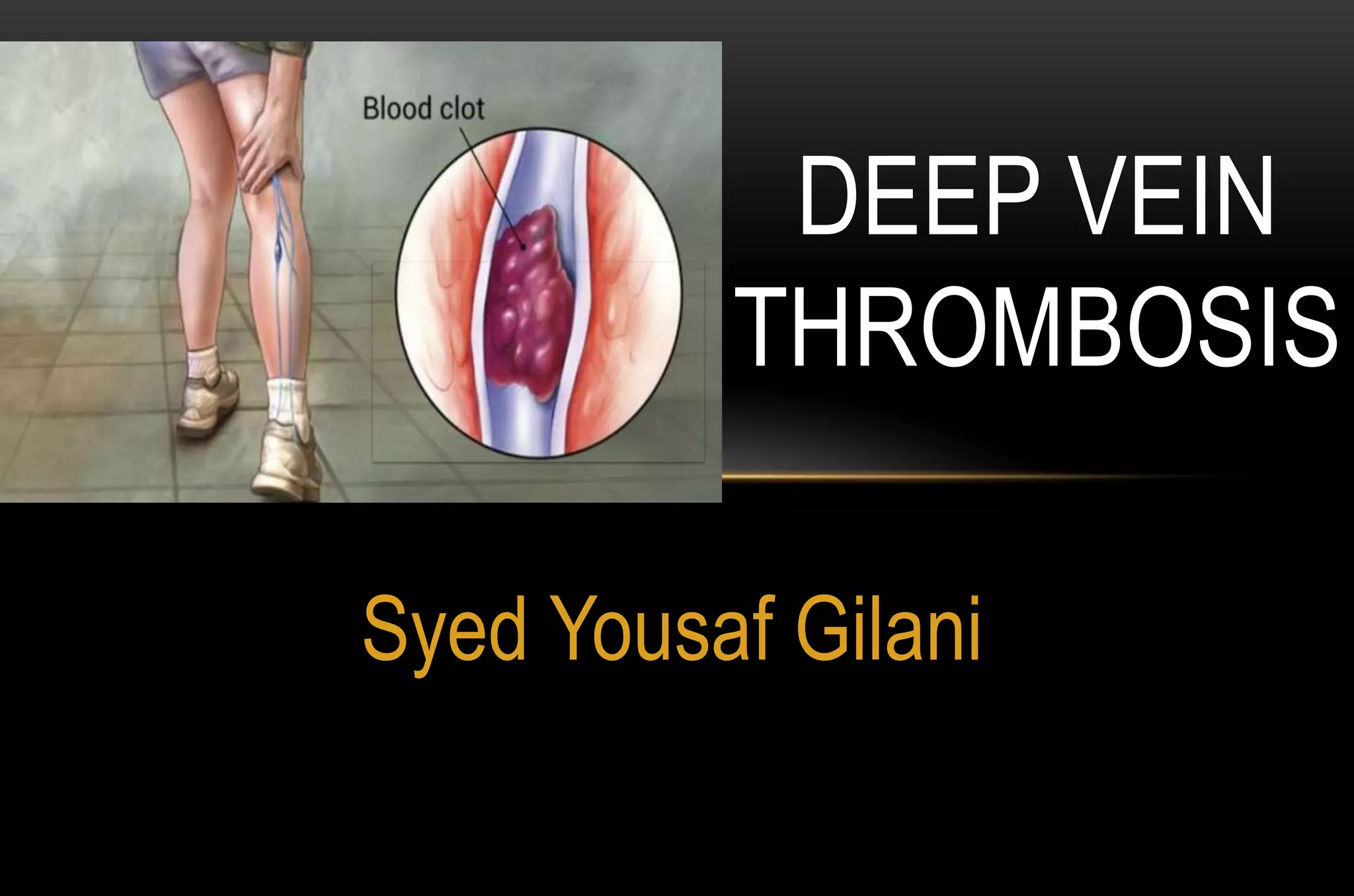
DEEP VEIN
THROMBOSIS
WHAT IS VENOUS THROMBOEMBOLISM?
• When a blood clot (thrombus) forms in a
deep vein, this is called deep vein
thrombosis (DVT) - If it happens it
happens most frequently in the leg
• Thromboembolism occurs when part of
a clot breaks away and enters the
bloodstream – When this happens the
blood clot is called an embolus
• Pulmonary embolism is the third most
common cause of mortality by cardiovascular
disease after coronary artery disease and
stroke.
EPIDEMIOLOGY
 DVTs occur in about 1 per 1000 persons per year.
 100,000 deaths may be directly or indirectly related to these diseases
• In pregnant women, it has an incidence of 0.5 to 7 per 1,000 pregnancies, and is
the second most common cause of maternal death in developed countries after
bleeding
Journal of Internal Medicine volume 232 Issue 2, Pages 155 -
160
PRESENTATION AND CLINICAL EXAMINATION
• PAIN AND TENDERNESS
• SWELLING (USUALLY IN ONE LIMB)
• REDNESS
• WARMTH
• EDEMA
• CYANOSIS
• HOMANS SIGN ( dorsiflexion of foot
while knee is extended)
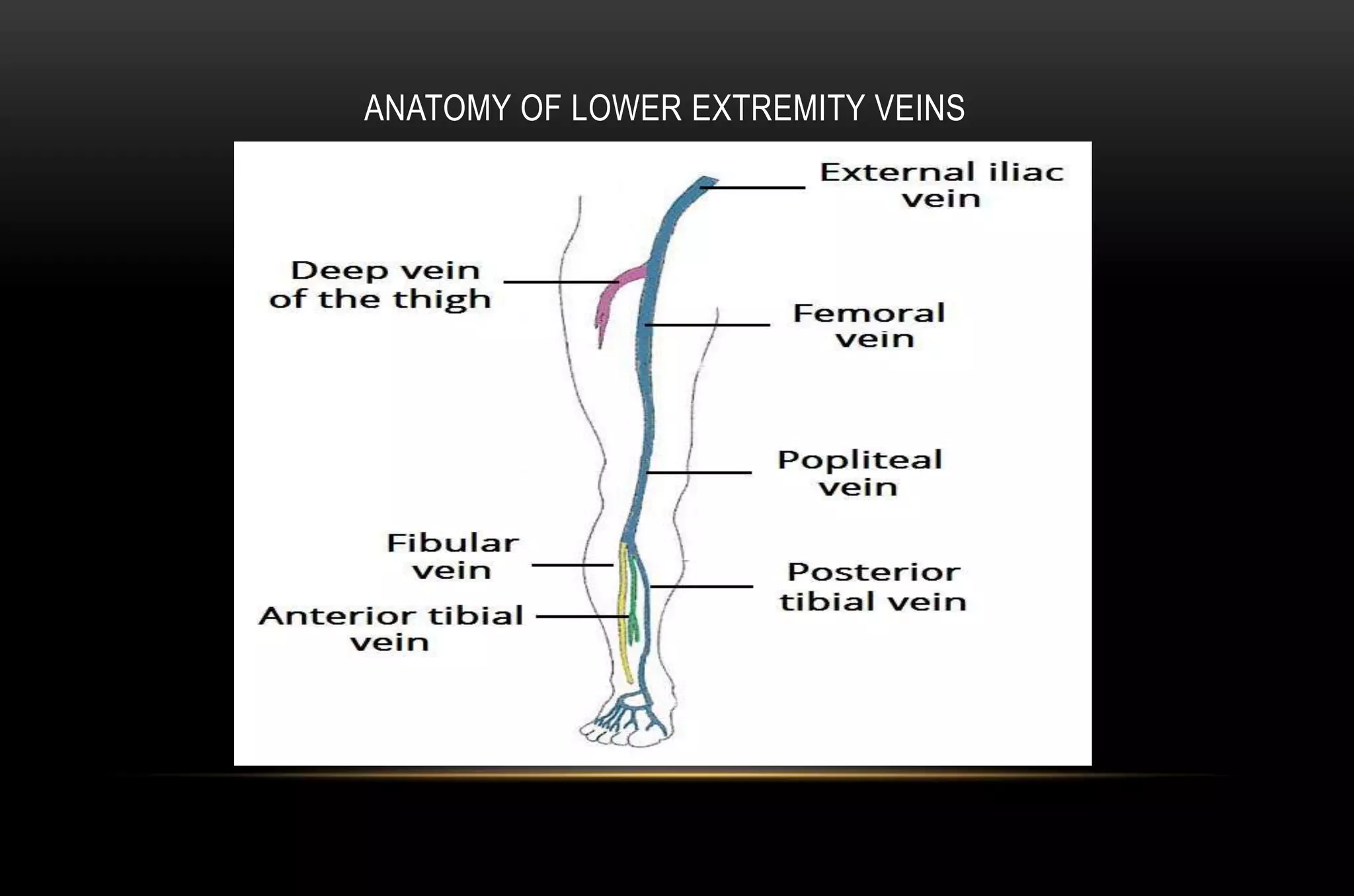
ANATOMY OF LOWER EXTREMITY VEINS
VEINS OF LOWER LIMB
Superficial veins
Deep veins
Perforating veins
Superficial veins includes great and small sephanous veins and their
tributaries. They drain into deep veins through perforating veins.
The greater saphenous vein joins the femoral vein at afixed point in the
groin 2.5 cm below and lateral to the pubic tubercle, and the lesser
saphenous vein terminates at avariable site in the popliteal fossa.
Blood passing up the superficial veins enters the deep veins at the
saphenopopliteal and saphenofemoral junctions..
ULTRASONOGRAPHY
color-flow Duplex scanningis the imaging
test of choice for patients with suspected
DVT
inexpensive,
noninvasive,
widely available
Ultrasound can also
distinguish other
causes of leg
swelling, such as
tumor, popliteal
cyst,
abscess, aneurysm, or hematoma.
COMMON FEMORAL VEIN- NORMAL AND DVT
FEMORAL VEIN
superficial femoral vein
POPLITEAL VEIN
Leg allowed to hang over the edge off the bed with
the probe positioned in the popliteal fossa
Ma OJ, Mateer JR. Blaivas M. Emergency Ultrasound, 2nd Edition
NORMAL VENOUS FLOW
1. Spontaneity: Spontaneous flow without augmentation
2. Phasicity: Flow changes with respiration
3. Compression: Transverse plane
4. Augmentation: Compression distal to site of examination patency below
site of examination patency below site of examination
5. Valsalva: Deep breath strain while holding breath patency of
abdominal & pelvic vein
PHASICITY
FLOW CHANGES WITH RESPIRATION
Rapid Slow Apnea
EXTERNAL COMPRESSION OF THE VEINS
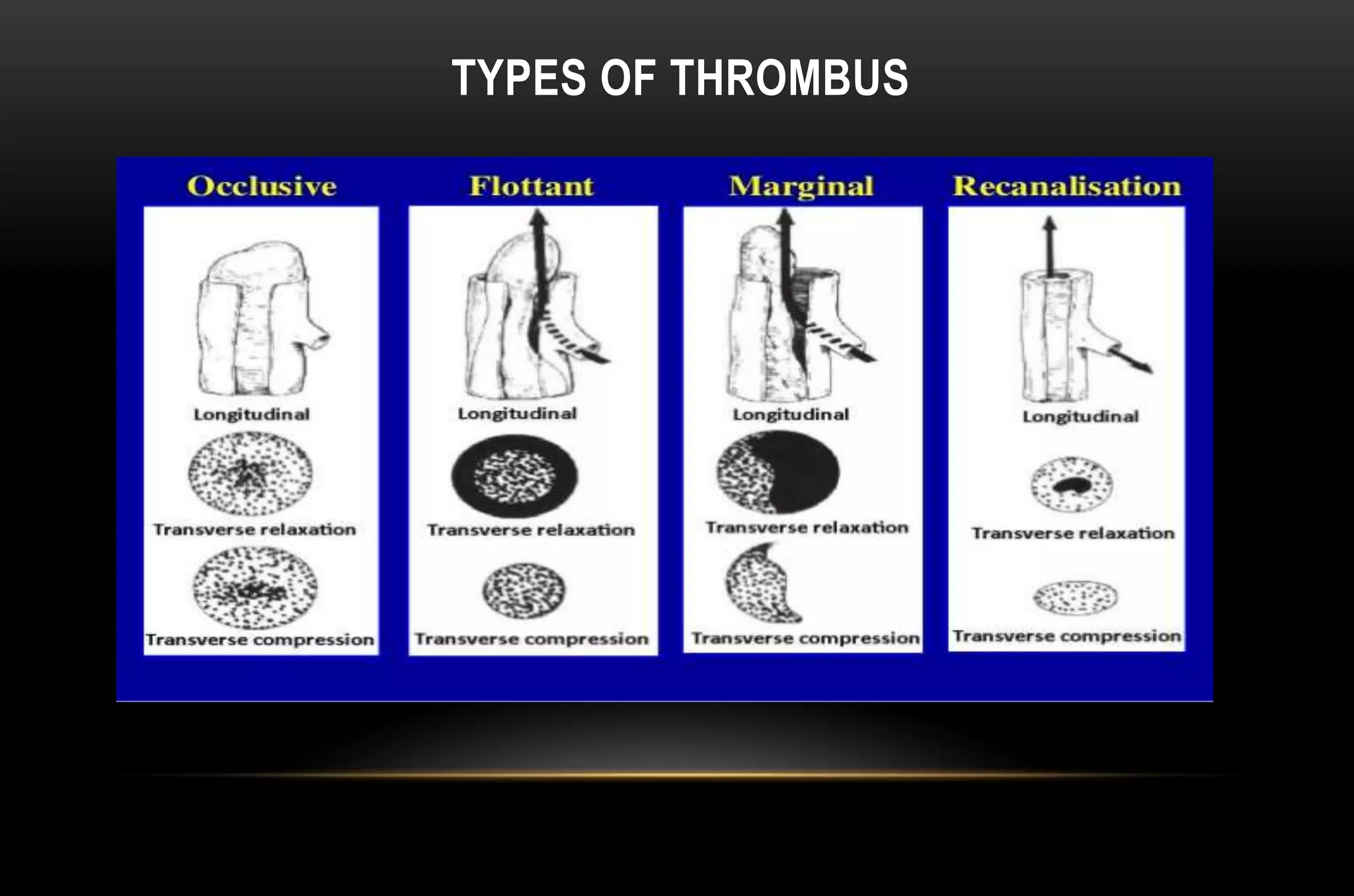
TYPES OF THROMBUS
PATIENT
POSITION
LEG BENT AT THE KNEE AND ROTATED OUTWARD
BEST EXPOSURE OF THE FEMORAL VEINS AND THE POPLITEAL
FOSSA
MICKEY MOUSE SIGN
COMPRESSION TEST AT LEVEL OF ADDUCTOR CANAL
Compression test inadequate at level of adductor canal. Rather, examiner additionally presses
the vein against transducer from below the flat hand.
NORMAL POSTERIOR TIBIAL VEINS
Diastole Systole Augmentation
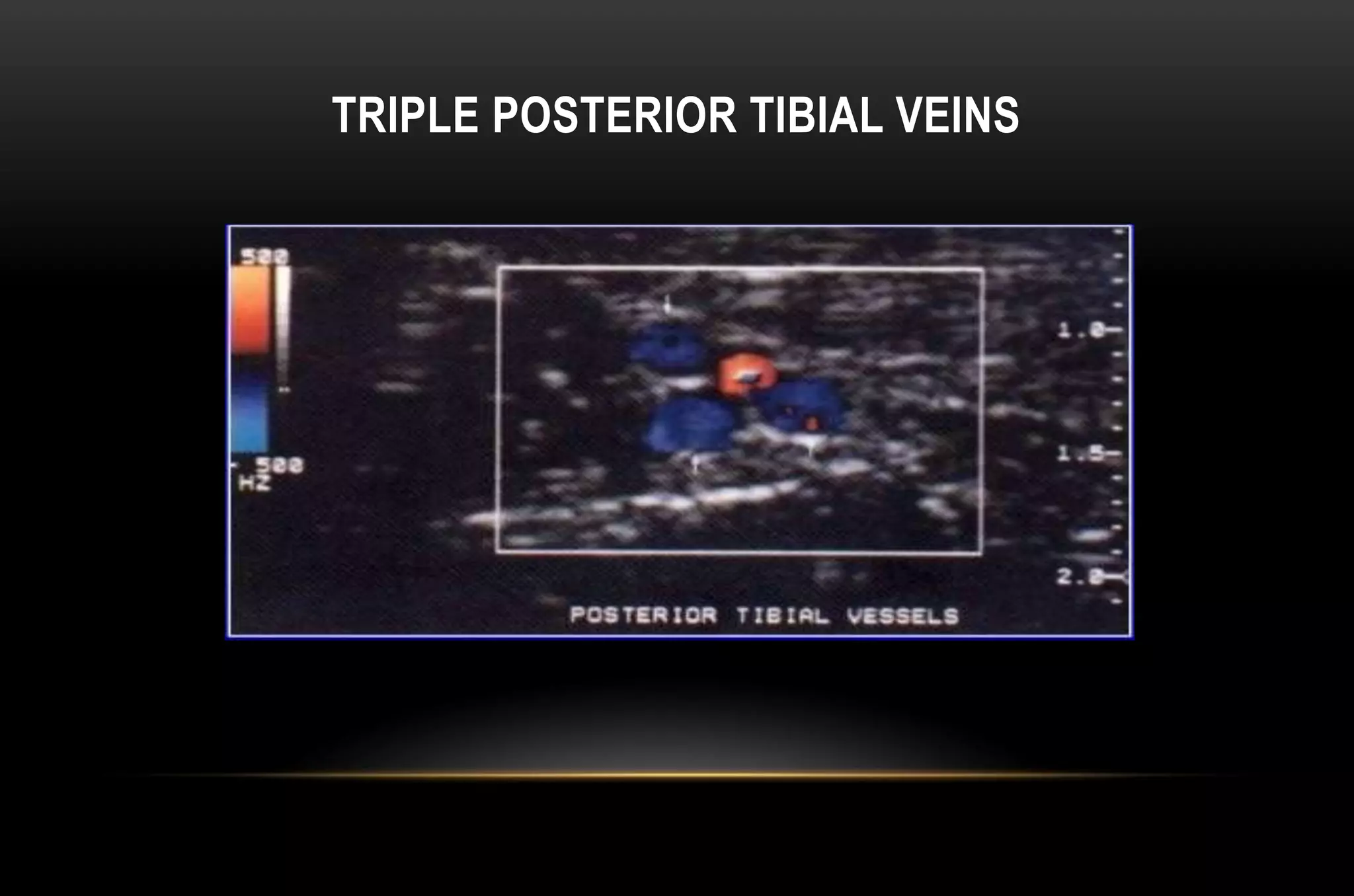
TRIPLE POSTERIOR TIBIAL VEINS
THROMBUS IN THE CFV
Relaxation Compression
FREE- FLOATING THROMBUS
Free-floating thrombus in LFV extending into CFV
Hamper UM et al. Radiol Clin N Am 2007 : 45: 525 – 547/
DUPLICATED SFV
Normal Thrombus
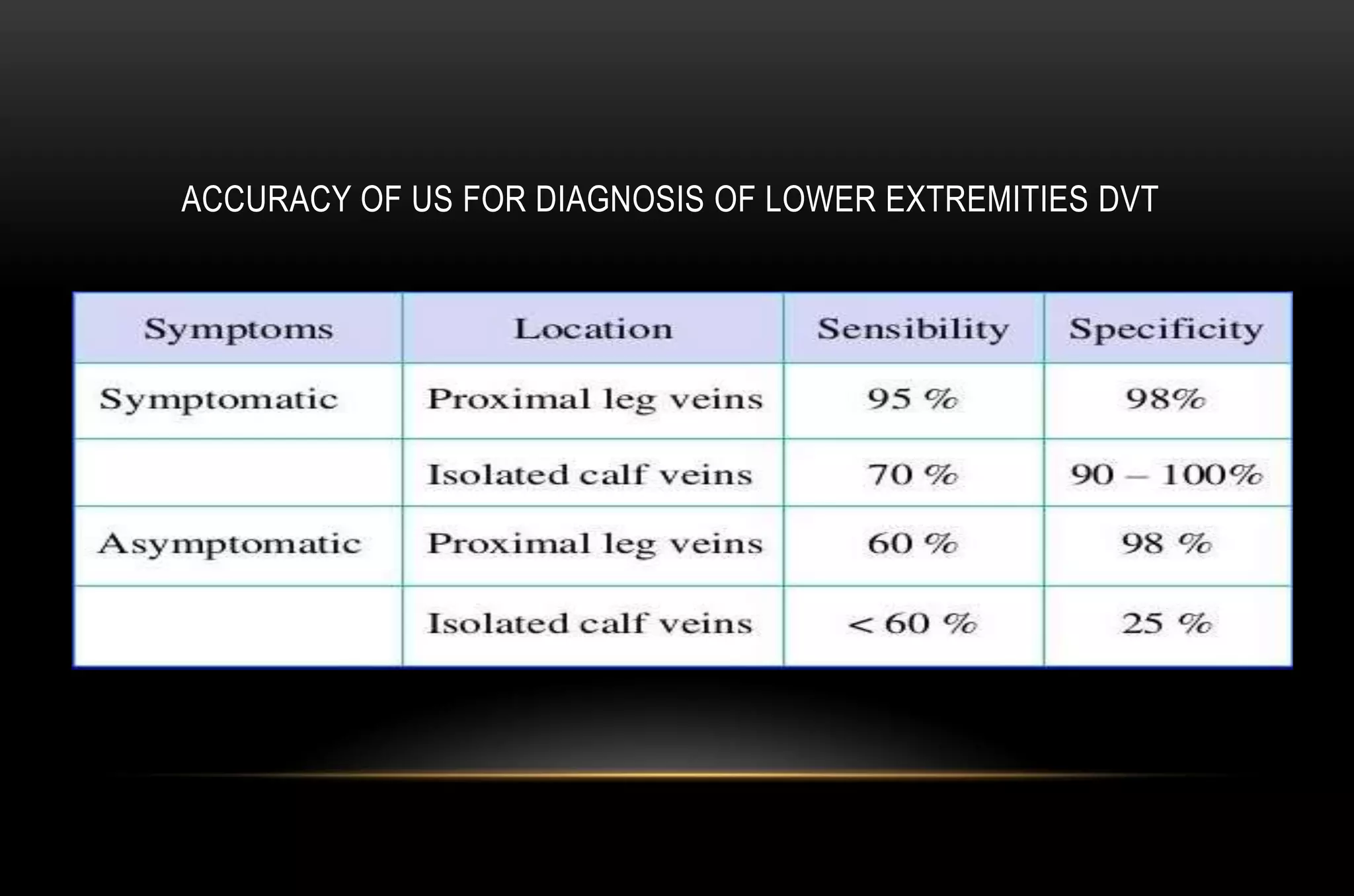
ACCURACY OF US FOR DIAGNOSIS OF LOWER EXTREMITIES DVT
US diagnostic criteria of DVT
Acute and chronic thrombus
Signs interpreted according to clinical history
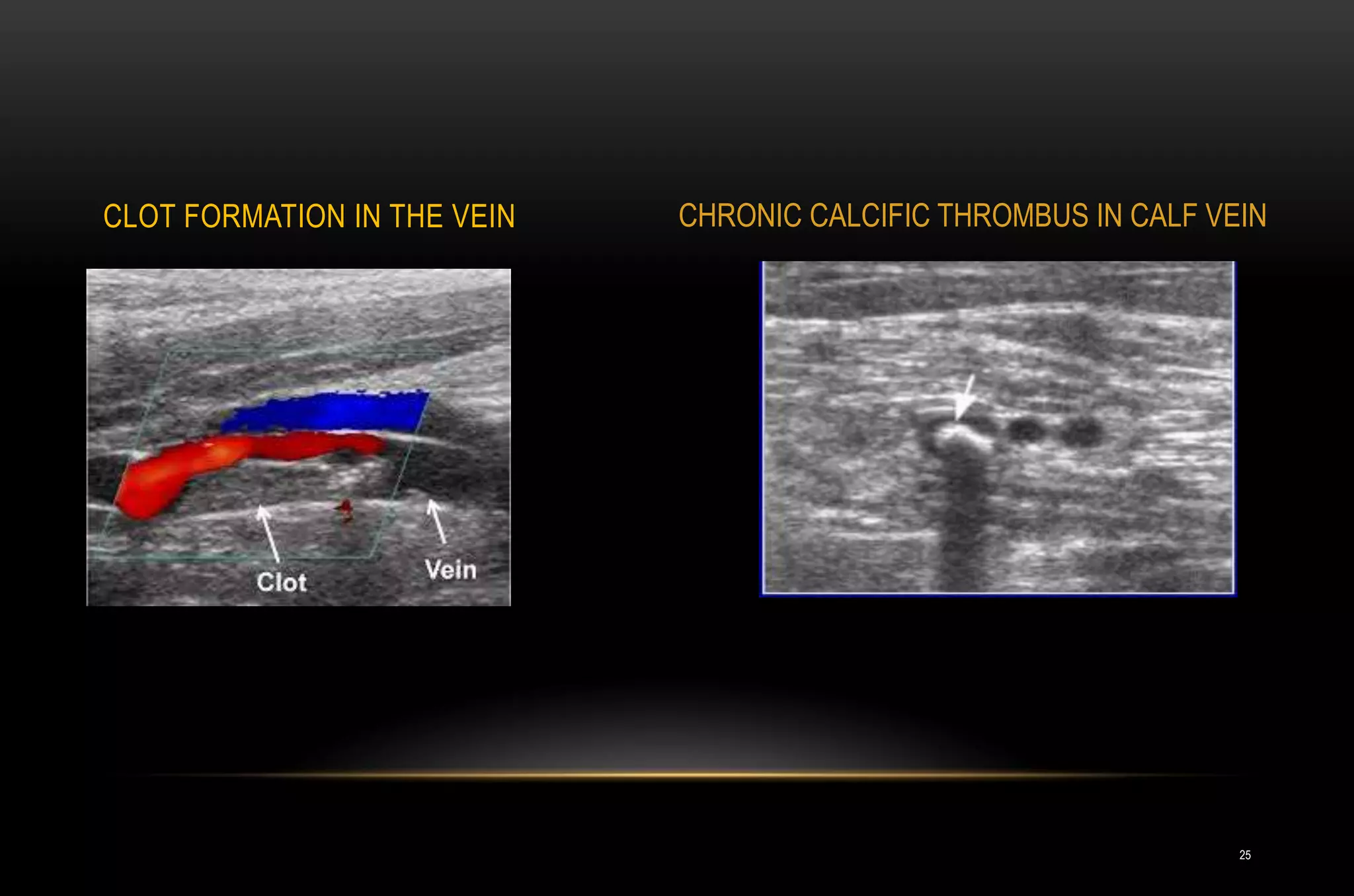
CLOT FORMATION IN THE VEIN
25
CHRONIC CALCIFIC THROMBUS IN CALF VEIN
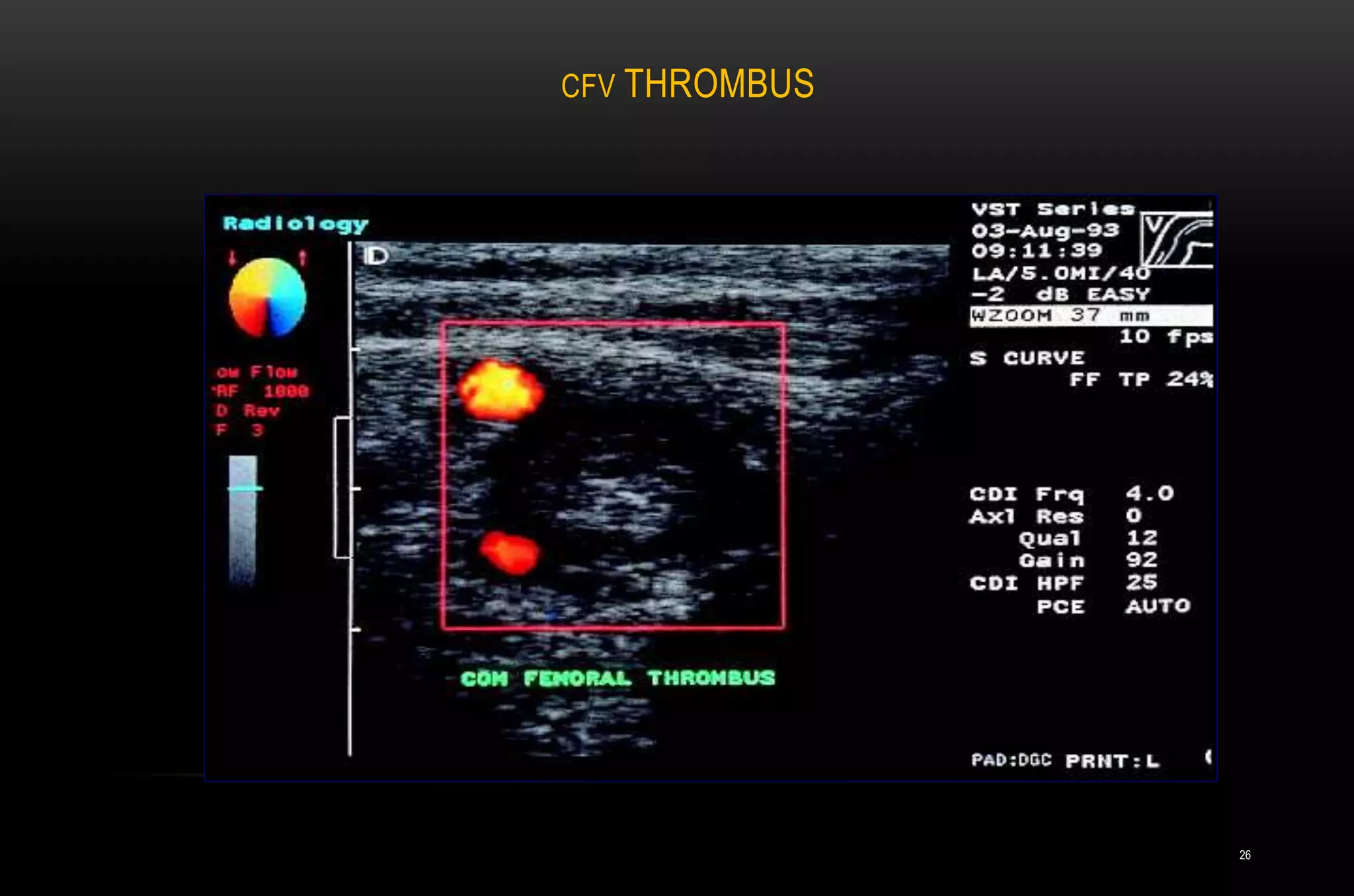
CFV THROMBUS
26
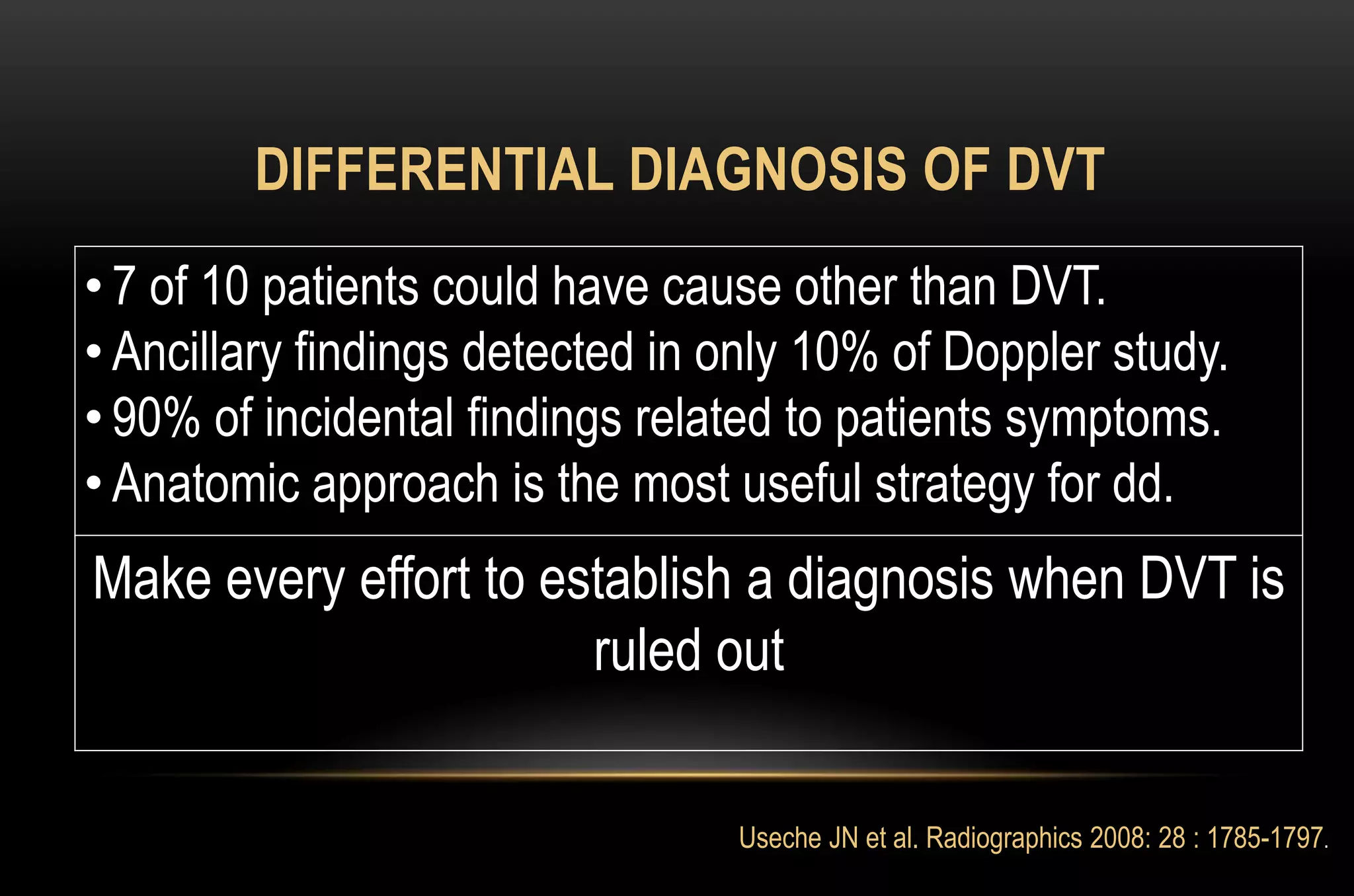
DIFFERENTIAL DIAGNOSIS OF DVT
Useche JN et al. Radiographics 2008: 28 : 1785-1797.
• 7 of 10 patients could have cause other than DVT.
• Ancillary findings detected in only 10% of Doppler study.
• 90% of incidental findings related to patients symptoms.
• Anatomic approach is the most useful strategy for dd.
Make every effort to establish a diagnosis when DVT is
ruled out
DIFFERENTIAL DIAGNOSIS OF DVT
ANATOMIC APPROACH
• Groin From inguinal ligament to 10cm below.
• Thigh From this line to Hunter canal.
• Popliteal From hunter canal to 10cm below pop crease.
• Lower leg 10cm from popliteal crease to ankle
Useche JH et al. RadioGraphics 2008 : 28 : 1785 – 1797.
DIFFERENTIAL DIAGNOSIS OF DVT
Region Differential Diagnosis
1. Inguinal Hernias: Femoral – Inguinal.
Hiopsoas & Heopectineal bursitis.
Adenopathy (inflammatory & neoplastic)
Pseudo aneurysm – AVI – anticoagulation hematoma.
2. Thigh Sports-related lesions (conclusions, muscle tears, hematoma) Muscle herniation –
myositis – abscess.
3. Popliteal Ruptured Baker’s cyst.
Para meniscal cyst – pes anserinus bursitis.
Popliteal artery thrombosis –aneurysm – adventitial cyst.
4. Lower Leg PA entrapment syndrome – thrombophlebitis
Tennis Leg
Cardiac and renal failure.
Useche JH et al. RadioGraphics 2008 : 28 : 1785 – 1797.
NORMAL INGINAL ANATOMY
RT INGUINAL REGION – PARALLEL TO & CRANIAL TO INGUINAL
LIGAMENT
Jamadar DA et al. AJR 2007: 188 : 1356-1364.
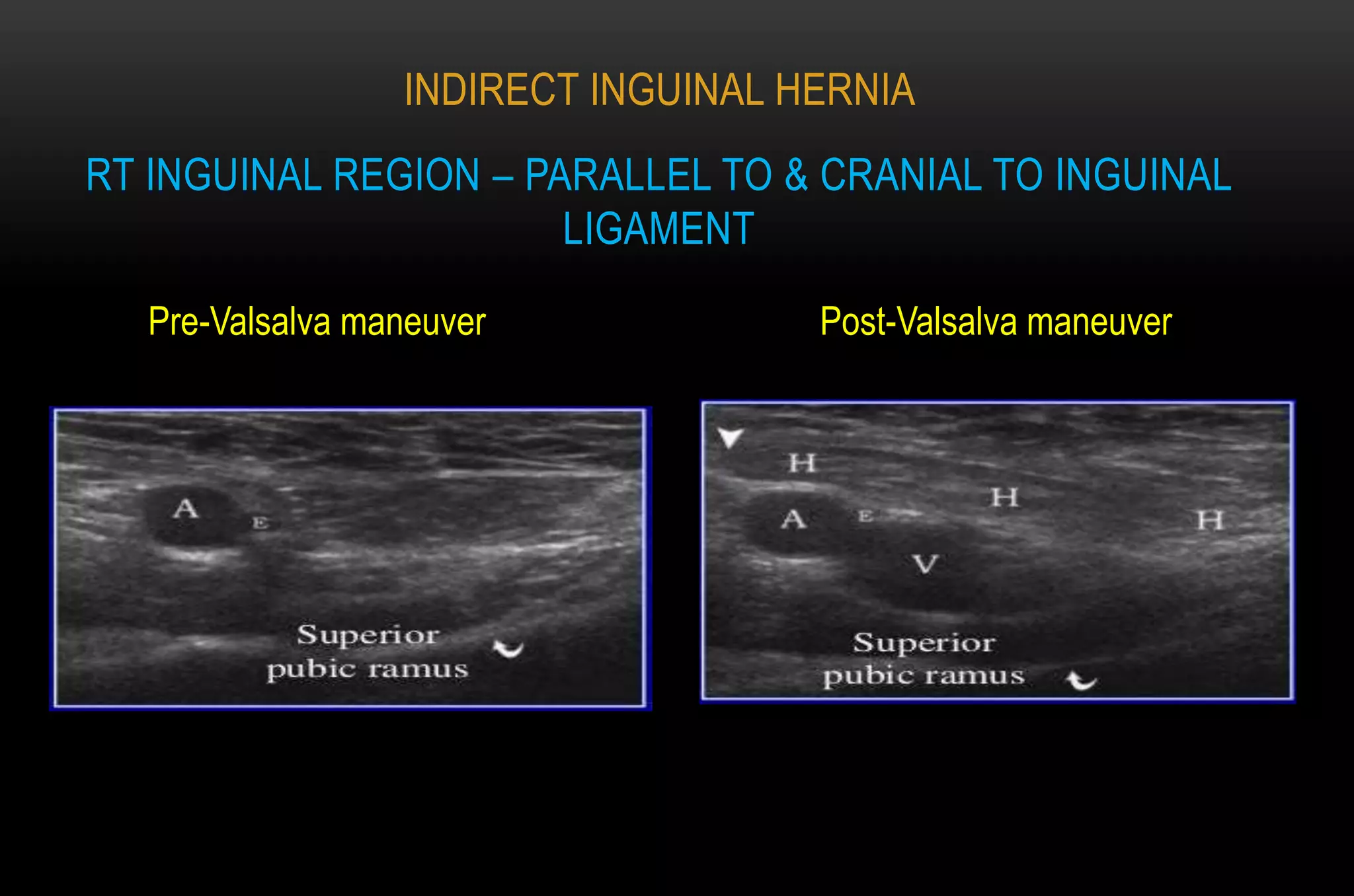
RT INGUINAL REGION – PARALLEL TO & CRANIAL TO INGUINAL
LIGAMENT
INDIRECT INGUINAL HERNIA
Pre-Valsalva maneuver Post-Valsalva maneuver
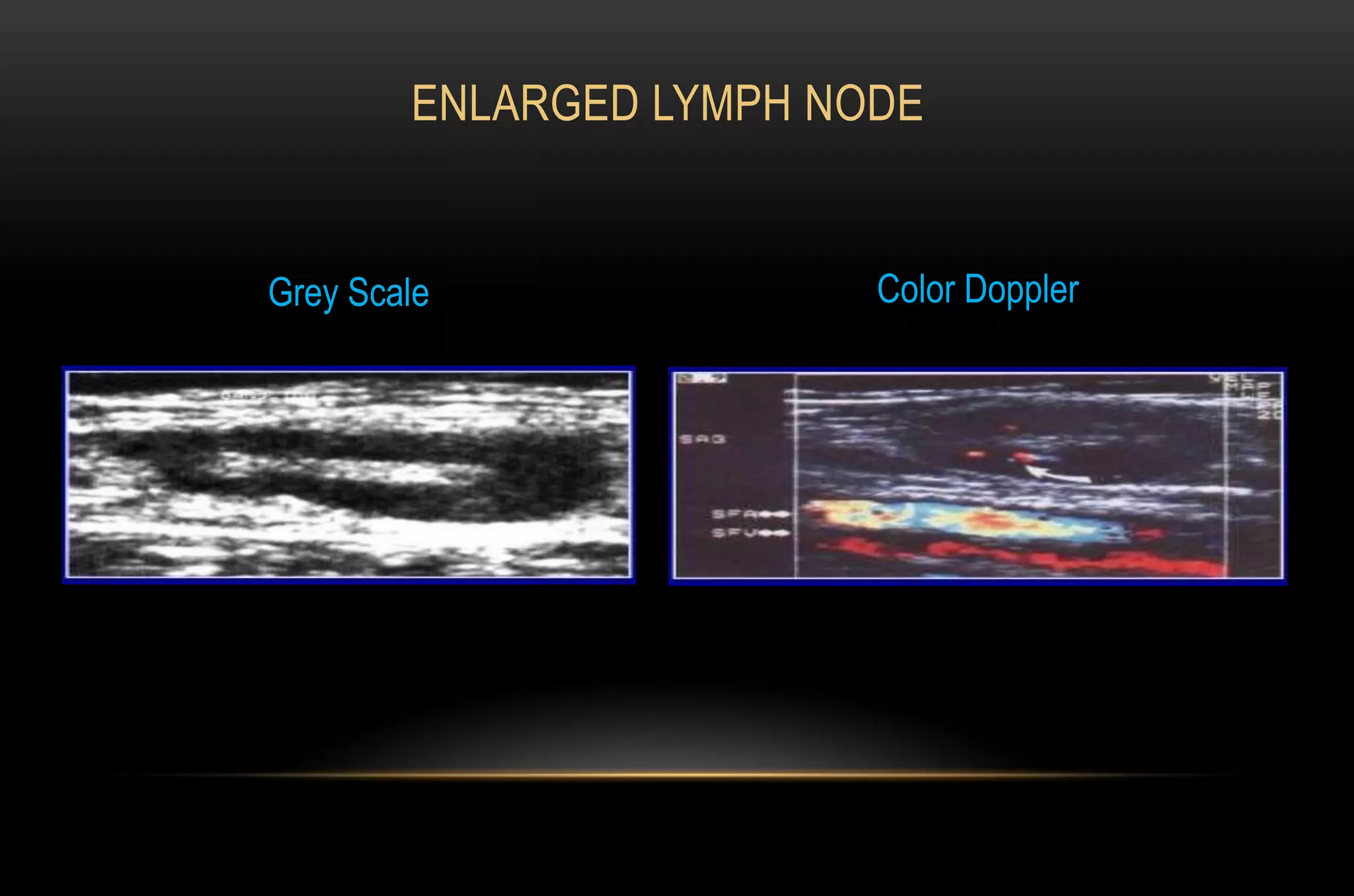
ENLARGED LYMPH NODE
Grey Scale Color Doppler
MUSCULAR ABSCESS
Abscess Normal femoral vessels
INTRAMUSCULAR HEMATOMA
BAKER’S CYST
Anechoic fluid distends SM – GC bursa
Characteristics neck between SM tendon & medial GC muscle & tendon,
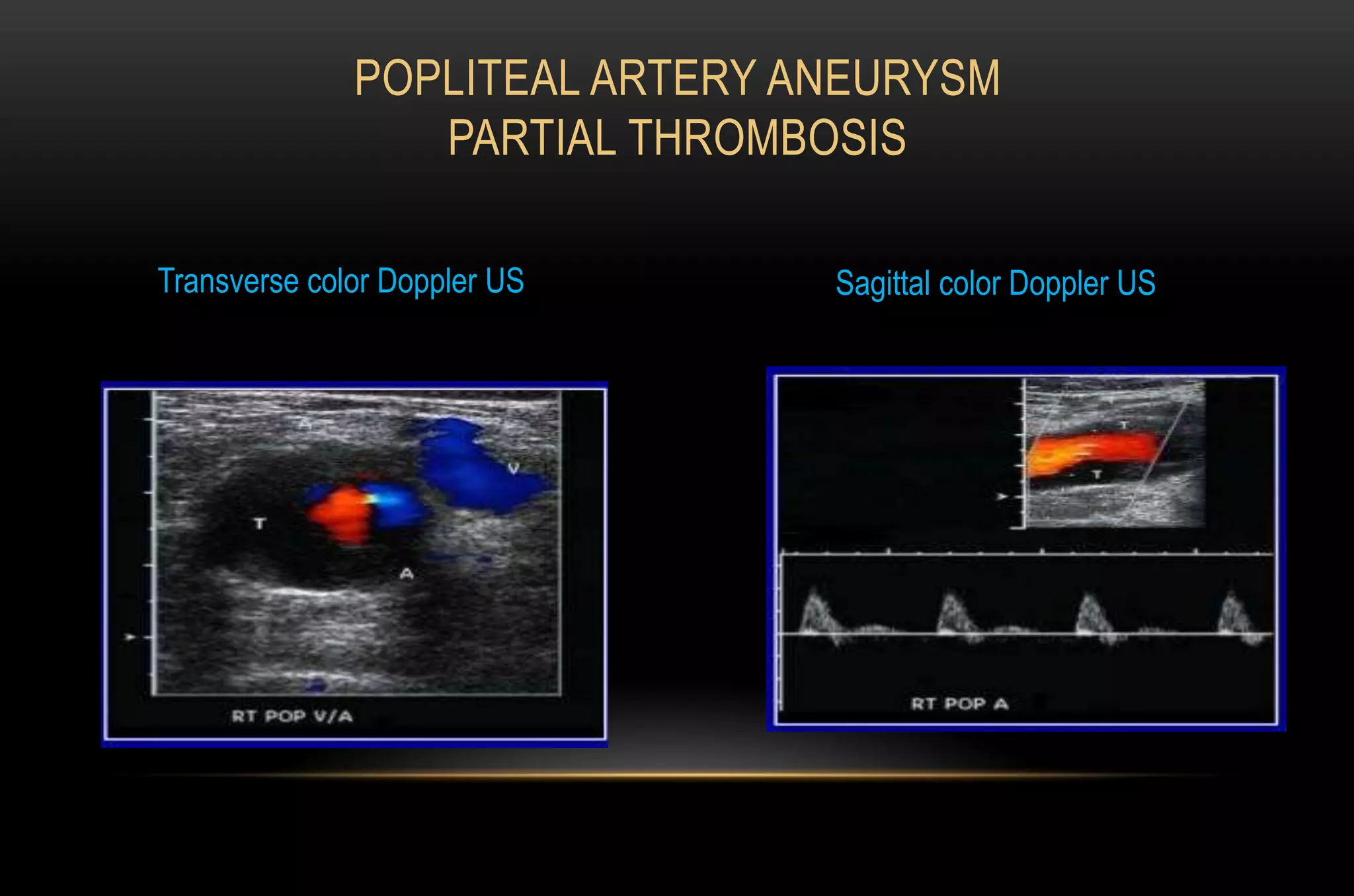
POPLITEAL ARTERY ANEURYSM
PARTIAL THROMBOSIS
Transverse color Doppler US Sagittal color Doppler US
THANK YOU

Deep vein thrombosis Ultrasound

  • 1.
    Syed Yousaf Gilani DEEPVEIN THROMBOSIS
  • 2.
    WHAT IS VENOUSTHROMBOEMBOLISM? • When a blood clot (thrombus) forms in a deep vein, this is called deep vein thrombosis (DVT) - If it happens it happens most frequently in the leg • Thromboembolism occurs when part of a clot breaks away and enters the bloodstream – When this happens the blood clot is called an embolus • Pulmonary embolism is the third most common cause of mortality by cardiovascular disease after coronary artery disease and stroke.
  • 3.
    EPIDEMIOLOGY  DVTs occurin about 1 per 1000 persons per year.  100,000 deaths may be directly or indirectly related to these diseases • In pregnant women, it has an incidence of 0.5 to 7 per 1,000 pregnancies, and is the second most common cause of maternal death in developed countries after bleeding Journal of Internal Medicine volume 232 Issue 2, Pages 155 - 160
  • 4.
    PRESENTATION AND CLINICALEXAMINATION • PAIN AND TENDERNESS • SWELLING (USUALLY IN ONE LIMB) • REDNESS • WARMTH • EDEMA • CYANOSIS • HOMANS SIGN ( dorsiflexion of foot while knee is extended)
  • 5.
    ANATOMY OF LOWEREXTREMITY VEINS
  • 6.
    VEINS OF LOWERLIMB Superficial veins Deep veins Perforating veins Superficial veins includes great and small sephanous veins and their tributaries. They drain into deep veins through perforating veins. The greater saphenous vein joins the femoral vein at afixed point in the groin 2.5 cm below and lateral to the pubic tubercle, and the lesser saphenous vein terminates at avariable site in the popliteal fossa. Blood passing up the superficial veins enters the deep veins at the saphenopopliteal and saphenofemoral junctions..
  • 7.
    ULTRASONOGRAPHY color-flow Duplex scanningisthe imaging test of choice for patients with suspected DVT inexpensive, noninvasive, widely available Ultrasound can also distinguish other causes of leg swelling, such as tumor, popliteal cyst, abscess, aneurysm, or hematoma.
  • 8.
    COMMON FEMORAL VEIN-NORMAL AND DVT
  • 9.
  • 10.
    POPLITEAL VEIN Leg allowedto hang over the edge off the bed with the probe positioned in the popliteal fossa Ma OJ, Mateer JR. Blaivas M. Emergency Ultrasound, 2nd Edition
  • 11.
    NORMAL VENOUS FLOW 1.Spontaneity: Spontaneous flow without augmentation 2. Phasicity: Flow changes with respiration 3. Compression: Transverse plane 4. Augmentation: Compression distal to site of examination patency below site of examination patency below site of examination 5. Valsalva: Deep breath strain while holding breath patency of abdominal & pelvic vein
  • 12.
    PHASICITY FLOW CHANGES WITHRESPIRATION Rapid Slow Apnea
  • 13.
  • 14.
  • 15.
    PATIENT POSITION LEG BENT ATTHE KNEE AND ROTATED OUTWARD BEST EXPOSURE OF THE FEMORAL VEINS AND THE POPLITEAL FOSSA
  • 16.
  • 17.
    COMPRESSION TEST ATLEVEL OF ADDUCTOR CANAL Compression test inadequate at level of adductor canal. Rather, examiner additionally presses the vein against transducer from below the flat hand.
  • 18.
    NORMAL POSTERIOR TIBIALVEINS Diastole Systole Augmentation
  • 19.
  • 20.
    THROMBUS IN THECFV Relaxation Compression
  • 21.
    FREE- FLOATING THROMBUS Free-floatingthrombus in LFV extending into CFV Hamper UM et al. Radiol Clin N Am 2007 : 45: 525 – 547/
  • 22.
  • 23.
    ACCURACY OF USFOR DIAGNOSIS OF LOWER EXTREMITIES DVT
  • 24.
    US diagnostic criteriaof DVT Acute and chronic thrombus Signs interpreted according to clinical history
  • 25.
    CLOT FORMATION INTHE VEIN 25 CHRONIC CALCIFIC THROMBUS IN CALF VEIN
  • 26.
  • 27.
    DIFFERENTIAL DIAGNOSIS OFDVT Useche JN et al. Radiographics 2008: 28 : 1785-1797. • 7 of 10 patients could have cause other than DVT. • Ancillary findings detected in only 10% of Doppler study. • 90% of incidental findings related to patients symptoms. • Anatomic approach is the most useful strategy for dd. Make every effort to establish a diagnosis when DVT is ruled out
  • 28.
    DIFFERENTIAL DIAGNOSIS OFDVT ANATOMIC APPROACH • Groin From inguinal ligament to 10cm below. • Thigh From this line to Hunter canal. • Popliteal From hunter canal to 10cm below pop crease. • Lower leg 10cm from popliteal crease to ankle Useche JH et al. RadioGraphics 2008 : 28 : 1785 – 1797.
  • 29.
    DIFFERENTIAL DIAGNOSIS OFDVT Region Differential Diagnosis 1. Inguinal Hernias: Femoral – Inguinal. Hiopsoas & Heopectineal bursitis. Adenopathy (inflammatory & neoplastic) Pseudo aneurysm – AVI – anticoagulation hematoma. 2. Thigh Sports-related lesions (conclusions, muscle tears, hematoma) Muscle herniation – myositis – abscess. 3. Popliteal Ruptured Baker’s cyst. Para meniscal cyst – pes anserinus bursitis. Popliteal artery thrombosis –aneurysm – adventitial cyst. 4. Lower Leg PA entrapment syndrome – thrombophlebitis Tennis Leg Cardiac and renal failure. Useche JH et al. RadioGraphics 2008 : 28 : 1785 – 1797.
  • 30.
    NORMAL INGINAL ANATOMY RTINGUINAL REGION – PARALLEL TO & CRANIAL TO INGUINAL LIGAMENT Jamadar DA et al. AJR 2007: 188 : 1356-1364.
  • 31.
    RT INGUINAL REGION– PARALLEL TO & CRANIAL TO INGUINAL LIGAMENT INDIRECT INGUINAL HERNIA Pre-Valsalva maneuver Post-Valsalva maneuver
  • 32.
    ENLARGED LYMPH NODE GreyScale Color Doppler
  • 33.
  • 34.
  • 35.
    BAKER’S CYST Anechoic fluiddistends SM – GC bursa Characteristics neck between SM tendon & medial GC muscle & tendon,
  • 36.
    POPLITEAL ARTERY ANEURYSM PARTIALTHROMBOSIS Transverse color Doppler US Sagittal color Doppler US
  • 37.