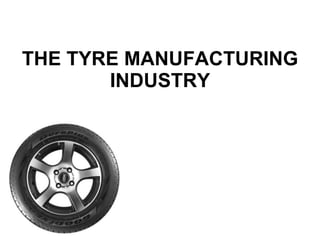
THE TYRE MANUFACTURING INDUSTRY
PRESENTED BY: NAME   ROLL NO. Dattu Ade 1 Reena Alva 4 Vicky Barot 6 Abhijit Bhongle 8 Bhushan Bhoye 9
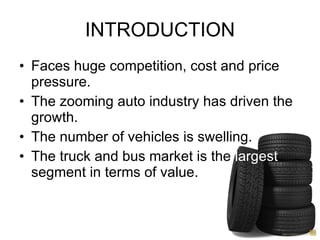
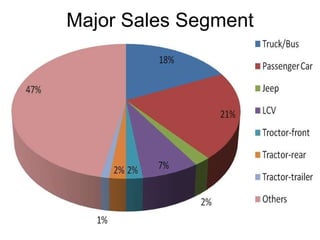
INTRODUCTION Faces huge competition, cost and price pressure. The zooming auto industry has driven the growth. The number of vehicles is swelling. The truck and bus market is the  largest  segment in terms of value.
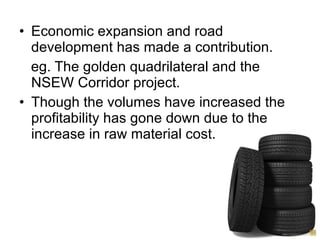
Economic expansion and road development has made a contribution. eg. The golden quadrilateral and the NSEW Corridor project. Though the volumes have increased the profitability has gone down due to the increase in raw material cost.
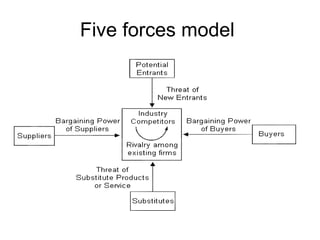
Five forces model
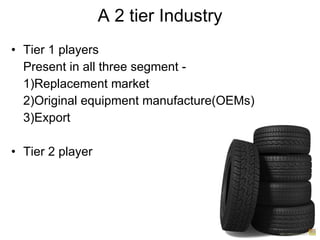
A 2 tier Industry Tier 1 players Present in all three segment - 1)Replacement market 2)Original equipment manufacture(OEMs)  3)Export Tier 2 player
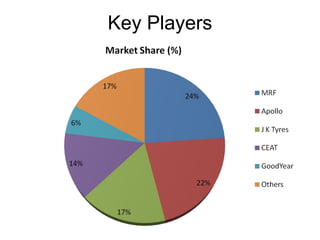
Key Players
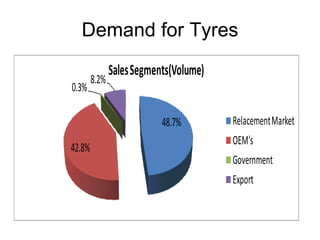
Major Sales Segment
Intensity of Rivalry : High  The tyre industry in India is fairly concentrated, with the top 5 companies accounting for more than 80% of the total production of tyres.
BARGAINING POWER OF SUPPLIERS -  High
 
Number of Suppliers – Low Availability/ acceptability of raw material substitutes – Low Switching costs – High Threat of forward integration –  High Tyre industry not the key customer
Demand for Tyres
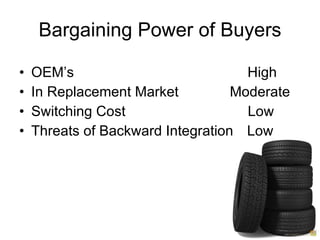
Bargaining Power of Buyers OEM’s  High In Replacement Market  Moderate Switching Cost  Low Threats of Backward Integration   Low
THREAT OF POTENTIAL ENTRANTS LOW, due to HIGH ENTRY BARRIERS
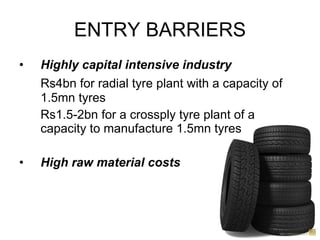
ENTRY BARRIERS Highly capital intensive  industry Rs4bn for radial tyre plant with a capacity of 1.5mn tyres Rs1.5-2bn for a crossply tyre plant of a capacity to manufacture 1.5mn tyres High raw material costs
Shortage of raw material Force of rivalry High risk
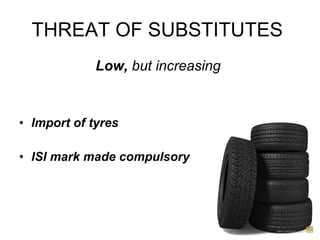
THREAT OF SUBSTITUTES  Low,  but increasing   Import of tyres   ISI mark made compulsory
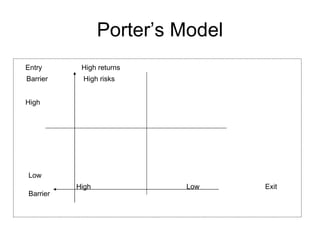
Porter’s Model Entry  High returns Barrier   High risks High Low   High   Low   Exit Barrier

Mktg Strats Tyre Industry

  • 1.
  • 2.
    PRESENTED BY: NAME ROLL NO. Dattu Ade 1 Reena Alva 4 Vicky Barot 6 Abhijit Bhongle 8 Bhushan Bhoye 9
  • 3.
    INTRODUCTION Faces hugecompetition, cost and price pressure. The zooming auto industry has driven the growth. The number of vehicles is swelling. The truck and bus market is the largest segment in terms of value.
  • 4.
    Economic expansion androad development has made a contribution. eg. The golden quadrilateral and the NSEW Corridor project. Though the volumes have increased the profitability has gone down due to the increase in raw material cost.
  • 5.
  • 6.
    A 2 tierIndustry Tier 1 players Present in all three segment - 1)Replacement market 2)Original equipment manufacture(OEMs) 3)Export Tier 2 player
  • 7.
  • 8.
  • 9.
    Intensity of Rivalry: High The tyre industry in India is fairly concentrated, with the top 5 companies accounting for more than 80% of the total production of tyres.
  • 10.
    BARGAINING POWER OFSUPPLIERS - High
  • 11.
  • 12.
    Number of Suppliers– Low Availability/ acceptability of raw material substitutes – Low Switching costs – High Threat of forward integration – High Tyre industry not the key customer
  • 13.
  • 14.
    Bargaining Power ofBuyers OEM’s High In Replacement Market Moderate Switching Cost Low Threats of Backward Integration Low
  • 15.
    THREAT OF POTENTIALENTRANTS LOW, due to HIGH ENTRY BARRIERS
  • 16.
    ENTRY BARRIERS Highlycapital intensive industry Rs4bn for radial tyre plant with a capacity of 1.5mn tyres Rs1.5-2bn for a crossply tyre plant of a capacity to manufacture 1.5mn tyres High raw material costs
  • 17.
    Shortage of rawmaterial Force of rivalry High risk
  • 18.
    THREAT OF SUBSTITUTES Low, but increasing Import of tyres ISI mark made compulsory
  • 19.
    Porter’s Model Entry High returns Barrier High risks High Low High Low Exit Barrier